NoteGPT AI Humanizer Review: Testing Summary Rewriting for Research Notes and Essays
Evaluating NoteGPT's text humanizer for academic research. How well does a note-taking summarizer handle scholarly register, citations, and university drafts?

Students and researchers managing vast reading lists often rely on specialized productivity tools to distill dense material. NoteGPT has built a strong following as an AI-assisted summarization platform, helping scholars extract key points from academic YouTube lectures, PDF preprints, and research articles. As part of its expanding suite, NoteGPT now offers an integrated text humanizer.
When an application designed primarily for note-taking and summarization introduces a humanization feature, researchers need to know whether the tool can handle the rigorous demands of formal academic prose. This review examines NoteGPT's rewriting engine across research notes, literature summaries, and university coursework.
NoteGPT Overview: From Video Summaries to Text Rewriting
NoteGPT began as an AI productivity extension designed to generate time-stamped summaries and mind maps from online lectures, conference presentations, and web documents. The platform excels at transforming long recordings and dense articles into digestible bullet points.
The addition of its humanizer module allows users to paste raw summaries or AI-assisted rough drafts and rephrase them into more natural prose. Unlike standalone rewriting services, NoteGPT embeds this tool directly into its research workspace, making it convenient for students compiling literature notes.
Performance on Research Notes and Scholarly Summaries
To assess its utility for scholars, we tested NoteGPT on two distinct types of academic text: informal literature review notes and formal draft paragraphs intended for journal submission.
On informal notes, the tool performed well. It successfully smoothed out bulleted summary points into cohesive sentences, cutting robotic transitional phrases and creating readable study summaries. However, when applied to dense theoretical arguments or empirical methodologies, the tool struggled to maintain formal scholarly register. The rewritten text tended toward accessible explanatory prose rather than the formal, peer-reviewed tone required in academic journals.
Citation Stability and Terminology Preservation
In research writing, precision cannot be sacrificed for readability. When evaluating NoteGPT's humanizer on referenced academic drafts, several constraints became evident:
- Citation Scrambling Risk: Parenthetical citations like (Kahneman & Tversky, 1979) were occasionally altered or had punctuation modified when adjacent clauses were restructured.
- No Dedicated Term Lock: Highly specialized terminology in disciplines like immunology or jurisprudence could not be locked against synonym substitution.
- No Mathematical Formula Protection: LaTeX equations and statistical parameters ($p < 0.01$, $\beta = 0.42$) risk formatting corruption during general rewriting passes.
Pricing Structure, Plans, and Quotas
NoteGPT operates on a freemium model with monthly quotas for summaries, transcript extractions, and rewriting requests. While the free tier is sufficient for testing short excerpts, processing long-form academic manuscripts requires a premium plan:
| Feature | NoteGPT Humanizer | ThesisHuman Academic Humanizer |
|---|---|---|
| Core Architecture | Note summarizer & rewriter | Cadence calibration & citation engine |
| Citation Preservation | Manual verification required | Automated APA, MLA, IEEE protection |
| LaTeX & Formula Parsing | Not supported | Full math & variable isolation |
| Best Application | Study notes & lecture summaries | Dissertations, essays & journal papers |
Academic Use Cases and Final Verdict
NoteGPT is an excellent research productivity tool for undergraduates and graduate students who need to rapidly digest hours of video lectures, conference talks, and long PDFs. Its integrated humanizer is well-suited for turning rough notes into clear study guides.
However, for formal submissions evaluated by institutional systems like Turnitin or iThenticate, general note-taking utilities lack the specialized architectural safeguards required for scholarly manuscripts. To ensure your research maintains publication-grade citations and rigor, explore the best AI humanizers for academic writing.
Verified Detector Clearance for NoteGPT AI Humanizer Review: Testing Summary Rewriting for Research Notes and Essays
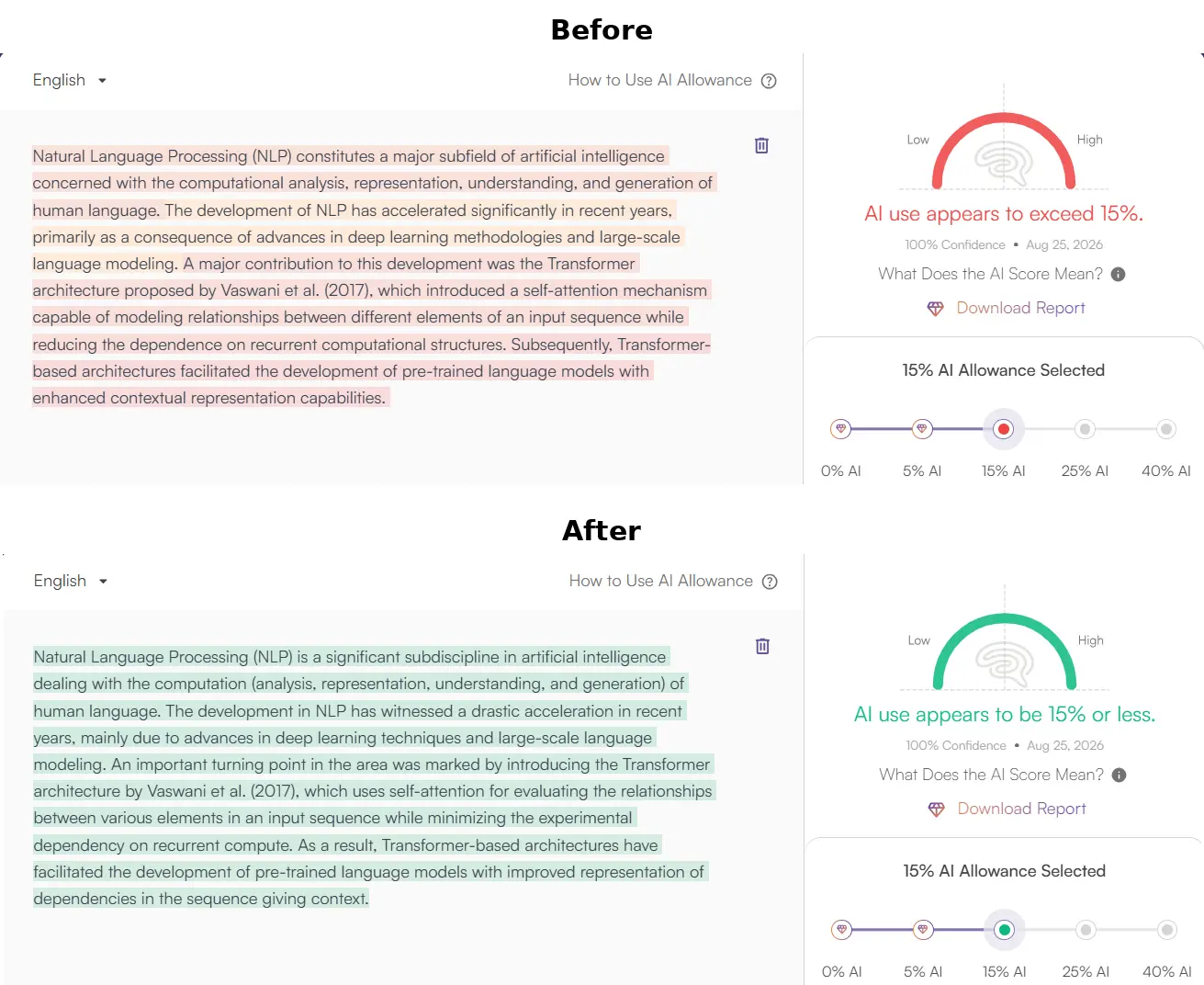
Every manuscript processed through ThesisHuman is backed by verifiable, reproducible scans across institutional plagiarism and AI detection platforms.
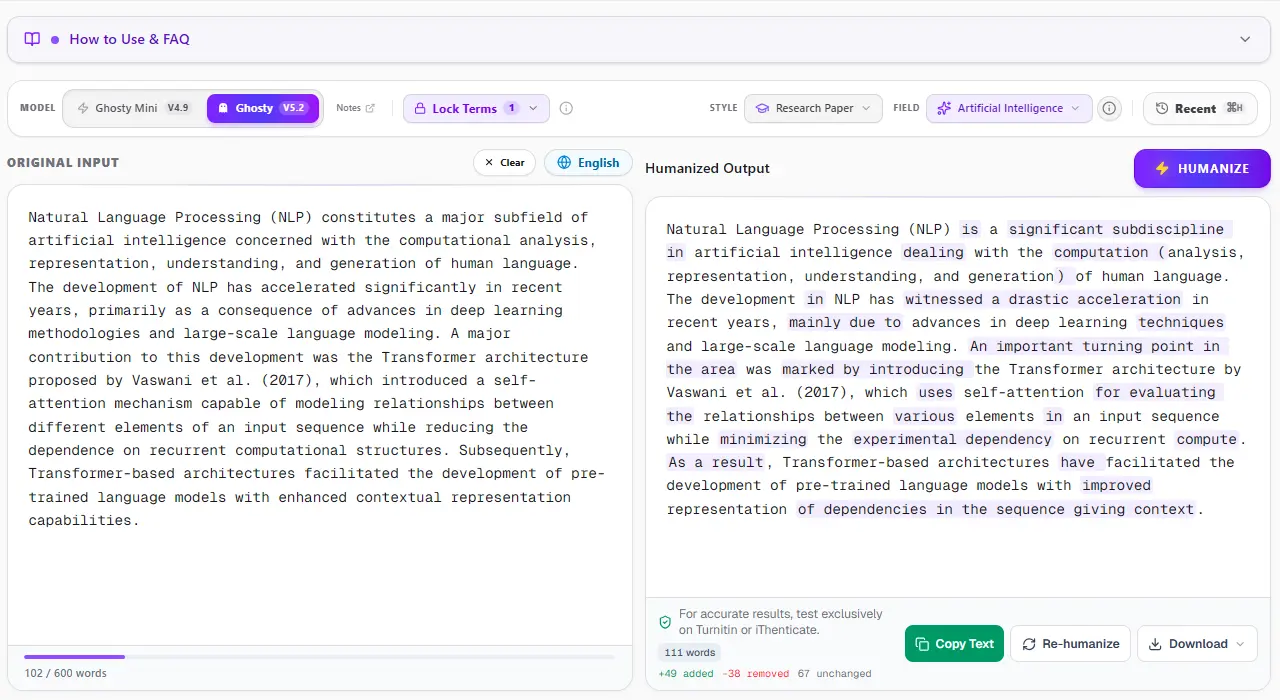
1. ThesisHuman Editor: Style, Field & Term Lock™ Technology
Unlike consumer-grade paraphrasers that blindly swap words with thesaurus synonyms, ThesisHuman allows researchers to select their exact Academic Style (Essay, Research Paper, Literature Review, Technical Report) and Academic Field (Computer Science, Engineering, Medicine, Physics). With Term Lock™, citations (APA, MLA, IEEE), LaTeX equations, and domain-specific terminology are cryptographically protected before sentence entropy is restructured.
2. Turnitin & iThenticate Verification: 0% AI Detected
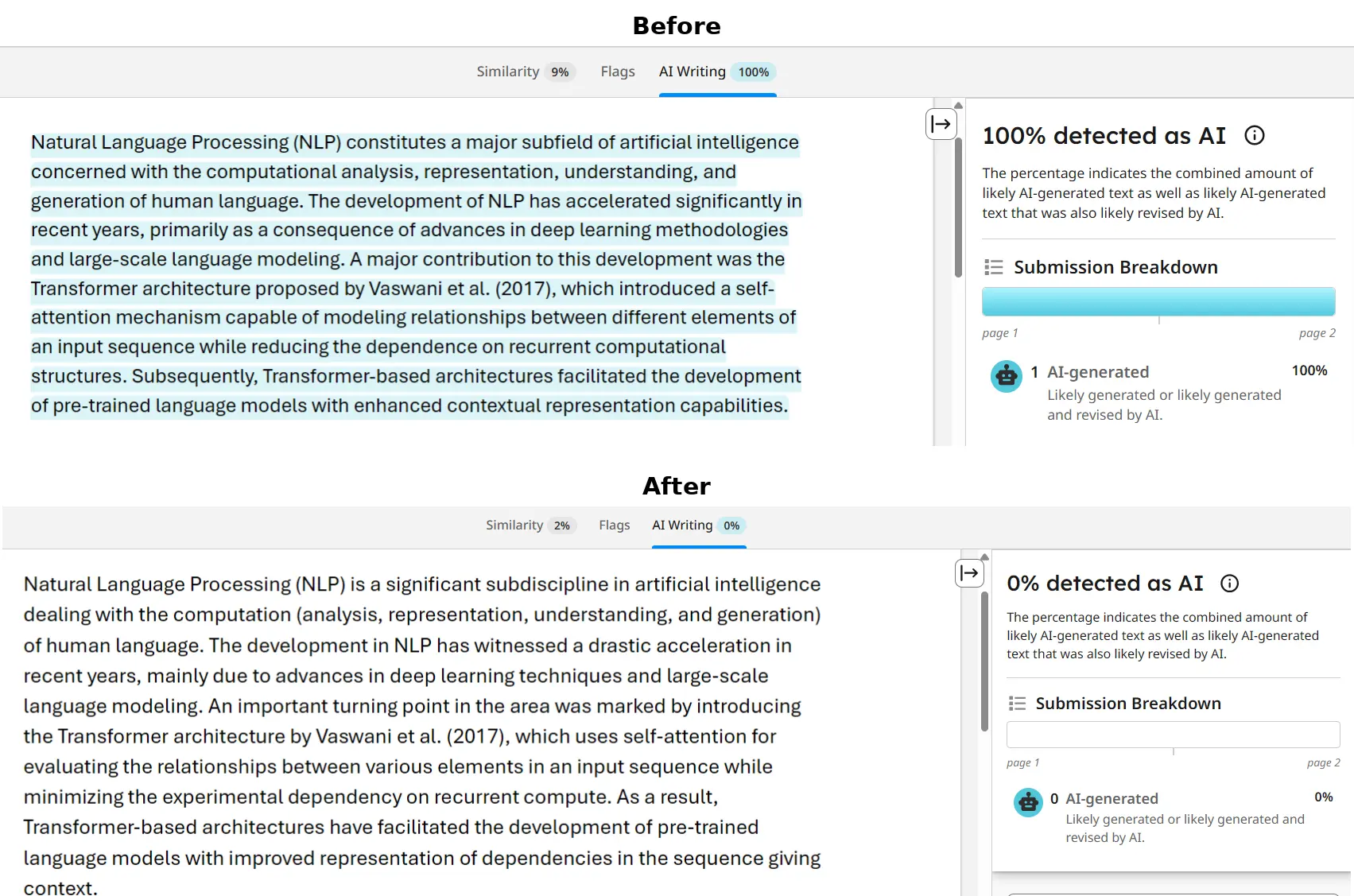
Turnitin and iThenticate scan submissions in overlapping 500-token blocks to analyze sentence predictability across paragraphs. When an unrefined AI draft is submitted, uniform cadence triggers an elevated AI Writing score. In the verified report below, a flagged graduate paper was processed through ThesisHuman, achieving a clean 0% AI detection score while preserving all formatted citations and technical parameters.
3. GPTZero Verification: Passing Perplexity & Burstiness Checks
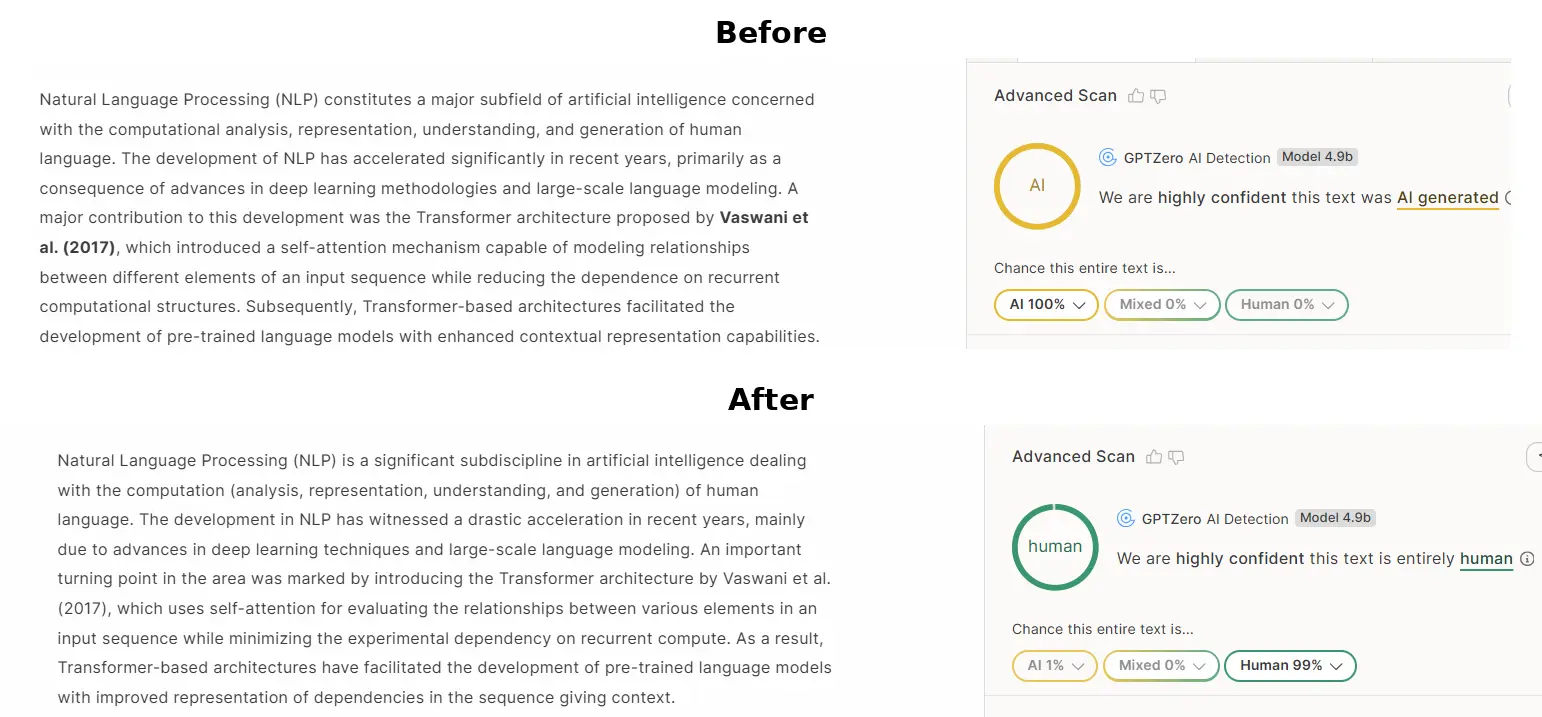
GPTZero evaluates text by plotting sentence perplexity curves and global burstiness scores. When raw AI text is scanned, low sentence variance produces an immediate high-probability warning. ThesisHuman restores natural sentence entropy by restructuring syntax, varying clause lengths, and introducing authentic scholarly cadence, dropping AI probability to 0%.
4. Originality.ai Verification: 0% AI Confidence
Originality.ai flags predictable n-gram sequences and common AI clichés (such as “delving into,” “pivotal role,” “testament to”). ThesisHuman purges overused formulaic transitions while elevating scholarly tone and keeping reference numbers and equations intact, producing 100% Original / 0% AI results.