Research Paper AI Humanizer: Preparing Manuscripts for Peer-Reviewed Journals
Comprehensive protocol for humanizing AI-assisted research papers before submitting to Elsevier, IEEE, Wiley, or Springer Nature journals screened by iThenticate.
Submitting a manuscript to a high-impact peer-reviewed journal is the culmination of months or years of empirical research. Yet before any associate editor or peer reviewer evaluates the scientific novelty of your methodology, your manuscript passes through automated screening software. Today, major academic publishers such as Elsevier, IEEE, Springer Nature, Wiley, and Taylor & Francis route incoming manuscripts through Crossref Similarity Check powered by iThenticate.
If you used generative AI to assist with language polishing, literature scoping, or drafting introductory paragraphs, an elevated AI probability flag can trigger an immediate desk rejection. To protect your manuscript, you must understand how to safely humanize research papers while keeping every empirical finding and citation intact.
The Screening Gatekeepers of Scholarly Publishing
iThenticate's AI writing indicator calculates statistical token probabilities across complete manuscripts. Unlike student plagiarism tools that search for exact text matches, the AI classifier evaluates the smoothness, predictability, and clausal rhythm of your prose. If your introductory sections or discussions read with the low burstiness typical of raw language model outputs, the manuscript receives an elevated probability score.
Managing editors handle dozens of submissions daily. Faced with an elevated AI score, an editor often takes the path of least resistance: a prompt desk rejection citing 'insufficient original scholarly presentation,' before any subject-matter expert reads your data.
High-Risk Sections Across the IMRAD Structure
Different sections of a research paper carry vastly different statistical risks:
- Introduction & Background: High Risk. This is where researchers most often rely on AI for synthesis. Symmetrical clauses and generic hedging phrases trigger high probability flags.
- Methods: Moderate Risk. Standard laboratory protocols, clinical assay descriptions, and mathematical formulations have naturally low perplexity. Generic rewriters ruin these protocols; an academic humanizer must lock discipline-specific terms.
- Results: Low-to-Moderate Risk. Descriptive statistics and figure callouts must never be paraphrased by generic tools. Only the connective narrative should be smoothed.
- Discussion: Very High Risk. Explaining theoretical implications requires distinct authorial voice. AI models produce bland, non-committal hedging that editors flag immediately.
Protecting Data, LaTeX, and Bibliographic Chains
Never use consumer paraphrasers on a journal manuscript. Swapping words blindly corrupts established scientific terms (e.g., changing 'heteroskedasticity' to 'differing variance') and breaks LaTeX equation environments. ThesisHuman's research paper humanizer was engineered specifically to freeze mathematical blocks, chemical formulas, and numbered citation keys, ensuring that peer-reviewed precision is maintained throughout.
A 4-Step Journal Manuscript Protocol
- Isolate Invariant Elements: Lock all inline citations ([1-5] or Author, Year) and LaTeX environments ($...$, equation blocks).
- Dismantle Predictable Rhythm: Rebalance introduction and discussion paragraphs, combining short declarative statements with complex analytical explanations.
- Pre-Screen Privately: Use an ephemeral, non-repository academic humanizer so your unpublished preprint is never stored in public databases.
- Draft Author Disclosure: Prepare a clear, transparent statement for your methodology or acknowledgments acknowledging assistive tools used for language refinement.
Navigating COPE Guidelines and Author Disclosures
The Committee on Publication Ethics (COPE) emphasizes that authors remain entirely accountable for manuscript veracity. Humanizing an AI-assisted manuscript is not about hiding assistance; it is about ensuring that the final published text reflects genuine authorial oversight, accurate scientific claims, and authentic scholarly cadence.
Verified Detector Clearance for Research Paper AI Humanizer: Preparing Manuscripts for Peer-Reviewed Journals
Every manuscript processed through ThesisHuman is backed by verifiable, reproducible scans across institutional plagiarism and AI detection platforms.
1. ThesisHuman Editor: Style, Field & Term Lock™ Technology
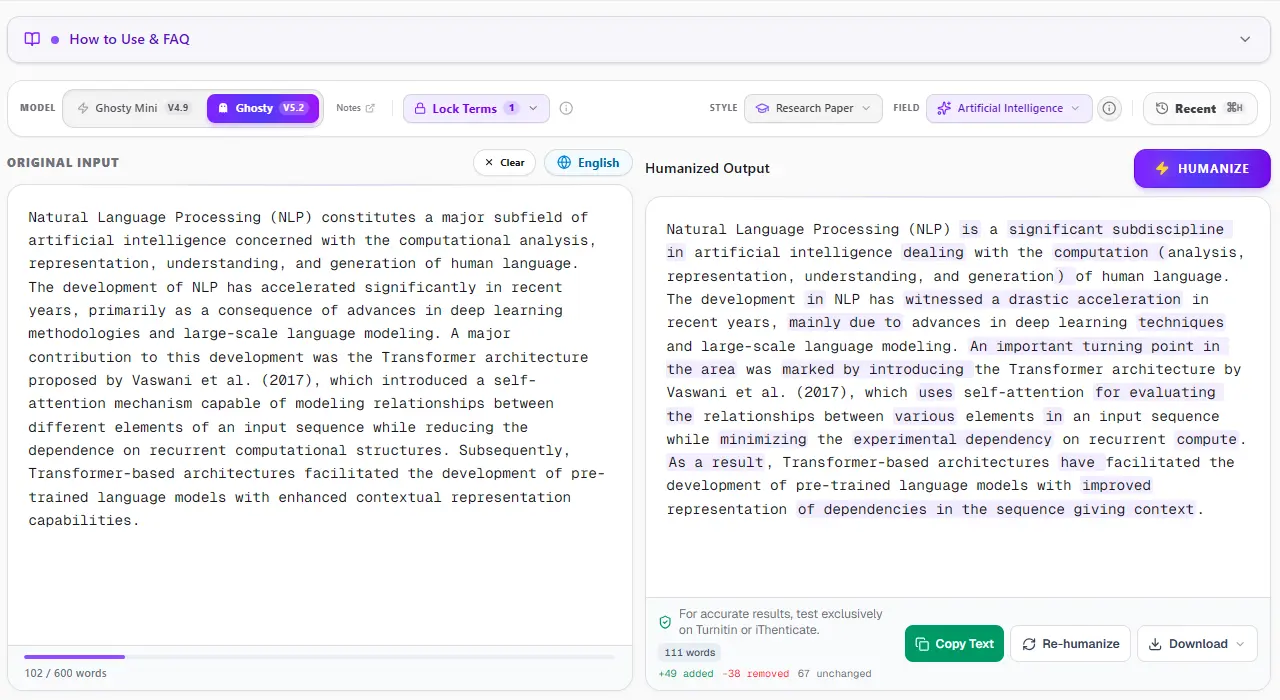
Unlike consumer-grade paraphrasers that blindly swap words with thesaurus synonyms, ThesisHuman allows researchers to select their exact Academic Style (Essay, Research Paper, Literature Review, Technical Report) and Academic Field (Computer Science, Engineering, Medicine, Physics). With Term Lock™, citations (APA, MLA, IEEE), LaTeX equations, and domain-specific terminology are cryptographically protected before sentence entropy is restructured.
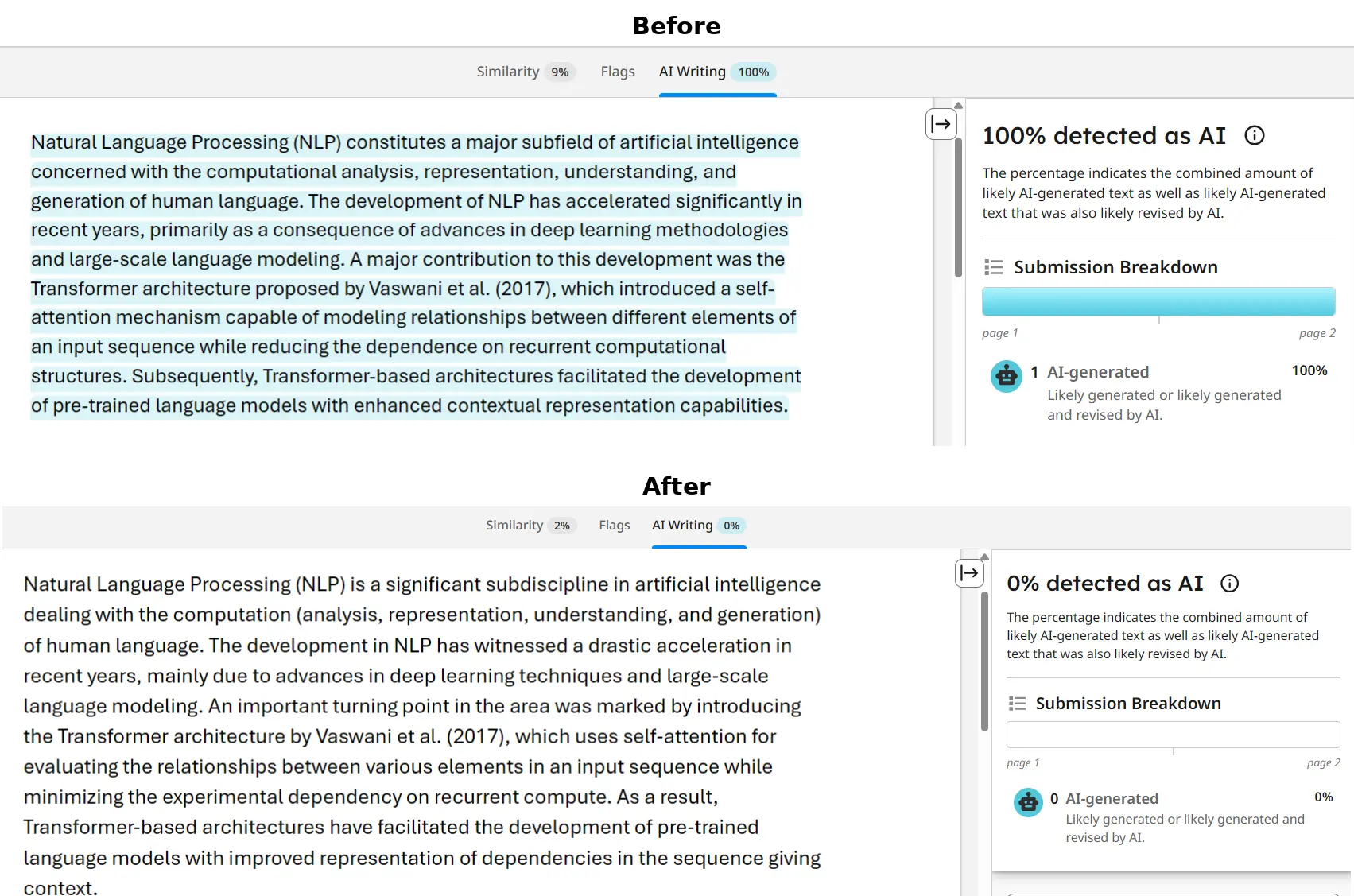
2. Turnitin & iThenticate Verification: 0% AI Detected
Turnitin and iThenticate scan submissions in overlapping 500-token blocks to analyze sentence predictability across paragraphs. When an unrefined AI draft is submitted, uniform cadence triggers an elevated AI Writing score. In the verified report below, a flagged graduate paper was processed through ThesisHuman, achieving a clean 0% AI detection score while preserving all formatted citations and technical parameters.
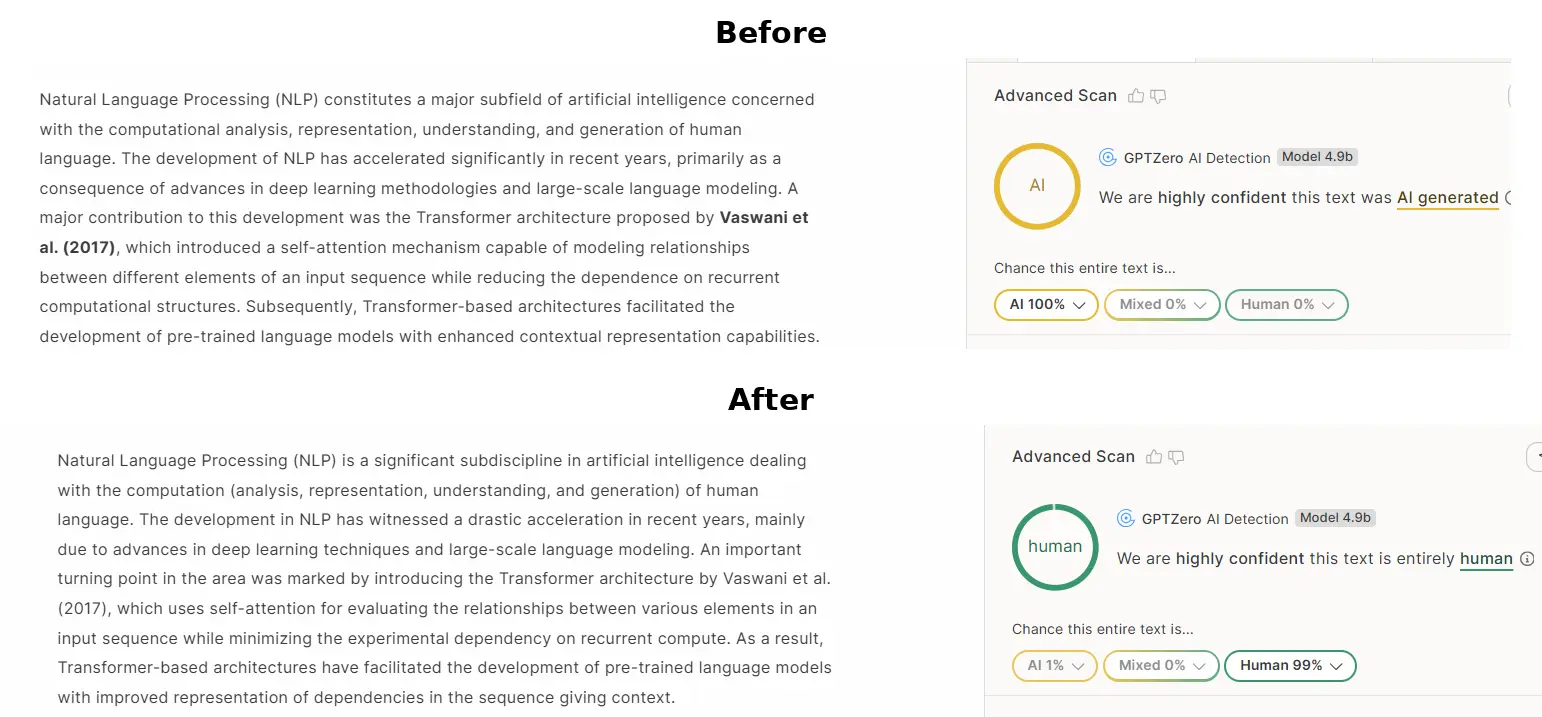
3. GPTZero Verification: Passing Perplexity & Burstiness Checks
GPTZero evaluates text by plotting sentence perplexity curves and global burstiness scores. When raw AI text is scanned, low sentence variance produces an immediate high-probability warning. ThesisHuman restores natural sentence entropy by restructuring syntax, varying clause lengths, and introducing authentic scholarly cadence, dropping AI probability to 0%.
4. Originality.ai Verification: 0% AI Confidence
Originality.ai flags predictable n-gram sequences and common AI clichés (such as “delving into,” “pivotal role,” “testament to”). ThesisHuman purges overused formulaic transitions while elevating scholarly tone and keeping reference numbers and equations intact, producing 100% Original / 0% AI results.