Thesis AI Humanizer: Preparing Master's Theses for Institutional Deposit
Navigating electronic thesis and dissertation (ETD) deposit screening. Learn how to humanize multi-chapter Master's theses while maintaining chapter-wide voice coherence.

Completing a Master's thesis represents the culmination of postgraduate study. However, finishing your defense before your committee is no longer the final step. Before your degree is officially conferred, your manuscript must clear the electronic thesis and dissertation (ETD) deposit process administered by your university library or graduate school.
University libraries now routinely subject deposited theses to automated AI writing screening through institutional iThenticate and Turnitin enterprise pipelines. Because theses are extensive documents (often 15,000 to 30,000 words), unedited AI-assisted drafting across chapters creates a cumulative statistical pattern that detectors flag with high confidence. Here is how to humanize your thesis safely prior to institutional deposit.
The Stakes of Electronic Thesis Deposit
Unlike a semester essay where an instructor might allow a quick rewrite, an ETD deposit flag can delay your graduation date, jeopardize postgraduate employment offers, or initiate an academic integrity review. Graduate school administrators reviewing deposit reports often look at both the similarity score and the AI probability indicator. If entire sections of your literature review or methodology show elevated machine scores, your manuscript is placed on administrative hold.
Maintaining Voice Uniformity Across Multi-Chapter Theses
The primary challenge in Master's theses is maintaining voice coherence across chapters written months apart. If Chapter 2 (Literature Review) was drafted with Claude, Chapter 3 (Methodology) with ChatGPT, and Chapter 4 (Results) written manually, the resulting thesis displays jarring stylistic discontinuities that reviewers notice immediately.
Using ThesisHuman's dedicated thesis humanizer allows you to harmonize cadence across chapters. By applying consistent sentence-length variation and eliminating model-specific hedging tropes, you create a cohesive, authoritative academic monograph.
Handling Self-Overlap and Prior Conference Publications
Many postgraduate students include previously published conference proceedings or journal articles as thesis chapters. This creates a dual screening issue: a high similarity score against your own published paper, combined with potential AI indicator flags if assistive tools were used during drafting. Always declare previously published material in your thesis preface, and naturalize the connecting synthesis chapters so your overarching narrative reads as original scholarly work.
The Thesis Humanization Playbook
- Batch Chapter Processing: Humanize one chapter at a time, keeping your Term Lock settings identical across all runs to ensure terminology consistency.
- Protect Committee References: Lock citations to your thesis advisor and committee members' foundational publications to prevent any accidental reference garbling.
- Preserve Data Tables: Do not pass raw numerical tables or statistical output through humanizers; focus strictly on explanatory prose.
- Retain Draft Provenance: Keep date-stamped document versions, laboratory notes, and supervisor feedback emails stored securely.
Verified Detector Clearance for Thesis AI Humanizer: Preparing Master's Theses for Institutional Deposit
Every manuscript processed through ThesisHuman is backed by verifiable, reproducible scans across institutional plagiarism and AI detection platforms.
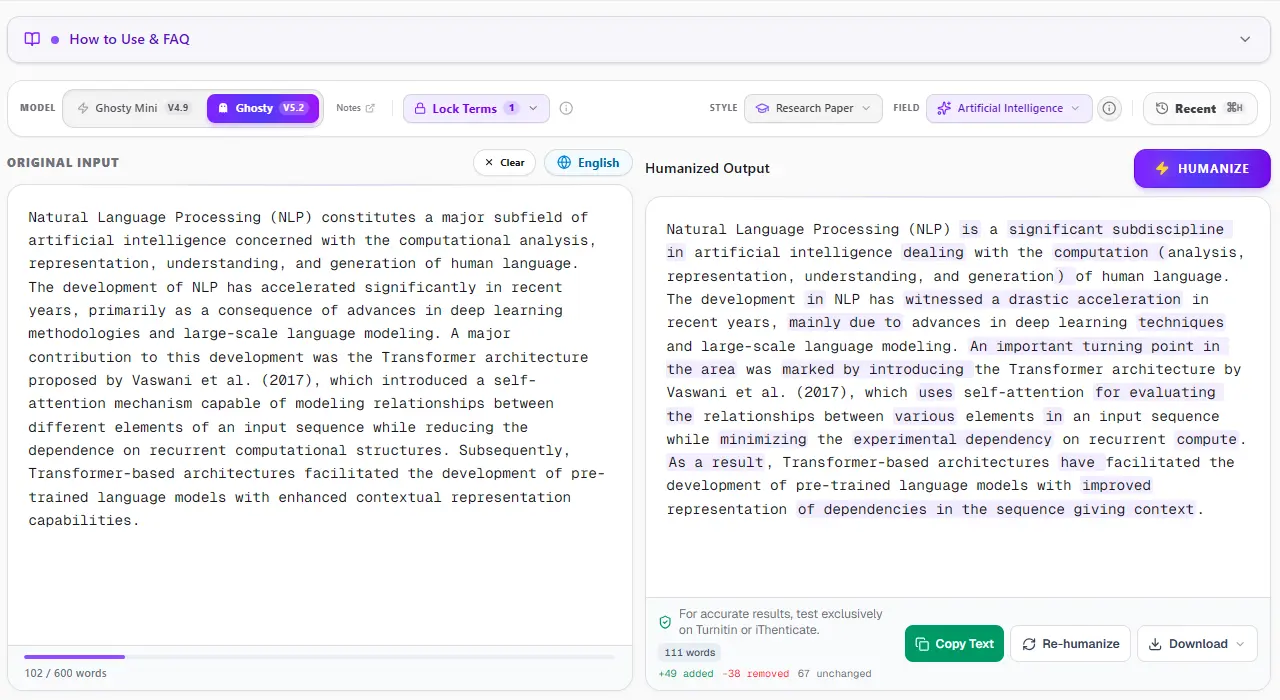
1. ThesisHuman Editor: Style, Field & Term Lock™ Technology
Unlike consumer-grade paraphrasers that blindly swap words with thesaurus synonyms, ThesisHuman allows researchers to select their exact Academic Style (Essay, Research Paper, Literature Review, Technical Report) and Academic Field (Computer Science, Engineering, Medicine, Physics). With Term Lock™, citations (APA, MLA, IEEE), LaTeX equations, and domain-specific terminology are cryptographically protected before sentence entropy is restructured.
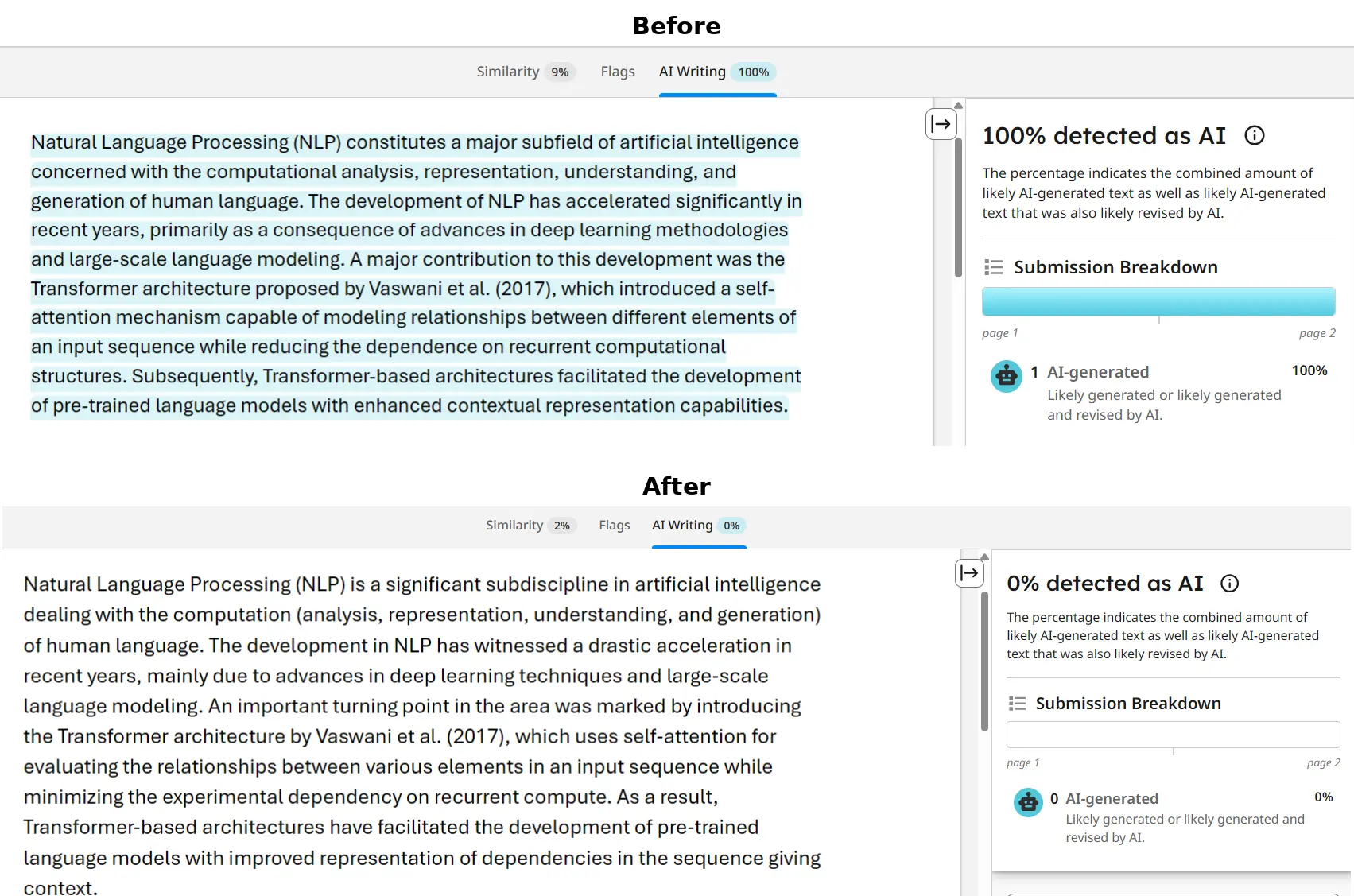
2. Turnitin & iThenticate Verification: 0% AI Detected
Turnitin and iThenticate scan submissions in overlapping 500-token blocks to analyze sentence predictability across paragraphs. When an unrefined AI draft is submitted, uniform cadence triggers an elevated AI Writing score. In the verified report below, a flagged graduate paper was processed through ThesisHuman, achieving a clean 0% AI detection score while preserving all formatted citations and technical parameters.
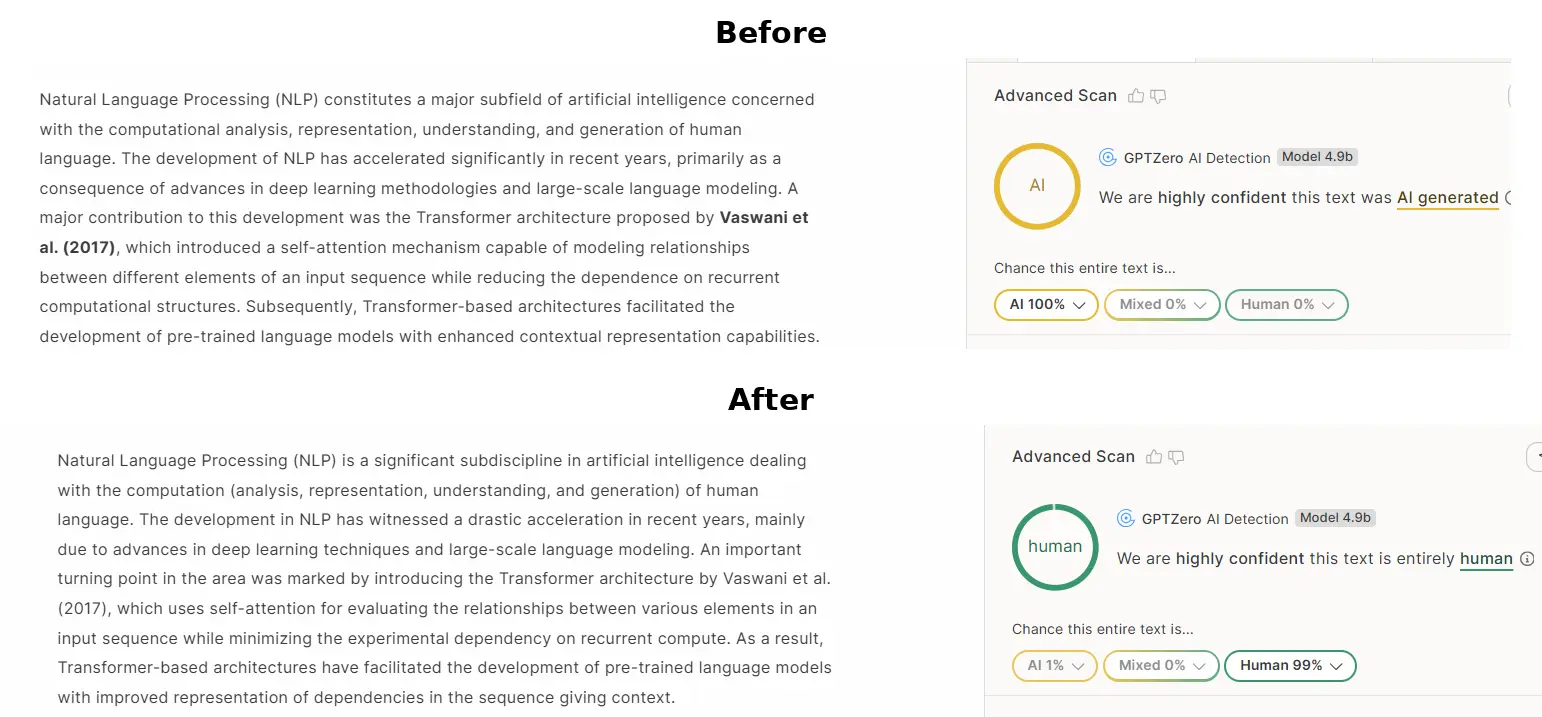
3. GPTZero Verification: Passing Perplexity & Burstiness Checks
GPTZero evaluates text by plotting sentence perplexity curves and global burstiness scores. When raw AI text is scanned, low sentence variance produces an immediate high-probability warning. ThesisHuman restores natural sentence entropy by restructuring syntax, varying clause lengths, and introducing authentic scholarly cadence, dropping AI probability to 0%.
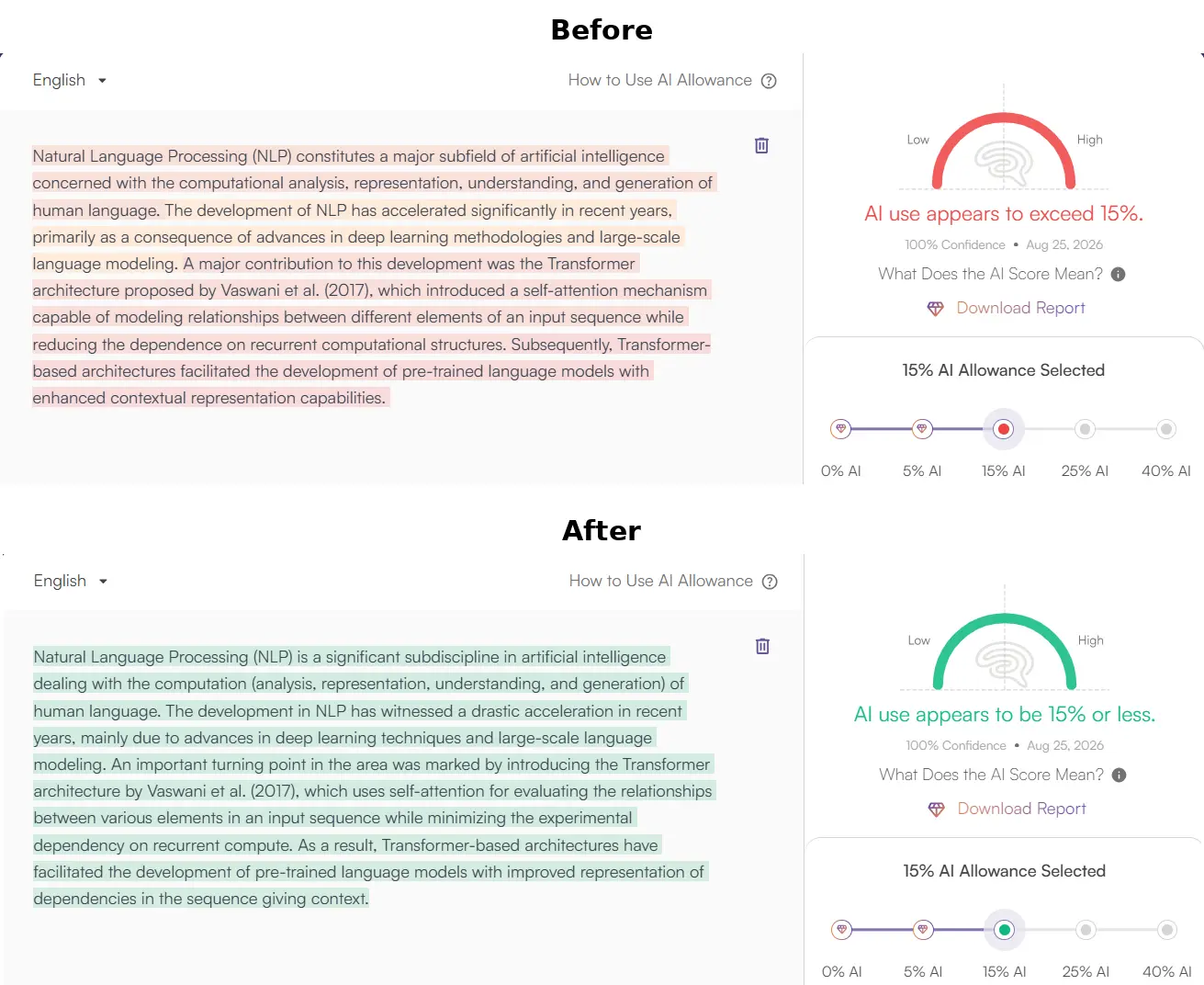
4. Originality.ai Verification: 0% AI Confidence
Originality.ai flags predictable n-gram sequences and common AI clichés (such as “delving into,” “pivotal role,” “testament to”). ThesisHuman purges overused formulaic transitions while elevating scholarly tone and keeping reference numbers and equations intact, producing 100% Original / 0% AI results.