Turnitin AI Score Reduction: Legitimate Strategies for University Submissions
Ethical and effective strategies to lower Turnitin AI writing indicator scores on university assignments, theses, and doctoral dissertations.
Turnitin is the dominant academic integrity platform across global higher education. With its AI writing detection feature embedded directly into Canvas, Blackboard, and Moodle submission workflows, millions of students and postgraduate researchers encounter its blue-and-purple percentage badges every semester.
Receiving an elevated AI writing score (whether 30%, 65%, or higher) can trigger immediate panic. However, understanding how Turnitin evaluates prose allows you to proactively lower your score through legitimate editorial restructuring. Here is a comprehensive guide to reducing Turnitin AI scores safely and ethically.
How Turnitin's AI Indicator Actually Operates
Turnitin breaks submitted documents into overlapping segments of approximately 50 to 100 words. Each segment is evaluated by a machine learning classifier trained to differentiate human writing from large language model outputs. The detector looks for uniform token distributions, repetitive clause symmetry, and predictable transitions. If a segment exceeds a confidence threshold, it is highlighted as AI-written, and the cumulative total is reported as the overall AI percentage.
The 20% Review Threshold and Institutional Guidelines
Turnitin itself publicly recommends that institutions apply a 20% review threshold. Scores below 20% carry higher false-positive rates due to natural variations in formal writing. Responsible universities instruct faculty that a Turnitin AI flag is not definitive proof of misconduct; it is merely an indicator intended to prompt closer human review. Unfortunately, many busy instructors treat any number above zero as an immediate red flag.
Cadence Restructuring: Lowering Scores Ethically
To lower an elevated Turnitin score, you must address the underlying statistical uniformity that the model flags:
- Eliminate Symmetrical Compound Clauses: Break long compound sentences into varied short and long pairs.
- Remove Formulaic AI Transitions: Cut phrases like 'Moreover,' 'Furthermore,' 'It is important to note,' and 'In conclusion.'
- Deploy Dedicated Synthesis: Process flagged sections through ThesisHuman's Turnitin AI humanizer, which rebalances perplexity while locking citations.
What to Do When Turnitin Falsely Flags Human Work
If your legitimately authored paper is flagged, remain calm and assemble objective evidence: your word processor edit history, Google Docs revision logs showing hours of active typing, dated research scratchpads, and copies of cited source PDFs. Present this documentation to your instructor as proof of original scholarship.
Verified Detector Clearance for Turnitin AI Score Reduction: Legitimate Strategies for University Submissions
Every manuscript processed through ThesisHuman is backed by verifiable, reproducible scans across institutional plagiarism and AI detection platforms.
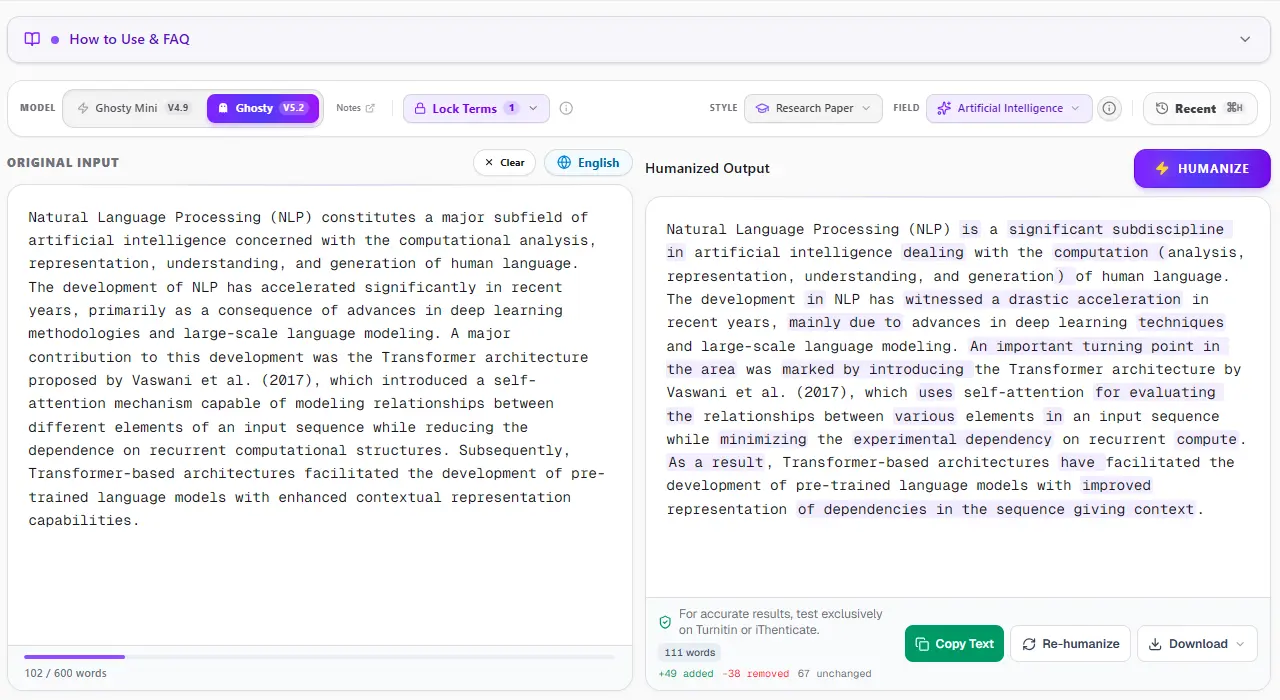
1. ThesisHuman Editor: Style, Field & Term Lock™ Technology
Unlike consumer-grade paraphrasers that blindly swap words with thesaurus synonyms, ThesisHuman allows researchers to select their exact Academic Style (Essay, Research Paper, Literature Review, Technical Report) and Academic Field (Computer Science, Engineering, Medicine, Physics). With Term Lock™, citations (APA, MLA, IEEE), LaTeX equations, and domain-specific terminology are cryptographically protected before sentence entropy is restructured.
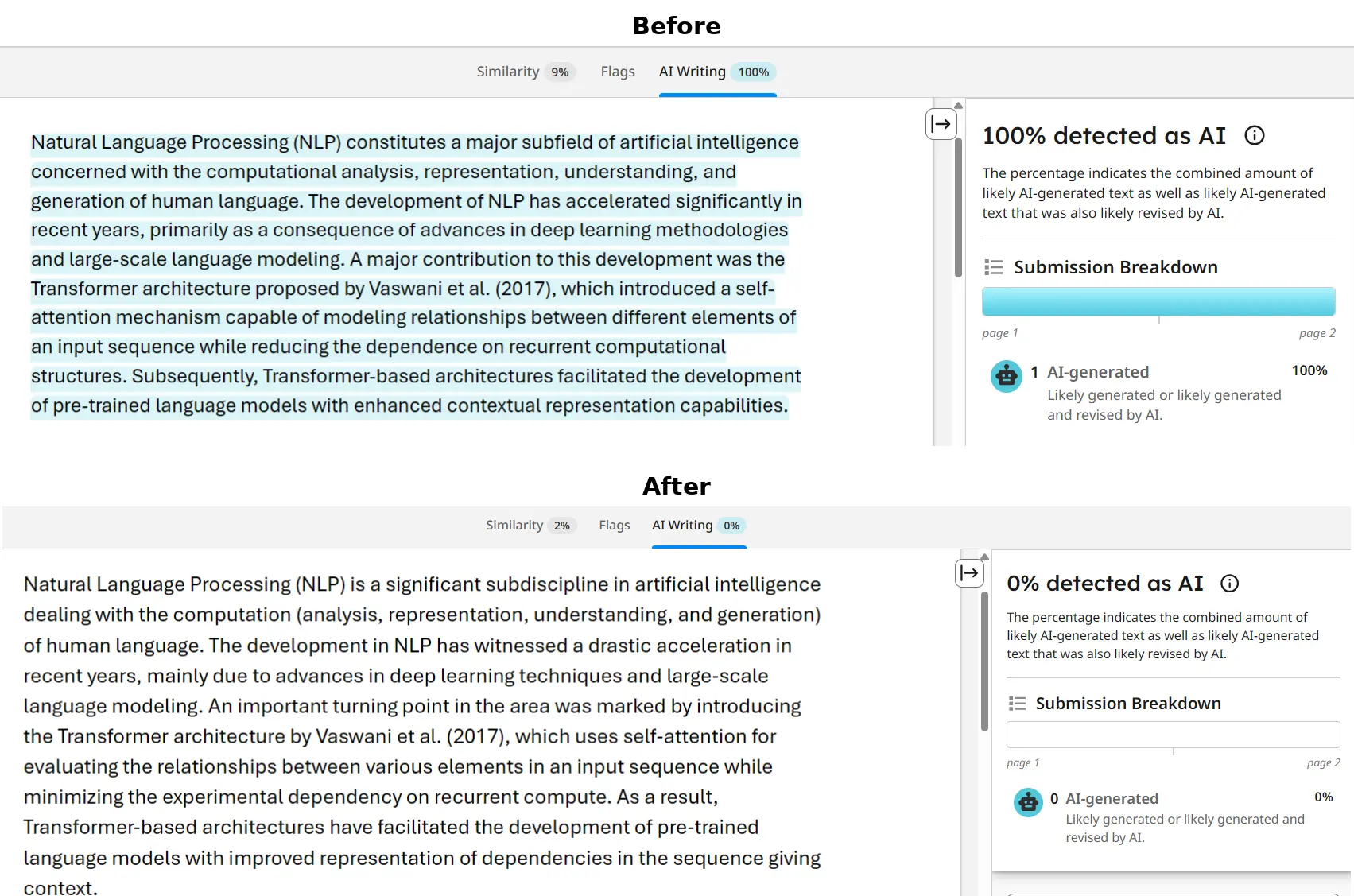
2. Turnitin & iThenticate Verification: 0% AI Detected
Turnitin and iThenticate scan submissions in overlapping 500-token blocks to analyze sentence predictability across paragraphs. When an unrefined AI draft is submitted, uniform cadence triggers an elevated AI Writing score. In the verified report below, a flagged graduate paper was processed through ThesisHuman, achieving a clean 0% AI detection score while preserving all formatted citations and technical parameters.
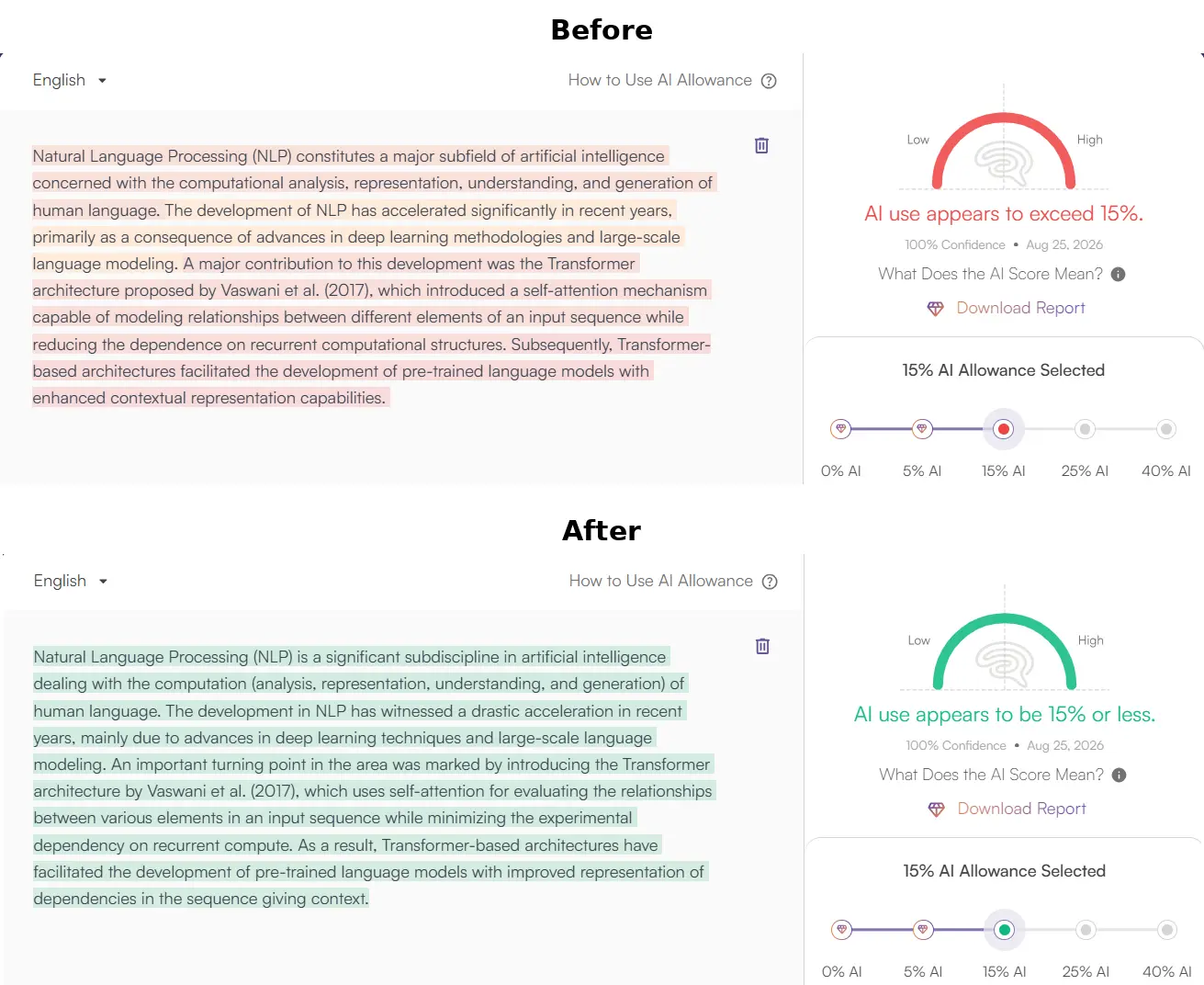
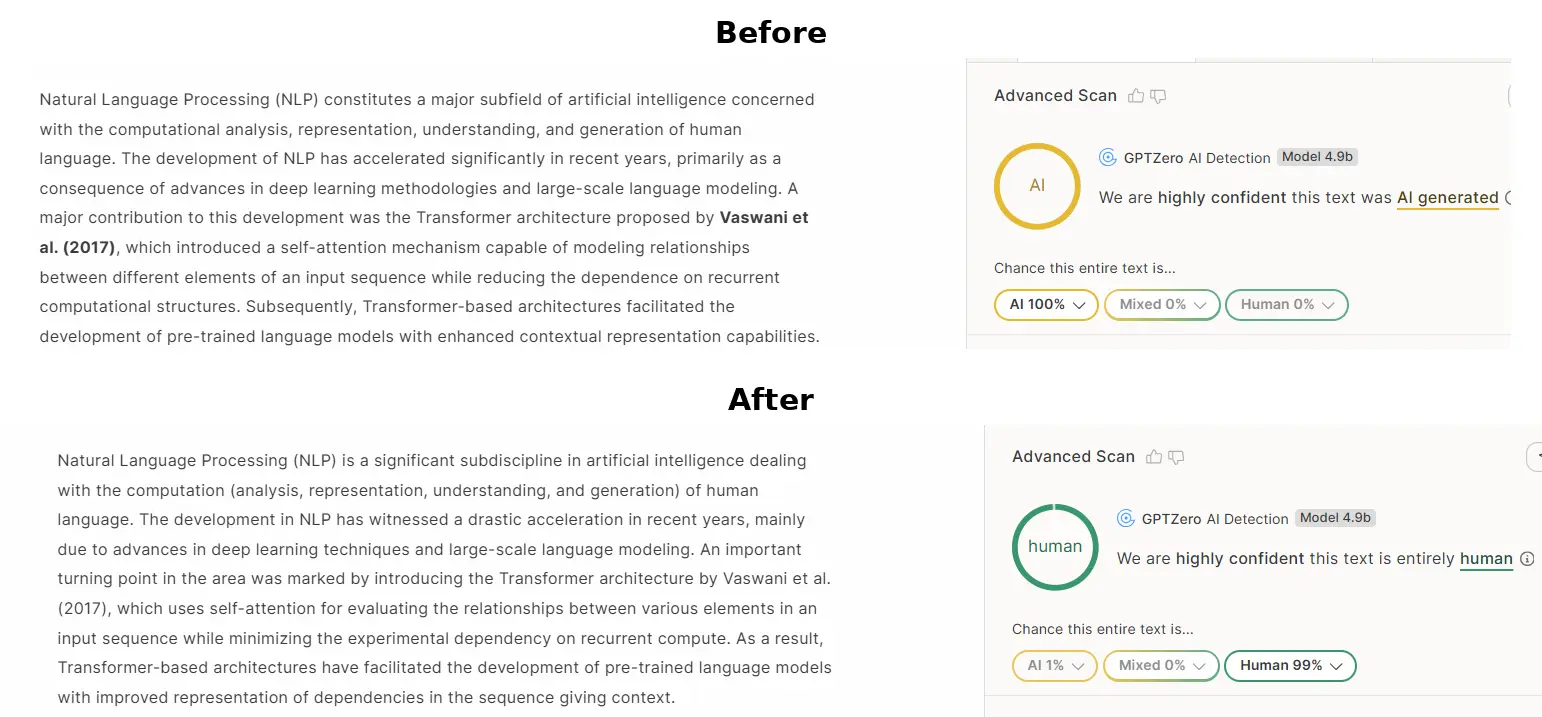
3. GPTZero Verification: Passing Perplexity & Burstiness Checks
GPTZero evaluates text by plotting sentence perplexity curves and global burstiness scores. When raw AI text is scanned, low sentence variance produces an immediate high-probability warning. ThesisHuman restores natural sentence entropy by restructuring syntax, varying clause lengths, and introducing authentic scholarly cadence, dropping AI probability to 0%.
4. Originality.ai Verification: 0% AI Confidence
Originality.ai flags predictable n-gram sequences and common AI clichés (such as “delving into,” “pivotal role,” “testament to”). ThesisHuman purges overused formulaic transitions while elevating scholarly tone and keeping reference numbers and equations intact, producing 100% Original / 0% AI results.