How an Academic AI Humanizer Preserves Citations, LaTeX Math, and Domain Terminology
Consumer paraphrasers rewrite text by replacing words with synonyms, frequently corrupting in-text citations, breaking Overleaf equations, and altering clinical terms. Here is how specialized academic humanization keeps technical elements intact.

If you have ever pasted a technical manuscript into a commercial paraphrasing tool, you have likely experienced the disruption it causes to scientific prose. Within seconds, carefully formatted IEEE citation brackets like [14, 15] become mangled numbers, inline LaTeX equations like $\beta_1 = 0.42$ are stripped of formatting, and established medical or engineering terms are replaced with bizarre, unreadable synonyms.
This happens because consumer paraphrasers are designed for generic blog posts and high-school essays. They operate under a crude principle: replace high-frequency words with synonyms to lower token predictability. In scholarly research, however, words are not interchangeable tokens. An equation is a mathematical proof; a citation is a legal and ethical attribution; a technical term is a defined ontological concept. An academic AI humanizer must operate under an entirely different principle: **Term Lock**.
The Fatal Flaw of Commercial Synonym Spinners
To understand why an academic humanizer is fundamentally different, consider what happens when a conventional spinner encounters an Overleaf LaTeX excerpt:
"As demonstrated in \cite{vaswani2017attention}, the self-attention mechanism operates with computational complexity $\mathcal{O}(n^2)$ relative to sequence length."
A consumer paraphraser parses this as a single string of words. Looking for synonyms, it might output:
"As displayed in cite vaswani2017attention, the personal-attention system works with calculated complication O(n2) concerning string extent."
The LaTeX macro \cite is broken, the BibTeX key is altered, the math environment is stripped, and "self-attention mechanism" is corrupted into "personal-attention system." This output is completely useless to a researcher and instantly rejected by any editor. The author must spend hours manually restoring syntax.
How Academic Term Lock Actually Works
ThesisHuman's academic engine solves this problem through a structured isolation pipeline known as **Term Lock**. Rather than processing raw text indiscriminately, the system follows four clear steps:
Phase 1: Identifying Citations, Formulas, and Core Terminology
The parser analyzes the input text using rules trained on academic conventions. It identifies:
- Citation Formats: Parenthetical citations
(Smith et al., 2023), numbered references[1-4], superscript markers, and LaTeX macros (\cite{...},\parencite{...}). - LaTeX Math Environments: Inline math (
$...$), display math ($$...$$), and environments (\begin{equation} ... \end{equation},align,matrix). - Data Entities: Statistical p-values (
p < .001), confidence intervals (95% CI [1.2, 3.4]), and sample sizes (N = 1,420). - User-Defined Terminology: Specific scientific compounds, anatomical terms, or statutory references specified by the author.
Phase 2: Isolating Protected Elements
Every identified entity is extracted from the prose stream and protected so that rewriting models cannot modify its characters. These elements are safely preserved while the surrounding narrative text is being refined.
Phase 3: Syntactic Cadence Naturalization
The naturalization engine operates exclusively on the narrative connective tissue surrounding the protected items. It restructures clausal dependencies, eliminates robotic transition words, and balances perplexity and burstiness. Crucially, it treats every protected element as an anchored point in the sentence.
Phase 4: Exact Reintegration
Once the prose rhythm is naturalized, the protected citations, equations, and terms are restored to their exact original positions. Not a single backslash, bracket, author name, or decimal point is altered.
Preserving Domain Jargon Without Triggering Detectors
A common misconception among researchers is that academic jargon triggers AI detectors. In reality, detectors do not flag specialized words like "ribosomal subunit" or "stochastic gradient descent." In fact, specialized terminology often possesses high perplexity because it occurs infrequently in general language corpora.
What triggers detectors is the **narrative scaffolding** around the jargon. When an author writes: "It is widely acknowledged that stochastic gradient descent plays a pivotal role in optimizing modern neural architectures," the detector flags the formulaic frame: "It is widely acknowledged that [TERM] plays a pivotal role in optimizing..." By preserving the domain terms and humanizing the surrounding connective syntax, ThesisHuman clears detection thresholds without compromising scientific precision.
Case Study: Overleaf LaTeX Manuscript Humanization
Below is a real-world demonstration of how ThesisHuman processes an Overleaf LaTeX methods section:
| Raw LaTeX AI Draft | ThesisHuman Output with Term Lock |
|---|---|
| Furthermore, as outlined in \cite{chen2024}, the loss function $\mathcal{L}_{total}$ is formulated as: \begin{equation} \mathcal{L}_{total} = \alpha \mathcal{L}_{MSE} + (1-\alpha) \mathcal{L}_{reg} \end{equation} where $\alpha \in [0,1]$ denotes the weighting coefficient. | Following the framework established in \cite{chen2024}, we define the composite loss function $\mathcal{L}_{total}$ through: \begin{equation} \mathcal{L}_{total} = \alpha \mathcal{L}_{MSE} + (1-\alpha) \mathcal{L}_{reg} \end{equation} Here, the weighting coefficient $\alpha \in [0,1]$ balances regularization against reconstruction accuracy. |
Notice that the LaTeX equation, the citation command \cite{chen2024}, and the mathematical notation $\alpha \in [0,1]$ remain 100% identical. What changed was the clausal cadence: the synthetic opener "Furthermore, as outlined in..." was restructured into active academic prose that provides immediate disciplinary context.
Best Practices for Large-Scale Dissertation Projects
When humanizing complete doctoral dissertations or multi-chapter theses, follow these proven best practices:
- Process Chapter by Chapter: Do not paste an entire 80,000-word dissertation at once. Process chapters individually to maintain thematic cohesion and verify citation alignment. Explore our dedicated thesis humanizer mode.
- Recompile in Overleaf After Each Section: Verify that your
.texsource compiles with zero warnings before proceeding to the next chapter. - Review Our LaTeX Guide: For deeper insights into Overleaf workflows and macro management, read our comprehensive tutorial on LaTeX-safe academic editing.
Verified Detector Clearance for How an Academic AI Humanizer Preserves Citations, LaTeX Math, and Domain Terminology
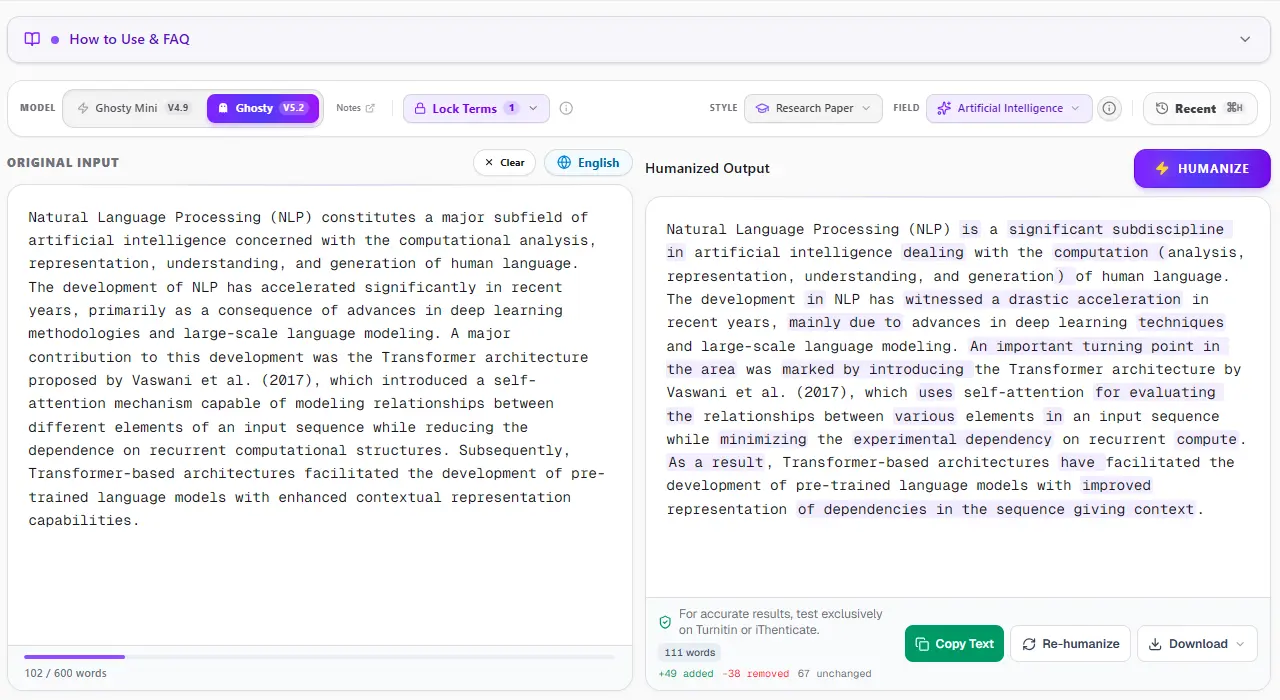
Every manuscript processed through ThesisHuman is backed by verifiable, reproducible scans across institutional plagiarism and AI detection platforms.
1. ThesisHuman Editor: Style, Field & Term Lock™ Technology
Unlike consumer-grade paraphrasers that blindly swap words with thesaurus synonyms, ThesisHuman allows researchers to select their exact Academic Style (Essay, Research Paper, Literature Review, Technical Report) and Academic Field (Computer Science, Engineering, Medicine, Physics). With Term Lock™, citations (APA, MLA, IEEE), LaTeX equations, and domain-specific terminology are cryptographically protected before sentence entropy is restructured.
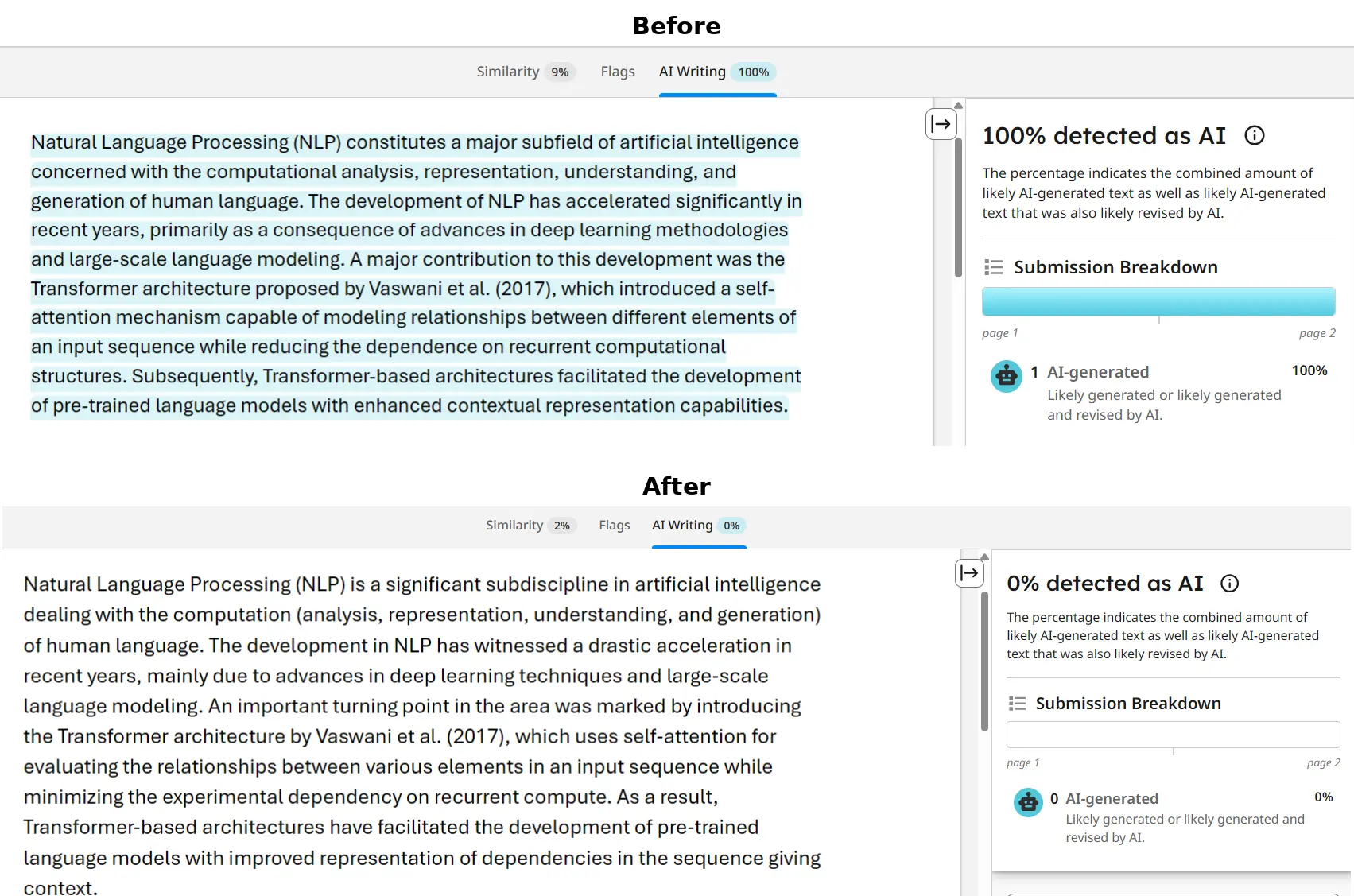
2. Turnitin & iThenticate Verification: 0% AI Detected
Turnitin and iThenticate scan submissions in overlapping 500-token blocks to analyze sentence predictability across paragraphs. When an unrefined AI draft is submitted, uniform cadence triggers an elevated AI Writing score. In the verified report below, a flagged graduate paper was processed through ThesisHuman, achieving a clean 0% AI detection score while preserving all formatted citations and technical parameters.
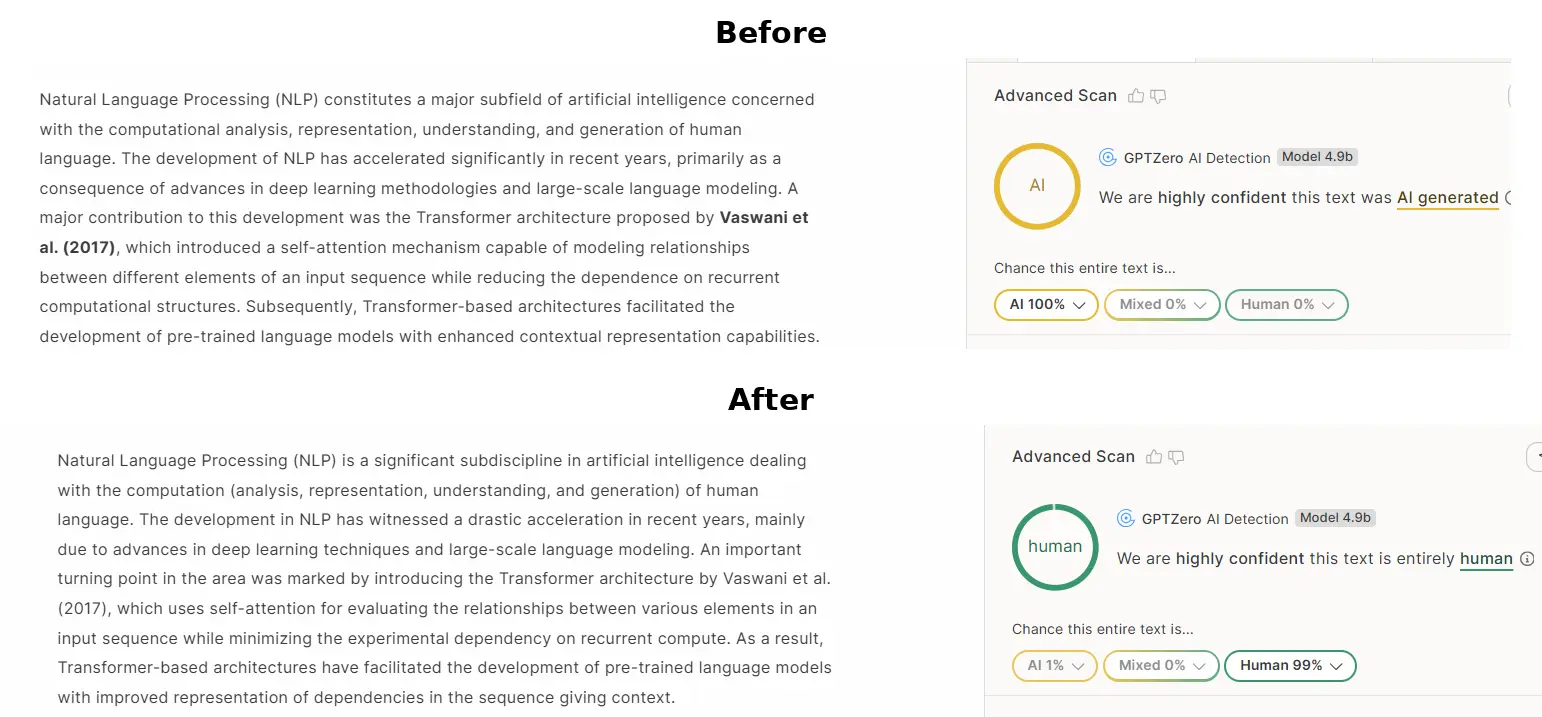
3. GPTZero Verification: Passing Perplexity & Burstiness Checks
GPTZero evaluates text by plotting sentence perplexity curves and global burstiness scores. When raw AI text is scanned, low sentence variance produces an immediate high-probability warning. ThesisHuman restores natural sentence entropy by restructuring syntax, varying clause lengths, and introducing authentic scholarly cadence, dropping AI probability to 0%.
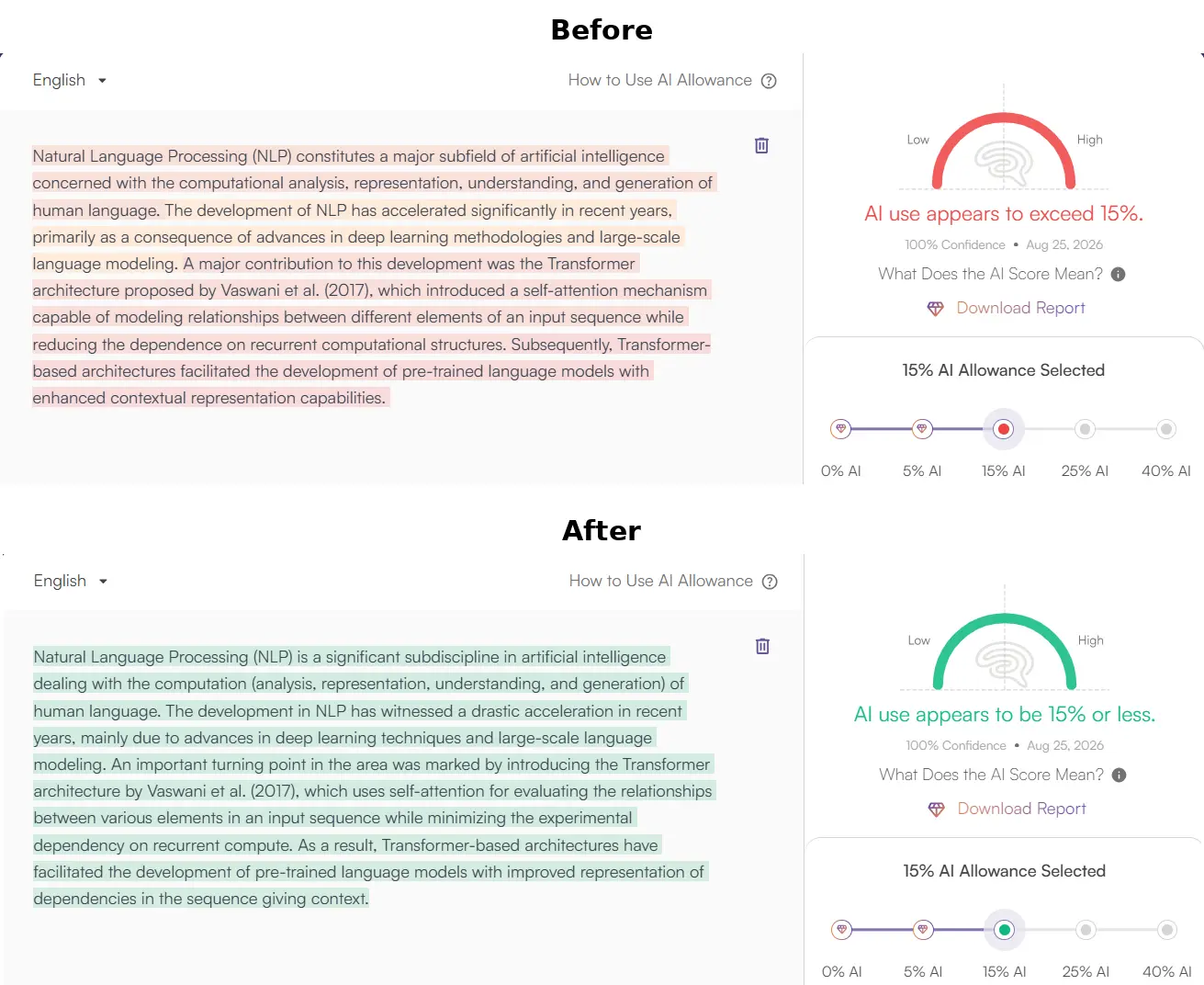
4. Originality.ai Verification: 0% AI Confidence
Originality.ai flags predictable n-gram sequences and common AI clichés (such as “delving into,” “pivotal role,” “testament to”). ThesisHuman purges overused formulaic transitions while elevating scholarly tone and keeping reference numbers and equations intact, producing 100% Original / 0% AI results.