Discussion vs. Conclusion in a Research Paper: Differences and Examples
Understand the critical differences between the Discussion and Conclusion sections in academic research papers, featuring structural breakdowns, rhetorical strategies, and worked examples across four disciplines.

The Discussion and Conclusion sections of a research paper represent the final stages of scholarly argumentation. While both sections move beyond raw data presentation to deliver analytical perspective, they perform fundamentally different rhetorical tasks. Confusing their functions is one of the most frequent reasons peer reviewers ask authors to reorganize manuscript drafts.
In brief: the Discussion explains what your empirical findings mean, how they relate to published scholarship, and why unexpected anomalies occurred, while the Conclusion synthesizes your study's ultimate contributions, broader field significance, and final takeaways. Mastering the boundary between these two sections ensures that your paper closes with analytical rigor and persuasive scholarly authority.
1. Direct Answer: What Is the Difference Between Discussion and Conclusion?
The primary difference between the Discussion and Conclusion lies in their analytical scope and rhetorical objective:
- The Discussion looks inward and downward at your empirical data: It interprets specific results, reconciles hypotheses, evaluates theoretical mechanisms, contrasts your findings with prior studies, and candidly examines methodological limitations.
- The Conclusion looks outward and upward at the broader academic discipline: It steps back from granular numbers to summarize overarching contributions, articulate macro-level implications, and frame future scholarly inquiries without reopening data debates.
| Analytical Dimension | Discussion Section | Conclusion Section |
|---|---|---|
| Primary Rhetorical Goal | Interpret and contextualize empirical results | Deliver synthesis, broad significance, and closure |
| Scope of Inquiry | Granular and comparative (focused on specific findings) | Holistic and panoramic (focused on field contributions) |
| Citations to Literature | Dense (cross-referencing previous studies) | Minimal or absent (focuses strictly on author's synthesis) |
| Treatment of Limitations | Detailed and constructive (methodological critique) | Brief restatement or implicit within future research scope |
| Typical Length | Substantial: 1,200 to 2,000 words (often with subheadings) | Concise: 250 to 500 words (2 to 4 focused paragraphs) |
| Position in Paper | Follows Results; precedes Conclusion | Final text section preceding References and Appendices |
2. Purpose and Rhetorical Role of the Discussion Section
The Discussion section is the interpretive heart of a scientific or scholarly paper. The Results section tells the reader what happened; the Discussion tells the reader why it happened and why it matters within the specialized domain.
Key rhetorical functions of the Discussion include:
- Answering Stated Research Questions: Directly linking observed findings back to original hypotheses or research objectives.
- Explaining Underlying Mechanisms: Proposing theoretical explanations for observed relationships, correlations, or qualitative patterns.
- Accounting for Discrepancies and Null Findings: Analyzing why certain hypotheses failed, why anticipated effects did not materialize, or why results conflicted with prior literature.
- Situating Findings in Existing Scholarship: Explicitly demonstrating whether your data confirms, extends, or challenges published benchmarks.
- Qualifying Claims Through Limitations: Explaining how sample boundaries, instrument sensitivity, or experimental constraints influence the generalizability of findings.
3. Purpose and Rhetorical Role of the Conclusion Section
The Conclusion provides intellectual closure. It is not an expanded abstract, nor is it a simple cut-and-paste summary of the Discussion. Its role is to leave the reader with a clear, enduring understanding of your study's contribution to knowledge.
Key rhetorical functions of the Conclusion include:
- Synthesizing Primary Insights: Distilling complex multi-part findings into one or two clear, memorable takeaways.
- Articulating Disciplinary Impact: Explaining how your findings shift theoretical understanding, professional practice, or policy decisions.
- Highlighting Methodological or Conceptual Novelty: Re-emphasizing what your study accomplished that previous research could not.
- Defining Actionable Future Research: Recommending concrete, non-obvious avenues for subsequent scholarly inquiry based on your discoveries.
- Providing Rhetorical Finality: Concluding with a strong, definitive statement regarding the evolving trajectory of the field.
4. Discussion vs. Conclusion Structural Comparison Table
To visualize how the two sections handle identical study elements differently within the exact same investigation, examine this comparative table based on an illustrative clinical telehealth trial:
| Structural Element | Discussion Section Approach (Illustrative Telehealth Study) | Conclusion Section Approach (Illustrative Telehealth Study) |
|---|---|---|
| Primary Findings | 'The observed 1.4% reduction in HbA1c among rural cohort participants ($p = .004, 95% ext{ CI } [0.8, 2.0]$) supports the primary hypothesis that bi-weekly mobile nurse consultations attenuate glycemic variability.' | 'This investigation demonstrates that structured asynchronous digital monitoring provides a clinically viable, scalable mechanism for stabilizing chronic glycemic markers in medically underserved rural populations.' |
| Relation to Prior Literature | 'While our findings align with Patel and Gomez (2022), who observed a 1.1% HbA1c drop in suburban clinics, our effect size was notably larger, likely due to higher baseline rural care deficits.' | Omitted entirely; the focus remains strictly on the overarching societal and clinical significance of the current trial's contribution. |
| Methodological Limitations | 'A primary limitation involves the 14-week observation window, which precludes assessment of permanent behavioral habituation or long-term medication adherence.' | 'While multi-year trials remain necessary to evaluate permanent lifestyle changes, the immediate clinical benefits provide clear justification for broader health network adoption.' |
| Practical Implications | 'Clinicians should integrate automated SMS glucometer prompts at 48-hour intervals to optimize patient reporting adherence.' | 'Healthcare administrators and rural hospital networks should allocate tele-endocrinology resources toward mobile-first monitoring platforms to narrow geographic healthcare disparities.' |
Four Complete Disciplinary Example Pairs
To see how these distinctions operate across diverse fields, consider four complete before-and-after disciplinary pairs. (Note: All studies below represent clearly labeled illustrative models to preserve academic integrity.)
Example Pair 1: Computer Science & Artificial Intelligence (Model Optimization)
- Discussion Excerpt:
'The benchmark evaluations confirm that 4-bit quantised matrix decomposition reduces transformer inference latency by 42% on edge hardware while maintaining a 94.2% BLEU recovery rate relative to the 16-bit FP baseline. However, hallucination frequencies increased by 3.8% ($p = .031$) when evaluating domain-specific legal vocabulary. This degradation aligns with the pruning vulnerability model described by Zhao and Vance (2023), suggesting that low-rank adapters fail to preserve long-tail token embeddings under extreme weight compression. Consequently, edge deployment must incorporate selective unquantised attention heads for sensitive technical terms.'
- Conclusion Excerpt:
'This study demonstrates that high-throughput transformer inference on resource-constrained edge devices does not require sacrificing general linguistic coherence. By achieving substantial latency reductions while identifying the precise failure mode in domain-specific token representations, our architecture establishes an empirical benchmark for practical edge intelligence. Future investigations should explore dynamic head-selective quantisation to eliminate domain-specific hallucinations entirely.'
Example Pair 2: Engineering & Materials Science (Cyclic Stress Testing)
- Discussion Excerpt:
'The microstructural fatigue analysis reveals that cross-laminated carbon-fiber composites subjected to 100,000 thermal cycles (-40 deg C to +85 deg C) experienced interfacial delamination primarily along matrix resin boundaries. The observed 18% reduction in ultimate tensile strength ($p < .01$) exceeds the theoretical failure threshold predicted by classical laminate theory (Hashin & Rotem, 1973). This discrepancy is attributable to thermal expansion mismatch between the epoxy matrix and reinforcing nanofillers, which induced micro-void coalescence under accelerated thermal cycling.'
- Conclusion Excerpt:
'Thermal fatigue cycling represents a primary failure mechanism in modern aerospace composite structures. By establishing the empirical boundaries of cross-laminated carbon-fiber interfaces under extreme cyclic temperatures, this research provides aerospace engineers with verified durability criteria to prevent catastrophic in-flight delamination. Implementing modified resin matrices with matched thermal coefficients constitutes the essential next engineering milestone.'
Example Pair 3: Social Sciences (Higher Education Retention)
- Discussion Excerpt:
'The hierarchical linear regression indicates that peer-mentoring participation accounted for 24% of the variance in first-year retention among first-generation college students ($beta = 0.38, p < .001$). However, this protective effect was heavily moderated by campus commute distance: off-campus students working more than 20 hours weekly attended 62% fewer mentoring sessions. This finding expands Tinto's (1993) student integration model by identifying off-campus labor commitments as an active barrier to institutional bonding.'
- Conclusion Excerpt:
'First-generation undergraduate persistence cannot be secured through academic advising alone; it requires structured, institutionally supported peer connections that accommodate the economic realities of student employment. Universities seeking to close completion disparities must transition from rigid on-campus mentoring formats toward flexible, credit-bearing peer cohorts. Addressing student labor constraints remains the defining equity challenge for contemporary higher education policy.'
Example Pair 4: Healthcare & Clinical Nursing (Geriatric Care)
- Discussion Excerpt:
'Implementing bedside quiet hours from 22:00 to 06:00 reduced nocturnal delirium incidence by 28% across acute geriatric hospital wards ($p = .014$). In contrast to previous findings by Larson et al. (2021), who reported nurse compliance resistance, our implementation achieved an 88% protocol fidelity rate. This success was driven by automated medication schedule clustering, which eliminated non-critical nocturnal awakenings without compromising medication dosing intervals.'
- Conclusion Excerpt:
'Simple environmental sleep preservation protocols significantly reduce acute delirium among hospitalized older adults. By demonstrating that clustered nocturnal nursing care achieves high clinical feasibility and immediate neurological protection, this investigation offers hospital systems a low-cost, non-pharmacological strategy for improving geriatric inpatient safety. Future research should evaluate multi-center hospital networks to establish national clinical benchmarks.'
5. Typical Structure and Progression of the Discussion Section
An effective Discussion section follows an 'inverted hourglass' or expanding progression, moving from specific empirical findings outward to broader theoretical implications:
- Opening Paragraph (Findings Recap): Restate your core research objective and provide a direct answer to your primary research question based on your strongest results, avoiding repetitive numerical data dumps.
- Interpretation & Theoretical Explanations (The 'Why'): Explain the underlying behavioral, biological, physical, or social mechanisms driving the observed phenomena.
- Comparison with Published Literature: Systematically contrast your findings with seminal and recent studies. Group your points into what aligns with prior work, what diverges, and what offers novel insight.
- Analysis of Unexpected or Negative Findings: Address counter-intuitive results directly rather than burying them. Suggest plausible confounding factors or theoretical boundaries that account for anomalies.
- Methodological Limitations: Candidly delineate sample size constraints, measurement instrument limitations, potential unmeasured confounders, and boundary conditions.
- Theoretical and Practical Implications: Detail how your findings advance theoretical paradigms and provide actionable guidance for practitioners in the field.
6. Typical Structure and Progression of the Conclusion Section
A compelling Conclusion section moves through three or four tightly structured paragraphs that deliver clarity and closure without repeating earlier prose:
- Synthesis of Central Contribution (Paragraph 1): Reframe the initial research problem and articulate your study's definitive findings. Do not recite raw statistical parameters ($p$-values, $t$-statistics); state the empirical truth established by the investigation.
- Broad Disciplinary and Practical Significance (Paragraph 2): Explain the wider implications for the discipline. How does this finding alter theoretical models, clinical protocols, industrial engineering workflows, or educational policy?
- Actionable Future Research Trajectories (Paragraph 3): Propose specific, high-priority research questions arising directly from your study's boundaries, avoiding generic statements like 'more research is needed.'
- Final Scholarly Coda (Paragraph 4 or Closing Sentence): Deliver a definitive closing observation emphasizing the enduring value of your contribution to the ongoing academic conversation.
7. Results vs. Discussion vs. Conclusion: Clarifying the Three Core Sections
Researchers sometimes blur the boundaries between Results, Discussion, and Conclusion. Understanding their distinct questions maintains manuscript clarity:
- Results answers: WHAT was observed? Presents raw, objective empirical measurements, descriptive statistics, inferential tests, and visual tables without commentary or external citations.
- Discussion answers: WHY did it occur, and HOW does it relate to prior scholarship? Interprets causal or correlational dynamics, explores theoretical mechanisms, compares findings with published studies, and evaluates methodological bounds.
- Conclusion answers: SO WHAT, and WHERE does the field go next? Synthesizes the big-picture significance, articulates broader field contributions, and outlines strategic future directions for researchers and practitioners.
Read our companion guide on how to write an abstract for a research paper and our specialized research abstract revision protocol to understand how to distill these three sections into submission-grade summaries.
8. Interpreting Empirical Findings Without Overclaiming
A common pitfall in the Discussion section is overclaiming, where authors extend conclusions far beyond what their data legitimately demonstrates. Maintaining appropriate academic hedging protects your credibility during peer review.
Before and After: Weak vs Improved Discussion Paragraph
Model A: Weak Discussion Paragraph (Mere Data Restatement)
'The data showed that participants in Group A scored 78.4 on the retention exam while Group B scored 64.2. This was a 14.2 point difference ($p = .01$). The standard deviation was 4.2 for Group A and 5.1 for Group B. This proves our hypothesis that method A works better than method B. Everyone should use method A now.' Deficiencies: Recites numbers already present in the Results table; provides zero theoretical interpretation; inappropriately uses the unhedged verb 'proves'; overclaims universal applicability without acknowledging sample bounds.
Model B: Improved Discussion Paragraph (Critical Interpretation)
'The marked performance divergence between the intervention and control cohorts ($d = 0.72$) suggests that spaced algorithmic retrieval substantially mitigates mid-semester cognitive decay. Rather than reflecting superior rote memorization, this outcome indicates that automated retrieval intervals disrupt the forgetting curve, compelling learners to engage in deeper semantic reconsolidation. While these results corroborate Sweller's (1988) cognitive architecture framework, the observed effect was restricted to algorithmic problem sets, indicating that retrieval scaffolding may exert less influence during open-ended, ill-structured analytical tasks.' Strengths: Explains the underlying cognitive mechanism; contextualizes the finding within foundational cognitive theory; candidly qualifies the boundary conditions of the intervention.
Principles of Disciplined Interpretation:
- Distinguish Association from Causation: Observational, correlational, or cross-sectional data must never be described in causal terms. Use verbs like is associated with, correlates with, or co-occurs with rather than causes, determines, or produces.
- Respect Sample Boundaries: A finding observed in a sample of 150 undergraduate psychology majors at an American university cannot be generalized to 'human cognitive behavior.' Explicitly qualify the population context.
- Use Epistemic Hedging Wisely: Employ calibrated modal verbs (may, might, suggests, indicates) when proposing theoretical mechanisms that were not directly measured. Review our comprehensive guide on hedging in academic writing for precise phrasing frameworks.
9. Contextualizing Findings Within Existing Scholarly Literature
Your findings do not exist in isolation; their scholarly value is established through active dialogue with published literature.
When comparing your results with prior studies, organize your discussion around three relational stances:
- Corroboration: Show how your data validates or reinforces established findings, particularly if your study used a more diverse sample, superior experimental controls, or newer instrumentation.
- Divergence: When your findings contradict published studies, explain the methodological divergence. Did prior studies use different operational definitions, less sensitive assays, or different statistical controls?
- Expansion: Demonstrate how your research fills a specific void or clarifies boundary conditions identified by earlier authors. Authors seeking to refine sentence-level transitions between sources can leverage our Academic Essay Humanizer to establish natural clausal cadence.
10. Framing Methodological Limitations Defensibly
Many authors fear discussing limitations, worrying that pointing out flaws invites desk rejection. In reality, peer reviewers regard a Discussion section lacking limitations as amateurish and intellectually dishonest.
Best Practices for Writing Limitations:
- Be Proactive and Candid: Present your limitations before reviewers point them out in peer review comments.
- Explain Impact, Not Just Deficiencies: Clearly explain how a limitation specifically affected the data. Did a small sample size limit statistical power, or did self-reported surveys introduce social desirability bias?
- Constructive Reframing: Explain why specific methodological choices were necessary (for example, balancing ecological validity against laboratory control) and show why the core findings remain defensible despite these bounds.
- Connect Limitations to Future Work: Use your identified constraints as natural springboards for subsequent investigations.
11. Distinguishing Theoretical, Practical, and Policy Implications
Both sections discuss implications, but they operationalize them at different altitudes:
Before and After: Weak vs Improved Conclusion Paragraph
Model A: Weak Conclusion Paragraph (Abstract Duplication)
'In conclusion, this study investigated 200 participants across four hospitals. We used a randomized design and measured blood pressure before and after the 8-week intervention. The results showed that the drug lowered blood pressure significantly ($p < .05$). Therefore, the study was successful and achieved all its goals. More research is needed in the future.' Deficiencies: Echoes the abstract methodology verbatim; recites raw sample sizes and p-values; offers vague, unhelpful future directions ('more research is needed'); lacks broader disciplinary significance.
Model B: Improved Conclusion Paragraph (Authoritative Scholarly Closure)
'This trial establishes that targeted nocturnal angiotensin blockade provides decisive vascular protection without increasing orthostatic hypotension risks in elderly hypertensive patients. By decoupling nocturnal blood pressure reduction from daytime fatigue, our protocol resolves a long-standing therapeutic dilemma in geriatric cardiovascular care. Future multi-center evaluations must determine whether these hemodynamic benefits persist beyond twelve months across diabetic cohorts. Ultimately, shifting clinical protocols toward circadian-aligned pharmacological dosing represents a transformative, low-cost milestone in hypertension management.' Strengths: Synthesizes findings without raw numbers; articulates immediate clinical significance; outlines concrete, qualified future directions; closes with authoritative professional impact.
12. Discussion and Conclusion Conventions Within the IMRaD Framework
The standard IMRaD (Introduction, Methods, Results, and Discussion) structure is common across STEM and social sciences, but journal requirements vary by publisher:
- Standard IMRaD (Separate Sections): Most APA, Elsevier, and Wiley social science journals require distinct Discussion and Conclusion sections, with Conclusion appearing as a major Heading 1.
- IEEE and Applied Engineering Style: Frequently utilizes a combined 'Results and Discussion' section followed by a concise 'Conclusion' section outlining technical utility and patent/industrial application.
- High-Impact Natural Science (Nature, Science): Often combines Results and Discussion into a unified narrative, followed by a very short concluding paragraph that integrates final takeaways and future outlook.
- Humanities and Qualitative Traditions: Frequently eschews IMRaD terminology entirely, replacing 'Discussion' with thematic analytical chapters and ending with a reflective 'Epilogue' or 'Final Considerations' section. When formatting academic proposals or dissertation prospectuses, consult our Research Proposal Humanizer for disciplinary alignment.
13. How to Approach Combined 'Discussion and Conclusions' Formats
When submitting to a journal that mandates a single 'Discussion and Conclusions' section, structure your text to ensure neither function is neglected:
- Part 1: Empirical Interpretation (approx. 40% of section): Immediately interpret the main results, relate findings to original research questions, and propose mechanistic explanations.
- Part 2: Literature Comparison and Limitations (approx. 35% of section): Contrast data with published benchmarks and transparently evaluate methodological limitations.
- Part 3: Synthesis, Contributions, and Future Directions (approx. 25% of section): Close with two or three definitive paragraphs that summarize core contributions, broad implications, and clear forward-looking research priorities.
14. Common Writing Mistakes in Discussion and Conclusion Sections
Authors frequently make seven critical structural errors when drafting these sections:
- The Results Re-Run: Reciting raw percentages, p-values, and table figures in the Discussion instead of interpreting their conceptual meaning.
- The Abstract Copy-Paste: Copying sentences from the Abstract or Results summary directly into the Conclusion.
- Introducing New Data in the Discussion: Presenting previously unmentioned statistical analyses or experimental observations in the Discussion.
- Overclaiming and Lack of Hedging: Claiming that a single modest study 'proves' a theory or solves a long-standing disciplinary controversy.
- Burying Negative or Discrepant Results: Ignoring data points that contradict hypotheses, which undermines scientific integrity.
- Weak Future Directions: Concluding with platitudes such as 'more research is needed in this area' rather than proposing precise experimental methodologies.
- Disconnecting Discussion from the Introduction: Failing to answer the explicit research questions posed in Chapter 1 or Section 1. To verify full manuscript coherence, review our transparent pricing and editing plans.
15. Pre-Submission Revision Checklist for Discussion and Conclusion
Before submitting your manuscript, verify that your Discussion and Conclusion satisfy this 10-point quality audit:
- Direct Question Answered: The opening of the Discussion clearly answers the research question posed in the Introduction.
- No Raw Data Dumping: Numerical findings are interpreted for significance rather than merely recited from Results tables.
- Literature Dialogue Present: Your results are actively compared with at least 5 to 10 seminal and recent peer-reviewed sources.
- Balanced Academic Hedging: Interpretations distinguish between established facts, strong associations, and tentative hypotheses.
- Transparent Limitations: At least two or three authentic methodological limitations are candidly examined with their impact noted.
- No New Data Introduced: Every empirical fact discussed has already been presented in the Results section.
- Distinct Rhetorical Roles: The Discussion interprets specific mechanisms; the Conclusion synthesizes broad field contributions.
- No Verbatim Abstract Duplication: The Conclusion articulates fresh, holistic closure without recycling previous prose.
- Concrete Future Research: The forward-looking statements recommend specific experimental designs, populations, or variables.
- Clear Takeaway Coda: The final sentence of the Conclusion provides an authoritative, memorable statement on the study's significance.
16. Frequently Asked Questions
Can the Discussion and Conclusion be combined into a single section?
Yes. Many journals in natural science, engineering, and computer science permit or explicitly require a unified 'Discussion and Conclusions' section to maintain concision. When combined, begin with results interpretation, transition into contextual literature comparison and limitations, and conclude with two or three paragraphs summarizing major contributions and future research directions.
Should I include new citations or references in the Conclusion section?
Generally no. The Conclusion section should synthesize your own study's findings, broader significance, and forward-looking implications. Introducing new citations in the final section risks opening new theoretical debates that should have been addressed in your Literature Review or Discussion.
Where should research limitations be placed: in the Discussion or Conclusion?
Methodological limitations belong primarily in the Discussion section (often near the final third of the section). Placing limitations in the Discussion allows you to qualify your interpretation of results transparently while leaving the Conclusion to focus on your verified contributions and closing significance.
How long should the Conclusion be compared to the Discussion?
In a standard empirical manuscript of 6,000 to 8,000 words, the Discussion section typically spans 1,200 to 2,000 words across multiple subheadings. In contrast, the Conclusion is much more concise, generally comprising 250 to 500 words organized into two to four tight paragraphs.
Can I introduce new empirical data or findings in the Discussion?
No. All primary empirical measurements, statistical test outputs, and qualitative coding results must be introduced in the Results section. The Discussion interprets and evaluates data that has already been reported, rather than introducing surprise findings.
Verified Detector Clearance for Discussion vs. Conclusion in a Research Paper: Differences and Examples
Every manuscript processed through ThesisHuman is backed by verifiable, reproducible scans across institutional plagiarism and AI detection platforms.
1. ThesisHuman Editor: Style, Field & Term Lock™ Technology
Unlike consumer-grade paraphrasers that blindly swap words with thesaurus synonyms, ThesisHuman allows researchers to select their exact Academic Style (Essay, Research Paper, Literature Review, Technical Report) and Academic Field (Computer Science, Engineering, Medicine, Physics). With Term Lock™, citations (APA, MLA, IEEE), LaTeX equations, and domain-specific terminology are cryptographically protected before sentence entropy is restructured.

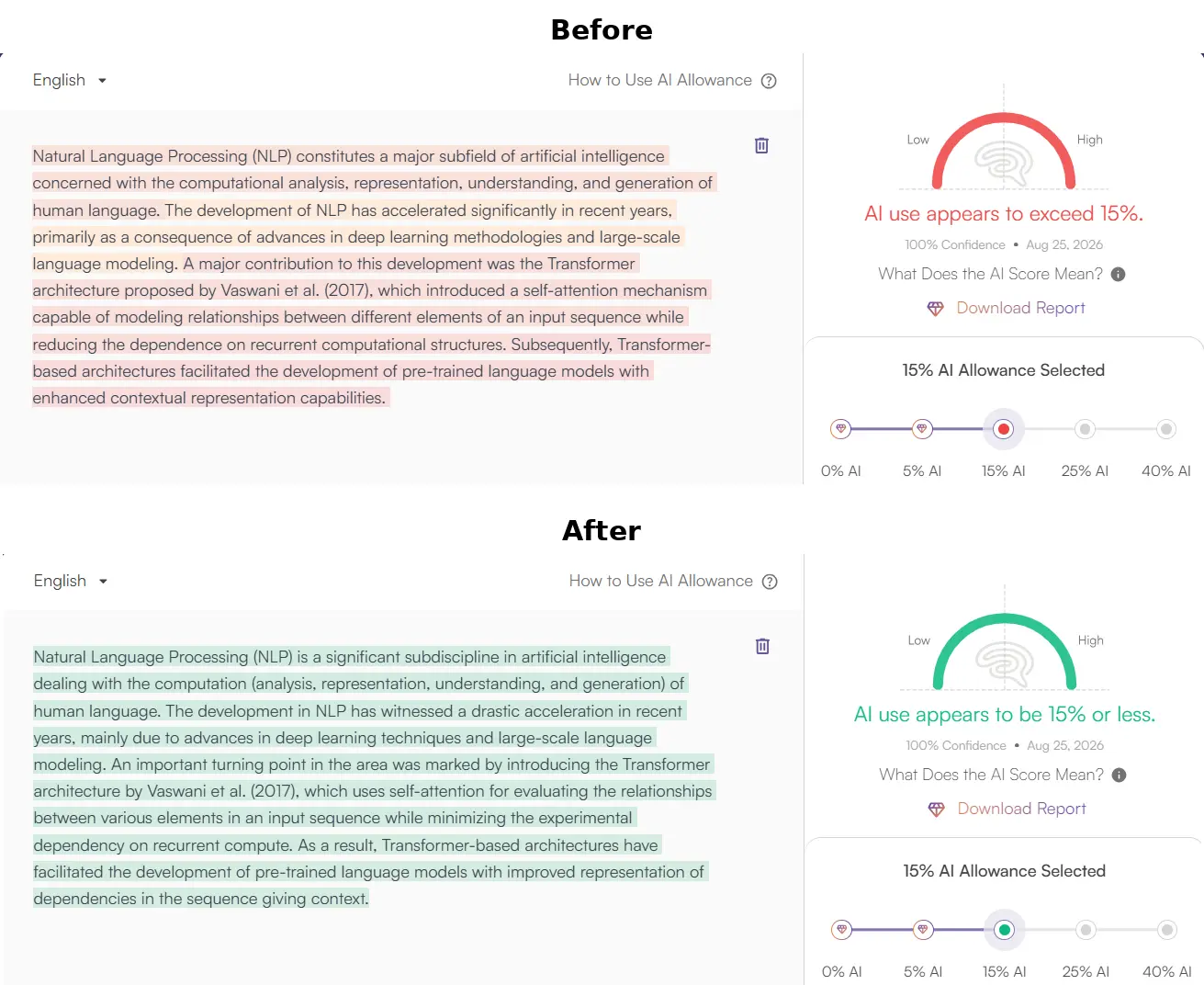
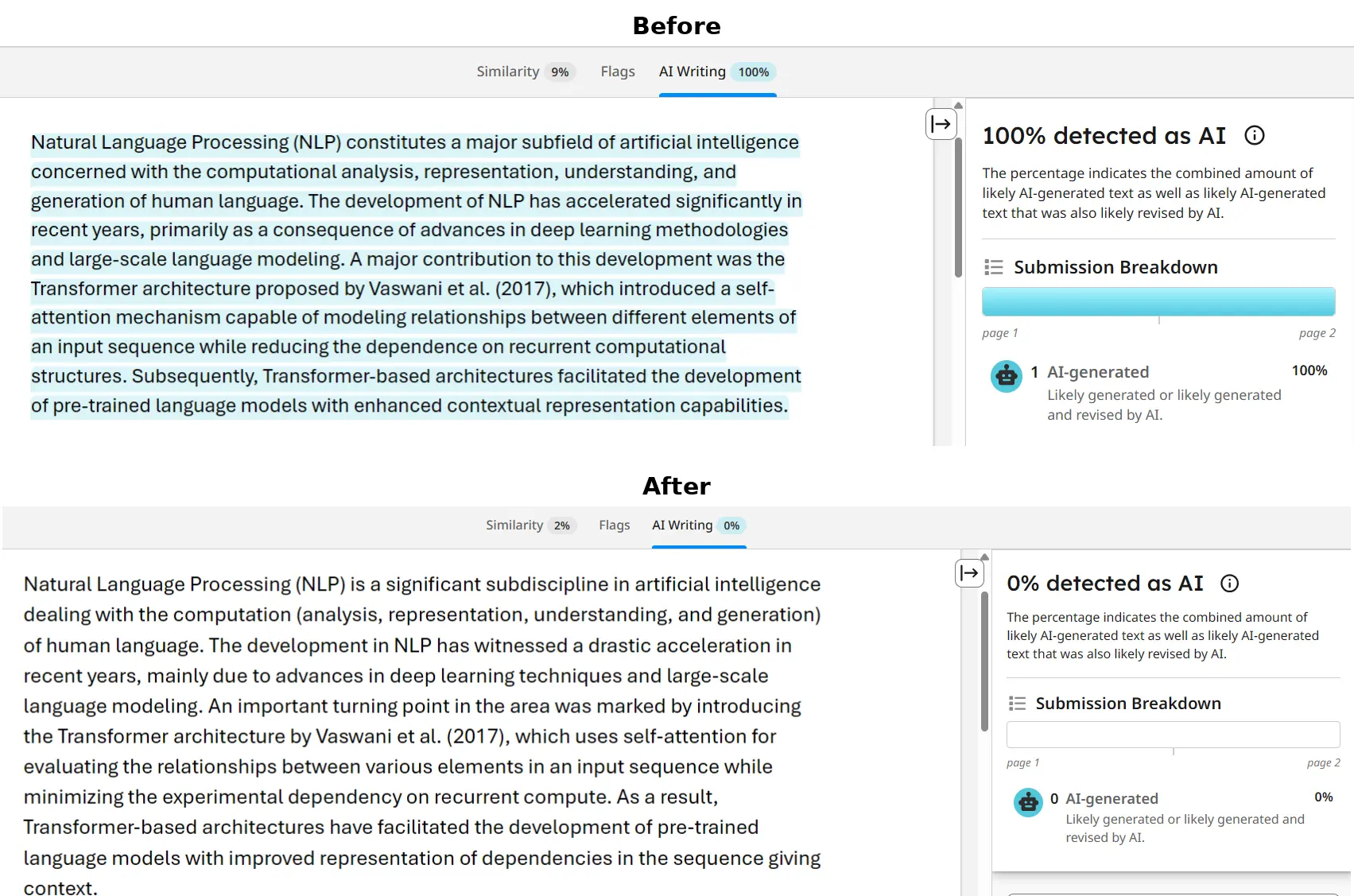
2. Turnitin & iThenticate Verification: 0% AI Detected
Turnitin and iThenticate scan submissions in overlapping 500-token blocks to analyze sentence predictability across paragraphs. When an unrefined AI draft is submitted, uniform cadence triggers an elevated AI Writing score. In the verified report below, a flagged graduate paper was processed through ThesisHuman, achieving a clean 0% AI detection score while preserving all formatted citations and technical parameters.
3. GPTZero Verification: Passing Perplexity & Burstiness Checks
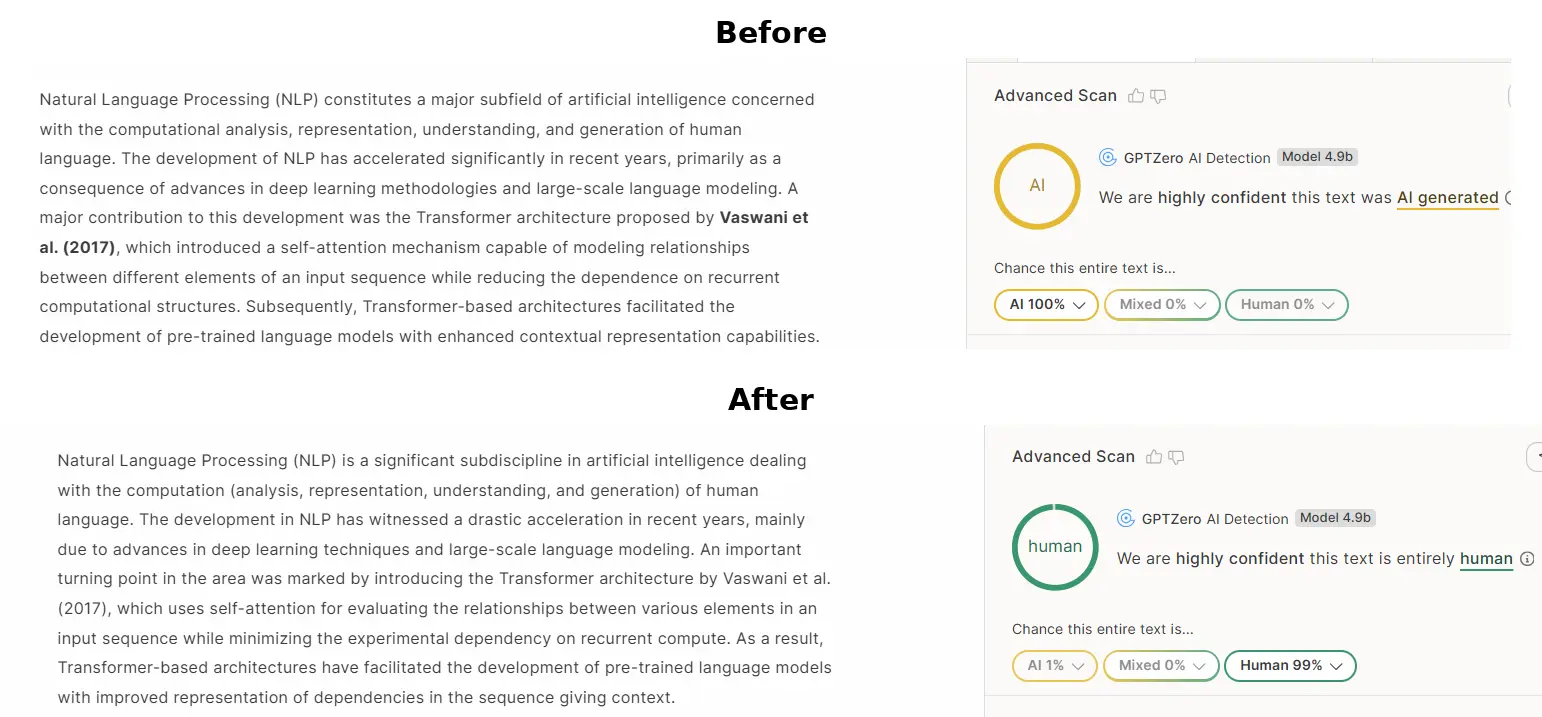
GPTZero evaluates text by plotting sentence perplexity curves and global burstiness scores. When raw AI text is scanned, low sentence variance produces an immediate high-probability warning. ThesisHuman restores natural sentence entropy by restructuring syntax, varying clause lengths, and introducing authentic scholarly cadence, dropping AI probability to 0%.
4. Originality.ai Verification: 0% AI Confidence
Originality.ai flags predictable n-gram sequences and common AI clichés (such as “delving into,” “pivotal role,” “testament to”). ThesisHuman purges overused formulaic transitions while elevating scholarly tone and keeping reference numbers and equations intact, producing 100% Original / 0% AI results.