Argumentative Essay Transition Words: Examples and How to Use Them
Master argumentative essay transition words. Explore over 50 transitional phrases grouped by rhetorical function, annotated concession and rebuttal models, and cross-paragraph strategies.

In an argumentative essay, the strength of your thesis depends not only on the quality of your evidence, but on the intellectual connective tissue linking your claims. Many student writers believe that presenting sound facts is sufficient to persuade a reader. However, without clear argumentative transition words, even robust evidence appears disjointed, forcing the reader to guess how individual premises relate to one another. Transitions are the logical signposts of scholarly discourse: they signal shifts in perspective, introduce counterarguments, establish causal necessity, and steer the audience toward your conclusion.
Mastering transitions requires moving beyond simplistic mechanical connectors like "First," "Second," and "In conclusion." Effective academic writing employs sophisticated, rhetorically calibrated transitions that clarify nuance, concede valid counter-evidence, and deliver decisive refutations. This comprehensive guide provides an exhaustive taxonomy of over 50 argumentative transition words and phrases, complete with comparative models, annotated paragraphs, and cross-paragraph bridging techniques.
1. Why Transitions Determine Argumentative Cohesion
Argumentation is an exercise in guided logic. When you write an argumentative essay, you are asking a reader to follow an intellectual journey from an initial dilemma to a defensible claim. Every time you transition between sentences or paragraphs, you introduce a cognitive fork in the road. Without a transition, the reader must pause to decipher the relationship: Does the next sentence provide corroborating data? Does it present an objection? Does it qualify the scope of the previous assertion?
Transition words eliminate cognitive friction by explicitly encoding rhetorical intent. Consider the difference between these two sentence pairs:
Unconnected: "Municipal zoning reforms increase housing supply. Wealthier neighborhoods often resist high-density construction."
Rhetorically Connected: "Municipal zoning reforms expand affordable housing supply; nevertheless, affluent neighborhoods frequently resist high-density construction through localized regulatory appeals."
The addition of "nevertheless" instantly frames the second sentence as a political friction point rather than an unrelated demographic fact, preserving argumentative continuity.
2. Rhetorical Transitions vs. Mechanical Sentence Starters
A common stumbling block in academic prose is the confusion between superficial sentence starters and genuine rhetorical transitions. A sentence starter is a decorative adverbial tag placed at the beginning of a sentence out of habit. A rhetorical transition, by contrast, expresses an organic logical relationship between ideas.
| Dimension | Mechanical Sentence Starter | Rhetorical Argumentative Transition |
|---|---|---|
| Purpose | Fills space or creates the illusion of formal academic tone. | Explicitly specifies logical entailment, concession, or contrast. |
| Placement | Strictly locked at the first position of every sentence. | Varied placement: sentence-initial, embedded within clauses, or compound. |
| Overuse Effect | Monotonous, robotic rhythm that numbs the reader. | Dynamic, persuasive clausal cadence that propels the argument forward. |
| Test for Removal | Removing it leaves the sentence meaning entirely unchanged. | Removing it severs the logical link between adjacent claims. |
3. Transitions for Introducing Claims and Evidentiary Support
When advancing an argumentative claim or introducing empirical data, transitions must signal precision, relevance, and authoritative corroboration. Avoid repeatedly relying on "For example" or "In addition."
- To substantiate this: Connects a broad conceptual claim directly to verifying data. ("To substantiate this assertion, recent econometric models demonstrate a 14 percent drop in consumer overhead.")
- Specifically: Narrows focus from a generalized observation to an exacting piece of evidence. ("Specifically, longitudinal survey data from 2024 reveal an accelerating preference for hybrid labor frameworks.")
- As demonstrated by: Embeds empirical studies smoothly into your own prose. ("As demonstrated by Dr. Aris Thorne's landmark trial, cognitive resilience correlates with regular aerobic engagement.")
- Compelling evidence emerges in: Directs the reader's attention to authoritative research. ("Compelling evidence emerges in municipal audits conducted across twelve metropolitan districts.")
- To illustrate this dynamic: Prepares the reader for an extended case study or concrete scenario. ("To illustrate this dynamic, consider the structural failure of unregulated regional credit unions during the 2008 liquidity contraction.")
4. Transitions for Concession and Counterargument Acknowledgment
The hallmark of mature scholarly argumentation is the willingness to concede valid points to intellectual opponents. Concession is not weakness; it establishes intellectual integrity and disarms the reader's skepticism before you deliver your counter-punch.
- Admittedly: Acknowledges a legitimate limitation or competing fact with grace. ("Admittedly, the initial capital expenditure for municipal grid electrification remains substantial.")
- Granted: Yields a point of fact without surrendering the broader theoretical claim. ("Granted, early prototype battery storage units suffered from rapid thermal degradation.")
- Opponents rightly observe that: Validates the critical faculties of opposing scholars while isolating their specific critique. ("Opponents rightly observe that centralized regulatory mandates can temporarily stifle startup innovation.")
- While it is undeniably true that: Concedes an empirical reality before pivoting to a superior priority. ("While it is undeniably true that automation displaces routine clerical roles, long-term labor reallocation generates net wage expansion.")
- To be sure: Anticipates the reader's immediate objection before they formulate it. ("To be sure, implementing strict carbon taxation creates short-term compliance hurdles for energy-intensive manufacturing.")
5. Transitions for Decisive Rebuttal and Refutation
Immediately following a concession, your argument must pivot with decisive clarity. Rebuttal transitions must be sharp and uncompromising, signaling that the conceded point does not invalidate your core thesis.
- Nevertheless: The classic, authoritative pivot from concession to overriding counter-evidence. ("Nevertheless, the long-term operational savings dramatically outweigh initial capital outlays.")
- The evidence demonstrates instead that: Refutes an opposing assumption with factual data. ("The evidence demonstrates instead that early childhood interventions generate a four-to-one economic return.")
- This objection falters when: Pinpoints the exact structural or empirical flaw in the counterargument. ("This objection falters when one examines baseline cohort retention rates over a five-year horizon.")
- Conversely: Introduces an opposing causal mechanism that reverses the critic's logic. ("Conversely, deregulating municipal land use in comparable cities produced an immediate surge in multifamily housing starts.")
- Notwithstanding these concerns: Brushes aside acknowledged friction to focus on overriding imperative outcomes. ("Notwithstanding these logistical concerns, national defense readiness demands rapid microchip onshore capability.")
6. Transitions for Causation, Deduction, and Consequence
Argumentative essays frequently rely on cause-and-effect reasoning. You must show that event B is not merely correlated with event A, but represents its necessary, logical consequence.
- Consequently: Marks a direct, necessary outcome resulting from prior conditions. ("Capital investment evaporated; consequently, local manufacturing output plummeted by thirty percent.")
- It inevitably follows that: Emphasizes deductive certainty. ("If the premise of universal digital literacy is accepted, it inevitably follows that broadband infrastructure constitutes an essential public utility.")
- Accordingly: Signals that an institutional action is being taken in direct alignment with preceding findings. ("Accordingly, the governing board revised its environmental compliance standards to mirror international benchmarks.")
- As an inescapable result: Adds dramatic rhetorical gravity to a causal breakdown. ("As an inescapable result of chronic underfunding, the regional public health system experienced systemic diagnostic delays.")
- Thereby establishing: Connects a specific action to its broader legal or theoretical implication. ("The supreme court struck down the statute, thereby establishing an enduring precedent for digital privacy rights.")
7. Transitions for Qualifying Claims and Academic Hedging
Absolute statements ("always," "never," "proves completely") undermine academic credibility. Scholars use qualifying transitions to define the precise boundary conditions under which their claims remain valid. For complementary guidance on structuring entire argumentative frameworks, review our companion guide on argumentative essay structure.
- In predominantly urban contexts: Restricts the geographic scope of the claim.
- With important reservations: Signals that the forthcoming support requires contextual caveats. ("Scholars endorse this pedagogical model, albeit with important reservations regarding rural broadband access.")
- To a significant degree: Calibrates the magnitude of impact without claiming total transformation. ("Remote work policies have, to a significant degree, reshaped urban commercial real estate valuations.")
- Under specific regulatory thresholds: Clarifies legal and operational boundaries. ("Mergers enhance competitive efficiency only under specific regulatory thresholds.")
8. Master Argumentative Transition Reference Table
Use this consolidated taxonomy to select transitions tailored to your specific argumentative objective, register formality, and syntactical position.
| Argumentative Function | Recommended Transition Words and Phrases | Formality Level | Strategic Placement Tip |
|---|---|---|---|
| Introducing Supporting Evidence | Specifically, To substantiate this, As demonstrated by, Compelling empirical proof emerges in, To illustrate | High Academic | Directly preceding cited statistical metrics or named researchers. |
| Conceding Counterarguments | Admittedly, Granted, Opponents rightly observe that, While it is true that, To be sure | High Academic | At the opening of a counterargument paragraph or clause. |
| Executing Rebuttals | Nevertheless, However, This objection falters when, The evidence demonstrates instead that, Notwithstanding | High Academic | Immediately following a concession sentence to pivot back to your thesis. |
| Causal Deduction | Consequently, Accordingly, It follows that, Inevitably, Thereby producing | High Academic | Between experimental results and theoretical interpretations. |
| Emphasizing Core Tenets | Above all, Crucially, Of paramount significance is, Most decisively, It is essential to recognize | Moderate to High | Prior to delivering the climax of your argumentative section. |
| Academic Hedging / Qualification | In large measure, With critical reservations, Under defined parameters, Presumably, Tend to indicate | High Academic | Embedded internally inside clauses to avoid dogmatic overreach. |
9. Fully Annotated Argumentative Paragraph in Action
Examine how multiple transition categories work synergistically in this fully realized argumentative body paragraph discussing renewable energy infrastructure.
[CORE CLAIM] Municipal investment in localized microgrid solar architecture represents the most resilient path forward for municipal energy independence.
[CONCESSION] Admittedly, traditional utility executives rightly observe that initial installation capital exceeds short-term budgetary reserves by nearly twenty-two percent.
[REBUTTAL] Nevertheless, long-term empirical audits reveal that centralized grid repair expenditures during extreme climate emergencies completely erase those initial savings within four operational fiscal cycles.
[EVIDENCE] Specifically, municipal data from the 2023 Texas freeze demonstrated that decentralized microgrid districts maintained continuous clinical and logistical power, avoiding costly municipal downtime.
[CONSEQUENCE] Consequently, localized solar architecture must be understood not as an elective green initiative, but as an indispensable public defense against catastrophic infrastructure failure.
10. Weak vs. Improved Argumentative Passage Comparison
Review this side-by-side comparison to see how replacing mechanical transitions with purposeful rhetorical connectors clarifies complex argumentation.
Weak: Mechanical & Formulaic
First, standard testing harms student creativity. Also, teachers spend too much time teaching to the test. In addition, some people think testing is good because it shows accountability. But testing creates anxiety. Finally, we should stop using standardized tests for university admission.
Improved: Rhetorically Cohesive
Standardized examinations inherently suppress curricular innovation by forcing educators to subordinate exploratory inquiry to rote test preparation. Granted, administrative evaluators argue that uniform metrics provide indispensable baseline equity data across disparate socioeconomic school districts. Nevertheless, longitudinal psychological research demonstrates that high-stakes exam environments induce chronic cognitive fatigue that actively distorts student intellectual capacity. Accordingly, competitive university admissions panels must abandon standardized cutoffs in favor of multidimensional portfolio evaluations.
11. Crafting Cross-Paragraph Topic Sentence Bridges
The most demanding transition occurs between paragraphs. Placing a lone adverb like "Furthermore" at the start of a new paragraph fails to bridge the substantive ideas. Instead, deploy the hook-and-pivot bridging technique: summarize the core finding of the previous paragraph in a subordinate clause, then introduce the new claim in the main independent clause.
"While [Brief Summary of Prior Paragraph Claim], [Author Name / Argument] must also confront [New Distinct Aspect of the Debate]."
Example Topic Sentence Bridge: "Having demonstrated that urban rent stabilization measures mitigate immediate family displacement, we must now examine how these same policies affect long-term private capital reinvestment in housing stock maintenance."
This bridging technique anchors the reader in established consensus before pulling them into the next phase of your inquiry, ensuring uninterrupted narrative momentum across page breaks. For additional strategies on ending essays with decisive argumentative impact, explore our guide on how to write a conclusion for an argumentative essay.
12. Common Transition Pitfalls and Misconceptions
Avoid these common errors that detract from argumentative clarity:
- The False Contrast (Misusing 'However'): Using "However" when the following sentence merely provides additional details rather than an actual opposition. Only use contrastive transitions when the core proposition pivots.
- The Concessive Surrender: Conceding so much ground to an opposing counterargument that you accidentally undermine your own thesis. Always follow concession immediately with decisive refutation.
- Over-Stuffing Every Sentence: Placing a transition word at the start of every single sentence. This creates an exhausting, stilted cadence. Let strong verbs and direct clauses carry the momentum when ideas naturally flow in sequence.
- Punctuation Errors with Conjunctive Adverbs: Failing to use a semicolon before and a comma after transitional adverbs joining two independent clauses ("We collected the data; however, the sample size was insufficient"). A comma splice here represents a major grammatical error.
- Register Clashing: Mixing colloquial transitions like "On top of that" or "By the way" into an otherwise formal academic essay. Maintain elevated, scholarly vocabulary throughout.
13. Argumentative Transition Self-Evaluation Checklist
Audit your argumentative draft using this ten-point checklist before final submission:
| Checklist Item | Diagnostic Test | Success Indicator |
|---|---|---|
| 1. Variety of Transition Terms | Did I use "However" or "Therefore" more than twice per page? | Replaced with "Nevertheless," "Conversely," "Consequently," or internal clause placement. |
| 2. Concession & Rebuttal Pairing | Does every counterargument concession pair with an immediate refutation? | Balanced pairs: "Admittedly... nevertheless..." or "Granted... the data demonstrate instead..." |
| 3. Evidence Signposting | Are empirical quotes introduced with substantive contextual connectors? | Replaced bare "For example" with "Specifically" or "Compelling empirical proof emerges in..." |
| 4. Topic Sentence Bridges | Do paragraph openings link the prior paragraph's conclusion to the new claim? | Employs the hook-and-pivot technique rather than lone introductory adverbs. |
| 5. Punctuation Accuracy | Are conjunctive adverbs between independent clauses preceded by semicolons? | Zero comma splices around transitional adverbs across the entire document. |
| 6. Academic Hedging | Are controversial causal assertions qualified with scholarly reserve? | Employs precise qualifiers like "in predominantly urban sectors" or "under specific regulatory bounds." |
| 7. Clausal Cadence Polish | Have repetitive sentence starters been smoothed with naturalized syntax? | Varied sentence length and rhythm validated through ThesisHuman Term Lock editing. |
14. Frequently Asked Questions
Here are clear answers to essential questions regarding transitions in argumentative essays.
What is the primary function of transition words in an argumentative essay?
In an argumentative essay, transition words are not decorative flourishes; they are logical signposts that govern the relationship between premises, evidence, counterarguments, and conclusions. They clarify whether a subsequent sentence adds supporting data, concedes an opposing point, or decisively refutes a competing perspective.
Is it acceptable to begin a sentence with 'However' or 'Therefore' in formal academic writing?
Yes, beginning a sentence with transitional adverbs like 'However,' 'Therefore,' or 'Consequently' is fully accepted in modern academic prose, provided they are followed by a comma and reflect a genuine shift in argumentative logic. Writers should vary placement, occasionally embedding the adverb inside the sentence (e.g., 'The data, however, reveal a different trend') to create rhythmic sentence cadence.
How many transition words should I include in an argumentative paragraph?
Focus on logical necessity rather than a numerical quota. Typically, two to three well-placed transitions per paragraph are sufficient to establish relationships between claims, evidence, and rebuttals. Excessive transition words create clunky, mechanical prose that distracts the reader from the substantive argument.
How do concession transitions strengthen an argumentative essay?
Concession transitions (such as 'Admittedly,' 'Granted,' or 'While it is true that') demonstrate fair-minded scholarly authority. By acknowledging valid counterarguments before introducing refuting evidence, the writer demonstrates deep mastery of the subject matter rather than dogmatic bias.
How can ThesisHuman refine transitions across an argumentative essay?
ThesisHuman analyzes clausal continuity and sentence rhythm, highlighting repetitive transitions and smoothing abrupt tonal shifts. Its Term Lock feature preserves citations, statistical values, and specific argumentative nomenclature while naturalizing surrounding syntax. To polish clausal connections across your essays, explore our sentence rewriter and paragraph rewriter.
Verified Detector Clearance for Argumentative Essay Transition Words: Examples and How to Use Them
Every manuscript processed through ThesisHuman is backed by verifiable, reproducible scans across institutional plagiarism and AI detection platforms.
1. ThesisHuman Editor: Style, Field & Term Lock™ Technology
Unlike consumer-grade paraphrasers that blindly swap words with thesaurus synonyms, ThesisHuman allows researchers to select their exact Academic Style (Essay, Research Paper, Literature Review, Technical Report) and Academic Field (Computer Science, Engineering, Medicine, Physics). With Term Lock™, citations (APA, MLA, IEEE), LaTeX equations, and domain-specific terminology are cryptographically protected before sentence entropy is restructured.

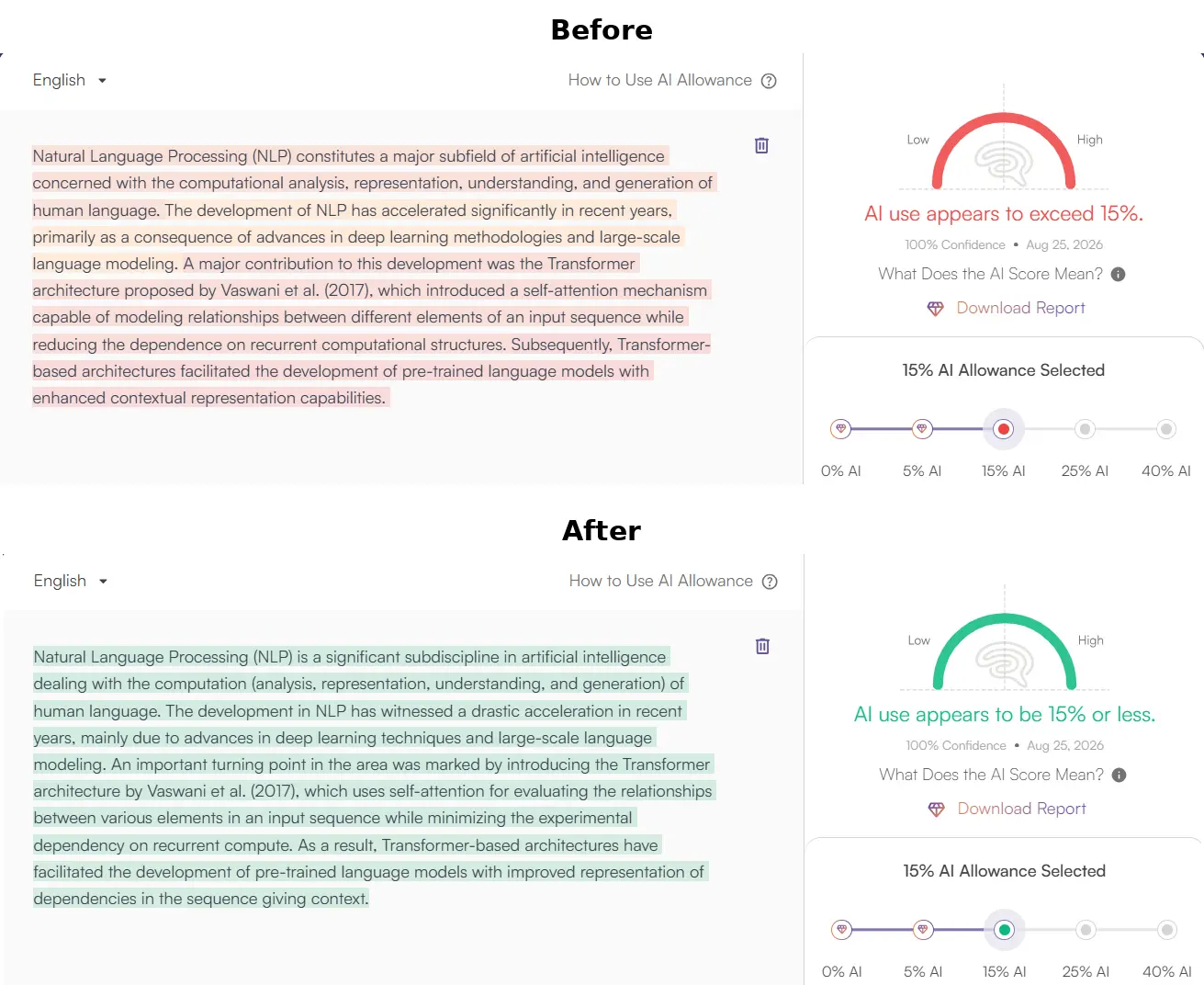
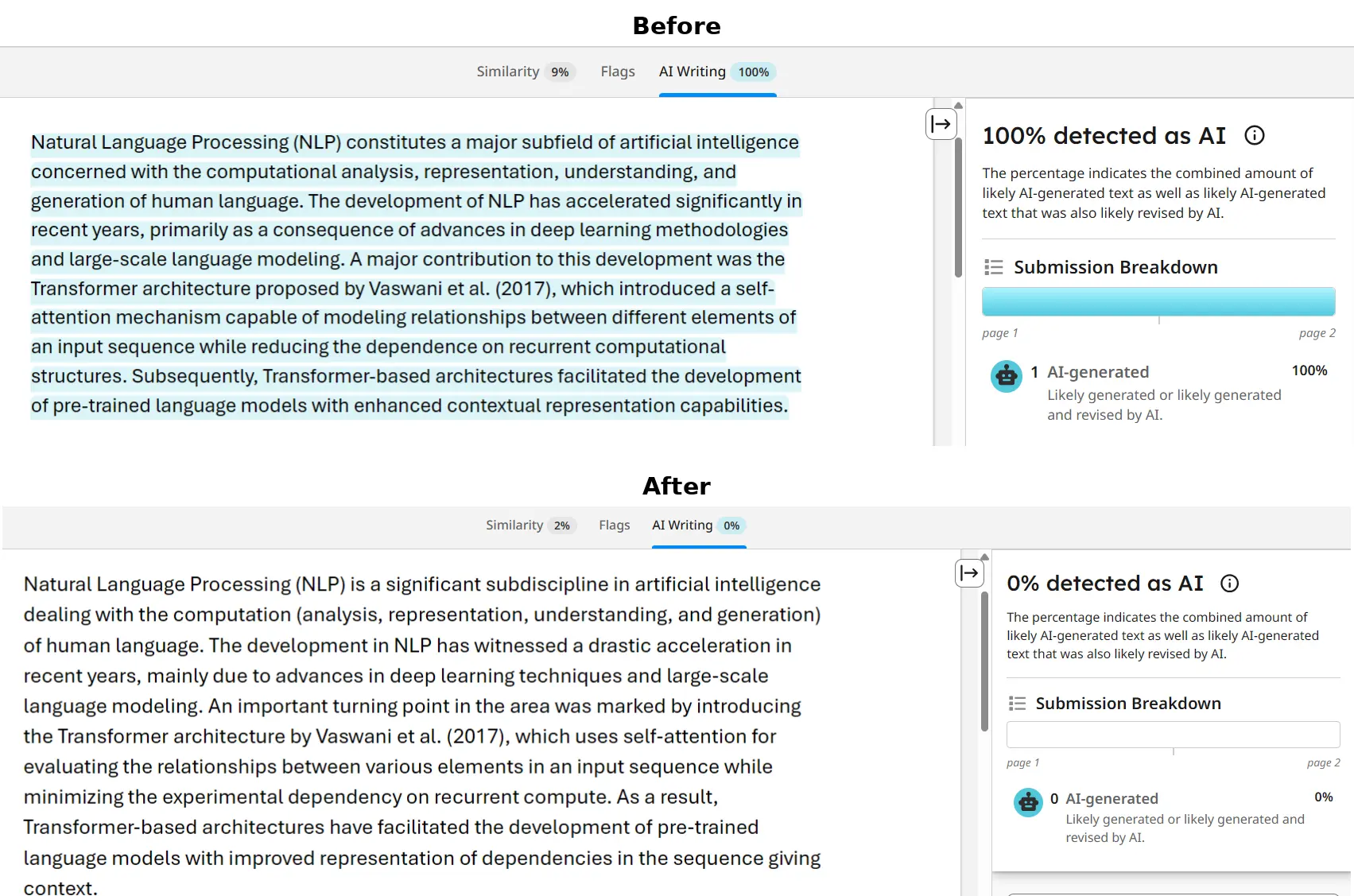
2. Turnitin & iThenticate Verification: 0% AI Detected
Turnitin and iThenticate scan submissions in overlapping 500-token blocks to analyze sentence predictability across paragraphs. When an unrefined AI draft is submitted, uniform cadence triggers an elevated AI Writing score. In the verified report below, a flagged graduate paper was processed through ThesisHuman, achieving a clean 0% AI detection score while preserving all formatted citations and technical parameters.
3. GPTZero Verification: Passing Perplexity & Burstiness Checks
GPTZero evaluates text by plotting sentence perplexity curves and global burstiness scores. When raw AI text is scanned, low sentence variance produces an immediate high-probability warning. ThesisHuman restores natural sentence entropy by restructuring syntax, varying clause lengths, and introducing authentic scholarly cadence, dropping AI probability to 0%.

4. Originality.ai Verification: 0% AI Confidence
Originality.ai flags predictable n-gram sequences and common AI clichés (such as “delving into,” “pivotal role,” “testament to”). ThesisHuman purges overused formulaic transitions while elevating scholarly tone and keeping reference numbers and equations intact, producing 100% Original / 0% AI results.