College Essay Length: Word Counts for Admissions and Academic Essays
Discover exact word counts and length guidelines for college essays. Learn verified limits for the Common App, UC Personal Insight Questions, supplemental essays, and academic coursework.

When students ask, "How long should a college essay be?", the answer depends entirely on which type of college essay they are writing. In the United States higher education landscape, the phrase "college essay" refers to two fundamentally different genres of writing: undergraduate admissions personal statements and university academic coursework papers.
Confusing these two categories can lead to severe consequences. Submitting an admissions personal statement at the length of a college research paper will cause online portals to truncate your text. Conversely, submitting an undergraduate coursework essay at the brevity of an admissions reflection will result in substantial grade penalties for underdevelopment. This definitive guide breaks down verified word counts, structural budgets, and concision techniques across every major college essay format.
1. Direct Answer: Quick-Reference Word Count Guidelines
Here is the quick-reference baseline for college essay lengths across major admissions platforms and academic coursework assignments:
- Common App Personal Essay: 250 to 650 words (verified hard ceiling; sweet spot is 500-620 words).
- UC Personal Insight Questions (PIQs): 350 words maximum per response (applicants submit 4 responses).
- Supplemental Admissions Essays: Typically 100 to 500 words depending on institutional prompts.
- College Coursework Reflection Papers: 500 to 1,000 words (approximately 2 to 4 double-spaced pages).
- Undergraduate Seminar and Analytical Essays: 1,500 to 2,500 words (approximately 6 to 10 double-spaced pages).
- Upper-Level Research and Term Papers: 3,000 to 5,000+ words (approximately 12 to 20 double-spaced pages).
2. College Admissions Essays vs. Academic Coursework Essays
Before drafting or editing your text, identify the exact functional category of your document. The stylistic expectations, pacing, and word constraints diverge sharply between admissions and coursework writing.
| Dimension | Admissions Personal Essays | Academic Coursework Essays |
|---|---|---|
| Primary Objective | Demonstrate character, personal values, self-reflection, and institutional fit. | Substantiate an evidence-backed thesis analyzing texts, data, or concepts. |
| Word Count Range | 250 to 650 words (strict platform cutoffs). | 1,000 to 5,000+ words (instructor-assigned guidelines). |
| Authorial Voice | Reflective, first-person narrative, personal and authentic. | Scholarly, objective, third-person or disciplined first-person plural. |
| Evidence Base | Lived personal experiences, challenges, intellectual curiosities. | Peer-reviewed scholarship, primary sources, empirical data. |
| Pacing Requirement | High economy; zero wasted phrases; fast contextual setup. | Systematic development; full counterarguments; comprehensive literature framing. |
3. Common Application Personal Essay Length (250-650 Words)
The Common Application serves over 1,000 higher education institutions across the United States and globally. For first-year undergraduate applicants, the primary personal essay prompt imposes a strictly enforced range of 250 to 650 words.
Key verified facts regarding Common App length parameters:
- The 650-word ceiling is absolute: The application text entry box will literally prevent you from typing or pasting word number 651. There is no grace margin or rounding up.
- The 250-word floor is a bare minimum: Submitting a 260-word essay signals an unwillingness to engage deeply with personal reflection. Admissions committees rarely view essays under 450 words as competitive for selective institutions.
- The optimal competitive target: Most experienced college counselors and admissions officers recommend targeting 550 to 620 words. This range allows sufficient space to establish a vivid narrative scene, analyze personal growth, and articulate future intellectual goals without exhausting your word budget.
Remember that admissions readers review thousands of files during reading season. Reaching 650 words simply because space remains is counterproductive if your final paragraphs repeat earlier sentiments. Aim for narrative economy and authentic insight.
4. University of California Personal Insight Questions (350-Word Limit)
The University of California System (including UC Berkeley, UCLA, UC San Diego, UC Davis, and sister campuses) does not use the Common App essay. Instead, applicants must answer 4 out of 8 Personal Insight Questions (PIQs).
Each individual response is capped at a strict maximum of 350 words. The UC system explicitly states that PIQs are not traditional essays; they are short-form informational responses. UC admissions officers do not want dramatic hooks, metaphorical dialogue, or poetic opening scenes. With only 350 words, you must address the prompt directly within the first two sentences, provide concrete examples of leadership or creative problem-solving, and quantify your contributions where possible.
Targeting 300 to 345 words per PIQ represents ideal practice. Writing fewer than 250 words leaves valuable evaluation criteria unaddressed.
5. Supplemental Admissions Essays: Institutional Variations
In addition to the primary Common App essay, many competitive colleges require one or more supplemental essays. These requirements vary widely by institution and admissions cycle:
- The "Why Us?" Supplemental Essay: Commonly set at 150 to 250 words (though some schools allow up to 400 words). Requires hyper-specific references to campus faculty, research laboratories, and curricular offerings.
- The Community or Diversity Prompt: Typically 250 to 300 words. Focuses on how your background shapes your perspective within a collegiate community.
- Short-Answer Extracurricular Elaboration: Often 100 to 150 words. Requires direct, concise explanation of a meaningful extracurricular role.
- Extensive Supplementary Essays: A minority of institutions (such as the University of Chicago or Princeton) require longer supplements of 500 to 650 words requiring substantial intellectual development.
Always verify the active admissions cycle requirements inside your specific application portal, as institutions routinely adjust word counts from year to year.
6. Scholarship Essay Length Benchmarks
Scholarship applications represent another distinct category of student writing. Selection committees typically establish strict word bounds to streamline applicant scoring:
- Short Scholarship Prompts: 250 words. Focuses strictly on financial need, academic milestone, or community commitment.
- Standard Foundation Grants: 500 words. Functions similarly to a focused personal statement with career trajectory articulation.
- Major Prestigious Fellowships: 750 to 1,000 words. Demands rigorous alignment between personal background, proposed scholarly research, and societal impact.
7. Undergraduate Coursework Essays: Reflection, Analysis, and Term Papers
Once enrolled in university, student writing transitions to course-based academic essays. Here, word counts reflect the analytical complexity required to satisfy rubric requirements:
Response and Reflection Essays (500 to 1,000 Words)
Often assigned as weekly seminar responses or reading reflections. Typically 2 to 4 double-spaced pages. The goal is synthesizing assigned readings and raising thoughtful questions rather than conducting exhaustive secondary research.
Argumentative and Critical Analysis Papers (1,500 to 2,500 Words)
The standard midterm or final paper for undergraduate humanities and social science courses. Approximately 6 to 10 pages. Requires an original thesis, systematic textual or empirical evidence, and engagement with counterarguments.
Upper-Level Research Papers (3,000 to 5,000 Words)
Capstone essays and senior seminar research papers. Approximately 12 to 20 pages. Involves substantial primary and secondary source research, a comprehensive literature review, and formal methodology.
8. Advanced Research Papers and Capstone Length Requirements
At the graduate and doctoral levels, length requirements expand to accommodate formal empirical investigations, archival surveys, and disciplinary methodologies. An honors undergraduate thesis often spans 8,000 to 12,000 words (30 to 50 pages), while master's theses range between 15,000 and 30,000 words. Doctoral dissertations routinely exceed 60,000 to 90,000 words across multiple chapters. In these extensive documents, maintaining structural flow across sections becomes essential.
9. Word Counts vs. Page Counts: The Formatting Variables
Professors frequently assign papers by page count (e.g., "Write a 5 to 7 page paper"), while modern submission portals measure word count. Converting pages to words requires understanding standard typographic conventions:
Standard Academic Formatting Baseline:
12-point font (Times New Roman or Calibri) + 1-inch margins on all sides + double line spacing = approximately 250 words per page.
However, relying strictly on page count is prone to distortion. The following formatting variables alter visual page length without changing word count:
- Font Typeface Metrics: 12-point Arial is visually larger than 12-point Times New Roman, occupying roughly 10 percent more physical page space for the exact same text.
- Block Quotations: Quotes exceeding 40 words (APA) or 4 lines (MLA) must be indented and single-spaced or set apart, changing page density.
- Headings and Subheadings: Section headers add vertical spacing that reduces total words per page.
- Tables and Figures: Embedded data charts consume visual space while adding minimal text words.
- Reference Lists: Works Cited or References pages are counted separately from your core body text in almost all academic rubrics.
Recommendation: Always rely on word count as your primary benchmark. A 5-page paper assignment effectively means 1,250 words; a 10-page paper equates to approximately 2,500 words.
10. Strategic Word Budgeting: Allocating Words Across Sections
Writing to an exact word limit becomes manageable when you allocate a percentage budget to each section of your essay before drafting. Consider this illustrative 2,000-word academic coursework essay budget:
| Essay Section | Target Percentage | Word Allocation (2,000-Word Essay) | Core Content Focus |
|---|---|---|---|
| Introduction | 10% | 200 words | Hook, background context, terminology definitions, and defensible thesis statement. |
| Literature / Background | 15% | 300 words | Summary of relevant scholarly conversation, theoretical framework, or historical context. |
| Core Evidence & Analysis | 55% | 1,100 words | Primary body paragraphs substantiating claims with textual quotes, data, and critical analysis. |
| Counterargument & Rebuttal | 10% | 200 words | Fair consideration of opposing views and substantiated rebuttal. |
| Conclusion | 10% | 200 words | Synthesizing findings, answering the "so what?" question, and indicating broader implications. |
11. Introduction and Conclusion Length Guidelines
Introductory and concluding paragraphs should generally comprise 10 to 15 percent each of your total word count.
In a 650-word admissions essay, an introduction should not exceed 80 to 100 words. Spending 200 words setting up a dramatic sunrise or quote leaves too little room to explain your personal growth. In contrast, in a 3,000-word research essay, a 300 to 400-word introduction spanning two paragraphs is entirely appropriate to frame complex historiographical debates before delivering the thesis. For worked models illustrating opening structures across essay types, review our curated collection of introduction paragraph examples.
Similarly, conclusions must match the document's scale. An admissions essay conclusion should briskly reaffirm future trajectory in 60 to 80 words. An academic coursework conclusion should synthesize analytical findings across 150 to 250 words without mechanically repeating earlier sentences.
12. How to Cut an Overlength Essay Without Losing Content
When your draft exceeds the assigned word ceiling, avoid the mistake of randomly deleting entire paragraphs. Apply these six targeted sentence-level concision strategies:
- Eliminate Nominalizations: Replace weak verb phrases with strong action verbs (e.g., change "conducted an evaluation of" to "evaluated"; change "came to the realization that" to "realized").
- Remove Filler Preamble: Cut introductory throat-clearing such as "It is important to remember that", "In my opinion", or "It can be seen that".
- Prune Redundant Paired Adjectives: Delete duplicate descriptions (e.g., "each and every", "first and foremost", "true and accurate").
- Convert Passive Constructions: Rewrite passive voice into active voice to shed helping verbs and prepositions (e.g., change "The survey was administered by the researchers to 100 students" [11 words] to "Researchers surveyed 100 students" [4 words]).
- Compress Prepositional Chains: Reduce strings of prepositional phrases (e.g., "the causes of the disruption of the supply chain" [9 words] becomes "supply chain disruption causes" [4 words]).
- Tighten Repetitive Quotations: Paraphrase lengthy quotes into succinct analytical summaries, preserving quotation marks only for crucial phrasing.
For comprehensive rules on diagnosing syntactic weakness, eliminating deadweight, and structuring balanced clauses, explore our guide on what is a good sentence.
13. How to Expand an Underlength Essay Without Adding Fluff
When an essay falls short of the required word count, never resort to visual tricks (such as increasing punctuation font size or widening margins) or generic verbal padding. Instructors spot filler immediately.
Instead, expand substantive intellectual content:
- Add Primary Evidence: Introduce an additional piece of textual data, historical case study, or empirical finding to support your least developed claim.
- Deepen Analytical Explanation: After quoting evidence, explain the precise causal mechanism or interpretive step connecting that quotation to your thesis.
- Address a Serious Counterargument: Dedicate an entire paragraph to exploring a credible counter-claim and explaining why your position remains defensible.
- Clarify Contextual Caveats: Explore boundary conditions or methodological limitations of your findings.
- Illustrate Abstract Claims with Examples: Replace general assertions with specific historical, literary, or clinical case illustrations.
14. Seven Critical College Essay Length Mistakes
Avoid these seven common missteps observed in admissions and college coursework submissions:
- Ignoring Hard Application Cutoffs: Believing that admissions software will accommodate a 660-word essay. Online portals automatically discard words exceeding the ceiling.
- Assuming Maximum Equals Mandatory: Writing exactly 650 words on the Common App even when the story naturally resolves at 580 words, leading to repetitive filler.
- Submitting Underlength Coursework: Handing in a 1,200-word essay for a 2,000-word prompt. Falling short by more than 10 percent almost always incurs rubric penalties.
- Padding with Artificial Vocabulary: Swapping simple words for polysyllabic synonyms in an effort to inflate sentence length.
- Sacrificing Content for Brevity: Cutting essential analytical steps or evidence to hit an arbitrary word count rather than tightening sentence syntax.
- Relying on Generative AI Expansion: Prompting an AI to "make this paragraph longer", which invariably injects repetitive, generic prose and hollow transition words.
- Confusing Assignment Guidelines: Failing to verify whether reference lists, title pages, and appendices are included in the assigned word limit.
15. Concision in Action: Tightening an Admissions Draft
Examine how an overlength Common App narrative paragraph can be substantially tightened while preserving personal voice and concrete narrative impact:
Original Draft (84 Words):
Verbose: "It was during the summer of my junior year when I came to the realization that working in our local community food pantry was an experience that fundamentally reshaped my entire worldview. Every single Saturday morning, I was responsible for the coordination of volunteer groups, which was a task that taught me a great deal about the importance of organizational leadership and communication in difficult, fast-paced situations."
Revised Draft (46 Words):
Tightened: "During junior year, coordinating Saturday volunteer shifts at our community food pantry reshaped my understanding of service. Managing supply logistics and volunteer teams during morning rush hours taught me how decisive communication stabilizes fast-paced community operations."
Reduction: 84 words down to 46 words (a 45 percent reduction). The revision eliminated weak filler phrases ("came to the realization that", "was an experience that", "Every single Saturday") while upgrading the active verbs ("coordinating", "managing", "stabilizes") and concrete details.
16. Depth in Action: Expanding a Coursework Argument
Now examine how an underdeveloped undergraduate coursework paragraph can be expanded through analytical substance rather than rhetorical padding:
Original Draft (38 Words):
Underdeveloped: "Online learning platforms can be difficult for some students. When universities moved classes to digital formats, many students struggled to participate because they lacked stable internet connections and quiet study spaces at home."
Revised Draft (89 Words):
Substantive Expansion: "Online learning platforms often exacerbate existing socioeconomic divides in post-secondary education. When institutions shifted to remote instruction, participation disparities mirrored digital infrastructure gaps. Students in rural and low-income urban districts disproportionately lacked broadband access, dedicated hardware, and quiet environments necessary for sustained synchronous engagement. Consequently, grade retention dropped significantly in seminar-based courses where continuous verbal participation was required, demonstrating that pedagogical accessibility depends directly on underlying infrastructural equity."
Expansion: 38 words expanded to 89 words. The expansion added analytical depth, named specific socio-technical mechanisms (broadband access, hardware, synchronous engagement), and connected the observation to structural educational equity.
17. The College Essay Length Revision Checklist
Before submitting your essay to an admissions portal or coursework drop box, verify these six length and formatting checks:
| Verification Step | Acceptance Criteria | Status |
|---|---|---|
| Admissions Essay Word Ceiling | Common App text is under 650 words; UC PIQ text is under 350 words. | Verified |
| Coursework Assignment Window | Word count falls within plus-or-minus 10 percent of instructor target. | Verified |
| Bibliography and Heading Exclusions | Works Cited / References list is excluded from the body word count. | Verified |
| Section Proportions | Introduction and conclusion comprise approximately 10 to 15 percent each. | Verified |
| Sentence Concision Pass | Nominalizations, passive sprawl, and empty qualifiers eliminated. | Verified |
| Authentic Voice Integrity | No synthetic AI padding or fabricated accomplishments introduced. | Verified |
18. Frequently Asked Questions
Is it bad to write exactly 650 words on the Common App?
No. Writing exactly 650 words is not inherently penalized. However, admissions officers notice when sentences at the end feel padded or unnaturally compressed just to hit the number. Prioritize narrative pacing over hitting the exact limit.
Does the title count toward the word count on an essay?
In admissions essays (Common App and UC PIQs), do not include a title; paste only your narrative body text. In college coursework, the essay title on the title page does not count toward the assigned body word count.
What if my coursework essay is slightly under the assigned word count?
Most university professors permit a standard 10 percent variance. For example, on a 2,000-word assignment, a submission between 1,800 and 2,200 words is typically acceptable unless the syllabus strictly designates the word count as a hard minimum.
Do in-text citations count toward college essay word limits?
Yes. In-text parenthetical citations such as (Smith, 2024, p. 45) count toward your document word processor's total count. The final References or Works Cited page at the end of the document is excluded.
How can I polish college application and coursework essays effectively?
For admissions narratives and coursework revision, review our dedicated college essay editor and check our structural guide on how many paragraphs is an essay.
Verified Detector Clearance for College Essay Length: Word Counts for Admissions and Academic Essays
Every manuscript processed through ThesisHuman is backed by verifiable, reproducible scans across institutional plagiarism and AI detection platforms.
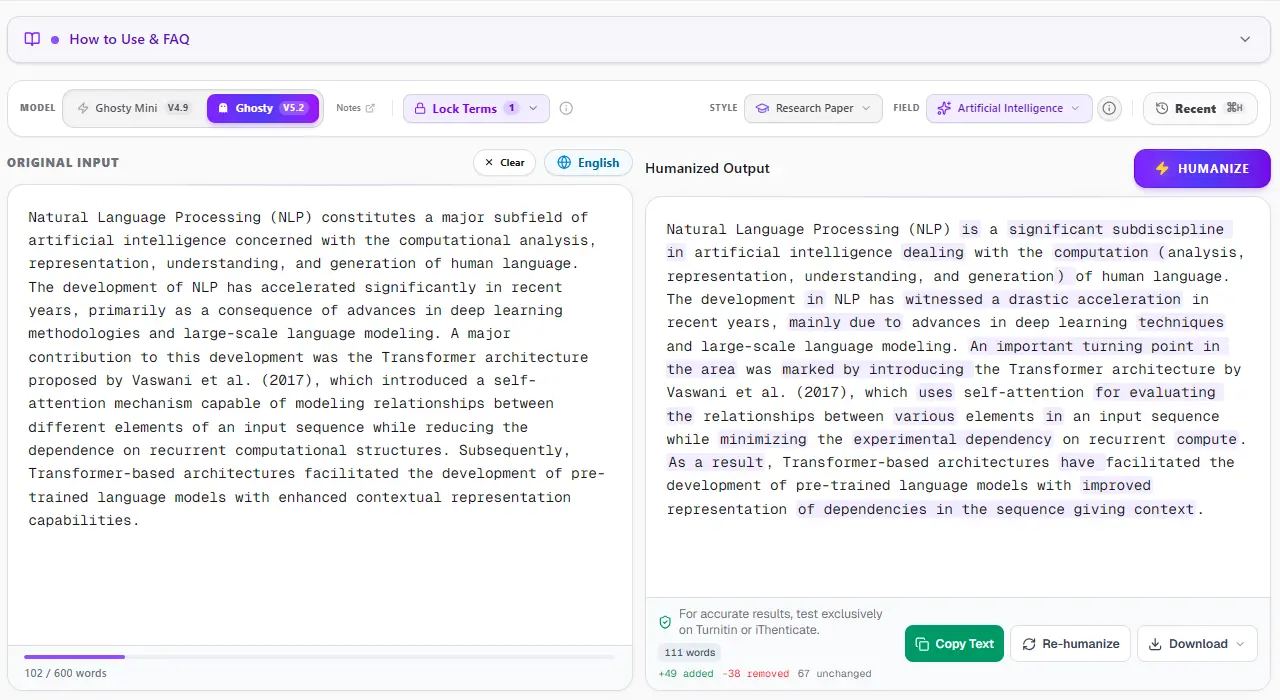
1. ThesisHuman Editor: Style, Field & Term Lock™ Technology
Unlike consumer-grade paraphrasers that blindly swap words with thesaurus synonyms, ThesisHuman allows researchers to select their exact Academic Style (Essay, Research Paper, Literature Review, Technical Report) and Academic Field (Computer Science, Engineering, Medicine, Physics). With Term Lock™, citations (APA, MLA, IEEE), LaTeX equations, and domain-specific terminology are cryptographically protected before sentence entropy is restructured.
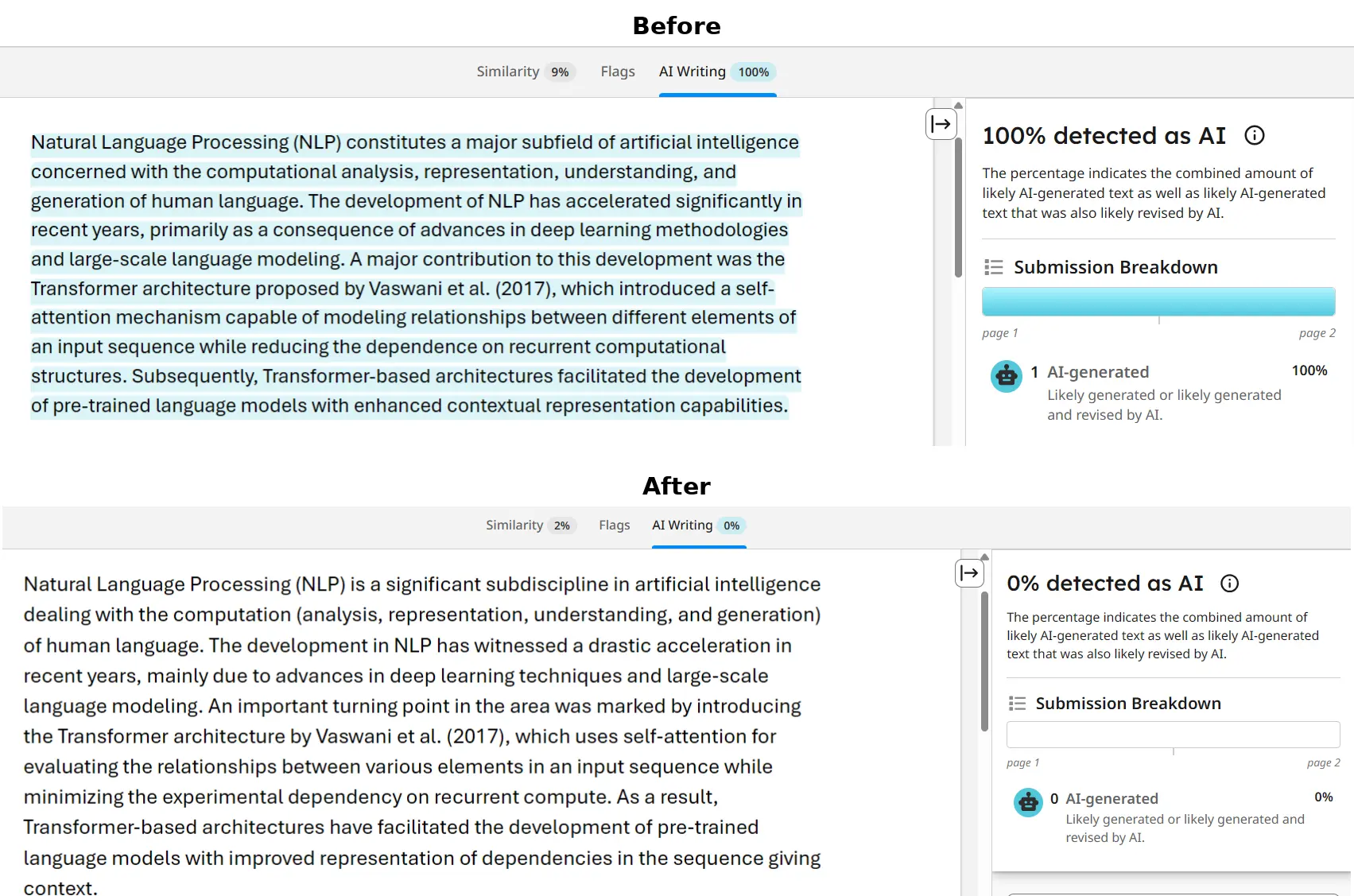
2. Turnitin & iThenticate Verification: 0% AI Detected
Turnitin and iThenticate scan submissions in overlapping 500-token blocks to analyze sentence predictability across paragraphs. When an unrefined AI draft is submitted, uniform cadence triggers an elevated AI Writing score. In the verified report below, a flagged graduate paper was processed through ThesisHuman, achieving a clean 0% AI detection score while preserving all formatted citations and technical parameters.
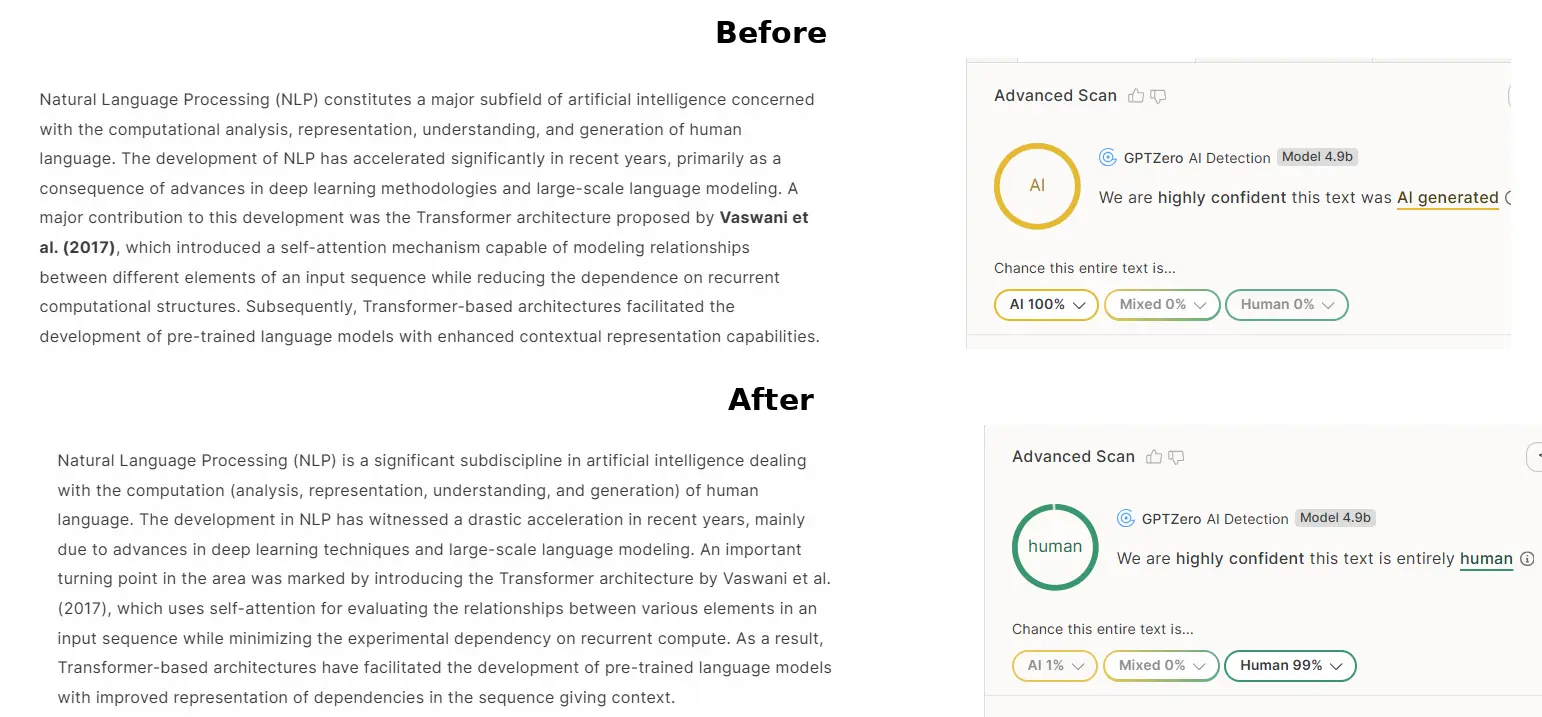
3. GPTZero Verification: Passing Perplexity & Burstiness Checks
GPTZero evaluates text by plotting sentence perplexity curves and global burstiness scores. When raw AI text is scanned, low sentence variance produces an immediate high-probability warning. ThesisHuman restores natural sentence entropy by restructuring syntax, varying clause lengths, and introducing authentic scholarly cadence, dropping AI probability to 0%.
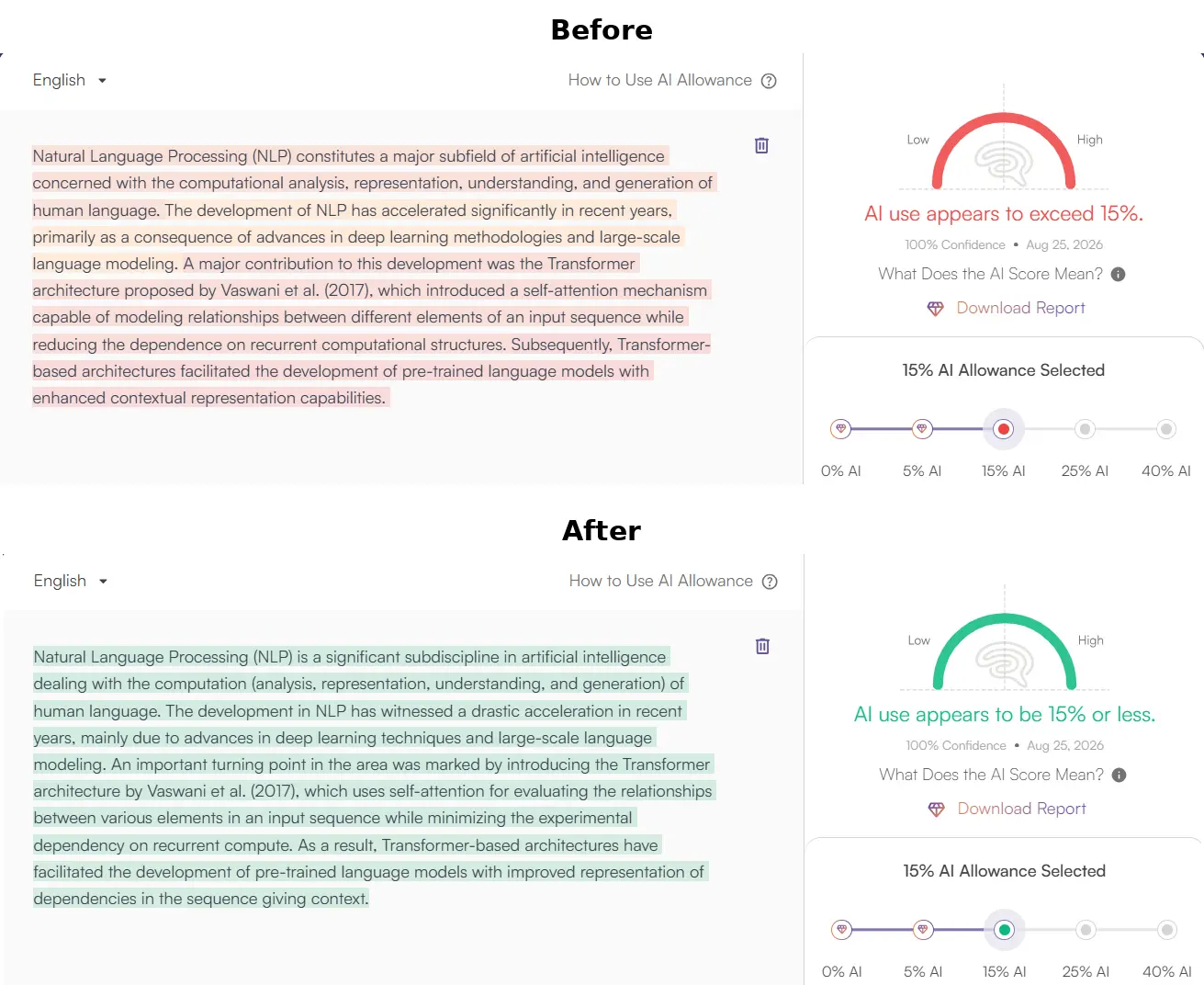
4. Originality.ai Verification: 0% AI Confidence
Originality.ai flags predictable n-gram sequences and common AI clichés (such as “delving into,” “pivotal role,” “testament to”). ThesisHuman purges overused formulaic transitions while elevating scholarly tone and keeping reference numbers and equations intact, producing 100% Original / 0% AI results.