Introduction Paragraph Examples: 10 Models with Step-by-Step Analysis
Explore 10 complete introduction paragraph examples across academic genres. Learn the hook-context-thesis architecture, discipline conventions, and revision rules.
HamzaPhD Researcher
16 min read
An introduction paragraph is the opening section of an essay, research article, or dissertation chapter that establishes the intellectual foundation of your writing. Rather than serving as decorative throat-clearing, an effective introduction prepares the reader to evaluate your claims with comprehension and curiosity.
## 1. Direct Answer: What Makes an Effective Introduction Paragraph
An effective introduction paragraph answers three fundamental reader questions within the first few sentences: What specific subject is being examined? Why does this subject matter right now? What central argument, interpretive claim, or research question will guide this investigation?
To achieve this clarity, a strong introduction moves deliberately from broad contextual relevance to a focused, defensible thesis statement. It avoids broad generalities about human history, rejects empty filler phrases, and provides necessary background details so that the reader understands the parameters of your inquiry before encountering your evidence.
```
[Broad Orienting Frame: 1-2 Sentences]
Establishes the specific scholarly or practical conversation.
|
v
[Contextual Background & Stakes: 2-3 Sentences]
Narrows scope, outlines relevant tensions, defines parameters.
|
v
[Focused Thesis Statement: 1-2 Sentences]
Asserts a clear, defensible position or research objective.
```
## 2. The Three Core Functions of an Academic Introduction
Every successful introduction fulfills three distinct rhetorical functions, regardless of discipline:
1. **Orienting the Reader**: The opening sentences signal the general topic, historical moment, or theoretical field. This orientation establishes mutual understanding between writer and reader.
2. **Contextualizing the Problem**: Readers cannot appreciate an argument without knowing the surrounding scholarly or civic circumstances. This middle layer outlines why the topic remains contested, unresolved, or significant.
3. **Establishing the Central Purpose**: The concluding sentence or sentences articulate your thesis statement, hypothesis, or guiding question. This component serves as the intellectual contract for the entire piece.
## 3. Characteristics of an Effective Introduction Paragraph
Academic writing centers, including the Purdue University Online Writing Lab (OWL), emphasize that an introductory paragraph must balance inviting engagement with analytical rigor. The following characteristics distinguish mature introductions:
- **Relevance**: Every detail included directly supports the topic and previews themes developed in the body paragraphs.
- **Syntactic Precision**: Sentences use specific terminology and concrete nouns rather than vague placeholders such as "society" or "aspects."
- **Controlled Scope**: The discussion focuses immediately on the precise topic rather than attempting to summarize centuries of background.
- **Accurate Background**: Historical context, scientific principles, and textual references accurately reflect the current state of knowledge.
- **Defensible Thesis**: The paragraph culminates in an explicit claim that reasonable readers could challenge or examine critically.
- **Logical Progression**: Sentences transition smoothly from general context to specific argumentation without sudden shifts in perspective.
## 4. The Hook, Context, and Thesis Architecture
The traditional "inverted pyramid" structure remains popular because it provides a reliable visual and conceptual framework for beginning writers. In this model, the paragraph starts wide and narrows to a sharp point:
- **The Hook (Optional in STEM)**: A targeted observation, striking empirical finding, or conceptual paradox that engages reader interest.
- **The Context / Bridge**: Two to four sentences that narrow the topic, define key boundaries, and explain why the question requires investigation.
- **The Thesis**: One or two sentences that state your specific claim, methodology, and primary lines of reasoning.
While this three-part model works effectively for undergraduate coursework and standard argumentative essays, advanced academic writing often treats the "hook" differently. In empirical scientific papers and technical reports, formal problem identification replaces theatrical attention-grabbing devices.
## 5. Disciplinary Expectations: Humanities, Social Sciences, and STEM
Different academic fields maintain distinct conventions for opening paragraphs. Understanding these conventions ensures your writing matches institutional expectations:
| Academic Domain | Typical Opening Strategy | Context Layer | Thesis / Purpose Statement | Stylistic Tone |
| :--- | :--- | :--- | :--- | :--- |
| **Humanities (Literature, History, Philosophy)** | Textual excerpt, historical incident, or conceptual tension | Cultural, intellectual, or historiographical debate | Interpretive argument analyzing themes, texts, or historical causes | Analytical, interpretive, reflective |
| **Social Sciences (Sociology, Political Science, Psychology)** | Real-world policy issue, behavioral pattern, or demographic trend | Prior empirical literature and observable institutional gaps | Hypotheses or research objectives explaining variables | Objective, empirical, systematically framed |
| **STEM (Biology, Engineering, Computer Science)** | Technical problem, physical limitation, or methodological challenge | Current technological state of the art or biological consensus | Specific aim, hypothesis, or engineering objective of the paper | Direct, factual, concise |
| **Admissions & Personal Statements** | Compelling narrative vignette or reflective personal challenge | Self-reflection connecting personal growth to academic ambitions | Articulation of intellectual goals and institutional alignment | Personal, engaging, authentic |
## 6. Six Strategic Opening Techniques Without Clichés
Opening sentences frequently suffer from tired clichés such as "Since the dawn of time" or dictionary definitions ("Webster's Dictionary defines justice as..."). Replace these habits with six proven academic opening techniques:
1. **The Specific Empirical Paradox**: Highlight two observed facts that seem contradictory on the surface, creating an immediate need for explanation.
2. **The Historiographical Reassessment**: Note how a historical event or literary figure has traditionally been interpreted, then introduce evidence that complicates that consensus.
3. **The Policy Dilemma**: Frame a contemporary regulatory, institutional, or educational challenge that lacks an obvious solution.
4. **The Close-Up Observation**: Begin with a concrete visual or textual detail that embodies a larger theoretical question.
5. **The Methodological Bottleneck**: Identify a limitation in how researchers traditionally gather data or measure outcomes in your field.
6. **The Carefully Framed Diagnostic Question**: Pose a focused analytical question that moves beyond a simple yes-or-no inquiry.
---
## 7. Model 1: Argumentative Essay Introduction
### Full Example
> While municipal transit authorities have historically prioritized suburban commuter rail expansions to reduce regional highway congestion, recent urban demographic shifts reveal that urban bus corridors carry three times more daily working-class commuters per operational dollar. In metropolitan regions such as Chicago and Philadelphia, transit budgets continue to favor capital-intensive rail extensions while core bus routes suffer from deferred maintenance and infrequent scheduling. This disparity not only compounds transit inequality for transit-dependent neighborhoods but also hampers regional carbon-reduction targets by neglecting the urban core. To build equitable and sustainable urban transportation networks, municipal transit agencies must redirect discretionary capital funding from low-density rail projects into dedicated electric bus rapid transit (BRT) networks that prioritize high-frequency service along high-density commercial arteries.
- **Genre**: Argumentative Essay (Urban Planning / Public Policy)
- **Core Purpose**: Challenge conventional public transit capital allocation and argue for prioritizing urban bus rapid transit.
- **Structural Breakdown**:
- *Sentences 1-2 (Orientation & Context)*: Contrasts suburban rail investments with actual working-class ridership metrics in major cities.
- *Sentence 3 (The Stakes)*: Explains the social and environmental consequences of the current funding imbalance.
- *Sentence 4 (Thesis Statement)*: Asserts a specific policy recommendation requiring municipal reallocation toward electric bus rapid transit.
- **Why This Example Works**: It grounds the debate in empirical comparisons (suburban rail vs. urban bus corridors) rather than vague complaints about public transit, creating a clear rationale for the thesis.
## 8. Model 2: Analytical Essay Introduction
### Full Example
> In Mary Shelley's 1818 novel *Frankenstein*, Victor Frankenstein's scientific ambition is frequently characterized as an overreaching desire to master natural processes. Yet an examination of Victor's laboratory notes and private reflections reveals that his revulsion toward the Creature begins well before the creature takes its first breath, centered on Victor's acute disgust with biological materiality itself. By surrounding the act of creation with imagery of charnel houses, slaughterhouse refuse, and decaying tissue, Shelley aligns Victor's scientific drive not with intellectual curiosity, but with a pathological impulse to bypass maternal biological reproduction. Ultimately, Shelley's narrative suggests that scientific endeavors divorced from communal, embodied human care inevitably transform biological wonder into morbid obsession, anticipating modern anxieties regarding detached technological creation.
- **Genre**: Analytical Essay (Literary Criticism)
- **Core Purpose**: Offer a close reading of Victor Frankenstein's motivations to challenge traditional interpretations of his ambition.
- **Structural Breakdown**:
- *Sentence 1 (Established View)*: Acknowledges the common critical reading of Victor's ambition as intellectual hubris.
- *Sentence 2 (Complicating Observation)*: Points to textual evidence of biological revulsion occurring prior to the animation scene.
- *Sentence 3 (Textual Evidence Synthesis)*: Connects specific motifs (charnel houses, slaughterhouses) to maternal bypass.
- *Sentence 4 (Interpretive Thesis)*: Formulates a claim regarding the dangers of disembodied technological reproduction.
- **Why This Example Works**: Instead of summarizing the plot of the novel, the paragraph analyzes how specific thematic motifs produce a counter-intuitive literary meaning. Readers looking to structure analytical writing can explore our dedicated guide on [how to write an analytical essay](/blog/how-to-write-an-analytical-essay).
## 9. Model 3: Compare-and-Contrast Essay Introduction
### Full Example
> During the early stages of the Industrial Revolution, both Great Britain and the lower Yangtze delta of China possessed commercialized agrarian economies, sophisticated merchant networks, and high agricultural yields. Despite these shared institutional foundations, eighteenth-century economic divergence produced radically different outcomes: Britain industrialized rapidly through coal-powered mechanization, while the Yangtze delta entered an involutionary path characterized by labor-intensive handcrafts and diminishing marginal agricultural returns. Historians Kenneth Pomeranz and Robert Allen attribute this divergence to differing structural constraints, particularly Britain's accessible coal deposits and overseas colonial trade networks. By evaluating regional fuel logistics, textile labor productivity, and capital accumulation patterns between 1750 and 1830, this essay demonstrates that Britain's breakthrough stemmed primarily from geographic resource endowments and high nominal wage pressures, rather than institutional or cultural superiority.
- **Genre**: Compare-and-Contrast Essay (Economic History)
- **Core Purpose**: Compare the economic conditions of eighteenth-century Britain and China to explain why Britain industrialized first.
- **Structural Breakdown**:
- *Sentence 1 (Shared Baseline)*: Identifies the comparable economic conditions in both regions before 1750.
- *Sentence 2 (The Divergence)*: Frames the contrasting outcomes (mechanization vs. labor involution).
- *Sentence 3 (Scholarly Frame)*: References established historiographical frameworks without losing focus.
- *Sentence 4 (Comparative Thesis)*: Specifies the comparison criteria (fuel, wages, geography) and asserts an analytical conclusion.
- **Why This Example Works**: It avoids simplistic point-by-point listing by establishing a shared starting point and focusing directly on the criteria that explain the divergent outcomes. For extended comparison models, see our breakdown of [how to write a compare and contrast essay](/blog/how-to-write-a-compare-and-contrast-essay).
## 10. Model 4: Rhetorical Analysis Essay Introduction
### Full Example
> In April 1963, while confined in the Birmingham city jail for participating in nonviolent desegregation demonstrations, Dr. Martin Luther King Jr. drafted a public response to eight white Alabama clergymen who had published an open letter criticizing his protests as untimely and inflammatory. Writing in the margins of a newspaper and on scrap paper, King faced a skeptical, moderate clerical audience that professed commitment to racial justice while counseling patient reliance on municipal courts. Rather than adopting an antagonistic tone, King constructs an intricate rhetorical strategy that combines Pauline biblical typology, Augustinian moral philosophy, and constitutional guarantees of civil liberty. By analyzing King's strategic shifts between religious brotherhood, philosophical jurisprudence, and evocative testimony of racial terror, this essay examines how King dismantles the clergymen's call for patience and redefines nonviolent civil disobedience as an urgent moral obligation.
- **Genre**: Rhetorical Analysis Essay (Communication Studies / American History)
- **Core Purpose**: Analyze the rhetorical strategies Dr. King employed to persuade moderate religious readers.
- **Structural Breakdown**:
- *Sentence 1 (Rhetorical Situation: Communicator, Occasion, Exigence)*: Identifies King, the Birmingham jail setting, and the clergymen's published letter.
- *Sentence 2 (Audience Analysis)*: Explains the mindset and political stance of the primary target audience.
- *Sentence 3 (Core Strategies)*: Names the primary rhetorical appeals (biblical typology, moral philosophy, constitutional rights).
- *Sentence 4 (Analytical Thesis Statement)*: Explains how these strategies work together to achieve King's persuasive purpose.
- **Why This Example Works**: It introduces all components of the classical rhetorical situation (speaker, audience, message, context, purpose) in four cohesive sentences. For deeper rhetorical study, read our guide on [rhetorical analysis essay writing](/blog/rhetorical-analysis-essay).
## 11. Model 5: Expository Essay Introduction
### Full Example
> As generative artificial intelligence models proliferate across higher education institutions, university administrators and academic integrity boards face an unprecedented technological shift in assessment design. Unlike traditional internet searches that retrieve static web pages, large language models generate novel, syntactically coherent text in response to natural language prompts, making automated detection via conventional string-matching algorithms ineffective. In response, higher education faculty are restructuring coursework assessments away from take-home summative essays and toward authentic evaluation methods, including oral defenses, staged drafting portfolios, and supervised in-class writing sessions. Understanding the technical mechanics of generative text synthesis, the pedagogical vulnerabilities of standard essay prompts, and the emerging design principles of authentic assessment clarifies how universities can safeguard intellectual rigor without resorting to invasive surveillance technologies.
- **Genre**: Expository Essay (Educational Technology)
- **Core Purpose**: Explain how generative AI has transformed college assessment design and outline institutional responses.
- **Structural Breakdown**:
- *Sentence 1 (Broad Topic Overview)*: Introduces generative AI within higher education administration.
- *Sentence 2 (Technical Mechanism & Contrast)*: Explains why large language models disrupt traditional string-matching plagiarism detection.
- *Sentence 3 (Observable Educational Response)*: Outlines specific alternative assessment practices universities are implementing.
- *Sentence 4 (Expository Roadmap Thesis)*: Previews the three key areas of analysis covered in the body sections.
- **Why This Example Works**: It maintains an objective, informative stance without forcing an artificial debate, clearly laying out an informational roadmap for the reader.
## 12. Model 6: Research Paper Introduction
### Full Example
> Municipal wastewater treatment plants represent critical infrastructure for protecting freshwater ecosystems, yet their high electrical energy demands contribute significantly to municipal operating costs and greenhouse gas emissions. Traditional activated sludge systems rely heavily on energy-intensive mechanical aeration, which accounts for approximately 50 to 60 percent of total facility power consumption. While microalgae-bacterial consortia have emerged as a promising alternative capable of providing photosynthetic oxygenation without mechanical aeration, existing laboratory studies have largely operated under controlled photoperiods that do not reflect outdoor seasonal irradiance fluctuations in temperate climates. To address this operational gap, this study investigates the nutrient removal efficiency and biomass yield of an outdoor pilot-scale high-rate algal pond across a six-month monitoring period in the northeastern United States. By quantifying chemical oxygen demand (COD), total nitrogen removal, and power consumption under variable natural sunlight, this research evaluates whether unheated microalgae-bacterial systems can achieve municipal discharge compliance while reducing operational energy consumption by at least 35 percent.
- **Genre**: Empirical Research Paper (Environmental Engineering)
- **Core Purpose**: Establish the practical engineering problem, identify the field-testing gap in current literature, and state experimental aims.
- **Structural Breakdown**:
- *Sentences 1-2 (General Problem & Energy Baseline)*: Establishes wastewater aeration as an energy-intensive municipal liability.
- *Sentence 3 (Literature State & Knowledge Gap)*: Identifies the limitation of existing research (controlled indoor studies vs. real-world seasonal variability).
- *Sentence 4 (Research Objective & Scope)*: Details the pilot-scale outdoor monitoring investigation.
- *Sentence 5 (Hypothesis & Measured Variables)*: States specific metrics (COD, total nitrogen, power reduction targets).
- **Why This Example Works**: It follows the formal engineering problem-gap-objective sequence required by peer-reviewed journals, avoiding promotional language or personal anecdotes.
## 13. Model 7: Literature Review Introduction
### Full Example
> Over the past two decades, educational psychology has produced an extensive body of scholarship investigating the relationship between growth mindset interventions and student academic achievement in secondary school mathematics. While early landmark investigations reported substantial positive effect sizes, particularly among economically disadvantaged students, recent large-scale pre-registered replication studies have yielded mixed findings, prompting vigorous debate regarding intervention fidelity, contextual moderating variables, and publication bias. Some scholars contend that mindset training succeeds only when reinforced by responsive classroom pedagogical environments, whereas critics argue that the observed benefits are artifacts of small sample sizes and selective outcome reporting. This literature review synthesizes 42 peer-reviewed empirical studies published between 2004 and 2024 to clarify the conditions under which mindset interventions demonstrate measurable academic utility. Specifically, this review organizes current findings around three thematic axes: teacher pedagogical reinforcement, student baseline socioeconomic status, and assessment task difficulty.
- **Genre**: Literature Review (Educational Psychology)
- **Core Purpose**: Map the state of scholarship on growth mindset interventions, articulate the ongoing debate, and outline the review's organizing themes.
- **Structural Breakdown**:
- *Sentence 1 (Historical Scholarly Context)*: Summarizes the origin and early consensus of the research field.
- *Sentence 2 (The Academic Debate)*: Explains how recent replication studies disrupted that consensus.
- *Sentence 3 (Competing Perspectives)*: Outlines the primary arguments from both proponents and skeptics.
- *Sentence 4 (Scope & Corpus Definition)*: Specifies the empirical dataset (42 studies across 2004-2024).
- *Sentence 5 (Organizational Synthesis Framework)*: Outlines the three thematic axes guiding the review.
- **Why This Example Works**: It treats literature as a dynamic, contested conversation rather than a static reading list. Students preparing comprehensive reviews can also examine our [synthesis essay guide and matrix](/blog/synthesis-essay-example).
## 14. Model 8: Cause-and-Effect Essay Introduction
### Full Example
> In the decade following the 2008 global financial crisis, central banks across developed economies lowered benchmark interest rates to near-zero levels while purchasing trillions of dollars in government bonds through quantitative easing programs. Although these extraordinary monetary interventions successfully averted liquidity freezes and stimulated corporate borrowing, sustained ultra-low interest rates generated unintended economic consequences throughout residential real estate markets. As institutional private equity firms gained access to virtually interest-free capital, they shifted investment strategies from commercial assets into single-family rental housing, dramatically compressing housing supply for entry-level home buyers. This essay analyzes the causal sequence linking sustained low central bank interest rates to institutional acquisitions of suburban single-family housing, demonstrating how monetary policy designed to stimulate macroeconomic recovery inadvertently accelerated wealth polarization and locked an entire generation of prospective homeowners out of generational equity building.
- **Genre**: Cause-and-Effect Essay (Economics / Real Estate Finance)
- **Core Purpose**: Trace the unintended causal path from monetary policy decisions to suburban housing affordability challenges.
- **Structural Breakdown**:
- *Sentence 1 (The Initial Cause / Catalyst)*: Explains post-2008 monetary policy actions (low interest rates, quantitative easing).
- *Sentence 2 (The Intermediate Mechanism)*: Identifies the institutional shift toward residential property acquisition.
- *Sentence 3 (Observable Impact)*: Outlines the direct effect on first-time home buyers.
- *Sentence 4 (Causal Thesis Statement)*: Links monetary policy directly to generational wealth polarization.
- **Why This Example Works**: It avoids simplistic single-cause claims by detailing intermediate economic mechanisms between interest rate policy and local homeownership barriers.
## 15. Model 9: Reflective Essay Introduction
### Full Example
> When I began my clinical internship in the pediatric intensive care unit, I operated under the assumption that professional nursing competence was measured primarily by technical fluency: accurately programming infusion pumps, deciphering arterial line waveforms, and swiftly executing resuscitation protocols. In my second week, however, a mother's silent grief following her infant's congenital cardiac arrest forced me to confront the limitations of clinical machinery when human presence was what the moment demanded. Sitting beside her for an hour without speaking or reaching for clinical charting tools revealed an uncomfortable truth: my preoccupation with technical procedures was partly a defensive mechanism against feeling the overwhelming vulnerability of our patients. This reflective essay examines how that clinical encounter challenged my understanding of patient advocacy, dismantling my reliance on procedural detachment and cultivating a more balanced nursing practice grounded in both clinical precision and authentic emotional presence.
- **Genre**: Reflective Essay (Nursing / Health Sciences Education)
- **Core Purpose**: Introduce a transformative clinical experience that shifted the author's understanding of healthcare practice.
- **Structural Breakdown**:
- *Sentence 1 (Initial Perspective / Assumption)*: Establishes the student's early view equating nursing quality with technical expertise.
- *Sentence 2 (The Disruptive Critical Incident)*: Recounts a specific clinical event that challenged that assumption.
- *Sentence 3 (Self-Aware Diagnostic Insight)*: Analyzes personal defensiveness and emotional discomfort.
- *Sentence 4 (Reflective Thesis Statement)*: Synthesizes personal transformation with future professional philosophy.
- **Why This Example Works**: It balances personal storytelling with analytical maturity, showing how personal reflection translates directly into professional growth.
## 16. Model 10: Problem-Solution Research Introduction
### Full Example
> Despite substantial public investment in municipal broadband initiatives across rural communities in the American Midwest, more than 28 percent of rural households remain without reliable high-speed internet access. While federal grant programs have traditionally prioritized funding for underground fiber-optic trunk lines, the exorbitant cost per mile of laying physical cable across dispersed agricultural landscapes has left last-mile connectivity largely incomplete. Consequently, rural students, agricultural enterprises, and healthcare clinics face persistent connectivity deficits that restrict educational attainment, precision farming adoption, and telemedicine delivery. Rather than continuing to subsidize cost-prohibitive fiber-to-the-home installations in low-density counties, municipal utility districts should adopt a hybrid infrastructure model combining centralized fiber backhaul with licensed fixed wireless access networks. This solution provides immediate, gigabit-speed connectivity to underserved households at less than one-third the capital expense of traditional cable infrastructure.
- **Genre**: Problem-Solution Research Paper (Public Administration / Telecommunications)
- **Core Purpose**: Frame the failure of rural broadband expansion and propose a cost-effective hybrid infrastructure solution.
- **Structural Breakdown**:
- *Sentence 1 (Empirical Problem Scope)*: Cites the 28 percent lack of broadband access in rural midwestern households.
- *Sentence 2 (Root Cause of Failure)*: Explains the high capital cost of underground fiber across agricultural terrain.
- *Sentence 3 (Human and Economic Consequences)*: Details the impacts on students, agriculture, and telemedicine.
- *Sentence 4 (Proposed Policy Solution)*: Recommends hybrid fiber backhaul combined with fixed wireless access.
- *Sentence 5 (Solution Justification)*: Highlights the cost-efficiency and immediate timeline benefits.
- **Why This Example Works**: It defines the scope of the problem with specific parameters before proposing an actionable, budget-conscious policy solution.
---
## 17. Comparative Analysis: Weak vs. Strong Introduction Transformation
To see how these principles apply in practice, examine this draft written by an undergraduate student about food deserts, followed by a revised, publication-ready version.
### The Weak Draft
> Since the beginning of civilization, food has been essential for human survival. Today, many people in America live in neighborhoods without access to healthy food, which are called food deserts. Food deserts are a very bad problem because everyone deserves fresh fruits and vegetables to eat. There are many reasons why supermarkets do not open stores in poor urban areas. Fast food is everywhere in low-income neighborhoods, which makes people unhealthy. In this essay, I will discuss the causes of food deserts in American cities and provide some solutions to fix this crisis.
### Why the Weak Draft Fails
1. **Sweeping Historical Cliché**: Starting with "Since the beginning of civilization" provides zero relevant information about contemporary municipal grocery zoning.
2. **Superficial Emotional Language**: Phrases such as "a very bad problem" and "everyone deserves" substitute moralizing adjectives for analytical explanation.
3. **Vague Causality**: Asserting that "there are many reasons" tells the reader nothing about commercial real estate, municipal taxation, or corporate redlining.
4. **Passive Announcement Thesis**: Ending with "In this essay, I will discuss..." merely announces the author's intention rather than asserting an argumentative thesis.
### The Strong Revision
> Over the past four decades, the consolidation of national supermarket chains has created geographic and economic disparities in urban food retail across the United States. In metropolitan centers such as Detroit, Baltimore, and Memphis, major grocery corporations systematically shuttered inner-city locations during the 1980s and 1990s, relocating investment capital to affluent suburban shopping centers with lower land costs and higher profit margins. This retail flight left low-income urban residents reliant on corner convenience stores and fast-food franchises that offer calorie-dense, shelf-stable foods at prices up to 30 percent higher than suburban grocers. Although municipal leaders frequently attempt to lure national supermarket operators back through property tax abatements, these corporate incentive packages rarely overcome persistent commercial real estate hurdles. To sustainably eliminate urban food apartheid, municipal governments must pivot funding away from corporate retail subsidies and toward municipal land trusts that support community-owned cooperative grocery stores and mobile fresh-produce distribution hubs.
### The Analytical Difference
- **Scope**: The revision replaces centuries of human existence with a focused four-decade economic timeline.
- **Context**: The text identifies specific cities (Detroit, Baltimore, Memphis) and economic drivers (corporate supermarket consolidation, retail flight to suburbs).
- **Logical Flow**: The discussion connects corporate retail flight directly to urban food pricing disparities and failed municipal tax abatement strategies.
- **Thesis Precision**: The final sentence proposes an actionable municipal strategy (land trusts and cooperative grocers) instead of passively promising to "discuss solutions."
---
## 18. Introduction Length Guidelines Across Essay Genres
How long should an introduction paragraph be? While many secondary school teachers recommend a strict five-sentence rule, word count in collegiate writing depends on document length, disciplinary genre, and analytical complexity:
| Document Type | Total Document Word Count | Recommended Introduction Length | Introduction Percentage | Structural Elements |
| :--- | :--- | :--- | :--- | :--- |
| **Short Response / Essay Exam** | 500 to 800 words | 75 to 120 words (1 paragraph) | 12 to 15% | Direct topic orientation, immediate contextual definition, concise thesis statement |
| **Standard Undergraduate Essay** | 1,000 to 1,500 words | 120 to 180 words (1 paragraph) | 10 to 12% | Engaging opening observation, 2-3 sentences of context, focused argumentative thesis |
| **Extended Research Paper** | 2,500 to 4,000 words | 250 to 400 words (1-2 paragraphs) | 8 to 10% | Problem identification, brief review of existing scholarship, research gap, hypothesis or thesis |
| **Undergraduate Capstone / Senior Thesis** | 6,000 to 10,000 words | 600 to 1,000 words (2-4 paragraphs) | 8 to 10% | Detailed background, literature overview, problem statement, research methodology roadmap |
| **Graduate Master's Thesis / Dissertation Chapter** | 8,000 to 15,000 words | 800 to 1,500 words (dedicated section) | 7 to 10% | Theoretical framework, institutional context, comprehensive research questions, chapter outline |
For guidance on budgeting word counts across entire assignments, consult our detailed breakdown of [college essay length](/blog/college-essay-length).
## 19. Comprehensive Introduction Revision Checklist
Before submitting your draft, evaluate your opening paragraph against these nine analytical criteria:
- [ ] **First Sentence Precision**: Does your opening sentence engage the specific topic immediately, avoiding sweeping historical platitudes or dictionary definitions?
- [ ] **Contextual Necessity**: Does every piece of background information directly inform the central argument?
- [ ] **Disciplinary Tone**: Does the vocabulary and presentation match the expectations of your field (analytical in humanities, empirical in sciences)?
- [ ] **Clear Thesis Placement**: Is your thesis statement located at or near the end of the introductory section?
- [ ] **Defensibility**: Can a reasonable reader disagree with your thesis or require evidence to be convinced?
- [ ] **Roadmap Transparency**: Does the introduction preview the major organizational arguments or methodology without mechanical phrasing?
- [ ] **Proportional Length**: Does your introduction occupy approximately 8 to 12 percent of your total document length?
- [ ] **Zero Passive Announcements**: Have you eliminated announcements such as "In this paper, I will show" or "This essay explores"?
- [ ] **Title Harmony**: Does the focus established in your opening paragraph align directly with your paper's title? If drafting your title, review our guide on [how to title an essay](/blog/how-to-title-an-essay).
## 20. Nine Common Introduction Mistakes to Avoid
1. **The Grand Universal Opening**: Avoid phrases like "Throughout human history" or "From ancient times to today." Start where your actual evidence begins.
2. **The Dictionary Definition**: Never open with "According to Merriam-Webster, democracy is..." Academic readers expect your analysis, not basic lexical entries.
3. **The Unsubstantiated Statistic**: Introducing dramatic percentages ("95% of people fail to realize...") without rigorous scholarly citation undermines credibility.
4. **The Disconnected Hook**: An entertaining opening anecdote that bears little relationship to your analytical thesis distracts rather than engages.
5. **Excessive Historical Background**: Packing your opening paragraph with dates and biographical minutiae delays the arrival of your central claim.
6. **The Vague or Absent Thesis**: Concluding your introduction with an ambiguous topic statement ("This paper looks at the American healthcare system") leaves the reader without direction.
7. **The Mechanical Paper Announcement**: Avoid using "In this paper I will discuss" or "The purpose of this essay is to prove." Formulate the argument directly.
8. **Overpromising Results**: Claiming that your short undergraduate essay will "resolve the crisis of climate change" sets impossible expectations.
9. **Introducing Evidence Without Synthesis**: Quoting long passages from primary sources in the opening paragraph crowds out your own authorial voice.
---
## 21. Frequently Asked Questions
### Can an academic introduction paragraph be more than one paragraph?
Yes. For papers longer than 2,500 words, including capstone projects, graduate theses, and empirical journal articles, introductory sections frequently span two to four paragraphs. In multi-paragraph introductions, the first paragraph establishes the problem context, the second reviews the scholarly consensus and knowledge gaps, and the final paragraph states the thesis, research questions, and methodology.
### Where should the thesis statement appear in the introduction?
In standard American academic writing, the thesis statement usually appears as the final sentence or two of the introductory paragraph. Placing the thesis at the end provides a logical transition into the first body paragraph, allowing the contextual sentences to build toward your central claim.
### What is the difference between a hook and a thesis statement?
A hook is the opening sentence designed to introduce the topic and capture reader attention through an empirical paradox, policy dilemma, or close observation. A thesis statement is the analytical claim, typically placed at the end of the introduction, that asserts your specific argument, interpretation, or research finding.
### Should I write the introduction first or last?
Many experienced academic writers draft a provisional introduction to guide their research, then thoroughly revise or rewrite the introduction after completing the body paragraphs. Because your arguments, evidence, and conclusions often evolve during drafting, refining the introduction last ensures that your opening accurately previews the final text.
### Can I use first-person pronouns (I, we) in an introduction?
First-person usage depends on your discipline and genre. Reflective essays, ethnographies, and personal statements encourage first-person reflection ("In this reflection, I examine..."). In contrast, empirical STEM papers and formal humanities analysis often favor third-person constructions ("This study investigates...") to maintain objective scholarly focus, though "we" is increasingly accepted in collaborative scientific papers to describe methodological actions.
Empirical Verification
Verified Detector Clearance for Introduction Paragraph Examples: 10 Models with Step-by-Step Analysis
Every manuscript processed through ThesisHuman is backed by verifiable, reproducible scans across institutional plagiarism and AI detection platforms.
Phase 1: Academic Engine Configuration
1. ThesisHuman Editor: Style, Field & Term Lock™ Technology
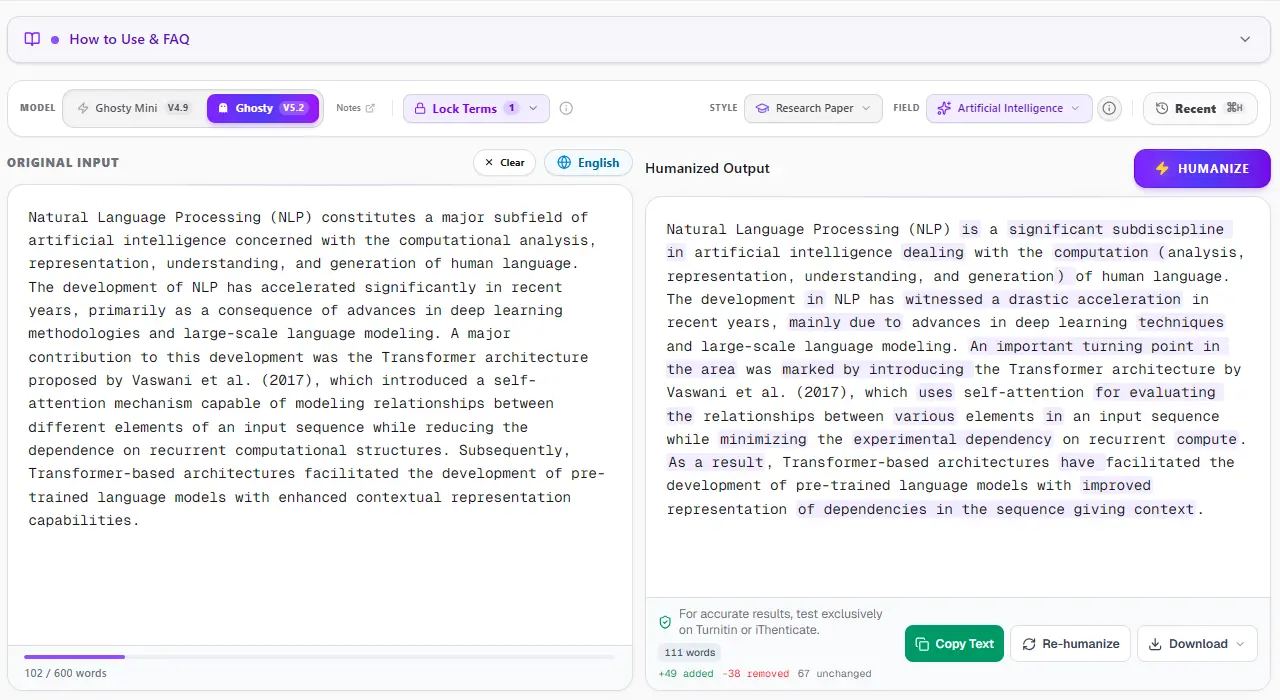
Unlike consumer-grade paraphrasers that blindly swap words with thesaurus synonyms, ThesisHuman allows researchers to select their exact Academic Style (Essay, Research Paper, Literature Review, Technical Report) and Academic Field (Computer Science, Engineering, Medicine, Physics). With Term Lock™, citations (APA, MLA, IEEE), LaTeX equations, and domain-specific terminology are cryptographically protected before sentence entropy is restructured.
Figure 1: The ThesisHuman editor processing an academic manuscript — featuring Academic Style selection, Academic Field customization, and Term Lock controls.
Phase 2: Institutional Integrity Screening
2. Turnitin & iThenticate Verification: 0% AI Detected
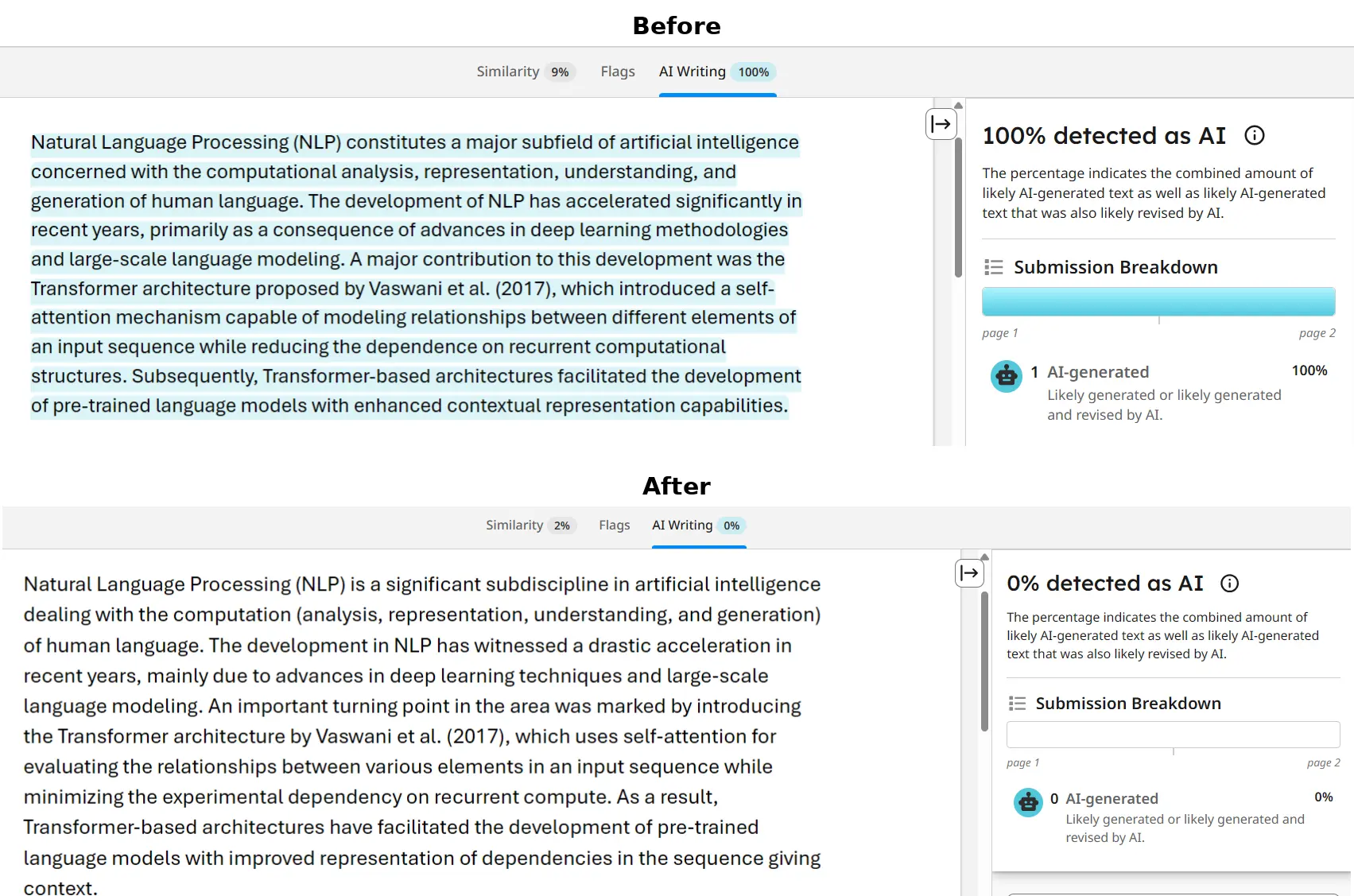
Turnitin and iThenticate scan submissions in overlapping 500-token blocks to analyze sentence predictability across paragraphs. When an unrefined AI draft is submitted, uniform cadence triggers an elevated AI Writing score. In the verified report below, a flagged graduate paper was processed through ThesisHuman, achieving a clean 0% AI detection score while preserving all formatted citations and technical parameters.
Figure 2: Turnitin AI detection scan — demonstrating complete 0% AI indicator clearance after ThesisHuman academic naturalization.
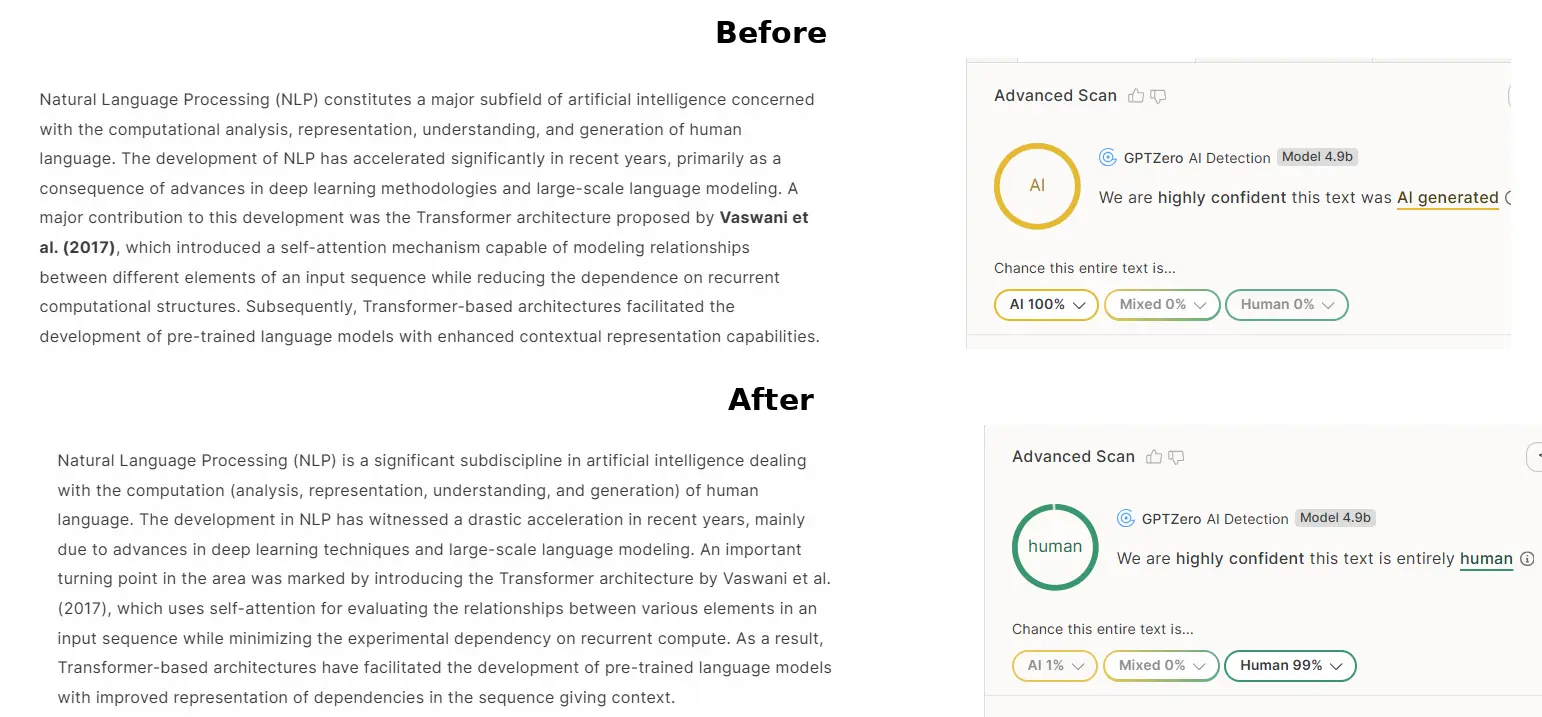
GPTZero evaluates text by plotting sentence perplexity curves and global burstiness scores. When raw AI text is scanned, low sentence variance produces an immediate high-probability warning. ThesisHuman restores natural sentence entropy by restructuring syntax, varying clause lengths, and introducing authentic scholarly cadence, dropping AI probability to 0%.
Figure 3: GPTZero perplexity and burstiness verification — raw machine-generated text (100% AI) transformed into 0% AI human-grade academic prose.
Phase 4: Cliché & N-Gram Elimination
4. Originality.ai Verification: 0% AI Confidence
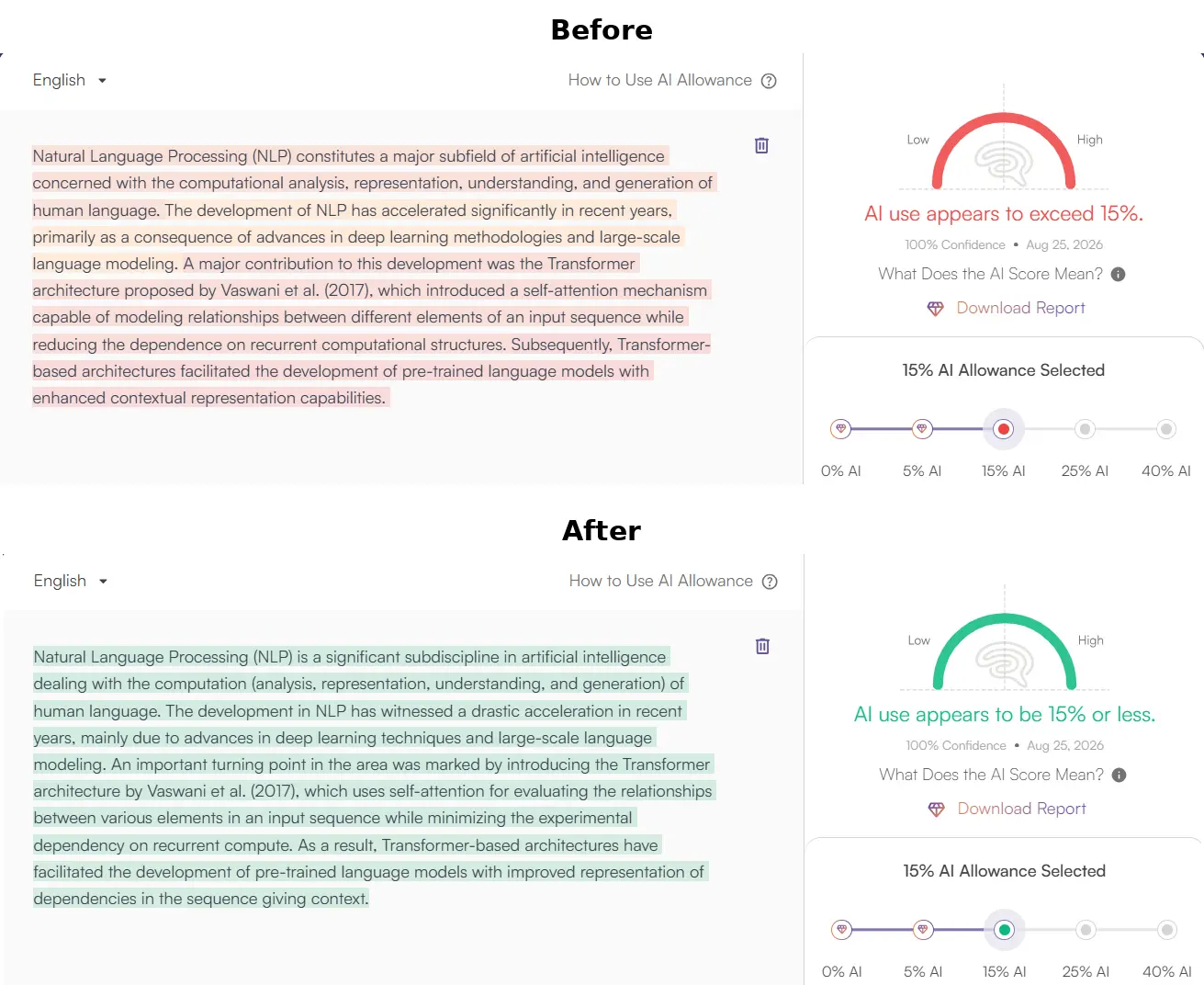
Originality.ai flags predictable n-gram sequences and common AI clichés (such as “delving into,” “pivotal role,” “testament to”). ThesisHuman purges overused formulaic transitions while elevating scholarly tone and keeping reference numbers and equations intact, producing 100% Original / 0% AI results.
Figure 4: Originality.ai detector scan — confirming complete removal of synthetic n-gram patterns and 0% AI detection confidence.
Does using an AI humanizer guarantee I pass Turnitin?
ThesisHuman optimizes your text to match the same statistical benchmarks (burstiness and perplexity) that Turnitin uses to identify human writing. This drastically reduces false positives by ensuring your prose genuinely meets human-writing quality standards.
Is my research data safe?
Your documents are stored securely in your private account so you can access them from your dashboard, protected by row-level security so only you can see them. We never sell your data, and we never use your submitted text to train our models. You can delete any document, or your whole account, at any time, and your intellectual property always remains yours.
Does this ruin my citations and LaTeX formulas?
No. Our Term Lock feature strictly protects all in-text citations, mathematical formulas, LaTeX expressions, and technical references. The engine restructures only the surrounding prose.
How is ThesisHuman different from standard ChatGPT?
ChatGPT produces generic, flat text with uniform sentence lengths and a single 'academic' tone. ThesisHuman is section-aware: it applies different directives for Abstract, Methodology, and Discussion, and uses burstiness algorithms specifically tuned for peer-reviewed academic journals.
Can I use this for my master's thesis or PhD dissertation?
Absolutely. ThesisHuman is designed precisely for long-form, rigorous academic writing. Whether you are drafting a 10,000-word journal article or a 100,000-word dissertation, the engine handles every IMRAD section with appropriate conventions.
Will this change the core meaning of my findings?
No. The AI focuses strictly on syntax, sentence flow, and readability. Your facts, data, arguments, and conclusions remain entirely untouched. ThesisHuman refines how you say it, not what you say.
How does the Term Lock feature work?
Simply type or paste your technical terms, acronyms, chemical formulas, or framework names into the lock box before processing. The AI is forced to preserve them exactly as written during the entire humanization process.
Are the generated texts considered plagiarism?
No. ThesisHuman rewrites and polishes your original ideas and rough drafts into publication-ready prose. The intellectual contribution (your research question, methodology, analysis, and conclusions) remains entirely yours.
Do I need technical skills to use this?
Not at all. The interface is as simple as a basic text editor. Paste your text, select your IMRAD section, lock your terms, and click Humanize. No coding, no configuration, no learning curve.
Is the output ready for immediate publication?
Our output is highly refined and optimized for academic standards. However, we always recommend a final human review to ensure it perfectly matches your personal voice and your institution's specific formatting requirements.
Bypass AI Detectors While Protecting Your Original Writing
Turn AI drafts into natural, undetectable academic writing. Protects your citations, research claims, and authentic scholarly tone. 500 words included free.