#Academic Writing#Grammar and Style#Writing Tips#Essay Writing#Sentence Structure
What Makes a Good Sentence? Clear Examples and Practical Writing Rules
Understand what makes a sentence effective across general and academic writing. Explore clarity, concision, logical coherence, sentence variety, and 10+ before-and-after examples.
HamzaPhD Researcher
15 min read
A sentence is the fundamental building block of written thought. In both general and scholarly prose, the quality of your writing is determined not by the grandiosity of your vocabulary, but by the clarity, precision, and grammatical integrity with which your sentences convey meaning.
## 1. Direct Answer: Defining an Effective Sentence
An effective sentence communicates a complete thought clearly, accurately, and efficiently to its intended reader. It makes its primary subject and action immediately identifiable, connects clauses logically, eliminates unnecessary clutter, and employs an appropriate tone for its communicative context.
Crucially, a sentence is not made "good" merely by being grammatically correct. A sentence can follow every rule of syntax and still fail if it is vague, unnecessarily convoluted, or emotionally flat. Conversely, the most powerful sentences often achieve their impact through disciplined simplicity and syntactic balance.
```
[Grammatical Integrity] + [Clausal Clarity] + [Precise Diction] = High-Impact Sentence
- Independent clause - Clear subject-verb bond - Concrete nouns
- Accurate punctuation - Logical modifier links - Purposeful verbs
```
## 2. Six Foundational Qualities of an Effective Sentence
Writing specialists and university rhetoric programs, including Purdue OWL and Harvard's Writing Center, identify six foundational qualities that characterize strong sentences:
1. **Completeness**: Contains at least one independent clause expressing a self-contained thought with an explicit or clearly understood subject and predicate.
2. **Clarity**: The reader can immediately discern who is performing the action, what is taking place, and what the conclusion signifies.
3. **Precision**: Words are chosen for their exact conceptual fit rather than generic impression, avoiding vague generalizations.
4. **Concision**: Every word carries communicative weight. Unnecessary padding, empty transitions, and redundant phrasing are removed.
5. **Logical Coherence**: Clauses, modifying phrases, and coordinate terms connect in a logical sequence that reflects the author's argument.
6. **Contextual Tone**: The vocabulary and grammatical formality match the audience, whether that audience is a general reader, an undergraduate seminar, or a peer-review panel.
## 3. Grammatical Completeness: Subject, Predicate, and Independent Clauses
At its grammatical core, a standard English sentence requires an independent clause: a grammatical structure containing a subject (the actor or topic) and a predicate (the action, occurrence, or state of being).
- **Complete Sentence**: "The committee published the preliminary clinical guidelines." (Subject: *The committee*; Verb: *published*; Object: *the preliminary clinical guidelines*)
- **Sentence Fragment**: "Although the committee published the preliminary clinical guidelines." (Dependent clause left standing alone without an independent main clause)
- **Run-On / Comma Splice**: "The committee published the preliminary guidelines, they were adopted immediately." (Two independent clauses joined by a comma without a coordinating conjunction)
### Stylistic Fragments in Creative vs. Academic Prose
In creative, journalistic, or informal writing, deliberate sentence fragments can create dramatic emphasis ("Silence. Complete silence."). In formal academic prose, however, stylistic fragments are generally avoided because scholarly discourse prioritizes structural completeness and explicit causal coordination.
## 4. Clarity vs. Complexity: Why Grammatical Sentences Can Still Fail
Many writers mistakenly believe that academic rigor requires dense, winding sentences packed with prepositional phrases. Consider this grammatically flawless sentence:
> *It was through the implementation of an extensive regulatory monitoring mechanism on the part of the administrative commission that the occurrence of financial misstatements regarding operational balances was able to be minimized.*
While every comma is grammatically defensible, the sentence is exhausted by nominalizations (turning verbs into nouns: *implementation*, *occurrence*, *misstatements*) and passive voice. Compare it to this revised version:
> *The administrative commission established strict regulatory monitoring, minimizing fraudulent financial reporting.*
The revision cuts the word count from 31 words to 11 words while sharpening the meaning. Grammatical correctness is the floor of writing quality, not the ceiling.
## 5. Precision: Concrete Diction vs. Vague Generalizations
A good sentence relies on concrete nouns and exact verbs rather than inflated adjectives. When writing becomes vague, it often leans on generic placeholders:
- **Vague**: "The economic situation caused major problems for local people in many different ways."
- **Precise**: "Inflation and factory closures reduced household purchasing power across the Rust Belt, forcing 14 percent of families to utilize food assistance programs."
Replacing generic words (*situation*, *problems*, *people*, *ways*) with concrete historical and economic specifics (*inflation*, *purchasing power*, *Rust Belt*, *food assistance*) transforms empty prose into authoritative analysis.
## 6. Concision: Removing Syntactic Deadweight Without Losing Nuance
Concision does not mean stripping away necessary qualifications, technical terms, or literary depth. Instead, concision means eliminating empty boilerplate that adds length without adding value:
| Fluffy Phrasing | Concise Alternative | Reason for Revision |
| :--- | :--- | :--- |
| *due to the fact that* | *because* | Three extra words serving the identical logical function |
| *in order to* | *to* | Unnecessary infinitive padding |
| *at this point in time* | *currently* or *now* | Temporal cliché |
| *is capable of producing* | *can produce* | Verbose modal circumlocution |
| *a total of eight participants* | *eight participants* | Redundant counting marker |
| *it is interesting to note that* | *notably* (or delete) | Empty throat-clearing announcing what the reader can see |
## 7. Logical Coherence: Connecting Modifiers, Clauses, and Ideas
In an effective sentence, words that belong together conceptually are placed together syntactically. Modifying clauses must clearly attach to their intended nouns, and coordinate clauses must follow a natural sequence:
- **Illogical Modifier Placement**: "Covered in heavy frost, the botanist inspected the alpine seedlings." (Implies the botanist was frozen)
- **Coherent Revision**: "The botanist inspected the alpine seedlings, which were covered in heavy frost."
Modifiers should stand as close as possible to the words they modify to prevent unintended humor or analytical ambiguity.
## 8. Appropriate Tone Across Contexts: General vs. Academic Writing
What counts as a "good sentence" changes depending on the rhetorical arena:
- **General Public Writing**: Prioritizes direct storytelling, conversational cadence, accessible metaphors, and varied sentence lengths.
- **Academic Writing**: Emphasizes epistemic hedging (*suggests*, *indicates*, *may reflect*), precise domain terminology, objective evidence attribution, and balanced clausal subordination.
A sentence like "The experimental results were completely insane and blew our minds" might work in a personal blog, but peer-reviewed scholarship requires: "The experimental outcomes departed substantially from baseline projections, suggesting unanticipated kinetic interactions."
## 9. Sentence Length and Rhythm: Debunking the Myth That Longer Equals Smarter
One of the most persistent misconceptions among student writers is that longer sentences automatically demonstrate superior intelligence. In truth, sustained 40-word sentences exhaust readers and obscure central arguments.
Masterful writers alternate sentence lengths to create rhythm:
- **Short Sentences (5 to 12 words)**: Deliver assertions, emphasize key findings, and reset reader attention.
- **Medium Sentences (13 to 22 words)**: Develop analytical relationships, provide supporting details, and connect claims.
- **Complex Sentences (23 to 35 words)**: Balance qualifications, introduce secondary evidence, and navigate nuanced conditions.
For an extensive investigation of how sentences assemble into coherent paragraphs, see our guide on [how many sentences are in a paragraph](/blog/how-many-sentences-are-in-a-paragraph) and the essential [characteristics of a strong paragraph](/blog/paragraph-characteristics).
---
## 10. The Four Sentence Structures and Their Strategic Deployment
Varied syntax keeps writing engaging. English provides four primary structural models:
### 1. Simple Sentence (One Independent Clause)
> *The vaccine stimulated a robust neutralizing antibody response.*
- **Function**: Direct, forceful assertion. Excellent for introducing key claims or summarizing empirical results.
### 2. Compound Sentence (Two Independent Clauses Joined by a Conjunction or Semicolon)
> *The laboratory completed the trial protocol, but the regulatory board requested additional pharmacokinetic data.*
- **Function**: Shows balance, tension, or equal relationship between two complete thoughts.
### 3. Complex Sentence (One Independent Clause + One or More Dependent Clauses)
> *Although the initial enzyme assay showed minimal catalytic activity, subsequent heating revealed heat-stable cofactor binding.*
- **Function**: Subordinates minor or qualifying information to the primary analytical claim.
### 4. Compound-Complex Sentence (Two Independent Clauses + At Least One Dependent Clause)
> *Because global wheat harvests dropped sharply after the drought, export prices surged within weeks, and import-dependent nations faced acute bread shortages.*
- **Function**: Handles multi-variable causal scenarios involving multiple actors and concurrent outcomes.
## 11. Active vs. Passive Voice: Legitimate Contexts for Both in Writing
Grammar checkers often flag passive voice as an unmitigated evil. In practice, both active and passive constructions serve legitimate rhetorical purposes:
- **Use Active Voice When the Agent Matters**: "Dr. Alvarez synthesized the novel polymer." (Focuses on the investigator's agency and discovery)
- **Use Passive Voice When the Object or Process Matters**: "The test tubes were sterilized at 121 degrees Celsius for 20 minutes." (The identity of the laboratory assistant operating the autoclave is irrelevant; the procedure is what matters)
In STEM methodology sections, passive voice appropriately shifts emphasis from human researchers to experimental procedures and materials.
## 12. Strong Verbs: Energizing Prose Without Artificial Thesaurus Swaps
Weak sentences often hide their central actions inside bland verbs of being (*is*, *are*, *was*, *were*) or generic actions (*make*, *do*, *have*):
- **Weak Verb Construction**: "The researcher had a suspicion that the findings were indicative of a systemic error."
- **Strong Verb Revision**: "The researcher suspected that the findings indicated a systemic error."
However, do not use a thesaurus to replace common words with flamboyant vocabulary. Swapping "said" for "ejaculated" or "demonstrated" for "manifested" often produces awkward, pretentious phrasing. Choose verbs that convey exact mechanical or analytical actions.
## 13. Subject-Verb Agreement and Common Structural Traps
Subject-verb agreement errors frequently happen when words intervene between the subject and the verb:
- **Intervening Prepositional Phrase**: "The collection of rare pre-Columbian gold artifacts **were** sold at auction." -> *Incorrect.* The subject is *collection* (singular), not *artifacts*.
- **Corrected**: "The collection of rare pre-Columbian gold artifacts **was** sold at auction."
Watch out for compound subjects joined by *neither/nor* or *either/or*, where the verb agrees with the closer subject: "Neither the lead investigator nor the graduate research assistants **were** present."
## 14. Punctuation as Syntactic Architecture: Commas, Semicolons, and Colons
Punctuation marks are not decorative flourishes; they are road signs that govern reader cognition:
- **The Comma (,)**: Separates introductory clauses, sets off non-restrictive appositives, and joins independent clauses when paired with coordinating conjunctions (FANBOYS: for, and, nor, but, or, yet, so).
- **The Semicolon (;)**: Connects two closely related independent clauses without a coordinating conjunction, or separates complex items in a list containing internal commas.
- **The Colon (:)**: Introduces an explanation, list, or dramatic elaboration that directly fulfills the promise of the preceding independent clause.
## 15. Sentence Variety: Enhancing Readability Through Cadence
Monotonous writing uses the same sentence structure repeatedly (e.g., Subject-Verb-Object, Subject-Verb-Object). To introduce natural cadence:
- Begin with a prepositional phrase: *"Across the southern delta, agricultural runoff accelerates eutrophication."*
- Open with a participial modifier: *"Facing widespread consumer boycott, the retail conglomerate overhauled its supply chain transparency."*
- Use an introductory adverbial clause: *"Before the treaty was signed, delegates spent months negotiating border enforcement protocols."*
Connecting thoughts effectively also requires disciplined transitional language. Review our curated lists of [transition sentences](/blog/transition-sentences) and [sentence starters for essays](/blog/sentence-starters-for-essays) to expand your repertoire.
## 16. Parallel Structure: Balancing Coordinate Elements
When sentences coordinate two or more phrases or clauses, they must share grammatical form:
- **Non-Parallel**: "The internship taught me to write technical briefs, organizing donor databases, and how to interview clients." (Infinitive + Gerund + Clause)
- **Parallel Revision**: "The internship taught me to write technical briefs, organize donor databases, and interview clients." (Three parallel infinitives)
Parallelism creates cognitive harmony, allowing the reader's brain to process complex lists with minimal friction.
## 17. Avoiding Ambiguity: Pronoun Antecedent Clarity and Modifier Placement
Ambiguous pronouns confuse readers by leaving the referent uncertain:
- **Ambiguous**: "When the dean met with the department chair, she announced her resignation." (Who resigned? The dean or the chair?)
- **Clear**: "During their meeting, the dean announced her resignation to the department chair."
Similarly, eliminate "broad pronoun reference" where words like *this* or *which* point vaguely to an entire preceding paragraph rather than a specific noun:
- **Vague**: "The state reduced higher education funding by 20 percent. This was disastrous."
- **Clear**: "The state reduced higher education funding by 20 percent, a budgetary contraction that forced universities to freeze faculty hiring."
## 18. Preserving Meaning in Research Writing: Hedging and Causal Precision
Scholarly sentences require epistemic calibration. Overstating claims damages academic credibility:
- **Overstated**: "These survey results prove that social media usage causes depression in adolescent girls."
- **Disciplined Academic Sentence**: "These survey findings suggest a significant correlation between daily screen time and self-reported depressive symptoms among adolescent girls, though longitudinal data is required to establish causality."
Preserving the distinction between *correlation* and *causation*, or *demonstrates* and *suggests*, is essential when drafting empirical arguments. For researchers working with source evidence, our guide on [evidence sentence starters](/blog/evidence-sentence-starters) provides tested academic templates.
---
## 19. Ten Before-and-After Transformations with Detailed Explanations
Here are ten real-world sentence revisions demonstrating how to diagnose and repair common writing weaknesses:
### Transformation 1: Eliminating Nominalizations
- **Before**: "A determination was reached by the clinical panel in regard to the termination of the treatment protocol."
- **After**: "The clinical panel decided to terminate the treatment protocol."
- **Explanation**: Replaced nominalizations (*determination*, *termination*) with active verbs (*decided*, *terminate*), eliminating empty prepositional phrases (*in regard to*).
### Transformation 2: Fixing Wordy Circumlocutions
- **Before**: "Owing to the fact that there was an absence of adequate funding, the municipal library was forced to curtail its operational hours."
- **After**: "Because funding declined, the municipal library reduced its hours."
- **Explanation**: Replaced "Owing to the fact that" with "Because" and streamlined "curtail its operational hours" into "reduced its hours."
### Transformation 3: Resolving a Dangling Modifier
- **Before**: "Having completed the statistical calculations, the hypothesis was verified by the research team."
- **After**: "Having completed the statistical calculations, the research team verified their hypothesis."
- **Explanation**: The modifier "Having completed the statistical calculations" must attach to the actor who did the math (*the research team*), not the abstract concept (*the hypothesis*).
### Transformation 4: Correcting Pronoun Antecedent Ambiguity
- **Before**: "The university president told the provost that her speech had alienated the student senate."
- **After**: "In a private meeting, the university president criticized the provost's speech for alienating the student senate."
- **Explanation**: Replaced the ambiguous pronoun *her* with explicit possessive identification (*the provost's speech*).
### Transformation 5: Energizing Passive Voice with a Clear Agent
- **Before**: "A sharp critique of the regulatory framework was delivered by the industry ombudsman during Wednesday's oversight hearing."
- **After**: "During Wednesday's oversight hearing, the industry ombudsman sharply criticized the regulatory framework."
- **Explanation**: Transformed the passive construction into an active sentence highlighting the ombudsman's action.
### Transformation 6: Removing Redundancies
- **Before**: "The final outcome of the election completely eliminated the past historical precedents that had previously existed."
- **After**: "The election outcome overturned all established historical precedents."
- **Explanation**: Removed redundant qualifiers: *final outcome* (outcomes are always final), *past historical* (history is always in the past), and *previously existed* (precedents already exist by definition).
### Transformation 7: Restoring Parallel Structure
- **Before**: "The executive committee is responsible for approving fiscal budgets, the management of employee grievances, and to draft annual policies."
- **After**: "The executive committee is responsible for approving fiscal budgets, managing employee grievances, and drafting annual policies."
- **Explanation**: Standardized all three coordinate duties into parallel gerund phrases (*approving*, *managing*, *drafting*).
### Transformation 8: Repairing a Comma Splice
- **Before**: "The deep-sea submersible lost acoustic telemetry at 3,000 meters, emergency ascent protocols were initiated by the crew."
- **After**: "When the deep-sea submersible lost acoustic telemetry at 3,000 meters, the crew initiated emergency ascent protocols."
- **Explanation**: Converted the first independent clause into a dependent time clause (*When...*), eliminating the comma splice.
### Transformation 9: Calibrating Unearned Certainty
- **Before**: "This single economic indicator proves without doubt that the nation will enter a severe recession within three months."
- **After**: "This leading economic indicator suggests that the risk of a domestic recession has increased significantly over the coming quarter."
- **Explanation**: Moderated sweeping assertions (*proves without doubt*, *will enter*) with disciplined scholarly hedging (*suggests*, *risk has increased*).
### Transformation 10: Untangling Convoluted Prepositional Chains
- **Before**: "The evaluation of the impact of the policy on the members of the community was carried out by the leaders of the civic association."
- **After**: "Civic association leaders evaluated how the policy affected community members."
- **Explanation**: Collapsed a five-preposition chain (*of the*, *of the*, *on the*, *of the*, *by the*) into a direct subject-verb-object structure.
---
## 20. Sentence Length Variation Study: Expressing Complex Information
To understand how sentence rhythm influences reader comprehension, observe how the same core information can be framed through three different structural strategies:
### Option A: The Short, Direct Staccato (Four Concise Sentences)
> *Central banks raised interest rates. Commercial borrowing declined sharply. Tech startups froze recruitment. Unemployment reached an 18-month high.*
- **Analysis**: Clear and urgent, but slightly choppy when sustained over long passages. Effective for executive summaries and news releases.
### Option B: The Balanced Medium Pair (Two Coordinated Sentences)
> *As central banks increased benchmark interest rates, commercial borrowing costs rose and tech startups froze hiring. Consequently, tech-sector unemployment reached an 18-month peak by late autumn.*
- **Analysis**: Balances cause and effect smoothly. Ideal for standard academic coursework and narrative reporting.
### Option C: The Complex Periodic Structure (One Multi-Clause Sentence)
> *By raising benchmark interest rates to curb inflation, central banks inadvertently restricted venture capital liquidity, forcing technology firms to implement widespread hiring freezes that pushed industry unemployment to an 18-month high.*
- **Analysis**: Synthesizes the initial policy catalyst, the economic mechanism, and the downstream human outcome into a single, cohesive causal sequence.
## 21. Causal and Evidentiary Precision Case Study: Correlation vs. Causation
Academic writers often face the challenge of explaining empirical associations without claiming unwarranted causation. Examine these three versions of a scientific finding:
- **Imprecise (Conflating Correlation with Causation)**:
> *"Consuming ultra-processed foods causes cognitive decline in older adults."*
> *Problem*: Asserts direct biological causation without accounting for confounding demographic, socioeconomic, or genetic variables.
- **Overly Hedged (Loss of Clarity)**:
> *"It could potentially be possible that there might exist some degree of association between the dietary intake of processed consumables and certain indicators that could be related to cognitive performance."*
> *Problem*: Excessive hedging buries the empirical signal in timid, defensive abstractions.
- **Calibrated and Precise (Journal-Grade Scholarly Sentence)**:
> *"In a multi-year cohort of adults over age 65, high dietary consumption of ultra-processed foods was significantly associated with accelerated cognitive decline, even after adjusting for baseline cardiovascular health and socioeconomic status."*
> *Why It Works*: Uses precise relational terminology (*was significantly associated with*), defines the cohort parameters (*adults over age 65*), and explicitly notes the statistical controls applied (*cardiovascular health, socioeconomic status*).
## 22. Active vs. Passive Voice Contexts: When Each Construction Excels
To decide whether active or passive voice serves your sentence best, consider the following situational guide:
### Context 1: Historical Agency (Prefer Active Voice)
- **Passive**: *"The Treaty of Versailles was rejected by the United States Senate in 1919."*
- **Active**: *"The United States Senate rejected the Treaty of Versailles in 1919."*
- **Verdict**: Active voice emphasizes political responsibility and institutional conflict.
### Context 2: Laboratory Methodology (Prefer Passive Voice)
- **Active**: *"We heated the polymer solution to 80 degrees Celsius and stirred it for 45 minutes."*
- **Passive**: *"The polymer solution was heated to 80 degrees Celsius and stirred for 45 minutes."*
- **Verdict**: Passive voice correctly focuses on the material transformation rather than the laboratory technicians.
### Context 3: Diplomatic Hedging and De-escalation (Strategic Passive)
- **Active**: *"The inspection team made several critical computational errors in the draft report."*
- **Passive**: *"Several computational errors were made in the draft inspection report."*
- **Verdict**: Passive voice addresses the procedural defect without singling out individuals for personal blame.
---
## 23. Five Practical Sentence Editing Exercises with Solutions
Test your editing instincts on these five flawed sentences. Attempt your own revision before reviewing the explanation and solution.
### Exercise 1: Redundancy and Wordiness
- **Sentence**: *"In my personal opinion, I believe that the basic fundamental principles of corporate accounting need to be completely overhauled from the ground up."*
- **Diagnose**: "In my personal opinion" and "I believe" are redundant. "Basic fundamental" is a duplicate modifier. "Completely overhauled from the ground up" contains triple redundancy.
- **Recommended Revision**: *"The fundamental principles of corporate accounting require comprehensive reform."*
### Exercise 2: Misplaced Modifier
- **Sentence**: *"While hiking through the national park, a rare species of spotted owl was observed by the conservation biologists."*
- **Diagnose**: As written, the owl appears to be hiking through the park.
- **Recommended Revision**: *"While hiking through the national park, the conservation biologists observed a rare species of spotted owl."*
### Exercise 3: Faulty Predication
- **Sentence**: *"The purpose of the clinical trial was tested on fifty diabetic patients."*
- **Diagnose**: A *purpose* cannot be tested on patients; the *experimental drug* or *intervention* is tested.
- **Recommended Revision**: *"The experimental therapy was tested on fifty diabetic patients during the clinical trial."*
### Exercise 4: Weak Verb and Nominalization
- **Sentence**: *"The committee made an announcement of their intention to conduct an investigation into the allegations."*
- **Diagnose**: "Made an announcement of their intention to conduct an investigation" buries two actions inside weak nouns.
- **Recommended Revision**: *"The committee announced that it will investigate the allegations."*
### Exercise 5: Ambiguous Coordination
- **Sentence**: *"The university library acquired historical manuscripts and maps that were damaged during the flood."*
- **Diagnose**: Did the flood damage both the manuscripts and the maps, or only the maps?
- **Recommended Revision (if both were damaged)**: *"The university library acquired flood-damaged historical manuscripts and maps."*
- **Recommended Revision (if only maps were damaged)**: *"The university library acquired historical manuscripts along with maps that were damaged during the flood."*
---
## 24. Common Sentence Mistakes Checklist
Run your writing through this quick diagnostic checklist before finalizing any paper:
- [ ] **Subject-Verb Proximity**: Keep core subjects and verbs close together. Avoid separating them with multi-clause interruptions.
- [ ] **Eliminate "There is / There are"**: Replace existential sentence openers with active actors (*"There are many reasons for this outcome"* -> *"Several economic factors drove this outcome"*).
- [ ] **Check Pronoun Clarity**: Ensure every *it*, *they*, *this*, and *which* refers to a single, unambiguous antecedent.
- [ ] **Prune Prepositional Overload**: If a single sentence contains more than three *of* phrases, restructure the clause.
- [ ] **Verify Comma Pairs in Appositives**: When inserting parenthetical details, use a comma before and after the clause.
- [ ] **Limit Nominalizations**: Turn abstract nouns ending in *-tion*, *-ment*, and *-ance* back into lively verbs.
- [ ] **Vary Sentence Openers**: Ensure that no three consecutive sentences begin with the exact same syntactic structure.
- [ ] **Assess Cadence Out Loud**: Read your paragraphs aloud. If you run out of breath before reaching a period, the sentence requires division.
For writers looking to streamline dense prose or transform complex academic syntax into clear arguments, our [sentence rewriter tool](/sentence-rewriter) and [AI text simplifier](/ai-text-simplifier) offer interactive clausal remodeling while preserving critical citations and technical terms.
---
## 25. Frequently Asked Questions
### What is the ideal sentence length for academic writing?
In scholarly and collegiate writing, the average sentence length typically ranges between 15 and 25 words. However, effective writing avoids uniform sentence lengths. Alternating concise 10-word assertions with structured 25-word qualifying sentences creates natural reading cadence and prevents reader fatigue.
### Can a good sentence begin with "And" or "But"?
Yes. Coordinating conjunctions like "And," "But," and "So" can effectively begin a sentence when used intentionally to create rhythmic emphasis or highlight contrast. While some traditional grammar instructors discourage this in introductory coursework, premier literary, journalistic, and scholarly publications regularly employ initial conjunctions.
### What is a nominalization, and why should I avoid it?
A nominalization is a noun created from a verb or adjective (e.g., turning "conclude" into "conclusion," or "applicable" into "applicability"). Overusing nominalizations drains energy from writing by burying core actions inside heavy abstract nouns, forcing sentences to rely on weak verbs like *make*, *do*, or *conduct*.
### What is the difference between a compound sentence and a complex sentence?
A compound sentence connects two or more independent clauses of equal grammatical rank, usually joined by a coordinating conjunction (such as *and*, *but*, *or*) or a semicolon. A complex sentence connects one independent clause with at least one dependent clause (introduced by a subordinating conjunction like *because*, *although*, or *since*), establishing a hierarchical relationship between the main idea and supporting qualifications.
### How can I make my sentences sound more academic without sounding pretentious?
Focus on conceptual precision rather than vocabulary inflation. Academic authority comes from concrete noun choices, accurate technical terminology, logical causal connections, and disciplined epistemic hedging (*suggests*, *indicates*, *may reflect*). Avoid searching a thesaurus for obscure synonyms, which almost always produces unnatural, stilted prose.
Empirical Verification
Verified Detector Clearance for What Makes a Good Sentence? Clear Examples and Practical Writing Rules
Every manuscript processed through ThesisHuman is backed by verifiable, reproducible scans across institutional plagiarism and AI detection platforms.
Phase 1: Academic Engine Configuration
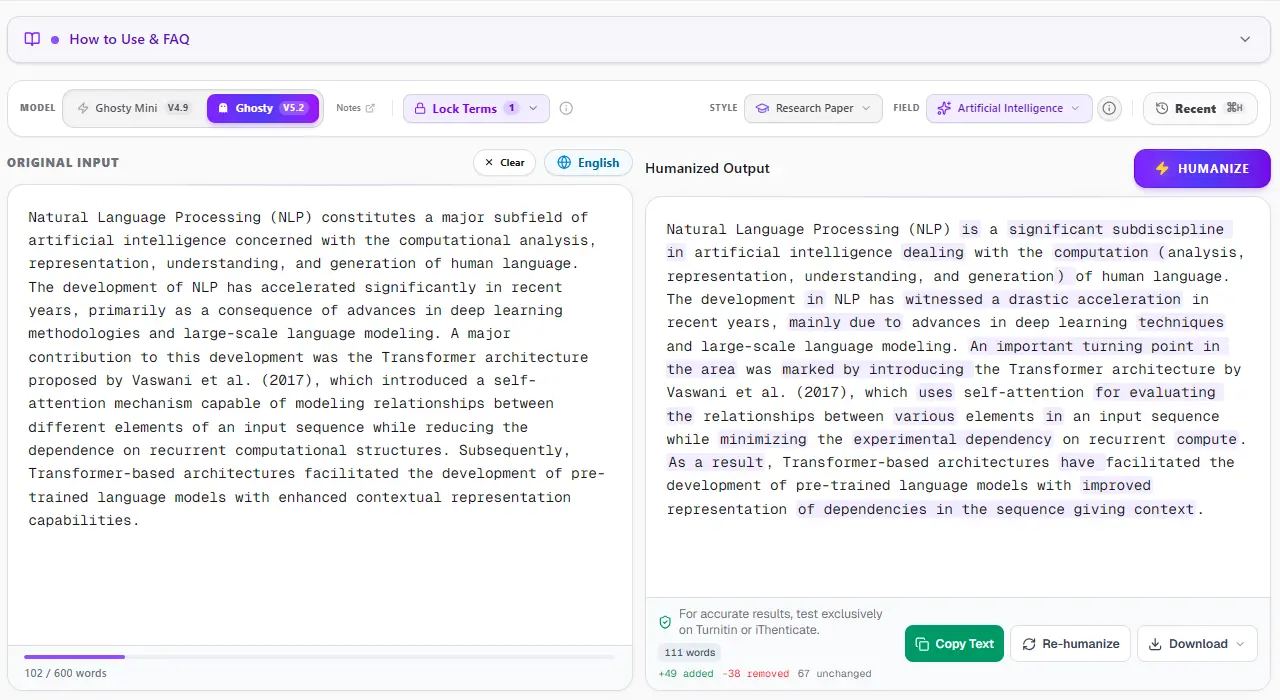
1. ThesisHuman Editor: Style, Field & Term Lock™ Technology
Unlike consumer-grade paraphrasers that blindly swap words with thesaurus synonyms, ThesisHuman allows researchers to select their exact Academic Style (Essay, Research Paper, Literature Review, Technical Report) and Academic Field (Computer Science, Engineering, Medicine, Physics). With Term Lock™, citations (APA, MLA, IEEE), LaTeX equations, and domain-specific terminology are cryptographically protected before sentence entropy is restructured.
Figure 1: The ThesisHuman editor processing an academic manuscript — featuring Academic Style selection, Academic Field customization, and Term Lock controls.
Phase 2: Institutional Integrity Screening
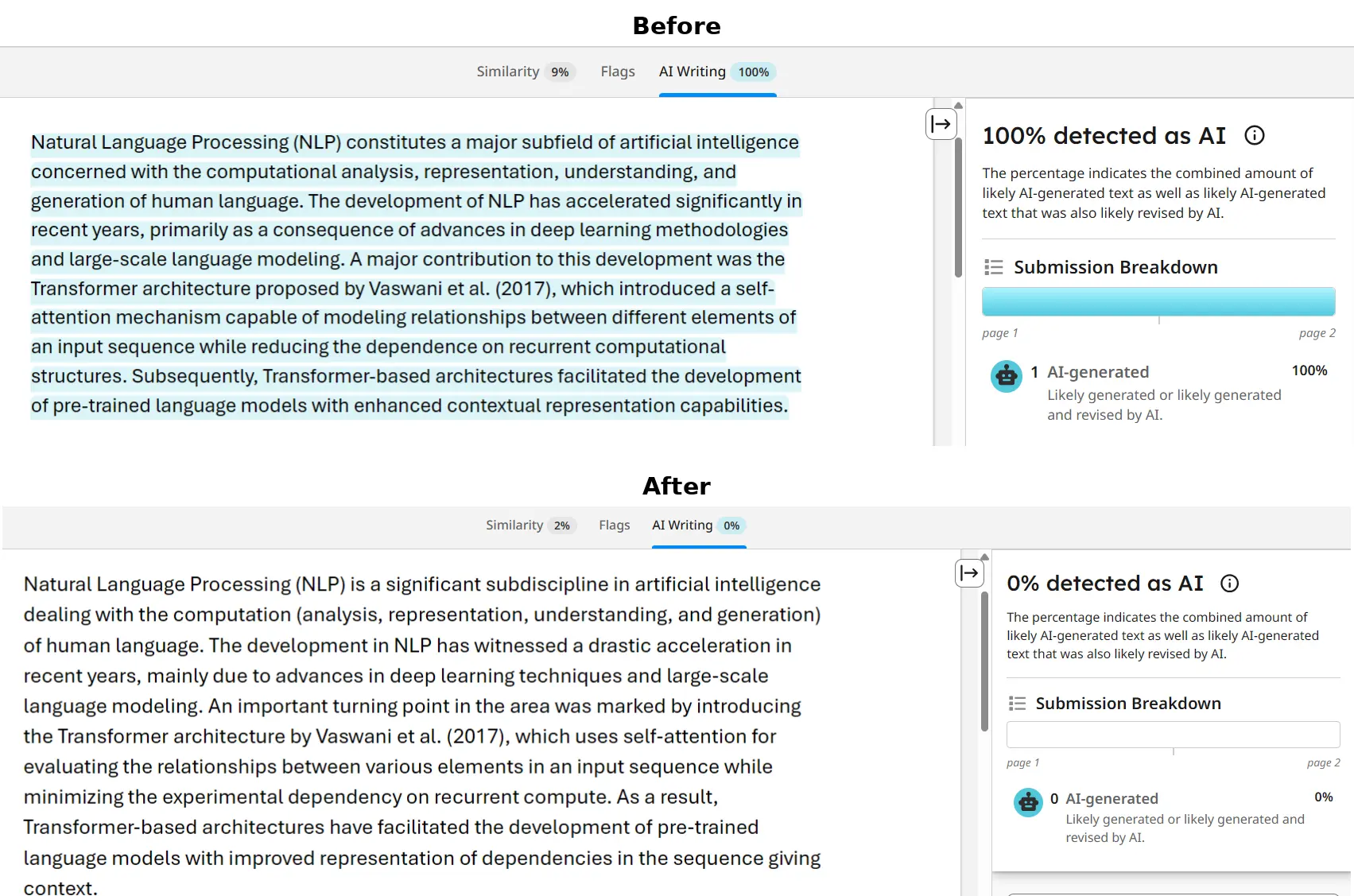
2. Turnitin & iThenticate Verification: 0% AI Detected
Turnitin and iThenticate scan submissions in overlapping 500-token blocks to analyze sentence predictability across paragraphs. When an unrefined AI draft is submitted, uniform cadence triggers an elevated AI Writing score. In the verified report below, a flagged graduate paper was processed through ThesisHuman, achieving a clean 0% AI detection score while preserving all formatted citations and technical parameters.
Figure 2: Turnitin AI detection scan — demonstrating complete 0% AI indicator clearance after ThesisHuman academic naturalization.
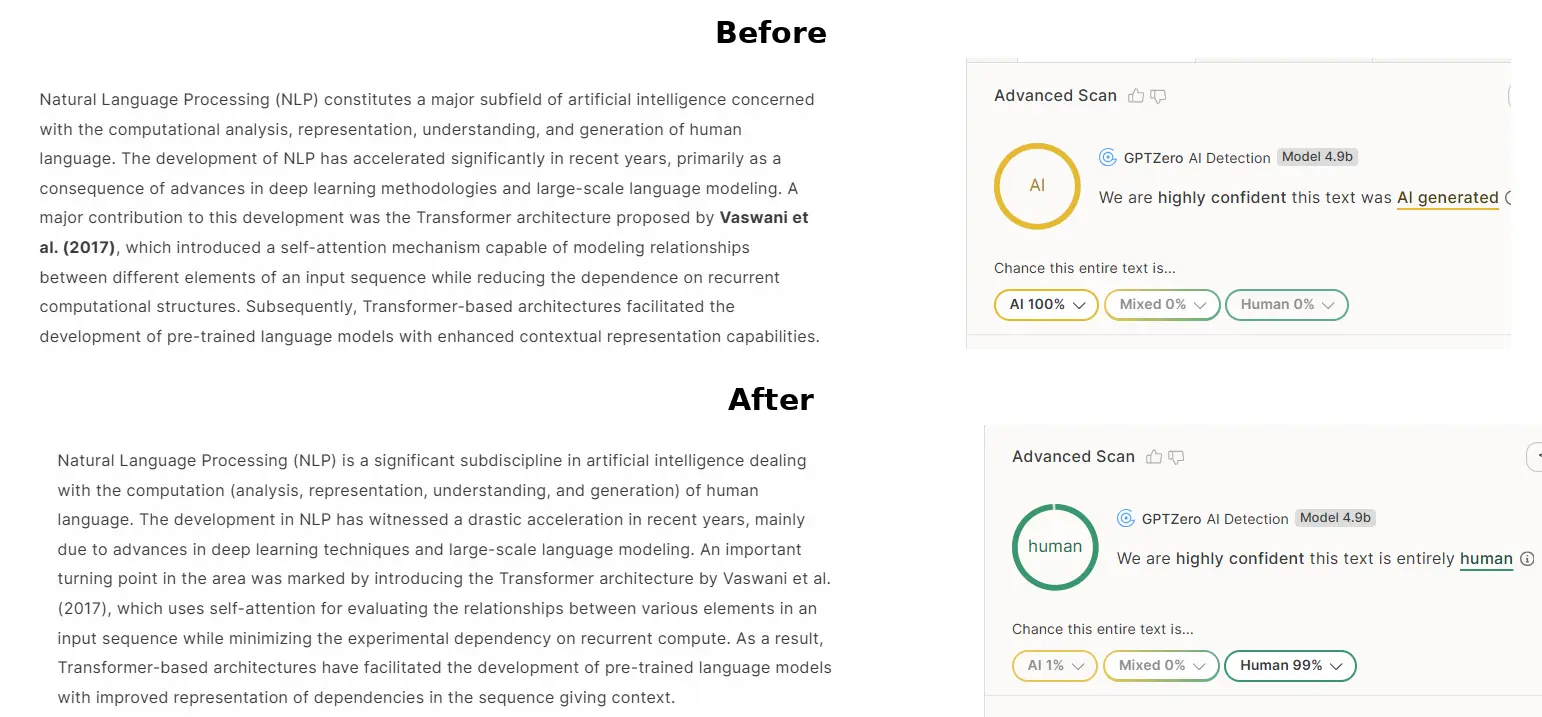
GPTZero evaluates text by plotting sentence perplexity curves and global burstiness scores. When raw AI text is scanned, low sentence variance produces an immediate high-probability warning. ThesisHuman restores natural sentence entropy by restructuring syntax, varying clause lengths, and introducing authentic scholarly cadence, dropping AI probability to 0%.
Figure 3: GPTZero perplexity and burstiness verification — raw machine-generated text (100% AI) transformed into 0% AI human-grade academic prose.
Phase 4: Cliché & N-Gram Elimination
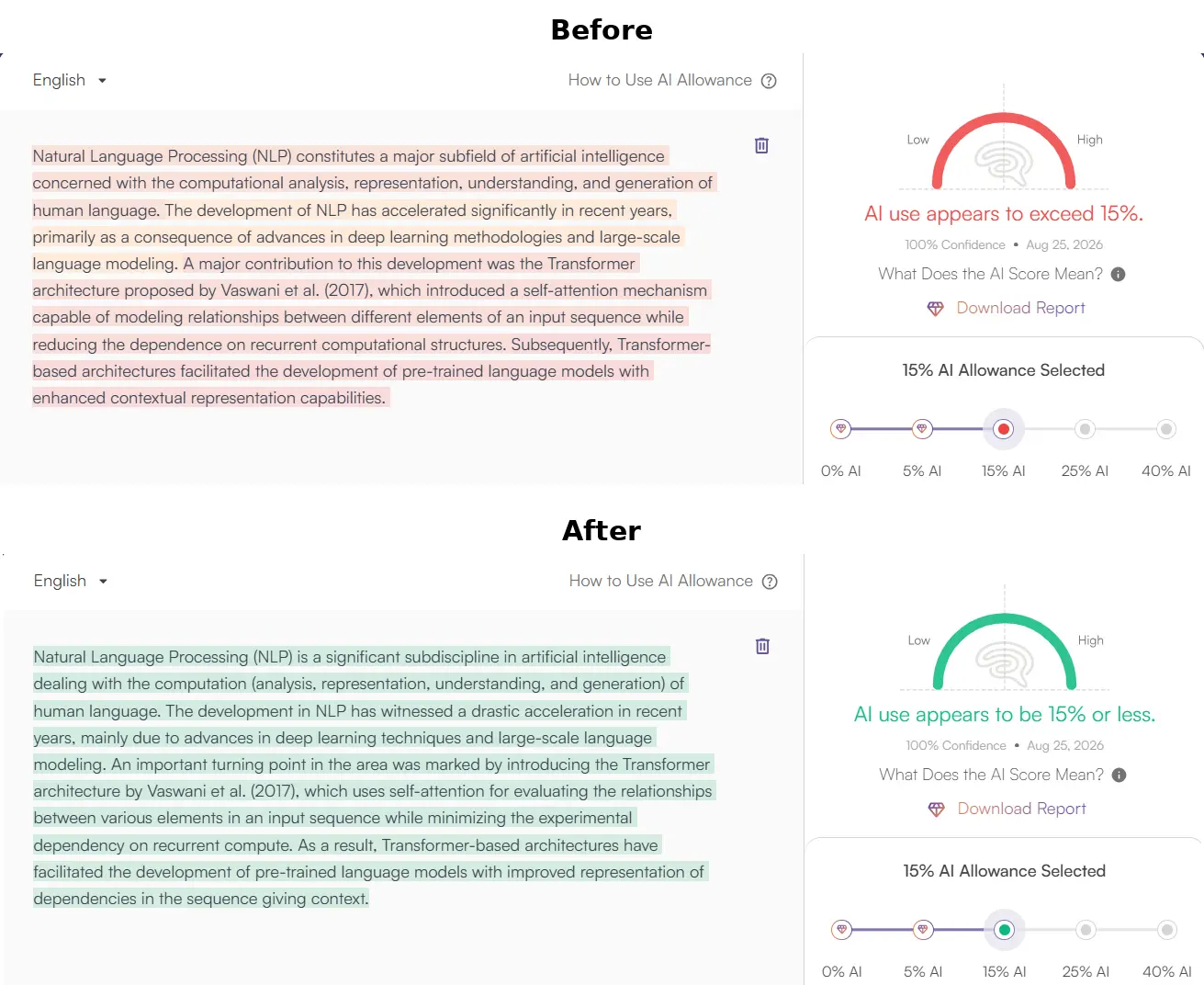
4. Originality.ai Verification: 0% AI Confidence
Originality.ai flags predictable n-gram sequences and common AI clichés (such as “delving into,” “pivotal role,” “testament to”). ThesisHuman purges overused formulaic transitions while elevating scholarly tone and keeping reference numbers and equations intact, producing 100% Original / 0% AI results.
Figure 4: Originality.ai detector scan — confirming complete removal of synthetic n-gram patterns and 0% AI detection confidence.
Does using an AI humanizer guarantee I pass Turnitin?
ThesisHuman optimizes your text to match the same statistical benchmarks (burstiness and perplexity) that Turnitin uses to identify human writing. This drastically reduces false positives by ensuring your prose genuinely meets human-writing quality standards.
Is my research data safe?
Your documents are stored securely in your private account so you can access them from your dashboard, protected by row-level security so only you can see them. We never sell your data, and we never use your submitted text to train our models. You can delete any document, or your whole account, at any time, and your intellectual property always remains yours.
Does this ruin my citations and LaTeX formulas?
No. Our Term Lock feature strictly protects all in-text citations, mathematical formulas, LaTeX expressions, and technical references. The engine restructures only the surrounding prose.
How is ThesisHuman different from standard ChatGPT?
ChatGPT produces generic, flat text with uniform sentence lengths and a single 'academic' tone. ThesisHuman is section-aware: it applies different directives for Abstract, Methodology, and Discussion, and uses burstiness algorithms specifically tuned for peer-reviewed academic journals.
Can I use this for my master's thesis or PhD dissertation?
Absolutely. ThesisHuman is designed precisely for long-form, rigorous academic writing. Whether you are drafting a 10,000-word journal article or a 100,000-word dissertation, the engine handles every IMRAD section with appropriate conventions.
Will this change the core meaning of my findings?
No. The AI focuses strictly on syntax, sentence flow, and readability. Your facts, data, arguments, and conclusions remain entirely untouched. ThesisHuman refines how you say it, not what you say.
How does the Term Lock feature work?
Simply type or paste your technical terms, acronyms, chemical formulas, or framework names into the lock box before processing. The AI is forced to preserve them exactly as written during the entire humanization process.
Are the generated texts considered plagiarism?
No. ThesisHuman rewrites and polishes your original ideas and rough drafts into publication-ready prose. The intellectual contribution (your research question, methodology, analysis, and conclusions) remains entirely yours.
Do I need technical skills to use this?
Not at all. The interface is as simple as a basic text editor. Paste your text, select your IMRAD section, lock your terms, and click Humanize. No coding, no configuration, no learning curve.
Is the output ready for immediate publication?
Our output is highly refined and optimized for academic standards. However, we always recommend a final human review to ensure it perfectly matches your personal voice and your institution's specific formatting requirements.
Bypass AI Detectors While Protecting Your Original Writing
Turn AI drafts into natural, undetectable academic writing. Protects your citations, research claims, and authentic scholarly tone. 500 words included free.