How to Title an Essay: Effective Titles, Examples, and Common Mistakes
Learn how to title an academic essay effectively. Discover differences between topic titles and argument-driven titles, how to use colons, formatting rules, and 10+ discipline examples.

Crafting an effective title for an academic essay is often left as an afterthought in the final minutes before submission. Yet your title represents the single most visible piece of prose in your entire paper. It functions as a compact covenant between writer and reader, signaling the exact boundaries of your inquiry, your analytical perspective, and your scholarly seriousness.
A weak title such as "History Paper" or "Social Media and Youth" forces your reader to guess what you are attempting to prove. Conversely, an overly complex, jargon-laden title obscures your core thesis beneath pretentious verbiage. This guide provides a comprehensive methodology for creating informative, compelling, and disciplined essay titles across multiple academic fields.
1. Direct Answer: What Makes an Effective Essay Title
An effective academic essay title does three specific things simultaneously:
- Identifies the exact subject: It names the text, historical period, empirical phenomenon, or theoretical issue under investigation.
- Communicates the analytical perspective: It reveals your stance, interpretive lens, or central research argument rather than merely naming a broad topic.
- Establishes the disciplinary register: It uses precise, scholarly language appropriate for your course, committee, or target journal.
Unlike creative writing headlines designed strictly for click-driven curiosity, academic titles prioritize clarity, topical accuracy, and intellectual defensibility. A strong title gives your reader an accurate forecast of what your body paragraphs will substantiate.
2. Why Essay Titles Matter in Academic Writing
In scholarly contexts, titles serve crucial structural and rhetorical purposes. Understanding these functions prevents the common error of treating a title as mere decorative packaging.
First, titles establish reader expectations. Academic readers, including instructors, peer reviewers, and researchers, read with focused intention. A specific title helps them immediately place your work within existing scholarly conversations. Second, your title sets the interpretive scope. If you are examining voter turnout in urban municipal elections between 2012 and 2020, announcing that exact timeframe prevents readers from expecting a nationwide longitudinal study.
Third, your title reinforces argumentative cohesion. When your title aligns directly with your thesis statement, it confirms that your paper possesses a unified throughline from the opening header to the final citation. However, it is important to maintain realistic expectations: a brilliant title will not compensate for unsupported claims, weak evidence, or disorganized paragraphs. The title's role is to accurately represent the quality of the intellectual work beneath it.
3. Core Characteristics of a Strong Academic Title
Before finalizing any essay title, evaluate it against these six essential criteria:
- Precision: Replaces broad abstractions with specific historical actors, texts, variables, or mechanisms.
- Conciseness: Conveys maximum meaning in 8 to 15 words without unnecessary conversational filler.
- Tone Alignment: Maintains an objective, scholarly register free from sensationalism or colloquial slang.
- Thesis Synergy: Directly reflects the primary claim substantiated in your thesis statement.
- Clarity: Reads smoothly upon first reading without requiring decipherment of nested acronyms.
- Disciplinary Appropriateness: Adheres to the methodological conventions of your academic field.
4. Informative Titles vs. Creative Hooks Across Disciplines
Academic disciplines approach titling with varying tolerances for stylistic creativity. Recognizing where your paper sits on this spectrum ensures your title meets institutional expectations.
In the humanities (literature, philosophy, cultural studies, art history), scholars frequently pair an evocative phrase or thematic metaphor with an explanatory subtitle. For instance, a paper analyzing Toni Morrison might use an evocative quotation from the novel followed by a colon and a precise analytical subtitle. This allows the author to demonstrate literary sensitivity while clearly stating their interpretive focus.
In the social sciences and STEM disciplines (psychology, sociology, economics, biology, engineering), titles prioritize direct, literal informativeness. Readers in these fields seek immediate clarity regarding the population studied, experimental variables manipulated, and methodology employed. Creative puns or literary metaphors are generally discouraged because they obscure search discovery and scientific precision.
| Discipline Cluster | Dominant Titling Convention | Representative Example |
|---|---|---|
| Literary Studies | Thematic hook paired with analytical subtitle | Silenced Voices: Vocal Fracture and Maternal Trauma in Morrison's Beloved |
| History | Event, actors, geographic bounds, and temporal period | Negotiating Concession: British Imperial Administration and the Canton Factories, 1834-1839 |
| Psychology | Key variables, participant cohort, and cognitive mechanism | Working Memory Capacity Moderates Task Switching Under Acute Social Stress |
| Political Science | Institutional structure, causal relationship, and policy context | Proportional Representation and Welfare Spending in Post-Industrial Democracies |
5. Topic Titles vs. Argument-Driven Titles
The single most effective way to elevate an essay title from novice to advanced is transforming a passive topic label into an active, argument-driven claim.
A topic title merely names the subject area. It tells the reader where the paper is looking, but says nothing about what the paper sees or concludes. An argument-driven title names the topic and reveals your analytical stance, core finding, or interpretive conclusion.
Consider this concrete three-tier progression:
Level 1 (Weak Topic Label): Artificial Intelligence in Education
Critique: Completely generic. Gives no indication of educational level, AI technology, pedagogical context, or author stance.
Level 2 (Focused Descriptive Title): Automated Feedback Systems in Secondary Composition Classrooms
Critique: Substantially better. Bounded by educational tier (secondary) and specific application (automated composition feedback), but still neutral.
Level 3 (Argument-Driven Title): The Limits of Automated Evaluation: How Machine Scoring Constrains Syntactic Variety in Secondary Student Prose
Critique: Exceptional. Announces the critical finding: automated scoring actively restricts syntactic diversity in student writing. The reader knows precisely what evidence will be presented.
6. Using a Colon: The Two-Part Academic Title Formula
The two-part colon title is the most widely utilized format in contemporary scholarship. When deployed deliberately, it balances engagement with technical rigor.
The standard structure consists of a primary title (left of the colon) and a secondary subtitle (right of the colon):
[Engaging Concept, Problem, or Hook] : [Methodological Scope, Specific Context, or Main Thesis]
For example, examine: Beyond Automation: How Adaptive Learning Platforms Reshape Formative Assessment in Undergraduate Calculus. The left side announces the theoretical transition ("Beyond Automation"), while the right side specifies the software context, discipline, and pedagogical outcome.
However, beware of colon overuse. Not every paper requires a two-part construction. If your primary title is already specific and complete (for instance, Evaluating Nitrogen Deposition Rates in Urban Wetland Soil Samples), forcing an artificial poetic hook before a colon creates unnecessary clutter. Ensure your subtitle adds genuinely new information rather than merely repeating words from the first half.
7. Titling Specific Essay Genres (Argumentative, Analytical, Compare-Contrast, Rhetorical)
Different academic essay genres require tailored titling strategies to reflect their specific rhetorical tasks:
Argumentative Essay Titles
An argumentative essay title should clearly signal the central debate, your chosen position, and the key rationale. Avoid balanced, timid phrasing if your essay takes a definitive stand. Contrast The Minimum Wage Debate (passive) with Stabilizing Entry-Level Employment: Why Targeted Minimum Wage Increases Do Not Reduce Small Business Viability (active stance with economic justification).
Analytical Essay Titles
An analytical essay deconstructs a primary text, dataset, or cultural artifact. Your title must identify the object of analysis and the critical framework you are applying. For instance: Architectural Claustrophobia: Panoptic Surveillance in Shirley Jackson's The Haunting of Hill House identifies the literary text, the analytical theme, and the theoretical lens (panoptic surveillance). For more on analytical writing structures, see our guide on how to write an analytical essay.
Compare-and-Contrast Essay Titles
Titling a comparative paper requires naming both subjects and the unifying benchmark used for comparison. Avoid titles that merely string names together with "and" or "versus". Instead of Locke and Hobbes, write Preserving the Sovereign: Differing Conceptions of Property and Natural Law in Locke and Hobbes. For structuring comparative papers, consult our walkthrough on how to write a compare and contrast essay.
Rhetorical Analysis Essay Titles
A rhetorical analysis examines how a communicator persuades an audience. The title must name the speaker or author, the speech or text, and the dominant persuasive appeal or rhetorical strategy. Contrast King's Speech Analysis with Mobilizing Moral Urgency: Kairos and Prophetic Rhetoric in Martin Luther King Jr.'s Riverside Church Address. To review rhetorical frameworks like SOAPS and ethos/pathos/logos, review our guide on the rhetorical analysis essay.
8. Titling Empirical and Research-Oriented Papers
Empirical research essays, capstone projects, and journal manuscripts adhere to strict conventions governing discoverability and replication. In database indexing systems such as PubMed, Crossref, and Google Scholar, titles are indexed by keyword search algorithms.
For empirical papers, incorporate these core elements where applicable:
- The independent and dependent variables under observation.
- The specific population, sample cohort, or experimental subject.
- The primary methodological framework (e.g., longitudinal study, randomized trial, ethnography).
- The geographic or institutional setting when context-dependent.
Example: Impact of High-Intensity Interval Training on Glycemic Control in Adults with Type 2 Diabetes: A 12-Week Randomized Trial. Notice how every word carries empirical utility, allowing fellow researchers to immediately assess methodological relevance.
9. Question-Based Titles: When They Work and When to Avoid Them
Students often gravitate toward question titles because they mirror initial curiosity: Is Social Media Ruining Democracy? or Should Nuclear Power Be Expanded?
While question titles can work well in informal essays, personal reflections, or journalistic opinion columns, they carry distinct risks in formal academic writing:
- They obscure your thesis: A question delays revealing your conclusion, whereas academic readers prefer knowing your claim upfront.
- They invite simplistic answers: Questions phrased with "Can", "Is", or "Should" often trigger a simplistic "yes" or "no", undercutting the nuance of your argument.
- They often signal incomplete research: When an author cannot summarize their finding concisely, a vague question frequently acts as a placeholder.
Recommendation: Convert open questions into declarative assertions that reflect your conclusion. Instead of asking Can Urban Farming Solve Food Insecurity?, state your evidence-backed finding: The Structural Constraints of Urban Agriculture: Why Community Gardens Cannot Replace Regional Supply Chains in Food Deserts.
10. Title Capitalization Rules (Headline Style vs. Sentence Case)
Academic style manuals govern how individual words inside an essay title must be capitalized. Most undergraduate and graduate coursework utilizes headline style (also known as Title Case), though specific reference lists and international formats utilize sentence case.
Headline Style Rules (APA 7, MLA 9, Chicago 18)
Under headline style capitalization, apply the following consistent guidelines:
- Always capitalize: The first and last word of the title, regardless of part of speech.
- Always capitalize: The first word following a colon, em-free dash, or question mark that begins a subtitle.
- Always capitalize major words: Nouns, pronouns, verbs (including forms of "to be" such as Is, Are, Was), adjectives, and adverbs.
- Keep lowercase: Articles (a, an, the), coordinating conjunctions (and, but, for, or, nor), and short prepositions (e.g., in, on, at, by, to, for) unless they begin the title or subtitle.
- Note style variations on prepositions: MLA and Chicago keep prepositions lowercase regardless of length, while APA capitalizes prepositions containing four or more letters (e.g., With, From, Between).
11. Document Formatting and Title Placement Conventions
Formatting your essay title on the physical or digital page must comply with the style sheet required by your instructor or department. Crucially, do not confuse titling your own essay with referencing an existing published book inside your text (which we detailed in our guide on how to write a book title in an essay).
| Style Manual | Title Page Requirement | Font and Styling Formatting | First Page Placement |
|---|---|---|---|
| APA 7th Edition (Student Paper) | Mandatory title page | Bold, centered, Title Case. Do not italicize, underline, or place inside quotes. | Repeated at top of page 2, bold, centered. |
| MLA 9th Edition | Optional (unless instructor specifies) | Standard non-bold type, centered, Title Case. No quotation marks, no underlining. | Placed one double-spaced line below your header block on page 1. |
| Chicago 18th Edition | Title page preferred for formal term papers | Centered, headline style, plain text or subtle bold. One-third down the page. | Begins on page 1 following the separate title page. |
Key Rule: Never place quotation marks around your own essay title, and never italicize your own essay title. Quotation marks and italics are reserved for referencing other published works within your title. For example, if your essay analyzes F. Scott Fitzgerald's novel, format your title as: The Illusion of Moral Mobility: Class Fractures in The Great Gatsby. Notice that only the novel title is italicized; your essay title remains in standard type.
12. Seven Common Essay Titling Mistakes to Avoid
Review your draft against these seven frequent pitfalls observed in academic submissions:
- The Assignment Label Placeholder: Writing "Essay 3" or "Final Research Paper". This signals apathy and fails to identify your subject.
- The Overpromising Claim: Claiming to provide "The Complete Solution to Global Climate Change" in a five-page undergraduate seminar paper. Bound your scope realistically.
- Sensational Clickbait: Using exaggerated phrasing ("The Shocking Truth About...") suited for social media rather than peer-reviewed discourse.
- Excessive Length and Clause Stacking: Creating a title over 25 words that functions as an entire paragraph. Aim for tight, economical phrasing.
- Punctuation Clutter: Combining exclamation marks, brackets, and multiple colons into a single header. Exclamation points have virtually no place in academic essay titles.
- Thesis Disconnect: Using a title drafted during initial brainstorming that no longer reflects the actual argument developed in the completed paper.
- Unsupported Scientific Generalizations: Stating causal links in empirical titles ("Drug X Cures Condition Y") when the study only demonstrated preliminary correlation.
13. A Six-Step Method for Crafting Defensible Titles
Follow this structured workflow to generate an academic title that accurately communicates your essay's findings:
Step 1: Finish Drafting the Essay: Never lock in your title before completing the body and conclusion. Your argument invariably sharpens during the writing process.
Step 2: Isolate the Central Thesis Sentence: Copy your thesis statement onto a blank document. Highlight the three or four most critical nouns, analytical verbs, and boundary terms.
Step 3: Extract Core Theoretical Keywords: Identify the specific framework, historical actor, text, or variables that distinguish your paper from general commentary.
Step 4: Draft Three Distinct Structural Variations: Create one informative descriptive title, one two-part colon title with a thematic hook, and one direct argument-driven title.
Step 5: Prune Conversational Filler: Eliminate words like "A Study of", "An Examination of", or "A Look Into" unless required by your discipline's methodology standards.
Step 6: Check Capitalization and Formatting Rules: Verify that prepositions, articles, and subtitle initial words conform strictly to APA, MLA, or Chicago standards.
14. Ten Weak vs. Strong Title Transformations Across Disciplines
The following table illustrates how generic topic labels across ten academic disciplines can be transformed into specific, defensible scholarly titles:
| Discipline | Weak / Generic Title | Improved Academic Title | Core Reason for Improvement |
|---|---|---|---|
| Literature | Hamlet's Madness | Calculated Instability: Political Self-Defense and Feigned Insanity in Hamlet | Identifies the interpretive motive (political self-defense) and analytical stance. |
| History | The New Deal | Agricultural Subsidies and Tenant Dispossession: Unequal Relief in the Southern New Deal, 1933-1937 | Limits temporal scope, names specific policy mechanism, and states socioeconomic consequence. |
| Sociology | Social Media Trends | Algorithmic Curation and Civic Polarization: Echo Chamber Dynamics Among First-Time Voters | Replaces vague trends with specific sociological mechanisms and demographic cohort. |
| Economics | Inflation in America | Supply Chain Bottlenecks vs. Monetary Expansion: Disentangling Post-Pandemic Inflationary Pressures | Frames the central macroeconomic debate and analytical comparison. |
| Biology | Coral Bleaching | Thermal Tolerance and Symbiont Density in Acropora cervicornis Under Elevated Ocean Temperatures | Names precise biological species, experimental metrics, and environmental variable. |
| Political Science | Voter Turnout Paper | Mail-In Ballot Access and Partisan Turnout: Evidence from Ohio's 2020 General Election | Specifies electoral policy, geographic dataset, and empirical evidence base. |
| Philosophy | Kant and Utilitarianism | The Limits of Instrumental Worth: Deontological Critiques of Maximizing Welfare in Bioethics | Applies philosophical concepts to a concrete applied domain (bioethics). |
| Psychology | Sleep and Memory | Slow-Wave Sleep Disruption Impairs Hippocampal Memory Consolidation in Young Adults | States the specific neurobiological mechanism, affected brain structure, and participant group. |
| Education | Standardized Testing | Predictive Validity vs. Socioeconomic Bias: Reevaluating High-Stakes Testing in College Admissions | Focuses on two conflicting institutional priorities in higher education. |
| Art History | Renaissance Painting | Linear Perspective and Civic Authority in Masaccio's Santa Maria Novella Frescoes | Identifies exact visual technique, ideological theme, and artistic artifact. |
15. Case Study: One Essay, Three Strategic Title Variations
To understand how title choices influence reader perception, consider a single analytical paper evaluating municipal bus rapid transit (BRT) systems in mid-sized post-industrial American cities. Depending on the author's emphasis, three distinct titling strategies emerge:
Option A: Descriptive Methodological Title
Evaluating Dedicated Lane Bus Rapid Transit Implementation in Three Midwestern Cities, 2015-2022
Best suited for: Urban planning case studies, policy evaluations, and empirical grant reports. It emphasizes geographic region, infrastructure type, and temporal scope.
Option B: Conceptual Subtitle Formula
Transit Equity on the Concrete: Dedicated Bus Lanes, Commuter Mobility, and Working-Class Access
Best suited for: Interdisciplinary urban sociology and public policy journals. The conceptual hook ("Transit Equity on the Concrete") signals a human-centered equity framework.
Option C: Argument-Driven Claim
Cost-Effective Connectivity: Why Dedicated Bus Lanes Outperform Light Rail Extensions in Low-Density Municipalities
Best suited for: Argumentative policy briefs, thesis chapters, and comparative transport analyses where the paper defends a definitive fiscal and logistical stance.
None of these three options is inherently superior in a vacuum. The optimal choice depends directly on your audience, assignment brief, and methodological approach.
16. The Academic Title Evaluation Checklist
Run your final essay title through this seven-point self-diagnostic before printing or submitting:
| Diagnostic Question | Verification Target | Pass / Fail |
|---|---|---|
| Does the title name the specific topic without vague catch-alls? | No standalone words like "Culture", "Society", or "Media" without qualifiers. | Check |
| Does the title align directly with your thesis statement? | Key nouns and claims match the paper's central conclusion. | Check |
| Is the title within 8 to 15 words? | Economical, tight, and free of redundant preambles. | Check |
| Are published works inside the title styled correctly? | Book titles italicized; article titles in quotation marks; rest in plain text. | Check |
| Is your own essay title in plain font (no outer quotes/italics)? | Standard non-quoted type compliant with APA 7 or MLA 9. | Check |
| Is capitalization applied consistently per style rules? | First word after colon capitalized; minor prepositions lowercase. | Check |
| Are sensational clickbait words eliminated? | Tone is measured, scholarly, and intellectually defensible. | Check |
17. Practical Title Repair Exercises with Explanations
Test your understanding by reviewing these five flawed titles and examining the grammatical and conceptual rationales behind their corrections:
Exercise 1 (Undergraduate Ethics):
Flawed: "Ethical Dilemmas in Modern Medicine"
Corrected: Surrogate Consent and Cognitive Decline: Autonomy vs. Beneficence in End-of-Life Dementia Care
Rationale: Removed the unhelpful quotation marks around one's own title. Replaced the generic "ethical dilemmas" with specific conflicting moral principles (autonomy vs. beneficence) applied to a defined clinical setting.
Exercise 2 (Literary Analysis):
Flawed: Symbolism in The Great Gatsby and what it means for money.
Corrected: Commodifying the Green Light: Material Illusion and Social Stratification in Fitzgerald's The Great Gatsby
Rationale: Eliminated the conversational clause ("and what it means for money"). Italicized the novel title, named the specific primary symbol (the green light), and established an analytical focus on class stratification.
Exercise 3 (Political Economy):
Flawed: Why Cryptocurrency Is Destroying the Traditional Banking System Forever!
Corrected: Decentralized Settlement vs. Central Banking: Evaluating Structural Vulnerabilities in Sovereign Monetary Policy
Rationale: Removed clickbait sensationalism ("Destroying... Forever!") and the forbidden exclamation mark. Substituted measured economic concepts suitable for graduate-level research.
Exercise 4 (Environmental Science):
Flawed: An Investigation Into the Microplastics Found in Freshwater River Systems: A Study of the Ohio River Basin
Corrected: Microplastic Concentration and Polymer Composition Across Urban Tributaries of the Ohio River Basin
Rationale: Stripped out redundant filler phrases ("An Investigation Into", "A Study of"). Positioned the specific chemical and physical metrics (concentration, polymer composition) upfront.
Exercise 5 (Comparative Politics):
Flawed: Comparing the healthcare systems of France and the United States of America to see which one works better.
Corrected: Universal Mandates vs. Market Fragmentation: Administrative Overhead and Preventative Access in French and American Healthcare
Rationale: Replaced the vague goal ("to see which one works better") with concrete comparative criteria (administrative overhead, preventative access) and policy models (universal mandates vs. market fragmentation).
18. Frequently Asked Questions
Can an essay title begin with an article like "The" or "A"?
Yes. Beginning with an article is completely acceptable if it contributes to syntactic flow (e.g., The Architecture of Deterrence). However, avoid opening subtitles with unnecessary articles if a direct noun phrase is more impactful.
Should abbreviations or acronyms be included in an essay title?
Avoid obscure or discipline-specific acronyms in titles unless they are universally recognized by the target audience (such as DNA, NASA, or UNESCO). Spelling out terms ensures your paper remains discoverable to interdisciplinary readers.
How long should an academic essay title be?
Most effective academic titles range between 8 and 15 words. Titles under 5 words are frequently too vague, while titles exceeding 20 words risk grammatical bloat and reduced reader comprehension.
Do you put a period at the end of an essay title?
No. Standalone titles on title pages, headers, and assignment cover sheets do not take terminal periods. If your title ends with a question mark (in rare exploratory contexts), that punctuation mark serves as the terminus.
How do I align my title with my thesis statement?
Extract the primary claim and key analytical variables from your thesis sentence. Ensure those exact conceptual nouns appear in your title. For comprehensive thesis formulation guidance, see our guide on what is a thesis statement.
Verified Detector Clearance for How to Title an Essay: Effective Titles, Examples, and Common Mistakes
Every manuscript processed through ThesisHuman is backed by verifiable, reproducible scans across institutional plagiarism and AI detection platforms.
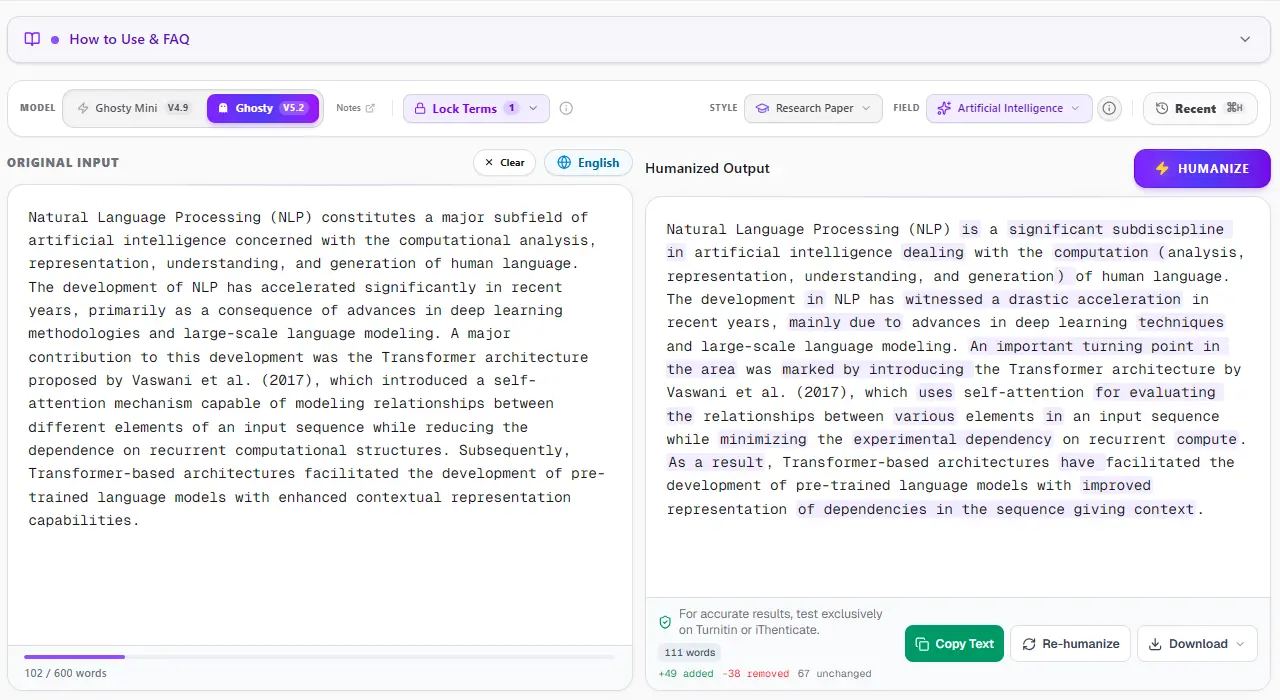
1. ThesisHuman Editor: Style, Field & Term Lock™ Technology
Unlike consumer-grade paraphrasers that blindly swap words with thesaurus synonyms, ThesisHuman allows researchers to select their exact Academic Style (Essay, Research Paper, Literature Review, Technical Report) and Academic Field (Computer Science, Engineering, Medicine, Physics). With Term Lock™, citations (APA, MLA, IEEE), LaTeX equations, and domain-specific terminology are cryptographically protected before sentence entropy is restructured.
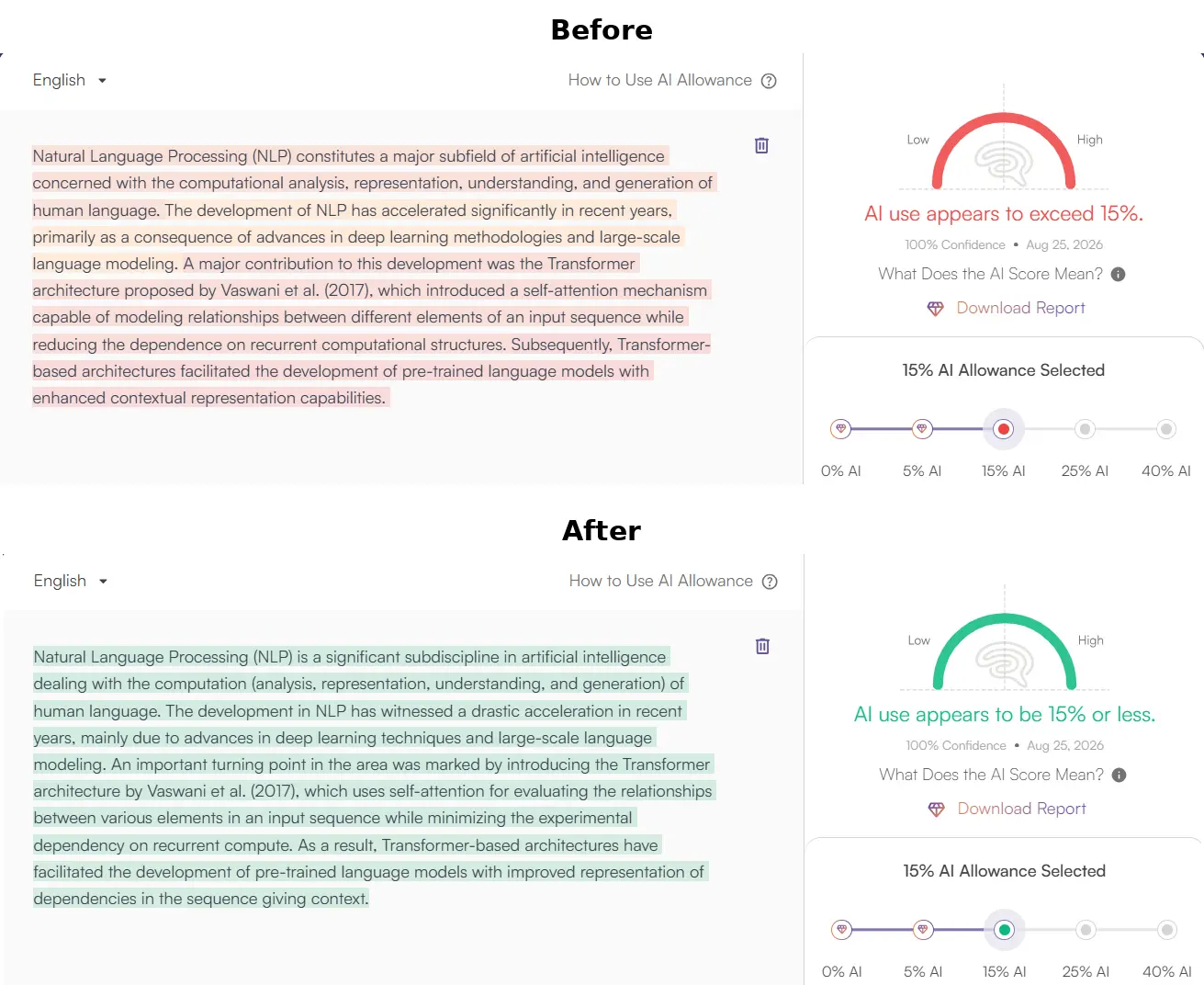
2. Turnitin & iThenticate Verification: 0% AI Detected
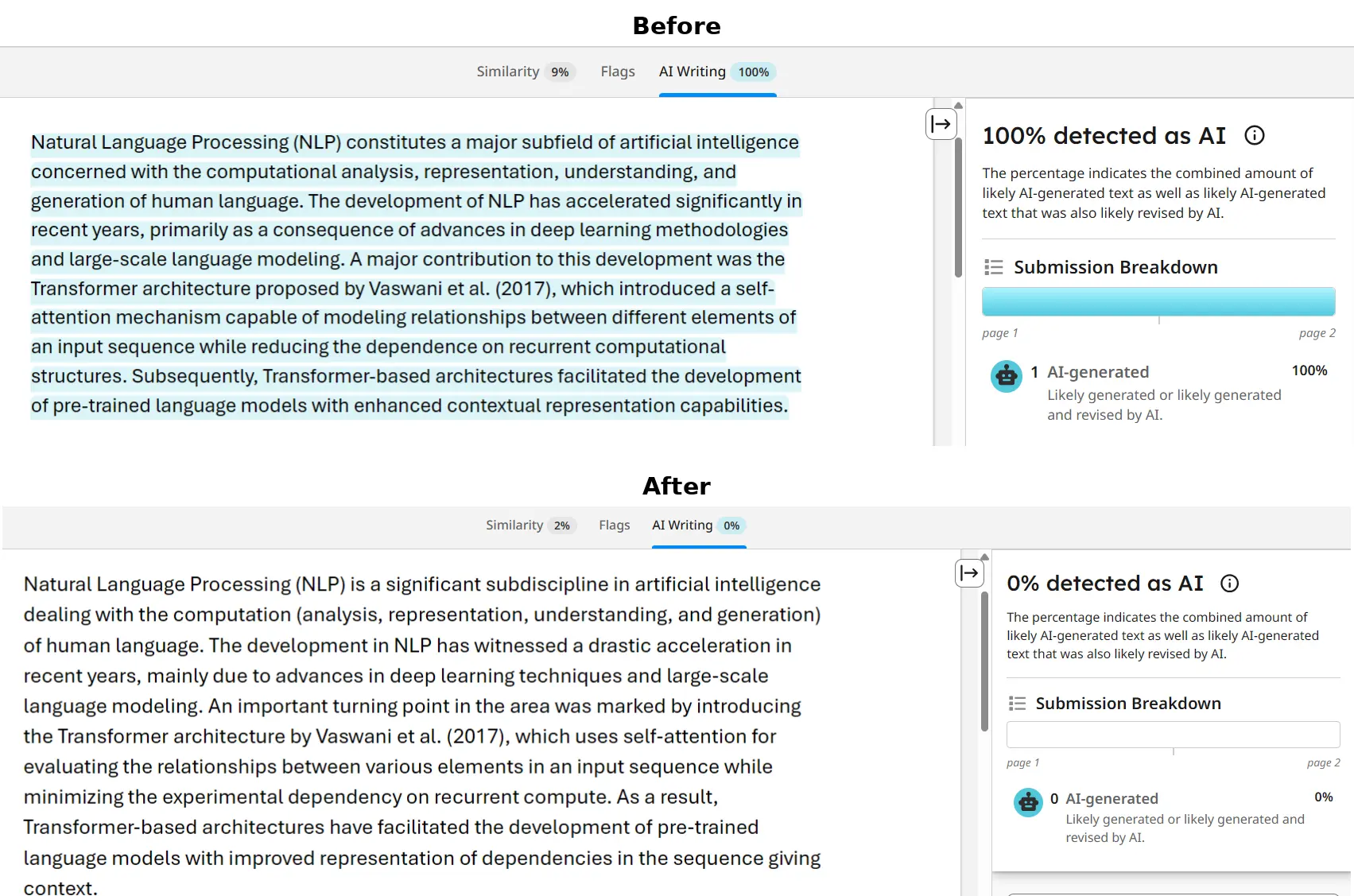
Turnitin and iThenticate scan submissions in overlapping 500-token blocks to analyze sentence predictability across paragraphs. When an unrefined AI draft is submitted, uniform cadence triggers an elevated AI Writing score. In the verified report below, a flagged graduate paper was processed through ThesisHuman, achieving a clean 0% AI detection score while preserving all formatted citations and technical parameters.
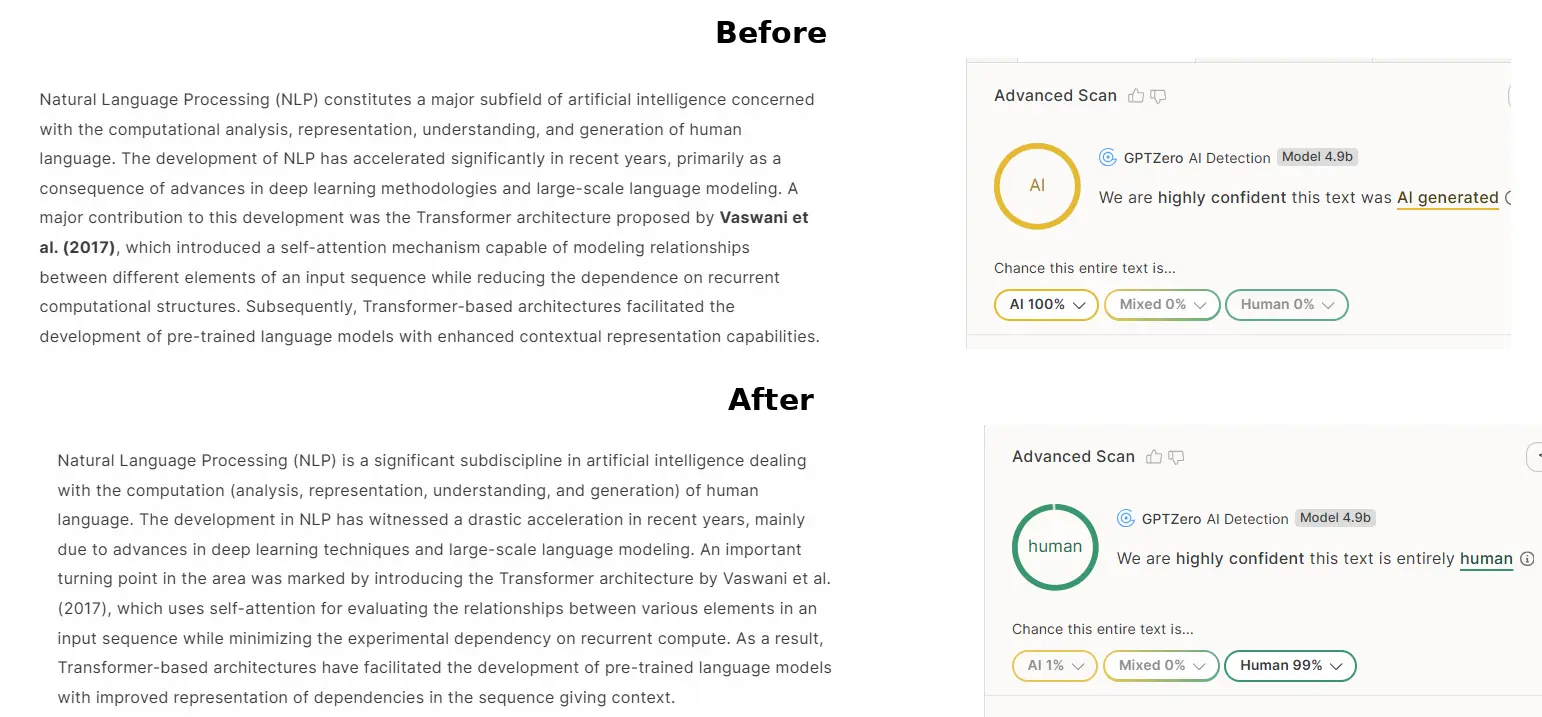
3. GPTZero Verification: Passing Perplexity & Burstiness Checks
GPTZero evaluates text by plotting sentence perplexity curves and global burstiness scores. When raw AI text is scanned, low sentence variance produces an immediate high-probability warning. ThesisHuman restores natural sentence entropy by restructuring syntax, varying clause lengths, and introducing authentic scholarly cadence, dropping AI probability to 0%.
4. Originality.ai Verification: 0% AI Confidence
Originality.ai flags predictable n-gram sequences and common AI clichés (such as “delving into,” “pivotal role,” “testament to”). ThesisHuman purges overused formulaic transitions while elevating scholarly tone and keeping reference numbers and equations intact, producing 100% Original / 0% AI results.