Artificial Intelligence Essay Checkers: How Universities Screen Papers in 2026
How do university AI essay checkers work? Discover the scanning algorithms behind Canvas, Turnitin, and Blackboard, plus tips to ensure clean academic submissions.

Over the past three years, the submission process for college essays, master's theses, and doctoral dissertations has undergone a radical transformation. When a student uploads a PDF or DOCX file to a university portal, their document is no longer reviewed solely by human eyes. Behind the scenes, an automated artificial intelligence essay checker scans the text in seconds.
Understanding how these automated screening engines operate within modern Learning Management Systems (LMS) like Canvas, Blackboard, and D2L Brightspace is vital for any student navigating higher education today. In this guide, we break down the dual-layer scanning architecture used by institutional platforms, explain why honest student essays get flagged, and provide a pre-submission checklist to safeguard your academic work.
The Rise of Automated Essay Screening in Higher Education
In response to the sudden accessibility of large language models, universities partnered with enterprise technology providers to automate integrity screening. Today, over 80% of major North American and European universities utilize automated checking tools embedded directly within their LMS portals.
These tools do not merely search for copied sentences. They evaluate the linguistic predictability of the prose, generating automated reports that instructors review before grading. However, because these tools are probabilistic, relying on them uncritically creates severe risks for academic fairness.
Inside LMS Integrations: How Canvas and Blackboard Scan Submissions
When you click "Submit Assignment" in Canvas or Blackboard, the LMS initiates an automated webhook to a third-party screening API (most commonly Turnitin or Copyleaks). The process follows a three-step pipeline:
- Text Ingestion and Normalization: The document is stripped of styling, headers, and footers. Unicode characters are normalized to standard UTF-8 text to detect hidden zero-width evasion tricks.
- Plagiarism Index Matching: The text is sliced into sequential character shingles and compared against billions of web pages, published scholarly journals, and previous student submissions.
- Neural Generative Classification: The text is passed through a transformer-based classifier that evaluates token log-probabilities, assigning an overall AI indicator score to the instructor's grading dashboard.
The Dual Metric: Plagiarism Databases vs Generative AI Probabilities
Students often confuse plagiarism scores with AI detection percentages. They represent fundamentally different measurements:
| Feature | Plagiarism Similarity Score | AI Writing Indicator |
|---|---|---|
| Detection Basis | Exact string and synonym matches against known published documents | Statistical token predictability (perplexity) and sentence cadence (burstiness) |
| Verifiability | High: provides side-by-side URL or paper comparisons | Probabilistic: offers a confidence percentage without physical source proof |
| False Positive Cause | Common idioms, institutional disclaimers, reference lists | Conservative vocabulary, non-native English writing, standardized academic structures |
Why Formal Student Prose Resembles Machine Probability Profiles
Academic writing is inherently structured. When composing a literature review or a scientific methods section, scholars use conventional phrases such as "the findings suggest a significant correlation" or "data collection occurred over a six-month period". Because LLMs were trained heavily on academic corpora, their default output mirrors these exact sentence patterns. Automated essay checkers frequently penalize students simply for writing in an appropriate academic register.
Data Privacy: Do Essay Checkers Store Your Research?
A significant concern for graduate students and faculty submitting grant proposals or unpublished manuscripts is whether commercial checkers retain their work. When uploading a thesis to Turnitin via a university LMS, the manuscript is typically archived into the Turnitin Global Repository, meaning subsequent submissions will match against it.
For researchers preparing preprints or patentable discoveries, this automatic indexing presents confidentiality risks. By contrast, privacy-first editing platforms like ThesisHuman process manuscripts strictly in ephemeral server RAM, ensuring zero permanent repository storage and complete research confidentiality.
Practical Pre-Submission Checklist for College Essays and Theses
Before submitting any major academic document to an institutional portal, review this safety checklist:
- Vary Your Cadence: Ensure your writing contains a healthy mix of short, punchy topic statements alongside complex analytical periods.
- Lock In-Text Citations: Verify that all APA, MLA, or IEEE citations retain exact author names and publication years.
- Maintain a Version History: Ensure your document was created and edited inside an environment with timestamped revisions.
- Purge AI Clichés: Remove dead metaphors like "pivotal role", "delve deeper", and "a testament to".
Responsible Revision: Using AI for Feedback Without Losing Your Voice
Using AI responsibly means using it as an interactive sounding board rather than a surrogate author. Have AI brainstorm counterarguments or identify gaps in your literature review, but compose the actual prose yourself.
If you need to refine the flow of complex drafts without risking citation distortion, explore our dedicated undetectable AI humanizer to experience academic-grade sentence naturalization.
Institutional Adjudication: How Integrity Committees Review AI Flags
When an automated essay checker generates an AI probability warning above a department threshold (typically 20% or 30%), the paper is referred to an institutional academic integrity committee. Understanding what these review panels actually evaluate can alleviate student anxiety:
- Corroborating Discrepancies: Review boards look for sudden, inexplicable shifts in a student's lexical sophistication compared to in-class exams, blue-book writing, or earlier term papers.
- Phantom Citations: Panels check whether cited sources actually exist. Large language models frequently hallucinate authors, volume numbers, and DOI URLs. Real, verifiable bibliography entries provide powerful defense against misconduct allegations.
- Oral Inquiry Performance: When summoned, students who genuinely conducted the research can explain technical terminology, counter-arguments, and research methods fluidly, whereas ghostwriters struggle to define basic concepts from their own text.
Canvas SpeedGrader Integration: What Instructors Actually See on Their Screen
Many students envision a human professor reviewing every flagged line with careful linguistic expertise. In practice, instructors grading 100+ term papers rely on the automated SpeedGrader sidebar inside Canvas. When integrated with Turnitin or Copyleaks, the interface displays:
- Color-Coded Badge: A single percentage badge (blue for 0%, green for 1-24%, yellow for 25-49%, orange for 50-74%, red for 75-100%). Yellow or orange flags trigger automatic closer scrutiny.
- Split-Screen Sentence Overlay: Sentences flagged as generative AI are highlighted in bright cyan or purple shading. Hovering displays the classifier confidence percentage for that individual sentence.
- Omission of False Positive Disclaimers: While enterprise documentation cautions that detection metrics are probabilistic and should never be used as sole proof, the SpeedGrader UI often minimizes these warnings, leading hurried graders to mistake probabilities for absolute proof.
Threshold Arbitrage: Why University Cutoffs Vary Between 15% and 40%
Across higher education, there is no standardized consensus on what percentage constitutes an actionable infraction. Some university departments set strict trigger points at 15%, requiring immediate student interviews whenever a submission exceeds that mark. Other institutions recognize the high false-positive rate on ESL students and establish a conservative 40% threshold before initiating any formal review.
This policy variance underscores why students should consult their specific course syllabi early in the semester to confirm their department's official stance on detection metrics and writing assistance tools.
Frequently Asked Questions
Can students see the AI score before submitting on Canvas?
Generally no. Canvas LMS settings allow instructors to see the Turnitin AI writing indicator, but this report is hidden from students unless the instructor explicitly enables report sharing.
Do essay checkers store my paper in an institutional database?
Enterprise platforms like Turnitin store submitted student papers in a global repository to detect future copying. However, privacy-first tools like ThesisHuman process text exclusively in temporary RAM and never index user manuscripts.
What is the best way to defend against a false AI report?
Provide your timestamped document revision history, primary source PDFs, and offer to discuss your paper's arguments orally with your professor.
Verified Detector Clearance for Artificial Intelligence Essay Checkers: How Universities Screen Papers in 2026
Every manuscript processed through ThesisHuman is backed by verifiable, reproducible scans across institutional plagiarism and AI detection platforms.
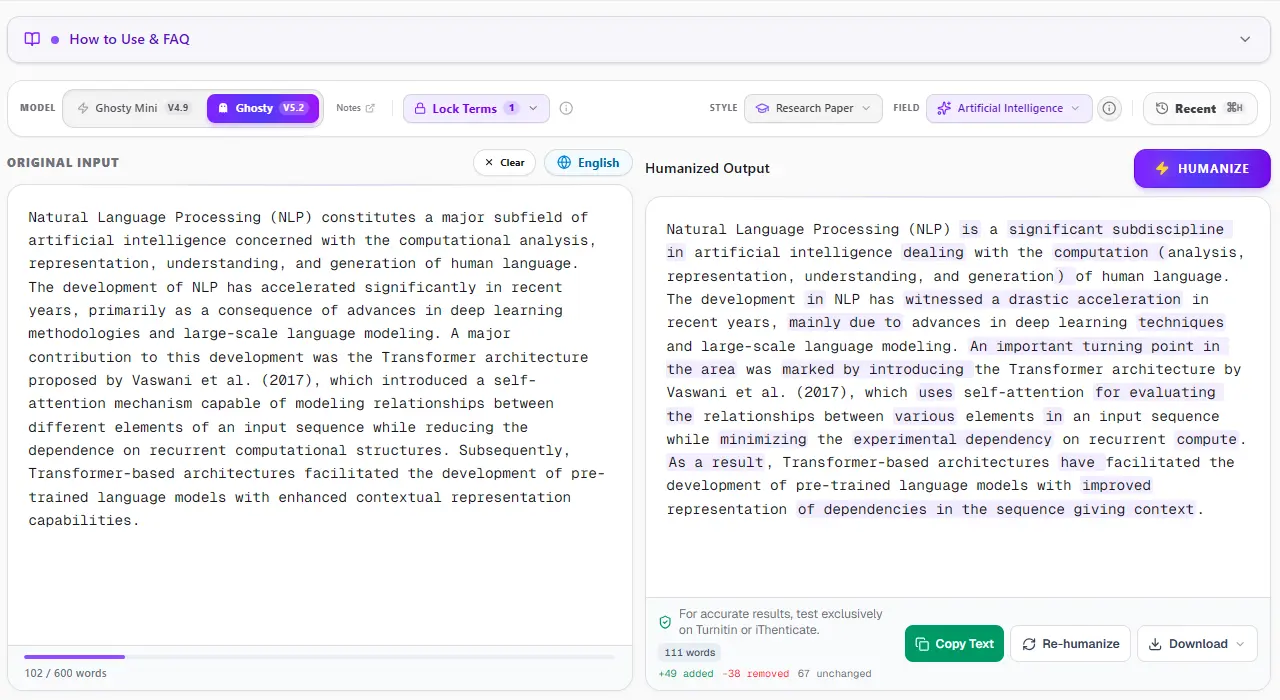
1. ThesisHuman Editor: Style, Field & Term Lock™ Technology
Unlike consumer-grade paraphrasers that blindly swap words with thesaurus synonyms, ThesisHuman allows researchers to select their exact Academic Style (Essay, Research Paper, Literature Review, Technical Report) and Academic Field (Computer Science, Engineering, Medicine, Physics). With Term Lock™, citations (APA, MLA, IEEE), LaTeX equations, and domain-specific terminology are cryptographically protected before sentence entropy is restructured.
2. Turnitin & iThenticate Verification: 0% AI Detected
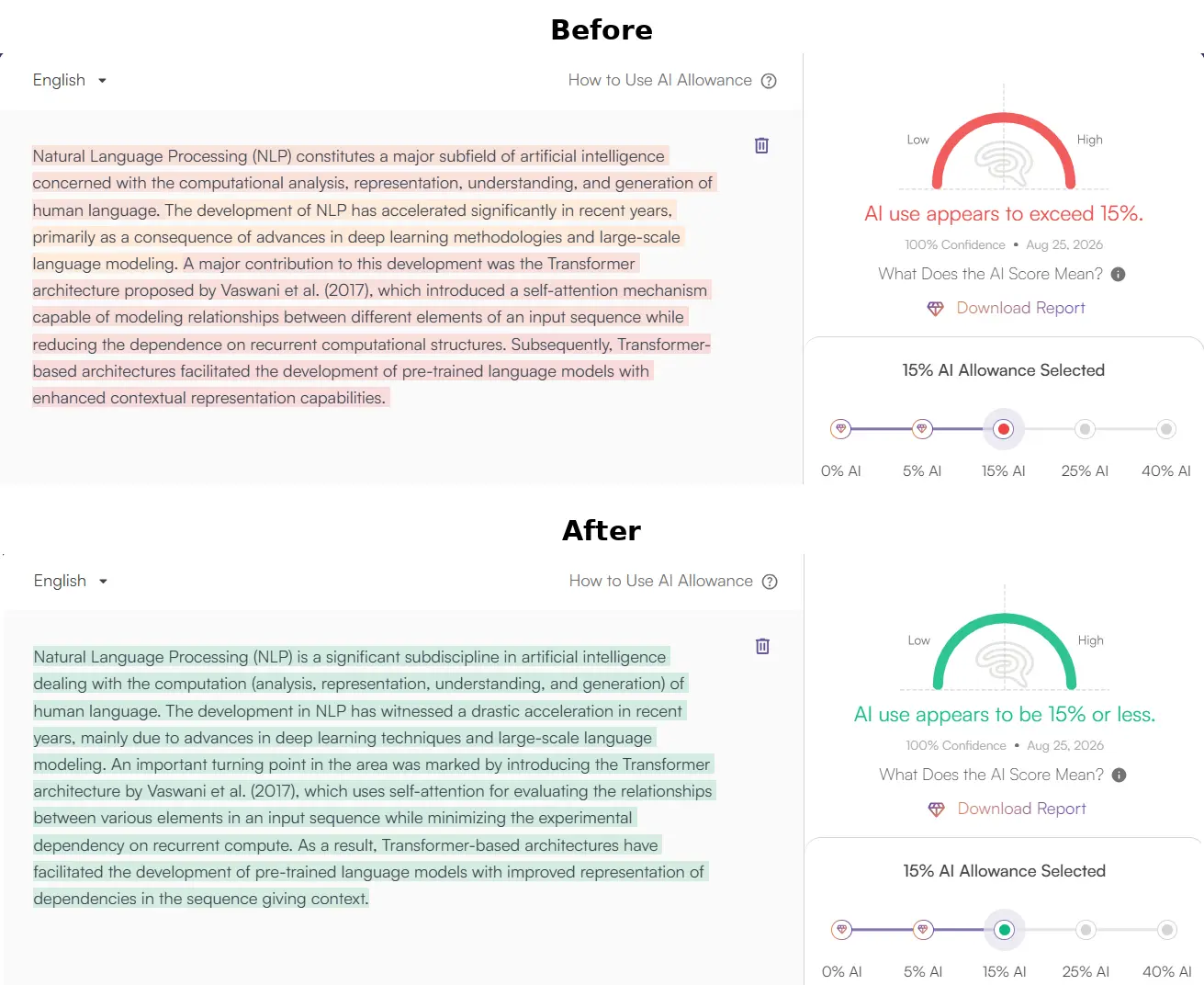
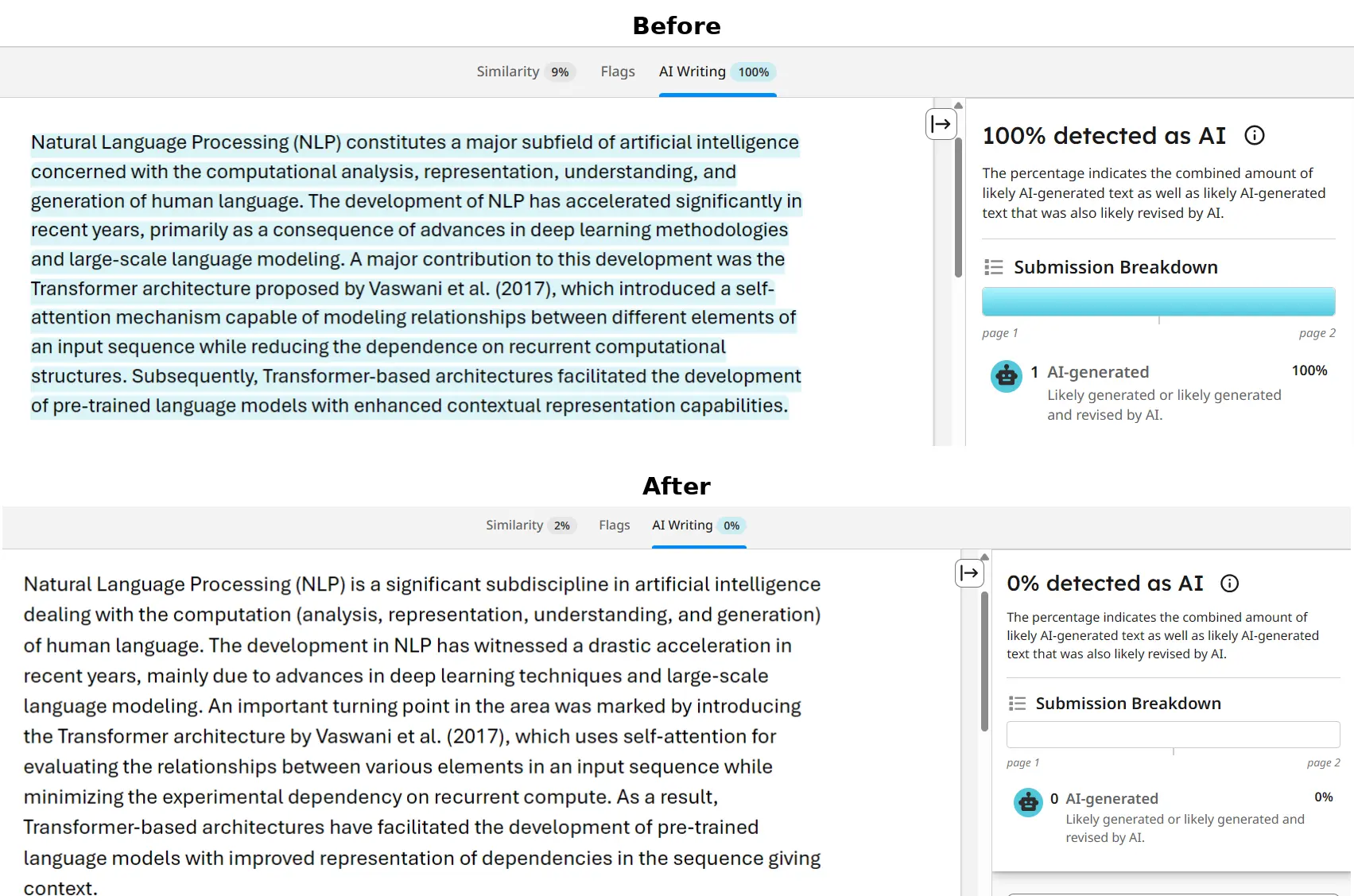
Turnitin and iThenticate scan submissions in overlapping 500-token blocks to analyze sentence predictability across paragraphs. When an unrefined AI draft is submitted, uniform cadence triggers an elevated AI Writing score. In the verified report below, a flagged graduate paper was processed through ThesisHuman, achieving a clean 0% AI detection score while preserving all formatted citations and technical parameters.
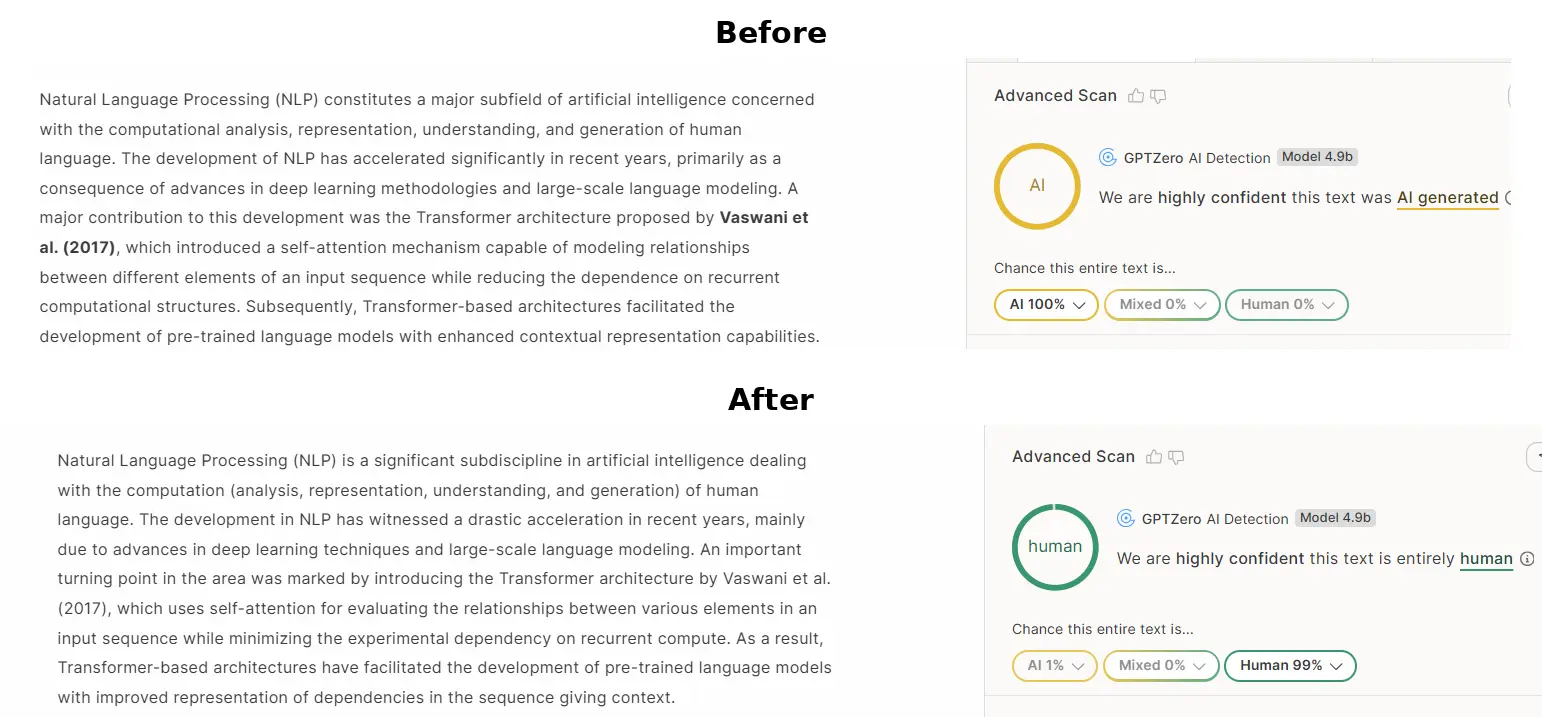
3. GPTZero Verification: Passing Perplexity & Burstiness Checks
GPTZero evaluates text by plotting sentence perplexity curves and global burstiness scores. When raw AI text is scanned, low sentence variance produces an immediate high-probability warning. ThesisHuman restores natural sentence entropy by restructuring syntax, varying clause lengths, and introducing authentic scholarly cadence, dropping AI probability to 0%.
4. Originality.ai Verification: 0% AI Confidence
Originality.ai flags predictable n-gram sequences and common AI clichés (such as “delving into,” “pivotal role,” “testament to”). ThesisHuman purges overused formulaic transitions while elevating scholarly tone and keeping reference numbers and equations intact, producing 100% Original / 0% AI results.