How Many Sentences Are in a Paragraph? Academic Writing Guide
Discover how many sentences belong in an academic paragraph, why no universal rule exists, how disciplinary norms shape paragraph length, and how to structure clear arguments.

In academic writing, an effective paragraph typically contains between three and eight sentences, generally totaling between 75 and 200 words. However, no universal style guide or grammatical rule dictates an immutable sentence count. A paragraph is fundamentally a unit of thought, not an arbitrary numerical quota. In scholarly essays, journal manuscripts, and dissertations, the proper length of any paragraph is determined by the complexity of the argument it presents, the evidence required to support that argument, and the cognitive needs of the reader.
While beginners are often taught that every paragraph must contain exactly five sentences, advanced scholarly communication demands flexibility. A paragraph must be long enough to introduce, substantiate, and interpret an academic claim, yet focused enough to prevent confusion. This guide examines how academic paragraphs function, how disciplinary norms shape paragraph length, when single-sentence paragraphs are justified, and how to use systematic revision frameworks to ensure every paragraph fulfills its intellectual objective.
The Myth of the Universal Sentence-Count Rule
Many novice writers assume that a paragraph has an exact mathematical definition. In secondary classrooms, instructors frequently teach the five-sentence model: one topic sentence, three supporting detail sentences, and one concluding sentence. While this scaffolding helps emerging writers organize thoughts linearly, university scholarship requires greater nuance.
Academic arguments vary substantially in scope. Introducing a theoretical framework in political philosophy demands extensive conceptual elaboration, whereas documenting an empirical measurement in a laboratory experiment requires concise precision. Forcing diverse ideas into an identical five-sentence mold leads writers to pad simple claims with filler or truncate complex analyses before reaching a defensible conclusion.
Major style manuals like The Chicago Manual of Style, APA 7, and MLA 9 define paragraphs by conceptual coherence rather than sentence count. If a paragraph achieves complete development in four sentences, adding a fifth merely satisfies an imaginary quota while diluting clarity. Conversely, if synthesizing multiple empirical studies requires seven sentences, forcing an artificial split disrupts logical continuity.
The Anatomical Structure of an Academic Paragraph
Successful scholarly writing relies on dependable structural components. Writing centers frequently recommend organizational models such as the MEAL framework (Main idea, Evidence, Analysis, Link) or the PIE model (Point, Information, Explanation). Understanding these core components enables authors to determine paragraph length by functional necessity.
1. The Topic Sentence and Controlling Idea
The topic sentence establishes the conceptual boundaries of the paragraph. An effective topic sentence articulates a controlling idea that reflects the author's argument. Stating that "aging municipal water infrastructure in post-industrial cities concentrates lead pipe exposure in marginalized districts" provides a clear controlling claim that governs every subsequent sentence.
2. Supporting Evidence and Contextual Data
Following the topic sentence, the author substantiates the claim with empirical evidence, textual quotations, or citations to peer-reviewed literature. Depending on the complexity of the claim, presenting evidence typically requires one to three sentences. Authors must contextualize cited data so readers understand its origin and methodological relevance.
3. Critical Analysis and Interpretation
The analytical stage is where original scholarship occurs. Facts rarely speak for themselves; the author must explain how the evidence substantiates the topic sentence, reconcile apparent discrepancies, or demonstrate how findings challenge existing models. This analytical bridge typically requires two to three sentences and forms the substantive core of the paragraph.
4. The Concluding Synthesis or Transition
The final sentence synthesizes the discussion or creates a logical bridge to the following section. Rather than simply repeating the topic sentence, an effective concluding sentence explains the broader significance of the finding or links the current premise to the subsequent paragraph.
The MEAL Framework in Action: Before and After
To illustrate how functional components dictate paragraph length, consider the contrast between an underdeveloped draft and a fully realized academic paragraph applying the MEAL model.
Underdeveloped Paragraph (Too Short: 2 Sentences, 41 Words)
Remote work policies have significantly altered organizational communication across corporate sectors. Studies show that employees communicate less frequently with colleagues outside their immediate project teams, which threatens long-term innovation.
This opening draft leaves critical questions unanswered: Which studies established this finding? What mechanism causes communication breakdowns? Why does cross-team communication influence innovation? The paragraph feels abrupt because it presents assertions without analytical interpretation.
Fully Developed Academic Paragraph (Balanced: 5 Sentences, 126 Words)
The widespread adoption of remote work arrangements has fundamentally altered cross-departmental communication architectures. In a longitudinal study of 61,000 knowledge workers, Yang et al. (2022) observed that distributed collaboration became significantly more siloed, resulting in a 25 percent reduction in spontaneous interactions between distinct business units. This structural contraction limits the transmission of novel information across informal organizational networks. Without cross-functional exposure, research teams frequently duplicate exploratory inquiries rather than building upon discoveries generated in parallel departments. Consequently, sustaining organizational creativity requires deliberate institutional mechanisms that recreate informal interdisciplinary encounters within digital workspaces.
In this revised version, each sentence performs a distinct role: introducing the shift, supplying attribution, analyzing mechanisms, identifying consequences, and synthesizing solutions.
Short versus Long Paragraphs: Managing Cognitive Load
Managing paragraph length is essential for regulating cognitive load. When readers encounter academic text, visual formatting directly influences comprehension. Both excessively short and excessively long paragraphs create distinct reading obstacles.
The Hazards of Fragmented Paragraphs
A manuscript populated by rapid successions of two-sentence paragraphs reads like journalistic commentary rather than sustained scholarship. Fragmented paragraphs force readers to jump between disjointed premises before arguments reach analytical maturity, obscuring the hierarchy between major findings and supporting details.
The Dangers of Exhaustive Monoliths
Monolithic paragraphs exceeding 250 to 300 words induce visual fatigue and cognitive overload. When a single paragraph contains multiple sub-arguments, readers lose track of the primary claim, complicating citation and review.
| Paragraph Type | Sentence Range | Word Count | Primary Rhetorical Role |
|---|---|---|---|
| Introductory | 4 to 6 sentences | 100 to 180 words | Establishes academic context, outlines scope, presents thesis. |
| Standard Body | 4 to 8 sentences | 100 to 190 words | Presents controlling claim, cites data, provides analysis. |
| Methods | 2 to 5 sentences | 60 to 130 words | Documents exact procedural steps, cohorts, or apparatus. |
| Discussion | 5 to 9 sentences | 140 to 230 words | Synthesizes findings, reconciles literature, examines limits. |
| Concluding | 4 to 6 sentences | 100 to 170 words | Restates thesis in refined light, outlines broader impact. |
Disciplinary Variations: STEM vs. Humanities and Social Sciences
Appropriate paragraph length shifts depending on disciplinary customs. In STEM disciplines, clarity, reproducibility, and efficiency govern stylistic choices. Paragraphs in technical manuscripts often trend shorter, ranging between two and five sentences. In an experimental methods section, paragraphs serve procedural functions, describing an assay or model parameter with direct precision.
In the humanities and qualitative social sciences, arguments develop through interpretive synthesis, close textual reading, and rhetorical nuance. Scholars in history, literature, or sociology frequently write paragraphs comprising six to ten sentences, reaching 200 to 250 words. Analyzing archival manuscripts or philosophical claims requires contextualizing source material and contrasting viewpoints, making longer paragraphs necessary to sustain the analytical chain.
When a One-Sentence Paragraph May Be Appropriate
In formal empirical journal articles, one-sentence paragraphs are almost never permissible within methods, results, or literature reviews because claims require methodological evidence. However, in extended scholarly monographs, book reviews, or essayistic critique, an isolated single-sentence paragraph can serve as an effective rhetorical pivot.
Positioned between substantial analytical sections, a concise single sentence arrests the reader's attention, emphasizes a crucial conceptual transition, or poses an urgent research dilemma. For example, after pages documenting failed international treaties, an environmental policy scholar might write: "Despite three decades of diplomatic declarations, atmospheric carbon concentrations continue to accelerate." Placed on its own line, this statement delivers rhetorical impact that would be muted inside a larger block. Nonetheless, authors should use this technique sparingly.
Signs That a Paragraph Needs to Be Split
During drafting, writers often produce overgrown paragraphs that contain multiple competing arguments. Look for these four diagnostic warning signs during manuscript revision:
- Exceeding 250 Words: Any paragraph spanning more than a full double-spaced page should be scrutinized for multiple controlling ideas.
- Shifting Chronology or Scope: If the opening discusses historical precedents and the second half shifts to modern reforms, the text contains two distinct temporal frameworks requiring separate paragraphs.
- Contrasting Pivot Conjunctions: Words such as "in contrast," "nevertheless," or "conversely" appearing midway through a lengthy paragraph often signal that an opposing argument is beginning.
- Unrelated Secondary Evidence: Introducing a second study that addresses a different dimension of the problem belongs in its own dedicated paragraph.
Case Study: Properly Splitting an Overloaded Research Paragraph
Consider this draft from a public health study that combines clinical trial efficacy and cold-chain supply barriers into a single block:
Overloaded Monolith (Before Revision: 1 Paragraph, 114 Words)
Third-generation synthetic antimalarials demonstrated 96 percent parasite clearance in Phase III trials, showing minimal toxicity. These outcomes indicate that molecular targeting circumvents regional resistance. However, severe cold-chain logistics hurdles threaten operational deployment in rural clinics. Because the agent degrades above 4 degrees Celsius, distribution requires scarce solar refrigeration. Seasonal flooding also disrupts transit networks, while clinic staff lack standardized temperature monitoring. Until health ministries invest in decentralized cold-storage, these clinical advantages will remain inaccessible to vulnerable populations.
Dividing the text at the logical pivot ("However, severe cold-chain logistics hurdles...") produces two balanced, unified paragraphs:
Paragraph 1: Clinical Efficacy (After Revision: 2 Sentences, 44 Words)
Third-generation synthetic antimalarials demonstrated a 96 percent parasite clearance rate during Phase III trials while exhibiting minimal patient toxicity. These clinical outcomes indicate that synthetic molecular targeting provides a potent pharmacological mechanism to circumvent emerging regional resistance mutations.
Paragraph 2: Supply Chain Infrastructure (After Revision: 4 Sentences, 74 Words)
Despite these favorable clinical markers, severe cold-chain logistics hurdles threaten operational deployment across rural clinics. Because the active chemical agent degrades rapidly above 4 degrees Celsius, reliable distribution requires specialized solar refrigeration units that remain scarce in peripheral health posts. Seasonal flooding also disrupts regional transit networks, compromising supply continuity. Until health ministries invest in decentralized cold-storage infrastructure, these clinical therapies will remain largely inaccessible to vulnerable populations.
Step-by-Step Paragraph Revision Checklist
Before submitting an essay, thesis chapter, or research article, conduct a structural review of your paragraphs using this systematic checklist:
- Verify the Controlling Idea: Summarize the core claim in a single clause to confirm the paragraph contains one primary focus.
- Inspect the Opening Sentence: Ensure the first statement frames an argument rather than presenting an unmoored fact or quotation.
- Check Evidence Attribution: Verify that empirical claims cite peer-reviewed evidence, primary documents, or experimental data.
- Measure Analytical Balance: Ensure authorial analysis balances or exceeds descriptive evidence and quotations.
- Evaluate Sentence Length Variance: Alternate longer compound-complex sentences with direct statements to maintain reader engagement.
- Assess Visual Density: Aim for paragraphs that occupy between one-third and two-thirds of a standard double-spaced page.
- Confirm the Transition: Check that the final sentence connects logically to the premise of the subsequent paragraph.
Refining Sentence Rhythm and Flow with ThesisHuman
Crafting balanced academic paragraphs requires attention to rhythm, sentence complexity, and terminology. When revising dense research drafts, scholars frequently encounter passages that feel heavy or repetitive. Specialized drafting assistants like the ThesisHuman Editor help researchers polish syntax, eliminate passive bloat, and balance cadence without altering original meaning.
With Term Lock protecting citations and domain terminology, scholars can use our AI Sentence Rewriter to untangle awkward clauses, our AI Text Simplifier to enhance readability, or our Essay Rewriter to improve cohesion. For broader guidance, explore our articles on academic writing standards and how to write a strong thesis statement.
Frequently Asked Questions
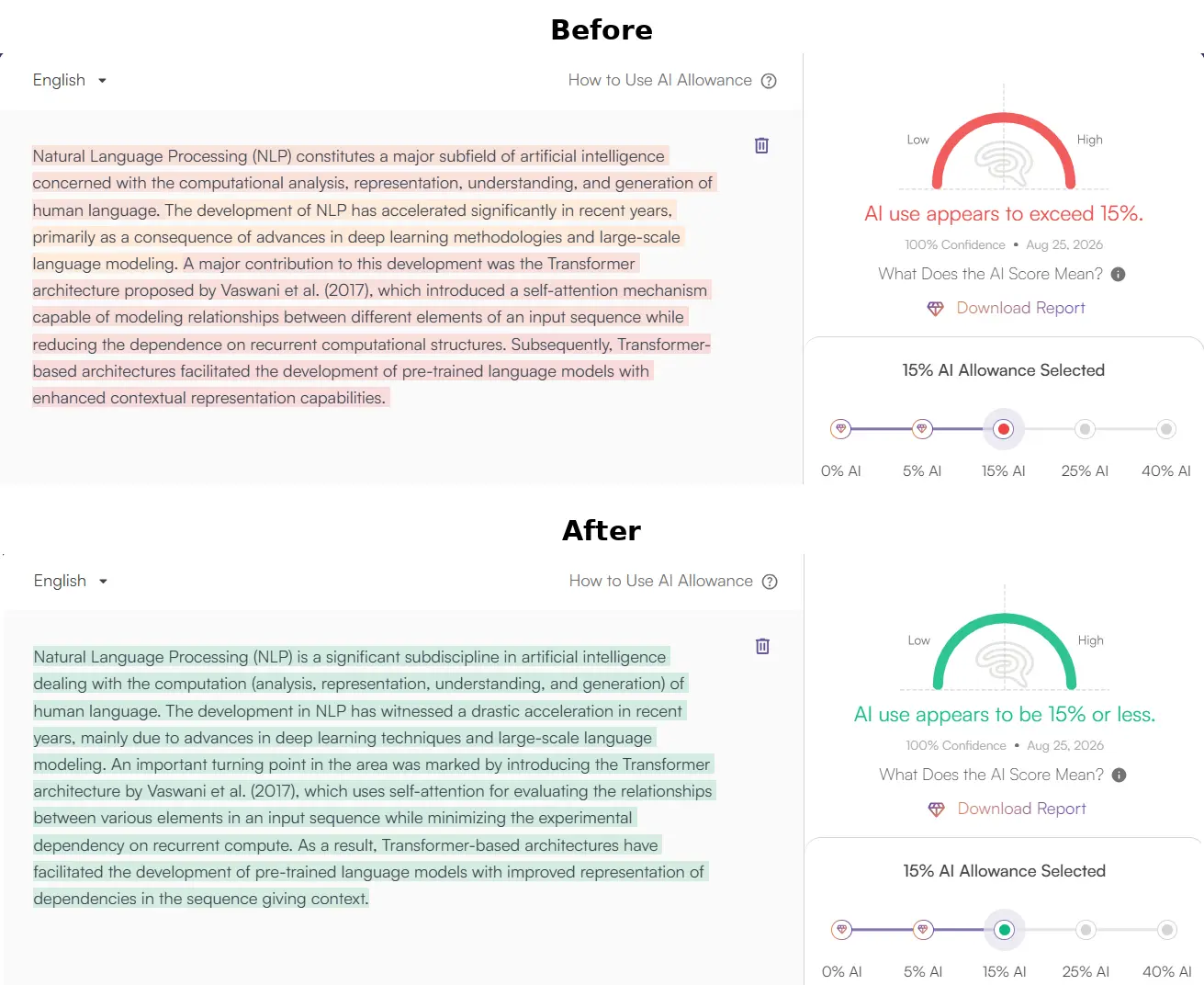
Verified Detector Clearance for How Many Sentences Are in a Paragraph? Academic Writing Guide
Every manuscript processed through ThesisHuman is backed by verifiable, reproducible scans across institutional plagiarism and AI detection platforms.
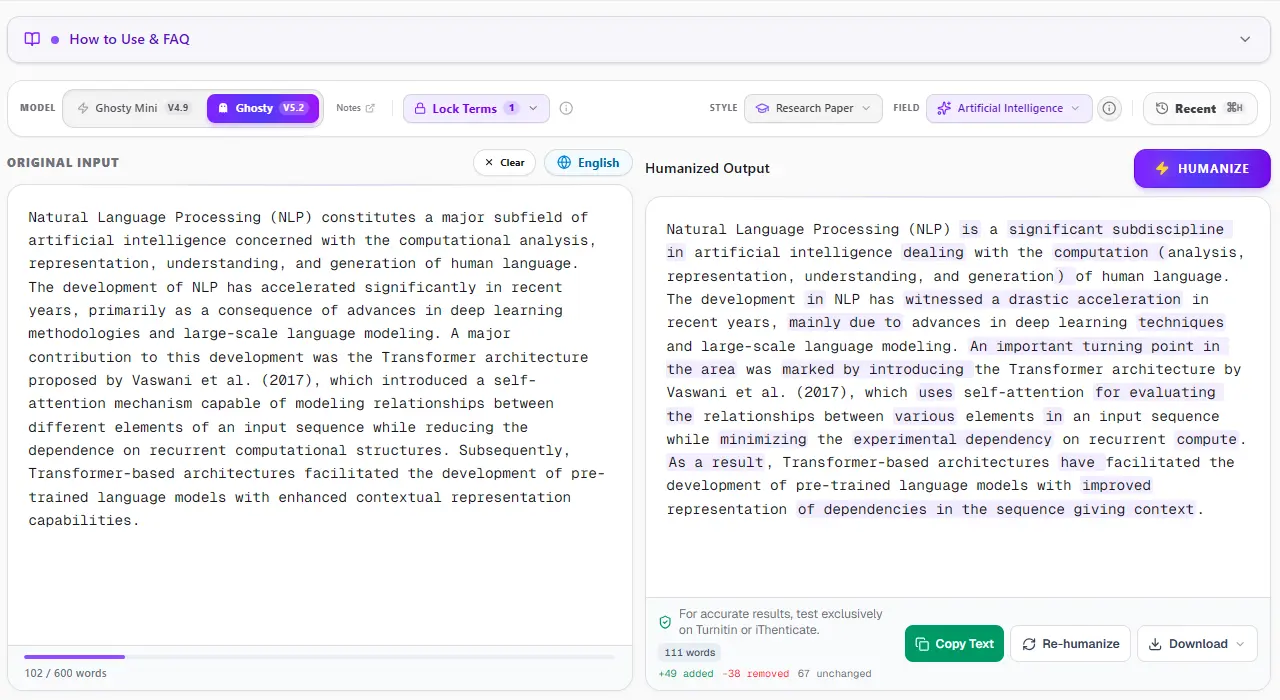
1. ThesisHuman Editor: Style, Field & Term Lock™ Technology
Unlike consumer-grade paraphrasers that blindly swap words with thesaurus synonyms, ThesisHuman allows researchers to select their exact Academic Style (Essay, Research Paper, Literature Review, Technical Report) and Academic Field (Computer Science, Engineering, Medicine, Physics). With Term Lock™, citations (APA, MLA, IEEE), LaTeX equations, and domain-specific terminology are cryptographically protected before sentence entropy is restructured.
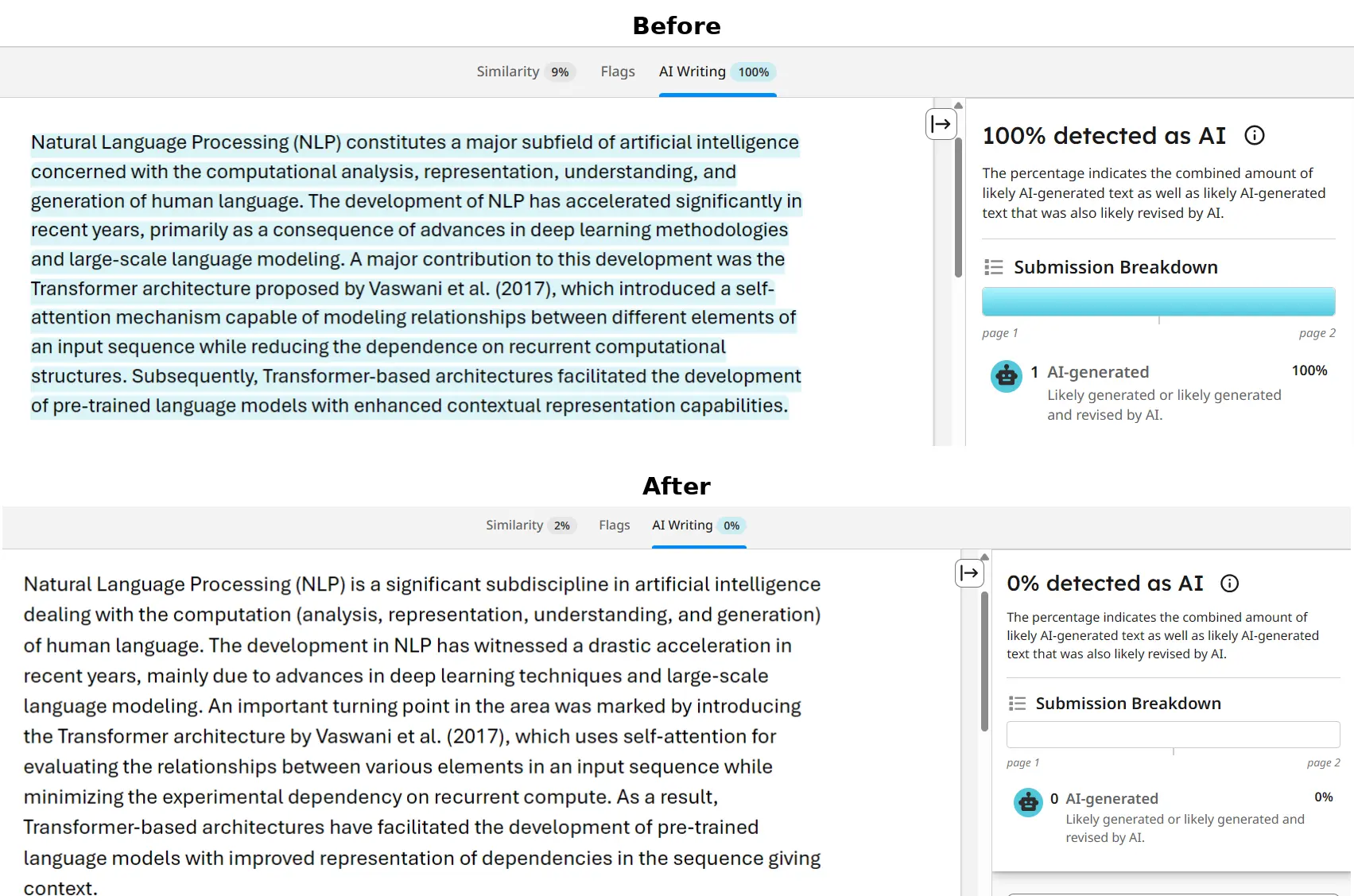
2. Turnitin & iThenticate Verification: 0% AI Detected
Turnitin and iThenticate scan submissions in overlapping 500-token blocks to analyze sentence predictability across paragraphs. When an unrefined AI draft is submitted, uniform cadence triggers an elevated AI Writing score. In the verified report below, a flagged graduate paper was processed through ThesisHuman, achieving a clean 0% AI detection score while preserving all formatted citations and technical parameters.
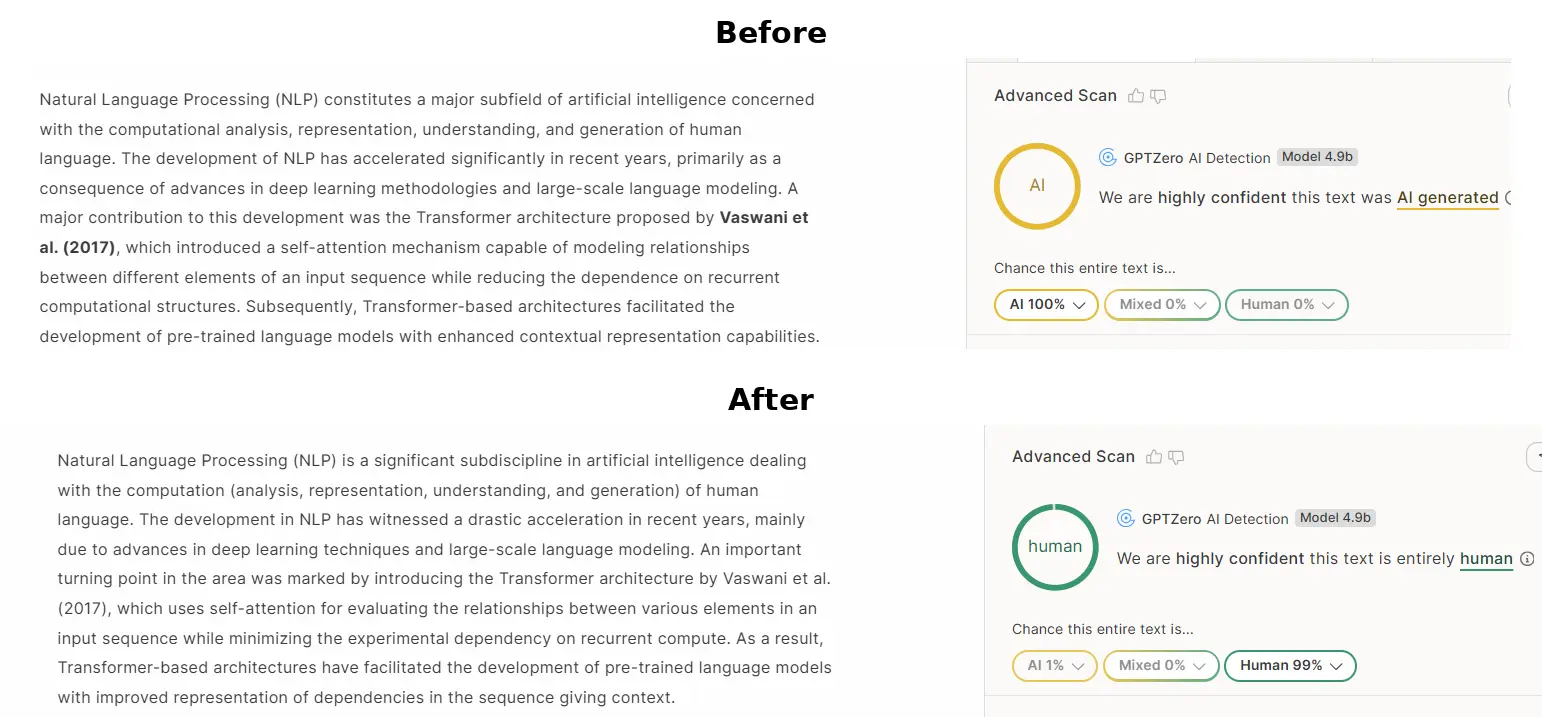
3. GPTZero Verification: Passing Perplexity & Burstiness Checks
GPTZero evaluates text by plotting sentence perplexity curves and global burstiness scores. When raw AI text is scanned, low sentence variance produces an immediate high-probability warning. ThesisHuman restores natural sentence entropy by restructuring syntax, varying clause lengths, and introducing authentic scholarly cadence, dropping AI probability to 0%.
4. Originality.ai Verification: 0% AI Confidence
Originality.ai flags predictable n-gram sequences and common AI clichés (such as “delving into,” “pivotal role,” “testament to”). ThesisHuman purges overused formulaic transitions while elevating scholarly tone and keeping reference numbers and equations intact, producing 100% Original / 0% AI results.