What Is a Comma Splice? Examples, Rules, and How to Fix It
Learn what a comma splice is, why it weakens scholarly prose, how to distinguish it from run-on sentences, and four reliable methods to repair it in academic writing.

A comma splice is a common grammatical error that occurs when two independent clauses are joined with only a comma and no coordinating conjunction. In standard formal English, a comma lacks the grammatical strength to unite two complete grammatical thoughts. When an author places a comma between two independent sentences without a coordinating word, the resulting punctuation fault creates cognitive confusion for readers and signals a lack of editorial precision to journal editors, peer reviewers, and faculty evaluation committees.
Comma splices frequently emerge in academic prose because researchers think in complex conceptual associations. When two findings or arguments are intimately related, writers instinctively connect them with a comma to reflect that conceptual proximity. However, grammatical structure must mirror formal syntactic rules rather than internal associative thought. This detailed guide defines the anatomy of a comma splice, explains why it weakens scholarly manuscripts, contrasts it with related punctuation errors, and demonstrates four reliable methods for repairing comma splices across academic disciplines.
Anatomy of an Independent Clause
To identify and resolve comma splices, writers must first understand what constitutes an independent clause. An independent clause is an autonomous syntactic unit containing a grammatical subject, a finite predicate verb, and a complete thought that can stand alone as a coherent sentence. Consider this straightforward example: "The laboratory sample reached thermal equilibrium." In this clause, "the laboratory sample" functions as the subject, "reached" serves as the finite verb, and "thermal equilibrium" completes the predicate. Because this expression forms a complete assertion, it can end with a period.
Now consider a second independent clause: "The researchers initiated spectrometer measurements." This sentence likewise contains an autonomous subject and finite verb. If an author connects these two clauses using only a comma ("The laboratory sample reached thermal equilibrium, the researchers initiated spectrometer measurements"), a comma splice occurs. Each clause possesses the syntactic completeness to stand alone; linking them with a simple comma violates standard punctuation mechanics.
Why Comma Splices Weaken Academic and Scholarly Prose
In professional and academic communication, punctuation functions as a navigational system that guides cognitive processing. A period signifies a full conceptual stop, signaling that a proposition is complete. A semicolon indicates an intimate conceptual partnership between two balanced assertions. A comma, by contrast, denotes a brief pause, introducing subordinate elements, separating items in a series, or setting off parenthetical qualifiers.
When a reader encounters a comma, their brain anticipates a dependent modifier, a qualifying phrase, or a coordinating conjunction. Encountering a completely new subject and predicate without warning forces the reader to perform a cognitive double-take, re-reading the sentence to determine where the primary assertion terminates. In peer-reviewed journal submissions, dissertation defenses, and grant applications, frequent comma splices distract reviewers from substantive empirical findings, creating an impression of hasty drafting or deficient syntactic mastery.
Comma Splices vs. Run-On Sentences vs. Compound Sentences
Students and researchers frequently confuse comma splices with other syntactic structures. Clarifying the precise distinction between these related sentence forms ensures accurate diagnosis and correction.
| Sentence Structure | Definition | Example | Status |
|---|---|---|---|
| Comma Splice | Two independent clauses joined by only a comma. | The survey closed early, response rates were high. | Incorrect in formal prose |
| Fused Sentence | Two independent clauses with zero punctuation. | The survey closed early response rates were high. | Incorrect in formal prose |
| Compound Sentence | Two clauses joined by comma and FANBOYS conjunction. | The survey closed early, but response rates were high. | Correct formal structure |
| Semicolon Compound | Two clauses linked by a semicolon. | The survey closed early; response rates were high. | Correct formal structure |
Both comma splices and fused sentences join independent clauses incorrectly. A fused sentence omits punctuation entirely. A comma splice attempts punctuation, but utilizes a comma where a stronger grammatical boundary is required.
Four Reliable Methods to Repair a Comma Splice
Fixing a comma splice does not require rewriting an entire paragraph. Writers have four established, grammatically sound options, each imparting a distinct rhetorical emphasis.
Method 1: Separate into Two Sentences with a Period
The most straightforward solution is to replace the faulty comma with a period (full stop), capitalizing the second clause. This method works best when both clauses are lengthy or represent distinct steps in an argument.
- Incorrect: The clinical trial completed its second phase, statistical analysis revealed significant cognitive gains.
- Corrected: The clinical trial completed its second phase. Statistical analysis revealed significant cognitive gains.
Method 2: Link Closely Related Clauses with a Semicolon
When two independent clauses express thoughts that are intimately connected, a semicolon provides an elegant bridge. It signals that the second statement directly elaborates on the first without creating an abrupt full stop.
- Incorrect: Qualitative interviews capture personal perspectives, quantitative surveys document widespread behavioral patterns.
- Corrected: Qualitative interviews capture personal perspectives; quantitative surveys document widespread behavioral patterns.
Method 3: Insert a Coordinating Conjunction (The FANBOYS Rule)
Authors can retain the comma by placing a coordinating conjunction immediately following it. The acronym FANBOYS recalls the seven options: For, And, Nor, But, Or, Yet, So.
- Incorrect: The simulation predicted turbulence, the test aircraft completed the corridor without incident.
- Corrected: The simulation predicted turbulence, yet the test aircraft completed the corridor without incident.
Method 4: Subordinate One Clause with a Subordinating Conjunction
By converting one independent clause into a dependent clause with words such as although, because, since, while, whereas, or if, you resolve the comma splice while elevating prose sophistication.
- Incorrect: The manuscripts suffered water damage during storage, researchers deciphered ninety percent of the text.
- Corrected: Although the manuscripts suffered water damage during storage, researchers deciphered ninety percent of the text.
The Conjunctive Adverb Trap: The "However" Fallacy
The most common cause of comma splices involves conjunctive adverbs such as however, therefore, moreover, furthermore, consequently, nevertheless, and thus. Writers often treat these as coordinating conjunctions, placing only a comma before them.
Conjunctive adverbs lack the grammatical capacity to join independent clauses. Standard academic punctuation requires a semicolon preceding the adverb and a comma immediately following it:
- Incorrect: The enzyme assay yielded rapid reaction rates, however, sample volatility hindered prolonged observation.
- Corrected (Semicolon): The enzyme assay yielded rapid reaction rates; however, sample volatility hindered prolonged observation.
- Corrected (Two Sentences): The enzyme assay yielded rapid reaction rates. However, sample volatility hindered prolonged observation.
Stylistic Exceptions in Creative Literature vs. Formal Research
Literary authors occasionally use deliberate comma splices. Historical translations like Julius Caesar's "I came, I saw, I conquered" unite brief clauses solely by commas. Modern novelists deploy splices to convey urgency or stream-of-consciousness thought.
In academic writing, however, stylistic comma splices are prohibited. Scholarly journals, dissertations, and institutional reports prioritize semantic precision and unambiguous syntactic hierarchy. Reviewers will catalog splices as mechanical errors requiring correction.
Academic Before-and-After Examples Across Four Disciplines
Review these four realistic disciplinary examples demonstrating common comma splices along with tailored repairs:
1. Physical and Chemical Sciences
Faulty Draft:
The catalyst increased conversion efficiency, reaction temperature exceeded the upper threshold within forty minutes.
Scholarly Revision (Subordination):
Although the catalyst increased conversion efficiency, the reaction temperature exceeded the upper operating threshold within forty minutes.
2. Quantitative Social Sciences
Faulty Draft:
Survey participants completed sixty demographic items, response fidelity declined significantly during the final battery.
Scholarly Revision (Coordinating Conjunction):
Survey participants completed sixty demographic items, but response fidelity declined significantly during the final battery.
3. Literary and Cultural Studies
Faulty Draft:
The protagonist rejects societal conformity through intentional isolation, her silence exposes aristocratic hypocrisy.
Scholarly Revision (Semicolon Connection):
The protagonist rejects societal conformity through intentional isolation; her silence exposes aristocratic hypocrisy.
4. Research Methodology
Faulty Draft:
Control subjects received an inert saline placebo, experimental participants received the target antibody infusion.
Scholarly Revision (Two Autonomous Sentences):
Control subjects received an inert saline placebo. Experimental participants received the target antibody infusion.
Three Common Comma Splice Misconceptions
Misunderstandings regarding sentence boundaries often lead writers to overcorrect or diagnose errors incorrectly:
- Misconception 1: Long Sentences Are Automatically Comma Splices. Sentence length does not determine grammatical validity. A grammatically sound sentence can span fifty words if it utilizes proper subordination. Conversely, a comma splice can consist of five words: "It rained, they walked."
- Misconception 2: Compound Predicates Require a Comma. When a single subject performs two verbs ("The committee reviewed the manuscript and approved the revision"), placing a comma before "and" is an error because the second clause lacks an independent subject.
- Misconception 3: Commas Simply Reflect Speech Pauses. Relying on vocal breathing patterns to determine comma placement is unreliable. Punctuation in scholarly prose is syntactic, governing grammatical relationships rather than speech acoustics.
Practice Exercise: Test Your Editing Skills
Test your ability to spot and repair comma splices in these four sample sentences. Review the prompt, formulate your correction, and check the provided explanation:
1. Exercise Sentence:
"The archive contains five thousand digitized manuscripts, few historians have examined the marginal commentary."
Diagnosis & Solution:
Comma splice. Both clauses contain independent subjects and verbs. Fix with a semicolon ("...manuscripts; few historians...") or by adding a conjunction ("...manuscripts, but few historians...").
2. Exercise Sentence:
"The model achieved high predictive validity, however, the sample size was too small to establish generalizability."
Diagnosis & Solution:
Conjunctive adverb comma splice. "However" cannot join independent clauses with a simple comma. Fix with a semicolon and comma ("...validity; however, the sample size...") or two sentences.
3. Exercise Sentence:
"Because the algorithm adjusts weights dynamically, convergence occurred within twenty iterations."
Diagnosis & Solution:
Correct sentence. The initial clause begins with the subordinating conjunction "Because," making it a dependent introductory clause correctly set off by a comma from the main clause.
4. Exercise Sentence:
"The temperature dropped below freezing, the crystallization process began almost immediately."
Diagnosis & Solution:
Comma splice. Both statements are independent. Fix by subordinating the condition ("When the temperature dropped below freezing, the crystallization process began almost immediately.") or using a period.
Polishing Sentence Architecture with ThesisHuman
Eliminating comma splices is part of developing a disciplined academic style. When refining dissertation chapters or journal submissions, authors must ensure sentence boundaries support clarity. Advanced writing assistants like the ThesisHuman Editor help scholars evaluate sentence rhythms, eliminate passive clunkiness, and rephrase awkward constructions while preserving citations and specialized terminology.
To refine complex compound arguments or dense clause structures, explore our targeted tools: use our AI Sentence Rewriter to restructure convoluted clauses, our AI Text Simplifier to untangle dense prose, and our companion guides on the defining features of academic writing and how many sentences belong in an academic paragraph.
Frequently Asked Questions
Verified Detector Clearance for What Is a Comma Splice? Examples, Rules, and How to Fix It
Every manuscript processed through ThesisHuman is backed by verifiable, reproducible scans across institutional plagiarism and AI detection platforms.
1. ThesisHuman Editor: Style, Field & Term Lock™ Technology
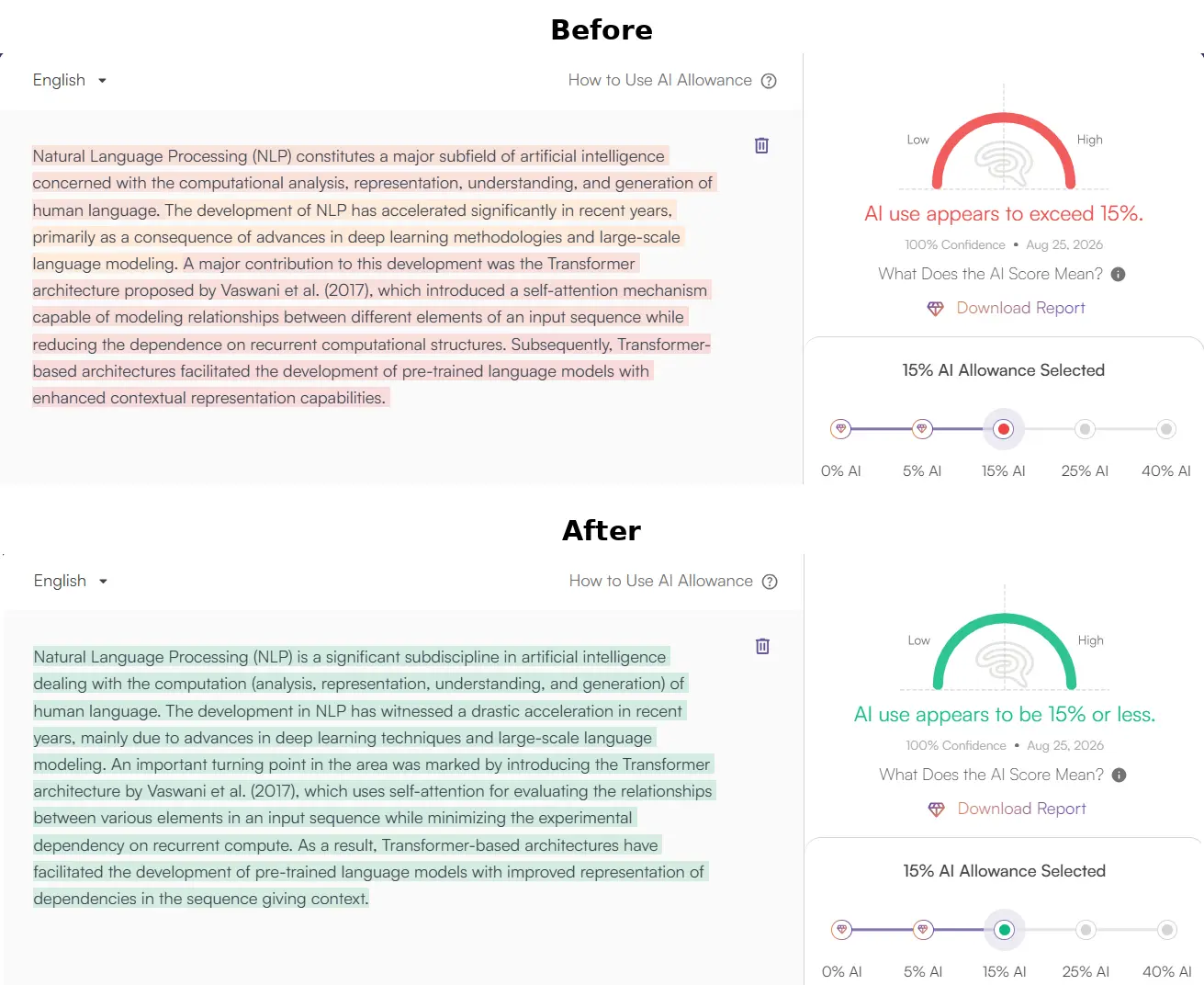
Unlike consumer-grade paraphrasers that blindly swap words with thesaurus synonyms, ThesisHuman allows researchers to select their exact Academic Style (Essay, Research Paper, Literature Review, Technical Report) and Academic Field (Computer Science, Engineering, Medicine, Physics). With Term Lock™, citations (APA, MLA, IEEE), LaTeX equations, and domain-specific terminology are cryptographically protected before sentence entropy is restructured.
2. Turnitin & iThenticate Verification: 0% AI Detected
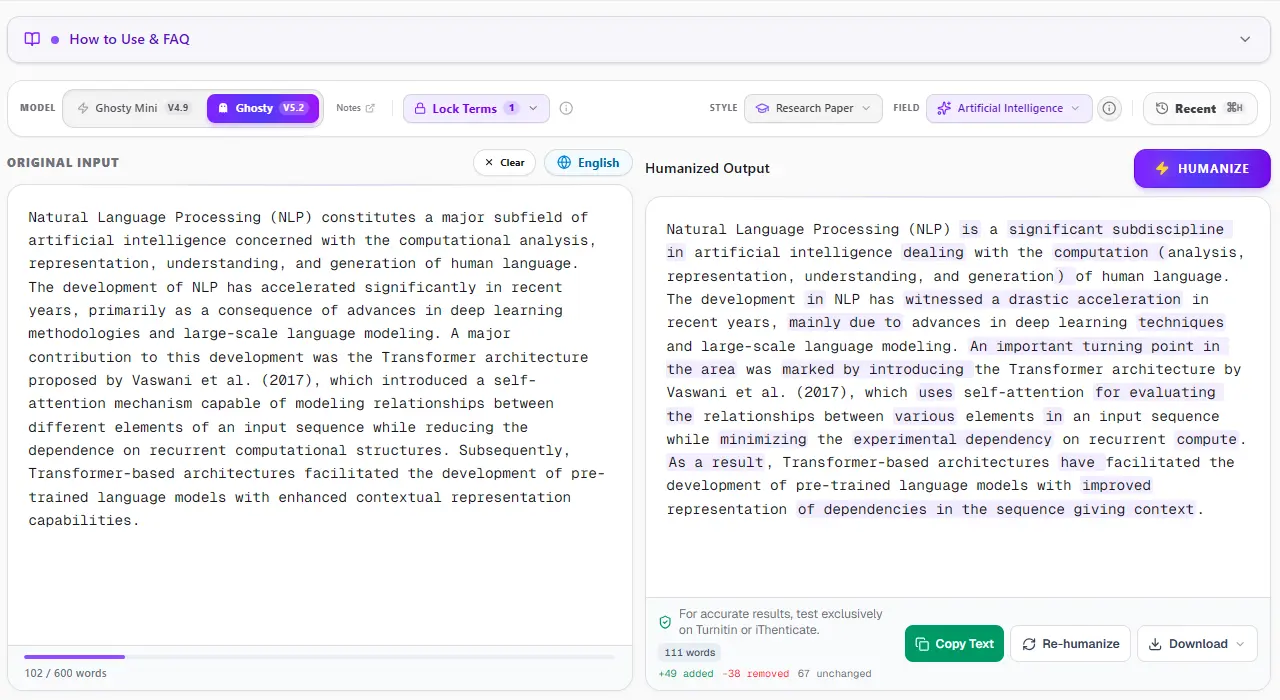
Turnitin and iThenticate scan submissions in overlapping 500-token blocks to analyze sentence predictability across paragraphs. When an unrefined AI draft is submitted, uniform cadence triggers an elevated AI Writing score. In the verified report below, a flagged graduate paper was processed through ThesisHuman, achieving a clean 0% AI detection score while preserving all formatted citations and technical parameters.
3. GPTZero Verification: Passing Perplexity & Burstiness Checks
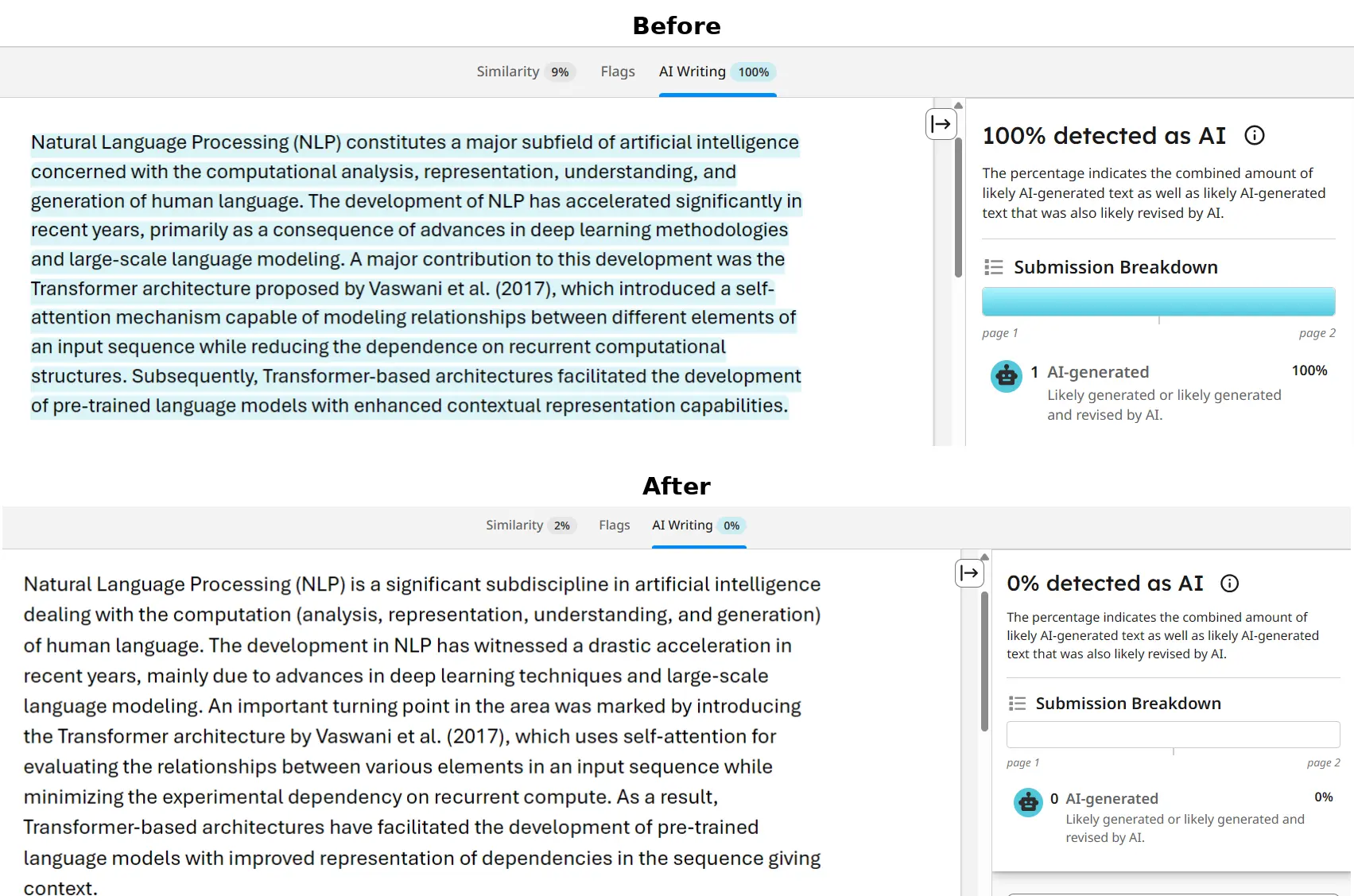
GPTZero evaluates text by plotting sentence perplexity curves and global burstiness scores. When raw AI text is scanned, low sentence variance produces an immediate high-probability warning. ThesisHuman restores natural sentence entropy by restructuring syntax, varying clause lengths, and introducing authentic scholarly cadence, dropping AI probability to 0%.
4. Originality.ai Verification: 0% AI Confidence
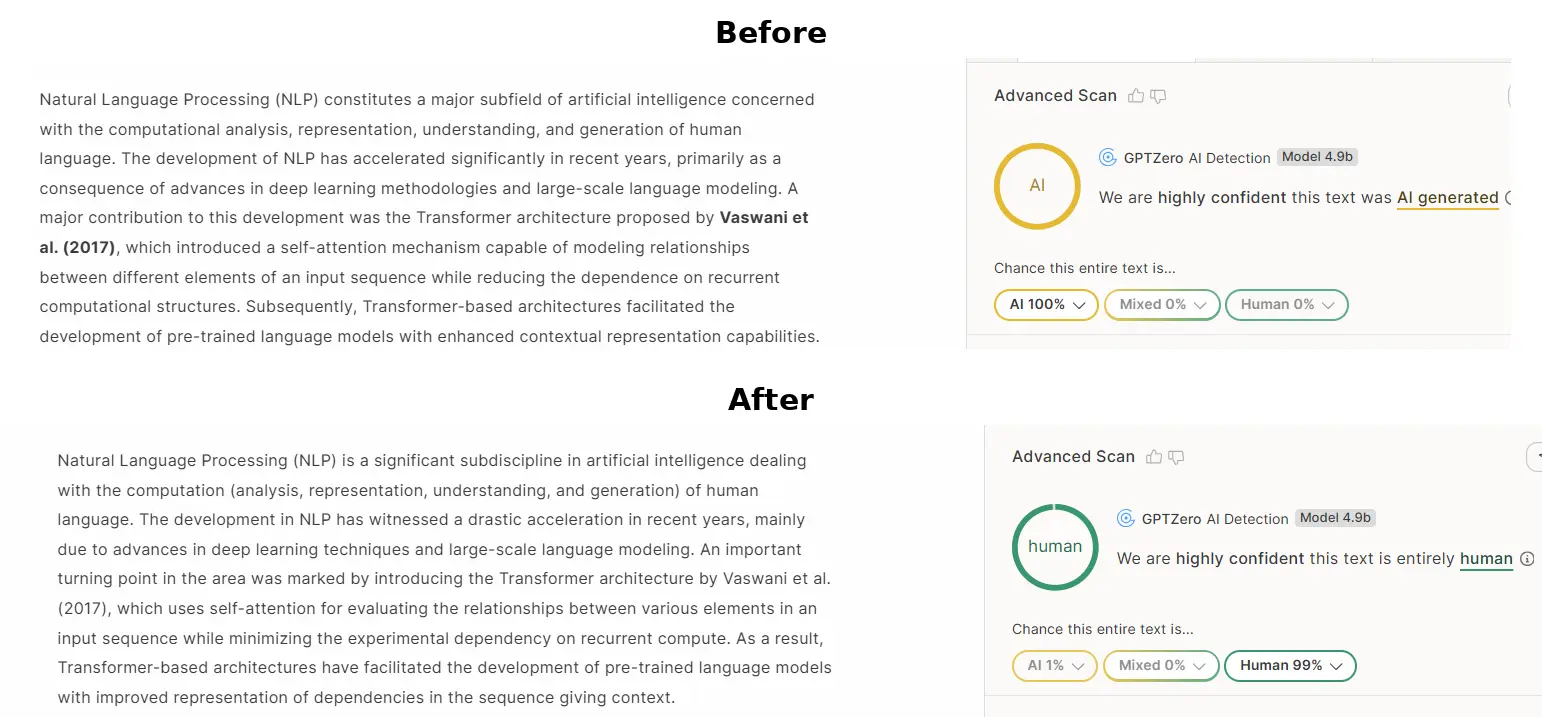
Originality.ai flags predictable n-gram sequences and common AI clichés (such as “delving into,” “pivotal role,” “testament to”). ThesisHuman purges overused formulaic transitions while elevating scholarly tone and keeping reference numbers and equations intact, producing 100% Original / 0% AI results.