Dissertation vs Thesis: Key Differences, Purpose, Structure, and Examples
Understand the differences between a dissertation and a thesis: examine US vs. UK conventions, degree levels, research scope, document structure, and defense formats.

In graduate education and academic research, few terminological distinctions generate as much cross-national confusion as the comparison between a dissertation and a thesis. Prospective master's students, doctoral candidates, and international researchers routinely encounter conflicting definitions, varied institutional guidelines, and regional conventions that appear directly contradictory at first glance.
A major source of this confusion is the historical divergence between the higher education systems of North America and those of the United Kingdom, Europe, and the Commonwealth. In the United States and Canada, a master's degree typically culminates in a thesis, while a doctoral degree culminates in a dissertation. Across the United Kingdom, Australia, and numerous European universities, this terminology is frequently inverted, with doctoral candidates submitting a doctoral thesis and master's students completing a dissertation.
This comprehensive academic manual clarifies the structural, methodological, and institutional distinctions between dissertations and theses. We examine the core differences in research objectives, compare original knowledge creation with literature synthesis, explore traditional monographs versus cumulative article formats, and outline examination procedures across major international university frameworks.
Defining Thesis and Dissertation: Core Concepts
To navigate academic terminology accurately, one must first understand the etymology and conceptual roots of both terms within scholarly tradition:
- The Concept of a Thesis: Originating from the Greek word tithenai ('to place or position'), a thesis historically represented an intellectual proposition or claim advanced by an author. In contemporary academic usage, a thesis embodies a structured investigation in which a researcher takes a scholarly stance on an existing problem, evaluates evidence, and demonstrates mastery over disciplinary conventions.
- The Concept of a Dissertation: Derived from the Latin dissertatio ('to debate or discuss in detail'), a dissertation represents an extensive treatise based on original, independent research. Its governing purpose is not merely to demonstrate comprehensive command of existing scholarship, but to expand the boundaries of disciplinary knowledge by contributing novel empirical, theoretical, or archival findings.
While both documents represent culminations of advanced academic training, their difference lies primarily in the expected degree of intellectual autonomy, methodological originality, and evidentiary scale.
US vs. UK and Commonwealth Conventions: The Inverted Nomenclature
The most persistent challenge international graduate candidates encounter is the regional variation in institutional terminology. Neither system is incorrect; rather, they reflect differing evolutionary paths of medieval university degree structures.
| Academic Degree Level | United States & Canada Convention | UK, Australia & Commonwealth Convention |
|---|---|---|
| Master's Degree (MA, MS, MRes) | Master's Thesis: A culminating project demonstrating mastery of existing scholarship, research design, and analytical methods. | Master's Dissertation: An independent research project, often completed during a summer term, evaluating specific literature or applied casework. |
| Doctoral Degree (PhD, DPhil, EdD) | Doctoral Dissertation: A multi-year, book-length manuscript presenting substantial, novel empirical or theoretical contributions to the field. | Doctoral Thesis: An extensive original scholarly contribution defended in an oral examination (viva voce) before external examiners. |
In discussions with potential advisors, scholarship committees, or credential evaluators, always clarify the regional context. When American scholars refer to a dissertation, they almost invariably mean a doctoral project; when British scholars refer to a dissertation, they frequently refer to an undergraduate or taught master's final paper.
Degree Levels: Master's vs. Doctoral Contexts
Beyond nomenclature, the operational distinction between master's-level and doctoral-level capstone manuscripts revolves around three fundamental institutional parameters:
- Pedagogical Objective: A master's capstone assesses whether a graduate student can frame a viable research question, execute established methodologies, and synthesize relevant literature with academic maturity. A doctoral capstone assesses whether a candidate has transitioned from a student of the discipline into an independent producing scholar.
- Duration and Effort: A master's project is typically completed within one or two semesters (three to nine months of dedicated drafting). In contrast, a doctoral manuscript represents between three and six years of continuous research, data collection, and recursive drafting.
- Institutional Oversight: Master's theses are typically evaluated by the candidate's primary advisor and one or two departmental readers. Doctoral manuscripts require a multidisciplinary committee, periodic milestone defenses (prospectus, qualifying exams), and often external faculty reviewers.
Research Scope: Original Knowledge Contribution vs. Advanced Synthesis
The defining intellectual threshold that separates a doctoral project from a master's project is the requirement for original contribution to knowledge.
In a master's thesis, synthesizing published scholarship and applying recognized methodologies to an existing dataset or localized case study is fully acceptable. For instance, a master's candidate in education might replicate an established survey instrument across a new school district to evaluate whether previously documented correlation trends persist.
In a doctoral dissertation, mere replication or descriptive literature synthesis is insufficient. The candidate must discover, formulate, or prove something previously unknown to the scholarly community. This originality may manifest in several recognized forms:
- Empirical Discovery: Uncovering new archival documents, collecting novel experimental datasets, or observing unrecorded physical or social phenomena.
- Methodological Innovation: Designing a new computational algorithm, developing a novel laboratory assay, or creating an original statistical modeling technique.
- Theoretical Advancement: Formulating an alternative conceptual framework that resolves contradictions between competing disciplinary paradigms.
Document Structure: Traditional Monograph vs. Cumulative Article Format
Graduate manuscripts generally adopt one of two architectural frameworks, largely determined by disciplinary norms:
1. The Traditional Monograph Model
Favored across the humanities, qualitative social sciences, and theoretical disciplines, the traditional monograph is structured as an integrated book-length document with continuous thematic chapters:
- Introduction, Problem Statement, and Research Questions
- Comprehensive Literature Review and Theoretical Framework
- Methodology and Research Design
- Substantive Analytical and Empirical Chapters (often three to five chapters)
- Conclusion, Limitations, and Directions for Future Research
2. The Cumulative Format (Thesis by Publication)
Prevalent across STEM disciplines, quantitative economics, and life sciences, the cumulative format (often termed a sandwich thesis or three-paper dissertation) consists of several independent scholarly papers bound together by introductory and concluding synthesis chapters:
- Comprehensive Introductory Framing Chapter establishing overarching research goals
- Paper 1: Typically a peer-reviewed published or submittable manuscript
- Paper 2: An experimental or empirical investigation extending the primary inquiry
- Paper 3: A methodological or clinical application article
- Synthesis Chapter contextualizing overall findings and theoretical implications
Methodology, Supervision Committees, and Institutional Oversight
The supervisory and methodological oversight governing graduate research reflects the gravity of the credential being earned:
Master's candidates work under the direct tutelage of a primary faculty advisor. Methodological adjustments are usually reviewed informally between the student and advisor, with ethical compliance handled through standard institutional review board (IRB) protocols.
Doctoral research, however, requires formal committee consensus. In the North American model, candidates typically defend an exhaustive dissertation proposal (or prospectus) before a four- or five-member faculty committee prior to commencing full data collection. The committee includes a designated outside chair or external departmental representative to guarantee impartiality and maintain institutional quality standards.
Examination and Defense Procedures: Committee Defenses vs. Viva Voce
The final stage of evaluating a thesis or dissertation exhibits notable procedural differences between educational systems:
North American Oral Defense
In the United States, the defense typically begins with a public presentation (often lasting 30 to 45 minutes) attended by faculty, peers, and family. This presentation is followed by a closed-door question-and-answer examination where committee members interrogate the candidate on research validity, statistical rigor, and theoretical assumptions before deliberating on pass/fail outcomes.
UK & Commonwealth Viva Voce
In the United Kingdom, Oxford, Cambridge, and Australian institutions, the examination is known as the viva voce ('with living voice'). The viva is an entirely private oral examination conducted exclusively between the candidate, an internal university examiner, and an independent external expert appointed from another institution. The candidate's primary supervisor usually attends only as a non-speaking observer.
Realistic Research Examples Across Disciplinary Domains
To appreciate how the scope and scale differ between master's and doctoral projects, review these representative scenarios across distinct fields of inquiry:
Biomedical Engineering:
Master's Project: Evaluating the tensile fatigue properties of three commercially available 3D-printed titanium alloy surgical fixation plates under simulated physiological loading.
Doctoral Project: Formulating an original bioresorbable magnesium-polymer composite matrix, synthesizing novel surface nano-texturing protocols, and validating osteointegration kinetics through longitudinal in vivo animal trials.
Sociology of Work:
Master's Project: Conducting semi-structured interviews with 25 remote knowledge workers to assess reported work-life boundary friction during organizational policy transitions.
Doctoral Project: Formulating a novel theoretical model of digital surveillance alienation by combining ethnographic immersion across four multinational tech enterprises, longitudinal survey telemetry from 1,200 employees, and archival labor union records spanning two decades.
Common Misconceptions About Word Limits, Page Counts, and Difficulty
Several pervasive myths surround the comparison between dissertations and theses that can misdirect graduate researchers:
- Myth 1: Length Equals Scholarly Rigor: Academic quality is measured by evidentiary validity and analytical clarity, not raw volume. A 120-page mathematics doctoral manuscript containing a breakthrough proof is infinitely more valuable than a 400-page repetitive descriptive text.
- Myth 2: Universal Word Counts Exist: Word counts vary radically by field and institution. A history doctoral dissertation might reach 90,000 to 100,000 words, whereas a biochemistry doctoral thesis might be tightly focused within 40,000 words accompanied by extensive laboratory data tables.
- Myth 3: A Thesis Is Simply an Easy Dissertation: A rigorous master's thesis in an empirical field requires immense discipline, robust statistical testing, and impeccable academic prose. High failure or revision rates occur whenever candidates underestimate its methodological demands.
Revising Graduate Manuscripts for Clarity and Academic Rigor
Whether you are preparing a master's thesis for library deposit or revising doctoral dissertation chapters for your defense committee, scholarly revision requires rigorous attention to prose cadence, clausal variety, and citation fidelity. Tangled passive constructions and repetitive transitions frequently obscure powerful empirical findings.
Scholarly revision platforms such as the ThesisHuman editor are calibrated specifically to assist graduate candidates. By utilizing Term Lock technology, ThesisHuman freezes your complex bibliographies, LaTeX mathematical equations, and in-text citations while remodeling clausal pacing to reflect authentic academic expression. You can explore our research paper humanizer for manuscript-level refinement or test our paper rewriter to polish dense literature reviews and dissertation methodology sections.
For additional guidance on related academic milestones, study our comprehensive guide on what a thesis statement is and how to write one, consult our manual on restating thesis claims in academic conclusions, or review our guide to citing paraphrased sources accurately.
Frequently Asked Questions
Verified Detector Clearance for Dissertation vs Thesis: Key Differences, Purpose, Structure, and Examples
Every manuscript processed through ThesisHuman is backed by verifiable, reproducible scans across institutional plagiarism and AI detection platforms.
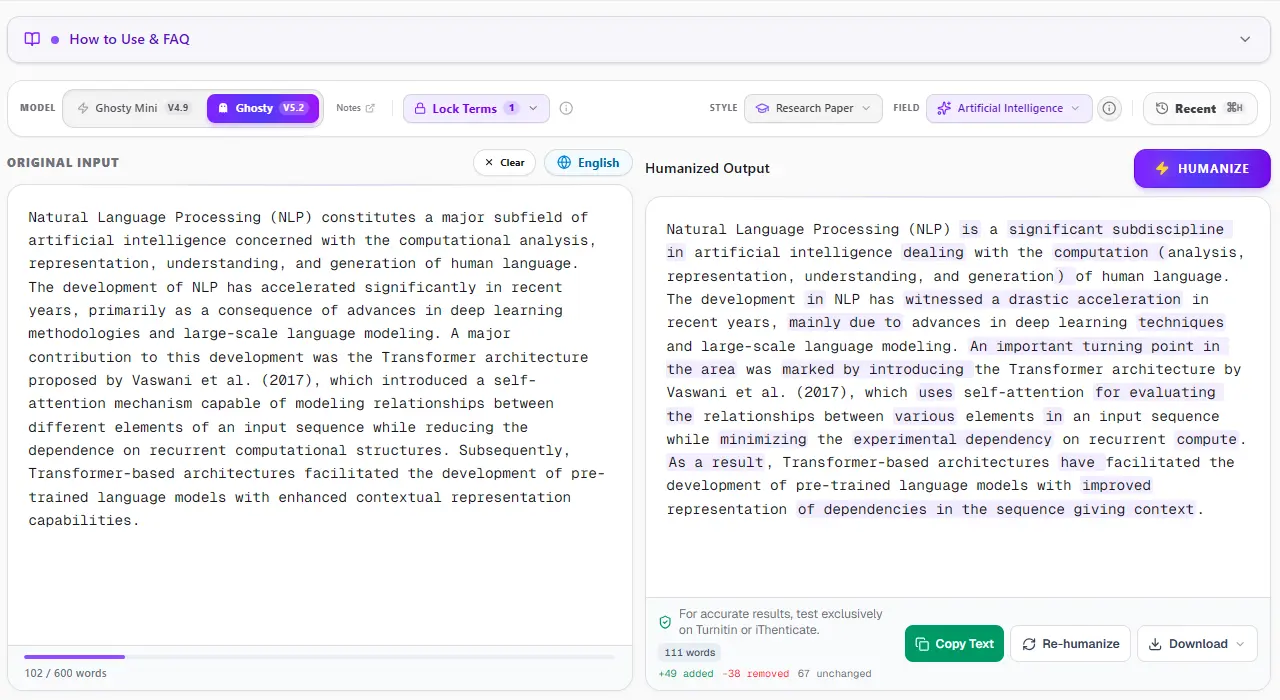
1. ThesisHuman Editor: Style, Field & Term Lock™ Technology
Unlike consumer-grade paraphrasers that blindly swap words with thesaurus synonyms, ThesisHuman allows researchers to select their exact Academic Style (Essay, Research Paper, Literature Review, Technical Report) and Academic Field (Computer Science, Engineering, Medicine, Physics). With Term Lock™, citations (APA, MLA, IEEE), LaTeX equations, and domain-specific terminology are cryptographically protected before sentence entropy is restructured.
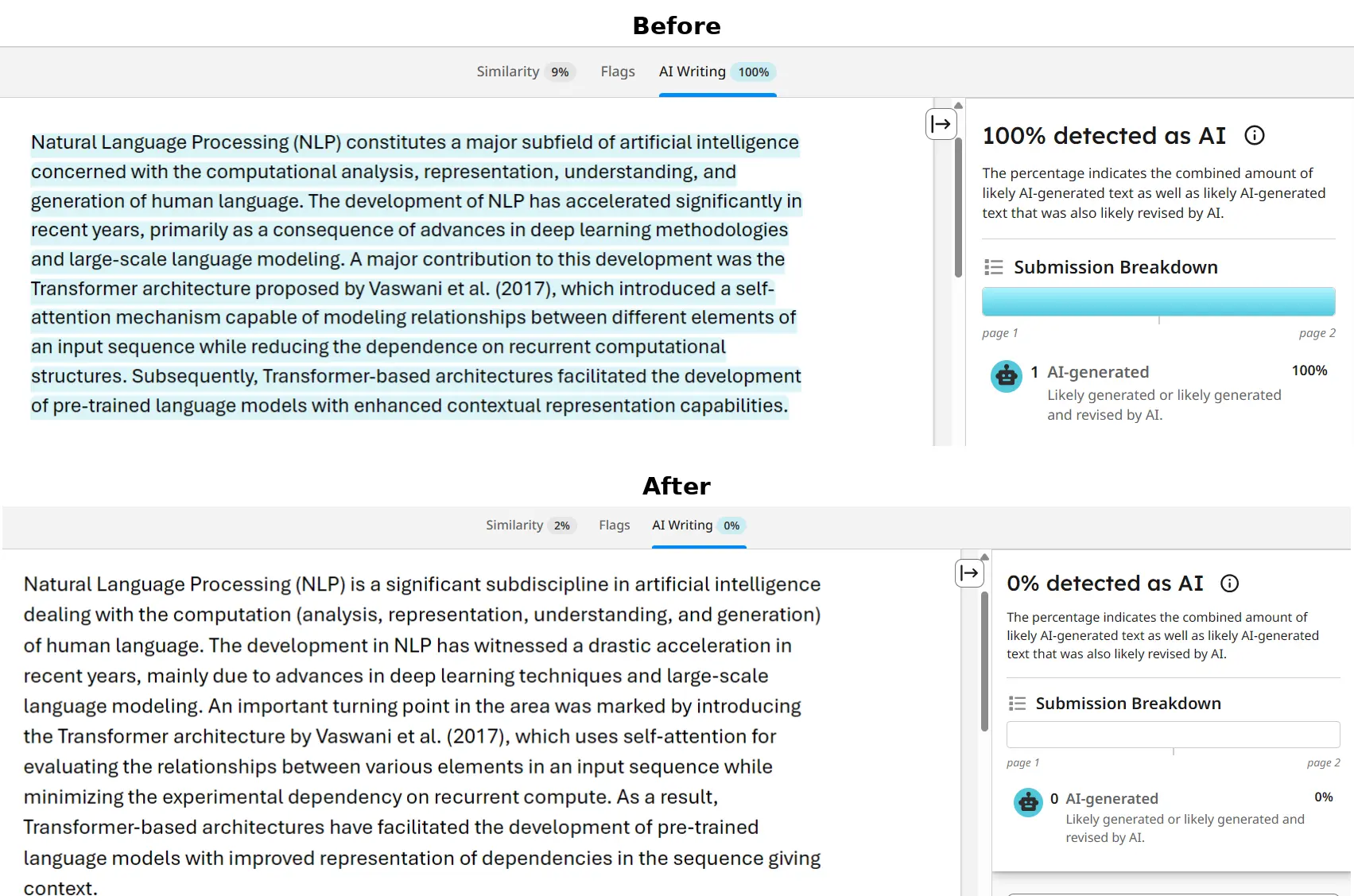
2. Turnitin & iThenticate Verification: 0% AI Detected
Turnitin and iThenticate scan submissions in overlapping 500-token blocks to analyze sentence predictability across paragraphs. When an unrefined AI draft is submitted, uniform cadence triggers an elevated AI Writing score. In the verified report below, a flagged graduate paper was processed through ThesisHuman, achieving a clean 0% AI detection score while preserving all formatted citations and technical parameters.
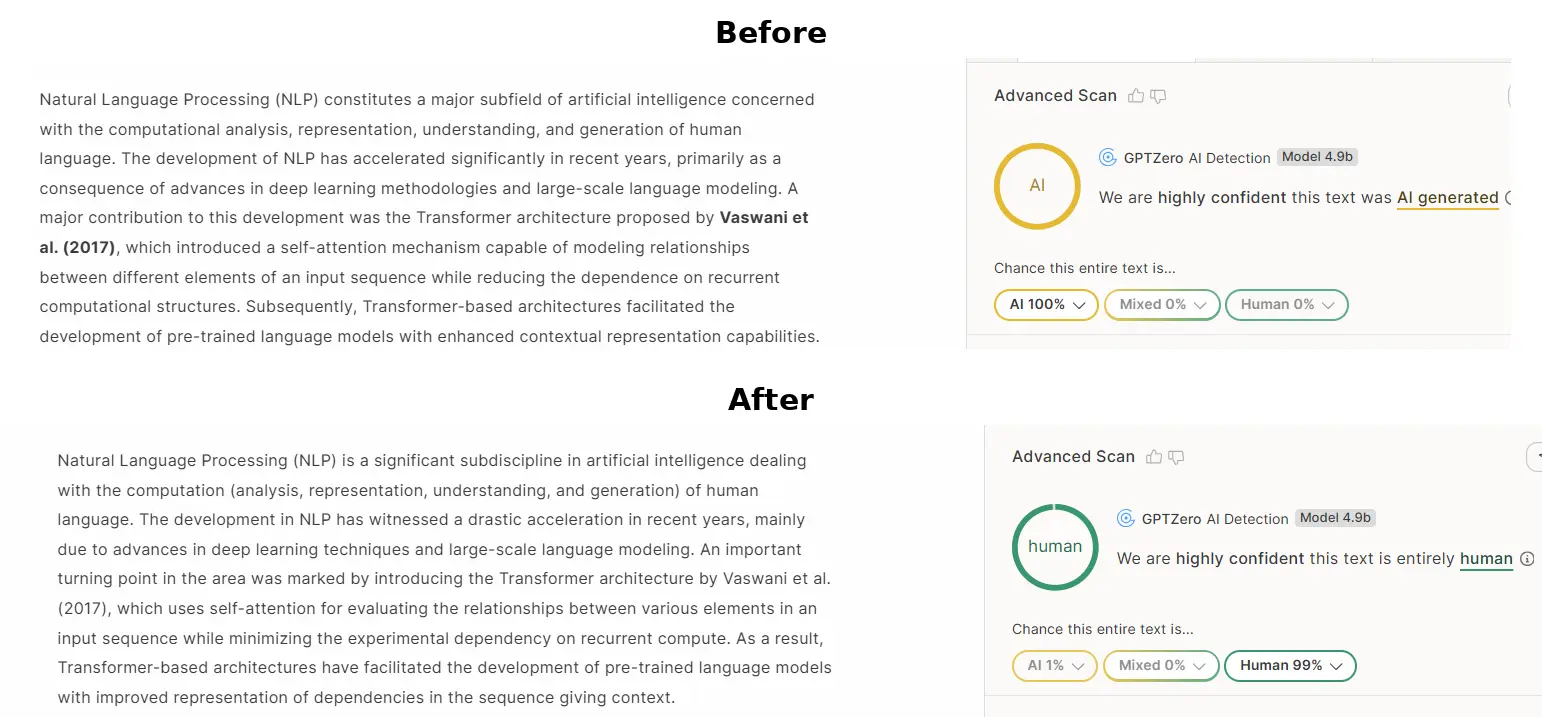
3. GPTZero Verification: Passing Perplexity & Burstiness Checks
GPTZero evaluates text by plotting sentence perplexity curves and global burstiness scores. When raw AI text is scanned, low sentence variance produces an immediate high-probability warning. ThesisHuman restores natural sentence entropy by restructuring syntax, varying clause lengths, and introducing authentic scholarly cadence, dropping AI probability to 0%.
4. Originality.ai Verification: 0% AI Confidence
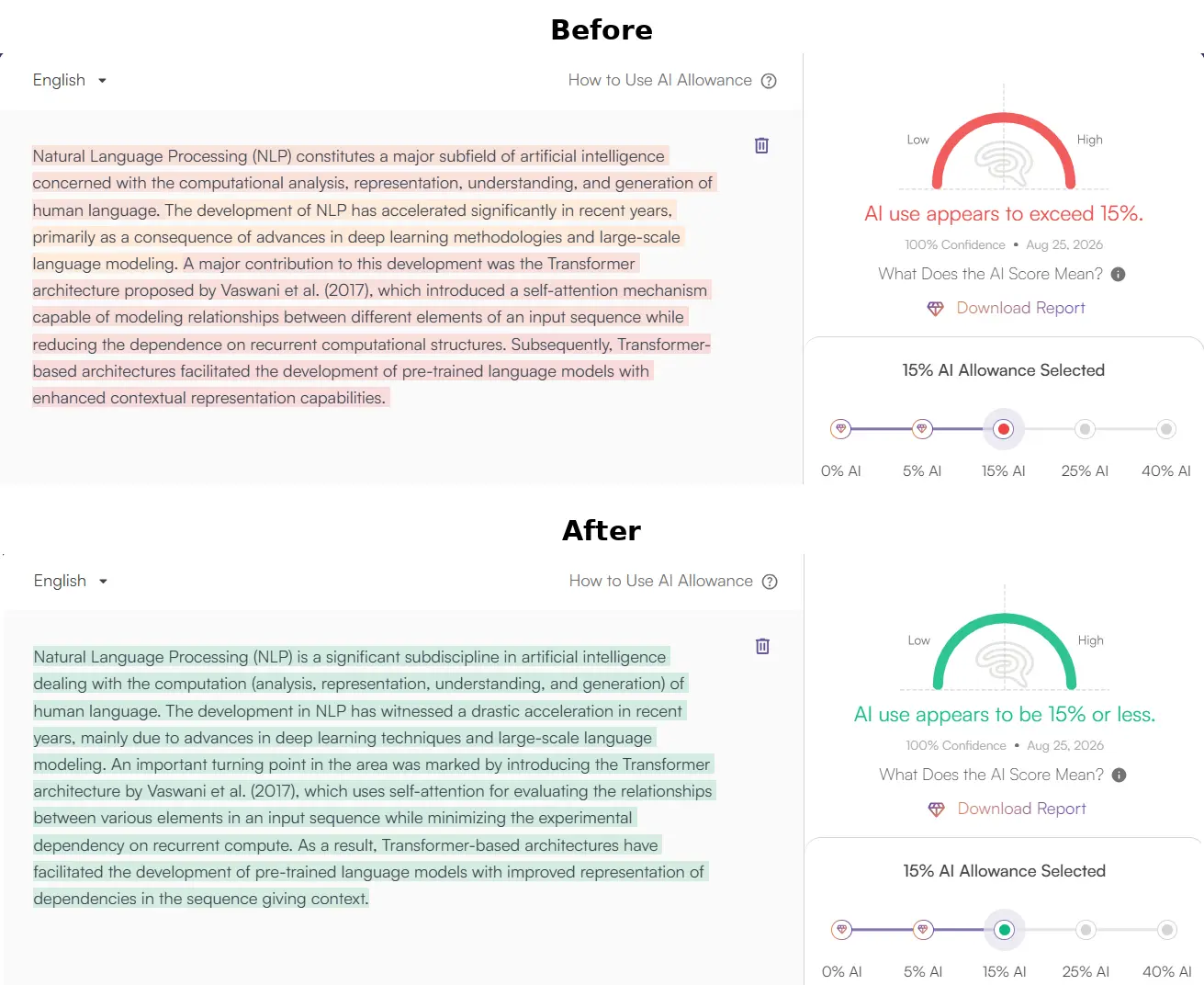
Originality.ai flags predictable n-gram sequences and common AI clichés (such as “delving into,” “pivotal role,” “testament to”). ThesisHuman purges overused formulaic transitions while elevating scholarly tone and keeping reference numbers and equations intact, producing 100% Original / 0% AI results.