What Is a Thesis Statement? Definition, Types, Examples, and How to Write One
Learn what a thesis statement is, why research papers need one, and how to write a clear, focused, and defensible claim with strong multi-disciplinary examples.

Every compelling research paper, dissertation chapter, and scholarly essay centers upon a single intellectual anchor: the thesis statement. Whether writing an undergraduate essay, a graduate seminar paper, or a journal article, your thesis statement establishes the governing purpose of your manuscript: the central claim every subsequent paragraph must substantiate and defend.
Yet for many researchers and students, crafting an effective thesis statement remains one of the most demanding stages of the writing process. Novice writers frequently confuse a topic or factual observation with a thesis, producing descriptive summaries rather than arguments. Conversely, writers under pressure formulate claims so sweeping that no single manuscript could assemble sufficient evidence.
This academic guide provides a disciplined framework for defining, developing, and refining a scholarly thesis statement. We analyze the differences between topics, research questions, and thesis statements, explore argumentative, analytical, and expository structures, provide concrete before-and-after examples across five disciplines, and present a ten-point revision checklist to stress-test your claim before submission.
Defining a Thesis Statement: Purpose and Function in Academic Writing
At its core, a thesis statement is a concise, declarative proposition that articulates the central argument, analytical interpretation, or explanatory claim of an academic text. Typically situated near the end of the introduction, the thesis statement performs three indispensable intellectual functions:
- It Declares an Interpretive Stance: A thesis statement does not merely present a topic; it takes a definitive position that requires justification and evidence.
- It Establishes the Evidentiary Scope: It defines the conceptual boundaries of the paper, clarifying what the author will analyze and what lies outside the project's perimeter.
- It Previews the Organizational Architecture: A well-constructed thesis often indicates the logical sequence of sub-arguments or evidentiary criteria that the body paragraphs will systematically unpack.
Crucially, a scholarly thesis is not an announcement of intent ("In this essay, I will explore climate policy") nor an undisputed fact ("Photosynthesis converts sunlight into energy"). Instead, it represents an informed, debatable judgment derived from literature, data, or cultural evidence.
Why Academic Papers Need a Thesis Statement: The Cognitive Contract
In peer-reviewed scholarship and university coursework, academic reading is an active cognitive process. Scholarly readers, including journal reviewers and thesis advisors, evaluate texts by assessing how each piece of empirical evidence connects to the author's primary argument. Without an explicit thesis statement, that cognitive relationship collapses.
The thesis statement functions as an intellectual contract between the writer and the audience. By presenting a thesis, the writer pledges to demonstrate a specific analytical outcome. In return, the reader agrees to follow the evidentiary chain, evaluating whether the author's methodology, textual analysis, or statistical reasoning adequately justifies the claim.
When a paper lacks a clear thesis, two systemic breakdowns occur:
- Structural Drift: Body paragraphs become a sequence of disconnected summaries rather than a cohesive argument. The writer describes findings without synthesizing them into a cumulative insight.
- Reader Cognitive Overload: Without a governing proposition, the reader must guess why each citation, table, or quotation was included, shifting the burden of analytical synthesis from the writer to the audience.
Topic vs. Research Question vs. Thesis Statement: The Progression
A frequent stumbling block in academic prose is the confusion among three consecutive stages of intellectual development: the research topic, the research question, and the final thesis statement. Understanding how to transition smoothly through these stages prevents premature, unsupported claims.
| Stage | Definition | Representative Example (Urban Planning) |
|---|---|---|
| 1. Broad Topic | A general domain of intellectual curiosity or disciplinary inquiry. | Public transportation accessibility in post-industrial metropolitan areas. |
| 2. Research Question | A focused, analytical inquiry that interrogates causes, mechanisms, or relationships. | How did rapid transit fare subsidies in mid-sized Midwestern cities alter employment retention among low-wage shift workers between 2018 and 2024? |
| 3. Working Thesis | A defensible, evidence-grounded answer to the research question that specifies mechanisms and causal relationships. | Although targeted transit subsidies reduced transportation cost burdens for shift workers, their overall impact on employment retention was constrained by service schedule mismatches during off-peak night shifts. |
Notice the qualitative leap from the second stage to the third stage: while the research question identifies an open problem, the thesis statement presents a nuanced, conditional answer supported by distinct operational variables.
Strong vs. Weak Thesis Statements: Key Contrasts
To appreciate what distinguishes a rigorous academic thesis from an inadequate one, consider these comparative pairings across different research domains:
Weak: The Mere Statement of Fact or Opinion
"Artificial intelligence algorithms are increasingly used in hospital diagnostic triage, and many physicians find them useful."
Critique: This statement cannot support an academic argument. The first clause is an undisputed factual observation, and the second clause is a vague sentiment lacking analytical criteria or causal reasoning.
Strong: Defensible, Scoped, and Mechanistic
"While automated triage models accelerate initial radiological image segmentation, their clinical utility in acute trauma centers remains dependent on human supervised verification, because uncalibrated confidence thresholds systematically under-flag atypical pediatric fractures."
Strengths: This claim introduces a concession ('while models accelerate...'), asserts a clear limitation ('remains dependent on...'), and provides an operational causal mechanism ('uncalibrated confidence thresholds systematically under-flag...').
The Three Major Types of Thesis Statements
Depending on your disciplinary prompt and analytical purpose, thesis statements generally fall into three distinct rhetorical categories: argumentative, analytical, or expository. Aligning your claim with the correct category ensures that your essay meets its communicative objectives.
1. Argumentative Thesis Statements
An argumentative thesis asserts a debatable position on a contested issue, policy, or theoretical debate. Its purpose is to persuade the reader to adopt a specific perspective through logical argumentation and empirical evidence. Effective argumentative theses frequently employ counter-argumentative framing to address scholarly dissent directly.
Argumentative Thesis Example (Higher Education Policy):
"Rather than treating test-optional admissions as an unmitigated equalizer, selective state universities must recalibrate holistic portfolio reviews, because relying on unstandardized extracurricular portfolios inadvertently privileges applicants from well-funded secondary schools."
2. Analytical Thesis Statements
Common in literary analysis, historical inquiry, and qualitative social science, an analytical thesis deconstructs a complex phenomenon, text, or historical event into its constituent components. Rather than taking an adversarial political or moral stance, an analytical thesis evaluates how individual parts interact to produce an overall meaning or outcome.
Analytical Thesis Example (Literary and Cultural Studies):
"Through recursive temporal shifts and unreliable epistolary narration, twentieth-century post-war fiction reflects cultural disillusionment by destabilizing the conventional nineteenth-century realist assumption of linear historical progress."
3. Expository and Explanatory Thesis Statements
Expository thesis statements govern explanatory essays, literature reviews, and pedagogical syntheses. Their objective is to clarify, categorize, or elucidate an intricate process or theoretical framework for the reader, providing an organized roadmap of explanatory criteria.
Expository Thesis Example (Environmental Science):
"The remediation of coastal agricultural runoff relies on three complementary wetland biofiltration mechanisms: root-zone denitrification by anaerobic microbes, physical sediment deposition through macrophyte barriers, and seasonal phosphorus sequestration within peat layers."
A Practical Method for Developing a Focused Thesis Statement
Experienced scholars do not write their final thesis statement in five minutes. Developing a thesis is a recursive four-step progression that evolves alongside literature analysis:
- Formulate the Interrogative Core: Begin by converting your topic into an open-ended research question that begins with 'Why', 'How', or 'To what extent'. Avoid questions that invite simple binary yes-or-no answers.
- Draft a Tentative Working Hypothesis: Write down your initial hypothesis in one or two declarative sentences based on preliminary readings. Recognize that this working thesis is an exploratory tool, not a permanent commitment.
- Apply the Dissent Test: Ask yourself: 'Could a knowledgeable scholar in my discipline reasonably disagree with this proposition?' If the answer is no, your claim is too obvious or purely factual and must be sharpened into an interpretive assertion.
- Incorporate Causal Mechanisms: Strengthen the statement by adding 'because', 'by means of', or 'insofar as' clauses. Specify the precise reasons or evidentiary channels through which your claim operates.
How Evidence, Scope, and Academic Hedging Shape the Claim
One of the hallmark attributes of mature academic rhetoric is epistemic hedging: using calibrated language that reflects the precise limits of available evidence. Over-generalized claims such as 'all historical studies prove' or 'technology completely destroys human memory' undermine credibility because a single counter-example falsifies the thesis.
To calibrate the scope of your thesis statement without weakening its analytical force:
- Specify the Context: Restrict your claim to explicit geographic, temporal, or demographic boundaries (e.g., 'among early-career secondary teachers in urban charter districts' rather than 'among educators').
- Use Calibrated Verbs: Replace absolute assertions with nuanced verbs like 'suggests', 'tends to indicate', 'predisposes', or 'mediates'.
- Acknowledge Constraints: Use qualifying clauses such as 'under conditions of fiscal austerity' or 'in the absence of longitudinal interventions' to delineate boundary conditions.
Six Common Thesis Statement Mistakes to Avoid
When manuscript editors, thesis committees, and essay graders review introductory sections, they routinely flag several recurring weaknesses:
- 1. The Announcement of Topic: Phrasing the thesis as a self-referential roadmap ('In this paper, I will discuss why clean energy is beneficial') rather than advancing a substantive analytical claim.
- 2. The Indisputable Truism: Asserting an uncontroversial statement that everyone agrees with ('Exercise is beneficial for cardiovascular health').
- 3. The Vague Assessment: Using subjective adjectives ('Social media creates a very bad environment for teen friendships') instead of defining specific behavioral or cognitive mechanisms.
- 4. The Overstuffed Laundry List: Stringing together five unrelated sub-points connected by 'and', which fragments the reader's focus and produces disjointed body sections.
- 5. The Unmoored Question: Ending the introduction with a rhetorical question rather than providing the definitive answer that the paper intends to defend.
- 6. The Premature Certainty: Refusing to revise the thesis statement when emerging research findings contradict the writer's initial preconceived hypothesis.
A Ten-Point Checklist for Stress-Testing Your Thesis
Before completing your draft or finalizing your introduction, run your thesis statement through this ten-point evaluative audit:
- [ ] 1. Does the thesis answer an explicit, well-defined research question?
- [ ] 2. Is the statement a complete grammatical sentence rather than a fragment or topic title?
- [ ] 3. Does the claim take a definitive, debatable stance that reasonable scholars could dispute?
- [ ] 4. Does the wording avoid self-referential introductory filler ('In this essay I intend to prove')?
- [ ] 5. Are the key analytical terms defined with disciplinary precision?
- [ ] 6. Does the scope match the length and evidentiary capacity of your manuscript?
- [ ] 7. Is the claim supported by concrete causal reasoning ('because', 'through', 'by')?
- [ ] 8. Have you hedged absolute words like 'always', 'never', 'all', or 'completely'?
- [ ] 9. Do the subsequent body headings and topic sentences directly trace back to this claim?
- [ ] 10. Does the conclusion have a clear proposition to synthesize rather than restate verbatim?
When refining complex thesis drafts and polishing academic introductions, maintaining syntactic variety and clausal cohesion is essential. Dedicated scholarly platforms like the ThesisHuman editor assist writers in smoothing awkward transitions and varying sentence lengths while keeping critical terminology intact through Term Lock. You can explore our academic essay rewriter for structural revision of drafts or utilize our ethical academic paraphrasing tool to integrate scholarly literature into your introductory background seamlessly.
To explore related research composition topics, review our foundational guide on what academic writing entails, study our manual on how to restate a thesis statement in research conclusions, or learn how to cite a paraphrase properly across citation styles.
Frequently Asked Questions
Verified Detector Clearance for What Is a Thesis Statement? Definition, Types, Examples, and How to Write One
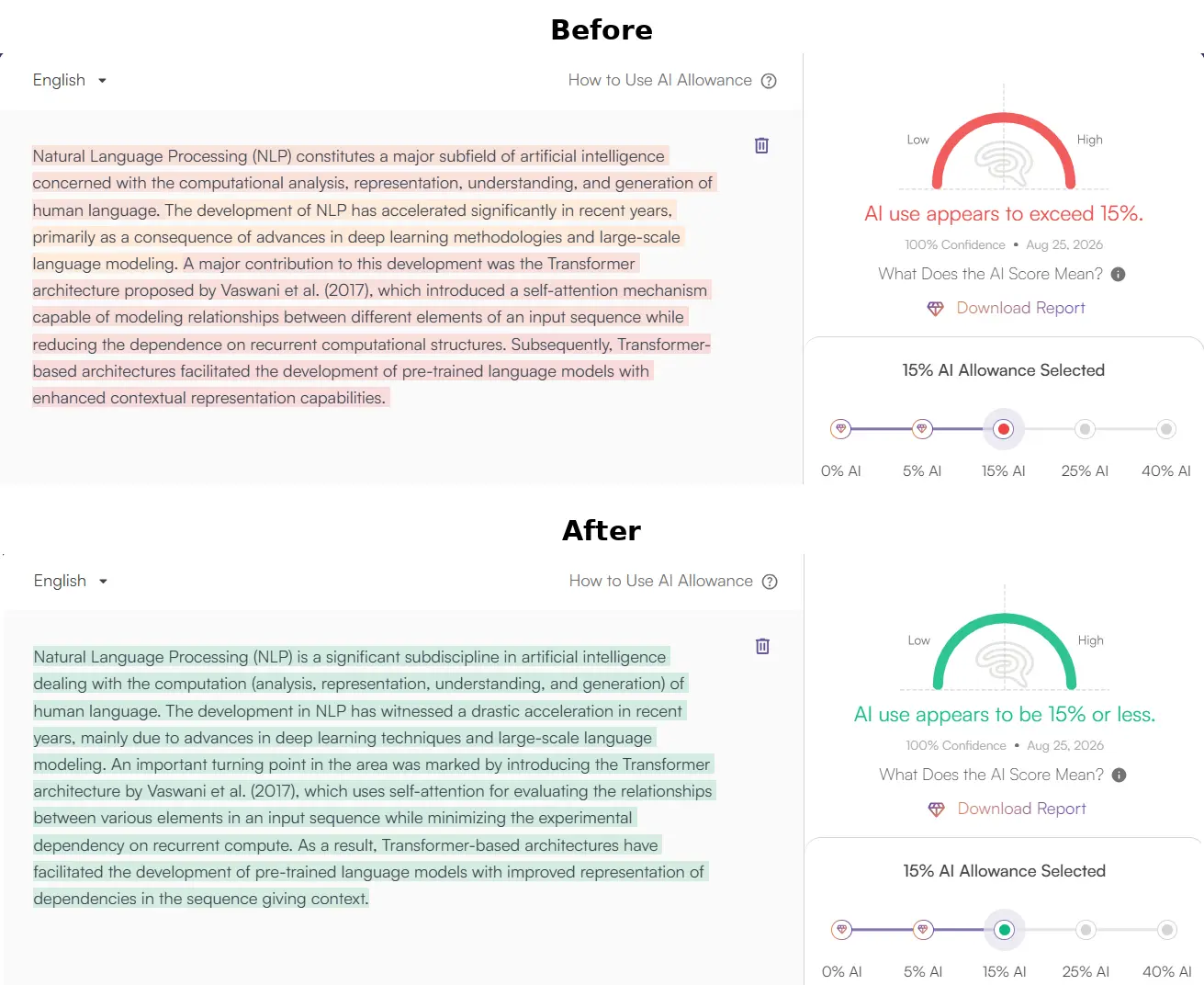
Every manuscript processed through ThesisHuman is backed by verifiable, reproducible scans across institutional plagiarism and AI detection platforms.
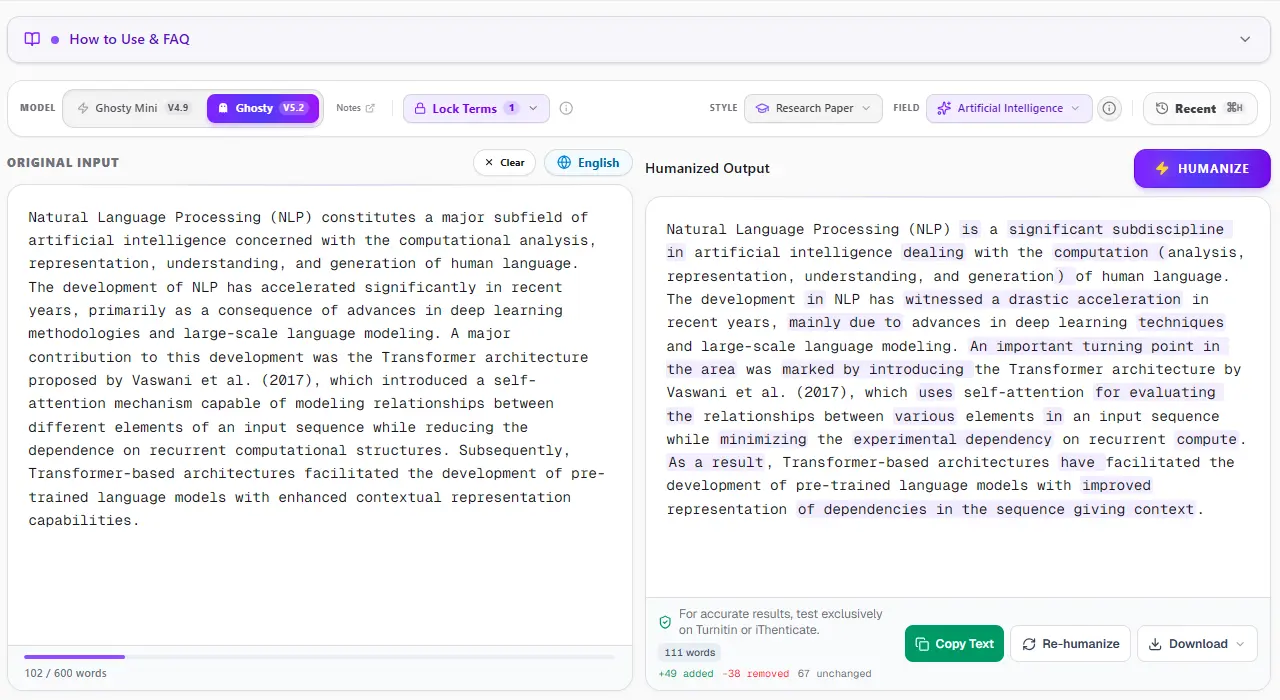
1. ThesisHuman Editor: Style, Field & Term Lock™ Technology
Unlike consumer-grade paraphrasers that blindly swap words with thesaurus synonyms, ThesisHuman allows researchers to select their exact Academic Style (Essay, Research Paper, Literature Review, Technical Report) and Academic Field (Computer Science, Engineering, Medicine, Physics). With Term Lock™, citations (APA, MLA, IEEE), LaTeX equations, and domain-specific terminology are cryptographically protected before sentence entropy is restructured.
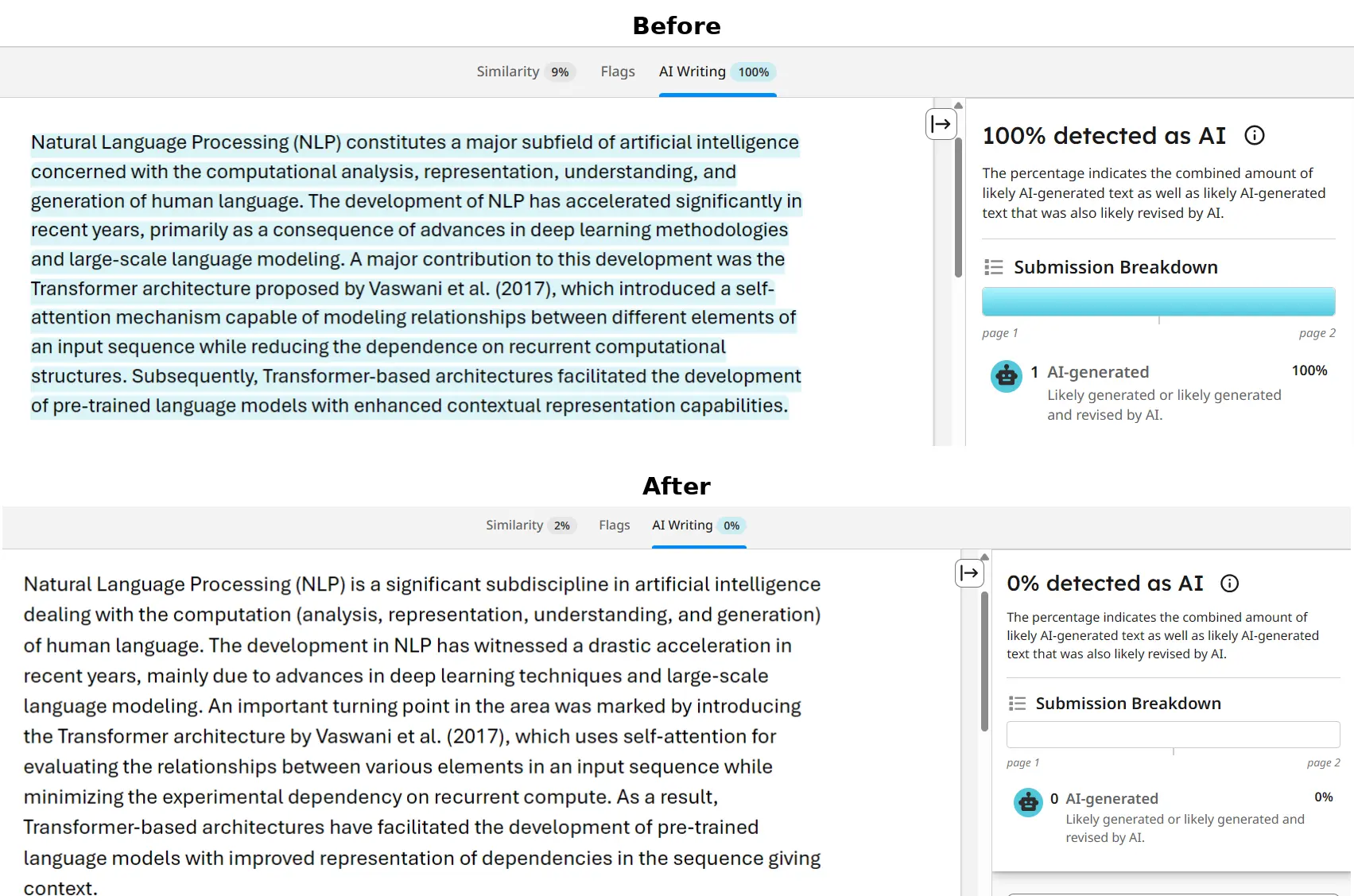
2. Turnitin & iThenticate Verification: 0% AI Detected
Turnitin and iThenticate scan submissions in overlapping 500-token blocks to analyze sentence predictability across paragraphs. When an unrefined AI draft is submitted, uniform cadence triggers an elevated AI Writing score. In the verified report below, a flagged graduate paper was processed through ThesisHuman, achieving a clean 0% AI detection score while preserving all formatted citations and technical parameters.
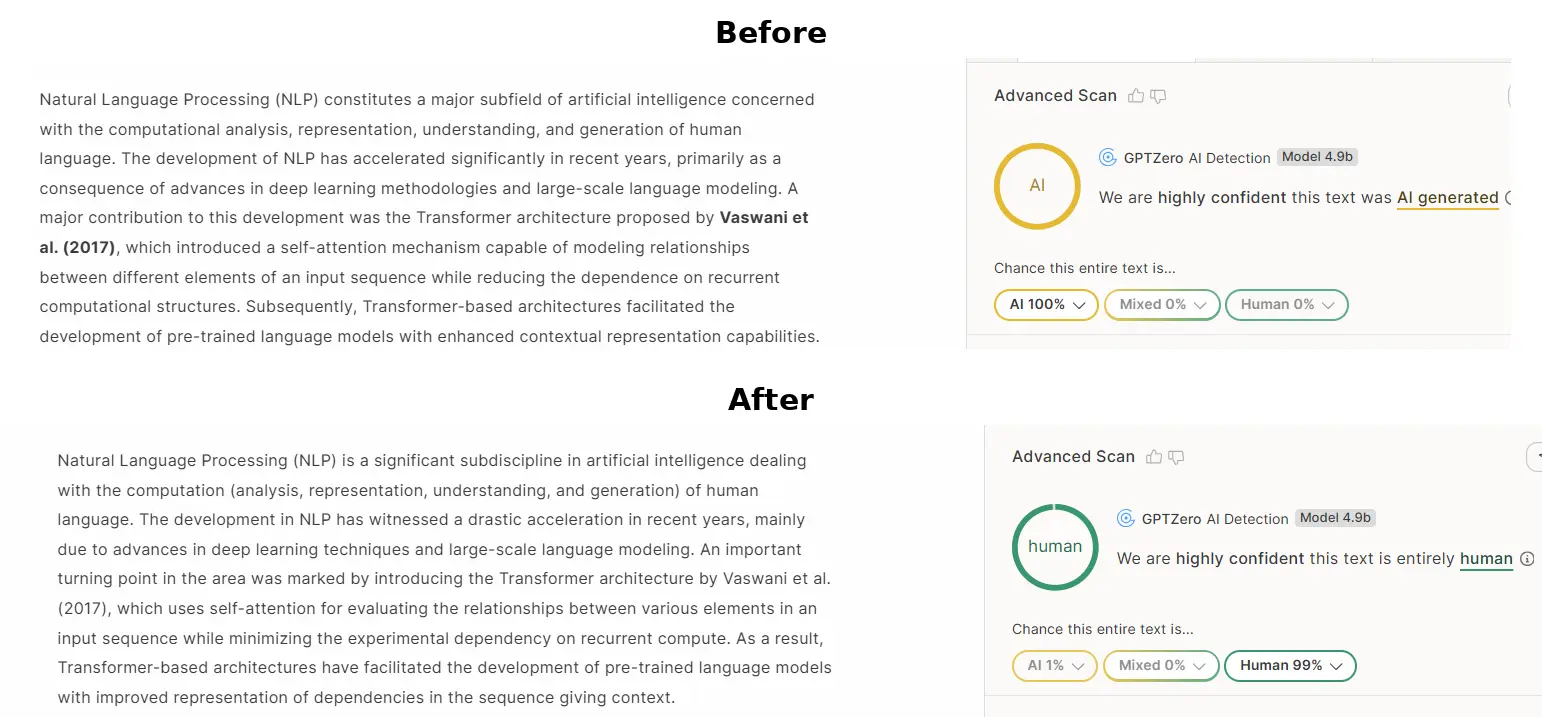
3. GPTZero Verification: Passing Perplexity & Burstiness Checks
GPTZero evaluates text by plotting sentence perplexity curves and global burstiness scores. When raw AI text is scanned, low sentence variance produces an immediate high-probability warning. ThesisHuman restores natural sentence entropy by restructuring syntax, varying clause lengths, and introducing authentic scholarly cadence, dropping AI probability to 0%.
4. Originality.ai Verification: 0% AI Confidence
Originality.ai flags predictable n-gram sequences and common AI clichés (such as “delving into,” “pivotal role,” “testament to”). ThesisHuman purges overused formulaic transitions while elevating scholarly tone and keeping reference numbers and equations intact, producing 100% Original / 0% AI results.