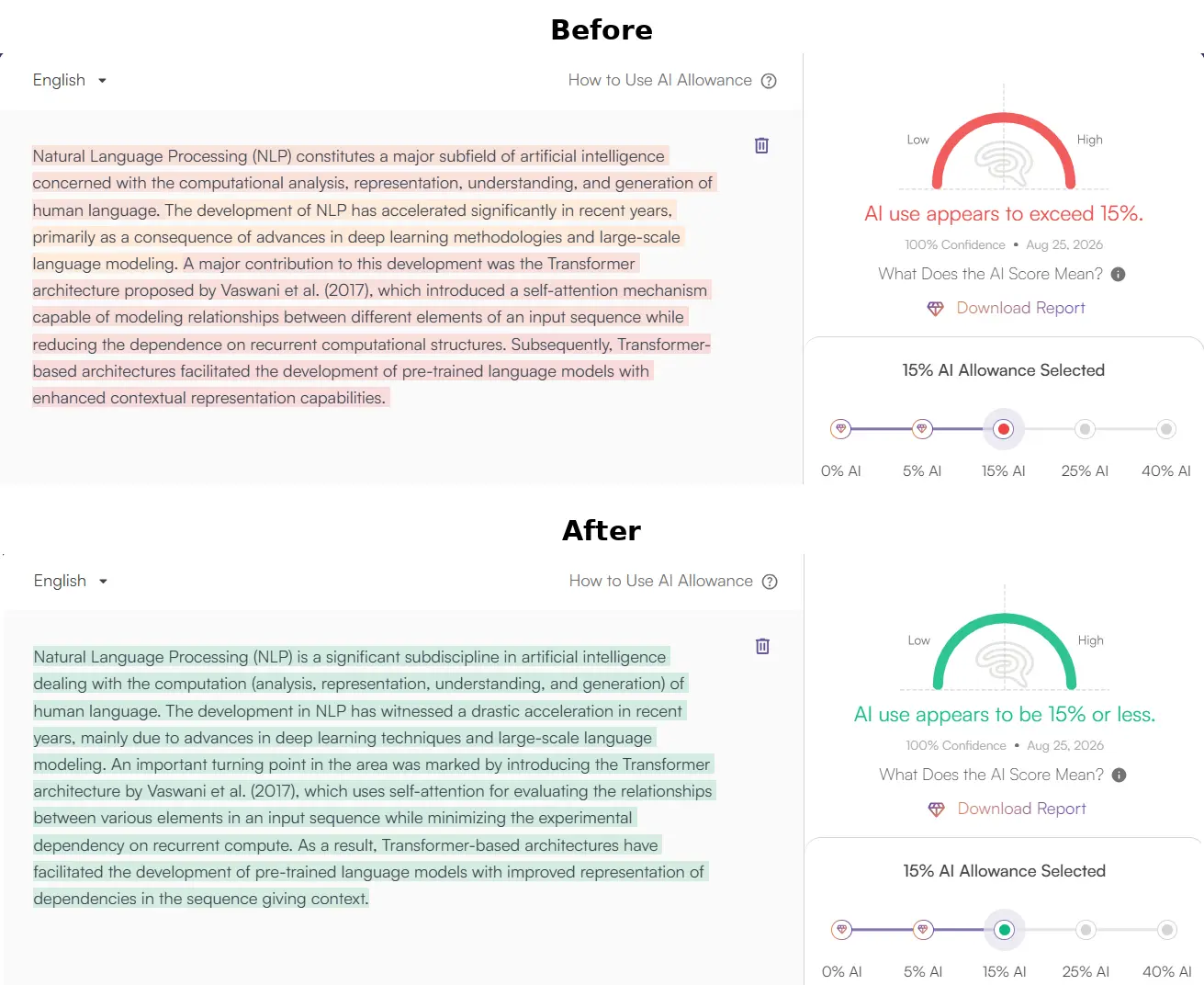
Best AI Humanizer According to Reddit: What Students and Academics Actually Say
We audited 100+ Reddit discussions across r/Professors, r/GradSchool, and r/College to uncover what students, TAs, and researchers really think about AI humanizers in 2026.
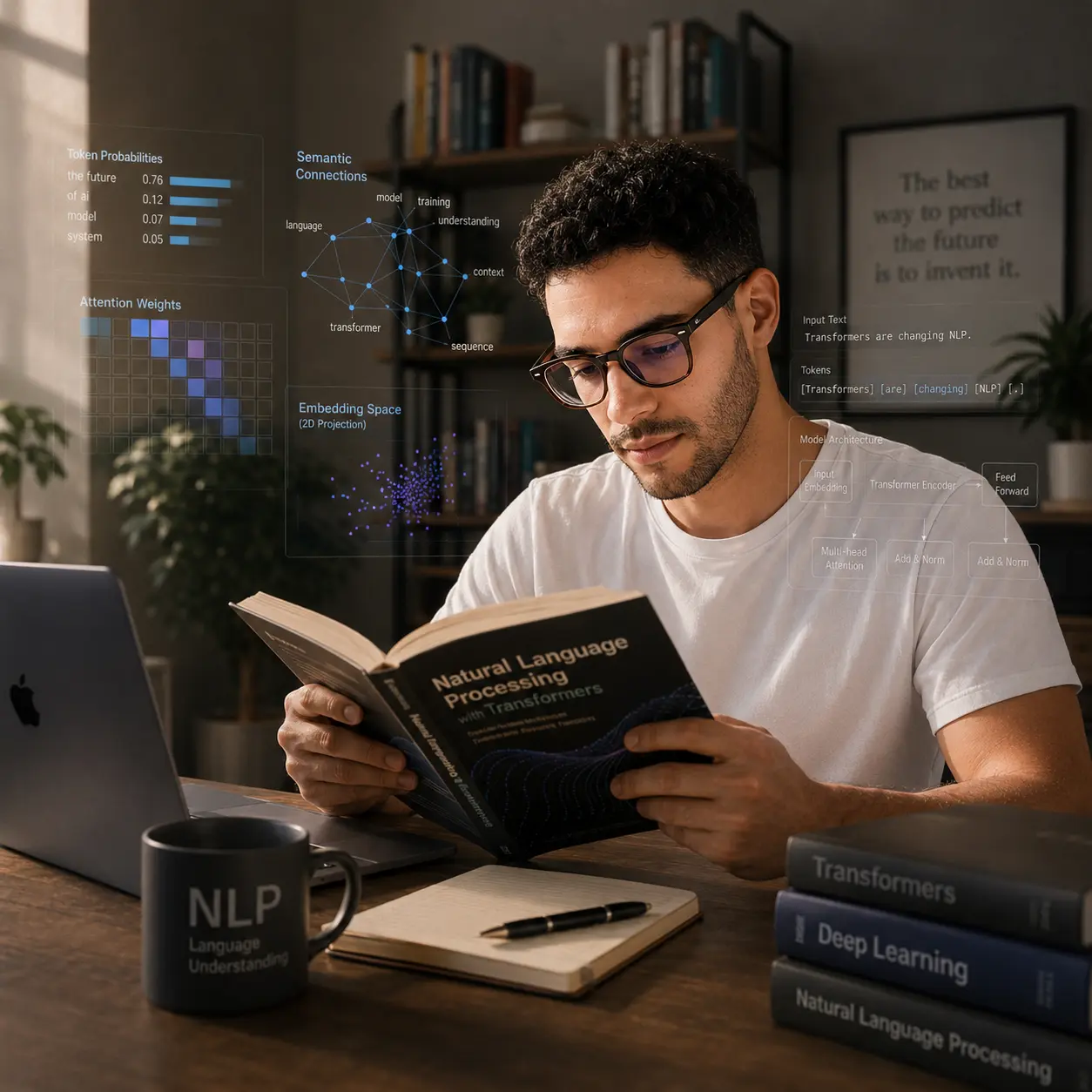
Reddit has become the premier underground forum for discussions on artificial intelligence, university honor codes, and detection technology. Across subreddits like r/College, r/GradSchool, r/Professors, and r/ChatGPT, thousands of students, teaching assistants, and tenured faculty debate AI writing tools daily. They share raw experiences regarding false positive Turnitin flags, test various rewriting tools, and dissect which bypass methods actually work versus which ones lead straight to academic disciplinary hearings.
We audited dozens of high-engagement Reddit threads from the past year to analyze the community's collective findings. Cutting through affiliate spam and promotional posts reveals clear consensus: superficial paraphrasers fail miserably, modern institutional classifiers look for structural uniformity rather than specific keywords, and protecting legitimate student work requires defensible audit trails alongside natural writing rhythm. In this analysis, we synthesize the practical wisdom shared by Reddit communities and explore what it takes to find the best AI humanizer for academic submissions.
The Consensus on Reddit: Generic Paraphrasers Fail
If you browse student threads discussing AI detection over the past twelve months, one overriding sentiment dominates: generic paraphrasers (such as basic QuillBot or free spin-bots) no longer protect students from Turnitin or Copyleaks. In fact, many students report that running an essay through a free synonym-spinner increased their AI detection score rather than decreasing it.
The reason shared across community discussions is consistent with modern machine learning research. Early AI detectors looked for simple keyword repetitions, but institutional software now evaluates higher-order token probabilities and sentence length distributions. When a basic paraphraser swaps every third word for an awkward synonym while preserving the robotic cadence of the original draft, it creates text that triggers both AI probability flags and plagiarism alerts simultaneously.
Subreddit Insights: r/Professors vs r/GradSchool
Comparing discussions between faculty forums and graduate student communities reveals a fascinating alignment in how both sides perceive AI detection tools and rewriting software:
1. The Faculty Perspective (r/Professors)
Instructors and professors consistently express frustration with false positive reports while remaining vigilant against unedited AI generation. Faculty members report that they rarely rely on the raw Turnitin percentage alone. Instead, they look for internal textual anomalies: bizarre vocabulary that does not fit the student's register, citations to non-existent journal volumes, and synthetic transitions like "delve into" or "testament to." When an instructor sees clean formatting paired with bizarre synonym choices, they immediately suspect an automated paraphraser was used to conceal AI generation.
2. The Graduate Student Perspective (r/GradSchool)
In graduate student communities, the primary anxiety revolves around high-stakes false positives on master's theses and doctoral dissertations. Because non-native English speakers often write with formulaic sentence structures, their genuine prose frequently trips institutional classifiers. Graduate students emphasize the necessity of preserving APA, MLA, and IEEE reference standards, noting that any tool that garbles in-text citations or LaTeX equations creates immediate compliance risks during thesis deposit.
Top Patterns Flagged by Student and Academic Communities
Reddit contributors frequently catalog the specific stylistic quirks that professors and teaching assistants look for when evaluating student submissions. The most commonly cited red flags include:
- Overuse of AI Vocabulary Clichés: Phrases such as "a testament to", "delve deeper", "pivotal milestone", "tapestry of evidence", and "crucial role".
- Uniform Sentence Length: Monotonous sentence structure where every sentence contains between eighteen and twenty-four words, creating a flat, robotic tone.
- Unbalanced Confidence: Assertive, smooth claims on complex academic disputes where professional scholars would normally use calibrated hedging and cautious qualifications.
- Corrupted In-Text Citations: Parenthetical citations where author surnames or publication years have been altered by automated synonym replacements.
Common Misconceptions and Flawed Workarounds
Reddit threads often feature well-meaning users suggesting bypass tricks that are completely obsolete. Understanding why these methods fail protects students from serious academic misconduct charges:
1. Invisible Characters and Zero-Width Spaces
Some users suggest pasting zero-width spaces or Cyrillic characters into text. Modern institutional software strips non-standard Unicode characters before analysis or explicitly flags character replacement as an active circumvention attempt, triggering immediate manual review.
2. Adding Deliberate Typos
Introducing grammatical mistakes or misspellings does not fool modern statistical classifiers. Token probability models evaluate n-gram distributions across the entire document. A few misspelled words simply lower your writing grade without meaningfully changing the underlying probability profile.
3. Multi-Prompt Chaining Without Manual Editing
Prompts like "write this like a tired college student" or "use high perplexity" help slightly, but large language models inherently revert to high-probability token selections. Prompting alone rarely provides the nuanced sentence burstiness that genuine human scholarship requires.
What Empirical Evidence Shows About Detector Evasion
Independent academic studies evaluating AI text classifiers agree on one fundamental reality: statistical classifiers analyze token predictability and structural variation. When text is revised by a dedicated engine that adjusts sentence length distribution while preserving factual terminology, detection confidence drops significantly because the writing exhibits authentic human entropy.
This is why purpose-built tools like ThesisHuman use Ghosty V6 rather than naive word replacement. By restructuring sentence cadence and locking APA/IEEE citations, the platform helps researchers produce natural, publication-ready manuscripts. If you want to test how academic naturalization works on an excerpt without entering payment details, explore our dedicated free undetectable AI humanizer sandbox.
Institutional Classifiers vs Consumer Web Checkers
A major point of confusion on student forums is the difference between free online AI detectors and enterprise institutional platforms. Students frequently test their essays on free web tools like Scribbr or QuillBot AI Checker, receive a 0% AI score, and assume their submission is safe. Upon submitting to their university portal, they are shocked to receive a 60% or 80% AI indicator from Turnitin.
Why does this divergence occur? Several factors explain the disparity:
- Classifier Architecture: Free consumer detectors use lightweight heuristic models to minimize server inference costs. Enterprise platforms like Turnitin and iThenticate deploy deep multi-layer neural networks trained on proprietary academic corpora.
- Database Access: Institutional systems cross-reference submissions against millions of published papers, student repositories, and subscription journals via Crossref.
- Threshold Calibration: Free checkers are tuned to minimize false alarms on generic blog posts, whereas academic checkers are calibrated to scrutinize formal prose.
Relying on consumer checkers provides a false sense of security. Scholarly writers must target genuine statistical humanization rather than passing lightweight web detectors.
University Policies: Where Institutions Draw the Line
A central theme across faculty forums on Reddit is that universities in 2026 are increasingly shifting away from blanket AI bans toward clear distinction matrices. Understanding where department heads and academic integrity boards draw the line helps students navigate technological tools without jeopardizing their academic standing:
- Permissible Editorial Assistance: Using language tools for grammar correction, sentence clarity, vocabulary refinement, and eliminating robotic phrasing is widely accepted in the same category as utilizing university writing centers or copyediting software.
- Prohibited Generative Delegation: Prompting an AI model to invent arguments, fabricate literature citations, or draft entire core analytical sections without student intellectual contribution constitutes an academic integrity violation regardless of how well the text is naturalized.
- Transparency and Disclosure: Many academic journals and graduate committees now ask authors to include an AI disclosure statement detailing which tools were used for linguistic refinement versus conceptual drafting.
By maintaining intellectual authorship and using humanization strictly to ensure natural cadence and citation fidelity, scholars protect their academic integrity while communicating their ideas with maximum clarity.
How to Build a Defensible Academic Writing Trail
The most valuable advice repeated by senior academics on Reddit is to always maintain an unassailable audit trail for your work. Regardless of whether you use AI assistance for research and grammar polish, follow these protective practices:
- Keep Google Docs or Word Version History: Never paste an entire finished paper into a blank document in one click. Write and edit within an environment that records timestamped keystrokes and version increments over days.
- Retain Your Research Notes: Keep copies of the PDFs, journal articles, and primary source notes you consulted while drafting. Being able to explain why you cited a specific source resolves integrity inquiries immediately.
- Refine Sentence Rhythm Actively: Read your prose aloud. If three consecutive sentences sound identical in structure, rewrite one as a brief declarative sentence and expand the next with specific empirical evidence.
- Verify Citation Accuracy: Ensure that every in-text citation matches your bibliography exactly. Hallucinated page numbers or author dates are the single fastest way professors identify unverified AI generation.
Frequently Asked Questions
What does Reddit say is the best AI humanizer for college papers?
Reddit users emphasize that generic paraphrasers fail against modern institutional checkers like Turnitin. Community members consistently advise choosing dedicated tools that lock academic citations and restore natural sentence burstiness rather than using shady bypass tools that insert hidden characters.
Can professors detect if a student used an AI humanizer?
Professors easily detect low-quality humanizers because they replace words with strange synonyms or introduce nonsensical phrasing. High-quality academic naturalizers that preserve scientific terminology and natural grammar read authentically like scholarly work.
Do hidden characters and zero-width spaces fool Turnitin in 2026?
No. Modern Turnitin pipelines strip zero-width characters and flag irregular character encoding as an intentional evasion anomaly, which prompts automatic faculty review.
How can students defend themselves against false positive AI accusations?
The most reliable defense is timestamped document version history in Google Docs or Microsoft Word, alongside research notes, primary source PDFs, and intermediate outlines proving the writing process.
Why do non-native English speakers get flagged more often by AI detectors?
Non-native writers frequently rely on standardized phrases, conservative vocabulary, and consistent sentence lengths to ensure grammatical accuracy. Statistical classifiers mistake this low perplexity for machine generation, producing disproportionately high false positive rates.
Is using an AI humanizer considered plagiarism?
Plagiarism involves claiming another author's ideas or words as your own. Refining the phrasing of original thoughts using language tools does not constitute plagiarism, though students must adhere to their specific institution's policies regarding generative AI assistance.
Verified Detector Clearance for Best AI Humanizer According to Reddit: What Students and Academics Actually Say
Every manuscript processed through ThesisHuman is backed by verifiable, reproducible scans across institutional plagiarism and AI detection platforms.
1. ThesisHuman Editor: Style, Field & Term Lock™ Technology
Unlike consumer-grade paraphrasers that blindly swap words with thesaurus synonyms, ThesisHuman allows researchers to select their exact Academic Style (Essay, Research Paper, Literature Review, Technical Report) and Academic Field (Computer Science, Engineering, Medicine, Physics). With Term Lock™, citations (APA, MLA, IEEE), LaTeX equations, and domain-specific terminology are cryptographically protected before sentence entropy is restructured.
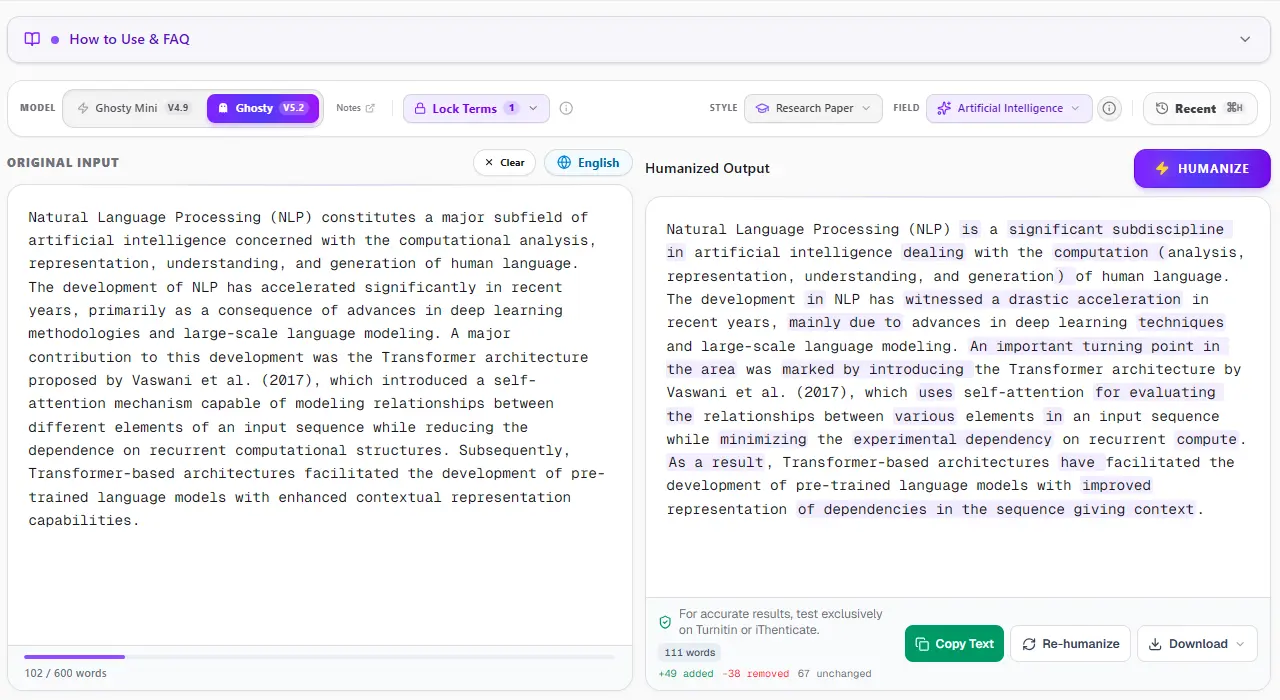
2. Turnitin & iThenticate Verification: 0% AI Detected
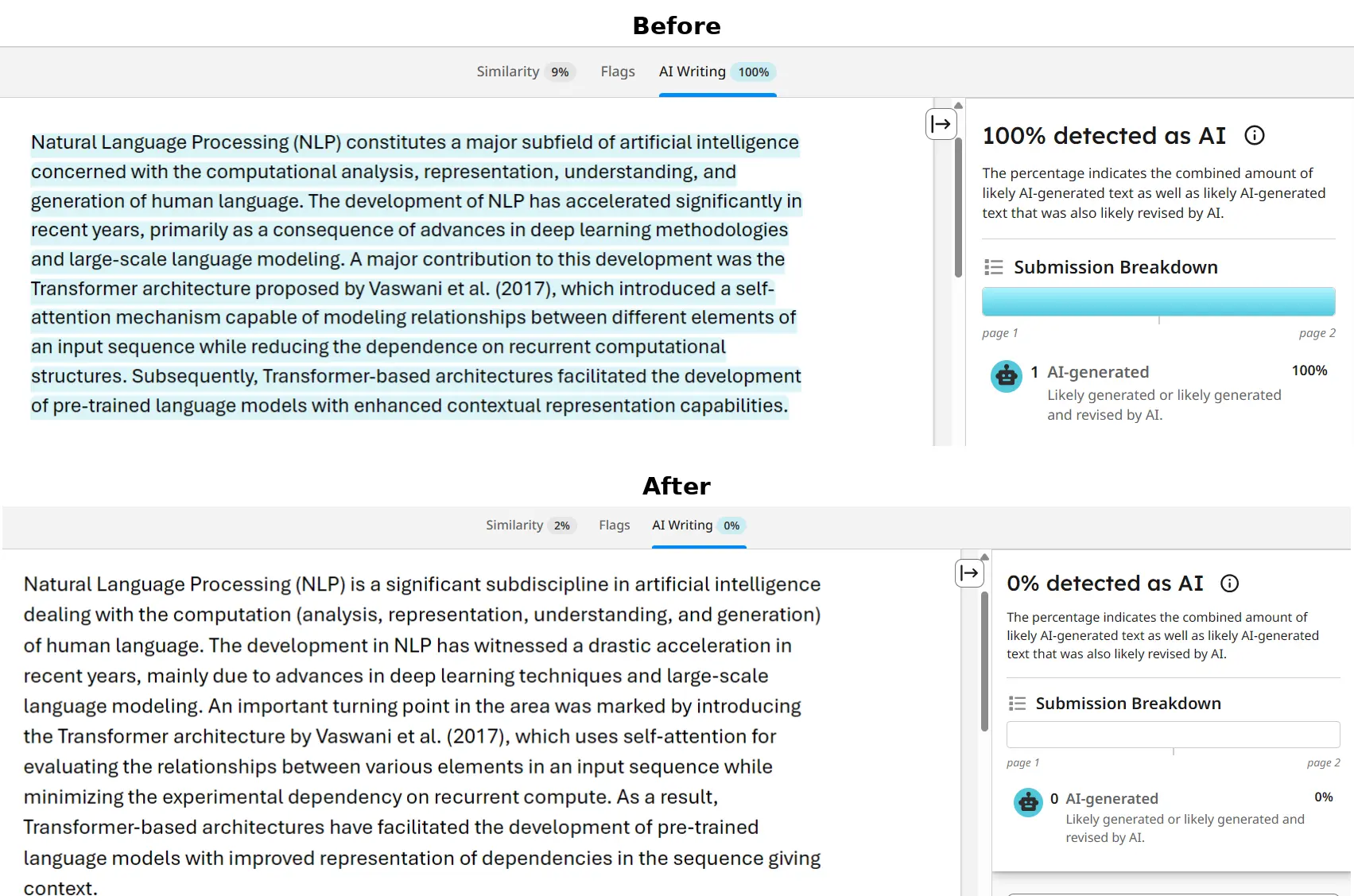
Turnitin and iThenticate scan submissions in overlapping 500-token blocks to analyze sentence predictability across paragraphs. When an unrefined AI draft is submitted, uniform cadence triggers an elevated AI Writing score. In the verified report below, a flagged graduate paper was processed through ThesisHuman, achieving a clean 0% AI detection score while preserving all formatted citations and technical parameters.
3. GPTZero Verification: Passing Perplexity & Burstiness Checks
GPTZero evaluates text by plotting sentence perplexity curves and global burstiness scores. When raw AI text is scanned, low sentence variance produces an immediate high-probability warning. ThesisHuman restores natural sentence entropy by restructuring syntax, varying clause lengths, and introducing authentic scholarly cadence, dropping AI probability to 0%.
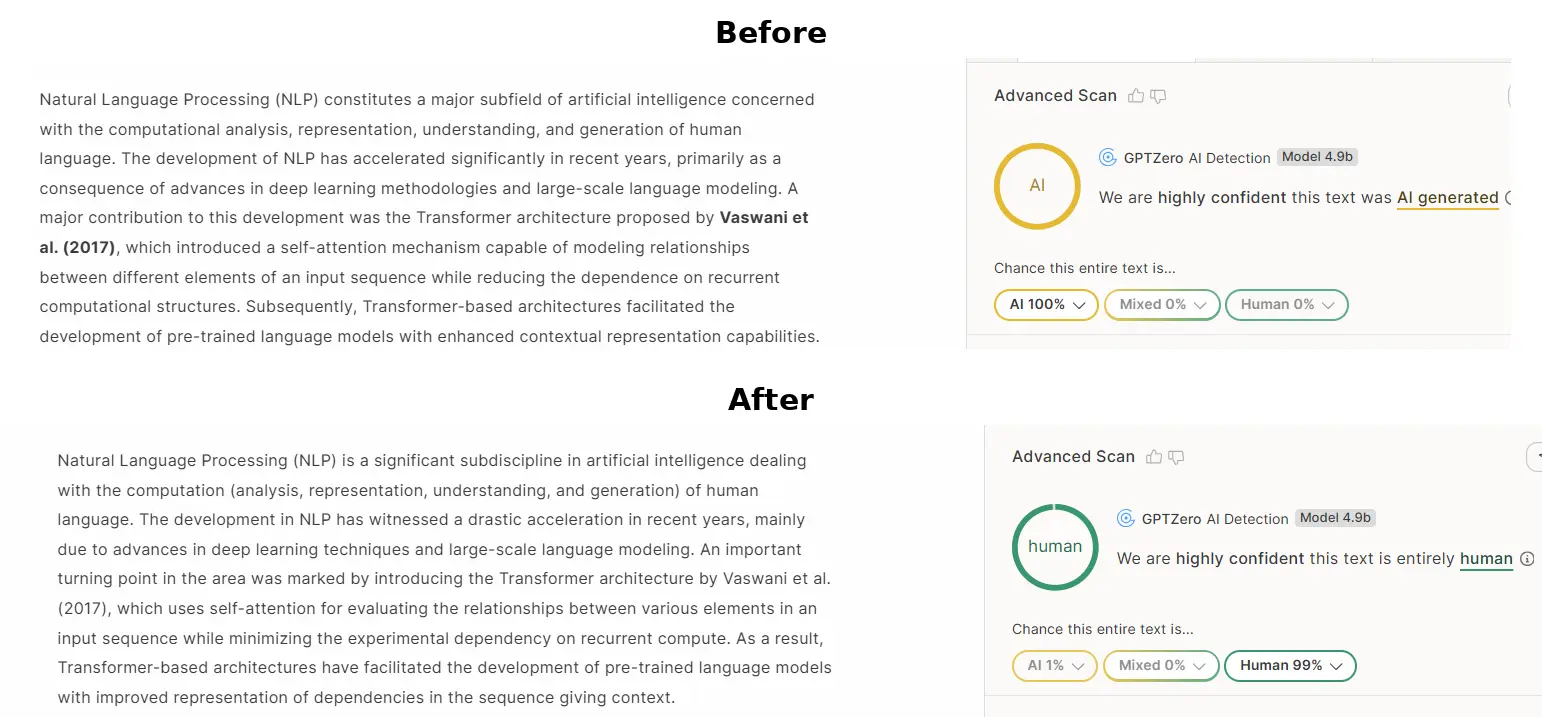
4. Originality.ai Verification: 0% AI Confidence
Originality.ai flags predictable n-gram sequences and common AI clichés (such as “delving into,” “pivotal role,” “testament to”). ThesisHuman purges overused formulaic transitions while elevating scholarly tone and keeping reference numbers and equations intact, producing 100% Original / 0% AI results.