The Best AI Tools for Thesis Writing in 2026: Accelerate Your Academic Research
Discover the best AI tools for every stage of your thesis from literature review to data analysis to humanization. Build a complete AI-powered research workflow with ThesisHuman as the critical final step.

The pressure on academic researchers in 2026 is unprecedented. The average time to complete a PhD has increased by 18% over the past decade. The volume of published literature doubles approximately every nine years, meaning you need to review exponentially more papers just to stay current. Journal rejection rates in top venues exceed 90% in many fields. Grant funding is more competitive than ever. And through it all, the expectation remains: produce rigorous, original, publishable research faster.
In this environment, AI tools are no longer a luxury or a shortcut. They are a necessity. The researchers who will thrive in the coming decade are those who build intelligent, efficient workflows that leverage AI for what it does best processing information at scale, identifying patterns, and accelerating the mechanical aspects of research while preserving the human judgment, creativity, and domain expertise that make research meaningful.
But here is the critical truth that most "best AI tools" lists will not tell you: using AI to accelerate your research creates a new risk that can undo all the time you saved. If your AI-assisted drafts are flagged by detection tools, you face academic integrity investigations, publication delays, and potential career damage. The final step in any AI-powered research workflow humanization is not optional. It is the step that determines whether the rest of your workflow helps you or destroys you.
Why You Need an AI Research Paper Writer in 2026
The landscape of academic research has fundamentally changed. A decade ago, a doctoral student could reasonably read every significant paper in their subfield. Today, that is impossible in most disciplines. The sheer volume of published research means that literature reviews that once took weeks now require months unless you have tools that can help you navigate the flood.
Similarly, the complexity of modern research data has outpaced what most researchers can analyze manually. Multi-omics datasets, large-scale survey data, high-dimensional imaging results, and longitudinal studies all generate data that demands computational assistance for meaningful analysis. Trying to compete without AI tools is like trying to do genomics research without a sequencer technically possible, but practically suicidal.
The key is choosing the right tools for each stage of your workflow and understanding how they fit together. Not all AI tools are created equal, and using the wrong tool for a given task can waste time, introduce errors, or create risks that negate any efficiency gains.
What follows is a curated overview of the most impactful AI tools for thesis writing and academic research in 2026, organized by the stage of the research process they serve. More importantly, we will explain why the final stage humanization is the one that matters most, and why getting it wrong can render every other tool in your workflow useless.
Top AI Tools for Every Stage of Your Thesis
A thesis is not a single task. It is a complex, multi-stage project that spans months or years and involves fundamentally different types of intellectual work: finding and synthesizing literature, designing studies, collecting and analyzing data, drafting prose, revising and formatting, and preparing for submission. Each stage has different requirements and different tools that can help.
Literature Review: Elicit & Consensus
The literature review is where most thesis projects begin, and it is often the most time-consuming phase. You need to identify relevant papers across multiple databases, extract key findings, synthesize themes, identify gaps, and build the theoretical foundation for your own work.
Elicit is an AI-powered research assistant that helps you find and analyze academic papers efficiently. It can surface relevant studies based on natural-language research questions, extract structured data from papers, and help you identify connections across large bodies of literature. For researchers drowning in the volume of published work, it dramatically reduces the time required to build a comprehensive literature foundation.
Consensus takes a complementary approach, allowing you to ask research questions and receive evidence-based answers synthesized from peer-reviewed studies. It is particularly useful for getting a quick overview of what the literature says on a specific topic before diving into the detailed reading that your thesis requires.
Both tools excel at accelerating the discovery and initial synthesis phases of literature review. They help you cast a wider net and process more sources than would be feasible through manual database searching alone.
Data Analysis: Julius AI
Once you have collected your data, analysis is where many thesis projects stall. Statistical analysis, visualization, and interpretation require specialized knowledge that varies enormously across disciplines. A tool that helps a social scientist run regression models is not the same as one that helps a bioinformatician process sequencing data.
Julius AI is a versatile data analysis platform that allows researchers to upload datasets, perform statistical analyses, and generate visualizations through a conversational interface. It supports a wide range of analytical approaches and can help researchers explore their data more quickly than writing analysis scripts from scratch. For researchers who are not expert programmers, it provides a way to conduct sophisticated analyses without the steep learning curve of tools like R or Python.
The value of tools like Julius lies in acceleration, not replacement. You still need to understand your data, choose appropriate methods, and interpret results critically. But the mechanical work of implementing analyses, debugging code, and generating publication-quality figures can be dramatically compressed.
Drafting & Humanizing: ThesisHuman
The drafting phase is where AI offers the most obvious assistance and where it creates the most dangerous risk. Large language models can help you structure arguments, draft initial sections, and overcome writer's block. But every word they generate carries a statistical signature that modern detection tools are specifically designed to identify.
This is where ThesisHuman becomes the most critical tool in your entire workflow. It is not a drafting tool it is the specialized humanization engine that ensures your AI-assisted drafts can withstand the scrutiny of Turnitin, GPTZero, and other detection platforms that your institution almost certainly uses.
ThesisHuman's proprietary burstiness engine transforms AI-generated academic text into prose that naturally aligns with the statistical properties of human-authored writing. But what makes it indispensable for researchers as opposed to a generic paraphrasing tool is its deep understanding of academic conventions:
- Term Lock preserves your technical terminology with absolute fidelity. Gene names, chemical compounds, statistical notations, methodology terms, acronyms everything stays exactly as you wrote it. No "creative" synonym substitutions that destroy your precision.
- IMRAD-aware processing recognizes that an Introduction paragraph and a Methods paragraph have fundamentally different characteristics. The engine adapts its processing to each section type, maintaining the structural coherence that peer reviewers evaluate.
- Citation integrity keeps your reference formats, BibTeX keys, in-text citations, and cross-references completely intact. No broken references. No reformatted citation styles. No missing DOIs.
- Continuous calibration ensures the engine stays effective as detection algorithms evolve. This is not a static tool it is an actively maintained defense system.
The difference between ThesisHuman and every other tool in this list is simple: the other tools help you work faster. ThesisHuman ensures that your faster work does not get you flagged, investigated, or penalized. Without it, every other AI tool in your workflow becomes a liability rather than an asset.
The Missing Piece: Why Humanization Matters Most
Here is the uncomfortable truth that most AI tool recommendations ignore: you can use the best literature review tools, the most powerful data analysis platforms, and the most sophisticated drafting assistants available and still lose everything if your final output reads like it was machine-generated.
It does not matter how brilliant your research is if your thesis is flagged for AI content. It does not matter how rigorous your methodology is if your journal submission is desk-rejected because the editor's AI screening tool flagged it. It does not matter how many hours you spent on your literature review if your dissertation committee cannot get past the integrity question.
This is why humanization is not just another tool in the chain it is the keystone tool that determines whether the rest of your workflow succeeds or fails. Every hour you saved using AI for literature review, every day you compressed with AI-assisted data analysis, every week you accelerated with AI drafting support all of it is wasted if the final product cannot pass the detection gauntlet.
And the detection gauntlet is not going away. Universities are investing heavily in AI detection infrastructure. Journals are integrating automated screening into their submission pipelines. Conference proceedings are implementing detection checks. The trend is clear and irreversible: every piece of academic writing you produce will be analyzed for AI content markers, now and for the foreseeable future.
The researchers who understand this are building their workflows with humanization as a core step not an afterthought. They use AI tools throughout their research process to work more efficiently, and they use ThesisHuman as the final step to ensure that their efficiency does not come at the cost of their academic standing.
Conclusion
Building an effective AI research paper writer workflow in 2026 means choosing the right tool for every stage: literature discovery, data analysis, drafting, and critically humanization. Each stage has specialized tools that dramatically outperform generic solutions, and the cost of using the wrong tool at any stage can range from wasted time to career-ending consequences.
The tools we have covered Elicit and Consensus for literature review, Julius AI for data analysis, and ThesisHuman for humanization represent a complete, modern research workflow that can compress months of work into weeks while protecting you from the detection risks that AI-assisted writing creates.
But remember: the final step is the one that matters most. You can afford to do your literature review manually if you have the time. You can analyze data with traditional tools if you have the expertise. But you cannot afford to submit an AI-assisted draft without proper humanization. The stakes are too high, the detectors are too sophisticated, and the consequences are too severe.
Build your complete thesis writing AI workflow today. Start with the tools that accelerate your research, and finish with the tool that protects it. Try ThesisHuman and make humanization the last mile of every paper you produce.
Verified Detector Clearance for The Best AI Tools for Thesis Writing in 2026: Accelerate Your Academic Research
Every manuscript processed through ThesisHuman is backed by verifiable, reproducible scans across institutional plagiarism and AI detection platforms.
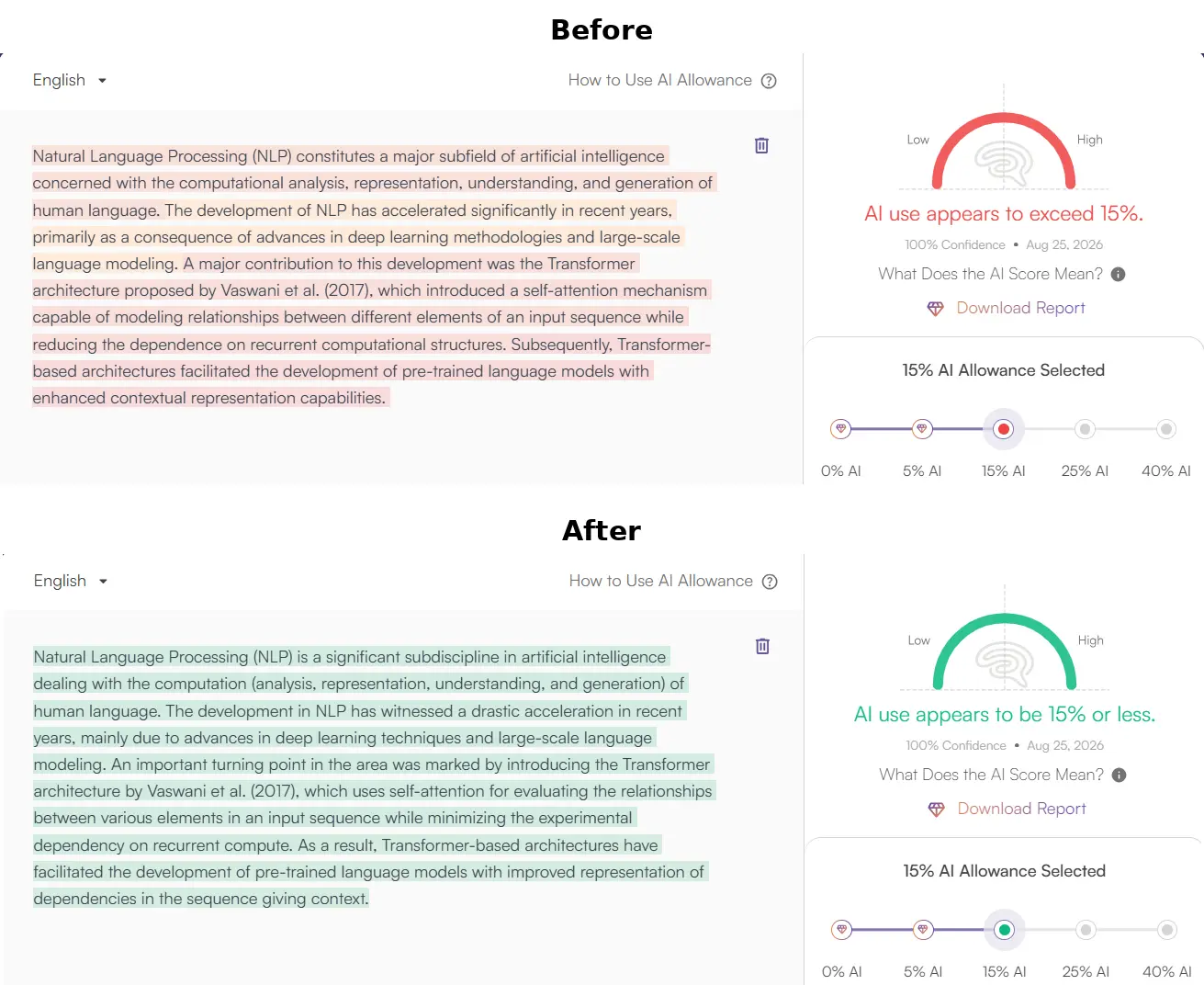
1. ThesisHuman Editor: Style, Field & Term Lock™ Technology
Unlike consumer-grade paraphrasers that blindly swap words with thesaurus synonyms, ThesisHuman allows researchers to select their exact Academic Style (Essay, Research Paper, Literature Review, Technical Report) and Academic Field (Computer Science, Engineering, Medicine, Physics). With Term Lock™, citations (APA, MLA, IEEE), LaTeX equations, and domain-specific terminology are cryptographically protected before sentence entropy is restructured.
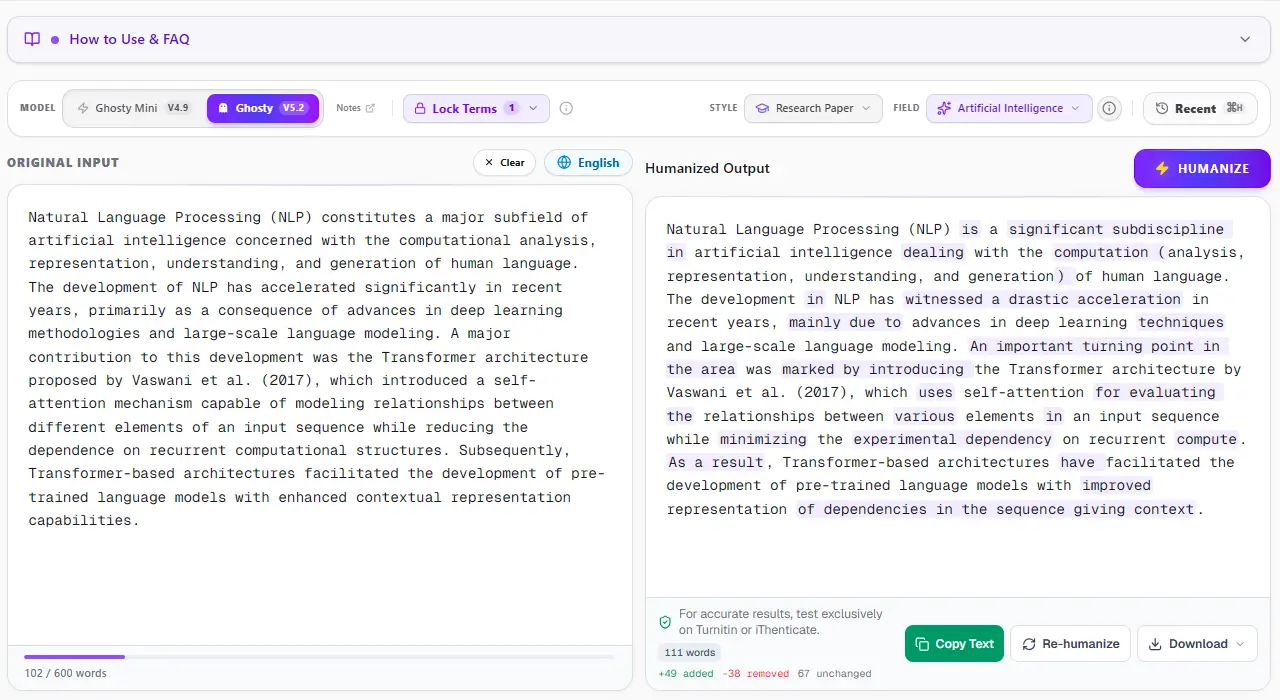
2. Turnitin & iThenticate Verification: 0% AI Detected
Turnitin and iThenticate scan submissions in overlapping 500-token blocks to analyze sentence predictability across paragraphs. When an unrefined AI draft is submitted, uniform cadence triggers an elevated AI Writing score. In the verified report below, a flagged graduate paper was processed through ThesisHuman, achieving a clean 0% AI detection score while preserving all formatted citations and technical parameters.
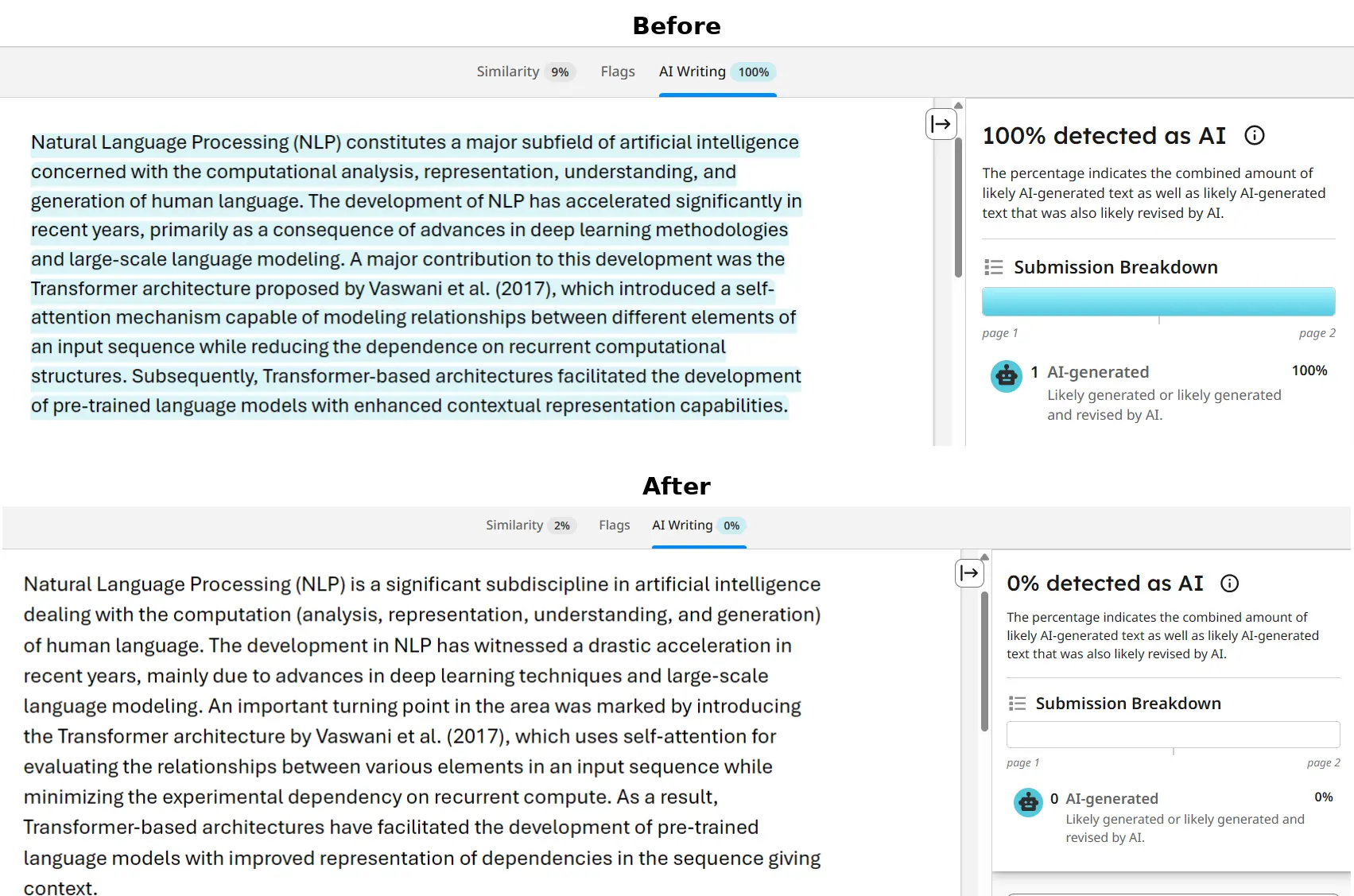
3. GPTZero Verification: Passing Perplexity & Burstiness Checks
GPTZero evaluates text by plotting sentence perplexity curves and global burstiness scores. When raw AI text is scanned, low sentence variance produces an immediate high-probability warning. ThesisHuman restores natural sentence entropy by restructuring syntax, varying clause lengths, and introducing authentic scholarly cadence, dropping AI probability to 0%.
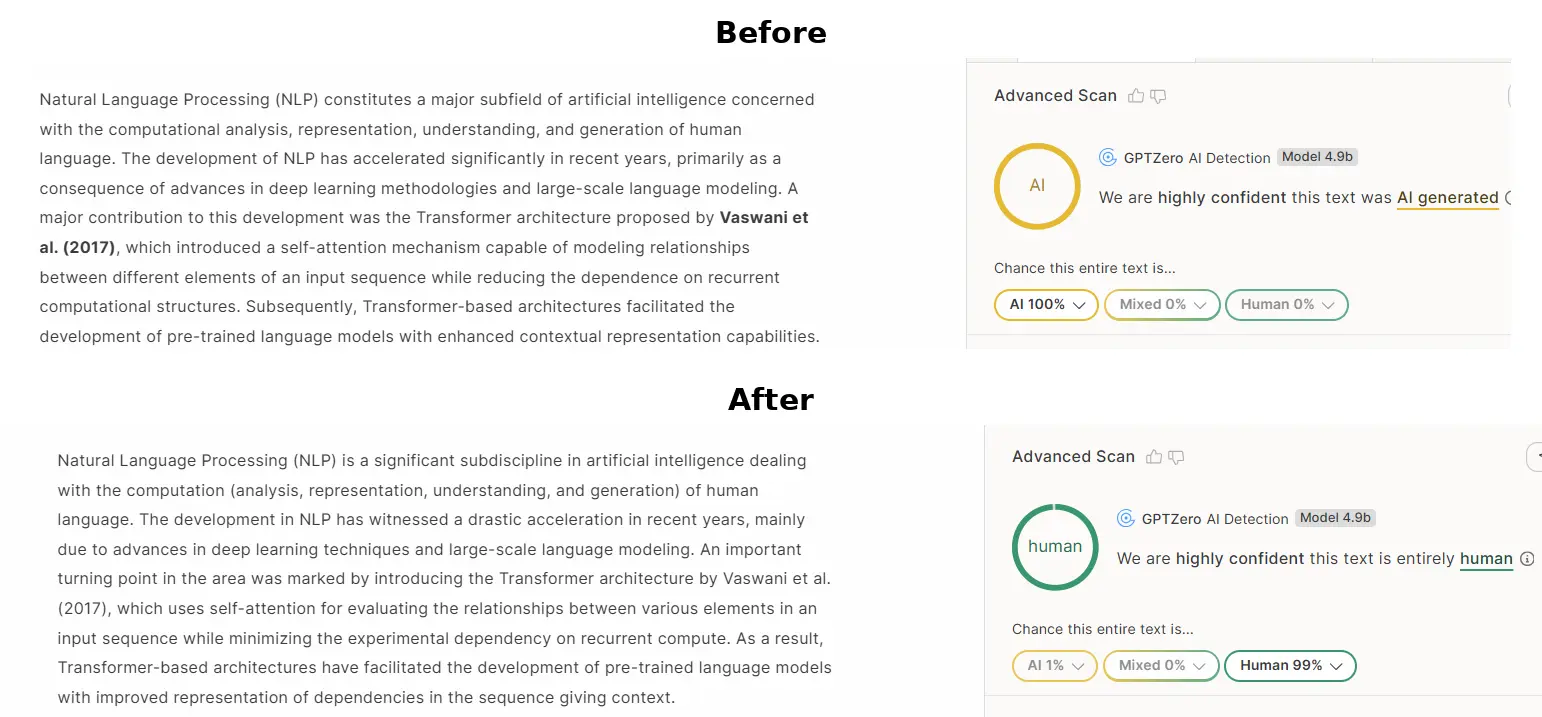
4. Originality.ai Verification: 0% AI Confidence
Originality.ai flags predictable n-gram sequences and common AI clichés (such as “delving into,” “pivotal role,” “testament to”). ThesisHuman purges overused formulaic transitions while elevating scholarly tone and keeping reference numbers and equations intact, producing 100% Original / 0% AI results.