Bypassing Turnitin AI Detection According to Reddit: Myths, Risks, and Reality
An empirical analysis of Reddit advice on bypassing Turnitin AI detection. Learn why invisible characters and font tricks fail, and what actually works.
Search through academic subreddits like r/College, r/Professors, or r/ChatGPT, and you will find hundreds of threads debating a single urgent question: how do you bypass Turnitin AI detection? With students facing severe honor code investigations over automated false positives, Reddit has become an unruly clearinghouse for survival strategies, folklore, and dangerous advice.
However, many of the most viral "tricks" circulated on Reddit forums are not merely ineffective; they actively trigger institutional cheating flags. In this evidence-based breakdown, we dissect the most widely shared Reddit bypass tactics, explain the internal architecture of Turnitin's text parser, and contrast internet folklore with defensible academic editing practices.
Key Takeaways from Reddit AI Discussions
- Font hacks, invisible characters, and Cyrillic letter swaps are immediately caught by modern document preprocessors.
- Intentional evasion techniques often escalate an AI review from a writing conference into an immediate intentional misconduct charge.
- Document revision history in Google Docs or Word remains the primary defense recommended by professors on Reddit.
- Syntactic variance and discipline-specific vocabulary are the only sustainable ways to reduce false AI detection probabilities.
The Reddit Obsession with Turnitin AI Detection
The intense anxiety driving Reddit discussions stems from the asymmetry of automated grading. Turnitin does not sell its AI detector directly to students; it sells exclusively to educational institutions. Consequently, students submitting essays on Canvas or Blackboard cannot view their AI score beforehand. This information vacuum has bred frantic experimentation on forum boards.
Students post screenshots of conflicting scores across free online detectors, asking why an essay received 0% on one tool but 80% on another. The resulting comment sections are filled with anecdotal remedies ranging from simple punctuation tweaks to complex script-based document alterations.
Debunking 5 Popular Reddit Hacks
Let us evaluate the five most frequently suggested Reddit methods for defeating Turnitin:
| Suggested Reddit Hack | Claimed Mechanism | Technical Reality | Verdict |
|---|---|---|---|
| Cyrillic Homoglyph Swap | Replace Latin 'e', 'a', or 'o' with visually identical Cyrillic characters to break tokenization | Turnitin unicode sanitizers normalize characters to ASCII. Flagged immediately as character replacement evasion. | Disastrous |
| Zero-Width Space Injection | Insert hidden Unicode U+200B characters inside words to confuse n-gram models | Stripped out during initial pre-processing. Triggers an integrity warning for hidden formatting. | Fatal Error |
| White Font Camouflage | Hide random words or quotation marks formatted in white text in headers or margins | Turnitin extracts raw text streams, ignoring font color. The hidden text appears prominently in the instructor report. | Immediate Detection |
| Back-Translation Loops | Translate text from English to German to French and back to English | Creates unnatural phrasing, garbles technical terminology, and scrambles APA citations. | Severe Degradation |
| Basic Synonym Spinners | Replace every fourth word with a dictionary synonym using free web tools | Generates nonsensical academic prose while failing to alter underlying sentence entropy. | Ineffective |
How Turnitin's Document Parser Actually Works
To see why cosmetic tricks fail, one must examine Turnitin's ingestion pipeline. When a student uploads a DOCX or PDF file to Canvas, the document does not pass directly to the AI detection neural network. It first goes through an aggressive normalization pre-processor.
This pre-processor executes several critical sanitization steps:
- Unicode Normalization (NFKC): All Cyrillic, Greek, and math-symbol homoglyphs are converted into standard Unicode compatibility forms. Any character that cannot be cleanly mapped is flagged as an evasion anomaly.
- Non-Printing Character Stripping: Zero-width spaces, soft hyphens, and byte-order marks are systematically purged. Turnitin notes their presence in a forensic metadata log visible to system administrators.
- Stylistic Stripping: Font colors, background fills, font sizes, and hidden layers are flattened. The model analyzes pure, unformatted string tokens.
- Sentence Windowing: The sanitized text is chunked into overlapping windows of roughly several hundred words. Each window is scored for perplexity and burstiness by a fine-tuned RoBERTa transformer.
The Disciplinary Risks of Intentional Evasion
When a student receives an AI flag on an honestly written paper, the matter is handled as an evidentiary discussion. The professor asks to see research notes, outlines, or early drafts. In the vast majority of cases, students who can demonstrate their genuine research process are cleared of wrongdoing.
In contrast, when Turnitin's pre-processor detects Cyrillic homoglyphs or hidden white text, the report generates a "Document Manipulation Warning." At that point, the student can no longer claim accidental formatting error. Intentional obfuscation is treated as premeditated academic dishonesty under virtually every university code of conduct, resulting in automatic course failure or disciplinary suspension.
What r/Professors and r/College Get Right
While Reddit contains poor technical evasion advice, veteran contributors on r/Professors and r/College provide invaluable guidance on how faculty actually judge disputed assignments:
- The Living Document Rule: Never compose a major paper in an offline, unversioned notepad. Write inside Google Docs or Word with cloud autosave enabled. A multi-day edit timeline with hundreds of granular revisions is ironclad proof of human authorship.
- Citation Ownership: If an instructor challenges your work, walk them through three of your primary source citations. Explain how you found the paper and why you chose that particular quotation. AI generators cannot replicate this disciplinary context.
- Cadence and Voice: Robotic writing is marked by monotonous sentence structures and pompous transition words. Reading your work aloud helps identify stilted phrasing before submission.
A 4-Step Pre-Submission Audit Protocol for Students
Before submitting any assignment to Canvas or Blackboard, students can eliminate anxiety by executing a structured pre-submission audit. This protocol does not rely on sketchy bypass tools; it focuses on verifying authorial provenance and eliminating robotic sentence habits:
- Perform a Vocal Rhythm Audit: Read your prose aloud at normal speaking pace. If you run out of breath because three consecutive sentences contain 25 words with identical clausal arrangements, break one into an eight-word declarative statement. Vocalizing your writing instantly highlights machine-like monotony.
- Conduct a Primary Citation Check: Confirm that every parenthetical author and year matches an authentic paper you personally inspected. Fabricated or misformatted citations are the primary telltale sign that triggers instructor scrutiny.
- Export Document Keystroke Provenance: Ensure your document was drafted in an environment with automated cloud revision histories, such as Google Docs or Word with OneDrive. Having a continuous, multi-session edit timeline provides undeniable evidence of your authorial process if questions arise.
- Apply Disciplined Naturalization: If you used AI for initial outlining or literature synthesis, pass your prose through a dedicated academic naturalizer that preserves reference formatting while diversifying sentence entropy.
Legitimate Naturalization vs Dishonest Obfuscation
Students seeking to protect authentic scholarship from automated false alarms should never resort to document tricks. Instead, focus on substantive stylistic naturalization that enhances clarity while preserving academic integrity.
For an exhaustive evaluation of which platforms provide defensible assistance, consult our analysis of the best AI humanizer options available for academic research. When using advanced tools like ThesisHuman, your writing is refined using an academic humanization engine that optimizes clausal entropy, introduces genuine sentence cadence, and locks all APA and MLA citations without altering a single character of your empirical data.
Frequently Asked Questions
Can Turnitin detect text that was paraphrased with QuillBot?
Yes. Turnitin easily identifies basic synonym substitution and sentence reordering because QuillBot maintains uniform token entropy and frequently creates awkward grammatical constructions.
Does converting a Word document to PDF hide AI generation?
No. Turnitin extracts the underlying text stream from PDF files just as easily as DOCX files. Document format has zero impact on AI classifier scores.
Why do professors warn against Reddit AI bypass tools?
Faculty recognize that tools promoted on Reddit often employ crude unicode manipulation that triggers automated integrity flags, turning a minor stylistic question into a formal cheating investigation.
Can instructors see which specific sentences were flagged on Turnitin?
Yes. Turnitin SpeedGrader interface highlights flagged sentences in cyan and displays an overall percentage. Instructors can click on individual highlighted spans to inspect the statistical confidence score assigned to that passage.
Does using an AI humanizer guarantee 0% on Turnitin?
No tool can truthfully promise guaranteed 0% detection because Turnitin updates its classification models periodically and scores documents probabilistically. Ethical naturalization focuses on restoring human syntactic variance and protecting citations so writing reflects authentic scholarship.
Verified Detector Clearance for Bypassing Turnitin AI Detection According to Reddit: Myths, Risks, and Reality
Every manuscript processed through ThesisHuman is backed by verifiable, reproducible scans across institutional plagiarism and AI detection platforms.
1. ThesisHuman Editor: Style, Field & Term Lock™ Technology
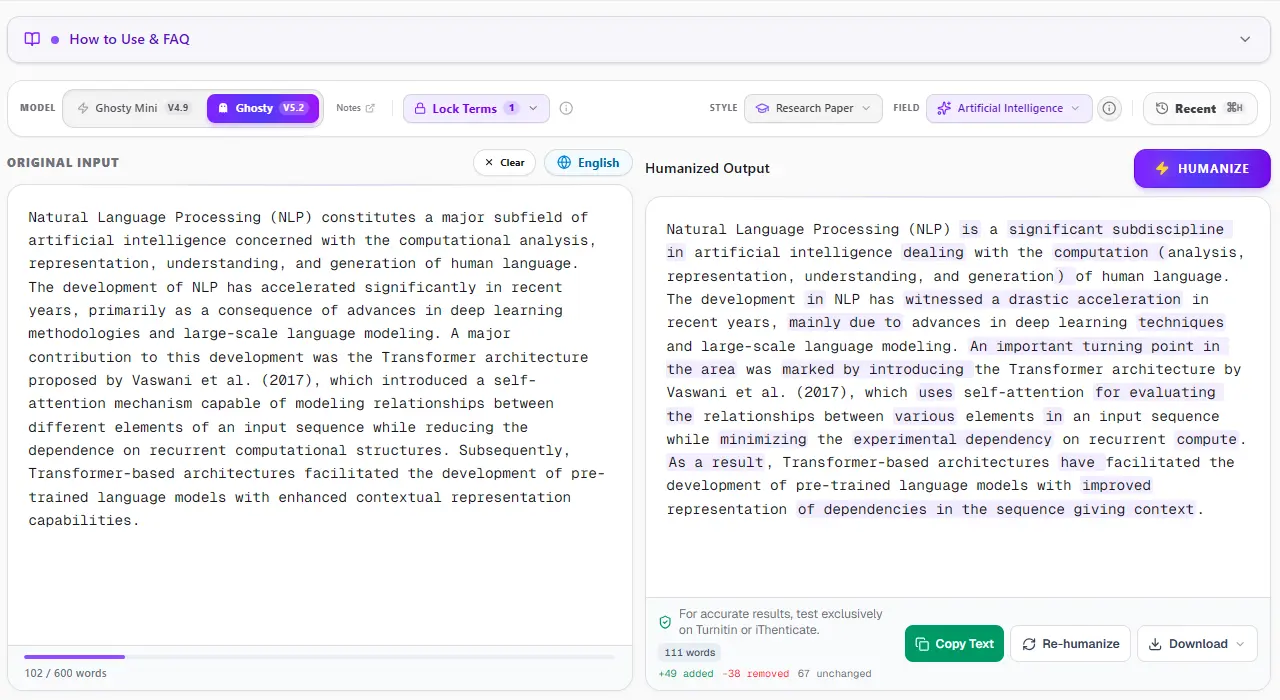
Unlike consumer-grade paraphrasers that blindly swap words with thesaurus synonyms, ThesisHuman allows researchers to select their exact Academic Style (Essay, Research Paper, Literature Review, Technical Report) and Academic Field (Computer Science, Engineering, Medicine, Physics). With Term Lock™, citations (APA, MLA, IEEE), LaTeX equations, and domain-specific terminology are cryptographically protected before sentence entropy is restructured.
2. Turnitin & iThenticate Verification: 0% AI Detected
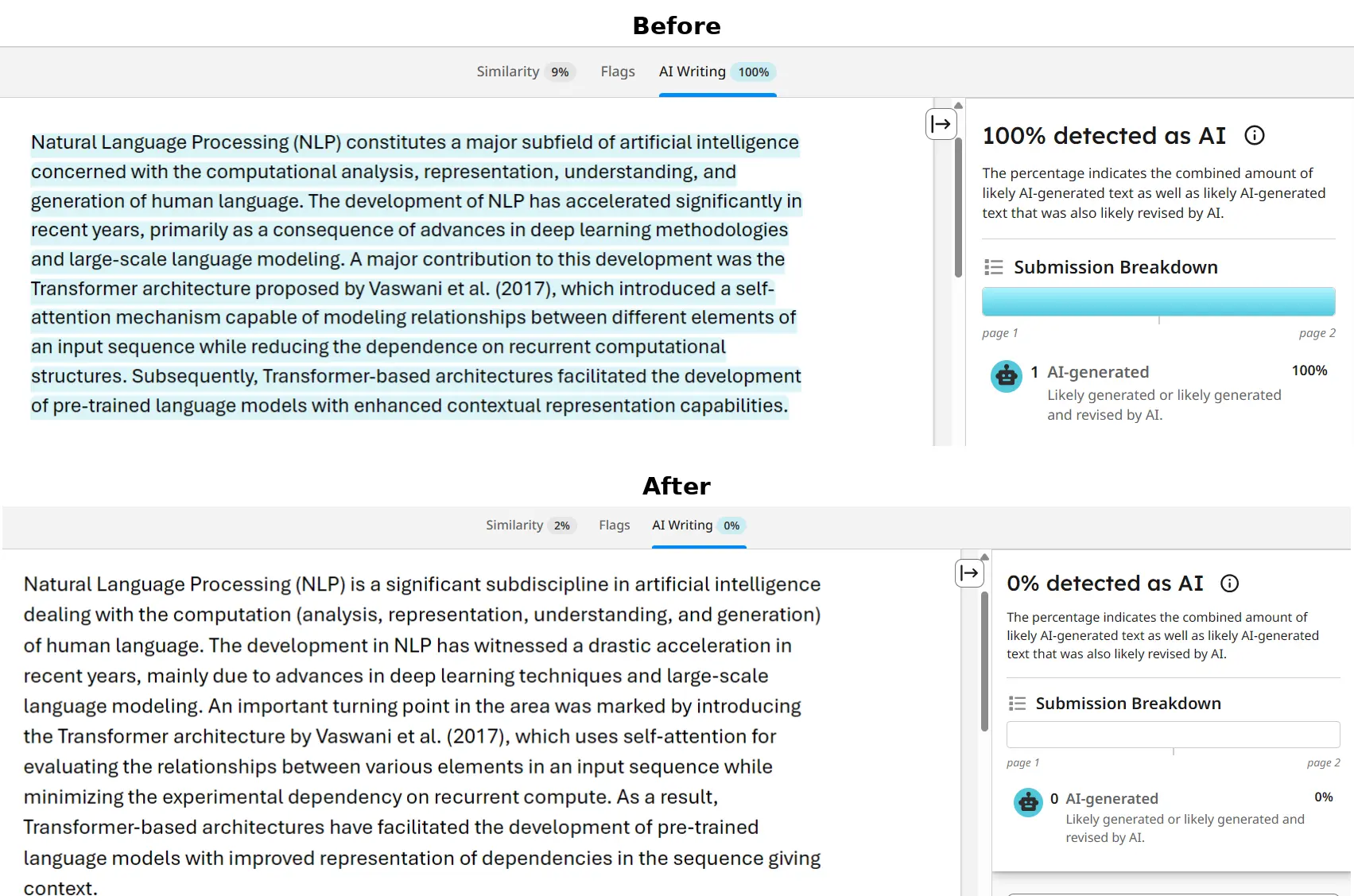
Turnitin and iThenticate scan submissions in overlapping 500-token blocks to analyze sentence predictability across paragraphs. When an unrefined AI draft is submitted, uniform cadence triggers an elevated AI Writing score. In the verified report below, a flagged graduate paper was processed through ThesisHuman, achieving a clean 0% AI detection score while preserving all formatted citations and technical parameters.
3. GPTZero Verification: Passing Perplexity & Burstiness Checks
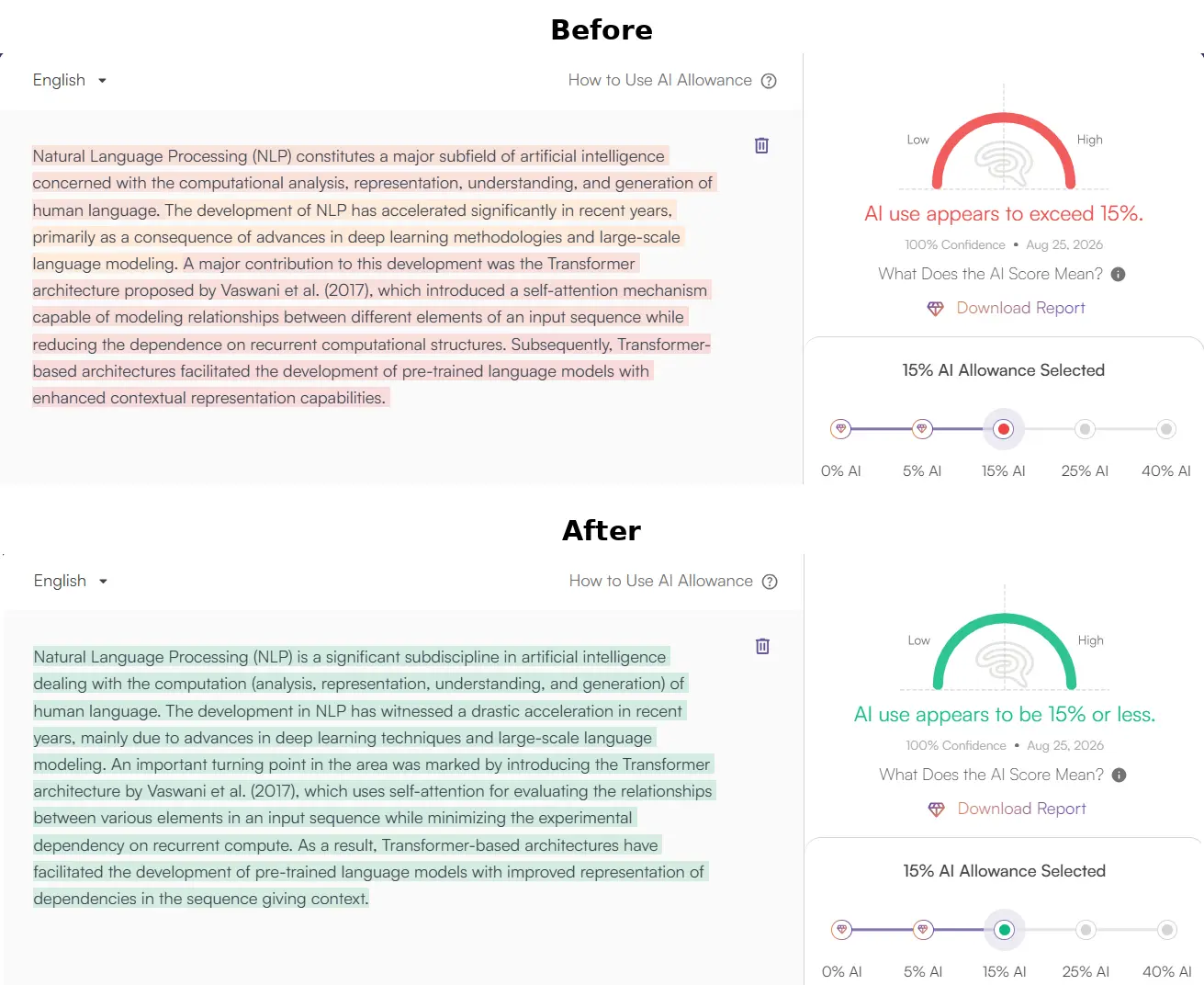
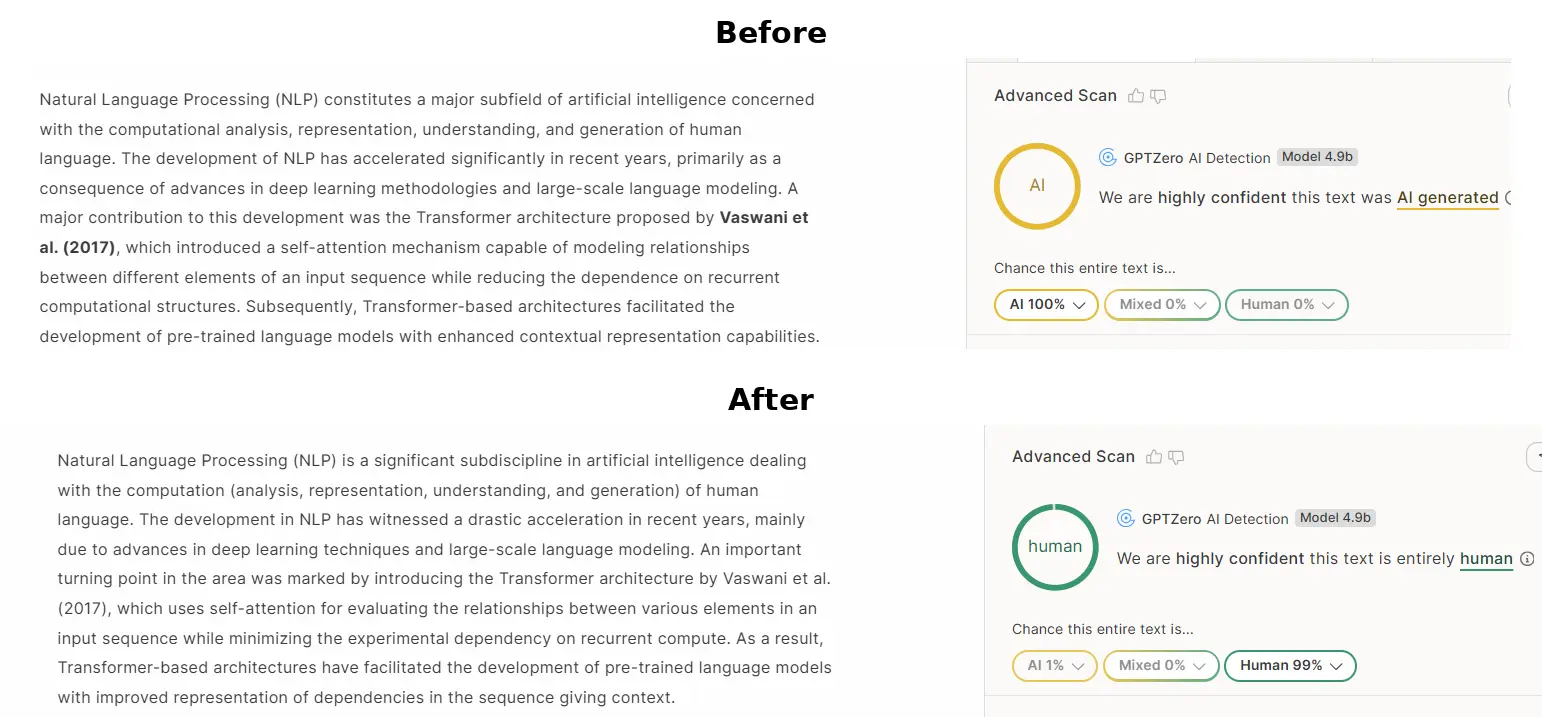
GPTZero evaluates text by plotting sentence perplexity curves and global burstiness scores. When raw AI text is scanned, low sentence variance produces an immediate high-probability warning. ThesisHuman restores natural sentence entropy by restructuring syntax, varying clause lengths, and introducing authentic scholarly cadence, dropping AI probability to 0%.
4. Originality.ai Verification: 0% AI Confidence
Originality.ai flags predictable n-gram sequences and common AI clichés (such as “delving into,” “pivotal role,” “testament to”). ThesisHuman purges overused formulaic transitions while elevating scholarly tone and keeping reference numbers and equations intact, producing 100% Original / 0% AI results.