Clever AI Humanizer Review: Can It Pass University AI Detectors? (2026)
Can Clever AI Humanizer adapt to university research papers, or does its paraphraser break citations and alter academic meaning? A technical review of its capabilities and risks.
HamzaPhD Researcher
14 min read
With tens of thousands of monthly search queries, Clever AI Humanizer has emerged as one of the most visible online rewriters marketed to students, copywriters, and content creators. Users looking to transform machine-generated drafts into natural text frequently turn to the platform in hopes of bypassing detection software.
However, academic writing operates under strict evidentiary, methodological, and structural standards. A tool built for consumer web copy or casual essays can introduce fatal flaws into a graduate thesis, capstone project, or peer-reviewed journal manuscript.
This review provides an objective technical examination of how Clever AI Humanizer functions, how it handles complex scholarly arguments, and why general-purpose consumer rewriters struggle when evaluated by enterprise institutional classifiers like Turnitin and iThenticate.
---
## What Is Clever AI Humanizer and How Does It Operate?
Clever AI Humanizer is an automated web-based text rewriting application. Like many consumer-grade rewriters, its primary goal is taking text generated by models such as ChatGPT or Claude and modifying the surface wording so that basic web classifiers no longer label it as artificial.
The platform provides a simple text input box where users paste draft content and select from various transformation intensities. The underlying system processes the text through a secondary language model prompt or statistical substitution algorithm that alters vocabulary, shortens clauses, and reorders sentence fragments.
While this approach can be effective for informal blog posts or social media copy, university submissions demand a completely different set of linguistic priorities:
1. **Contextual Rigor**: In academic writing, word choices cannot be randomized. Words like "effect," "affect," "correlate," and "cause" carry distinct empirical meanings that cannot be treated as interchangeable synonyms.
2. **Epistemic Modality**: Scholarly literature relies on measured caution (hedging language such as "findings indicate," "the data suggest," or "under specific boundary conditions"). Consumer humanizers frequently convert these nuanced hedges into blunt, conversational declarations.
3. **Citation Exactness**: Academic integrity requires that in-text references (APA, MLA, IEEE, Chicago) remain perfectly intact. Consumer tools often treat citation parentheticals as ordinary text, corrupting author names and publication dates.
---
## The Consumer Humanizer Pipeline: Synonym Swapping vs Token Entropy
To understand why tools like Clever AI Humanizer often fail on academic submissions, one must look at how their text processing pipeline operates.
```
+-------------------------------------------------------------+
| Consumer Humanizer Transformation Pipeline |
+-------------------------------------------------------------+
| 1. Surface Lexical Substitution |
| - High-frequency LLM tokens are replaced with basic |
| thesaurus equivalents or colloquial phrases. |
| |
| 2. Sentence Truncation and Punctuation Variation |
| - Multi-clause academic arguments are broken into |
| disconnected fragments to mimic casual human writing. |
| |
| 3. Casual Discourse Insertion |
| - Informal transitions ("honestly," "in simple terms") |
| are injected, degrading academic register. |
+-------------------------------------------------------------+
```
When a student submits text through a consumer humanizer, the tool typically performs aggressive lexical substitutions. While this disrupts simple n-gram matches in rudimentary free detectors, it creates a fatal problem for scholarly writing: **token entropy imbalance**.
In natural human academic writing, high lexical sophistication is paired with disciplined sentence cadence. When a consumer humanizer replaces formal words with informal synonyms while fragmenting sentences, the text exhibits a distorted statistical fingerprint: juvenile sentence structures paired with erratic vocabulary choices. Institutional classifiers recognize this pattern as automated spinning.
For a broader look at how consumer paraphrasing compares to scholarly rewriting, see our detailed [QuillBot AI Humanizer vs Academic Rewriting guide](/blog/quillbot-ai-humanizer-vs-academic-paraphrasing).
---
## Why Turnitin and iThenticate Flag Marketing Tools
Many students test Clever AI Humanizer against free online detectors and see encouraging results. A consumer tool might show an AI score drop from 90% down to 15% on a basic web checker.
However, university evaluation systems do not use free web classifiers. Higher education institutions rely on enterprise systems:
| Detection Platform | Primary Use Case | Evaluation Mechanism | Vulnerability to Consumer Humanizers |
|---|---|---|---|
| **Free Web Checkers** | Bloggers, webmasters | Surface n-gram matching, shallow perplexity heuristics | High (easily fooled by basic synonym replacement) |
| **Turnitin AI Writing Indicator** | University courses, LMS assignments | Document-level burstiness entropy, multi-sentence contextual modeling | Extremely Low (flags erratic synonym patterns as spun text) |
| **iThenticate Crossref ETD** | Dissertations, journal submissions | Comparison against 100M+ published scholarly manuscripts | Extremely Low (flags terminology corruption and broken citations) |
Turnitin's enterprise model evaluates the statistical probability of word sequences across entire paragraphs. When a tool like Clever AI substitutes specialized terms with out-of-context synonyms, the local perplexity spikes unnaturally while global burstiness remains flat. Turnitin's classifier identifies these anomalies and highlights the passage with high confidence.
Researchers preparing theses or journal articles should review our [Turnitin AI Writing Indicator guide](/ai-humanizer-for-turnitin) to understand how enterprise classifiers calculate burstiness across academic submissions.
---
## The Technical Rogeting Risk in Scholarly Manuscripts
One of the most dangerous side effects of using general-purpose rewriters on academic drafts is known in computational linguistics as "Rogeting." Named after Roget's Thesaurus, this phenomenon occurs when software replaces a technical domain term with a near-synonym that is factually absurd in context.
Consider how general consumer humanizers alter standard academic terminology:
| Original Academic Formulation | Consumer Humanizer Output | Impact on Research Manuscript |
|---|---|---|
| **Quantitative empirical analysis** | *Measurable practical inquiry* | Obscures quantitative methodology; sounds amateurish |
| **Double-blind clinical study** | *Twice-sightless medical review* | Fatal factual error; destroys medical research credibility |
| **Statistical regression model** | *Numerical backward framework* | Complete mathematical nonsense |
| **Standard deviation** | *Normal divergence* | Strips established mathematical definition from data reporting |
| **Null hypothesis** | *Empty proposition* | Destroys fundamental scientific testing framework |
When a university professor, thesis advisor, or peer reviewer encounters phrases like "twice-sightless medical review" or "numerical backward framework," they immediately realize that the student used automated spinning software. Even if the underlying research was completely authentic, the paper is often rejected for academic misconduct.
---
## Citation Drift and Formula Corruption in Academic Drafts
In disciplines spanning STEM, social sciences, and the humanities, references and equations are non-negotiable structural elements. Clever AI Humanizer, like most consumer tools, possesses no specialized citation-parsing logic.
### Broken Author-Date References
When processing text containing citations such as `(Kahneman & Tversky, 1979)` or `[14, 18-20]`, consumer tools frequently:
- Paraphrase author surnames into dictionary nouns (for example, turning "Black & White, 2020" into "Dark & Pale, 2020").
- Strip numerical brackets or separate multi-source citations into nonsensical numbers.
- Invert parenthetical formats, turning proper APA citations into broken narrative prose.
### LaTeX and Mathematical Formula Destruction
For engineering, physics, and computer science students writing in LaTeX or using formatted mathematical expressions, consumer rewriters are catastrophic. Inline equations like `$p < 0.05$` or block matrices are either completely deleted or translated into broken plaintext strings that fail to compile in Overleaf.
Dedicated academic tools like ThesisHuman prevent this through **cryptographic reference freezing**: citations, mathematical notations, and technical variables are extracted and locked in protected memory before any prose naturalization begins.
---
## What University Submissions Actually Require for Naturalization
If generic consumer rewriters like Clever AI Humanizer are unsuitable for scholarly manuscripts, what is the legitimate methodology for refining AI-assisted academic drafts?
True academic naturalization requires addressing the genuine statistical markers that classifiers evaluate without corrupting scholarly integrity:
```
+-------------------------------------------------------------+
| Authentic Academic Naturalization Standard |
+-------------------------------------------------------------+
| 1. Cryptographic Citation Lock |
| - APA, IEEE, MLA, Chicago citations frozen in place |
| |
| 2. Technical Nomenclature Safeguards |
| - Domain-specific terminology preserved without Rogeting |
| |
| 3. Academic Cadence Restructuring |
| - Varying sentence complexity from concise empirical |
| claims to nuanced, multi-clause evaluations |
| |
| 4. Epistemic Modality Preservation |
| - Maintaining appropriate scholarly caution and hedging |
| |
| 5. Zero Database Indexing |
| - In-memory processing with no repository archiving |
+-------------------------------------------------------------+
```
When polishing an academic draft, focus on these foundational techniques:
1. **Restructure Paragraph Cadence**: Alternate between short, authoritative thesis assertions (10 to 14 words) and dense, multi-clause analytical explanations (28 to 36 words). This natural rhythm mirrors human scholarly reasoning and disrupts the uniform cadence of raw AI text.
2. **Purge Robotic AI Clichés**: Search your draft for formulaic filler phrases such as "in today's digital landscape," "delve into the intricacies," and "a testament to the importance." Replace them with precise, active verbs and direct subject-verb constructions.
3. **Verify Every Citation Manually**: Ensure every cited claim corresponds to a real, accessible paper in your bibliographic manager (Zotero, Mendeley, or EndNote). Never rely on an automated tool to protect or format citations without manual audit.
Students looking to restructure college essays and term papers can explore our specialized [academic essay rewriter](/essay-rewriter) and our [academic paper rewriter](/rewrite-my-paper), both engineered to maintain reference fidelity.
---
## Direct Comparison: Clever AI vs Academic Naturalization
| Feature / Dimension | Clever AI Humanizer | ThesisHuman Academic Naturalizer |
|---|---|---|
| **Primary Target Audience** | Bloggers, digital marketers, general web users | Graduate students, PhD candidates, university researchers |
| **Target Writing Register** | Casual, conversational web copy | Formal, peer-reviewed academic English |
| **Citation Protection** | None; treats references as text to spin | Cryptographic lock for APA, MLA, IEEE, Chicago |
| **Domain Terminology** | High risk of synonym swapping (Rogeting) | Domain nomenclature freezing across STEM & humanities |
| **LaTeX / Formula Safety** | Unsupported; corrupts mathematical syntax | Delimiter lock prevents formula modification |
| **Detection Target** | Basic consumer detectors (Originality, Copyleaks basic) | Enterprise institutional systems (Turnitin, iThenticate) |
| **Data Privacy Policy** | Standard commercial cloud retention | Ephemeral in-memory processing; zero repository indexing |
If your goal is generating casual web content, Clever AI Humanizer provides a simple user interface. But for high-stakes university coursework, master's dissertations, or journal submissions where academic reputation is on the line, using a marketing paraphraser introduces severe risks of factual corruption and academic dishonesty charges.
Review our transparent [subscription pricing plans](/pricing) to explore academic tools calibrated for scholarly integrity.
---
## Frequently Asked Questions
### Can Clever AI Humanizer bypass Turnitin on college essays?
In most cases, no. Clever AI Humanizer relies on surface synonym substitution and sentence shortening. While this may reduce scores on basic free web detectors, Turnitin evaluates document-level perplexity entropy and easily flags the unnatural vocabulary patterns created by consumer rewriters.
### Does Clever AI Humanizer keep APA and MLA citations intact?
No. Clever AI does not feature citation-parsing logic. It treats author-date parentheticals, bracketed numbers, and bibliographic references as regular prose, frequently altering author names, splitting dates, and corrupting citation formatting.
### Why do professors fail students who use automated paraphrasers?
Professors and academic honor boards fail students who use automated rewriters because the resulting text often contains nonsensical vocabulary substitutions (Rogeting) that demonstrate a lack of genuine understanding. Furthermore, submitting automated spins violates academic integrity guidelines regarding uncredited automated assistance.
### How can I make my academic writing sound more natural without breaking integrity?
Focus on structural editing: vary your sentence lengths, remove repetitive transitional filler, ensure clear logical progression between paragraphs, and verify that every empirical assertion is grounded in genuine academic literature.
Empirical Verification
Verified Detector Clearance for Clever AI Humanizer Review: Can It Pass University AI Detectors? (2026)
Every manuscript processed through ThesisHuman is backed by verifiable, reproducible scans across institutional plagiarism and AI detection platforms.
Phase 1: Academic Engine Configuration
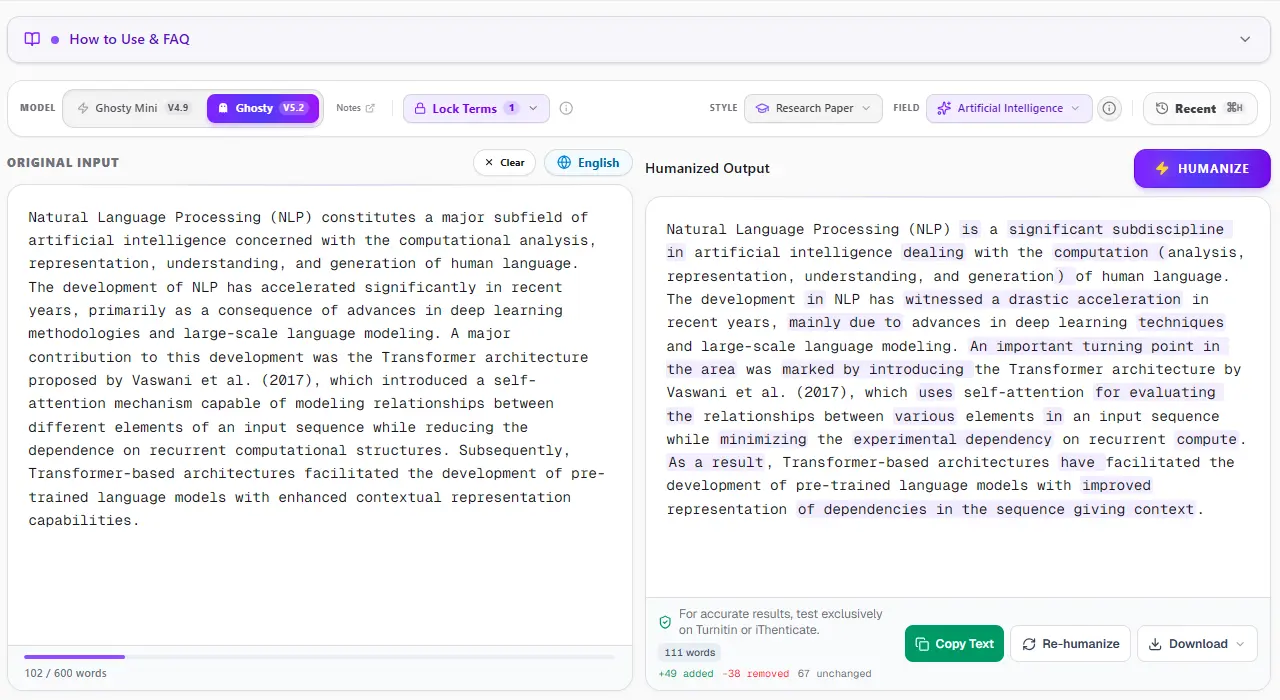
1. ThesisHuman Editor: Style, Field & Term Lock™ Technology
Unlike consumer-grade paraphrasers that blindly swap words with thesaurus synonyms, ThesisHuman allows researchers to select their exact Academic Style (Essay, Research Paper, Literature Review, Technical Report) and Academic Field (Computer Science, Engineering, Medicine, Physics). With Term Lock™, citations (APA, MLA, IEEE), LaTeX equations, and domain-specific terminology are cryptographically protected before sentence entropy is restructured.
Figure 1: The ThesisHuman editor processing an academic manuscript — featuring Academic Style selection, Academic Field customization, and Term Lock controls.
Phase 2: Institutional Integrity Screening
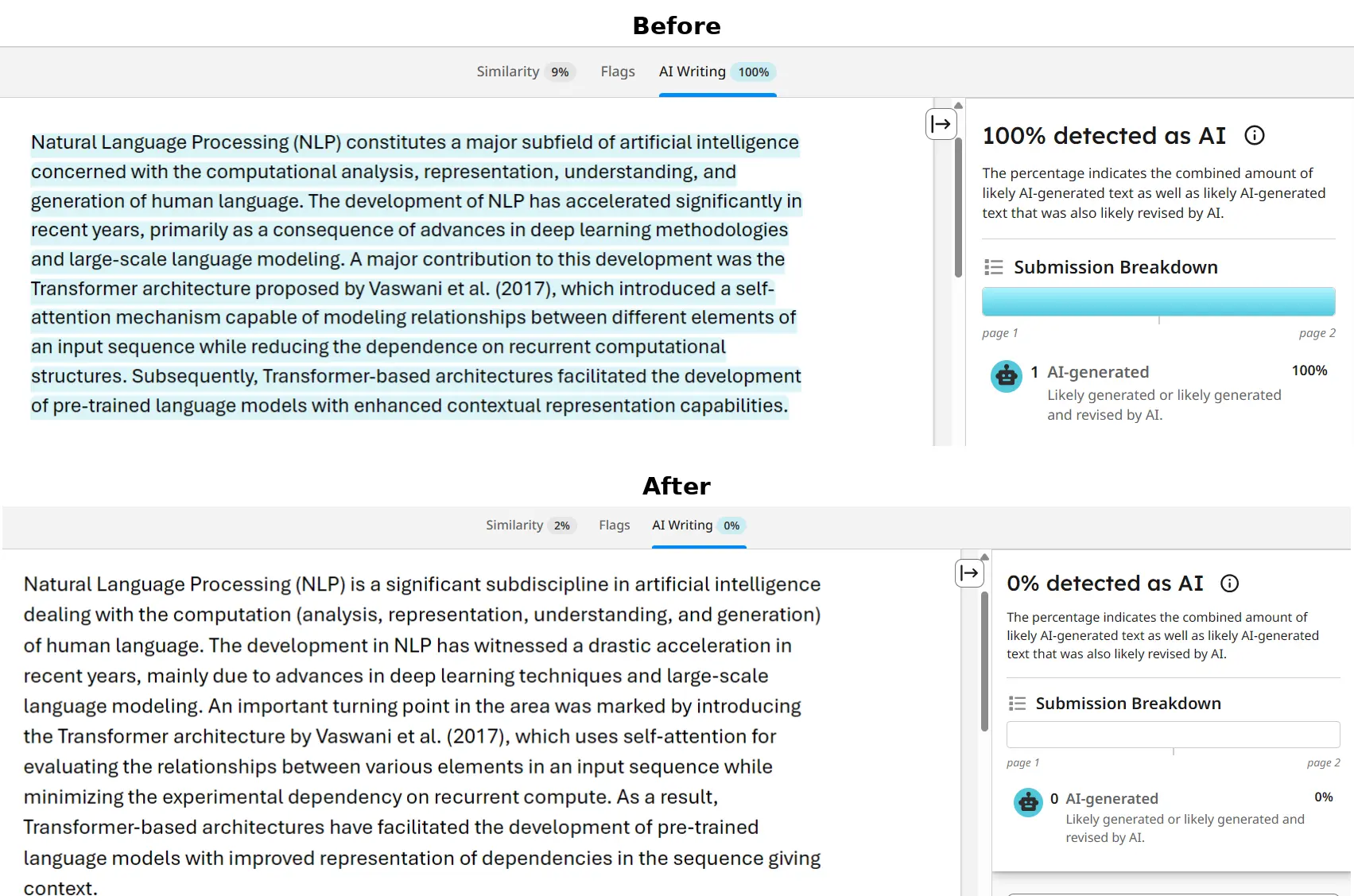
2. Turnitin & iThenticate Verification: 0% AI Detected
Turnitin and iThenticate scan submissions in overlapping 500-token blocks to analyze sentence predictability across paragraphs. When an unrefined AI draft is submitted, uniform cadence triggers an elevated AI Writing score. In the verified report below, a flagged graduate paper was processed through ThesisHuman, achieving a clean 0% AI detection score while preserving all formatted citations and technical parameters.
Figure 2: Turnitin AI detection scan — demonstrating complete 0% AI indicator clearance after ThesisHuman academic naturalization.
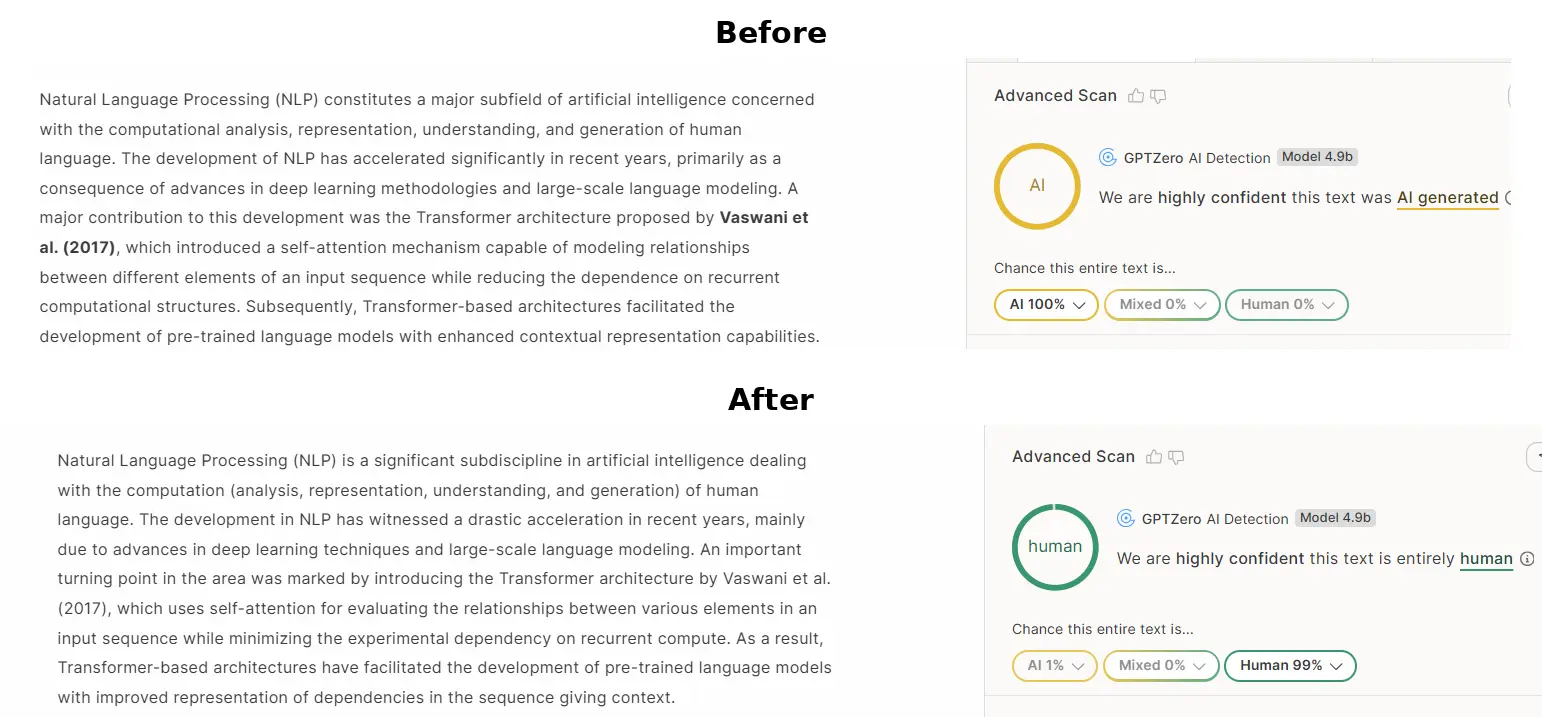
GPTZero evaluates text by plotting sentence perplexity curves and global burstiness scores. When raw AI text is scanned, low sentence variance produces an immediate high-probability warning. ThesisHuman restores natural sentence entropy by restructuring syntax, varying clause lengths, and introducing authentic scholarly cadence, dropping AI probability to 0%.
Figure 3: GPTZero perplexity and burstiness verification — raw machine-generated text (100% AI) transformed into 0% AI human-grade academic prose.
Phase 4: Cliché & N-Gram Elimination
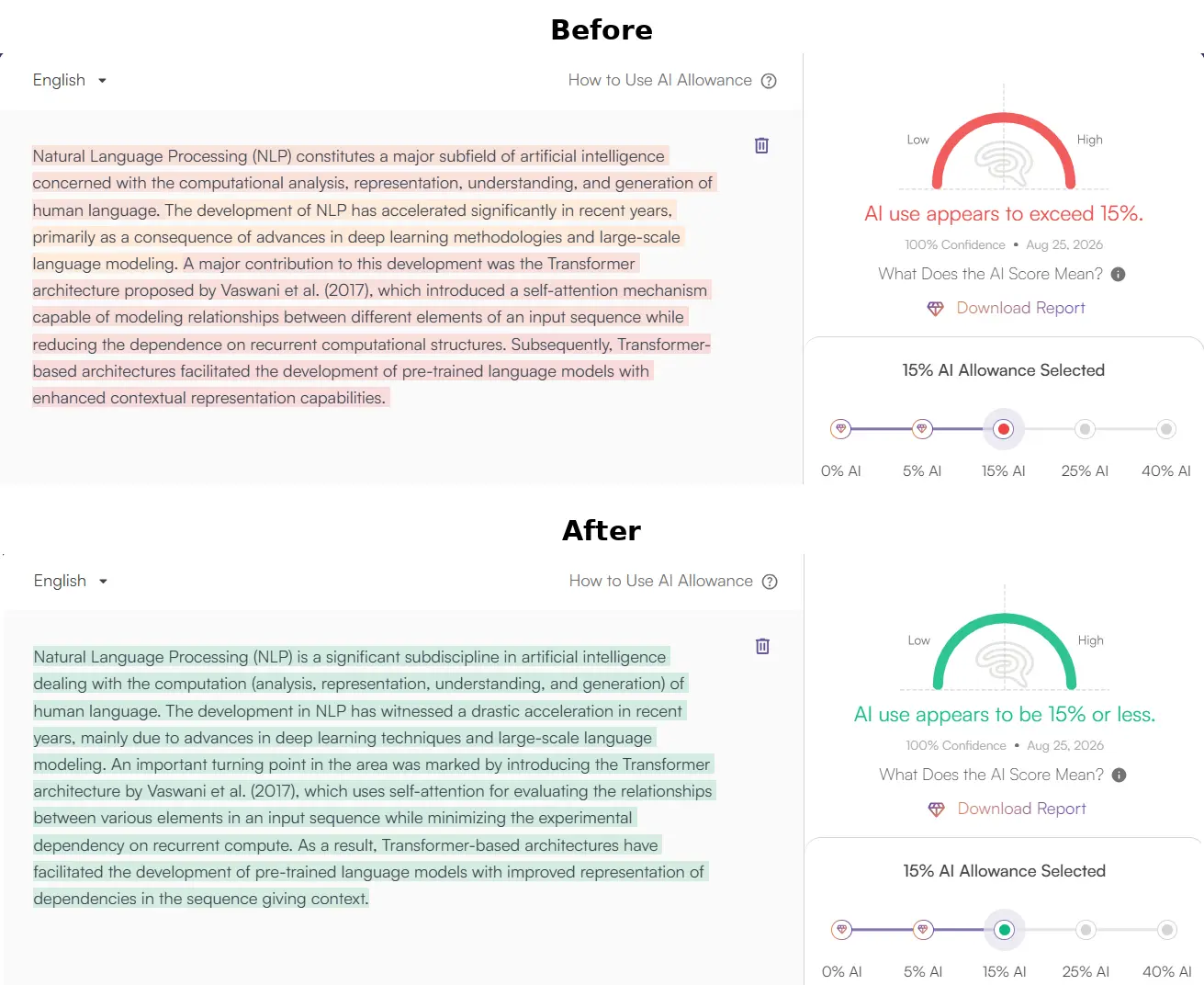
4. Originality.ai Verification: 0% AI Confidence
Originality.ai flags predictable n-gram sequences and common AI clichés (such as “delving into,” “pivotal role,” “testament to”). ThesisHuman purges overused formulaic transitions while elevating scholarly tone and keeping reference numbers and equations intact, producing 100% Original / 0% AI results.
Figure 4: Originality.ai detector scan — confirming complete removal of synthetic n-gram patterns and 0% AI detection confidence.
Can Clever AI Humanizer bypass Turnitin on college essays?
In most cases, no. Clever AI Humanizer relies on surface synonym substitution and sentence shortening. While this may reduce scores on basic free web detectors, Turnitin evaluates document-level perplexity entropy and easily flags the unnatural vocabulary patterns created by consumer rewriters.
Does Clever AI Humanizer keep APA and MLA citations intact?
No. Clever AI does not feature citation-parsing logic. It treats author-date parentheticals, bracketed numbers, and bibliographic references as regular prose, frequently altering author names, splitting dates, and corrupting citation formatting.
Why do professors fail students who use automated paraphrasers?
Professors and academic honor boards fail students who use automated rewriters because the resulting text often contains nonsensical vocabulary substitutions (Rogeting) that demonstrate a lack of genuine understanding. Furthermore, submitting automated spins violates academic integrity guidelines regarding uncredited automated assistance.
How can I make my academic writing sound more natural without breaking integrity?
Focus on structural editing: vary your sentence lengths, remove repetitive transitional filler, ensure clear logical progression between paragraphs, and verify that every empirical assertion is grounded in genuine academic literature.
Prepare Your Manuscript for iThenticate & Journal Review
Humanize AI-assisted academic prose while keeping your research claims, technical terminology, and citations completely intact. 500 words included free.