Looking for a HIX Bypass Alternative? Why Academic Writers Need Citation Shielding
Searching for a HIX Bypass alternative for college essays and theses? Discover why general marketing humanizers fail academic research and corrupt citations.

HIX Bypass (part of the broader HIX.AI suite) is one of the most prominent commercial AI bypass tools on the market. Engineered primarily for digital marketers, search engine optimizers, and web publishers, HIX Bypass is designed to rewrite AI drafts so they evade detection by tools like Originality.ai and CopyLeaks. However, when college students and academic researchers try using HIX Bypass on scholarly manuscripts, serious problems arise.
Marketing copy and academic scholarship operate under completely different linguistic and evidentiary rules. In this detailed review, we explore why scholars are actively looking for a dedicated HIX AI alternative, analyze the catastrophic impact general bypass tools have on scholarly citations, and highlight the technical features required for academic naturalization.
Why General Bypass Tools Fail Academic Papers
- Citation Degradation: General tools rewrite parentheses, altering author names, publication years, and page citations.
- Loss of Technical Accuracy: Disciplinary terminology is frequently swapped for vague commercial synonyms.
- Inappropriate Stylistic Shifts: Scholarly prose is converted into punchy marketing copy or conversational blog writing.
- Commercial Subscription Locks: Aggressive paywalls and limited free trials impede thorough testing on academic chapters.
The HIX Bypass Problem for Academic Writing
HIX Bypass achieves AI evasion by radically rephrasing sentences, introducing colloquial idioms, and varying sentence fragments. For an affiliate blog post or product description, this approach works reasonably well. But in a master's thesis or peer-reviewed journal submission, this technique produces disastrous results.
Scholarly writing requires absolute precision. When an algorithm alters "heteroscedasticity-consistent standard errors" into "different kinds of statistical mistakes that we checked," the entire methodological foundation of an economics thesis collapses. Academic writing cannot afford arbitrary lexical substitution.
Marketing Spin vs Academic Rigor
The difference between commercial marketing tools and scholarly naturalizers comes down to training objectives:
| Dimension | HIX Bypass / General Tools | ThesisHuman (Academic Engine) |
|---|---|---|
| Core Objective | Bypass SEO detectors (Originality, ZeroGPT) at any cost | Naturalize academic clausal entropy while preserving scholarly rigor |
| In-Text Citations | Treated as normal text; frequently altered or deleted | Protected by Citation Shield across APA, MLA, Chicago, and IEEE styles |
| Terminology Protection | None or minimal keyword freezing | Dedicated Term Lock preserves formulas, acronyms, and disciplinary terms |
| Vocabulary Register | Conversational, informal, and consumer-oriented | Disciplined scholarly prose suitable for university submission |
How General Humanizers Ruin In-Text Citations
Consider what occurs when a standard literature review passage is processed through HIX Bypass versus an academic naturalizer:
// Original Manuscript:
"As demonstrated by Habermas (1984, pp. 86-90), communicative rationality requires symmetrical participation among discourse partners."
// HIX Bypass Output:
"Just as Habermas pointed out back in 1984 on pages 86 through 90, talking rationally only happens when everyone chats equally."
// ThesisHuman Ghosty V6 Output:
"In accordance with communicative action theory (Habermas, 1984, pp. 86-90), rational discourse fundamentally depends upon symmetrical dialogue among participants."
HIX Bypass turned a foundational philosophical framework into colloquial internet dialogue, making it completely unacceptable for a graduate seminar. ThesisHuman preserved the exact citation and theoretical terminology while restructuring clausal syntax.
Multi-Chapter Consistency: Why General Humanizers Break at Scale
A fundamental weakness of commercial marketing tools like HIX Bypass is stylistic discontinuity across extensive academic manuscripts. In a short 200-word marketing snippet, random colloquial synonym shifts might evade a basic online checker without causing noticeable damage.
However, when applied to a 10,000-word thesis chapter or an 80,000-word doctoral dissertation, sentence-by-sentence spinning creates chaotic voice transitions. One paragraph adopts an overly casual marketing tone, while the next displays stilted thesaurus phrasing. Academic review committees and dissertation advisors instantly detect this stylistic whiplash, triggering deep scrutiny. Furthermore, when literature reviews contain dozens of interconnected studies, marketing tools frequently scramble chronological author attributions, turning coherent literature synthesis into disjointed narrative fragments. Maintaining stylistic continuity across multi-chapter manuscripts requires an engine that analyzes paragraph-level rhetorical purpose, matching sentence length variation to specific section demands without corrupting parenthetical dates or specialist terms.
Scholarly naturalization requires document-level stylistic cohesion. ThesisHuman Ghosty V6 model evaluates overarching argumentative flow, ensuring that passive methodologies, hedged analytical discussions, and active conclusions maintain appropriate discipline-specific registers from title page to appendix.
ThesisHuman vs HIX Bypass: Direct Comparison
When university students test ThesisHuman against HIX Bypass, three decisive operational advantages become immediately evident:
- Citation Shield: Automated regex detection isolates parenthetical and narrative citations, ensuring that authors, publication dates, and page ranges are never altered.
- Term Lock: Students can lock critical terms (e.g., "oligonucleotide", "capital asset pricing model") to prevent invalid synonym substitution.
- Zero Permanent Storage: Unlike commercial platforms that log user manuscripts in cloud databases, ThesisHuman processes text in temporary memory to ensure complete academic privacy.
Term Locking and Academic Formula Preservation
In STEM and quantitative social science papers, text frequently includes mathematical notations, chemical equations, and statistical formulas. General bypass tools often corrupt sub-indices, superscripts, and Greek letters like α and β.
By choosing an academic AI humanizer built specifically for scholars, researchers guarantee that empirical definitions, mathematical expressions, and literature citations remain completely intact.
Integrating Citation-Safe Naturalization into Your Research Workflow
To achieve natural academic cadence while safeguarding integrity, researchers should follow a structured four-stage workflow:
- Conceptual Drafting: Write your core arguments, research hypotheses, and empirical interpretations yourself. Maintain intellectual ownership of all analytical insights.
- Citation & Term Locking: Prior to naturalization, identify key technical phrases (e.g., econometric models, chemical reagents, medical diagnoses) and lock them so algorithms cannot substitute invalid synonyms.
- Clausal Entropy Optimization: Process text through an academic-grade engine that alters sentence length distributions and eliminates robotic filler without corrupting in-text APA or IEEE references.
- Vocal Verification: Read the final output aloud to confirm that the prose sounds authentic, rigorous, and distinctly personal.
Choosing the Right Tool for Theses and Dissertations
Before investing in an expensive recurring subscription, determine the exact writing context you need to support. If your goal is generating high-volume SEO marketing content, general tools like HIX Bypass or StealthWriter provide broad utility. However, if your document is an academic essay, thesis chapter, or research paper, relying on general bypass software introduces severe attribution risks. Choosing a platform that safeguards authorial provenance, freezes technical notation, and optimizes sentence entropy ensures that your research passes institutional screening while upholding the highest standards of academic integrity.
Investing time in authentic revision, combined with dedicated citation protection, produces scholarship that stands up to faculty scrutiny, oral viva defenses, and rigorous digital archiving standards across university repositories.
Frequently Asked Questions
Why does HIX Bypass corrupt academic citations?
HIX Bypass treats citation numbers and parenthetical references as regular prose words, altering dates, names, and formats to reduce token predictability.
Can HIX Bypass beat Turnitin AI detection?
While HIX Bypass can occasionally lower Turnitin percentages, it often does so by degrading writing quality into casual or awkward phrasing that triggers manual scrutiny from professors.
What makes ThesisHuman the best alternative for researchers?
ThesisHuman was designed specifically for academic writing, featuring built-in Citation Shielding, Term Locking, and scholarly tone optimization powered by Ghosty V6.
Can HIX Bypass handle LaTeX and mathematical equations?
No. HIX Bypass frequently corrupts LaTeX syntax, brackets, and mathematical superscripts because it treats mathematical expressions as ordinary text strings.
How does Citation Shield preserve APA and IEEE bibliography keys?
ThesisHuman isolates formatted citations using cryptographic placeholder anchors during sentence restructuring, re-injecting the exact citation string into the naturalized prose without altering a single character.
Verified Detector Clearance for Looking for a HIX Bypass Alternative? Why Academic Writers Need Citation Shielding
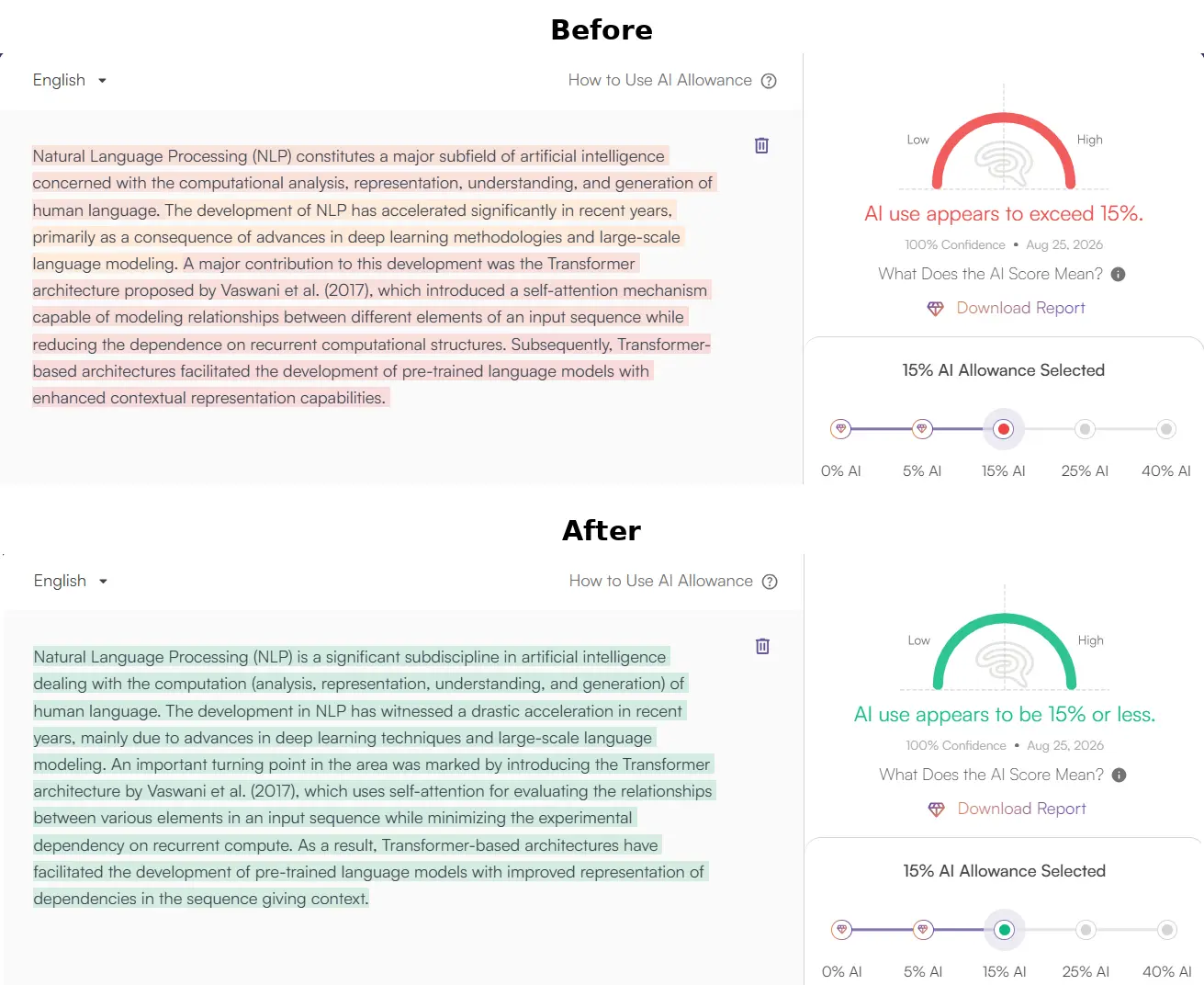
Every manuscript processed through ThesisHuman is backed by verifiable, reproducible scans across institutional plagiarism and AI detection platforms.
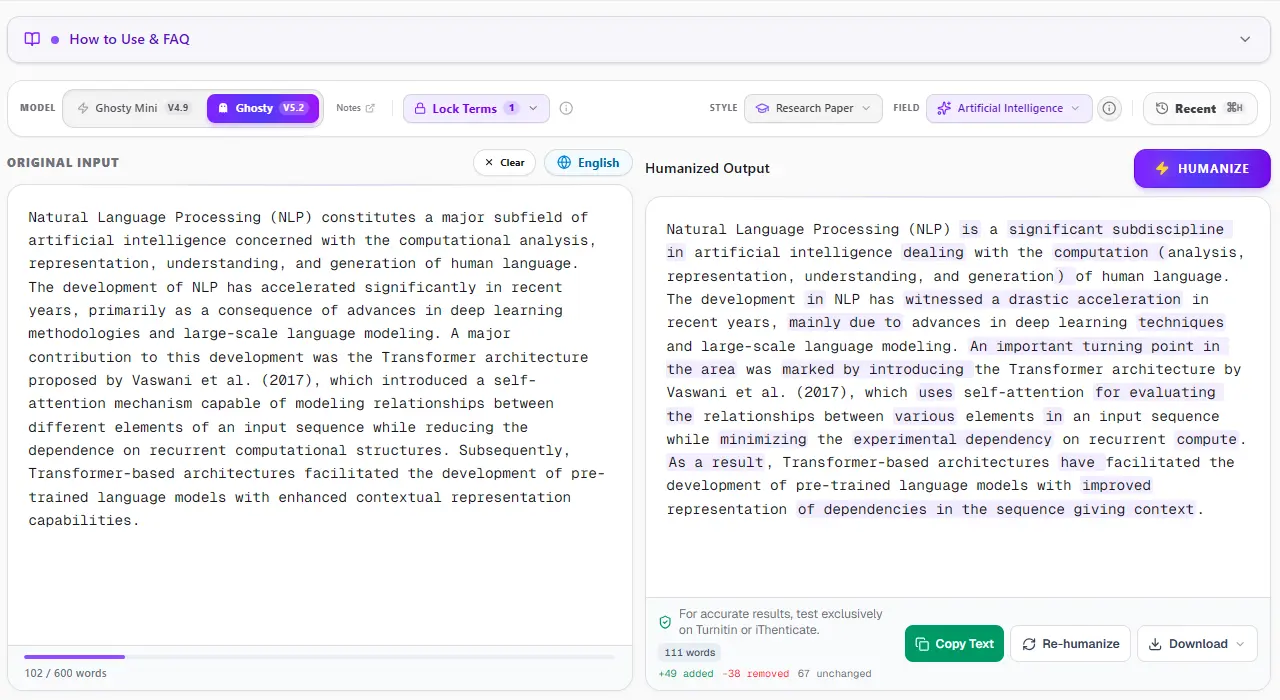
1. ThesisHuman Editor: Style, Field & Term Lock™ Technology
Unlike consumer-grade paraphrasers that blindly swap words with thesaurus synonyms, ThesisHuman allows researchers to select their exact Academic Style (Essay, Research Paper, Literature Review, Technical Report) and Academic Field (Computer Science, Engineering, Medicine, Physics). With Term Lock™, citations (APA, MLA, IEEE), LaTeX equations, and domain-specific terminology are cryptographically protected before sentence entropy is restructured.
2. Turnitin & iThenticate Verification: 0% AI Detected
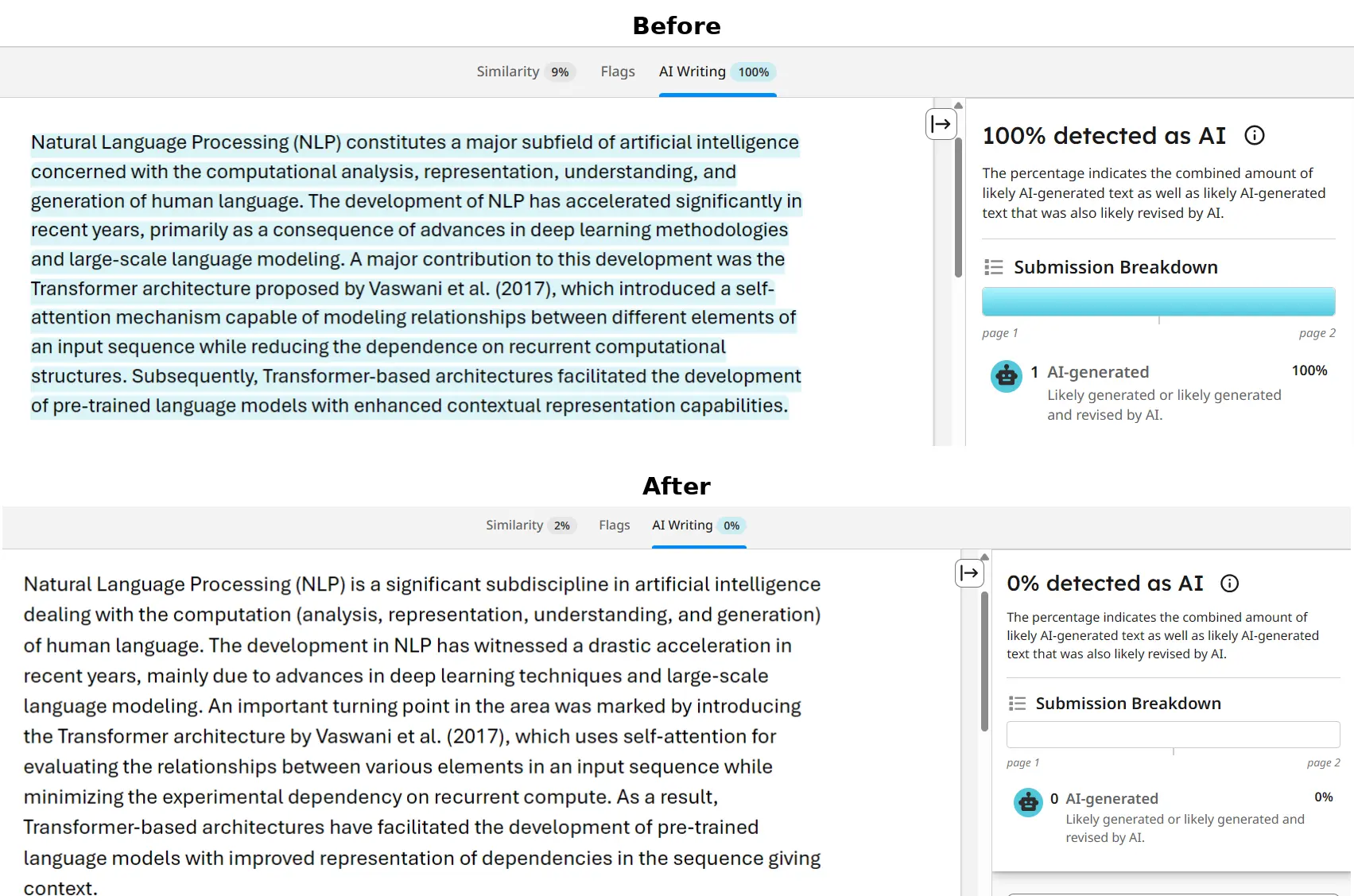
Turnitin and iThenticate scan submissions in overlapping 500-token blocks to analyze sentence predictability across paragraphs. When an unrefined AI draft is submitted, uniform cadence triggers an elevated AI Writing score. In the verified report below, a flagged graduate paper was processed through ThesisHuman, achieving a clean 0% AI detection score while preserving all formatted citations and technical parameters.
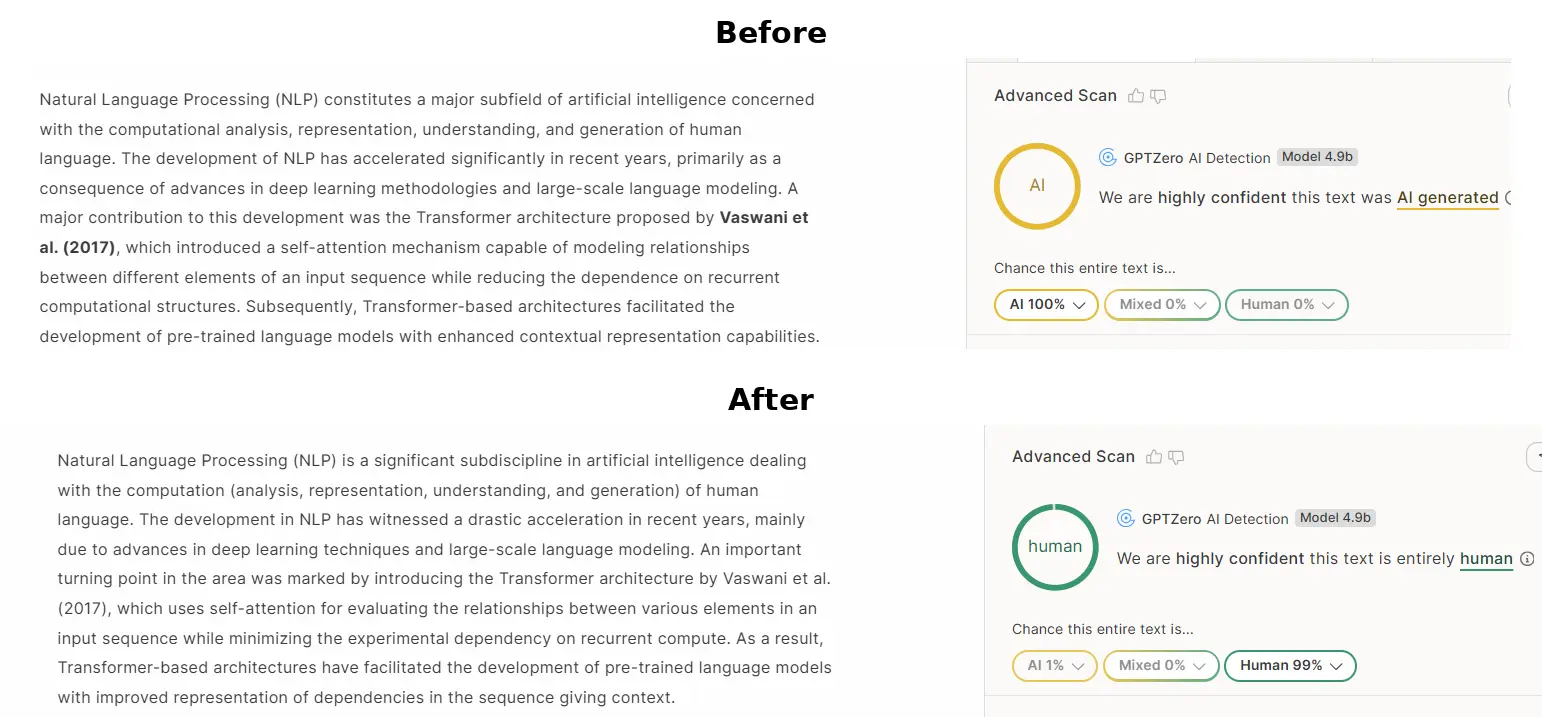
3. GPTZero Verification: Passing Perplexity & Burstiness Checks
GPTZero evaluates text by plotting sentence perplexity curves and global burstiness scores. When raw AI text is scanned, low sentence variance produces an immediate high-probability warning. ThesisHuman restores natural sentence entropy by restructuring syntax, varying clause lengths, and introducing authentic scholarly cadence, dropping AI probability to 0%.
4. Originality.ai Verification: 0% AI Confidence
Originality.ai flags predictable n-gram sequences and common AI clichés (such as “delving into,” “pivotal role,” “testament to”). ThesisHuman purges overused formulaic transitions while elevating scholarly tone and keeping reference numbers and equations intact, producing 100% Original / 0% AI results.