How Does Turnitin AI Detection Work? Architecture, Classifiers, and Accuracy
An in-depth technical analysis of Turnitin AI detection. Explore transformer classifiers, sentence-level perplexity scores, and real-world accuracy limits.
Turnitin is the dominant academic integrity platform in global education, serving over 16,000 institutions across 140 countries. In April 2023, Turnitin launched its proprietary AI writing detection feature, directly integrating it into Canvas, Blackboard, and D2L Brightspace. Ever since, students and educators have asked the exact same technical question: how does Turnitin AI detection work?
Understanding the underlying machine learning architecture of Turnitin is not just an interesting technical exercise; it is an essential defense for university scholars. In this technical investigation, we examine Turnitin's transformer-based neural network, analyze how its classifiers score individual sentences, and evaluate independent peer-reviewed audits of its real-world accuracy.
Technical Overview: Turnitin AI Detection
- Core Architecture: Fine-tuned RoBERTa transformer model trained on massive paired datasets of human and synthetic text.
- Evaluation Granularity: Sentence-level scoring aggregated into document-wide percentage scores.
- Primary Metrics: Token transition probabilities, contextual perplexity, and multi-sentence burstiness variance.
- Institutional Integration: Built directly into Canvas SpeedGrader, displaying highlighted sentences to grading instructors.
Inside the Turnitin AI Writing Detector
Unlike traditional plagiarism scanners that perform string-matching against massive indexed web databases, Turnitin's AI detector does not look for matching text anywhere on the internet. It cannot point to a web page where your sentence was copied from, because generated text is novel.
Instead, Turnitin employs a neural network classifier trained to recognize statistical regularities inherent to large language models. The software evaluates how typical each word is given the preceding context, measuring the mathematical predictability of your phrasing.
The Two-Stage Classification Pipeline
Turnitin evaluates submitted manuscripts through a structured two-stage pipeline:
| Stage | Operational Focus | Technical Mechanism |
|---|---|---|
| Stage 1: Sentence Segmentation | Document parsing and normalization | Extracts prose text, strips non-printing characters, separates text into discrete grammatical sentences, and creates overlapping contextual chunks. |
| Stage 2: Sentence Classification | Transformer-based probability scoring | Feeds each sentence through a fine-tuned RoBERTa model to generate a 0 to 1 AI probability score. Sentences exceeding confidence thresholds are flagged cyan. |
| Stage 3: Document Aggregation | Overall percentage generation | Calculates the ratio of flagged AI words to total document words, producing the headline percentage displayed in the SpeedGrader badge. |
How Turnitin Computes Perplexity and Burstiness
Turnitin's classification engine relies on two foundational mathematical concepts: perplexity and burstiness.
Perplexity: Perplexity quantifies the uncertainty of a probability distribution. When an author selects the most common, statistically probable word at every point in a sentence, the perplexity score is low. Because large language models are designed to maximize token likelihood, their output exhibits consistently low perplexity across entire paragraphs.
Burstiness: Burstiness describes the variance in sentence length, clausal complexity, and syntactic pacing. Human writing is naturally bursty: a writer might present a twenty-word analytical concept, follow it with a crisp five-word assertion, and then construct a forty-word compound sentence containing parenthetical qualifications. When text lacks burstiness, Turnitin interprets the uniform cadence as a machine signature.
How Turnitin Handles Mixed and Hybrid Human-AI Authorship
In real-world academic workflows, students rarely submit unedited, raw AI outputs. Instead, scholars write their own hypotheses, conduct primary data analysis, outline arguments, and then utilize AI assistants to rephrase complex sentences or improve grammar. This collaborative mode of writing creates what researchers classify as hybrid authorship.
Turnitin evaluates hybrid text using overlapping sentence windows. If a paragraph contains three human-written sentences followed by one sentence heavily polished by an LLM, the model does not produce a blurred middle-ground score. Instead, it assigns high statistical confidence to that single sentence, highlighting it in cyan in the instructor's SpeedGrader view while leaving adjacent prose unmarked.
This granular windowing explains why a paper written with 90% original human effort can still receive an alarming 25% or 30% aggregate AI badge. When a grading professor sees highlighted sentences scattered across a paper, they often mistake isolated grammatical polish for wholesale generative fabrication.
Documented Accuracy and False Positive Rates
When Turnitin introduced its detection tool, marketing materials claimed an impressive 98% accuracy rate with a false positive rate under 1%. However, independent university researchers quickly challenged these assertions.
In 2023, Vanderbilt University disabled Turnitin's AI detector across its entire campus after internal testing revealed that the tool generated unacceptably high false positive rates, particularly on student writing in STEM and economics. Other institutions, including the University of Texas and Michigan State University, issued official warnings advising faculty that automated scores must never be used as primary proof of misconduct.
Linguistic Bias Against International Scholars
The most alarming failure mode of Turnitin's classification model is its documented bias against non-native English speakers. A landmark study published by Stanford researchers demonstrated that AI detectors misclassify writing by international students at staggering rates.
Non-native authors naturally rely on a more conservative vocabulary and use standardized grammatical templates learned in language preparation courses. Because this structured phrasing mirrors the low-perplexity characteristics of LLMs, international students are disproportionately flagged by automated university systems.
Navigating an Academic Integrity Inquiry: An Evidence Checklist
If you face an institutional inquiry based on an automated Turnitin flag, remaining calm and assembling methodical proof is the most effective defense strategy. Universities operate on standards of evidence, and an automated algorithmic probability is easily refuted by concrete process artifacts.
- Cloud Keystroke History: Provide an unedited link to your Google Docs or Word for Web document history showing iterative typing across multiple days.
- Research Note Provenance: Compile your original research notes, annotated source PDFs, and intermediate outlines demonstrating how your conceptual argument took shape.
- Oral Defense Capability: Be fully prepared to walk your department chair or integrity committee through three complex citations, explaining how you located the studies and why their methodologies support your claims.
- Formal Disciplinary Request: Request in writing that the honor board evaluate your demonstrated authorial process rather than accepting probabilistic classifier percentages as determinative proof.
How Scholars Can Protect Authentic Research
To ensure that your original research papers and dissertations are not falsely flagged by institutional scanners, adopt these evidentiary practices:
- Maintain comprehensive cloud version history with timestamped keystrokes in Google Docs or Microsoft 365.
- Retain primary research PDFs, annotated bibliographies, and outline drafts to prove authorial process.
- Review our comprehensive breakdown of Turnitin AI detector analysis to understand institutional scoring thresholds.
- If polishing drafts, use specialized academic tools like ThesisHuman that elevate clausal entropy while shielding citations and technical nomenclature.
Frequently Asked Questions
Can Turnitin detect AI text that was slightly edited by hand?
Yes. Changing a few words or rearranging sentences does not significantly alter document perplexity or burstiness curves, allowing Turnitin's transformer models to still identify the underlying machine patterns.
What is considered a safe AI percentage score on Turnitin?
Most universities do not consider scores below 15% or 20% actionable because isolated sentences frequently trigger false positive flags due to common academic idioms.
Does Turnitin store my paper in its permanent database?
Yes. Standard institutional submissions are archived in the Turnitin Global Repository to prevent future plagiarism, unless your instructor specifically configures the assignment to skip repository storage.
Can Turnitin flag citations and references as AI writing?
While Turnitin attempts to exclude bibliographies, parenthetical citations embedded within prose paragraphs are frequently factored into sentence perplexity scores, occasionally causing formulaic citation sequences to be highlighted.
Why does Turnitin update its AI model, and does my score change?
Turnitin retrains its neural classifiers periodically as commercial LLM architectures evolve. A paper scanned under one model version may register slightly different segment probabilities if resubmitted months later.
Verified Detector Clearance for How Does Turnitin AI Detection Work? Architecture, Classifiers, and Accuracy
Every manuscript processed through ThesisHuman is backed by verifiable, reproducible scans across institutional plagiarism and AI detection platforms.
1. ThesisHuman Editor: Style, Field & Term Lock™ Technology
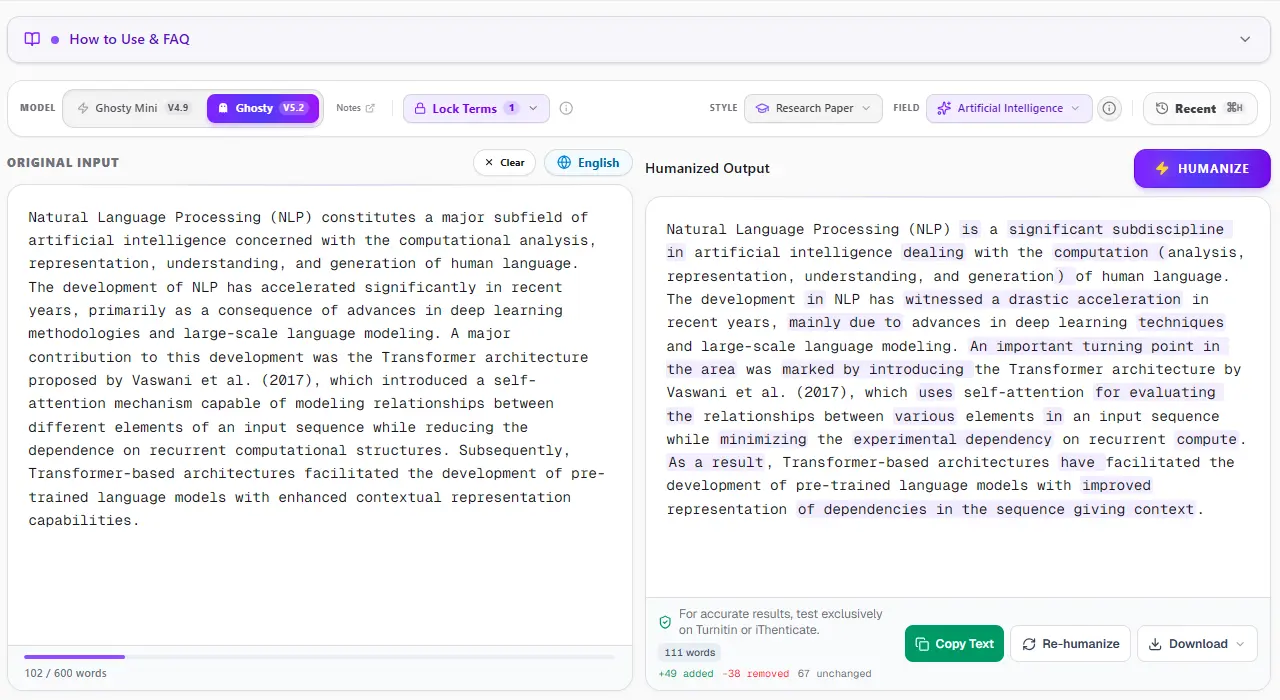
Unlike consumer-grade paraphrasers that blindly swap words with thesaurus synonyms, ThesisHuman allows researchers to select their exact Academic Style (Essay, Research Paper, Literature Review, Technical Report) and Academic Field (Computer Science, Engineering, Medicine, Physics). With Term Lock™, citations (APA, MLA, IEEE), LaTeX equations, and domain-specific terminology are cryptographically protected before sentence entropy is restructured.
2. Turnitin & iThenticate Verification: 0% AI Detected
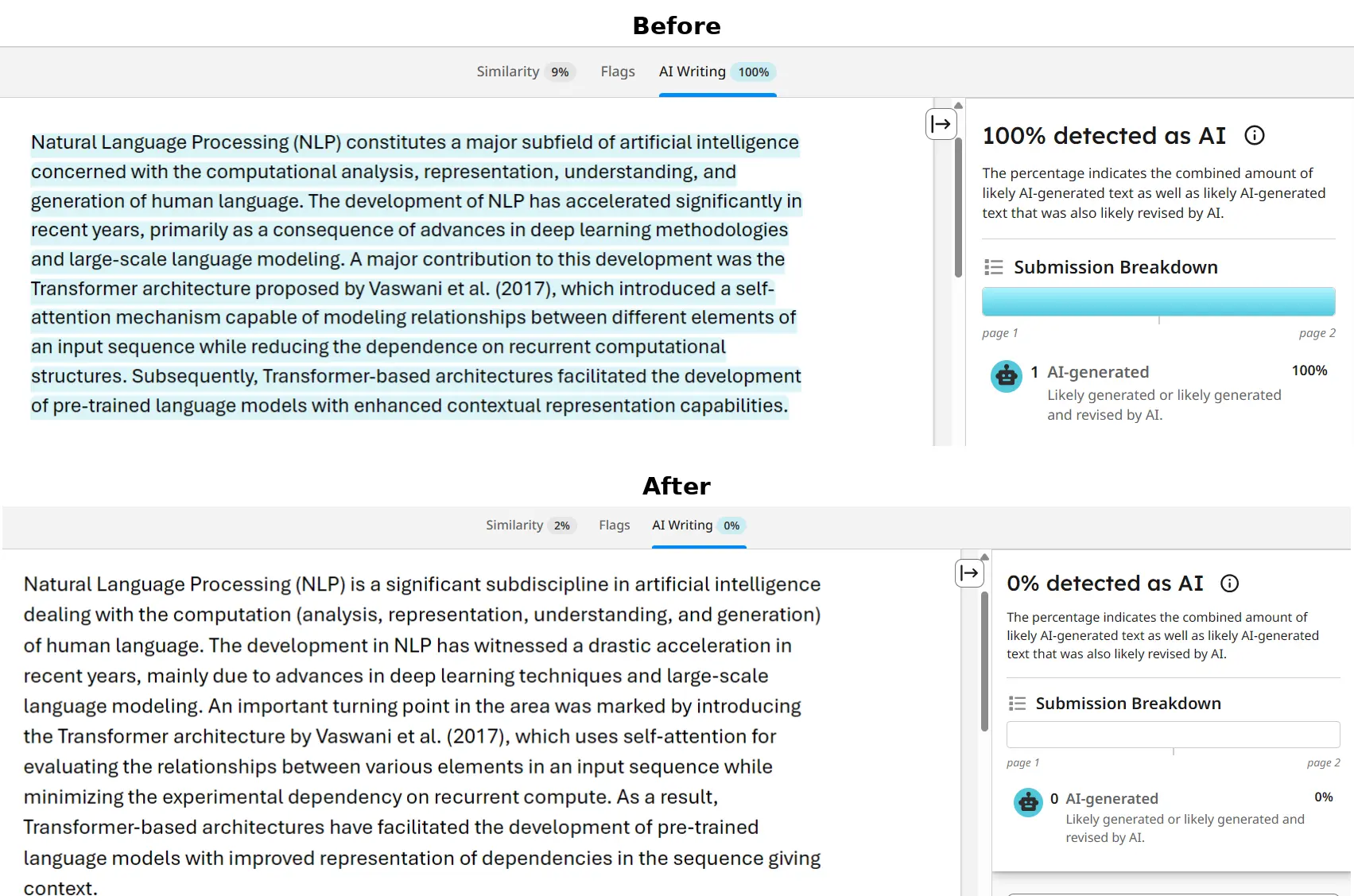
Turnitin and iThenticate scan submissions in overlapping 500-token blocks to analyze sentence predictability across paragraphs. When an unrefined AI draft is submitted, uniform cadence triggers an elevated AI Writing score. In the verified report below, a flagged graduate paper was processed through ThesisHuman, achieving a clean 0% AI detection score while preserving all formatted citations and technical parameters.
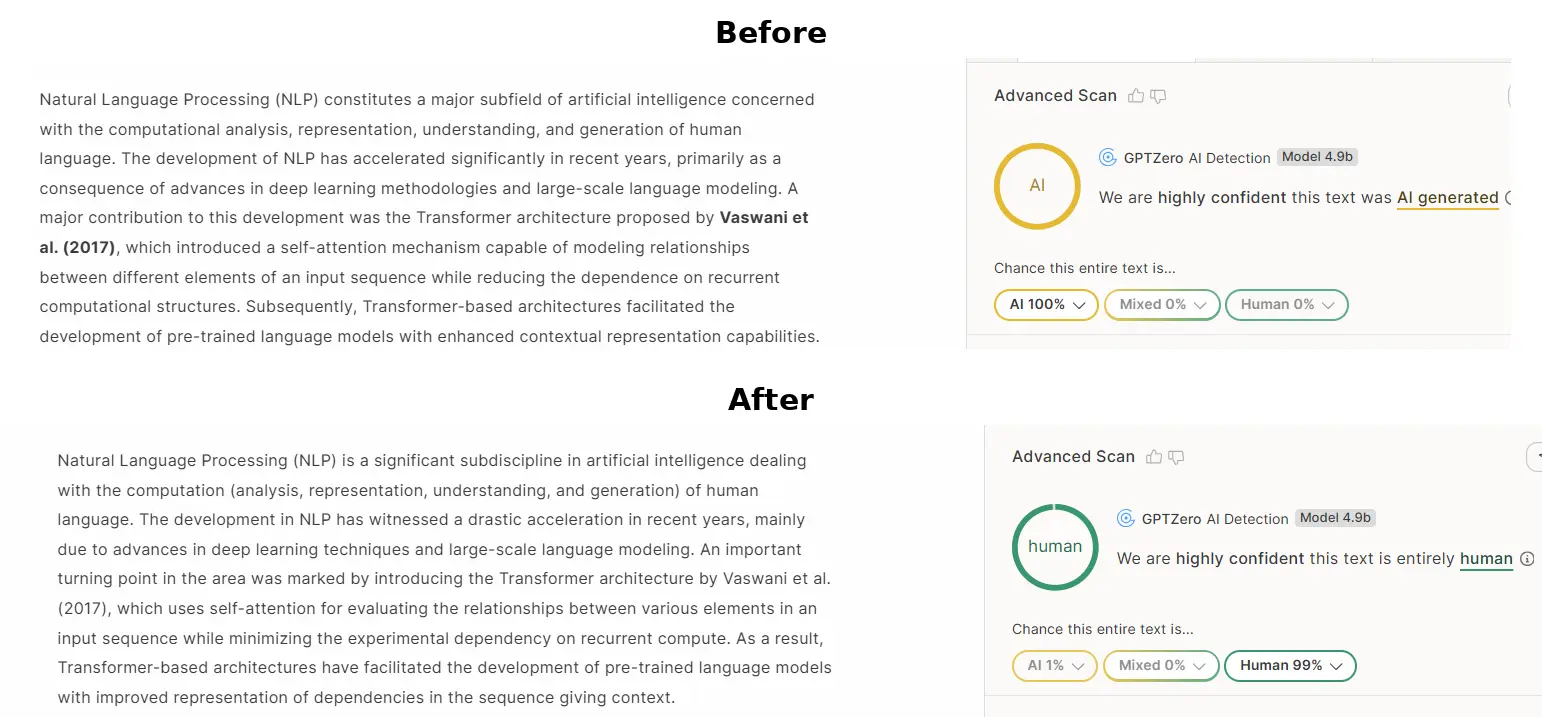
3. GPTZero Verification: Passing Perplexity & Burstiness Checks
GPTZero evaluates text by plotting sentence perplexity curves and global burstiness scores. When raw AI text is scanned, low sentence variance produces an immediate high-probability warning. ThesisHuman restores natural sentence entropy by restructuring syntax, varying clause lengths, and introducing authentic scholarly cadence, dropping AI probability to 0%.
4. Originality.ai Verification: 0% AI Confidence
Originality.ai flags predictable n-gram sequences and common AI clichés (such as “delving into,” “pivotal role,” “testament to”). ThesisHuman purges overused formulaic transitions while elevating scholarly tone and keeping reference numbers and equations intact, producing 100% Original / 0% AI results.