How to Bypass SynthID Text Watermarks? What Google DeepMind Says About Rewriting and Detection
Can you bypass or remove Google SynthID text watermarks? We examine Google DeepMind's published findings on word edits, paraphrasing, translation, and academic rewriting.

With the global expansion of Google's SynthID Detector on October 7, 2026, searches for terms like bypass SynthID, remove SynthID watermark, and SynthID watermark remover have surged. Students, researchers, and content creators are asking whether Google's generative text watermarking can be avoided, and what actually happens when watermarked prose is edited or paraphrased.
Online forums are already flooded with questionable advice, from stripping clipboard formatting to running drafts through basic synonym spinners. To understand what genuinely affects SynthID Text, we must examine the mathematical foundation of statistical watermarking and the specific limitations published by Google DeepMind researchers.
What Does Bypassing SynthID Mean for AI Text?
To evaluate how to bypass or neutralize a watermark, you must first define what the watermark actually is. In photography or video, watermarking often involves embedding patterns into high-frequency pixel channels. In text, however, there are no pixels.
SynthID Text operates by introducing subtle probability biases across vocabulary choices during model generation. Bypassing SynthID does not mean deleting a hidden tracking code from a file. It means altering the sequence of words so that the mathematical pattern connecting candidate tokens no longer aligns with Google's verification key at a statistically significant confidence threshold.
Debunking Myths: Invisible Unicode, Metadata Tags, and Copy-Paste
Before reviewing valid techniques, consider the widespread myths that fail against statistical watermarks:
- Myth 1: Pasting into Notepad strips the watermark. Pasting as unformatted text removes HTML formatting tags, but SynthID Text does not rely on HTML. The watermark is embedded in the words themselves.
- Myth 2: Deleting zero-width Unicode characters removes SynthID. While some amateur scripts use zero-width spaces, Google DeepMind's architecture uses no hidden characters. Inspecting the draft reveals only standard alphanumeric text.
- Myth 3: Rearranging punctuation breaks detection. Adding commas or changing em dashes to periods leaves word choice distributions unchanged.
Google DeepMind Evidence: What Happens After Minor Edits?
Google DeepMind has tested SynthID Text under extensive perturbation benchmarks. In its published documentation and 2024 Nature study, the research team reported that the watermark exhibits strong resilience against small modifications:
When an editor crops sections of text, deletes introductory sentences, or replaces a handful of vocabulary words with direct synonyms, the underlying statistical distribution remains largely intact. Because verification aggregates scores across dozens of token transitions, altering 5% or 10% of the words is insufficient to drop detection confidence below the threshold of statistical significance.
Google DeepMind Evidence: What Happens After Mild Paraphrasing?
Many writers believe that running a draft through a generic paraphrasing utility or basic synonym spinner will reliably bypass detection. DeepMind's published findings directly contradict this belief:
Google specifically notes that SynthID Text can remain detectable after mild paraphrasing. Consumer paraphrasing tools often preserve the sentence spine, substituting isolated nouns and adjectives while maintaining identical clause hierarchy and transitional phrases. Because the structural token relationships persist, verification algorithms can still identify the watermark signal.
Substantial Rewriting and Token Resampling
Where does SynthID Text actually lose efficacy? DeepMind's documentation is explicit: detection confidence can be greatly reduced when text is thoroughly rewritten.
Why does thorough rewriting disrupt the watermark? Because deep rewriting performs complete token resampling:
- Syntactic Reversal: Inverting active and passive constructions alters the preceding context that determined token selection.
- Information Re-synthesis: Extracting core arguments and articulating them in a distinct personal voice replaces synthetic probability chains with human linguistic intuition.
- Cadence Variation: Alternating short declarative sentences with nuanced compound analyses disrupts the uniform rhythm typical of machine generation.
Importantly, reducing confidence is not identical to a guaranteed clean slate on every short passage. The degree of disruption depends on how extensive the structural changes are.
Language Translation as a Watermark Disruptor
Google DeepMind also identified language translation as a major factor that degrades watermark confidence. When text is translated into French, German, or Spanish, and subsequently translated back into English, the intermediate language model maps ideas through an entirely different vocabulary matrix.
This double translation breaks the original English token probability sequence. However, back-translation frequently introduces clumsy phrasing, unidiomatic expressions, and corrupted technical citations, making it poorly suited for rigorous academic manuscripts.
Watermark Confidence vs Generic AI Detector Scores
A critical distinction that every student and scholar must understand is the difference between clearing a watermark and clearing an academic integrity scan:
| Feature | SynthID Watermark Verification | Institutional AI Detection (Turnitin, GPTZero) |
|---|---|---|
| Mechanism | Matches specific mathematical key bias | Measures statistical perplexity and burstiness |
| Scope | Only identifies supported Gemini generations | Screens all text regardless of model origin |
| False Positive Risk | Extremely low (cryptographic key required) | Documented risk, especially on non-native writing |
| Impact of Rewriting | Resampling breaks probability sequence | Requires raising perplexity and burstiness |
You could completely disrupt a SynthID watermark by substituting words, yet if the resulting draft remains formulaic and uniform, Turnitin or Copyleaks will still flag it with a high AI probability score. True safety requires addressing both challenges simultaneously.
Responsible Academic Rewriting and Citation Preservation
For university scholars, the objective is never to bypass ethical integrity; it is to ensure legitimate AI-assisted ideation is refined into rigorous, authentic academic prose that reflects your own scholarship.
When refining Gemini-assisted research, focus on deep structural transformation:
- Lock Citations and References: Never permit automated rewriters to alter author-date citations or numbered brackets.
- Protect Technical Nomenclature: Specialized terminology in law, medicine, or engineering must remain exact using Term Lock protection.
- Rebalance Sentence Rhythm: Inject natural burstiness by combining concise analytical statements with detailed methodological explanations.
Google confirms that substantial rewriting reduces SynthID Text detection confidence. For researchers seeking citation-safe prose rebalancing, learn more about our Google Gemini academic naturalization workflow and read our analysis of what the SynthID Detector really checks.
Verified Detector Clearance for How to Bypass SynthID Text Watermarks? What Google DeepMind Says About Rewriting and Detection
Every manuscript processed through ThesisHuman is backed by verifiable, reproducible scans across institutional plagiarism and AI detection platforms.
1. ThesisHuman Editor: Style, Field & Term Lock™ Technology
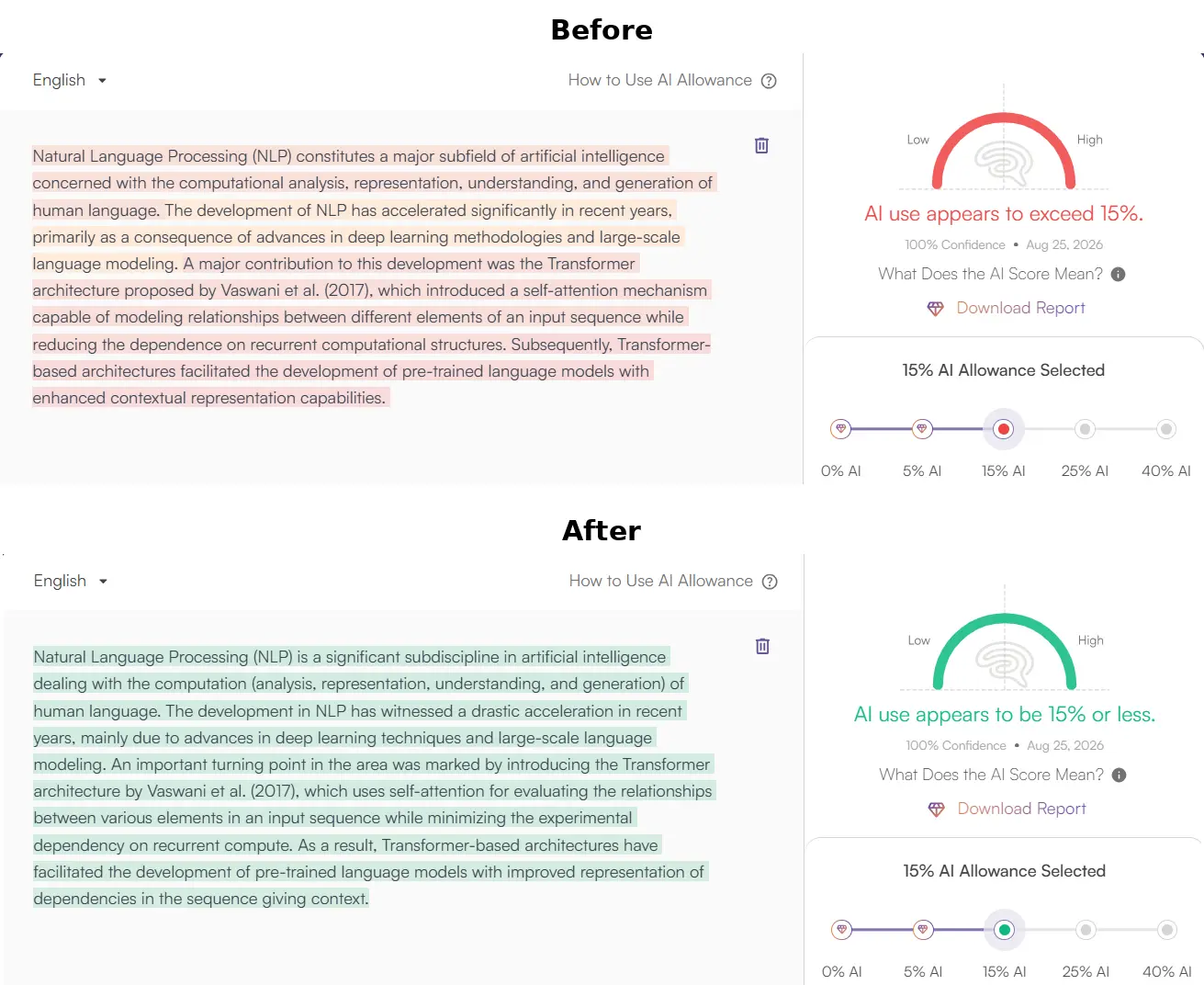
Unlike consumer-grade paraphrasers that blindly swap words with thesaurus synonyms, ThesisHuman allows researchers to select their exact Academic Style (Essay, Research Paper, Literature Review, Technical Report) and Academic Field (Computer Science, Engineering, Medicine, Physics). With Term Lock™, citations (APA, MLA, IEEE), LaTeX equations, and domain-specific terminology are cryptographically protected before sentence entropy is restructured.
2. Turnitin & iThenticate Verification: 0% AI Detected
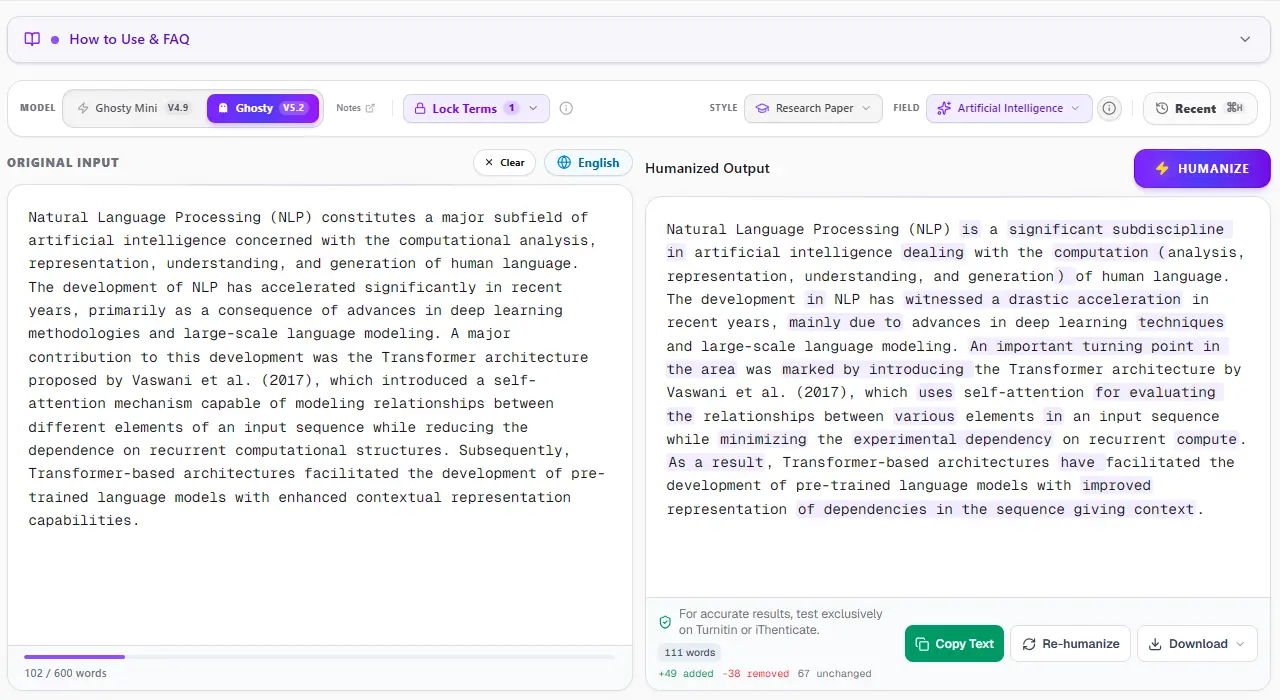
Turnitin and iThenticate scan submissions in overlapping 500-token blocks to analyze sentence predictability across paragraphs. When an unrefined AI draft is submitted, uniform cadence triggers an elevated AI Writing score. In the verified report below, a flagged graduate paper was processed through ThesisHuman, achieving a clean 0% AI detection score while preserving all formatted citations and technical parameters.
3. GPTZero Verification: Passing Perplexity & Burstiness Checks
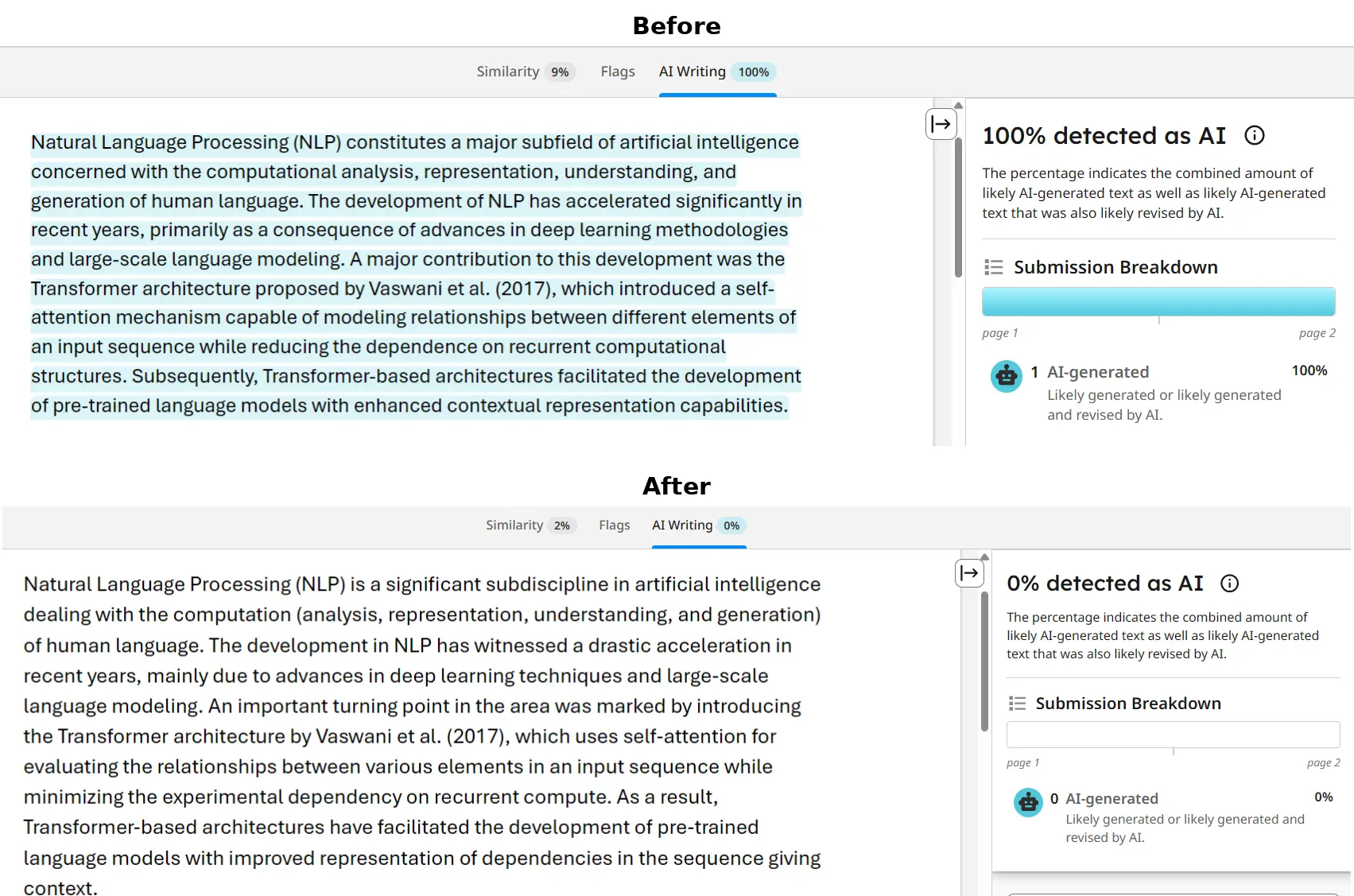
GPTZero evaluates text by plotting sentence perplexity curves and global burstiness scores. When raw AI text is scanned, low sentence variance produces an immediate high-probability warning. ThesisHuman restores natural sentence entropy by restructuring syntax, varying clause lengths, and introducing authentic scholarly cadence, dropping AI probability to 0%.
4. Originality.ai Verification: 0% AI Confidence
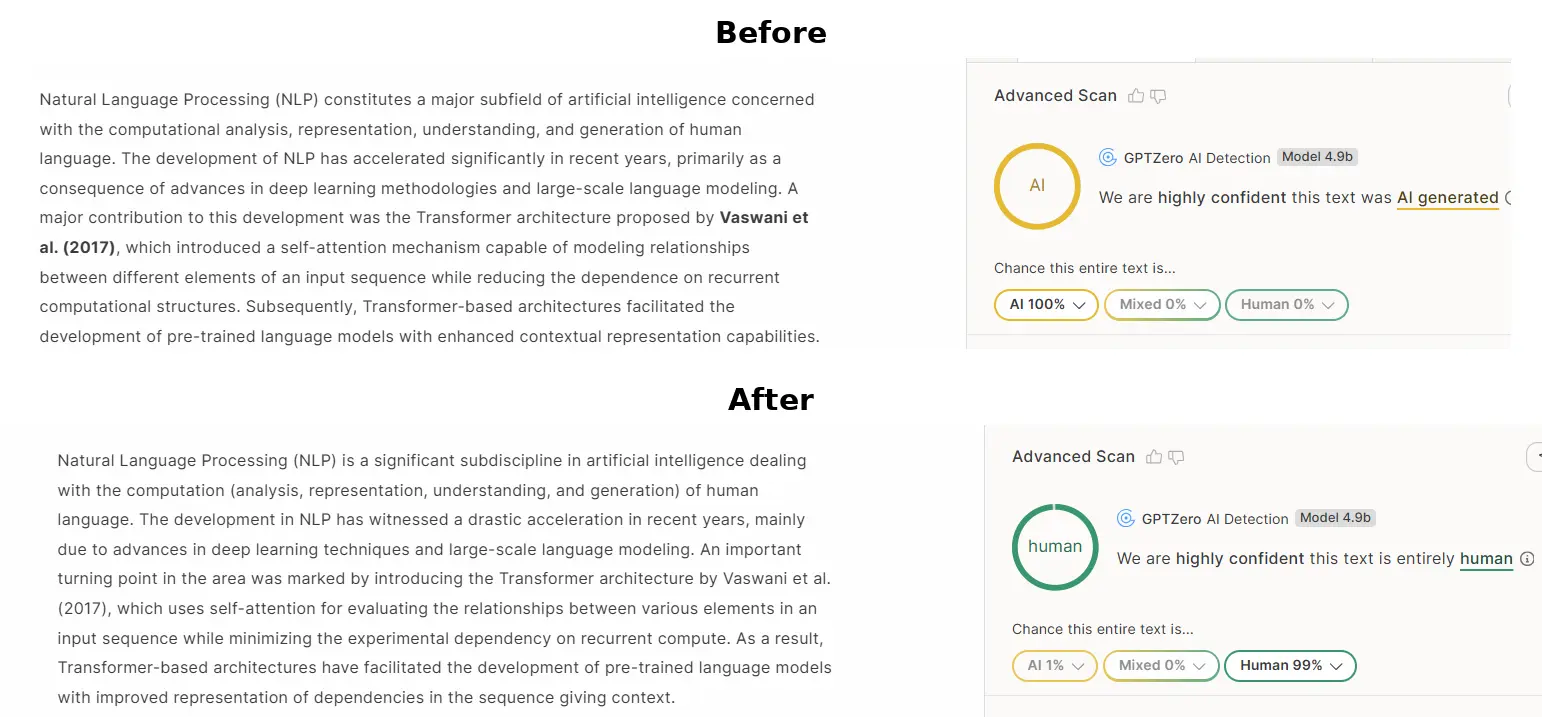
Originality.ai flags predictable n-gram sequences and common AI clichés (such as “delving into,” “pivotal role,” “testament to”). ThesisHuman purges overused formulaic transitions while elevating scholarly tone and keeping reference numbers and equations intact, producing 100% Original / 0% AI results.