SynthID Detector for Text: Can Google Detect AI Writing and ChatGPT Content?
Google expanded the public SynthID Detector on October 7, 2026. Learn what the public portal verifies, how SynthID Text watermarks Gemini, and whether it detects ChatGPT.
On October 7, 2026, Google officially expanded global public access to its SynthID Detector at synthid.com. Originally available only to selected researchers and media professionals, the standalone portal now invites anyone to verify digital content for Google DeepMind watermark signals. The announcement immediately sparked intense interest across universities, publishing houses, and student communities: Can this new detector identify AI-generated essays, and does it expose writing from ChatGPT and Google Gemini?
Separating marketing headlines from technical reality is crucial for academic writers. While Google's watermarking technology is revolutionary, public reporting has frequently conflated the newly expanded public upload portal with SynthID Text, and mistaken provenance watermarking for general AI text detection.
What Changed on October 7, 2026?
On October 7, 2026, Google expanded the SynthID Detector from a restricted pilot into a globally accessible web portal available in English at synthid.com. Users worldwide can now upload files directly to verify whether they bear an authentic watermark created by participating AI generation engines.
Alongside the global public rollout, Google highlighted cross-industry collaboration. The current public SynthID Detector can verify supported image, video, and audio media from Google and partners including OpenAI, NVIDIA, and Kakao, with Apple coming soon. Crucially, this does not establish that ChatGPT text is SynthID-watermarked, and understanding what the portal evaluates requires looking at supported modalities.
What Does the Public SynthID Detector Actually Verify?
A widespread misconception is that users can simply paste a student term paper or dissertation chapter into synthid.com to check for AI authorship. Understanding the interface requires distinguishing between early announcements, current public portal modalities, and underlying watermarking tech.
When Google initially announced the SynthID Detector portal in May 2025, early documentation described the capability to scan an image, audio track, video, or piece of text created with supported Google AI tools. The current public SynthID Detector experience announced on October 7, 2026 exposes image, video, and audio verification:
- Images: Digital visual files generated by Imagen and compatible partner image models.
- Video: Synthetic video clips produced by generative video architectures such as Google Veo.
- Audio: Generated music and voice tracks generated through platforms like Lyria.
The current public SynthID Detector experience announced on October 7, 2026 exposes image, video and audio verification. This does not mean SynthID Text no longer exists, and earlier Detector documentation also described text scanning capabilities. SynthID Text itself remains a real underlying watermarking and identification technology for supported Gemini-generated text.
SynthID Text Explained: How Google Watermarks AI Prose
Unlike image watermarking, which modulates pixel values in imperceptible frequency bands, text consists of discrete characters. You cannot embed invisible pixels in plain ASCII or Unicode text without using hidden tags that any simple text editor would strip.
According to Google DeepMind's published research (including its 2024 Nature study), SynthID Text works during the generation process itself by applying statistical token biasing:
- Candidate Token Scoring: When a language model generates a response, it calculates probability distributions across candidate words for each position.
- Pseudo-Random Modulation: SynthID introduces a deterministic, key-dependent mathematical bias that subtly alters these probability scores, favoring certain tokens that align with a secret verification key.
- Preserved Quality: The bias is subtle enough that generation quality, vocabulary diversity, and factual accuracy remain virtually indistinguishable from unwatermarked output.
- Statistical Aggregation: When evaluating a suspect passage, a verification algorithm scores the text against the key. If the sequence choices exhibit the mathematical pattern across a sufficient length, the system confirms high watermark confidence.
Google uses SynthID Text across supported Gemini generative experiences. However, because verification requires analyzing sequence probabilities against DeepMind's proprietary keys, it operates through Google's backend infrastructure rather than a generic text input box.
Does the SynthID Detector Identify ChatGPT Text?
The short answer is no. Standard text generated by ChatGPT (GPT-4o, o1, or earlier models) does not carry SynthID text watermarks, and the SynthID Detector does not identify ChatGPT prose.
OpenAI has explored watermarking techniques in research settings, but standard ChatGPT web outputs consist of unwatermarked plain text characters. The October 7, 2026 announcement confirms that the current public SynthID Detector can verify supported image, video, and audio media from Google and partners including OpenAI, NVIDIA, and Kakao, with Apple coming soon. Crucially, this does not establish that ChatGPT text is SynthID-watermarked.
The Partner Announcements: OpenAI, NVIDIA, and Kakao Facts
Google's October 7 announcement confirmed that the current public SynthID Detector can verify supported image, video, and audio media from Google and partners including OpenAI, NVIDIA, and Kakao, with Apple coming soon. What do the confirmed facts show?
| Organization | Confirmed Announcement Scope | Establishes ChatGPT Text Watermarking? |
|---|---|---|
| Google DeepMind | Imagen, Veo, Lyria, Gemini Text | Yes, in supported Gemini services |
| OpenAI | Verification of supported media in Detector | No, does not establish ChatGPT text is SynthID-watermarked |
| NVIDIA | Verification of supported partner media | No, does not establish text watermarking |
| Kakao & Apple | Partner media integration (Apple coming soon) | No, does not establish text watermarking |
The October 7 announcement confirms that the current public SynthID Detector can verify supported image, video, and audio media from Google and partners including OpenAI, NVIDIA, and Kakao, with Apple coming soon. This represents significant cross-industry coordination, but it does not establish that ChatGPT text is SynthID-watermarked.
Watermark Verification vs Statistical AI Detectors
Understanding the fundamental distinction between watermark verification and statistical AI detection is vital for anyone writing in academia or publishing:
- Statistical Classifiers (Turnitin, GPTZero, Copyleaks): These tools analyze general text features such as uniform clause lengths (burstiness) and token predictability (perplexity). They calculate a probabilistic guess based on whether the prose looks machine-like, which frequently causes false positives on structured academic writing.
- Watermark Verification (SynthID): This system searches for a specific mathematical sequence deliberately inserted by a cooperating model. If the watermark key is absent, the system cannot classify whether the text was drafted by a human or an unwatermarked AI model.
SynthID is a provenance system, not a generic catch-all AI detector. An unwatermarked AI draft will show no SynthID signal, while a human author cannot trigger a SynthID watermark match because human minds do not generate text according to DeepMind's pseudo-random cryptographic key.
How Text Editing Affects Watermark Confidence
Google DeepMind has documented the resilience and boundaries of SynthID Text in technical publications. How does editing affect the watermark?
- Cropping and Minor Word Swaps: The watermark is designed to remain identifiable even if a user cuts paragraphs or changes a few individual words.
- Mild Paraphrasing: Light grammatical adjustments or surface synonym exchanges generally preserve the underlying token probability distribution.
- Thorough Rewriting: DeepMind explicitly notes that detection confidence can be greatly reduced when the text undergoes comprehensive rewriting, because restructuring clauses and replacing phrases resamples token selections.
- Translation: Translating watermarked text into another language fundamentally alters the token sequence, typically degrading the watermark signal.
For an in-depth breakdown of how rewriting impacts detection, read our companion guides on how rewriting impacts SynthID text watermarks and whether paraphrasing removes SynthID watermarks.
Practical Implications for Students and Academic Researchers
The October 7, 2026 expansion represents a major milestone in content authenticity, but university researchers and students should draw measured conclusions:
- Your university does not paste papers into synthid.com: Academic integrity offices continue to use tools like Turnitin, iThenticate, and Canvas LMS, which evaluate stylistic metrics rather than SynthID keys.
- Gemini drafts carry mathematical signatures: If you use Google Gemini to assist with literature summaries or drafting, its output may carry SynthID token biases. Relying on raw generation risks both watermark retention and high statistical detection scores.
- Focus on deep authorial refinement: Rather than swapping occasional words with a basic thesaurus, researchers should thoroughly rewrite assisted drafts into an authentic scholarly register, preserving citations and mathematical precision. Explore how ThesisHuman refines Gemini drafts for peer review.
Verified Detector Clearance for SynthID Detector for Text: Can Google Detect AI Writing and ChatGPT Content?
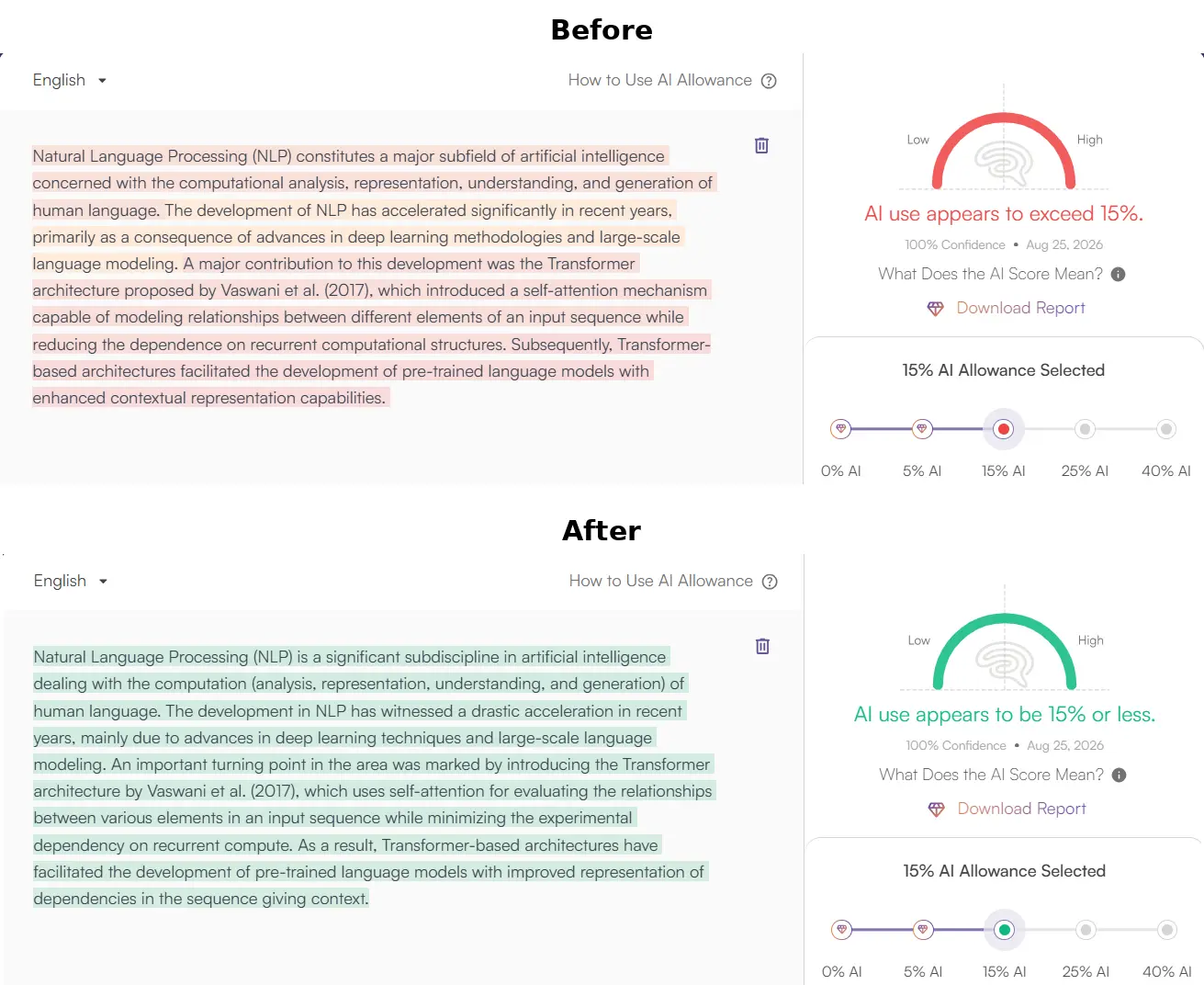
Every manuscript processed through ThesisHuman is backed by verifiable, reproducible scans across institutional plagiarism and AI detection platforms.
1. ThesisHuman Editor: Style, Field & Term Lock™ Technology
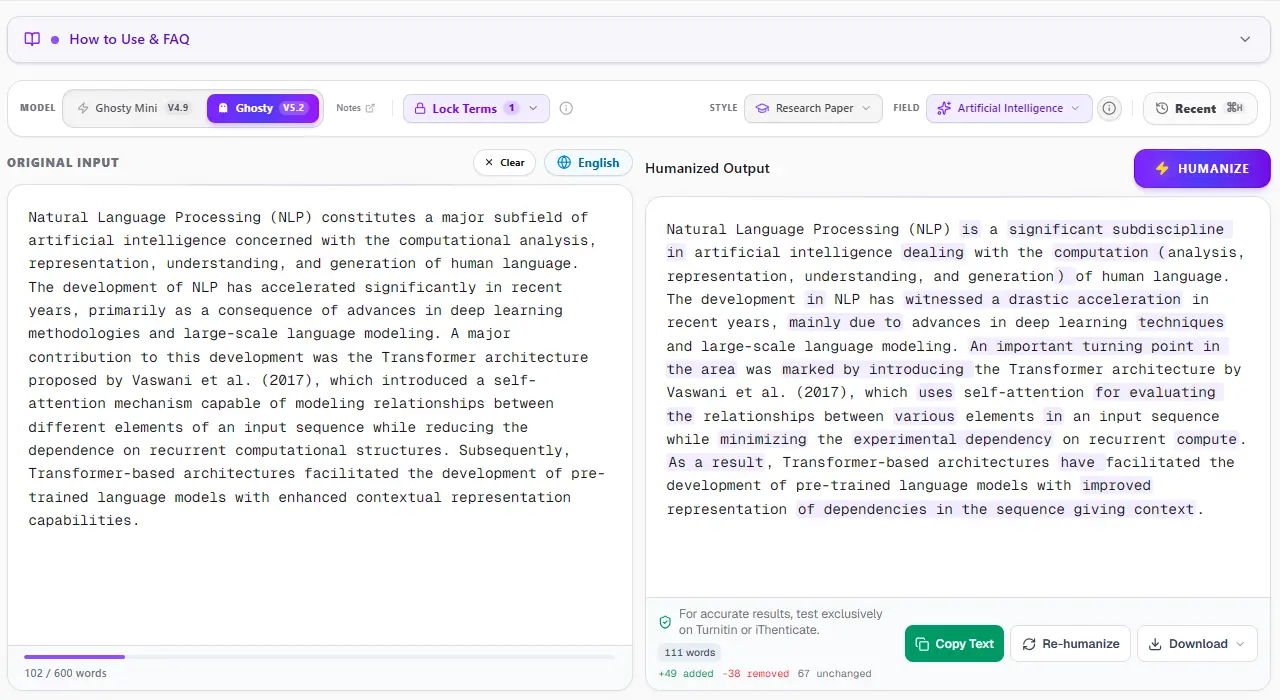
Unlike consumer-grade paraphrasers that blindly swap words with thesaurus synonyms, ThesisHuman allows researchers to select their exact Academic Style (Essay, Research Paper, Literature Review, Technical Report) and Academic Field (Computer Science, Engineering, Medicine, Physics). With Term Lock™, citations (APA, MLA, IEEE), LaTeX equations, and domain-specific terminology are cryptographically protected before sentence entropy is restructured.
2. Turnitin & iThenticate Verification: 0% AI Detected
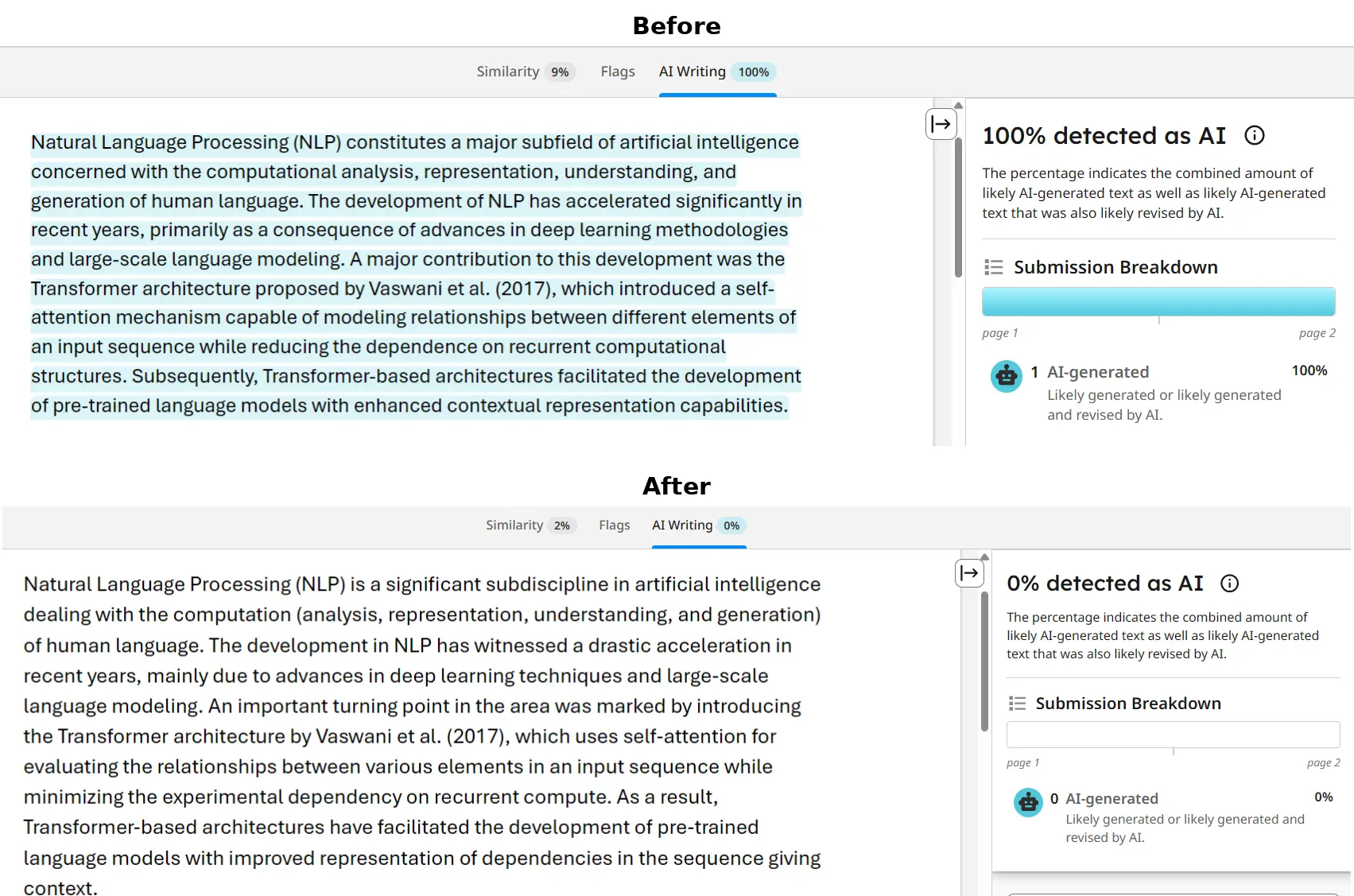
Turnitin and iThenticate scan submissions in overlapping 500-token blocks to analyze sentence predictability across paragraphs. When an unrefined AI draft is submitted, uniform cadence triggers an elevated AI Writing score. In the verified report below, a flagged graduate paper was processed through ThesisHuman, achieving a clean 0% AI detection score while preserving all formatted citations and technical parameters.
3. GPTZero Verification: Passing Perplexity & Burstiness Checks
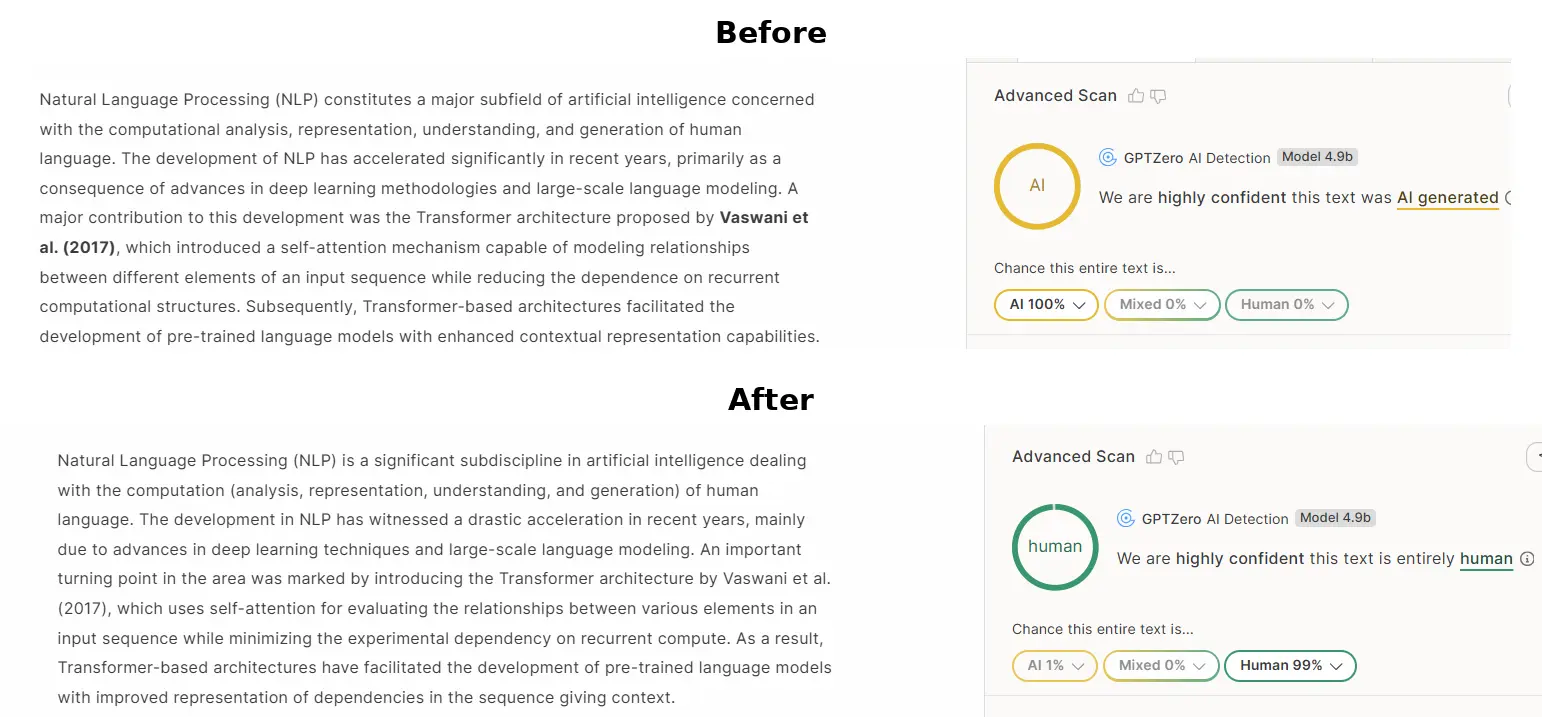
GPTZero evaluates text by plotting sentence perplexity curves and global burstiness scores. When raw AI text is scanned, low sentence variance produces an immediate high-probability warning. ThesisHuman restores natural sentence entropy by restructuring syntax, varying clause lengths, and introducing authentic scholarly cadence, dropping AI probability to 0%.
4. Originality.ai Verification: 0% AI Confidence
Originality.ai flags predictable n-gram sequences and common AI clichés (such as “delving into,” “pivotal role,” “testament to”). ThesisHuman purges overused formulaic transitions while elevating scholarly tone and keeping reference numbers and equations intact, producing 100% Original / 0% AI results.