Does Paraphrasing Remove a SynthID Text Watermark? Rewriting, Translation, and Humanizers Explained
Does paraphrasing eliminate SynthID text watermarks? Explore DeepMind's evidence comparing synonym spinners, structural rewriting, translation, and academic humanizers.

As generative AI tools become ubiquitous in research drafting, text watermarking has emerged as the forefront of provenance technology. Google DeepMind's SynthID Text, which subtly biases token probability distributions during Gemini generation, represents the most widely deployed text watermarking system in production. But as researchers experiment with assistive drafting, a central practical question arises: does paraphrasing remove a SynthID text watermark?
The answer depends entirely on what kind of paraphrasing is performed. Computational linguistics and Google DeepMind's published evaluations show a clear division: surface-level synonym swapping largely preserves the watermark, whereas thorough structural rewriting substantially reduces detection confidence.
What Google Means by Mild Paraphrasing
In its technical documentation and peer-reviewed Nature publications on SynthID Text, Google DeepMind evaluates how the watermark withstands various textual transformations. Under the category of mild paraphrasing, Google includes:
- Substituting individual words with direct dictionary synonyms.
- Minor changes in grammatical tense or voice without altering clause structure.
- Trimming introductory filler phrases or reordering adjacent adjectives.
Under these mild conditions, DeepMind found that the watermark remains reliably detectable. Because the mathematical signal is distributed across dozens of sequential word transitions, preserving the broader grammatical skeleton allows the verification key to accumulate enough statistical confidence to confirm the watermark.
Why Simple Synonym Replacement Leaves the Signal Intact
Most popular online rewriters and paraphrasing extensions operate by identifying high-frequency words and replacing them with near-synonyms. For example, changing 'The study demonstrates an important relationship' to 'The investigation shows a significant connection' alters vocabulary but maintains the exact clausal architecture.
Because SynthID Text modulates candidate token probabilities during sequential generation, it creates a subtle global probability bias across the entire passage. If 80% of the sentence structure and word order remain intact, the statistical correlation with Google's verification key remains well above the detection threshold.
Structural Rewriting: Resampling Token Probability Distributions
The dynamic changes completely when text undergoes thorough, structural rewriting. Google DeepMind explicitly acknowledges that detection confidence can be greatly reduced when text is thoroughly rewritten.
Structural rewriting involves fundamental changes to how ideas are articulated:
- Clause Dissolution: Merging or breaking compound sentences forces completely different transitional token choices.
- Argument Restructuring: Leading with evidentiary findings rather than generic topic sentences shifts the sequence context for every subsequent phrase.
- Complete Token Resampling: By formulating arguments from primary data rather than paraphrasing machine output, the token probability chain is reset.
Translation and Cross-Lingual Degradation
Google DeepMind also documented that translating watermarked text into another language greatly reduces detection confidence. Why does translation disrupt the signal?
When Gemini generates text in English, SynthID biases English vocabulary tokens. If that passage is translated into German or Spanish, the translation model generates words in the target language based on target-language token probabilities. The subtle English bias is effectively erased in the target language. However, translating back into English frequently creates awkward syntax and damages academic citations, making it unviable for scholarly work.
Text Length and Factual Constraint Thresholds
Google DeepMind identified two structural conditions where SynthID Text is inherently less effective:
- Short Generations: Short sentences or single paragraphs lack enough token transitions to accumulate statistically significant watermark confidence. The watermark works far better on extended prose.
- Highly Constrained Factual Responses: When answering factual queries (such as quoting a legal statute or stating a chemical formula), the model has minimal linguistic freedom. Forcing probability biases on constrained facts would harm accuracy, so watermarking is naturally subdued.
Watermark Provenance vs Statistical Detectors (Turnitin & GPTZero)
Writers often conflate two distinct screening mechanisms:
| Dimension | SynthID Watermark | Institutional Statistical Scanners |
|---|---|---|
| Evaluation Criterion | Matches DeepMind cryptographic key | Measures perplexity, burstiness, and sentence cadence |
| Applicability | Only Gemini-watermarked outputs | All text (ChatGPT, Claude, Gemini, human) |
| Paraphrasing Impact | Thorough rewriting reduces confidence | Synonym spinning often increases detection flags |
Even if a rewriting pass degrades SynthID watermark confidence, generic paraphrasing often flattens sentence rhythm, triggering severe false-positive flags on Turnitin or Copyleaks. True refinement requires elevating perplexity and burstiness to human academic standards.
Automated Paraphrasers vs Academic Text Naturalization
For university researchers, dissertation candidates, and grant applicants, consumer paraphrasers introduce severe risks to research manuscripts:
- Citation Damage: Unconstrained rewriters frequently misplace author-date citations or corrupt bracketed IEEE numbers.
- Mathematical Distortion: LaTeX equations and statistical variables ($p < 0.05$) often suffer dropped backslashes or altered Greek symbols.
- Loss of Academic Hedging: Scholarly caution is frequently replaced with informal conversational vocabulary.
By contrast, purpose-built academic humanizers focus on natural scholarly rhythm while freezing citations and technical terms. Google says substantial rewriting can reduce SynthID Text detection confidence; ThesisHuman provides that deep structural naturalization while protecting the integrity of your scholarship. Learn more about the best academic humanizers and our multi-chapter thesis humanizer workflow.
How Scholars Should Interpret Watermark Scans Responsibly
As detection tools evolve following Google's October 7, 2026 SynthID Detector expansion, researchers should maintain clear perspectives. Content provenance systems are designed to promote transparency, not to penalize legitimate assistive drafting.
Always maintain an unbroken provenance record: archive early notes, supervisor comments, and timestamped version histories. Understand the difference between provenance watermarks and classifier flags by reviewing our SynthID text detector guide and our analysis of how rewriting impacts watermark detection.
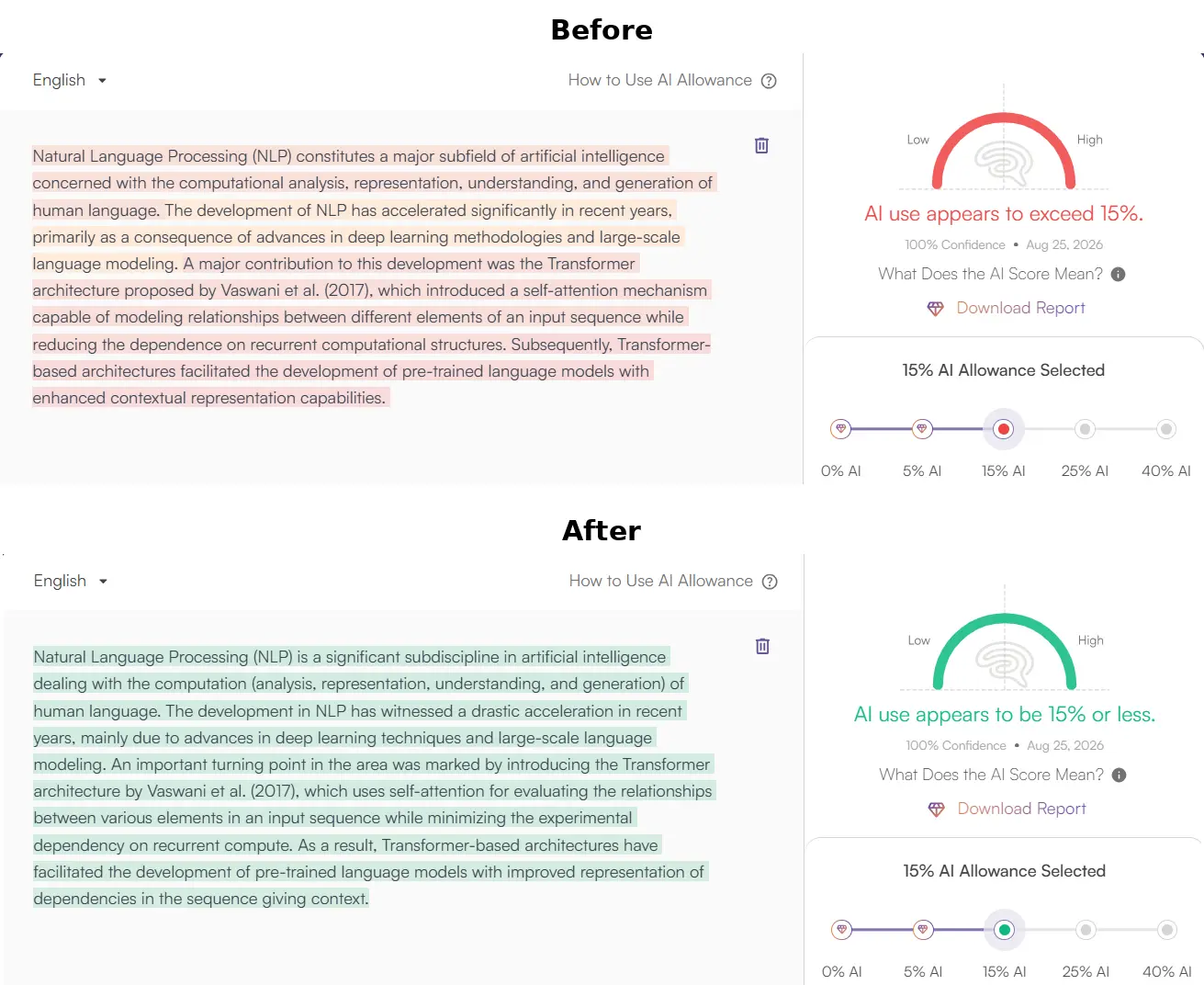
Verified Detector Clearance for Does Paraphrasing Remove a SynthID Text Watermark? Rewriting, Translation, and Humanizers Explained
Every manuscript processed through ThesisHuman is backed by verifiable, reproducible scans across institutional plagiarism and AI detection platforms.
1. ThesisHuman Editor: Style, Field & Term Lock™ Technology
Unlike consumer-grade paraphrasers that blindly swap words with thesaurus synonyms, ThesisHuman allows researchers to select their exact Academic Style (Essay, Research Paper, Literature Review, Technical Report) and Academic Field (Computer Science, Engineering, Medicine, Physics). With Term Lock™, citations (APA, MLA, IEEE), LaTeX equations, and domain-specific terminology are cryptographically protected before sentence entropy is restructured.
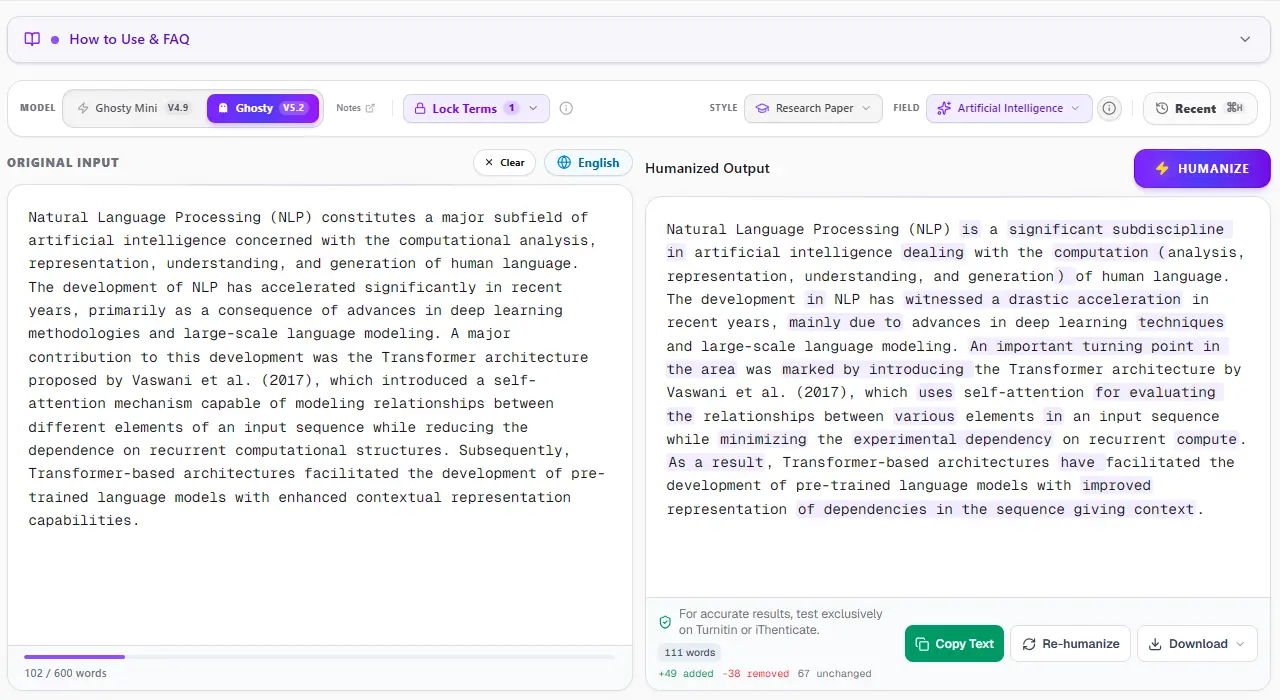
2. Turnitin & iThenticate Verification: 0% AI Detected
Turnitin and iThenticate scan submissions in overlapping 500-token blocks to analyze sentence predictability across paragraphs. When an unrefined AI draft is submitted, uniform cadence triggers an elevated AI Writing score. In the verified report below, a flagged graduate paper was processed through ThesisHuman, achieving a clean 0% AI detection score while preserving all formatted citations and technical parameters.
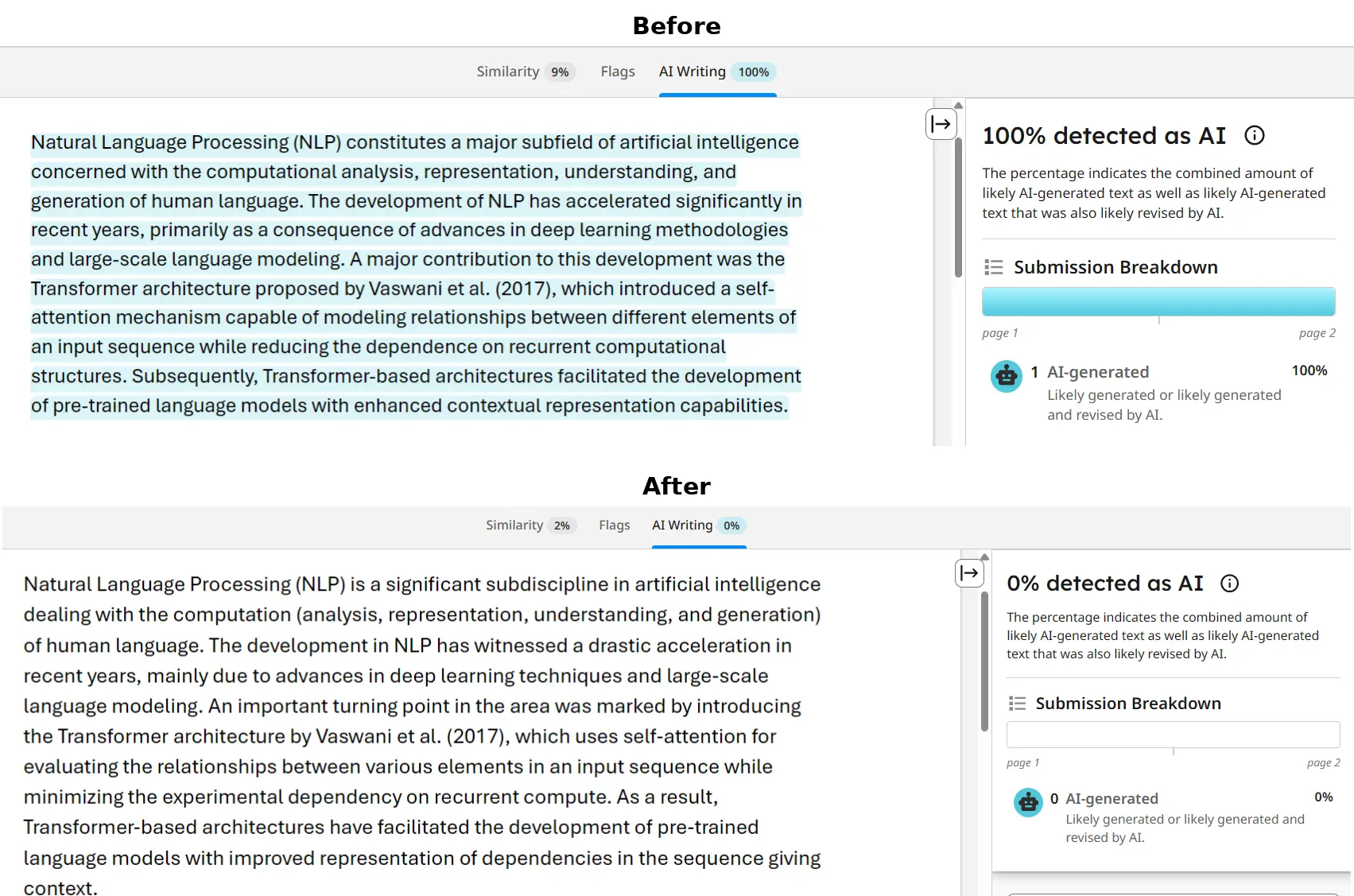
3. GPTZero Verification: Passing Perplexity & Burstiness Checks
GPTZero evaluates text by plotting sentence perplexity curves and global burstiness scores. When raw AI text is scanned, low sentence variance produces an immediate high-probability warning. ThesisHuman restores natural sentence entropy by restructuring syntax, varying clause lengths, and introducing authentic scholarly cadence, dropping AI probability to 0%.
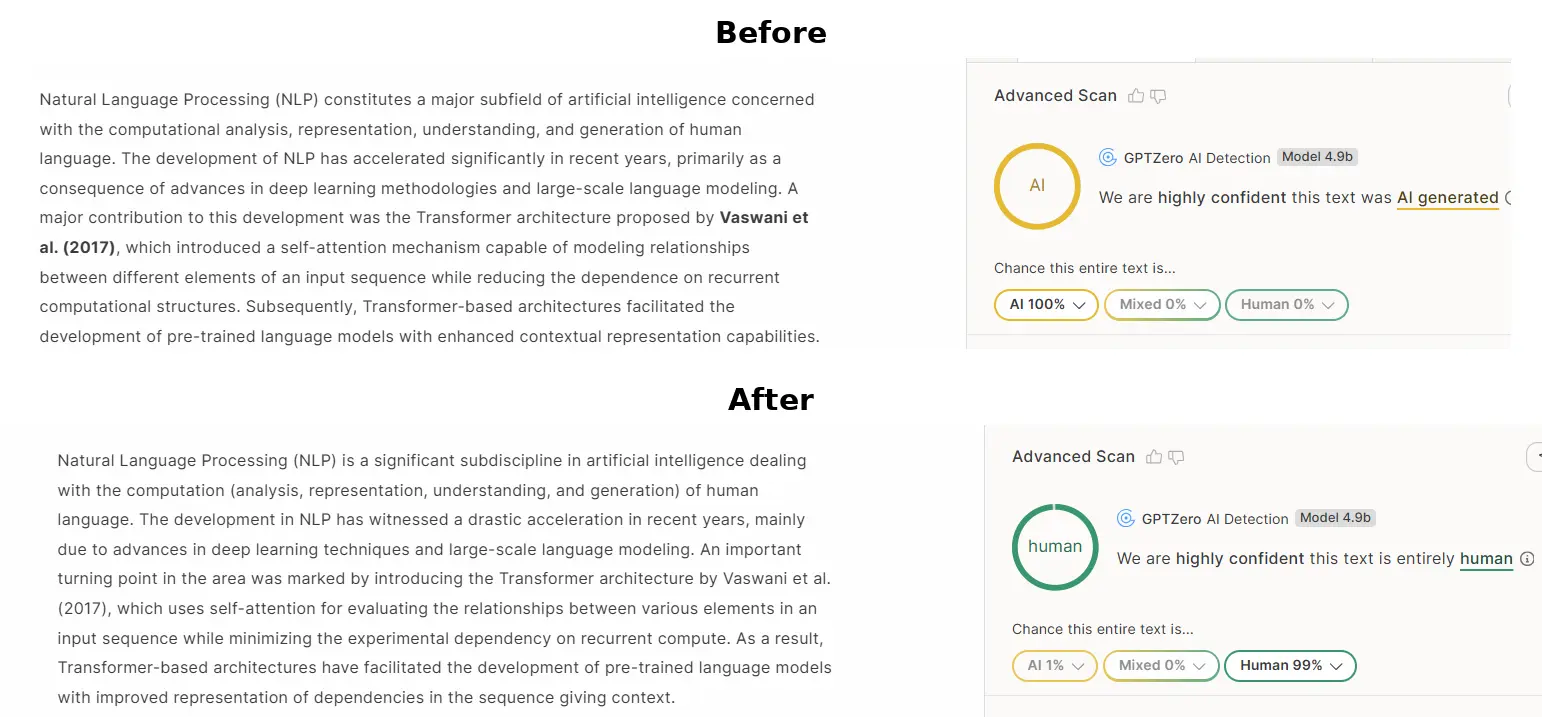
4. Originality.ai Verification: 0% AI Confidence
Originality.ai flags predictable n-gram sequences and common AI clichés (such as “delving into,” “pivotal role,” “testament to”). ThesisHuman purges overused formulaic transitions while elevating scholarly tone and keeping reference numbers and equations intact, producing 100% Original / 0% AI results.