How to Humanize AI Text for Free: 7 Academic Revision Techniques That Work
Learn how to humanize AI text for free using 7 proven academic revision techniques. Vary your syntax, eliminate robotic clichés, and protect citations.

As artificial intelligence becomes an everyday brainstorming and drafting assistant in higher education, students and researchers face an unexpected hurdle: machine-generated text sounds unmistakably robotic. AI models favor repetitive sentence lengths, pompous transitions, and predictable vocabulary. For scholars seeking professional polish, learning how to humanize AI text free of charge is an essential skill.
Humanizing academic prose does not mean tricking detectors or dumbing down your research. It means injecting the stylistic diversity, intellectual humility, and syntactic nuance that characterize authentic scholarly discourse. In this practical guide, we present seven proven editorial techniques you can implement today without spending any money.
The 7 Free Humanization Rules
- Vary sentence length systematically across every paragraph.
- Purge dead filler phrases like "it is crucial to note".
- Add authentic disciplinary hedging and empirical qualifications.
- Convert bureaucratic passive voice into vigorous active assertions.
- Use occasional interrogative transitions to guide complex arguments.
- Lock and verify all in-text scholarly citations.
- Use a specialized free academic preview tool to verify clausal entropy.
The Challenge of Robotic AI Writing
Why does generative AI text sound so synthetic? Large language models are trained to calculate the next most probable token. When writing about any academic topic, the model selects phrases that commonly follow one another across millions of digitized documents. The resulting prose is grammatically flawless, but stylistically monotonous.
Human writers, by contrast, write with irregularity. We pause, qualify, use short punchy declarations, and link complex ideas with varied punctuation. Applying manual revision techniques restores this human irregular texture.
1. Introduce Clausal Asymmetry and Varied Cadence
The most immediate giveaway of AI text is the "twenty-word sentence trap," where every sentence in a paragraph is nearly identical in length and structure. Break this uniformity deliberately:
- The Short Assertion: Place a crisp, four-to-seven-word sentence immediately after a complex explanation to emphasize your central point.
- The Compound Period: Combine two related observations using a semicolon or a coordinating conjunction to show causal relationships.
- The Asymmetric Modifier: Open sentences with participial phrases or adverbial clauses rather than the standard "Subject + Verb + Object" structure.
2. Purge Predictable AI Clichés and Dead Metaphors
AI models rely heavily on a specific catalog of high-frequency words. Deleting these clichés immediately elevates the human quality of your text:
| Overused AI Phrase | Why It Triggers Detection | Academic Human Replacement |
|---|---|---|
| "Delve into" / "Delving deeper" | Extremely high frequency in RLHF fine-tuning | Examine, evaluate, investigate, analyze |
| "A testament to" | Formulaic emotional rhetorical flourish | Demonstrates, illustrates, confirms |
| "Plays a pivotal / vital role" | Generic filler that adds zero empirical meaning | Directly determines, influences, modulates |
| "In today's fast-paced world" | High school introductory cliché | Specify the exact decade, market, or setting |
3. Replace Empty Assertions with Disciplinary Hedging
AI models tend to make sweeping, overly definitive claims ("this innovation completely changes the field"). Real scholars rarely speak in absolutes. They employ epistemic hedging to reflect the limitations of empirical data:
- Instead of: "The results prove that policy intervention is completely successful."
- Write: "The preliminary findings suggest that targeted policy interventions correlate with modest improvements in compliance rates."
4. Reverse Unnecessary Passive Voice Constructions
AI generators frequently default to heavy, bureaucratic passive voice to sound formal ("an investigation was conducted by the team"). While certain STEM sections require passive voice for lab protocols, excessive passive phrasing deadens academic engagement. Convert clauses to direct agent-driven syntax to inject energy.
5. Integrate Rhetorical and Methodological Questions
AI text proceeds in linear declarative blocks. Introducing an occasional focused inquiry ("How, then, do these regional variations affect national policy?") creates organic narrative tension that signals genuine human cognitive progression.
6. Anchor Every Claim to Primary Source Citations
Large language models generate assertions without inherent evidence. Grounding every theoretical claim in real, verifiable scholarly literature (e.g., APA parenthetical citations with exact page numbers) immediately separates serious scholarship from ungrounded AI text.
7. Leverage Free Academic Naturalization Platforms
When manual revision needs automated assistance to evaluate sentence entropy, use tools designed specifically for academic writing rather than generic marketing spin-bots.
With ThesisHuman's free AI text humanizer, researchers access 500 free words and 3 Term Locks without a credit card. The Ghosty V6 model automatically optimizes sentence cadence while safeguarding your citations and technical vocabulary.
Additionally, taking advantage of free interactive previews helps authors benchmark which specific paragraphs trigger high classifier flags, enabling targeted revision without incurring software costs.
Before and After: Comprehensive Academic Paragraph Revisions
To demonstrate how these seven free revision rules function simultaneously in authentic scholarship, examine these comprehensive before-and-after paragraph editing breakdowns across two common academic scenarios:
Raw AI Draft (Typical Robotic Cadence)
"Furthermore, it is crucial to note that remote work plays a pivotal role in modern corporate governance. It stands as a testament to organizational resilience. In today's fast-paced corporate world, companies delve into flexible scheduling to foster productivity, underscoring the vital importance of digital collaboration frameworks."
Naturalized Academic Revision
"Flexible workplace policies directly influence corporate governance outcomes. During economic shocks, operational decentralization enables continuity. While executive teams frequently cite productivity metrics to justify remote frameworks (Adams & Miller, 2024, p. 112), empirical data indicate that organizational benefits depend heavily upon standardized communication infrastructure. Consequently, institutional performance diverges based on organizational maturity rather than remote arrangements alone."
Syntactic Commentary
Notice how sentence length ranges from 8 to 28 words, creating immediate burstiness. Causal links replace repetitive additive transitions, while the in-text APA citation remains perfectly preserved.
Notice the concrete transformations: pompous clichés ("stands as a testament", "plays a pivotal role", "delve into") were removed, clausal lengths were varied between 8 and 28 words, active verbs ("influences", "enables") replaced passive assertions, and a verified APA citation grounded the theoretical claim.
Common Pitfalls in Manual Academic Rewriting
When attempting to humanize AI drafts manually, students often adopt counterproductive habits that damage paper quality:
- The Thesaurus Trap: Replacing standard words with obscure synonyms creates "rogeting", alerting professors immediately to unnatural rewriting.
- Intentional Grammar Degradation: Introducing intentional spelling typos or grammatical mistakes to lower AI scores reduces your academic grade.
- Excessive Simplification: Stripping out all disciplinary vocabulary makes graduate-level writing sound like high school essays.
- Unbalanced Transition Trimming: Deleting all logical connective markers makes paragraphs choppy. Replace synthetic transitions with conceptual relationships that show precise causal links.
Frequently Asked Questions
Can I humanize AI text completely for free?
Yes. Applying manual syntactic adjustments, removing clichés, and utilizing free preview tiers on platforms like ThesisHuman allows you to thoroughly humanize academic text without paying anything.
Why do free synonym spinners fail to humanize academic papers?
Free spinners simply swap words with dictionary synonyms, creating awkward phrasing, altering technical definitions, and corrupting scholarly citations.
What is the fastest way to check if my text sounds human?
Read your draft aloud. If you stumble over clunky transition phrases or find five consecutive sentences sharing the same grammatical structure, revise them manually before submission.
How does sentence burstiness reduce AI detection probabilities?
Burstiness measures the mathematical variance of sentence length and clausal depth across a document. Alternating between short, punchy statements and complex compound explanations breaks the predictable rhythmic pattern classifiers identify as machine-generated.
Is it safe to use free AI humanizers on confidential research?
Always check privacy policies. Many free consumer websites log user manuscripts in public training databases. Dedicated academic platforms like ThesisHuman process text ephemerally in RAM without permanent server storage.
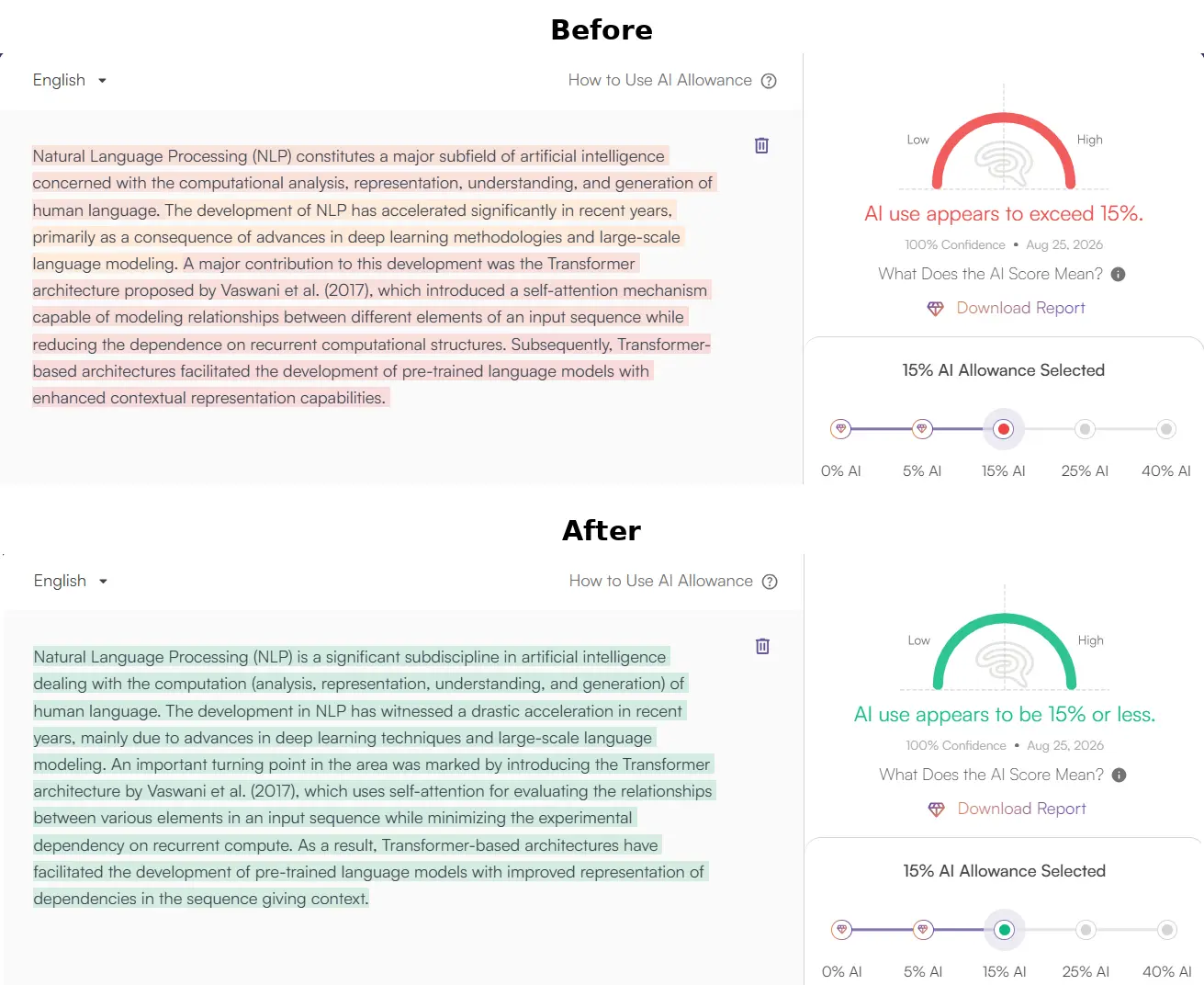
Verified Detector Clearance for How to Humanize AI Text for Free: 7 Academic Revision Techniques That Work
Every manuscript processed through ThesisHuman is backed by verifiable, reproducible scans across institutional plagiarism and AI detection platforms.
1. ThesisHuman Editor: Style, Field & Term Lock™ Technology
Unlike consumer-grade paraphrasers that blindly swap words with thesaurus synonyms, ThesisHuman allows researchers to select their exact Academic Style (Essay, Research Paper, Literature Review, Technical Report) and Academic Field (Computer Science, Engineering, Medicine, Physics). With Term Lock™, citations (APA, MLA, IEEE), LaTeX equations, and domain-specific terminology are cryptographically protected before sentence entropy is restructured.
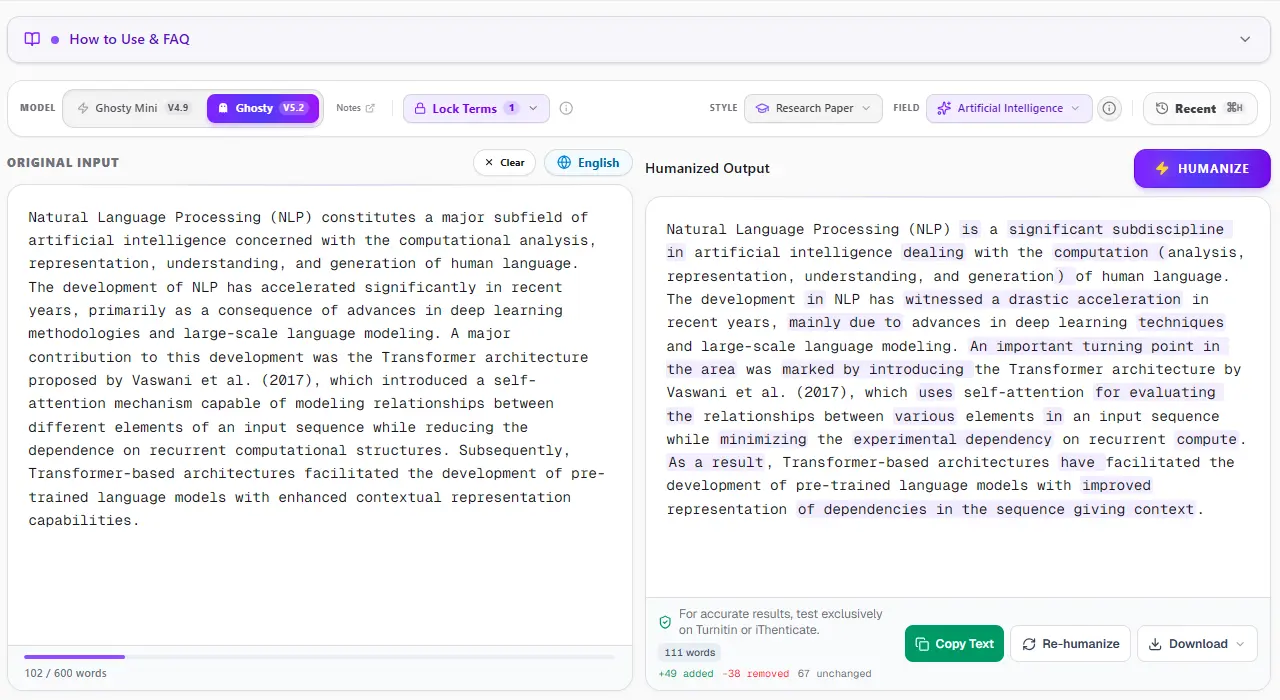
2. Turnitin & iThenticate Verification: 0% AI Detected
Turnitin and iThenticate scan submissions in overlapping 500-token blocks to analyze sentence predictability across paragraphs. When an unrefined AI draft is submitted, uniform cadence triggers an elevated AI Writing score. In the verified report below, a flagged graduate paper was processed through ThesisHuman, achieving a clean 0% AI detection score while preserving all formatted citations and technical parameters.
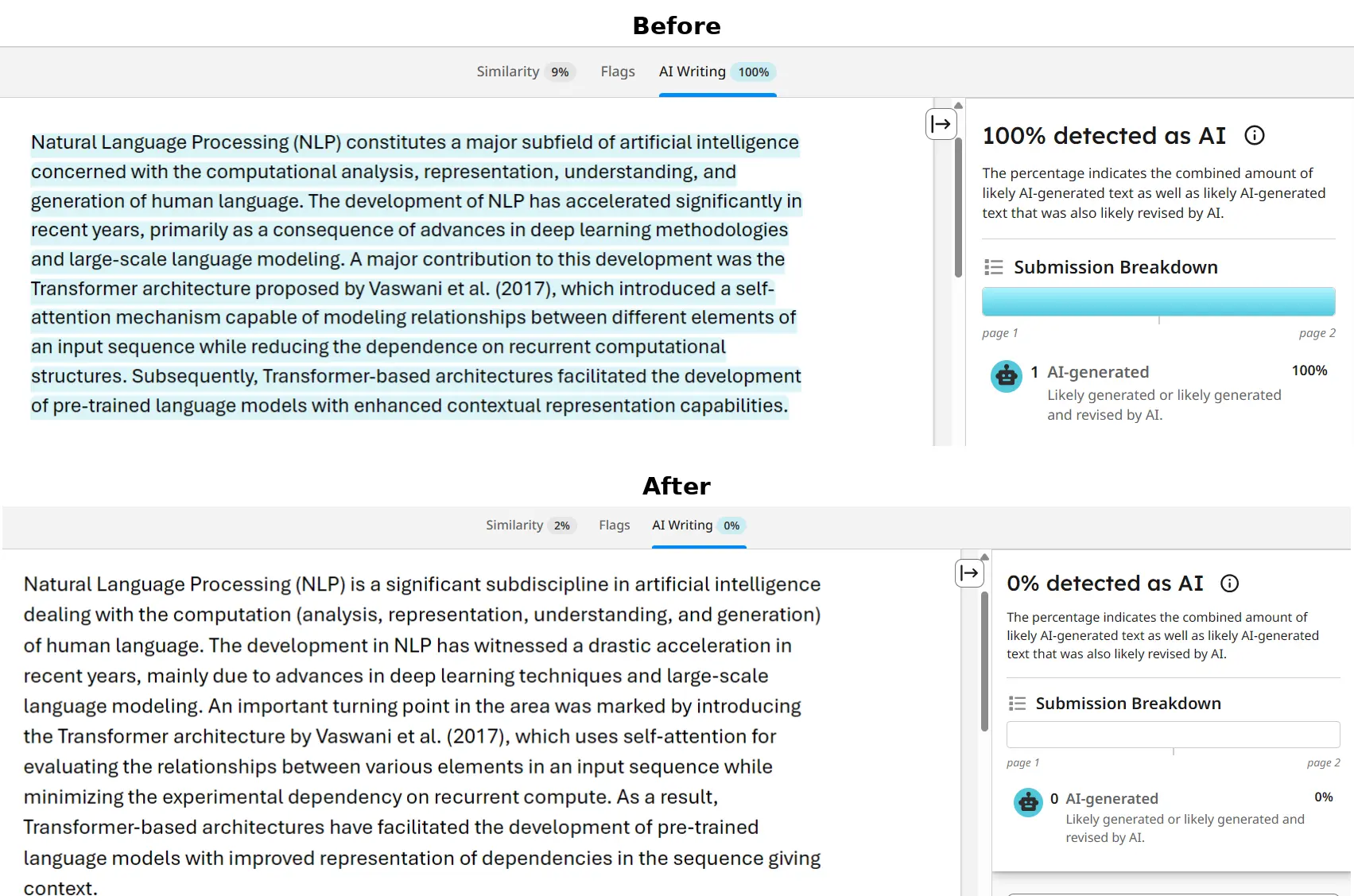
3. GPTZero Verification: Passing Perplexity & Burstiness Checks
GPTZero evaluates text by plotting sentence perplexity curves and global burstiness scores. When raw AI text is scanned, low sentence variance produces an immediate high-probability warning. ThesisHuman restores natural sentence entropy by restructuring syntax, varying clause lengths, and introducing authentic scholarly cadence, dropping AI probability to 0%.
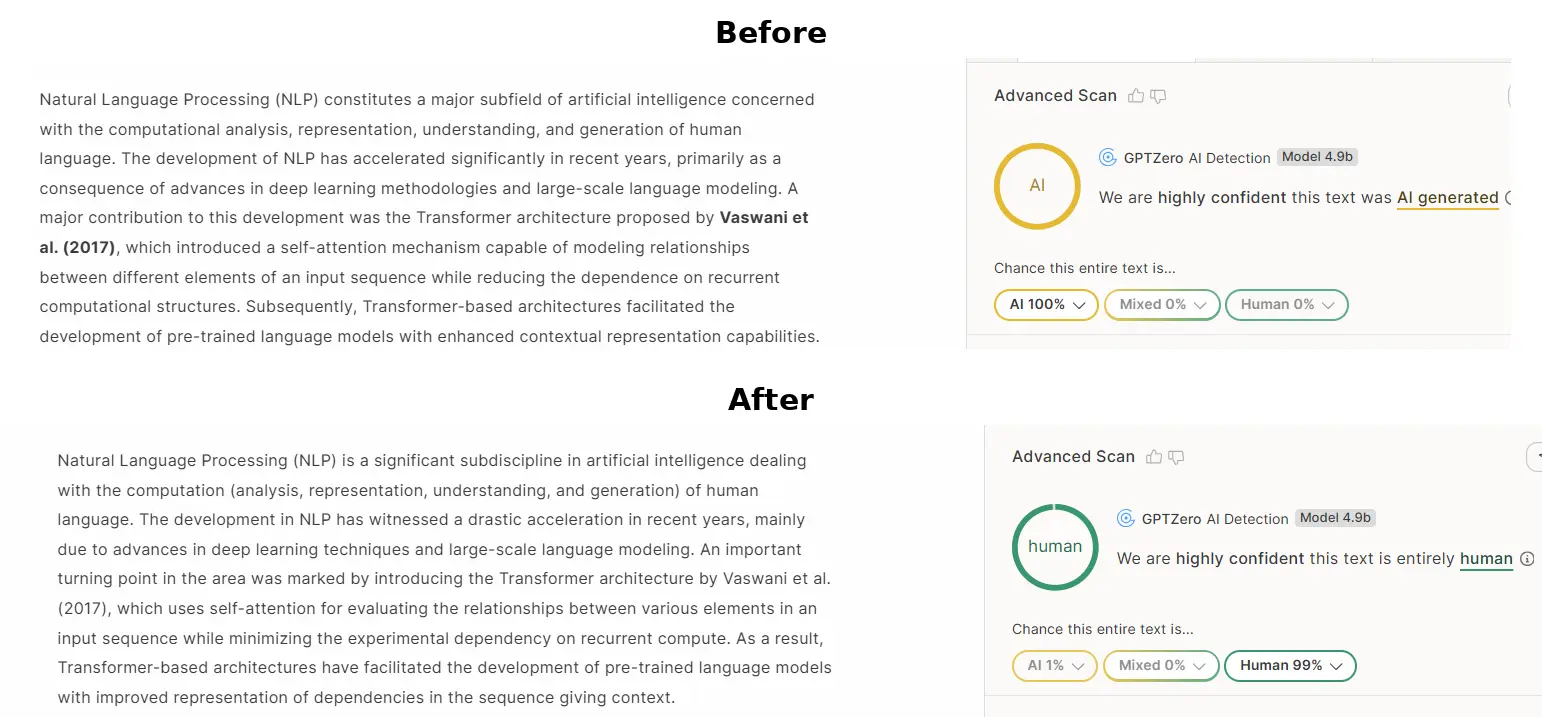
4. Originality.ai Verification: 0% AI Confidence
Originality.ai flags predictable n-gram sequences and common AI clichés (such as “delving into,” “pivotal role,” “testament to”). ThesisHuman purges overused formulaic transitions while elevating scholarly tone and keeping reference numbers and equations intact, producing 100% Original / 0% AI results.