How to Restate a Thesis Statement in Your Conclusion: Examples & Step-by-Step Guide
Learn how to restate a thesis statement in an essay conclusion without repeating yourself verbatim. Includes step-by-step techniques and academic examples.

Restating a thesis statement means rephrasing your paper's central argument in your conclusion paragraph using new vocabulary, altered clause order, and a synthesized tone that reflects the evidence presented across your essay. It does **not** mean copying your introduction's thesis statement word-for-word, nor does it refer to rewriting a full Master's or PhD dissertation document.
A strong thesis restatement reminds readers of your core research claim while demonstrating how your analytical arguments have proven that claim.
What Does It Mean to Restate a Thesis Statement?
In academic writing, your thesis statement evolves between your introduction and conclusion. In your introduction, your thesis announces a claim you **promise to prove** using upcoming evidence. In your conclusion, your restated thesis reasserts your claim as **proven conclusion**, synthesized through the evidence you analyzed in the body paragraphs.
If you are refining an academic essay or dissertation chapter, discover how ThesisHuman refines sentence cadence.
The Difference Between Repeating and Restating a Thesis
| Approach | Phrasing & Syntax | Reader Impact |
|---|---|---|
| Repeating Verbatim | Identical word-for-word copy from introduction | Sounds repetitive, lazy, and uninspired |
| Synthesized Restatement | Altered clause structure + active conclusion verbs | Reinforces argument authority and synthesis |
3-Step Formula for Restating Your Thesis Statement in a Conclusion
Step 1: Shift Tone from Introductory Claim to Proven Conclusion
Transition from introductory verbs ("This paper argues that...") to decisive analytical statements reflecting completed evidence evaluation ("The empirical data demonstrates that...").
Step 2: Vary Sentence Structure, Clause Order, and Key Verbs
If your original thesis started with an independent clause followed by supporting reasons, invert the restatement by beginning with a dependent clause highlighting key evidence.
Step 3: Connect Restated Thesis to Broader Implications
Link your restated claim to broader scholarly implications, future research directions, or practical policy applications.
Real Academic Examples Across Disciplines (Humanities, STEM, Social Sciences)
Environmental Science Example
Intro Thesis: "Urban green roofs reduce metropolitan heat island effects, lower building energy consumption, and improve stormwater management in dense cities."
Conclusion Restatement: "By lowering surface temperatures and absorbing excess runoff, green roof infrastructure offers a scalable solution for municipal climate adaptation."
History & Humanities Example
Intro Thesis: "The introduction of the printing press in 15th-century Europe destabilized religious authority by democratizing access to biblical texts."
Conclusion Restatement: "15th-century print technology fundamentally reshaped European religious institutions by placing scriptural interpretation directly in the hands of the reading public."
Common Mistakes to Avoid in Conclusion Paragraphs
Avoid these frequent conclusion writing errors:
- Introducing entirely new evidence or uncited arguments in the final paragraph.
- Copying the introduction thesis statement verbatim.
- Apologizing or using weak qualifiers ("In my humble opinion", "Although I might be wrong").
Verified Detector Clearance for How to Restate a Thesis Statement in Your Conclusion: Examples & Step-by-Step Guide
Every manuscript processed through ThesisHuman is backed by verifiable, reproducible scans across institutional plagiarism and AI detection platforms.
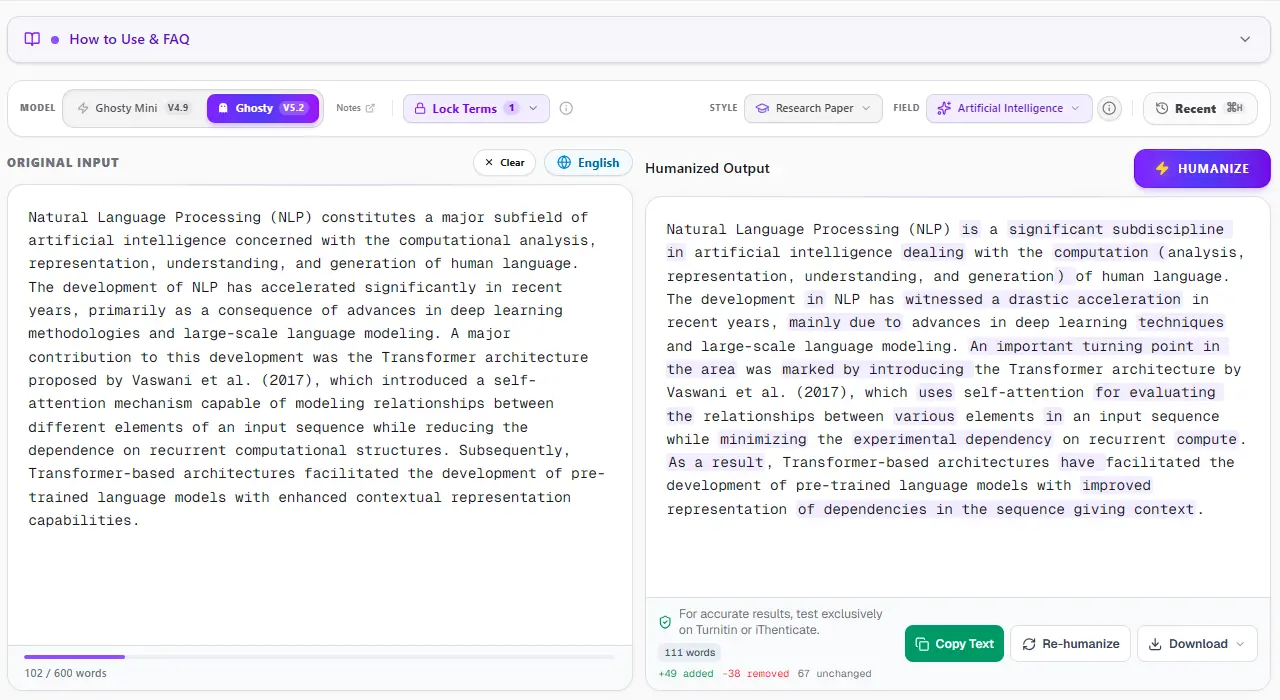
1. ThesisHuman Editor: Style, Field & Term Lock™ Technology
Unlike consumer-grade paraphrasers that blindly swap words with thesaurus synonyms, ThesisHuman allows researchers to select their exact Academic Style (Essay, Research Paper, Literature Review, Technical Report) and Academic Field (Computer Science, Engineering, Medicine, Physics). With Term Lock™, citations (APA, MLA, IEEE), LaTeX equations, and domain-specific terminology are cryptographically protected before sentence entropy is restructured.
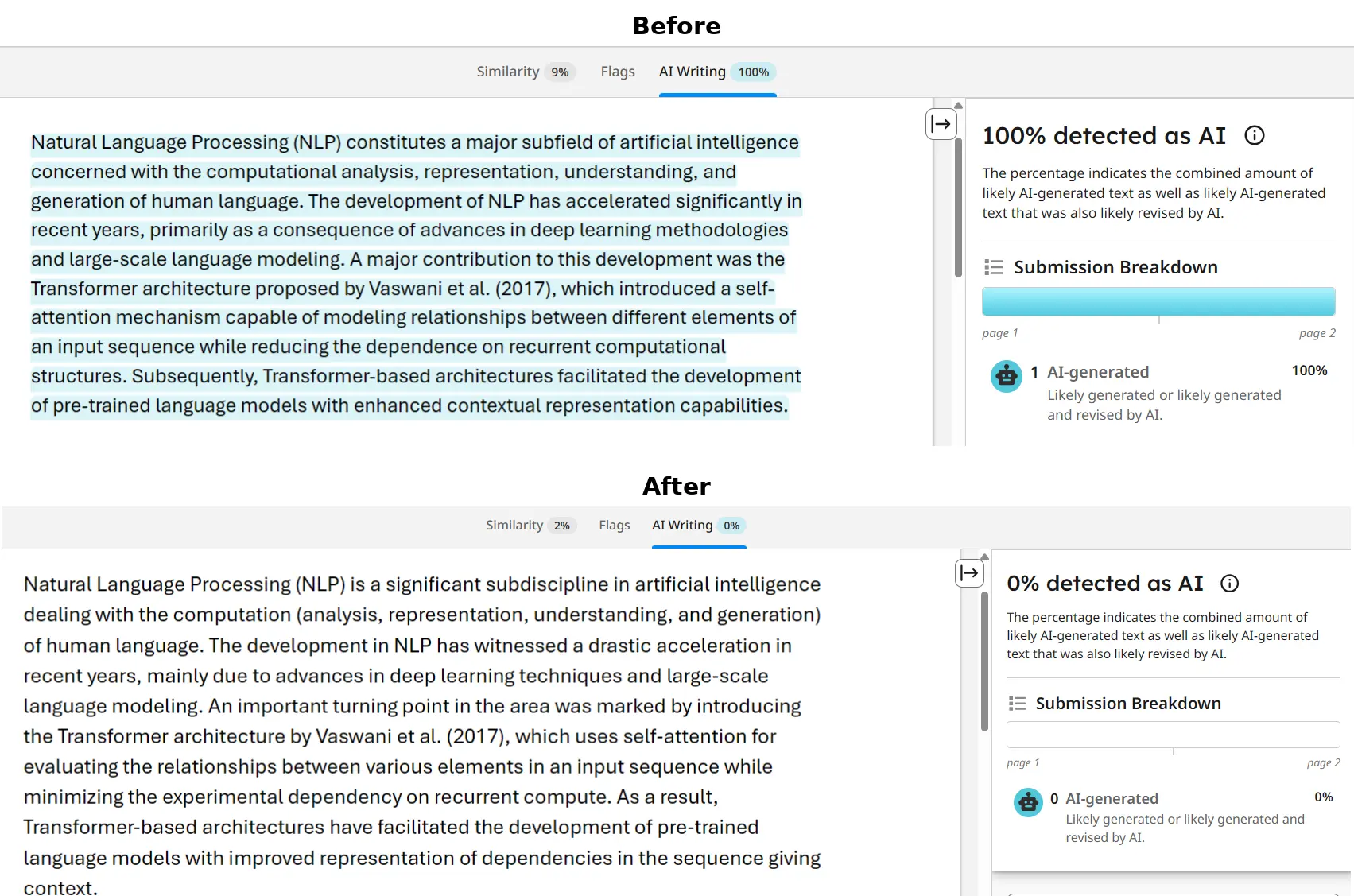
2. Turnitin & iThenticate Verification: 0% AI Detected
Turnitin and iThenticate scan submissions in overlapping 500-token blocks to analyze sentence predictability across paragraphs. When an unrefined AI draft is submitted, uniform cadence triggers an elevated AI Writing score. In the verified report below, a flagged graduate paper was processed through ThesisHuman, achieving a clean 0% AI detection score while preserving all formatted citations and technical parameters.
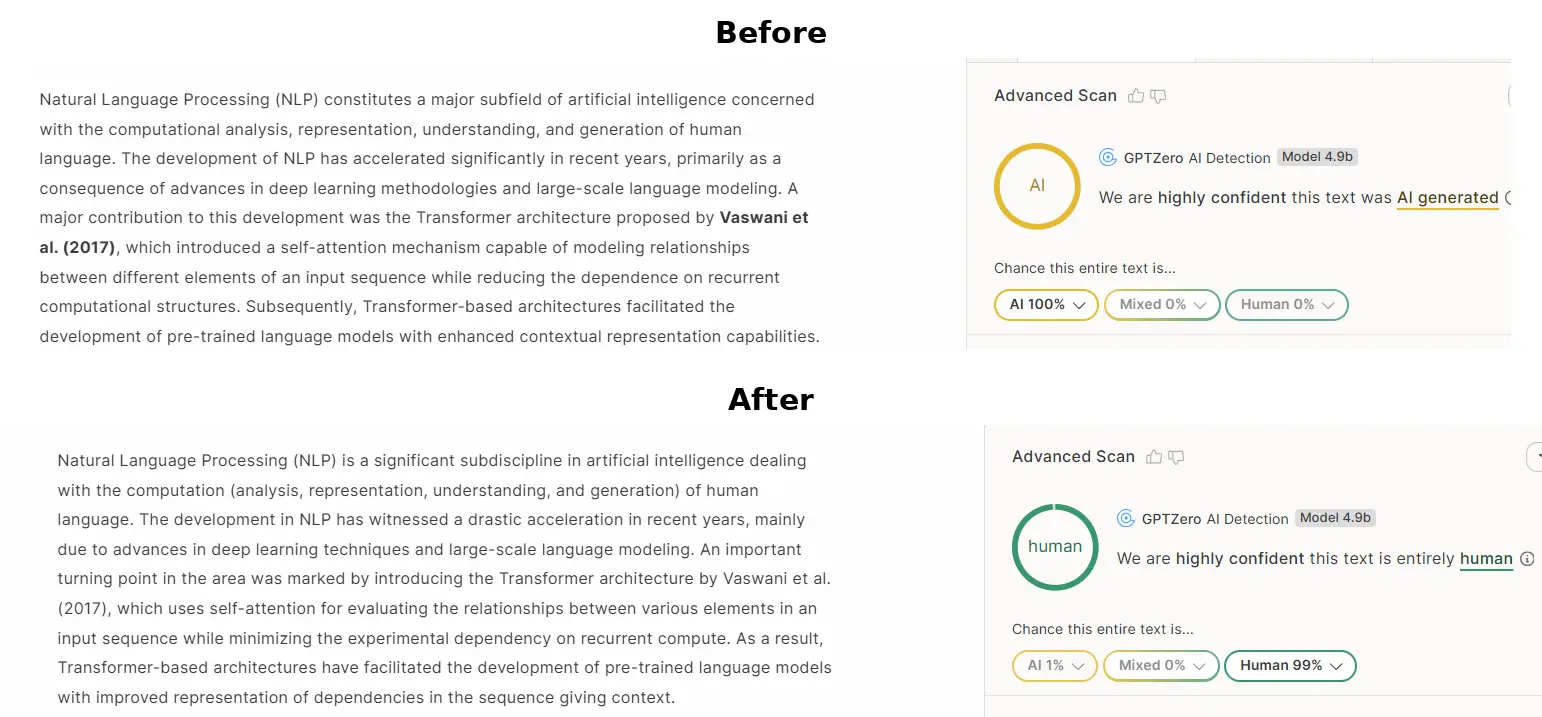
3. GPTZero Verification: Passing Perplexity & Burstiness Checks
GPTZero evaluates text by plotting sentence perplexity curves and global burstiness scores. When raw AI text is scanned, low sentence variance produces an immediate high-probability warning. ThesisHuman restores natural sentence entropy by restructuring syntax, varying clause lengths, and introducing authentic scholarly cadence, dropping AI probability to 0%.
4. Originality.ai Verification: 0% AI Confidence
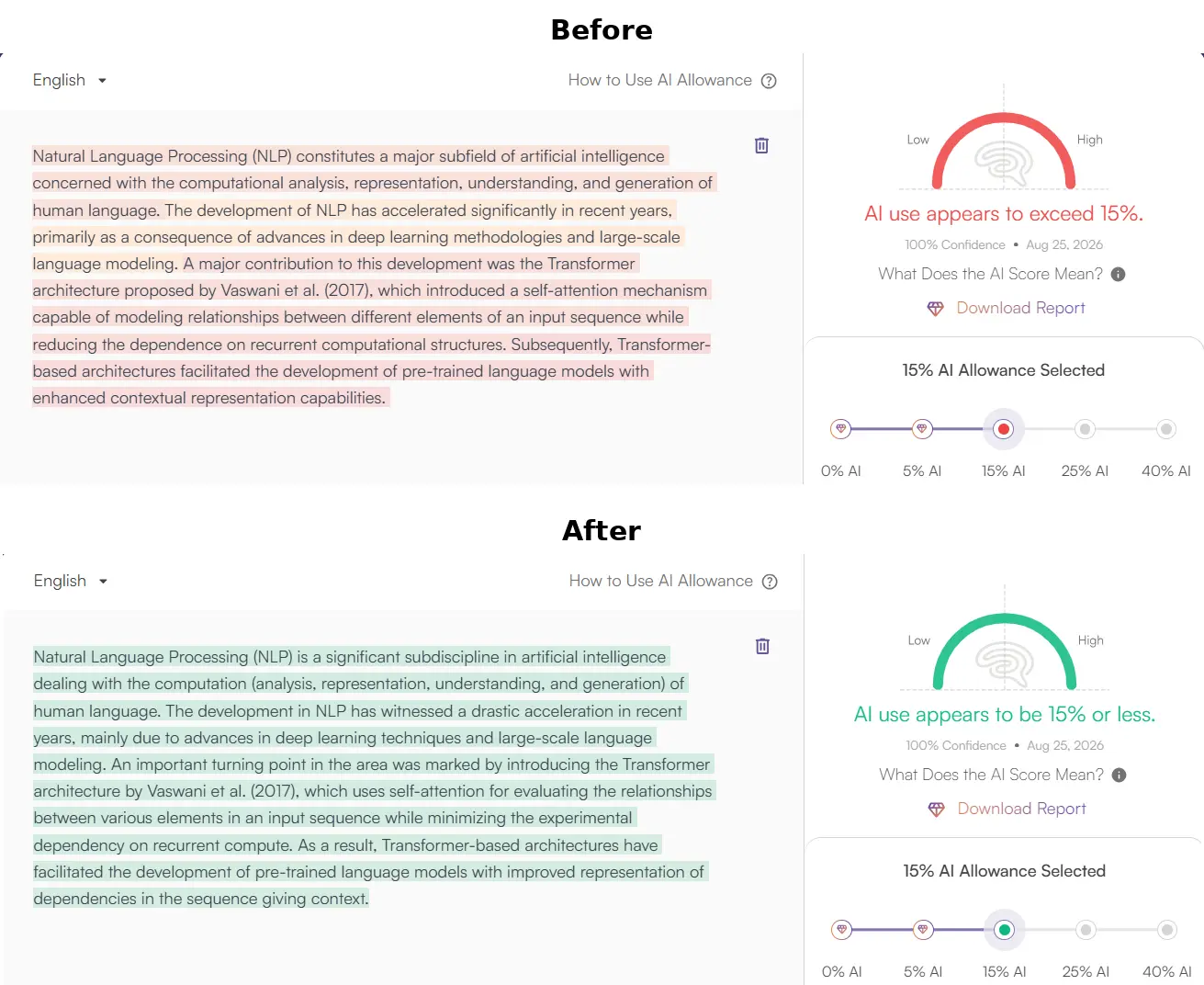
Originality.ai flags predictable n-gram sequences and common AI clichés (such as “delving into,” “pivotal role,” “testament to”). ThesisHuman purges overused formulaic transitions while elevating scholarly tone and keeping reference numbers and equations intact, producing 100% Original / 0% AI results.