How Many Paragraphs Is an Essay? Examples by Essay Length
Learn how many paragraphs an essay should have across 500 to 3,000 words. Explore paragraph structures, genre differences, and 3 annotated essay outlines.

One of the most persistent questions facing students and emerging academic writers is how many paragraphs an essay should contain. Many students were taught in secondary school that an essay is strictly five paragraphs: one introduction, three body paragraphs, and one conclusion. However, university writing assignments, research papers, and scholarly journal manuscripts operate on fundamentally different structural principles.
This definitive guide provides actionable, non-prescriptive answers to the question of essay paragraph counts. We examine why paragraph count is governed by argument complexity rather than arbitrary formulas, provide practical paragraph-count benchmarks from 250 to 3,000 words, compare structural requirements across academic genres, and analyze three annotated essay outlines for five-paragraph, argumentative, and research-oriented papers.
1. How Many Paragraphs in an Essay? The Direct Answer
There is no universal, fixed number of paragraphs required for an essay. In academic writing, the number of paragraphs is determined by your word count, the complexity of your thesis statement, and the number of distinct logical steps needed to substantiate your argument.
As a general empirical benchmark, a standard academic paragraph in university-level English spans between 100 and 200 words. Consequently, dividing your target word count by approximately 125 to 175 words yields a realistic paragraph estimate:
- 500-word essay: Typically 3 to 5 paragraphs
- 1,000-word essay: Typically 5 to 8 paragraphs
- 1,500-word essay: Typically 8 to 12 paragraphs
- 2,000-word essay: Typically 10 to 16 paragraphs
- 3,000-word essay: Typically 15 to 22 paragraphs
These estimates provide flexible planning ranges rather than rigid mandates. Your primary goal is to ensure that every single paragraph develops one coherent sub-argument.
2. Why Paragraph Counts Depend on Scope and Complexity
Paragraphs are units of thought, not arbitrary containers of text. In professional and scholarly discourse, a paragraph break signals a cognitive shift: introducing a new evidentiary claim, addressing a counterargument, or transitioning to methodological analysis.
Several core factors dictate your ultimate paragraph count:
- Thesis Architecture: A multi-pronged thesis addressing economic, political, and sociological variables naturally demands more body paragraphs than a narrow inquiry into a single poem.
- Evidence Density: When substantiating claims with quantitative statistical metrics, qualitative interview quotes, and methodological caveats, each evidentiary chain requires adequate explanatory space.
- Disciplinary Conventions: Scientific and social science manuscripts often favor concise, focused paragraphs (100 to 140 words), whereas literary and philosophical treatises frequently construct extended discursive paragraphs (150 to 220 words).
3. The Five-Paragraph Essay: Origins, Utility, and Limits
The five-paragraph essay (comprising an introduction, three body paragraphs, and a conclusion) is the most famous instructional model in secondary education. While it offers clear training wheels for novice writers, it possesses serious limitations in higher education.
Where the 5-Paragraph Model Works
- Timed classroom essay exams (e.g., AP exams, SAT/ACT writing).
- Introductory high school analytical assignments.
- Short 500-word opinion or reflective responses.
- Teaching basic tripartite thesis structures.
Why University Professors Reject It
- Forces complex multidimensional problems into an artificial triad.
- Encourages repetitive introductory and concluding summaries.
- Discourages in-depth exploration of counterarguments and nuances.
- Results in superficial 700-word treatments of substantive topics.
In university-level essays, abandon the rigid requirement of having exactly three body paragraphs. Instead, allow your thesis to dictate the number of evidentiary sections needed.
4. Paragraph-Count Estimates Across Word-Count Ranges
The following guidelines illustrate how paragraph distribution scales across standard academic essay assignments:
- 250-Word Response: Typically 1 to 2 paragraphs. At this length, you have room only for a concise introductory claim followed by focused evidence, or a single unified analytical paragraph.
- 500-Word Essay: Typically 3 to 5 paragraphs. Commonly formatted as a 500-word five-paragraph essay or a four-paragraph structure (introduction, two substantive analytical sections, conclusion).
- 750-Word Essay: Typically 4 to 6 paragraphs. Allows for an introduction, 3 to 4 well-developed analytical body paragraphs, and a synthetic conclusion.
- 1,000-Word Essay: Typically 6 to 8 paragraphs. The quintessential college midterm paper length. Consists of an introduction, 4 to 6 analytical body paragraphs (including counterarguments), and a conclusion.
- 1,500-Word Essay: Typically 8 to 12 paragraphs. Accommodates multi-step arguments, theoretical framing, and multiple empirical sub-points.
- 2,000-Word Essay: Typically 11 to 16 paragraphs. Suitable for term papers, literature reviews, and policy analyses with distinct thematic subsections.
- 3,000-Word Essay: Typically 16 to 24 paragraphs. Represents an extended seminar paper or capstone essay, requiring formal section headings and multi-paragraph thematic clusters.
5. Word Count versus Paragraph Count Reference Table
Study this reference table to plan the architectural layout of your next essay assignment:
| Target Word Count | Estimated Paragraphs | Typical Paragraph Length | Typical Academic Purpose |
|---|---|---|---|
| 250 words | 1-2 paragraphs | 120-150 words | Discussion forum post, abstract, reading reaction |
| 500 words | 3-5 paragraphs | 100-130 words | Admissions personal statement, short response |
| 750 words | 4-6 paragraphs | 125-160 words | Undergraduate weekly analytical paper, book review |
| 1,000 words | 6-8 paragraphs | 130-170 words | Standard college midterm essay, persuasive paper |
| 1,500 words | 8-12 paragraphs | 130-180 words | Course term paper, comparative literary analysis |
| 2,000 words | 11-16 paragraphs | 130-180 words | Upper-level research essay, literature review chapter |
| 3,000 words | 16-24 paragraphs | 130-190 words | Senior capstone paper, journal manuscript submission |
For detailed guidance on calibrating individual paragraph internal mechanics, consult our tutorial on what is a body paragraph and our analysis of how many sentences are in a paragraph.
6. Short Responses to Full Research Papers
It is vital to distinguish between a research essay and a full research paper:
- Research Essay (1,000 to 2,500 words): Focuses on developing a unified argumentative thesis supported by synthesized secondary literature. It generally does not require empirical methodology or results sections.
- Empirical Research Paper (3,000 to 8,000 words): Follows formal scientific formatting (IMRAD: Introduction, Methods, Results, and Discussion). Paragraph counts are divided across dedicated methodological descriptions, statistical tables, and substantive discussion sections.
7. Paragraph Organization Across Academic Genres
Different essay genres demand distinct paragraph structures:
- Argumentative Essays: Require dedicated paragraphs for claim presentation, evidentiary substantiation, counterargument acknowledgment, and refutation. Typically 6 to 10 paragraphs for a 1,200-word assignment.
- Compare-and-Contrast Essays: Can be organized block-style (one multi-paragraph block for Subject A followed by one for Subject B) or point-by-point (alternating paragraphs comparing both subjects across specific thematic criteria). Point-by-point structures generally yield 6 to 9 tightly focused paragraphs.
- Persuasive Essays: Organize paragraphs according to rhetorical momentum, beginning with high-impact emotional or ethical framing before transitioning to empirical substantiation and a decisive call to action.
- Narrative and Reflective Essays: Structure paragraphs chronologically or thematically, with shorter paragraphs (70 to 120 words) used to accelerate pacing during critical personal turning points.
8. Paragraph Length versus Paragraph Count
Writers often focus on paragraph count while neglecting paragraph length. A 1,000-word essay containing only two massive 500-word paragraphs is unreadable, while an essay containing fifteen 60-word paragraphs reads like superficial bullet points.
When to Split a Paragraph
- The paragraph exceeds 220 words.
- You shift from presenting evidence to addressing a counterargument.
- You introduce a new historical epoch, study, or theoretical model.
- Readers lose track of your main topic sentence.
When to Combine Paragraphs
- A paragraph contains only two sentences or fewer than 60 words.
- Two adjacent paragraphs discuss the same piece of empirical data.
- One paragraph serves merely as an orphaned introductory phrase.
- The second paragraph fails to present an independent analytical claim.
9. Organizing Supporting Claims (MEAL and TEEL)
To ensure that every body paragraph contributes to your target paragraph count without devolving into filler, structure paragraphs using the MEAL or TEEL frameworks:
- M - Main Idea / T - Topic Sentence: State the precise analytical claim that this paragraph proves in relation to your thesis.
- E - Evidence / E - Explanation: Furnish concrete empirical data, textual citations, or statistical metrics.
- A - Analysis / E - Evaluation: Unpack how the evidence supports your claim; explain the underlying mechanism or significance.
- L - Link: Connect the analytical takeaway back to your central thesis statement or transition to the subsequent paragraph.
For practical sentence templates across each of these components, explore our curated resources on topic sentence starters and transition sentences.
10. Planning Introductions and Conclusions
In standard essays between 500 and 1,500 words, the introduction and conclusion each occupy exactly one paragraph. However, their structural functions differ sharply:
- Introduction (Funnel Shape): Begins with broad real-world or theoretical context, defines key disciplinary parameters, and culminates in a specific, debatable thesis statement.
- Conclusion (Inverted Funnel): Restates the thesis in light of the evidence presented, synthesizes core body claims without repeating verbatim sentences, and explores broader academic or policy implications.
11. Building a Functional Essay Outline
Before drafting, map out each paragraph on paper. Assign each paragraph a designated topic sentence, specific evidence items, and an estimated word budget (e.g., Paragraph 3: 150 words on cognitive load metrics). Outlining prevents rambling and ensures your essay matches required page counts.
12. Three Practical Annotated Essay Outlines
Study these three illustrative structural models to see how paragraph counts adapt across different academic levels:
Model 1: Standard 5-Paragraph Academic Essay (600 Words)
- Paragraph 1 (Intro): Context on renewable energy adoption; thesis arguing solar municipal subsidies reduce peak grid demand (100 words).
- Paragraph 2 (Body 1): Economic feasibility and reduced consumer kilowatt costs (130 words).
- Paragraph 3 (Body 2): Carbon emissions reduction metrics across urban centers (140 words).
- Paragraph 4 (Body 3): Grid resilience during seasonal weather extremes (130 words).
- Paragraph 5 (Conclusion): Restatement of tripartite benefits; policy recommendations for municipal funding (100 words).
- Rationale: Ideal for introductory coursework requiring a clean, direct tripartite thesis demonstration.
Model 2: Extended Argumentative Essay with Counterarguments (1,200 Words)
- Paragraph 1 (Intro): Debate over algorithmic bail determination; thesis rejecting automated risk scores (150 words).
- Paragraph 2 (Context): Legislative origins and current municipal implementation of risk algorithms (140 words).
- Paragraph 3 (Evidence 1): Racial and socioeconomic bias embedded in historical training datasets (160 words).
- Paragraph 4 (Evidence 2): Lack of transparency in proprietary scoring algorithms (150 words).
- Paragraph 5 (Counterargument): Examining proponent arguments regarding administrative efficiency (140 words).
- Paragraph 6 (Refutation): Demonstrating that speed cannot justify systematic due-process violations (160 words).
- Paragraph 7 (Alternatives): Examining human-supervised judicial pretrial diversion models (150 words).
- Paragraph 8 (Conclusion): Synthesis of constitutional concerns and final judicial reform imperative (150 words).
- Rationale: Eight paragraphs allow balanced, nuanced treatment of counterarguments without collapsing evidentiary claims.
Model 3: Research-Oriented Analytical Essay (2,000 Words)
- Paragraphs 1-2 (Intro): Two-paragraph opening framing antimicrobial resistance as a global public health crisis (250 words).
- Paragraphs 3-5 (Section 1 - Mechanisms): Three paragraphs detailing bacterial horizontal gene transfer and biofilm persistence (450 words).
- Paragraphs 6-8 (Section 2 - Agricultural Drivers): Three paragraphs examining sub-therapeutic livestock antibiotic misuse (450 words).
- Paragraphs 9-11 (Section 3 - Clinical Interventions): Three paragraphs analyzing phage therapy, CRISPR antimicrobials, and stewardship (450 words).
- Paragraph 12 (Policy Roadblocks): One paragraph addressing pharmaceutical development disincentives (150 words).
- Paragraphs 13-14 (Conclusion): Two-paragraph synthesis detailing international surveillance frameworks (250 words).
- Rationale: Fourteen paragraphs grouped into thematic clusters provide the deep analytical architecture expected in senior seminars.
13. Common Paragraph-Structure Mistakes to Avoid
Watch out for these five frequent architectural miscalculations:
- The Monolithic Mega-Paragraph: Writing a 400-word paragraph that exhausts readers and obscures where evidence ends and analysis begins.
- The Fragmented Journalistic Sprint: Inserting a paragraph break every two sentences, resulting in choppy, underdeveloped claims.
- The Unlinked Transition: Jumping abruptly from one topic to the next without a transitional phrase explaining conceptual relationships.
- The Evidence-Free Paragraph: Presenting a paragraph composed entirely of unsubstantiated personal assertions without data or scholarly citation.
- The Re-Summarized Conclusion: Treating the final paragraph as a mechanical rephrasing of the introduction without articulating broader significance.
14. Practical Revision Checklist
Before finalizing any academic essay draft, verify the following six architectural criteria:
- 1. Single Coherent Focus: Does each body paragraph advance exactly one identifiable analytical claim?
- 2. Balanced Length Distribution: Are body paragraphs relatively uniform in length (100 to 200 words), avoiding extremes?
- 3. Explicit Topic Sentences: Does every body paragraph open with an analytical assertion rather than a bare factual statistic?
- 4. Logical Connective Bridges: Are transitional words and phrases utilized to connect adjacent paragraphs smoothly?
- 5. Sufficient Evidence Density: Is every major analytical claim anchored by appropriate empirical citations or textual quotes?
- 6. Word Budget Match: Does your total paragraph count align with your required assignment word count?
If you need to restructure clunky essay drafts or improve paragraph flow, our specialized essay rewriter and AI paper rewriter help you remodel transitions, vary sentence cadence, and preserve formatted citations. Test your essays in the interactive ThesisHuman editor today, and explore our transparent student pricing plans for comprehensive editing capabilities.
15. Frequently Asked Questions
Is the five-paragraph essay required for college-level writing?
No. The five-paragraph essay is an introductory pedagogical model designed to teach basic organization in secondary schools. University professors and academic journals expect flexible paragraph structures governed by the logical complexity of your thesis rather than an arbitrary five-paragraph constraint.
How many paragraphs should a 1,000-word essay have?
A standard 1,000-word academic essay typically contains between 5 and 8 paragraphs, assuming an average academic paragraph length of 120 to 180 words. This generally comprises an introduction, 3 to 6 analytical body paragraphs, and a conclusion.
What is the recommended word length for an academic body paragraph?
In university-level writing, a substantive body paragraph typically spans between 100 and 200 words. Paragraphs under 75 words often lack analytical development, while paragraphs exceeding 250 words risk wandering into multiple unfocused subtopics.
Can an essay have two introductory paragraphs or two concluding paragraphs?
Yes. Longer academic essays (such as 2,500-word seminar papers or 5,000-word journal articles) frequently use two introductory paragraphs to establish broad historical context before narrowing to a specific thesis. Similarly, extended conclusions may separate broader theoretical implications from practical recommendations.
How do I know when to split a long paragraph into two smaller ones?
Split a paragraph whenever you shift from presenting primary empirical evidence to introducing a distinct counterargument, transition between different time periods or methodological approaches, or notice that your paragraph exceeds 250 words without a clear topical refocus.
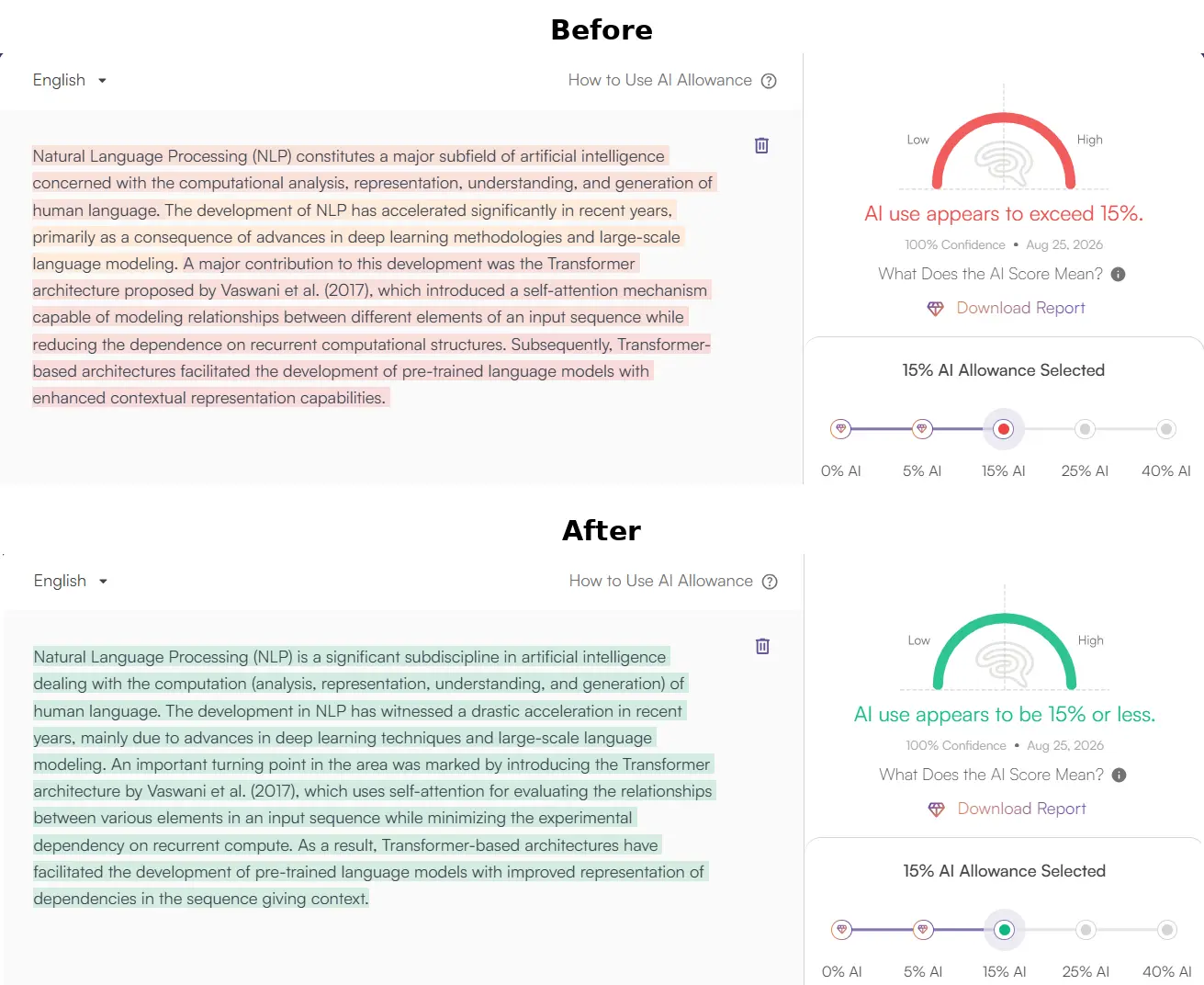
Verified Detector Clearance for How Many Paragraphs Is an Essay? Examples by Essay Length
Every manuscript processed through ThesisHuman is backed by verifiable, reproducible scans across institutional plagiarism and AI detection platforms.
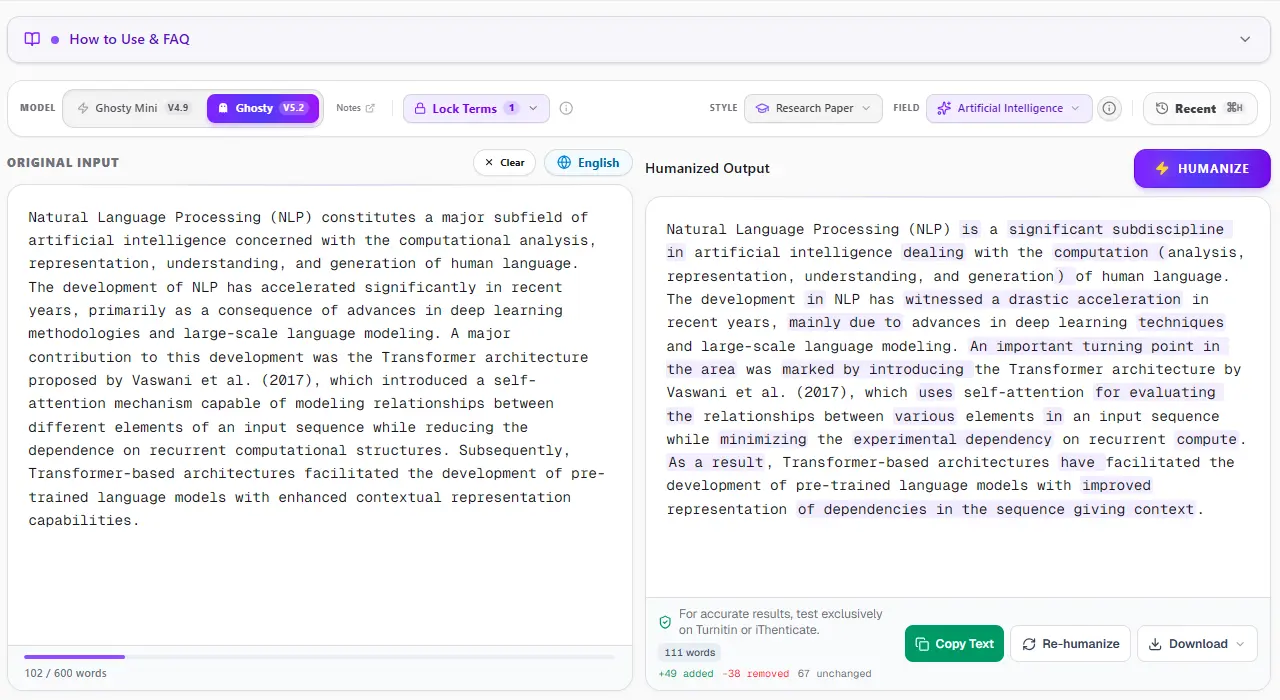
1. ThesisHuman Editor: Style, Field & Term Lock™ Technology
Unlike consumer-grade paraphrasers that blindly swap words with thesaurus synonyms, ThesisHuman allows researchers to select their exact Academic Style (Essay, Research Paper, Literature Review, Technical Report) and Academic Field (Computer Science, Engineering, Medicine, Physics). With Term Lock™, citations (APA, MLA, IEEE), LaTeX equations, and domain-specific terminology are cryptographically protected before sentence entropy is restructured.
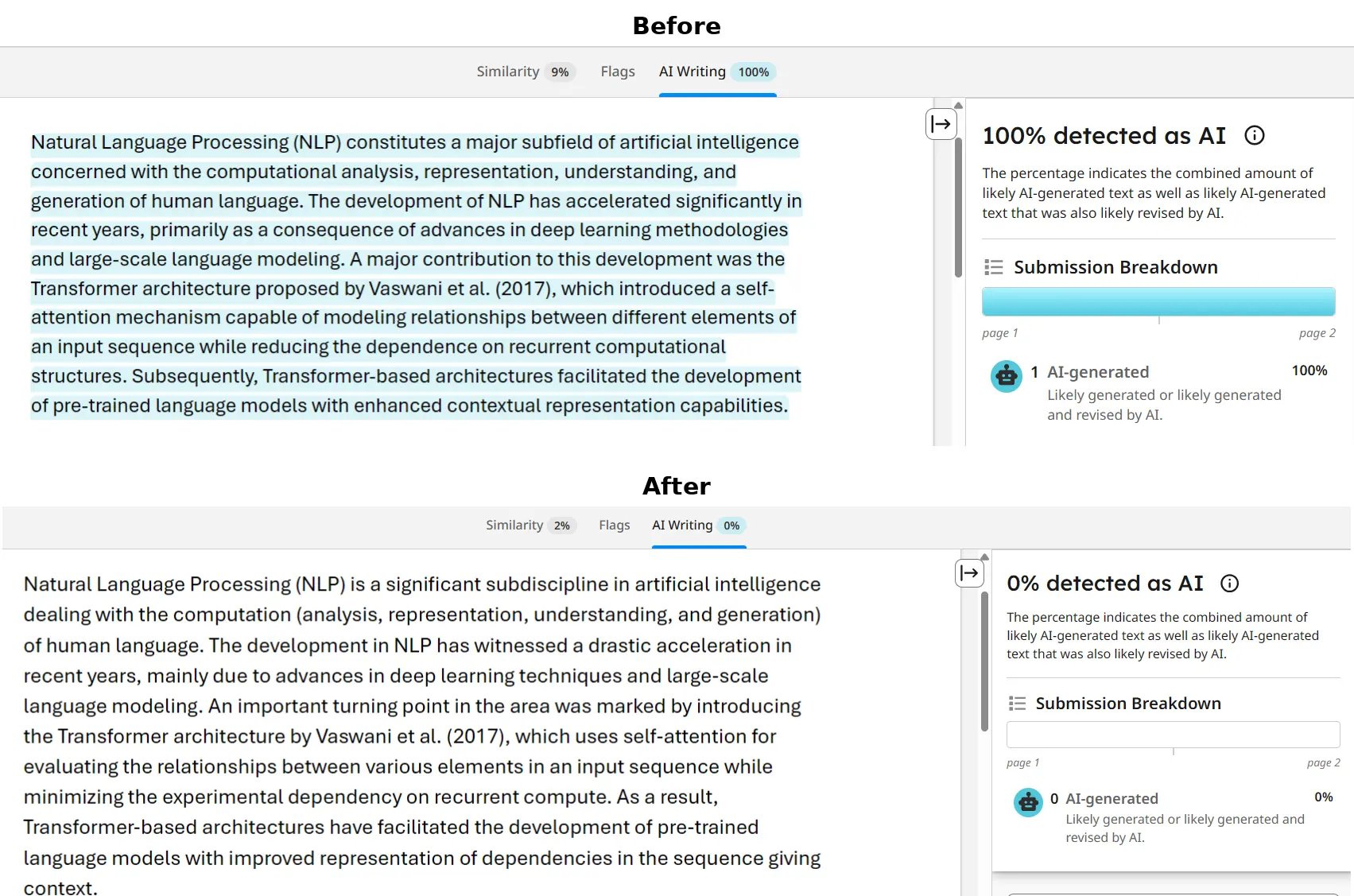
2. Turnitin & iThenticate Verification: 0% AI Detected
Turnitin and iThenticate scan submissions in overlapping 500-token blocks to analyze sentence predictability across paragraphs. When an unrefined AI draft is submitted, uniform cadence triggers an elevated AI Writing score. In the verified report below, a flagged graduate paper was processed through ThesisHuman, achieving a clean 0% AI detection score while preserving all formatted citations and technical parameters.
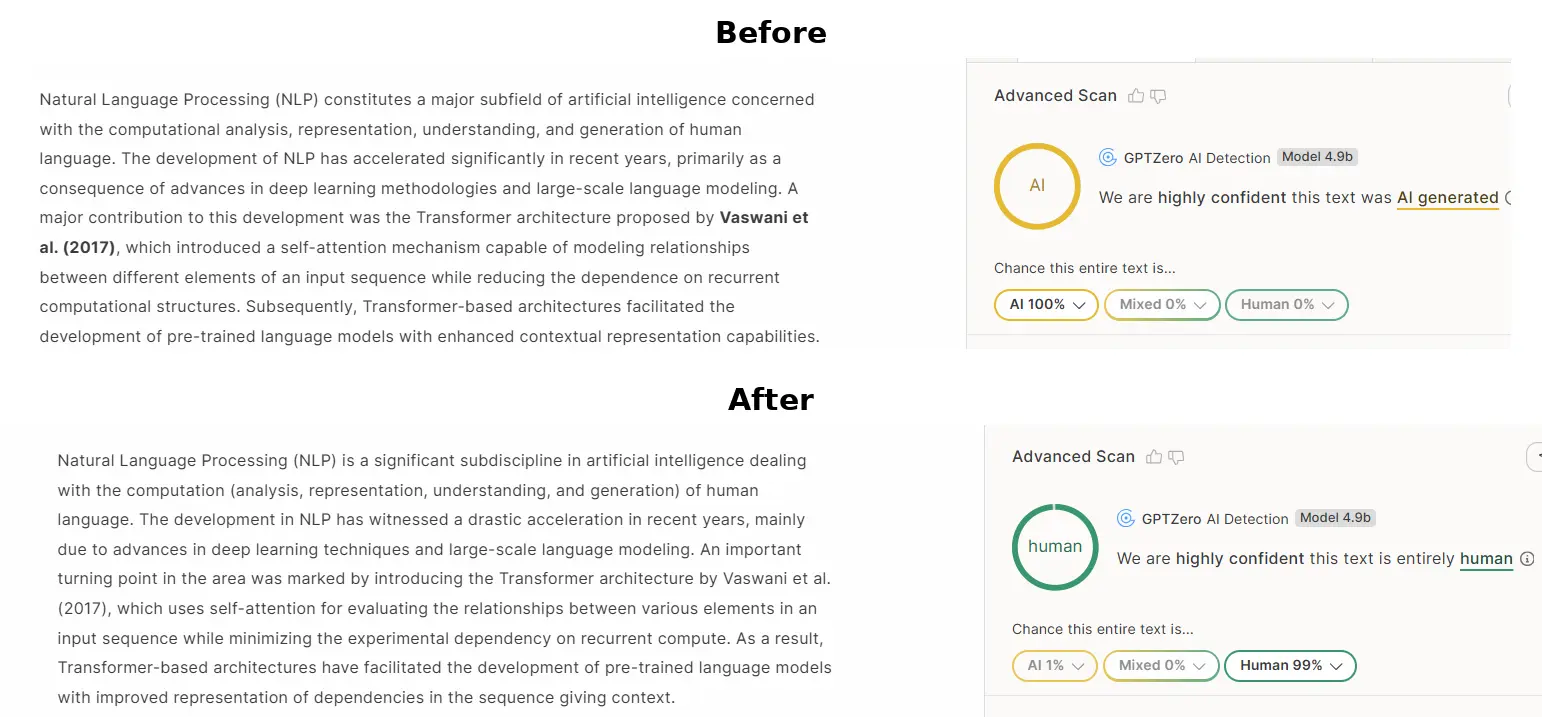
3. GPTZero Verification: Passing Perplexity & Burstiness Checks
GPTZero evaluates text by plotting sentence perplexity curves and global burstiness scores. When raw AI text is scanned, low sentence variance produces an immediate high-probability warning. ThesisHuman restores natural sentence entropy by restructuring syntax, varying clause lengths, and introducing authentic scholarly cadence, dropping AI probability to 0%.
4. Originality.ai Verification: 0% AI Confidence
Originality.ai flags predictable n-gram sequences and common AI clichés (such as “delving into,” “pivotal role,” “testament to”). ThesisHuman purges overused formulaic transitions while elevating scholarly tone and keeping reference numbers and equations intact, producing 100% Original / 0% AI results.