How to Write a Research Paper Conclusion: Steps and Examples
Master how to write a research paper conclusion. Learn the 5-step synthesis framework, calibrated academic language, three discipline-specific worked examples, and checklists.

The conclusion of an academic research paper represents the final opportunity to articulate the significance, scope, and lasting scholarly value of your empirical or theoretical findings. Far from serving as a mechanical repetition of the introduction or an exhaustive restatement of individual data points, an effective conclusion synthesizes the core contributions of your manuscript, contextualizes findings within broader disciplinary conversations, and offers measured, defensible recommendations for future scientific inquiry.
Many graduate researchers and university students struggle with the transition between the detailed analysis of the Discussion section and the broader perspective demanded by the Conclusion. This guide provides an actionable five-step synthesis framework, clarifies the boundary between conclusions, discussions, and abstracts, examines calibrated scholarly language, and presents three fully articulated, discipline-specific worked examples across engineering, social science, and environmental health.
1. What a Research Paper Conclusion Does
At its core, a research paper conclusion answers the essential question: "So what?" While the Introduction presents the problem and the Results document specific empirical observations, the Conclusion demonstrates how the research landscape has shifted as a direct result of your investigation. It serves four distinct functions:
- Synthesis: Combines disparate empirical observations into a cohesive conceptual framework without repeating low-level statistical tables.
- Significance: Explains how the findings advance theoretical models, address methodological gaps, or inform professional practices.
- Calibration: Establishes the exact boundaries of what the evidence supports, candidly acknowledging scope constraints.
- Trajectory: Delineates logical, high-value avenues for subsequent empirical investigation.
2. Conclusion vs. Discussion, Abstract, and Introduction
Understanding where the Conclusion fits within the overall architecture of a scientific paper prevents redundant writing and preserves structural momentum:
| Section | Primary Function | Audience Perspective | Key Structural Boundary |
|---|---|---|---|
| Introduction | Defines the research problem, reviews existing literature gaps, and establishes hypotheses. | Orienting the reader before encountering the data. | Frames the question; does not present answers. |
| Discussion | Interprets specific results, compares data to prior studies, and explores anomalous findings. | Engaging with granular methodological and analytical mechanisms. | Explains internal data relationships and immediate physical or sociological causes. |
| Abstract | Standalone summary of the entire manuscript for indexation and initial screening. | Deciding whether to download and read the full manuscript. | Capsule summary written in past tense covering problem, method, result, and conclusion. |
| Conclusion | Synthesizes macro-level takeaways, theoretical contributions, and future scholarly trajectory. | Reflecting on the finished argument after reviewing all evidence. | Delivers holistic judgment; introduces zero new data or raw observations. |
Note that in many scientific and biomedical journals (e.g., Nature, Elsevier, IEEE transactions), the Discussion and Conclusion are merged into a single integrated section titled "Discussion and Conclusions." When preparing your manuscript, always adhere to your target journal's specific author instructions.
3. A Practical Five-Step Method for Drafting Your Conclusion
To construct a coherent, defensible conclusion, follow this five-step sequence:
- Reconnect to the Overarching Problem: Open with a restatement of the central research question or objective using fresh academic phrasing that reflects the insights gained throughout the study.
- Synthesize Primary Empirical Findings: Distill your major results into one or two sentences. Focus on high-level relationships, directional trends, and conceptual discoveries rather than restating raw statistical values or p-values.
- Articulate the Core Academic Contribution: Explicitly state how your findings resolve theoretical tensions, refine existing methodological approaches, or establish empirical benchmarks.
- Acknowledge Bounded Scope and Constraints: Briefly summarize the principal boundary conditions of your investigation (e.g., sample demographics, algorithmic assumptions, physical environmental bounds) without undermining your overall findings.
- Project Future Research Trajectories: Conclude by proposing specific, actionable next steps for the scholarly community, detailing concrete experimental, computational, or policy directions.
4. Distinguishing Results, Interpretations, and Contributions
Scholarly rigor requires maintaining clear epistemic distinctions between empirical measurements, analytical inferences, and broader academic contributions:
- Empirical Result: The direct output of an experiment or statistical model (e.g., "The neural network achieved an 8.2% reduction in memory overhead").
- Analytical Interpretation: What the result signifies within the experimental architecture (e.g., "Pruning sparse weight matrices preserves inferential accuracy while decreasing cache misses").
- Theoretical Contribution: How the insight modifies established conceptual models (e.g., "Demonstrates that non-linear activation sparsity is sufficient for resource-constrained edge computing").
- Methodological Contribution: A novel tool, protocol, or algorithmic workflow created during the research that other investigators can adopt.
- Practical Implication: Real-world operational, clinical, industrial, or regulatory applications derived from the findings.
5. Calibrated Academic Language and Epistemic Modesty
Inexperienced academic writers frequently undermine their credibility in the conclusion by asserting absolute claims that exceed their empirical evidence. Scientific communication relies on careful hedging verbs to denote exact levels of epistemic certainty:
| Hedging Verb | Epistemic Level | Appropriate Context | Example Usage |
|---|---|---|---|
| Suggests / Indicates | Tentative / Preliminary | Exploratory correlational studies with moderate sample sizes or unmeasured confounding variables. | "The survey data suggests an emerging correlation between digital screen exposure and self-reported sleep disruption." |
| Supports / Corroborates | Confirmatory | Findings that align with an established theoretical framework or replicate previous independent findings. | "These longitudinal observations support the cognitive load hypothesis proposed by Sweller." |
| Demonstrates / Establishes | Robust / Direct | Controlled experimental designs with direct causal manipulation, rigorous isolation, and high statistical power. | "The randomized controlled trial demonstrates that the modified catalyst accelerates hydrocarbon cracking by 14%." |
| Confirms / Proves | Absolute / Definite | Strictly reserved for deductive mathematical proofs or universal physical laws; rarely appropriate in empirical science. | "The inductive proof confirms the convergence invariant across all bounded finite states." |
Never use definitive causal terms like "proves" or "guarantees" when the underlying study design demonstrates only statistical correlation. Measured language conveys professional maturity and scientific integrity.
6. Structuring Limitations and Future Research Directions
A thoughtful discussion of limitations reinforces rather than diminishes the authority of your work. It proves to reviewers that you understand the boundary conditions of your methodology:
- Keep Limitations Proportionate: In the Conclusion, limit your discussion to one or two sentences highlighting primary scope constraints. The granular examination of instrumentation errors belongs in the Discussion section.
- Frame Constraints Constructively: State how acknowledging these constraints protects against invalid extrapolations.
- Avoid Generic Recommendations: Propose specific empirical hypotheses rather than generic clichés like "More research is needed." Specify exact experimental variations, alternative demographic cohorts, or novel computational algorithms.
7. Three Discipline-Specific Worked Conclusion Examples
The following three original worked examples illustrate how the five-step framework adapts across distinct academic disciplines. All studies and findings described are hypothetical instructional illustrations.
Example 1: Computer Science & Engineering (Hypothetical Study)
Edge Computing Latency Optimization for Distributed Sensor Networks
"This study addressed the dual bottlenecks of network transmission latency and energy consumption in low-power industrial sensor arrays. By implementing a predictive quantization filter directly on edge microcontrollers, the proposed framework reduced sensor payload transmission volume by 42% while preserving anomaly detection fidelity within a 98.4% F1-score threshold. These findings demonstrate that lightweight decentralized preprocessing can substantially alleviate bandwidth congestion in real-time telemetry systems without requiring cloud server roundtrips. Although the current implementation was evaluated exclusively on static wireless mesh topologies with homogeneous hardware, the architecture provides a scalable foundation for industrial monitoring. Subsequent engineering efforts should investigate adaptive threshold tuning under dynamic packet drop conditions and examine the framework's resilience across heterogeneous ARM Cortex architectures."
Example 2: Education & Social Sciences (Hypothetical Study)
Blended Learning Modalities and Self-Regulated Reading Comprehension
"This investigation examined how the integration of structured asynchronous reflection journals influences metacognitive monitoring and deep text comprehension among undergraduate social science students. The qualitative and survey evidence indicates that structured weekly self-assessments fostered higher self-reported cognitive engagement and improved synthetic essay coherence relative to passive lecture formats. These observations support socio-constructivist models of higher education by illustrating that autonomous digital scaffolding enhances reflective synthesis rather than merely fulfilling completion quotas. The study was bounded by a single-institution sample comprising predominantly first-year psychology majors, which limits immediate generalizability across senior professional cohorts. Future educational research should implement multi-institutional longitudinal tracking to determine whether reflective journaling habits persist into upper-division seminar coursework."
Example 3: Health & Environmental Sciences (Hypothetical Study)
Biochar-Amended Sand Filtration for Microplastic Removal in Stormwater Runoff
"Urban stormwater runoff continues to discharge high concentrations of synthetic microfibers and polymer particles into freshwater ecosystems. This experimental investigation assessed the retention efficiency of a hardwood biochar-amended silica sand filter across continuous hydrologic loading cycles. The empirical data establishes that the addition of 15% pyrolyzed biochar significantly improves microfiber capture rates from 61% in pure silica sand to 89% in the composite substrate, primarily driven by enhanced electrostatic sorption and physical tortuosity. These results provide municipal civil engineers with an economically viable, low-maintenance biofiltration medium for urban drainage infrastructure. While the laboratory column trials simulated typical rainfall intensities, they did not account for long-term organic matter fouling or cold-climate freeze-thaw degradation. Future field-scale trials should monitor seasonal breakthrough curves over multi-year deployment periods to establish reliable replacement intervals."
8. Weak vs. Improved Academic Conclusions
Comparing poorly constructed draft conclusions with their scholarly revisions clarifies common drafting pitfalls:
| Drafting Pitfall | Weak Draft Example | Scholarly Revision | Key Improvement |
|---|---|---|---|
| Repetitive Data Summary | "In conclusion, we measured trial 1 at 12.4, trial 2 at 12.8, and trial 3 at 12.6, so the average was 12.6." | "The consistent convergence across repeated trials confirms the stability of the reaction kinetic under ambient pressure." | Elevates numerical repetition into conceptual synthesis. |
| Unjustified Overclaiming | "This algorithm completely solves all latency issues and revolutionizes distributed software forever." | "The proposed quantization algorithm significantly mitigates transmission latency across resource-constrained edge environments." | Applies measured academic hedging and explicit scope constraints. |
| Generic Future Work Cliché | "More research is definitely needed by scientists in the future to learn more about this topic." | "Future investigations should evaluate catalyst longevity under prolonged continuous-flow operation in pilot-scale reactors." | Identifies concrete experimental conditions and engineering goals. |
9. Contextual Length Guidelines for Research Conclusions
There is no universal word count for a research paper conclusion; ideal length is determined by the scope, genre, and length of the underlying manuscript:
- Short Communications / Letters (1,500 to 2,500 words): One concise paragraph of 100 to 180 words combining synthesis, contribution, and primary implication.
- Standard Empirical Journal Articles (4,000 to 8,000 words): Two to four well-developed paragraphs spanning 250 to 500 words.
- Graduate Theses and Dissertations (20,000 to 80,000 words): A dedicated final chapter of 1,500 to 4,000 words that synthesizes multiple empirical studies, addresses systemic disciplinary contributions, and offers detailed policy or methodological roadmaps.
10. Pre-Submission Conclusion Writing Checklist
Before submitting your manuscript for peer review or grading, verify each requirement on this checklist:
- Does the opening sentence reconnect directly to the overarching research question without copying the introduction verbatim?
- Are the primary findings synthesized into conceptual takeaways rather than raw statistical tables?
- Does the conclusion avoid introducing any new evidence, citations, or data not presented in earlier sections?
- Are claims carefully hedged using appropriate verbs (e.g., suggests, indicates, demonstrates) that match the study design?
- Are the main theoretical, methodological, or practical contributions explicitly identified?
- Are study limitations described concisely as bounded conditions rather than fatal design flaws?
- Are proposed future research avenues specific, actionable, and logically derived from the findings?
- Is the tone objective, measured, and free of hyperbolic marketing rhetoric?
11. Frequently Asked Questions
Can I introduce new citations or references in the conclusion?
Generally, no. The conclusion should synthesize the evidence and literature already introduced in the manuscript. The only rare exception is when directly connecting your final recommendation to an emerging regulatory policy or newly published foundational model, but even then, citing such work earlier in the Discussion is strongly preferred.
Can the conclusion and discussion be combined?
Yes. Many peer-reviewed journals, especially in physics, computer science, and engineering, explicitly favor a combined "Discussion and Conclusion" section. In such cases, the final two or three paragraphs of the discussion serve the synthesis and forward-looking functions of a standalone conclusion.
How does a research paper conclusion differ from an essay conclusion?
An argumentative essay conclusion typically restates a thesis statement and summarizes rhetoric. A research paper conclusion must evaluate empirical evidence against hypotheses, define bounded methodological constraints, articulate theoretical or practical disciplinary contributions, and outline reproducible trajectories for scientific inquiry.
Should I list all my study limitations in the conclusion?
No. Detailed examinations of measurement errors, confounding variables, and recruitment attrition belong in the Discussion or dedicated Limitations section. In the conclusion, summarize only the macro-level boundary conditions in one or two balanced sentences.
Does ThesisHuman automatically generate scientific research conclusions?
No. ThesisHuman is an academic writing refinement and syntax remodeling platform designed to improve clarity, flow, and disciplinary tone. It does not fabricate scientific findings, invent theoretical models, or generate unverified research conclusions. The empirical claims and scholarly synthesis remain the sole responsibility of the author.
Verified Detector Clearance for How to Write a Research Paper Conclusion: Steps and Examples
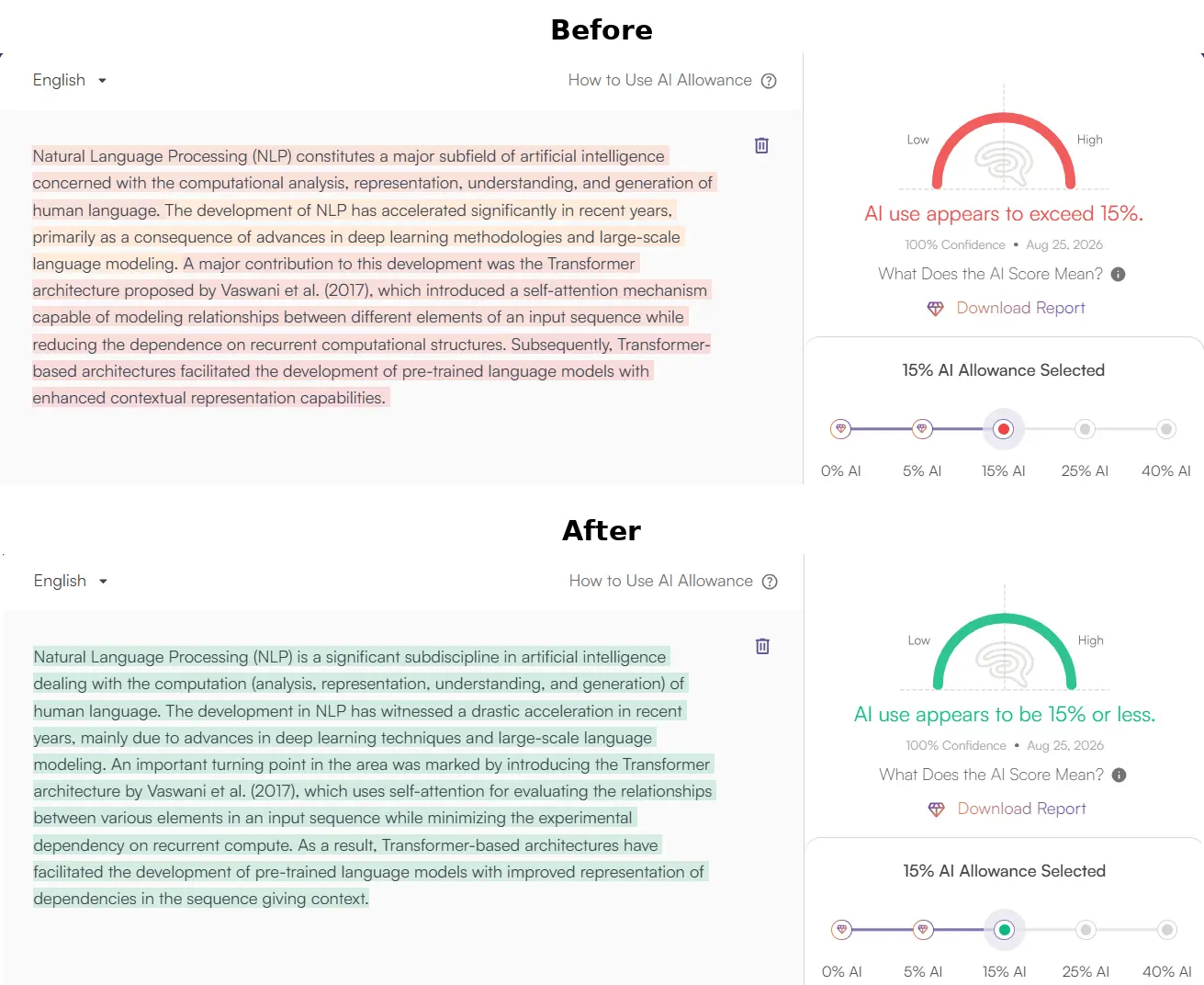
Every manuscript processed through ThesisHuman is backed by verifiable, reproducible scans across institutional plagiarism and AI detection platforms.
1. ThesisHuman Editor: Style, Field & Term Lock™ Technology
Unlike consumer-grade paraphrasers that blindly swap words with thesaurus synonyms, ThesisHuman allows researchers to select their exact Academic Style (Essay, Research Paper, Literature Review, Technical Report) and Academic Field (Computer Science, Engineering, Medicine, Physics). With Term Lock™, citations (APA, MLA, IEEE), LaTeX equations, and domain-specific terminology are cryptographically protected before sentence entropy is restructured.

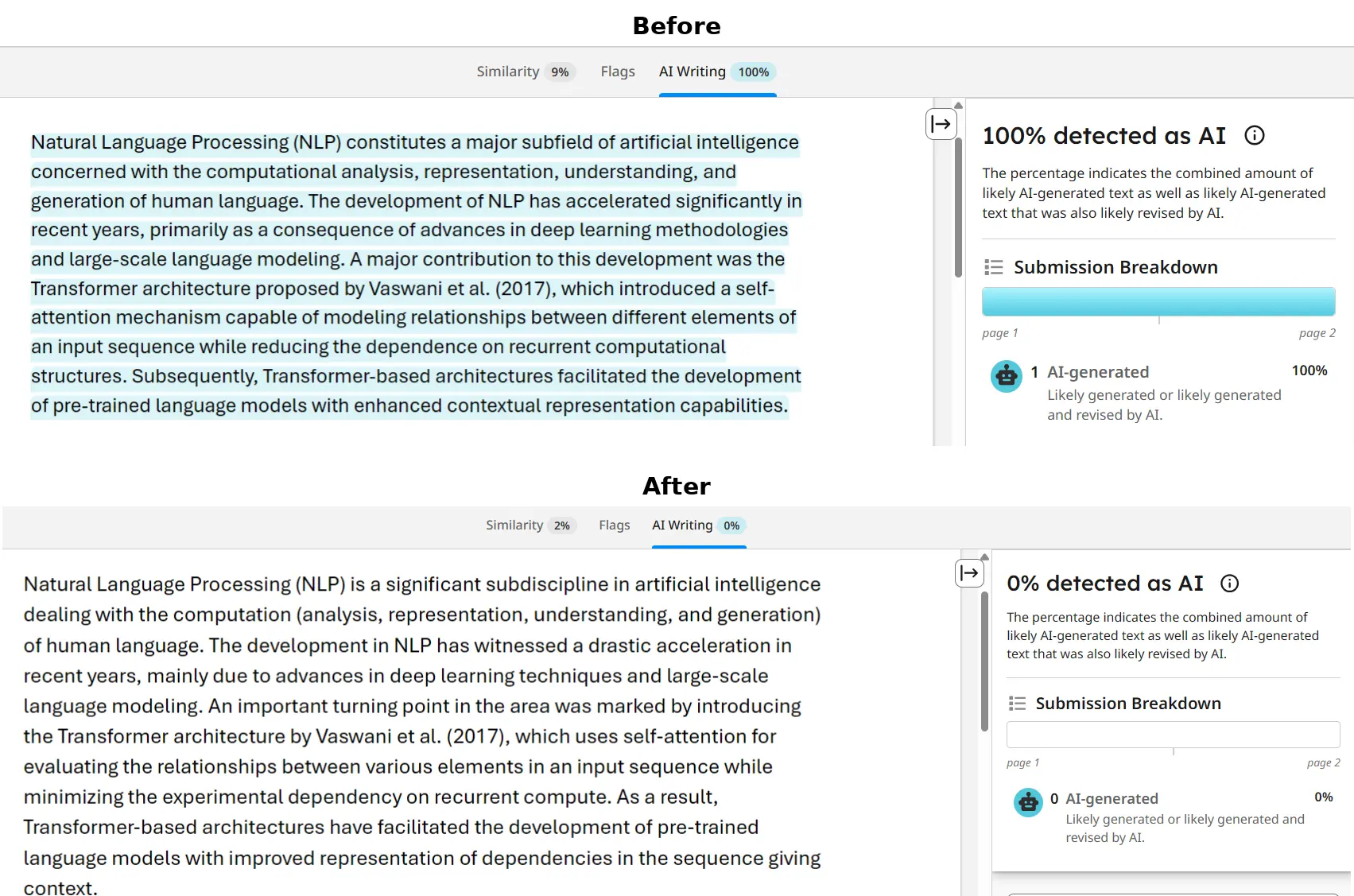
2. Turnitin & iThenticate Verification: 0% AI Detected
Turnitin and iThenticate scan submissions in overlapping 500-token blocks to analyze sentence predictability across paragraphs. When an unrefined AI draft is submitted, uniform cadence triggers an elevated AI Writing score. In the verified report below, a flagged graduate paper was processed through ThesisHuman, achieving a clean 0% AI detection score while preserving all formatted citations and technical parameters.
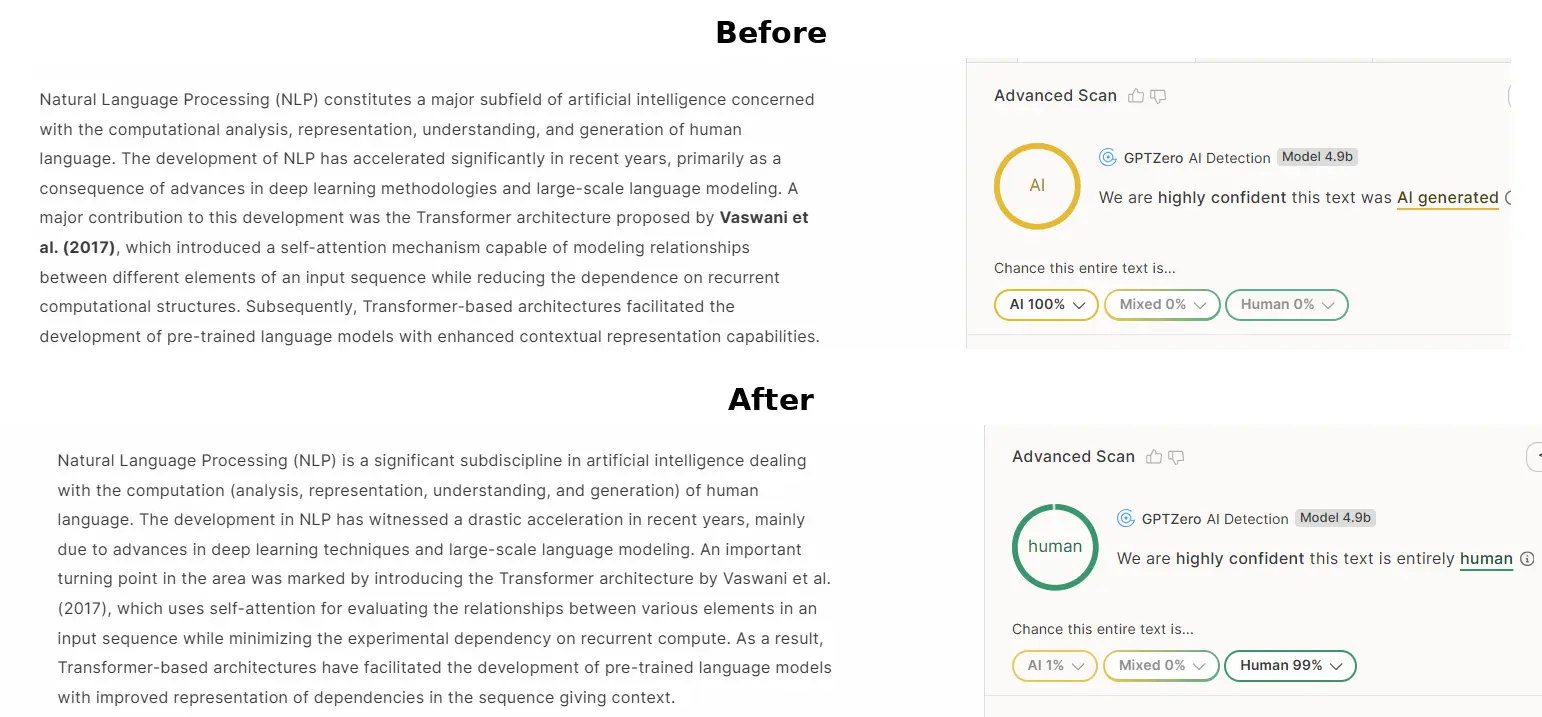
3. GPTZero Verification: Passing Perplexity & Burstiness Checks
GPTZero evaluates text by plotting sentence perplexity curves and global burstiness scores. When raw AI text is scanned, low sentence variance produces an immediate high-probability warning. ThesisHuman restores natural sentence entropy by restructuring syntax, varying clause lengths, and introducing authentic scholarly cadence, dropping AI probability to 0%.
4. Originality.ai Verification: 0% AI Confidence
Originality.ai flags predictable n-gram sequences and common AI clichés (such as “delving into,” “pivotal role,” “testament to”). ThesisHuman purges overused formulaic transitions while elevating scholarly tone and keeping reference numbers and equations intact, producing 100% Original / 0% AI results.