How to Cite APA In Text: APA 7th Edition Rules and Examples
Master APA 7th edition in-text citations with clear rules and examples for parenthetical, narrative, group author, multi-source, and direct quote formatting.

Formatting in-text citations accurately is one of the most essential technical skills in scholarly research. In disciplines following the American Psychological Association guidelines, including psychology, education, nursing, sociology, and business, citations adhere to the APA 7th edition author-date documentation system. In-text citations establish academic credibility, direct readers to complete bibliographic sources, and distinguish your original claims from external scholarship.
Unlike broad multi-style overviews, this comprehensive tutorial focuses specifically on the mechanics of APA 7th edition in-text citations. We explore parenthetical and narrative structures, single and multi-author rules, group author abbreviations, direct quote locators, multiple-source parentheticals, and secondary citations. We also examine an annotated academic paragraph model, analyze common errors, provide a quick reference table, and review five practical formatting exercises.
1. What Is an APA In-Text Citation?
An APA in-text citation is a concise alphanumeric marker placed directly within your sentence that identifies the author and publication year of external research. Every empirical statistic, paraphrased concept, and direct quotation requires an immediate in-text citation.
In APA style, every in-text citation corresponds directly to an entry in the reference list at the end of the manuscript:
- In-Text Citation (Pointer): Identifies the source by author surname and year (e.g., Vance, 2024).
- Reference List Entry (Complete Record): Provides full bibliographic metadata, including title, journal, volume, issue, page range, and DOI.
For an overarching perspective on how APA compares with other major referencing styles, consult our complete guide on how to cite a research paper.
2. Parenthetical versus Narrative Citations
APA 7th edition recognizes two structural formats for in-text citations: parenthetical citations and narrative citations.
Parenthetical Citation
Both author surname and publication date appear together inside parentheses, typically at the end of the clause or sentence before the period.
Academic anxiety significantly impedes working memory capacity during timed examinations (Vance, 2024).
Narrative Citation
The author surname is woven naturally into the grammatical structure of your sentence, followed immediately by the publication date in parentheses.
Vance (2024) observed that academic anxiety significantly impedes working memory capacity during timed examinations.
Alternating between parenthetical and narrative formats creates syntactic variation, enhancing readability across extended literature reviews and thesis chapters.
3. Citing One Author
When citing a publication with a single author, include only the surname and the four-digit year. Do not include suffixes, academic titles, or first initials unless distinguishing two distinct authors sharing the identical surname published in the same calendar year:
- Parenthetical Example:
(Sterling, 2023) - Narrative Example:
Sterling (2023) demonstrated that...
4. Citing Two Authors (& versus and)
When citing two authors, name both authors in every citation. Pay close attention to conjunction formatting:
- Parenthetical Citation: Join the surnames with an ampersand (
&):(Morales & Chen, 2024). - Narrative Citation: Join the surnames with the written English word 'and':
Morales and Chen (2024) established that....
Core Rule: Never use an ampersand in the running narrative text, and never use the word 'and' inside citation parentheses in APA style.
5. Citing Three or More Authors (The et al. Rule)
A major simplification introduced in APA 7th edition is the immediate truncation rule for works with three or more authors. In APA 6th edition, all authors up to five were listed on the first citation; in APA 7th edition, you shorten to the first author followed by 'et al.' on the very first citation:
- Parenthetical Citation:
(Holloway et al., 2024) - Narrative Citation:
Holloway et al. (2024) reported that...
Notice that 'et' has no period, while 'al.' must always be followed by a period. In a parenthetical citation, place a comma after 'al.' before the date: (Holloway et al., 2024).
Resolving Ambiguity with Multiple Multi-Author Works
If two distinct publications from the same year shorten to the identical 'et al.' form (for example, Holloway, Vance, & Chen, 2024, and Holloway, Sterling, & Davis, 2024), list as many author surnames as necessary to distinguish them before adding 'et al.':
(Holloway, Vance, et al., 2024)(Holloway, Sterling, et al., 2024)
6. Organization and Group Authors
When a study is published by a government agency, corporate body, or professional association without personal author bylines, cite the group name. If the group has a well-known acronym, introduce the abbreviation on first mention:
| Citation Type | First Citation in Document | Subsequent Citations |
|---|---|---|
| Parenthetical | (National Institute of Mental Health [NIMH], 2023) |
(NIMH, 2023) |
| Narrative | National Institute of Mental Health (NIMH, 2023) |
NIMH (2023) |
Notice that inside parenthetical citations, square brackets are used around the acronym to avoid nested parentheses.
7. Direct Quotations and Page Locators
Whenever you quote text verbatim, APA style mandates providing a specific locator identifying the exact location of the quote:
- Single Page: Use 'p.' with a space:
(Vance, 2024, p. 115). - Page Range: Use 'pp.' with a hyphen:
(Morales & Chen, 2024, pp. 42-43). - Unpaginated Electronic Documents: When page numbers are absent, cite a paragraph number using 'para.':
(Sterling, 2023, para. 6), or name the section heading followed by a paragraph count:(Sterling, 2023, Discussion section, para. 2).
Direct quotes under 40 words are enclosed in double quotation marks within your paragraph. Quotes of 40 words or more must be formatted as indented block quotations without quotation marks, with the parenthetical citation placed after the closing punctuation.
8. Paraphrasing Without Patchwriting
Paraphrasing involves translating an author's research findings into your own analytical voice while preserving complete conceptual integrity. Patchwriting, by contrast, merely substitutes synonyms into another author's grammatical framework:
- Legitimate Paraphrase:
Cognitive fatigue systematically degrades error-monitoring performance during high-stakes evaluations (Vance, 2024). - Patchwriting (Unacceptable): Retaining the original sentence structure while changing only three or four words, which constitutes an academic integrity breach even with a citation attached.
While page numbers are optional for broad paraphrases in APA 7, including them helps readers locate specific arguments in long monographs or book chapters. To explore paraphrasing standards in detail, see our companion guide on how to cite a paraphrase.
9. Multiple Sources in One Citation
When multiple independent studies corroborate the same finding, combine them within a single set of parentheses. Order the citations alphabetically by the first author's surname, separated by semicolons:
(Aris et al., 2023; Morales & Chen, 2024; Sterling, 2021; Vance, 2024)
Do not arrange sources chronologically within parentheses; alphabetical alignment matching the reference list is mandatory in APA style.
10. Same Author, Same Year (2024a, 2024b)
When citing two or more publications by the exact same author or author group published in the same calendar year, append lowercase letters ('a', 'b', 'c') to the publication year. Letters are assigned alphabetically based on the article title in the reference list:
(Vance, 2024a)(Vance, 2024b)- Combined parenthetical:
(Vance, 2024a, 2024b)
11. Missing Author or Publication Date
When handling sources lacking traditional author bylines or publication dates, apply the following APA 7th edition protocols:
- Missing Author: Move the title of the work to the author position. Put article titles in quotation marks with title-case capitalization:
("Neurobiology of Working Memory," 2023). For whole books or reports without authors, italicize the title:(Global Clinical Standards, 2022). - Missing Date: Use the abbreviation 'n.d.' (no date):
(Holloway, n.d.)orHolloway (n.d.) argued....
12. Secondary Citations (As Cited In)
A secondary citation occurs when you refer to an idea discussed in a primary work that you read inside another author's publication. In scholarly writing, you should always attempt to locate and read the original work directly. If the primary work is unavailable, cite the secondary source using 'as cited in':
(Kahneman, 1973, as cited in Sterling, 2024)
In this scenario, only Sterling (2024) appears in your final reference list, because you did not directly inspect Kahneman's 1973 text.
13. APA Citations Inside Academic Paragraphs
Study the following annotated scholarly paragraph to observe how parenthetical and narrative citations integrate naturally into evidence-based academic prose:
Annotated Academic Paragraph Model
Attentional regulation plays a foundational role in academic learning environments. As Vance et al. (2024) demonstrated across undergraduate cohorts, high cognitive load significantly impairs self-monitoring during timed problem-solving tasks. While early behavioral studies suggested that external pacing interventions could mitigate these deficits (Miller & Davis, 2020), subsequent investigations reveal that student metacognitive awareness varies widely based on task framing (Morales & Chen, 2024; Sterling, 2023). Specifically, when participants received automated prompt scaffolding, error rates decreased by 14% (Aris et al., 2023, p. 112). These empirical patterns indicate that instructional scaffolding must be calibrated to individual cognitive capacity rather than administered uniformly.
- Vance et al. (2024): Narrative citation for a study with three or more authors.
- (Miller & Davis, 2020): Two-author parenthetical citation with ampersand.
- (Morales & Chen, 2024; Sterling, 2023): Multiple corroborated sources ordered alphabetically.
- (Aris et al., 2023, p. 112): Direct empirical metric with explicit page locator.
For strategies on organizing supporting evidence logically, review our guide to what is academic writing and our guide on how to write a research paper.
14. Common APA Citation Mistakes to Avoid
Review these frequent formatting missteps encountered by peer reviewers and course instructors:
- Misplacing Ampersands: Writing 'Vance & Holloway (2024) argued' in running narrative prose instead of 'Vance and Holloway (2024) argued.'
- Incorrect et al. Punctuation: Omitting the period after 'al.' or writing 'et. al.' with a period after 'et.'
- Listing All Authors on First Citation: Listing four or five authors on initial citation under outdated APA 6th edition habits instead of immediately using 'et al.' per APA 7.
- Chronological Ordering in Multiple Citations: Ordering sources by publication year within parentheses rather than alphabetical order by first author surname.
- Omitting Page Numbers for Direct Quotes: Quoting exact language without specifying 'p.' or 'para.' locators.
- Invented or Hallucinated Citations: Relying on unverified generative AI outputs that manufacture non-existent author names, volumes, and DOIs.
15. Quick Reference Table
Keep this quick reference guide handy during manuscript drafting and final revisions:
| Author Scenario | Parenthetical Citation | Narrative Citation |
|---|---|---|
| One Author | (Sterling, 2023) |
Sterling (2023) |
| Two Authors | (Miller & Davis, 2024) |
Miller and Davis (2024) |
| Three or More Authors | (Vance et al., 2024) |
Vance et al. (2024) |
| Group with Acronym (First) | (World Health Organization [WHO], 2023) |
World Health Organization (WHO, 2023) |
| Group with Acronym (Later) | (WHO, 2023) |
WHO (2023) |
| Direct Quote (Single Page) | (Sterling, 2023, p. 45) |
Sterling (2023, p. 45) |
| No Date | (Morales, n.d.) |
Morales (n.d.) |
16. Five Practical Exercises with Explanations
Test your understanding of APA 7th edition citation rules with these five hands-on correction exercises:
Exercise 1: Narrative Two-Author Citation
Incorrect: According to Vance & Chen (2024), metacognitive feedback accelerates mastery.
Correct: According to Vance and Chen (2024), metacognitive feedback accelerates mastery.
Explanation: In running narrative sentences, the word 'and' must be spelled out; ampersands are reserved strictly for parenthetical citations.
Exercise 2: Initial Multi-Author Citation
Incorrect: The experiment yielded conclusive outcomes (Holloway, Vance, Chen, & Sterling, 2024).
Correct: The experiment yielded conclusive outcomes (Holloway et al., 2024).
Explanation: Under APA 7th edition, any source with three or more authors is truncated to 'et al.' from the very first citation.
Exercise 3: Multiple Parenthetical Sources
Incorrect: Working memory fluctuates with sleep quality (Vance, 2024; Aris, 2021).
Correct: Working memory fluctuates with sleep quality (Aris, 2021; Vance, 2024).
Explanation: Multiple sources inside one set of parentheses must be ordered alphabetically by author surname, matching reference list order.
Exercise 4: Direct Quote Page Locator
Incorrect: The model proved 'highly susceptible to noise' (Sterling, 2023, page 14).
Correct: The model proved 'highly susceptible to noise' (Sterling, 2023, p. 14).
Explanation: APA style mandates the abbreviation 'p.' for single pages and 'pp.' for page ranges, never the full word 'page.'
Exercise 5: Secondary Citation
Incorrect: Early trials demonstrated similar effects (Bandura, 1977).
Correct: Early trials demonstrated similar effects (Bandura, 1977, as cited in Morales, 2024).
Explanation: If you did not read Bandura directly, you must acknowledge the secondary source where you discovered the finding.
Practicing these citation rules ensures that your academic prose meets the stringent standards of institutional review committees and journal editors. When revising lengthy research manuscripts with our specialized research paper humanizer and AI paper rewriter, ThesisHuman Term Lock technology shields your formatted in-text citations from accidental alteration. You can refine and polish your drafts directly inside the ThesisHuman editor, or review our flexible pricing plans for comprehensive academic editing support.
17. Frequently Asked Questions
Do I use 'et al.' on the very first citation in APA 7th edition?
Yes. Under APA 7th edition guidelines, any work with three or more authors is shortened to the first author's surname followed by 'et al.' and the publication year starting from the very first in-text citation, unless doing so creates ambiguity between different works.
When should I use an ampersand (&) versus the word 'and' in APA citations?
Use an ampersand (&) inside parenthetical citations where author names are enclosed in parentheses, such as (Miller & Davis, 2024). Use the written word 'and' in narrative citations where author names form part of your running sentence, such as 'Miller and Davis (2024) observed.'
Are page numbers required for paraphrased information in APA style?
Page numbers are not strictly required when paraphrasing broad arguments, but APA 7th edition strongly encourages authors to include a page or paragraph number when paraphrasing a specific idea, data point, or localized concept within a long source.
How do I cite multiple sources within the same set of parentheses in APA?
List the sources in alphabetical order by the first author's surname, exactly as they appear in your reference list. Separate each distinct source with a semicolon, for example: (Chen, 2023; Miller & Davis, 2024; Vance et al., 2022).
How do I cite a source that has no publication date in APA style?
Use the abbreviation 'n.d.' (which stands for 'no date') in place of the year, enclosed in parentheses. For example, write (National Institute of Mental Health, n.d.) or 'According to the National Institute of Mental Health (n.d.).'
Verified Detector Clearance for How to Cite APA In Text: APA 7th Edition Rules and Examples
Every manuscript processed through ThesisHuman is backed by verifiable, reproducible scans across institutional plagiarism and AI detection platforms.
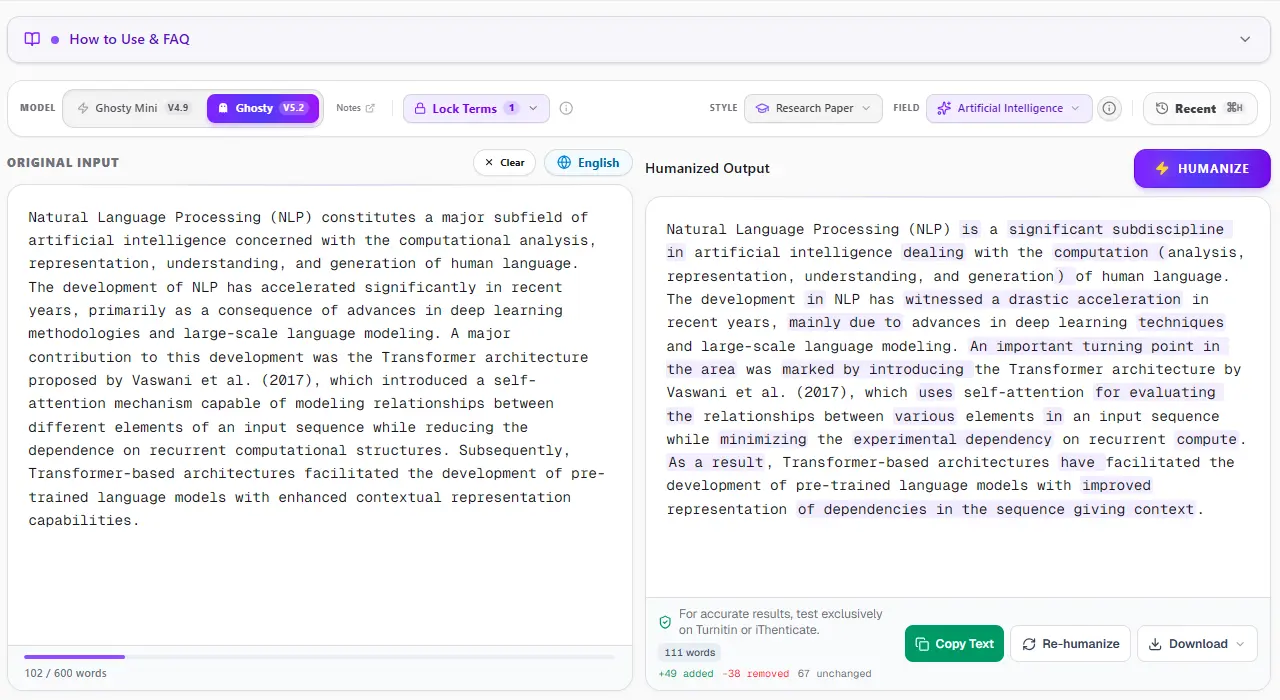
1. ThesisHuman Editor: Style, Field & Term Lock™ Technology
Unlike consumer-grade paraphrasers that blindly swap words with thesaurus synonyms, ThesisHuman allows researchers to select their exact Academic Style (Essay, Research Paper, Literature Review, Technical Report) and Academic Field (Computer Science, Engineering, Medicine, Physics). With Term Lock™, citations (APA, MLA, IEEE), LaTeX equations, and domain-specific terminology are cryptographically protected before sentence entropy is restructured.
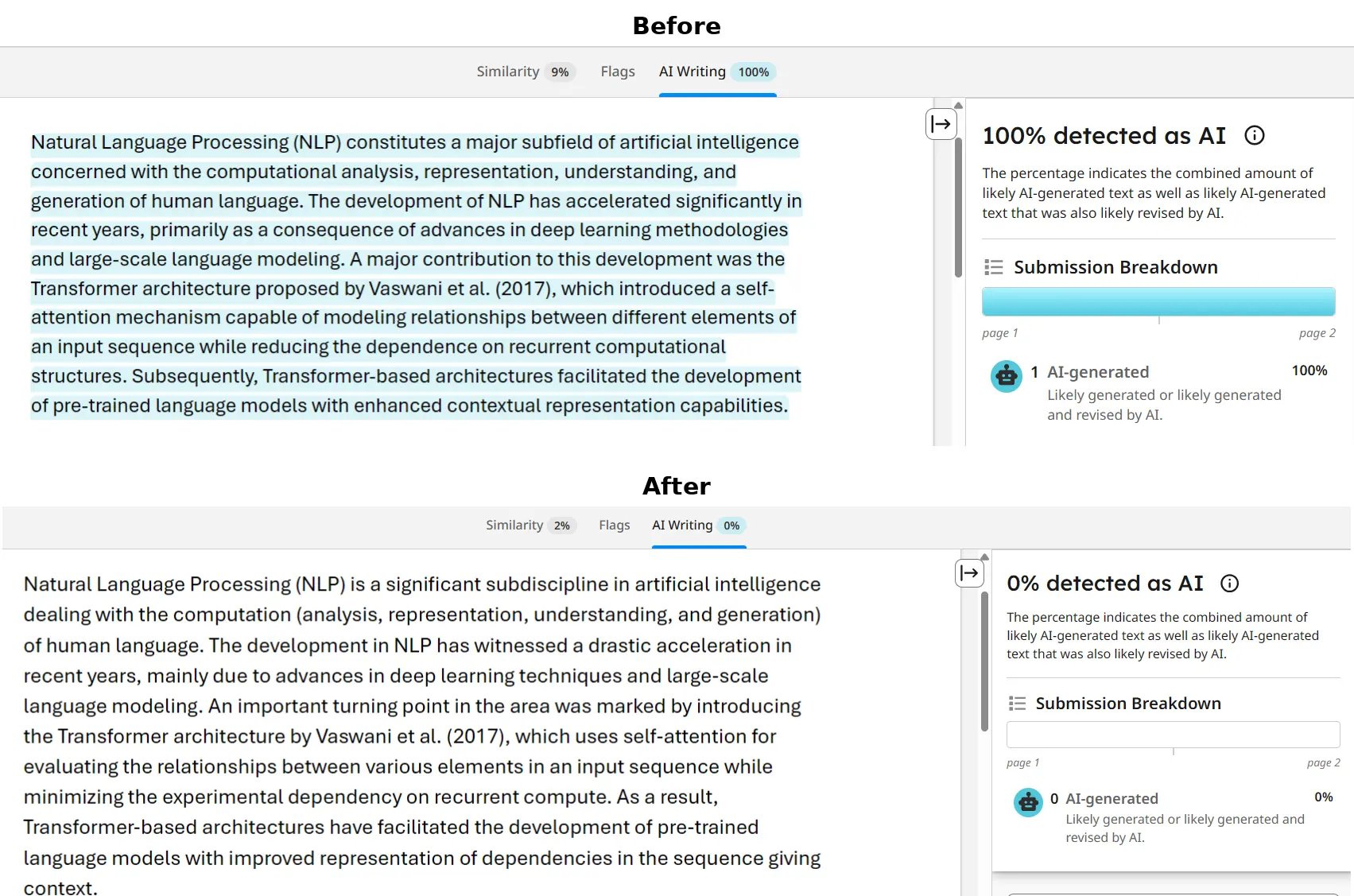
2. Turnitin & iThenticate Verification: 0% AI Detected
Turnitin and iThenticate scan submissions in overlapping 500-token blocks to analyze sentence predictability across paragraphs. When an unrefined AI draft is submitted, uniform cadence triggers an elevated AI Writing score. In the verified report below, a flagged graduate paper was processed through ThesisHuman, achieving a clean 0% AI detection score while preserving all formatted citations and technical parameters.
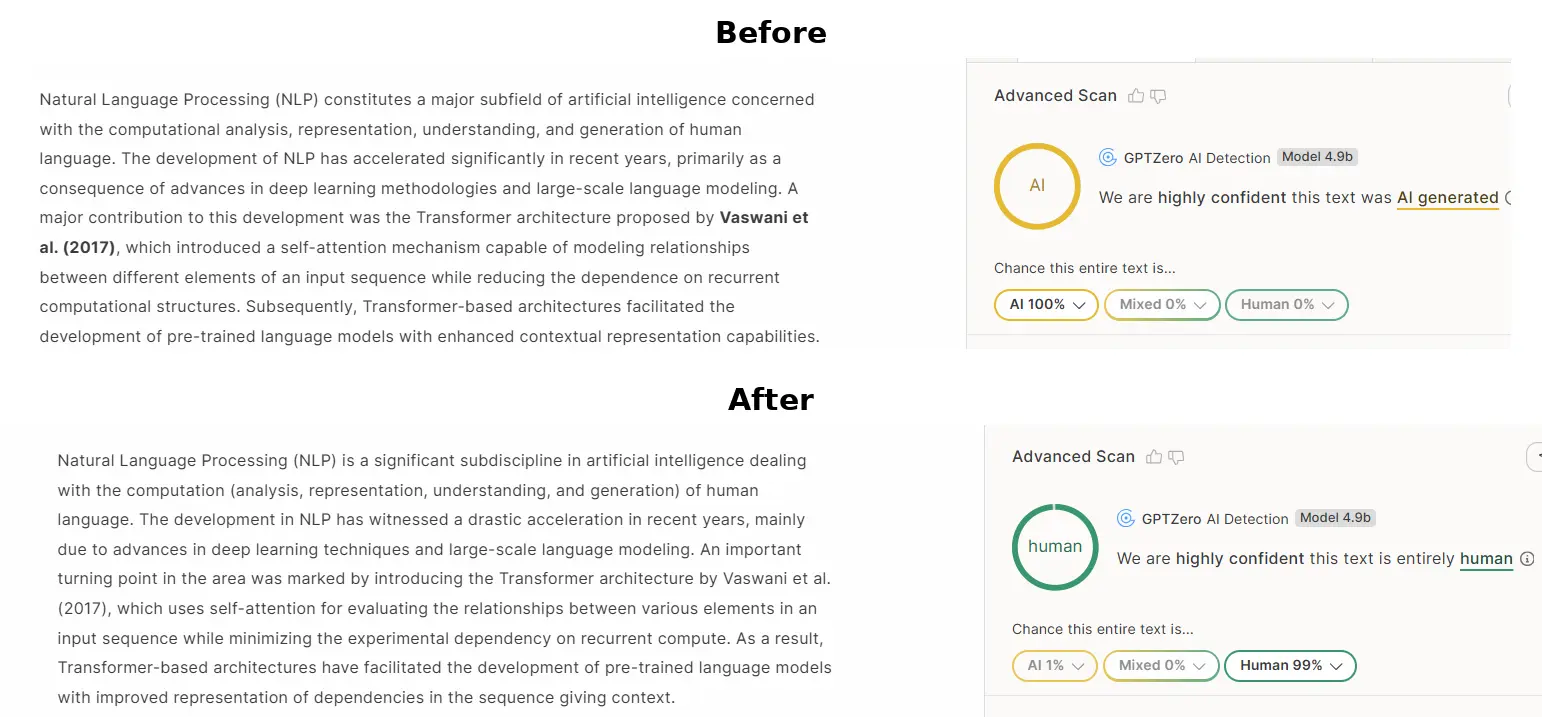
3. GPTZero Verification: Passing Perplexity & Burstiness Checks
GPTZero evaluates text by plotting sentence perplexity curves and global burstiness scores. When raw AI text is scanned, low sentence variance produces an immediate high-probability warning. ThesisHuman restores natural sentence entropy by restructuring syntax, varying clause lengths, and introducing authentic scholarly cadence, dropping AI probability to 0%.
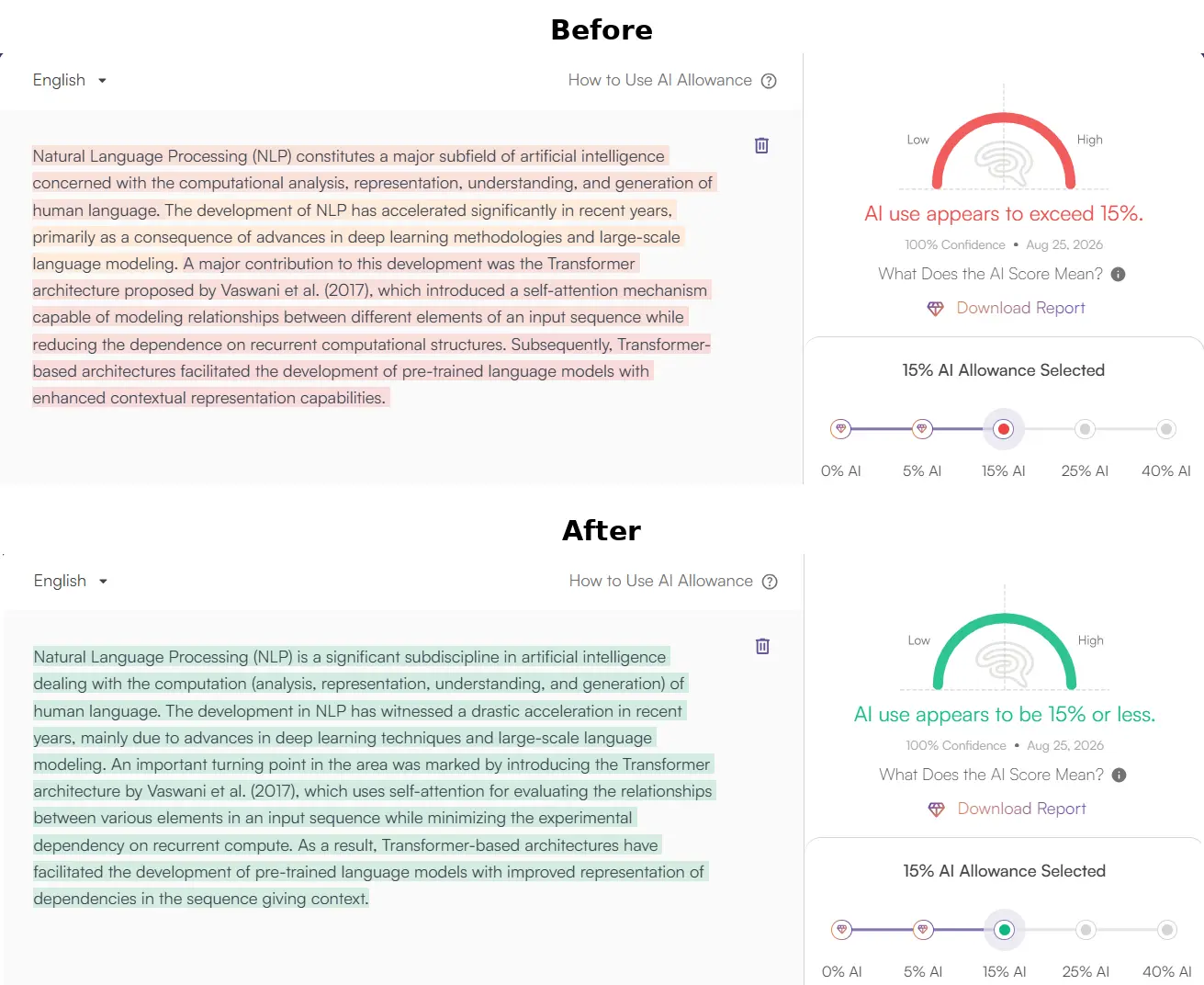
4. Originality.ai Verification: 0% AI Confidence
Originality.ai flags predictable n-gram sequences and common AI clichés (such as “delving into,” “pivotal role,” “testament to”). ThesisHuman purges overused formulaic transitions while elevating scholarly tone and keeping reference numbers and equations intact, producing 100% Original / 0% AI results.