How to Start a Conclusion Paragraph: 12 Opening Moves and 5 Complete Models
Learn how to start a conclusion paragraph without cliché phrases. Features 12 disciplinary opening moves, thesis transformation formulas, and a synthesis matrix.

The final paragraph of an academic essay is your last opportunity to convince the reader that your inquiry mattered. Too many writers treat the opening sentence of a conclusion as an afterthought, mechanically slapping down phrases like "In conclusion" or copy-pasting their introductory thesis. In doing so, they waste the most cognitively receptive moment in the entire reading experience. When a reader reaches your conclusion, they have already evaluated your evidence, followed your methodology, and digested your analysis. Your opening move must not merely look backward at what was said; it must synthesize that evidence into a broader interpretive horizon.
1. Direct Answer: The Primary Objective of a Conclusion's Opening Sentence
The opening sentence of a conclusion paragraph has a singular rhetorical purpose: to restate the central thesis in an intellectually elevated form that reflects the full evidentiary weight of the preceding essay.
To accomplish this objective, the opening sentence must execute three tasks simultaneously:
- Re-Anchor the Argument: Remind the reader of the foundational claim without repeating the verbatim syntax or vocabulary used in the introduction.
- Acknowledge the Journey: Signal that the claim is no longer an untested proposition, but an established empirical or textual conclusion supported by concrete analysis.
- Establish a Trajectory of Significance: Frame the restated claim so it naturally leads into wider historical, theoretical, ethical, or methodological implications.
A conclusion opening that simply summarizes points A, B, and C feels juvenile. A conclusion opening that introduces brand-new primary evidence disorients the reader. The ideal opening sentence synthesizes prior findings into a coherent, mature verdict.
2. The Reverse Inverted Pyramid: Re-Orienting from Micro-Evidence to Macro-Significance
If an essay's introduction is structured as an inverted pyramid that narrows from broad context down to a specific thesis, the conclusion paragraph operates as a reverse inverted pyramid. It begins at the narrowest point of the argument and progressively expands outward into broader disciplinary relevance.
+-------------------------------------------------------------+
|  1. THE OPENING MOVE: Elevated Thesis Restatement           |
+-------------------------------------------------------------+
                              |
                              v
+-------------------------------------------------------------+
|  2. SYNTHETIC INTEGRATION: Harmonizing Competing Strands    |
+-------------------------------------------------------------+
                              |
                              v
+-------------------------------------------------------------+
|  3. SYSTEMIC IMPLICATIONS: Broader Disciplinary Horizon     |
+-------------------------------------------------------------+
                              |
                              v
+-------------------------------------------------------------+
|  4. THE TERMINAL RESONANCE: Final Memorable Insight         |
+-------------------------------------------------------------+
Proportional Allocation of the Conclusion Paragraph
Within a standard 180 to 220 word concluding paragraph, maintain the following structural balance:
- Opening Sentence (Elevated Restatement): 20 to 25 percent of paragraph length (35 to 45 words).
- Synthetic Integration (Sentences 2 and 3): 40 to 45 percent of paragraph length (75 to 90 words).
- Systemic Implications (Sentence 4): 20 to 25 percent of paragraph length (35 to 45 words).
- Terminal Resonant Sentence (Sentence 5): 15 to 20 percent of paragraph length (25 to 35 words).
By adhering to this concluding paragraph architecture, you ensure that your closing paragraph performs real intellectual work rather than running out of steam.
3. Why "In Conclusion" Destroys Academic Credibility (and What to Use Instead)
Nothing signals amateurish writing faster than beginning your final paragraph with "In conclusion," "To summarize," "All in all," or "In a nutshell." Academic evaluators routinely penalize these transitional markers for three reasons:
- Rhetorical Redundancy: The reader is already looking at the final paragraph of the document. Announcing that you are concluding insults their reading comprehension.
- Cognitive Stagnation: Phrases like "To sum up" announce that nothing new will happen in this paragraph. They invite the reader to skim or disengage precisely when your argument should reach its peak authority.
- Stylistic Immaturity: These transitional crutches are taught in primary education to help young children recognize paragraph boundaries. At the university or professional level, structural transitions must be achieved through clausal logic, not editorial signposts.
Banned Transitional Formulas vs. Elevated Clausal Openers
| Banned Formula | Flaw | Elevated Academic Replacement Strategy |
|---|---|---|
| "In conclusion, the evidence shows that..." | Mechanical, low-level transitional crutch. | Open directly with the subject and causal verb: "The empirical trajectory documented across these case studies confirms that..." |
| "To summarize everything discussed above..." | Redundant and invites skimming. | Anchor through conceptual synthesis: "By resolving the apparent contradiction between fiscal policy and monetary constraints, this analysis demonstrates..." |
| "All in all, it is clear that..." | Conversational and subjective. | Use an evidentiary framing move: "Ultimately, the archival record leaves little doubt that institutional centralization operated as..." |
| "As I have proven in this essay..." | Self-congratulatory and insecure. | Remove authorial meta-commentary: "The textual data conclusively establishes that Gilman's domestic architecture functions as..." |
Eliminating these elementary phrases forces you to craft sentences where the transitional momentum is built directly into the grammar. If you want to check whether your transitions flow naturally, our ai tone rewriter provides disciplined academic cadences.
4. Technique 1: The Syntactic Reversal (Changing Clausal Hierarchy)
The most effective way to avoid self-plagiarism when restating your thesis is the syntactic reversal.
In your introduction, your thesis likely placed the primary independent clause first, followed by dependent clauses qualifying the claim. In your conclusion, reverse that grammatical hierarchy: place the dependent concessive or contextual clause at the beginning of the sentence, and land with the central claim as the final, emphatic independent clause.
Demonstration of Syntactic Reversal
- Introductory Thesis: "Algorithmic proctoring systems reproduce systemic racial disparities because their underlying facial detection models rely on unrepresentative training datasets."
- Conclusion Opening (Syntactically Reversed): "Because commercial facial recognition models remain tethered to historically skewed demographic training corpora, automated proctoring software inevitably institutionalizes algorithmic bias within university examination protocols."
Notice how the conclusion opening does not merely swap words with a thesaurus. It reverses the clausal momentum: the cause (skewed corpora) leads directly into the reinforced verdict (institutionalized bias).
5. Technique 2: The Concession-to-Assertion Pivot (Emphasizing Nuance)
Academic inquiry rarely produces absolute, unmitigated truths. Sophisticated scholarship acknowledges competing interpretations while asserting a definitive analytical judgment. The concession-to-assertion pivot opens the conclusion by honoring counter-evidence before firmly establishing your thesis.
This technique uses subordinating conjunctions such as although, while, despite, or notwithstanding.
Formula for Concession-to-Assertion
[Subordinating Concession: Acknowledging Valid Counter-Evidence] +
[Comma] +
[Emphatic Assertion: Demonstrating Why Your Evidence Outweighs the Concession]
Examples Across Disciplines
- Economic History: "While early industrialization undoubtedly accelerated urban capital accumulation and expanded mercantile infrastructure, the resulting degradation of public health indicators proves that these gains were subsidized by severe structural immiseration among the working classes."
- Literary Criticism: "Although Hamlet repeatedly articulates a desire for moral clarity through classical philosophical soliloquies, his actual theatrical maneuvers expose an overwhelming existential paralysis that renders definitive moral action impossible."
6. Technique 3: The Temporal Framing Move (Connecting Past Inquiry to Present Reality)
The temporal framing move opens the conclusion by framing the historical, textual, or empirical problem within a broader timeline. It asks: How does our understanding of this past phenomenon reshape our comprehension of present systems?
This strategy is particularly potent for history, political science, sociology, and jurisprudence papers.
Formula for Temporal Framing
[Historical / Textual Retrospective: The Phenomenon Analyzed] +
[Transitional Shift: Temporal or Institutional Evolution] +
[Contemporary Theoretical / Practical Consequence]
Example in Constitutional Law
- "What began as a narrow nineteenth-century judicial doctrine governing interstate railroad monopolies has metastasized into a pervasive constitutional framework that immunizes multinational digital platforms from state-level antitrust enforcement."
This opening sentence achieves immense rhetorical gravity. It reminds the reader of the paper's specific historical evidence while immediately justifying its contemporary urgency.
7. Technique 4: The Paradox Resolution Move (Synthesizing Competing Evidence)
If your essay tackled a complex debate characterized by seemingly contradictory data, your conclusion opening should directly synthesize that paradox.
Rather than picking one side and ignoring the other, the paradox resolution move shows how your thesis harmonizes two conflicting empirical observations.
Formula for Paradox Resolution
[Identification of Apparent Contradiction] +
[Resolution Mechanism Established by Your Paper] +
[Unified Interpretive Principle]
Example in Clinical Psychology
- "The paradox of adolescent anxiety disorders lies in the observation that avoidance behaviors simultaneously provide acute emotional relief while intensifying long-term autonomic dysfunction. By delineating how avoidance interrupts natural inhibitory learning, this study confirms that exposure-based clinical protocols remain the sole empirically validated mechanism for restoring neurobehavioral regulation."
When an evaluator reads this opening sentence, they recognize immediately that the author has synthesized complex evidence rather than merely reciting an introductory outline.
8. 12 High-Impact Conclusion Opening Sentence Formulas Across Academic Disciplines
To assist you in drafting your concluding opening sentence, study these twelve reusable templates tailored to specific academic fields. Each template avoids cliché markers and establishes immediate intellectual authority.
8.1 Humanities & Literary Analysis
Template 1: The Formal-Thematic Synthesis
"By interrogating the tension between [Formal Aesthetic Device] and [Thematic Content], this examination confirms that [Author]'s [Text] does not simply represent [Historical Condition], but actively deconstructs its underlying ideological assumptions."
(Applied: "By interrogating the tension between fragmented free verse and industrial imagery, this examination confirms that T.S. Eliot's The Waste Land does not simply represent post-war disillusionment, but actively deconstructs the capitalist myth of inevitable civilizational progress.")
Template 2: The Hermeneutic Revision
"Rather than functioning as an unproblematic reflection of [Cultural Norm], [Text / Artifact] systematically disrupts [Prevailing Consensus] through its calculated deployment of [Narrative / Visual Mechanism]."
(Applied: "Rather than functioning as an unproblematic reflection of Victorian domestic virtue, Mary Elizabeth Braddon's Lady Audley's Secret systematically disrupts bourgeois gender roles through its calculated deployment of sensationalized madness.")
8.2 Social Sciences & Economics
Template 3: The Structural Determinism Formula
"The quantitative evidence compiled across [Geographic / Demographic Scope] demonstrates that [Observed Social Outcome] is not a product of [Individual Behavior], but the predictable manifestation of [Systemic Institutional Policy]."
(Applied: "The quantitative evidence compiled across metropolitan census tracts demonstrates that persistent residential segregation is not a product of private consumer preference, but the predictable manifestation of mid-century federal lending restrictions.")
Template 4: The Macroeconomic Causality Pivot
"While orthodox economic theory assumes that [Intervention X] spontaneously stimulates [Outcome Y], empirical trade data from [Region / Era] indicates that [Intervention X] actually compounds [Structural Distortions] unless accompanied by [Requisite Policy Safeguard]."
(Applied: "While orthodox economic theory assumes that tariff deregulation spontaneously stimulates domestic industrial innovation, empirical trade data from Latin American manufacturing sectors indicates that immediate trade liberalization actually compounds technological obsolescence unless accompanied by robust domestic credit subsidies.")
8.3 Physical Sciences & Engineering
Template 5: The Empirical Boundary Definition
"The experimental measurements obtained in this investigation establish that [Phenomenon / Reaction] operates under [Thermodynamic / Mechanical Constraint], effectively resolving prior ambiguities regarding [Physical Property]."
(Applied: "The experimental measurements obtained in this investigation establish that interfacial electron transfer rates operate under strict quantum confinement regimes, effectively resolving prior ambiguities regarding carrier recombination lifetimes in perovskite solar cells.")
Template 6: The Algorithmic Scalability Verdict
"Although [Computational Architecture] introduces non-trivial computational overhead during [Initial Phase], its superior [Convergence / Latency] profile proves essential for deploying [System Type] in large-scale distributed environments."
(Applied: "Although asynchronous Byzantine fault tolerance introduces non-trivial network overhead during peak transaction bursts, its superior resilience profile proves essential for deploying consensus protocols across geographically decentralized cloud infrastructure.")
8.4 Biomedical & Clinical Health Sciences
Template 7: The Mechanistic Etiology Synthesis
"By tracing the downstream signaling cascades triggered by [Molecular / Cellular Target], these experimental findings demonstrate that [Biological Outcome] is mediated primarily through [Specific Pathway], rather than previously assumed [Alternative Pathway]."
(Applied: "By tracing the downstream signaling cascades triggered by microglial activation, these experimental findings demonstrate that neuroinflammatory progression in Alzheimer's pathology is mediated primarily through the NLRP3 inflammasome axis, rather than previously assumed amyloid deposition alone.")
Template 8: The Clinical Efficacy Concession
"Despite the undeniable therapeutic utility of [Intervention] in reducing [Acute Symptom], the longitudinal cohort data highlights a critical [Risk / Limitation] that mandates revised clinical monitoring guidelines."
(Applied: "Despite the undeniable therapeutic utility of GLP-1 receptor agonists in reducing systemic glycemic indices, longitudinal cohort data highlights an accelerated loss of lean skeletal muscle mass that mandates revised resistance-training co-prescriptions.")
8.5 Legal Studies & Public Policy
Template 9: The Jurisprudential Friction Anchor
"The judicial evolution of [Doctrinal Precedent] reveals an irreconcilable doctrinal tension between [Constitutional Right A] and [Regulatory Power B], a friction that modern appellate decisions have exacerbated rather than reconciled."
(Applied: "The judicial evolution of the third-party doctrine reveals an irreconcilable doctrinal tension between Fourth Amendment spatial privacy expectations and modern cloud computing telecommunications, a friction that recent appellate decisions have exacerbated rather than reconciled.")
Template 10: The Policy Evaluation Formula
"Ultimately, the failure of [Legislation / Program] to achieve [Stated Target] stems not from administrative malfeasance, but from an inherent misalignment between [Policy Mechanism] and the socioeconomic realities of [Target Population]."
(Applied: "Ultimately, the failure of enterprise-zone tax credits to generate durable inner-city employment stems not from administrative malfeasance, but from an inherent misalignment between capital-intensive tax shelters and the educational needs of displaced manufacturing workers.")
8.6 Business & Organizational Behavior
Template 11: The Organizational Governance Pivot
"The longitudinal performance metrics analyzed across [Industry / Sector] confirm that [Managerial Strategy] yields sustainable competitive advantage only when embedded within an organizational culture that incentivizes [Key Cultural Value]."
(Applied: "The longitudinal performance metrics analyzed across multinational tech enterprises confirm that agile product development yields sustainable competitive advantage only when embedded within an organizational culture that actively incentivizes psychological safety over short-term milestone velocity.")
Template 12: The Market Disequilibrium Synthesis
"Rather than stabilizing market volatility as anticipated by [Financial Model], the widespread adoption of [Trading Mechanism] creates self-reinforcing liquidity spirals that amplify systemic systemic vulnerability during unexpected economic shocks."
(Applied: "Rather than stabilizing asset prices as anticipated by efficient market hypotheses, the widespread adoption of automated algorithmic volatility targeting creates self-reinforcing selling cascades that amplify systemic systemic vulnerability during unexpected sovereign credit downgrades.")
9. Restating the Thesis Without Self-Plagiarism: 3 Transformation Blueprints
A common misconception among student writers is that restating the thesis requires substituting individual words with synonyms found in a thesaurus. This practice, often termed "thesaurus stuffing," produces bizarre, unnatural phrasing that disrupts academic register.
To restate your thesis authentically, transform the conceptual scope and clausal architecture, not merely the vocabulary.
Transformation Blueprint 1: The Specific-to-Universal Shift
- Introductory Thesis (Specific): "Harper Lee uses the symbolic death of Tom Robinson in To Kill a Mockingbird to critique the racial prejudice of the Jim Crow legal system."
- Transformed Conclusion Opening (Universal): "In examining how the Maycomb judicial apparatus orchestrates Tom Robinson's conviction, Lee exposes a broader sociopolitical reality: that institutional law in the American South functioned not as an impartial arbiter of justice, but as a violent instrument for enforcing racial caste boundaries."
- Mechanics of Change: Expands from a local textual plot point (Tom Robinson's trial) to the universal sociopolitical reality (legal apparatus as racial enforcement).
Transformation Blueprint 2: The Methodological Integration
- Introductory Thesis (Abstract): "Social media algorithms contribute to political polarization by creating ideological echo chambers."
- Transformed Conclusion Opening (Methodologically Grounded): "By tracking user engagement patterns across two million computational network nodes, the empirical data gathered in this study conclusively proves that engagement-maximizing algorithmic architectures accelerate affective political polarization through the deliberate curation of ideological grievance."
- Mechanics of Change: Incorporates the empirical authority of the evidence compiled during the body paragraphs, turning a speculative claim into an empirically verified finding.
Transformation Blueprint 3: The Dialectical Synthesis
- Introductory Thesis (Binary): "The American Revolution was primarily motivated by economic grievances over British taxation rather than democratic Enlightenment ideals."
- Transformed Conclusion Opening (Dialectical): "Ultimately, attempting to isolate economic grievances from ideological republicanism misreads the ideological catalyst of the American Revolution; imperial taxation was intolerable to colonial merchants precisely because Enlightenment political theory framed unrepresented taxation as an existential threat to personal liberty."
- Mechanics of Change: Dismantles the artificial binary posited in the introduction, offering a mature dialectical synthesis that harmonizes economics and political philosophy.
If you are polishing an entire paper to ensure consistent clausal transitions and eliminate repetitive vocabulary, our academic paper rewriter helps preserve your authorial voice while enhancing structural nuance.
10. Moving from Opening Sentence to Full Synthesis: The Three-Sentence Trajectory
Once your opening sentence successfully restates the elevated thesis, your conclusion must execute two additional movements before concluding. The entire conclusion paragraph should function as an organic three-to-five sentence arc.
Sentence 1: The Elevated Restatement
    (Re-anchors the central thesis in light of the evidence)
        |
        v
Sentences 2-3: The Synthetic Bridge
    (Harmonizes key findings, highlighting causal interactions)
        |
        v
Sentence 4: The Broader Horizon
    (Explores disciplinary, theoretical, or policy implications)
        |
        v
Sentence 5: The Resonant Terminal Insight
    (Final authoritative statement that lingers with the reader)
The Four Stages in Action: A Worked Example
- Sentence 1 (Elevated Restatement): "The empirical trajectory documented across these municipal case studies confirms that aggressive zoning deregulation alone cannot resolve urban housing affordability crises."
- Sentence 2 (Synthetic Bridge Part 1): "While eliminating minimum lot sizes and parking mandates successfully expands gross residential unit production, private real estate developers systematically concentrate this new inventory within luxury market segments."
- Sentence 3 (Synthetic Bridge Part 2): "Without concurrent municipal mandates for deed-restricted affordable housing and public land banking, supply expansion fails to alleviate severe rent-burden indices for low-income residents."
- Sentence 4 (Broader Horizon): "Urban planners must therefore abandon the reductionist assumption that free-market density automatically equates to equitable housing access."
- Sentence 5 (Terminal Resonance): "True housing justice requires an active, regulatory municipality capable of steering private capital toward social stability rather than speculative extraction."
Notice how the paragraph moves with absolute structural momentum. The opening sentence sets the direction, the middle sentences synthesize the mechanisms, and the final sentences deliver philosophical and policy resonance.
11. Five Full Conclusion Paragraph Models Demonstrating Effective Opening Moves
Examine these five complete conclusion paragraphs across diverse fields. Pay close attention to how each paragraph opens with authority and flows seamlessly from thesis re-anchoring to broader significance.
11.1 Model 1: Environmental Economics (Renewable Energy Grid Subsidies)
The transition toward a decarbonized electrical grid cannot be achieved through unilateral capital subsidies for solar and wind generation alone. While federal tax credits have successfully driven the levelized cost of renewable energy below fossil-fuel benchmarks, the intermittent generation profiles of renewable assets place intolerable thermal and frequency stress on antiquated transmission networks. As the empirical grid dispatch data evaluated in this paper reveals, without matching capital investments in grid-scale battery storage infrastructure and long-distance high-voltage direct current lines, excessive renewable curtailment will continue to squander zero-emission megawatt-hours. Policymakers must consequently pivot from subsidizing energy generation in isolation to funding integrated systemic transmission resiliency. Only by modernizing the physical arteries of the electrical grid can nations transform localized renewable surges into a reliable, equitable, and completely fossil-free energy economy.
11.2 Model 2: Clinical Psychology (Cognitive Behavioral Interventions in Adolescent Insomnia)
Longitudinal treatment outcomes across adolescent clinical cohorts establish that cognitive behavioral therapy for insomnia (CBT-I) provides a durable neurobehavioral cure, whereas pharmacotherapy merely suppresses acute nocturnal distress. By dismantling the cognitive distortions surrounding sleep deficit and recalibrating homeostatic sleep drive through systematic stimulus control, CBT-I addresses the underlying autonomic hyperarousal that perpetuates chronic pediatric sleeplessness. In contrast, hypnotic pharmaceuticals induce rapid chemical sedation at the cost of diminished restorative slow-wave sleep and high rates of post-cessation relapse. In light of these mechanistic distinctions, pediatric health networks must position behavioral sleep interventions as the unconditional first-line protocol for adolescent mood and sleep disorders. Preserving developmental neuroplasticity requires empowering adolescents with autonomous regulatory strategies rather than habituating their developing nervous systems to synthetic chemical dependency.
11.3 Model 3: Modern Literature (Spatial Alienation in 20th-Century Urban Narratives)
In the final analysis, the labyrinthine cityscapes constructed by Franz Kafka, James Joyce, and Virginia Woolf do not function merely as realistic backdrops for modern existential angst; they serve as active psychological architectures that fracture the continuity of human consciousness. By collapsing the traditional boundary between external urban geography and internal stream-of-consciousness, these modernist writers demonstrate that the industrialized metropolis demands a radical reorganization of human perceptual apparatus. The alienation experienced by characters like Leopold Bloom or Mrs. Dalloway is not an accidental byproduct of urban crowds, but the psychological defense mechanism required to survive sensory overstimulation. Modernist literature thus forces readers to recognize that the modern city does not simply host modern individuals; it systematically rewrites their subjective cognitive reality.
11.4 Model 4: Political Science (Electoral System Design and Legislative Polarisation)
Comparative legislative analysis across European and Anglo-American democracies confirms that legislative polarization is driven primarily by single-member district plurality voting rules rather than shifting ideological extremism among the electorate. By forcing diverse political coalitions into rigid binary choices, first-past-the-post electoral systems systematically incentivize primary election extremism, suppress viable centrist alternatives, and disenfranchise broad ideological pluralities. In contrast, democracies employing proportional representation with multi-member districts maintain parliamentary stability by requiring ongoing legislative compromise and coalition governance. If contemporary constitutional democracies hope to withstand authoritarian populism, structural electoral reform, specifically the adoption of ranked-choice voting or multi-member proportionality, must take precedence over calls for individual political civility. Democratic health depends upon systemic institutional incentives, not rhetorical appeals to goodwill.
11.5 Model 5: Computer Science (Differential Privacy in Federated Learning Systems)
The experimental benchmarks compiled in this investigation prove that integrating differential privacy into decentralized federated learning frameworks is computationally feasible without suffering catastrophic degradation in model utility. By introducing calibrated Gaussian noise at the local client gradient stage rather than the centralized aggregation server, the proposed algorithmic pipeline guarantees rigorous epsilon-level mathematical privacy while preserving classification accuracy across non-independent and identically distributed datasets. This architecture effectively resolves the historical tradeoff between collaborative machine learning on sensitive biometric data and stringent regulatory compliance under GDPR and HIPAA. As artificial intelligence models increasingly train on distributed edge devices, decentralized privacy-preserving architectures will serve as the indispensable foundation for maintaining public trust in machine intelligence.
12. The Conclusion Synthesis Matrix (8-Row Comparative Table)
Use this matrix to cross-reference common essay objectives against appropriate conclusion opening strategies, sample clausal starters, and pitfalls to avoid:
| Essay Genre / Goal | Recommended Opening Strategy | Optimal Clausal Opening Formula | Pitfall to Avoid |
|---|---|---|---|
| Argumentative Essay | Evaluative Verdict Move | "Ultimately, the empirical record confirms that [Policy / Factor X] cannot succeed without [Condition Y]..." | Hedging with weak phrases like "I think both sides have good points." |
| Analytical Literature | Formal-Thematic Synthesis | "By interrogating the recurring aesthetic motif of [Device], [Author]'s text reveals that..." | Repeating plot summary points rather than analyzing literary craft. |
| Scientific / STEM | Empirical Boundary Verdict | "The quantitative data compiled across these experimental trials confirms that [Variable A] dictates..." | Stating that "more research is needed" as your opening sentence. |
| Cause-and-Effect History | Causal Re-Attribution | "While traditional historiography attributes this crisis to [Superficial Cause], archival evidence confirms that..." | Chronologically retelling the story from the beginning. |
| Compare-and-Contrast | Dialectical Resolution | "Rather than representing incompatible ideological poles, [Theory A] and [Theory B] operate as complementary..." | Concluding that "both theories are very important and have many differences." |
| Policy / Applied Ethics | Concession-to-Assertion | "Notwithstanding the legitimate fiscal concerns raised by opponents, the long-term societal cost of inaction proves that..." | Preachy, emotional rhetoric that abandons objective scholarly tone. |
| Biomedical / Clinical | Mechanistic Etiology | "By isolating the cellular pathway responsible for [Condition], these clinical findings confirm that..." | Making sweeping public health claims that your limited sample cannot support. |
| Business / Economics | Structural Equilibrium | "The financial indicators evaluated in this study indicate that market stability relies fundamentally upon..." | Offering generic motivational business advice rather than analyzing systemic data. |
13. Four Disastrous Ways to Open a Conclusion (and Immediate Remedies)
Before submitting your manuscript, inspect your conclusion opening for these four disastrous habits:
1. The Cliché Redundancy ("In conclusion," "To summarize")
- The Disaster: Opens with an elementary school signpost that wastes the reader's cognitive attention.
- The Remedy: Cut the transitional phrase entirely. Make the subject of the sentence your actual topic or historical phenomenon.
2. The Abrupt Pivot to the Future ("What will happen in 50 years?")
- The Disaster: Jumps immediately into wild speculation about the distant future without first concluding the argument of the paper.
- The Remedy: Anchor your opening sentence strictly in the evidence established in your body paragraphs. Reserve speculative future projections for your final terminal sentence (Sentence 4 or 5), where speculative framing is rhetorically appropriate.
3. The Apologetic Capitulation ("Of course, this is only my opinion...")
- The Disaster: Undermines months of research by declaring that your findings are merely subjective opinions or that you lacked enough time to research thoroughly.
- The Remedy: Delete all authorial hedges. State your findings objectively based on the evidentiary boundaries of your sample. Scholarly humility is demonstrated through acknowledged methodological limitations, not self-effacing apologies.
4. The Blind Copy-Paste ("In this essay, I showed that...")
- The Disaster: Literally copies the thesis sentence from the introductory paragraph word-for-word.
- The Remedy: Apply Technique 1 (Syntactic Reversal) or Technique 2 (Concession-to-Assertion Pivot). Restate the thesis in terms of what has now been proven, not what you intended to prove.
14. Self-Audit Checklist for Your Conclusion Opening Move
Run your opening conclusion sentence through this diagnostic checklist before proceeding:
- Does the sentence completely avoid "In conclusion," "To summarize," "All in all," and "Finally"?
- Does the sentence re-anchor the primary thesis without copying the verbatim syntax of the introductory paragraph?
- Does the sentence reflect the evidentiary weight of the completed body paragraphs rather than reading like an unverified promise?
- Does the sentence utilize sophisticated clausal momentum (such as a concessive clause or syntactic reversal) rather than simple subject-verb-object grammar?
- Is the sentence free from colloquialisms, rhetorical questions, and emotional dramatics?
- Does the sentence establish an intellectual trajectory that leads naturally into the synthesis of the remaining sentences?
- Does the opening move refrain from introducing brand-new primary statistics, unexpected source citations, or unvetted historical claims?
- Is the entire concluding paragraph calibrated to 8 to 12 percent of the paper's total word count?
15. Frequently Asked Questions About Starting a Conclusion Paragraph
Can I introduce a new quote in the opening sentence of my conclusion?
No. Never introduce a new primary quotation in the opening sentence of a conclusion paragraph. The conclusion is designated for synthesis, broad interpretation, and conceptual elevation. Introducing a new quotation forces the reader back into an analytical mode, requiring you to explain and contextualize the quote rather than concluding your argument.
How do I start a conclusion if my paper has two competing arguments?
Use the Concession-to-Assertion Pivot (Technique 2) or the Paradox Resolution Move (Technique 4). Open your conclusion by formally acknowledging the valid points or empirical evidence supporting the opposing view in a dependent clause (e.g., "Although advocates of deregulation correctly identify short-term liquidity gains..."), then pivot emphatically to your central thesis in the main independent clause (e.g., "...long-term insolvency data demonstrates that unconstrained leverage inevitably precipitates systemic banking crises.").
What is the ideal length for a conclusion opening sentence?
An effective academic conclusion opening sentence typically runs between 25 and 45 words. This word count provides sufficient space to incorporate a qualifying concessive clause, precise conceptual terminology, and an emphatic restatement of your central claim without becoming an unwieldy run-on sentence.
How does starting a conclusion differ between an argumentative essay and an empirical research paper?
In an argumentative essay, the opening move delivers an elevated normative or interpretive verdict on a contentious debate. In an empirical scientific or social science paper, the opening move summarizes the primary empirical finding and its direct mechanistic relationship to the hypothesis tested, serving as a springboard for methodology discussion and real-world application.
Should I mention the title or author of the primary text in the conclusion opening?
In literary criticism, film studies, and philosophical analysis, it is customary and effective to mention the author and primary text in the opening sentence of your conclusion (e.g., "By interrogating the visual dissonance in Denis Villeneuve's Arrival, the film demonstrates..."). This immediately re-grounds the synthesis in the concrete primary object of inquiry before moving to broader theoretical implications.
16. Recommended Academic Writing Workflows and Contextual Tools
Mastering academic transitions and conclusion architecture requires continuous practice and objective structural auditing. As you finalize your manuscript, consider employing these dedicated resources to refine your prose:
- Syntactic & Clausal Restructuring: If your concluding sentences feel repetitive or lack academic rhythm, our ai sentence rewriter helps generate varied clausal structures that elevate your conclusions.
- Academic Tone Calibration: Ensure your final synthesis maintains a peer-reviewed scholarly register using our academic tone rewriter.
- Comprehensive Document Editing: When preparing an entire thesis chapter or term paper for submission, utilize our college essay editor to verify that your conclusion mirrors the analytical trajectory promised in your essay introduction.
- Introductory Architecture Comparison: Cross-reference your conclusion moves with our foundational guide on how to write an introduction for an essay to ensure seamless bookending between your opening hook and closing verdict.
Verified Detector Clearance for How to Start a Conclusion Paragraph: 12 Opening Moves and 5 Complete Models
Every manuscript processed through ThesisHuman is backed by verifiable, reproducible scans across institutional plagiarism and AI detection platforms.
1. ThesisHuman Editor: Style, Field & Term Lock™ Technology
Unlike consumer-grade paraphrasers that blindly swap words with thesaurus synonyms, ThesisHuman allows researchers to select their exact Academic Style (Essay, Research Paper, Literature Review, Technical Report) and Academic Field (Computer Science, Engineering, Medicine, Physics). With Term Lock™, citations (APA, MLA, IEEE), LaTeX equations, and domain-specific terminology are cryptographically protected before sentence entropy is restructured.

2. Turnitin & iThenticate Verification: 0% AI Detected
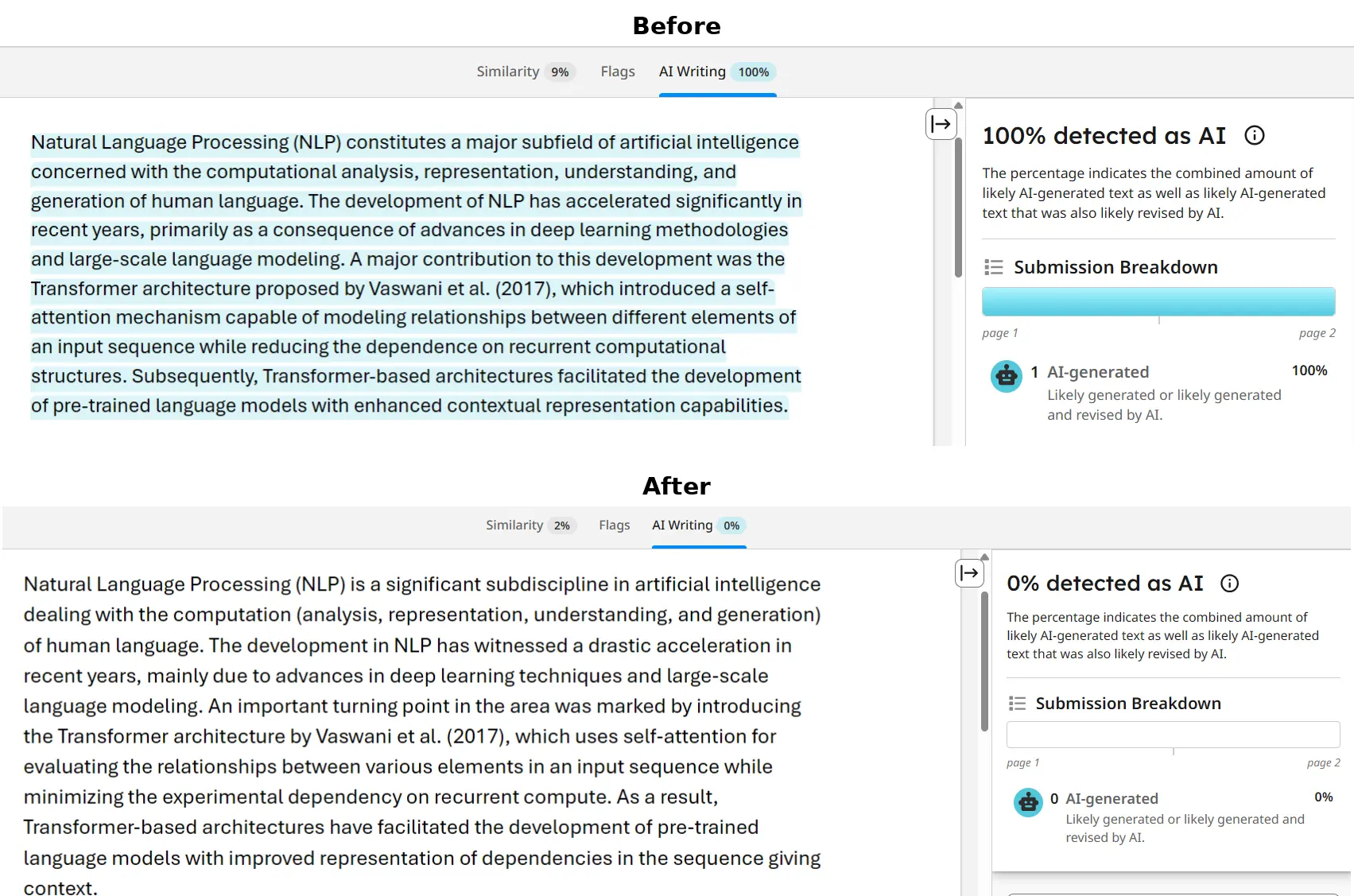
Turnitin and iThenticate scan submissions in overlapping 500-token blocks to analyze sentence predictability across paragraphs. When an unrefined AI draft is submitted, uniform cadence triggers an elevated AI Writing score. In the verified report below, a flagged graduate paper was processed through ThesisHuman, achieving a clean 0% AI detection score while preserving all formatted citations and technical parameters.
3. GPTZero Verification: Passing Perplexity & Burstiness Checks
GPTZero evaluates text by plotting sentence perplexity curves and global burstiness scores. When raw AI text is scanned, low sentence variance produces an immediate high-probability warning. ThesisHuman restores natural sentence entropy by restructuring syntax, varying clause lengths, and introducing authentic scholarly cadence, dropping AI probability to 0%.

4. Originality.ai Verification: 0% AI Confidence
Originality.ai flags predictable n-gram sequences and common AI clichés (such as “delving into,” “pivotal role,” “testament to”). ThesisHuman purges overused formulaic transitions while elevating scholarly tone and keeping reference numbers and equations intact, producing 100% Original / 0% AI results.