How to Write an Introduction for an Essay: Step-by-Step Architecture and 6 Models
Master essay introduction architecture from prompt analysis to thesis placement. Includes the inverted pyramid framework, 6 before-and-after models, and revision rules.

An essay introduction functions as an intellectual contract between the author and the reader. It establishes the topic, frames the scholarly or social debate, demonstrates the stakes of the inquiry, and anchors the central thesis statement. When executed correctly, the introduction provides a clear structural roadmap that guides the reader seamlessly into the body paragraphs. When executed poorly, it alienates the evaluator through vague generalities, historical clichés, or abrupt assertions that lack contextual grounding.
1. Direct Answer: The Three Mandatory Movements of an Essay Introduction
Every successful academic introduction executes three distinct cognitive movements, regardless of whether you are composing a 1,000-word undergraduate paper or a 20-page journal article:
- The Contextual Hook (Broad Entry): Opens the discussion by introducing an authentic scholarly puzzle, empirical contradiction, historiographical tension, or conceptual problem. It captures academic attention without resorting to journalistic sensationalism or empty rhetorical questions.
- The Framing Territory (Narrowing Context): Narrows the broad topic to the specific parameters of your investigation. It defines key terminology, establishes temporal and geographic boundaries, reviews prevailing consensus or debates, and reveals the analytical gap that your essay addresses.
- The Defensible Thesis (Terminal Anchor): States the central argument of the paper in precise, contestable language. It typically forms the final sentence (or final two sentences) of the introductory paragraph, functioning as the analytical foundation upon which every subsequent body paragraph depends.
An introduction that omits the hook feels abrupt and dry. An introduction that omits contextual framing produces a jarring cognitive leap between the opening sentence and the thesis. An introduction that omits or buries the thesis leaves the reader wandering through the evidence without an interpretive compass.
2. The Inverted Pyramid Architecture (Hook, Context, Pivot, Thesis)
The standard structural model for academic introductions is the inverted pyramid framework. This spatial metaphor illustrates how an effective opening paragraph transitions logically from wide conceptual horizons to a singular, razor-sharp argumentative point.
+-------------------------------------------------------------+
|  1. THE HOOK: Broad Scholarly Territory or Empirical Puzzle |
+-------------------------------------------------------------+
                              |
                              v
+-------------------------------------------------------------+
|  2. NARROWING CONTEXT: Scope, Parameters, and Definitions   |
+-------------------------------------------------------------+
                              |
                              v
+-------------------------------------------------------------+
|  3. THE PIVOT: Analytical Tension or Scholarly Impasse       |
+-------------------------------------------------------------+
                              |
                              v
+-------------------------------------------------------------+
|  4. THE THESIS: Specific Argumentative Claim and Blueprint  |
+-------------------------------------------------------------+
Proportional Balance of the Inverted Pyramid
Within a standard 200-word introduction paragraph, maintain the following structural proportions:
- Hook (Sentence 1): Approximately 15 to 20 percent of paragraph length (30 to 40 words).
- Contextual Framing (Sentences 2 through 4): Approximately 45 to 55 percent of paragraph length (90 to 110 words).
- Transitional Pivot (Sentence 5): Approximately 15 percent of paragraph length (25 to 30 words).
- Thesis Statement (Sentence 6 or 6 and 7): Approximately 20 to 25 percent of paragraph length (40 to 50 words).
Understanding this introduction paragraph format prevents common structural deformities, such as spending four sentences on irrelevant historical background only to cram a complex thesis into a hurried eight-word fragment at the finish.
3. Step 1: Deconstructing the Assignment Prompt and Establishing Boundaries
Before writing a single sentence of your draft, you must systematically deconstruct your assignment prompt. Most introduction failures originate not from flawed prose, but from a fundamental misunderstanding of the essay's core directive.
Every assignment prompt contains three functional components:
- The Directive Task Verb: Words such as analyze, evaluate, compare, synthesize, or assess. Each verb requires a distinct cognitive approach. An essay asking you to "evaluate" demands normative criteria and a weighted verdict, whereas an essay asking you to "trace" demands chronological or causal tracking.
- The Core Conceptual Focus: The primary subject, theory, phenomenon, or textual body under examination.
- The Delimiting Boundaries: The explicit constraints placed on scope, such as historical eras, geographic regions, demographic cohorts, or theoretical frameworks.
Prompt Deconstruction Matrix
| Prompt Directive | Incorrect Introductory Focus | Correct Introductory Focus |
|---|---|---|
| "Evaluate the socio-economic impacts of the Green Revolution in South Asia." | Tracing the entire history of global agriculture since the Neolithic era. | Defining the specific technological package of the Green Revolution in Punjab and Bengal between 1965 and 1980. |
| "Analyze the representation of domestic confinement in Charlotte Perkins Gilman's 'The Yellow Wallpaper'." | Providing a generalized biographical summary of Gilman's medical treatment under Dr. Silas Weir Mitchell. | Framing 19th-century patriarchal psychiatric diagnosis as an ideological mechanism enforced through domestic architectural space. |
| "Compare Hobbesian and Lockean conceptions of the state of nature." | Claiming that humans have always wondered why governments exist since prehistoric times. | Framing the divergent 17th-century ontological assumptions regarding human rationality, natural law, and sovereign authority. |
Notice that the correct introductory focus immediately establishes analytical rigor. It signals to the reader that the author commands the boundaries of the inquiry. If you struggle to maintain focus while drafting, our college essay editor helps identify wandering claims and unneeded generalities.
4. Step 2: Selecting an Evidence-Based Academic Hook (and Banning Dictionary Openings)
The opening sentence of an essay is the most heavily scrutinized real estate in academic writing. Evaluators use this sentence to judge the intellectual maturity of the author. Unfortunately, many writers fall back on formulaic, unscholarly clichés that instantly damage credibility.
The Four Banned Hook Types
- The Webster's Dictionary Opening: "Webster's Dictionary defines justice as..." A dictionary records common usage; it does not adjudicate theoretical or empirical nuance. Unless the semantic ambiguity of a lexicographical entry is the explicit subject of your paper, never open with a dictionary citation.
- The Cosmic Generalization: "Since the dawn of human civilization, people have always told stories." This statement is unverifiable, historically trivial, and intellectually hollow.
- The Rhetorical Question: "Have you ever wondered what makes an algorithm biased?" Rhetorical questions sound like promotional copywriting or middle-school speeches. Academic prose operates on assertion, evidence, and critical framing, not casual conversational prompts.
- The Dramatic Exaggeration: "Artificial intelligence is currently tearing apart the very fabric of human existence." Sensationalism undermines scholarly objectivity. Replace theatrical hyperbole with measured empirical reality.
Four Legitimate Academic Hooks
To construct an intellectually defensible hook, use one of the following four strategies:
- The Historiographical or Scholarly Paradox: Identify a contradiction between prevailing consensus and recent empirical findings. (Example: "While mid-century historians widely characterized the New Deal as a radical departure from laissez-faire capitalism, recent archival analyses demonstrate that its regulatory structures preserved and insulated traditional corporate cartels.")
- The Empirical or Statistical Anomaly: Open with a verifiable data point that challenges conventional intuition. (Example: "Between 2010 and 2022, per-capita healthcare expenditure across OECD nations rose by 42 percent, yet maternal mortality outcomes in the United States deteriorated by nearly double that margin.")
- The Conceptual Tension: Highlight an inherent friction between two established ethical, political, or theoretical principles. (Example: "Constitutional democracies consistently encounter an institutional tension when attempting to balance absolute digital encryption against the collective security mandates of national intelligence agencies.")
- The Micro-Case Grounding: Begin with a specific, representative case study, legal ruling, or archival artifact that illustrates a systemic phenomenon. (Example: "When the Supreme Court delivered its 1905 decision in Jacobson v. Massachusetts, it established a precedent for municipal police power that continues to govern modern biosecurity litigation.")
5. Step 3: Narrowing Context from Broad Scholarly Field to Specific Debate
Once your hook captures the topic, you must bridge the conceptual distance between that broad opening and your specific thesis statement. This bridge is the contextual territory.
Many writers make the error of treating context as an exhaustive historical summary. If your paper examines urban heat islands in Atlanta during the summer of 2024, you do not need to explain the Industrial Revolution or the invention of the internal combustion engine. Contextual framing should perform three specific tasks:
- Delimit the Scope: Specify the exact period, population, theoretical model, or primary texts under examination.
- Define Contested Terms: Clarify how you are using polysemous words. If your argument relies on terms like "hegemony," "epistemic injustice," or "algorithmic opacity," establish their operational definitions here.
- Map the Existing Scholarship: Briefly indicate how other researchers have interpreted this problem, setting up the gap your paper intends to occupy.
For guidance on managing paragraph density during this stage, consult our detailed analysis on how many words are in a paragraph to avoid overcrowding your introductory framework.
6. Step 4: Engineering the Transitional Pivot Sentence
The most critical structural joint in an introductory paragraph is the pivot sentence. The pivot appears immediately before the thesis statement. It functions as the intellectual hinge that turns the paragraph from general background and scholarly consensus toward your unique, contentious claim.
Without a strong pivot, the thesis arrives without justification. The pivot sentence accomplishes this shift by introducing one of three elements:
- A Complicating Complication: Revealing a variable that existing scholarship has ignored.
- A Methodological Limitation: Pointing out that prior studies relied on flawed samples or outdated models.
- An Unresolved Debate: Demonstrating that two competing scholarly camps have reached an analytical impasse.
Common Pivotal Transition Formulas
- Formula A (Complication): "Although prevailing models account for [Factor X], they fail to explain how [Factor Y] systematically alters outcomes under [Condition Z]."
- Formula B (Historical Reinterpretation): "While traditional historical accounts attribute this shift exclusively to [Cause A], archival evidence reveals that [Underlying Factor B] functioned as the primary catalyst."
- Formula C (Methodological Critique): "However, these optimistic projections overlook the systemic feedback loops generated when [Policy Intervention] is implemented in resource-constrained environments."
Refining these transitional turns requires syntactic control. When drafting, tools like an ai sentence rewriter or an academic essay rewriter can help test alternative clausal structures to ensure your pivot conveys the exact degree of scholarly skepticism.
7. Step 5: Anchoring the Defensible Thesis Statement
The thesis statement represents the ultimate destination of your introductory paragraph. Every sentence that preceded it was designed to make this claim comprehensible, relevant, and compelling.
An academic thesis statement must satisfy four criteria:
- Contestable: It cannot be a statement of indisputable fact (e.g., "The French Revolution began in 1789"). It must be an interpretive claim that a rational reader could reasonably dispute.
- Specific: It avoids vague adjectives like important, impactful, negative, or fascinating. It specifies exact mechanisms, causal relationships, and consequences.
- Evidence-Dependent: It outlines or implies the categories of empirical or textual proof that the essay will mobilize in the body paragraphs.
- Architecturally Linked: It introduces the interpretive logic that will govern the topic sentences of your body paragraphs.
For a comprehensive catalog of disciplinary thesis models, examine our specialized guide to thesis statement templates to structure your central argument with precision.
8. Six Weak vs. Improved Introduction Paragraph Walkthroughs across Essay Genres
To understand how these principles function in actual prose, study the following six before-and-after models across major academic genres. Notice how each weak version relies on generic clichés and passive syntax, while the improved version implements the inverted pyramid, an evidence-based hook, and a sharply focused thesis.
8.1 Model 1: Argumentative Essay (Algorithmic Surveillance in Higher Education)
Weak Version
In modern society today, technology is advancing faster than ever before. Many colleges and universities have started using artificial intelligence and automated proctoring software to monitor students during exams. There are many different opinions on this topic, with some people thinking it prevents cheating and others thinking it violates privacy rights. In this essay, I will discuss both sides of the issue and show why automated surveillance software in higher education causes serious ethical problems for students and should not be used.
Analysis of Weaknesses
The opening sentence is a cosmic cliché ("In modern society today..."). The context relies on vague passive phrasing ("There are many different opinions..."). The thesis announces the author's intent mechanistically ("In this essay, I will discuss...") rather than advancing a standalone argumentative claim.
Improved Version
The rapid adoption of remote educational infrastructure has normalized the deployment of automated algorithmic proctoring systems across university campuses. While commercial vendors advertise these tools as neutral safeguards against academic dishonesty, empirical audits demonstrate that their facial recognition and gaze-tracking algorithms exhibit systemic demographic error rates that disproportionately flag neurodivergent and racialized students. By privatizing academic integrity into automated predictive scoring, institutions inadvertently replace pedagogical trust with punitive surveillance architectures. Consequently, universities must abandon proprietary behavioral monitoring tools in favor of authentic assessment paradigms that evaluate synthesized critical thinking rather than biometric conformity.
Structural Highlights
- Hook: Pinpoints the institutional normalization of remote proctoring infrastructure.
- Context: Highlights the empirical audit data demonstrating demographic error rates and neurodivergent bias.
- Pivot: Shifts from vendor marketing claims to institutional consequences ("By privatizing academic integrity...").
- Thesis: Advances a clear, two-part policy imperative (abandon surveillance in favor of authentic assessment).
8.2 Model 2: Analytical Literary Essay (Narrative Unreliability in Post-War Fiction)
Weak Version
Since ancient times, authors have used storytelling to show human nature. In Ken Kesey's famous 1962 novel One Flew Over the Cuckoo's Nest, the story is told by Chief Bromden. Chief Bromden suffers from schizophrenia and has many hallucinations throughout the book. This makes him a very interesting character for the reader to follow. This paper will analyze how Bromden's narration affects the novel and why his mental illness makes him an unreliable narrator who reveals deeper truths about power in society.
Analysis of Weaknesses
Begins with an empty historical platitude ("Since ancient times..."). The transition into the novel is abrupt. The description relies on juvenile praise ("a very interesting character"). The thesis is largely descriptive rather than analytically interpretive.
Improved Version
In literary analysis of mid-century institutional fiction, narrators diagnosed with psychiatric pathology are frequently dismissed as mere vectors of distorted perception. In Ken Kesey's 1962 novel One Flew Over the Cuckoo's Nest, however, Chief Bromden's hallucinatory framework does not obscure empirical reality; instead, it provides a precise allegorical vocabulary for the systemic terror of the post-war psychiatric ward. Through the recurring metaphor of the Combine, Bromden translates administrative coercion into tangible mechanical violence, penetrating the institutional euphemisms used by Nurse Ratched to sanitize state-sanctioned compliance. Ultimately, Kesey employs Bromden's diagnosed unreliability not to undermine textual truth, but to demonstrate that institutional sanity itself is a manufactured political fiction designed to pacify ideological dissent.
Structural Highlights
- Hook: Challenges the conventional critical dismissal of psychiatrically diagnosed narrators.
- Context: Connects Bromden's hallucinatory framework directly to the allegorical reality of the psychiatric ward.
- Pivot: Transitions through the specific textual mechanism of the "Combine" metaphor.
- Thesis: Delivers a sophisticated literary claim that unreliability functions as a diagnostic tool against institutional sanity.
8.3 Model 3: Expository Scientific Essay (CRISPR Off-Target Cleavage Kinetics)
Weak Version
Genetics is one of the most important fields of science in the 21st century. CRISPR-Cas9 is a groundbreaking gene editing technology that allows scientists to cut DNA at specific places. Scientists have been trying to make it better and safer for curing genetic diseases in humans. However, sometimes the Cas9 enzyme cuts DNA in the wrong place, which is called an off-target effect. This essay will explain the biochemistry behind off-target cleavage in Cas9 and examine several modern chemical modifications designed to improve targeting accuracy in therapeutic applications.
Analysis of Weaknesses
The hook is generic praise of genetics. The explanation of Cas9 reads like a middle-school textbook summary. The conclusion is an informational statement of purpose rather than an analytical synthesis of chemical mechanics.
Improved Version
The therapeutic viability of CRISPR-Cas9 genome editing hinges on absolute enzymatic specificity during double-strand break induction. While standard Cas9-gRNA complexes effectively target complementary 20-nucleotide genomic sequences, thermodynamic tolerance for RNA-DNA base mismatches along the non-seed region frequently leads to catastrophic off-target cleavage at non-cognate loci. Recent biochemical modifications have attempted to constrain this catalytic flexibility, focusing on structural re-engineering of the RuvC and HNH nuclease domains and the incorporation of synthetic nucleotide analogues within the guide RNA scaffold. This paper examines how engineered high-fidelity Cas9 variants, particularly SpCas9-HF1 and eSpCas9(1.1), alter the energetic threshold for catalytic activation, thereby reducing off-target mutagenesis without compromising on-target cleavage efficiency in mammalian cell lines.
Structural Highlights
- Hook: Establishes the exact enzymatic condition required for therapeutic viability.
- Context: Pinpoints the precise biophysical mechanism of failure (thermodynamic tolerance for non-seed mismatches).
- Pivot: Introduces chemical re-engineering of the RuvC and HNH nuclease domains.
- Thesis: Specifies the comparative mechanistic scope (energetic activation thresholds in SpCas9-HF1 and eSpCas9).
8.4 Model 4: Cause-and-Effect Historical Essay (Post-Colonial Currency Devaluations)
Weak Version
Throughout history, money has always been a key part of every nation's economy. When countries in West Africa gained their independence from France in the 1960s, they experienced many economic difficulties. One of the biggest economic events was the 1994 devaluation of the CFA franc. Many historians and economists have written about this event. In this essay, I will explore the causes and effects of the CFA franc devaluation in West African nations and show how it damaged local standards of living while helping foreign exporters.
Analysis of Weaknesses
Opens with a meaningless cliché about money throughout history. Jumps four decades in a single sentence without causal linkage. The thesis is a simplistic binary summary that fails to articulate macroeconomic mechanisms.
Improved Version
When fourteen newly sovereign West and Central African nations secured formal independence from France in the early 1960s, monetary autonomy was conspicuously omitted from their decolonization settlements. By retaining the peg between the CFA franc and the French franc under the oversight of the French Treasury, post-colonial leaders secured monetary stability at the cost of structural competitiveness. When severe terms-of-trade shocks and fiscal deficits forced a sudden 50 percent currency devaluation in January 1994, the intervention exposed the fundamental contradictions of monetary dependence. Rather than catalyzing domestic export manufacturing as predicted by International Monetary Fund models, the devaluation decimated urban consumer purchasing power, exacerbated sovereign debt burdens, and consolidated neo-colonial mercantile extraction across the Francophone zone.
Structural Highlights
- Hook: Contextualizes the deliberate omission of monetary autonomy from independence settlements.
- Context: Explains the institutional mechanism of the French Treasury peg and structural trade shocks.
- Pivot: Highlights the dramatic 50 percent devaluation of January 1994.
- Thesis: Argues against IMF assumptions, demonstrating how the devaluation deepened fiscal vulnerability and mercantile extraction.
8.5 Model 5: Compare-and-Contrast Philosophy Essay (Rawlsian Justice vs. Nozickian Entitlement)
Weak Version
What is justice? This is a question that philosophers have argued about for thousands of years. Two of the most famous modern philosophers to discuss this are John Rawls and Robert Nozick. Both wrote books about justice in the 1970s. Rawls wrote A Theory of Justice and Nozick wrote Anarchy, State, and Utopia. They have very different views on government redistribution and individual rights. This essay will compare Rawls's difference principle with Nozick's entitlement theory to show their main differences and argue which philosopher has a better theory.
Analysis of Weaknesses
Opens with a rhetorical question followed by an ancient philosopher platitude. Mentions publication details as padding. Ends with a vague, evaluative pledge ("argue which philosopher has a better theory") without revealing the normative basis of the comparison.
Improved Version
Anglo-American political philosophy in the late twentieth century was decisively shaped by a fundamental ontological dispute over whether justice pertains to patterned social distributions or historical property transactions. In A Theory of Justice (1971), John Rawls conceptualizes fairness through the difference principle, maintaining that socioeconomic inequalities are legitimate only if they maximize the welfare of the least-advantaged citizens. In direct rebuttal, Robert Nozick's Anarchy, State, and Utopia (1974) formulates the entitlement theory of justice, arguing that compulsory state redistribution constitutes an intolerable infringement upon self-ownership and uncoerced exchange. While Rawlsian distributive egalitarianism correctly recognizes that moral arbitrariness compromises initial resource endowments, Nozick's critique exposes the inevitable authoritarian coercion required to sustain patterned outcomes against voluntary human enterprise.
Structural Highlights
- Hook: Frames the high-level ontological divide between patterned distributions and historical transactions.
- Context: Summarizes the operational logic of both Rawls's difference principle and Nozick's entitlement theory.
- Pivot: Contrasts moral arbitrariness against self-ownership.
- Thesis: Synthesizes the debate into a decisive comparative verdict on institutional coercion versus resource equity.
8.6 Model 6: Persuasive Public Policy Essay (Municipal Congestion Pricing Systems)
Weak Version
Traffic congestion is a major problem in big cities today that causes pollution and wastes people's time. In cities like New York and London, millions of cars drive on the streets every day. Many city planners want to use congestion pricing to fix this issue by charging drivers a fee to enter downtown areas. Some drivers hate this idea because they think it is an unfair tax, while environmentalists love it. This essay will argue why municipal governments should implement congestion pricing to reduce greenhouse gas emissions and fund public transit systems.
Analysis of Weaknesses
The hook is purely conversational. The stakeholders are presented as simplistic caricatures ("drivers hate it, environmentalists love it"). The thesis is a standard list of benefits without addressing operational equity or implementation hurdles.
Improved Version
Urban transportation planning in North American metropolitan centers has reached a fiscal and environmental impasse. Decades of highway expansion have repeatedly verified the axiom of induced demand, where expanded lane capacity predictably generates equivalent increases in vehicular volume rather than relieving gridlock. While municipal congestion pricing frameworks encounter fierce political resistance from suburban commuters, international implementations in London, Stockholm, and Singapore prove that dynamic tolling represents the only economically viable mechanism for internalizing the social costs of urban driving. By dedicating cordon pricing revenues directly to high-capacity municipal subway and bus networks, metropolitan administrations can curb toxic particulate emissions, dismantle automobile dependency, and establish a self-funding transit architecture that advances long-term socioeconomic mobility.
Structural Highlights
- Hook: Diagnoses the fiscal and environmental failure of highway expansion and induced demand.
- Context: Cites verified empirical models from international implementations in London, Stockholm, and Singapore.
- Pivot: Addresses suburban political resistance and the economic principle of internalizing negative externalities.
- Thesis: Argues for dynamic cordon pricing coupled with transit ring-fencing to achieve structural mobility gains.
9. Optimal Introduction Paragraph Length and Structural Proportions
A frequent source of anxiety for academic writers is determining how long an introductory paragraph should be. If an introduction is too short, the reader feels thrown into complex arguments without context. If an introduction is too long, the essay feels bloated, and the central thesis arrives long after the evaluator's attention has drifted.
As a general rule, an introductory paragraph should comprise 8 to 12 percent of the essay's total word count.
Length Calibration Guidelines by Document Scale
| Total Essay Length | Recommended Introduction Length | Number of Paragraphs | Structural Allocation Strategy |
|---|---|---|---|
| Short Essay (800 to 1,200 words) | 100 to 150 words | Exactly 1 paragraph | Tight 4 to 5 sentence inverted pyramid. Single hook sentence, two context sentences, one pivot, one thesis. |
| Standard Paper (1,500 to 2,500 words) | 180 to 250 words | Exactly 1 paragraph | Fully developed 6 to 8 sentence inverted pyramid. Dedicated scholarly hook, nuanced context, clear pivot, two-part thesis. |
| Long Research Paper (3,000 to 5,000 words) | 300 to 500 words | 2 paragraphs | Paragraph 1: Hook and broad scholarly landscape. Paragraph 2: Specific debate, empirical gap, and terminal thesis. |
| Senior Thesis / Dissertation Chapter (6,000 to 10,000 words) | 600 to 1,000 words | 3 to 5 paragraphs (or a titled section) | Sectional introduction featuring problem statement, theoretical framework, methodology preview, and overarching dissertation thesis. |
If you discover that your draft introduction exceeds 20 percent of your total word count, you have likely incorporated evidentiary details, source citations, or analytical proofs that belong in your body paragraphs. An introduction previews the argument; it does not prosecute the evidence.
10. The Reverse Drafting Strategy: Why Composing the Introduction Last Prevents Scope Drift
One of the most counter-intuitive yet effective habits of professional researchers is writing the introduction after drafting the body paragraphs and conclusion.
When you sit down before a blank document to compose your introduction first, you face severe cognitive handicaps:
- The Discovery Problem: You do not yet know the exact contours of your argument. During drafting, you will inevitably discover that certain pieces of evidence are stronger than expected, requiring adjustments to your central thesis.
- The False Commitment Trap: Having invested two hours crafting a polished introduction, you become psychologically resistant to modifying your thesis, even when your subsequent research proves it indefensible.
- The Writer's Block Barrier: Staring at a blank page attempting to craft the "perfect hook" creates disproportionate anxiety, stalling your overall productivity.
The Professional Reverse-Drafting Workflow
Phase 1: Working Thesis & Outline
         |
         v
Phase 2: Draft Body Paragraphs (Evidentiary Prosecution)
         |
         v
Phase 3: Draft Conclusion Paragraph (Synthesis & Broader Meaning)
         |
         v
Phase 4: Compose Polished Introduction (Exact Reflection of Reality)
         |
         v
Phase 5: Global Alignment Audit (Verifying Intro-to-Conclusion Arc)
By drafting your introduction during Phase 4, you possess a completed body of text. You know precisely what claims you proved, what sources you cited, and what nuances you developed. You can construct an introduction that functions as an accurate mirror of your actual paper rather than an aspirational projection of what you hoped to write. To refine your final conclusions with equal rigor, study our sister guide on how to start a conclusion paragraph.
11. Five Common Introduction Failure Modes (and Diagnostic Fixes)
When evaluators review essay introductions, five recurring defects routinely lead to score deductions. Learn to identify and repair these structural faults:
Failure Mode 1: The Historical Telescope
- Symptom: Starting centuries or millennia in the past before zooming awkwardly into the present day. (e.g., "From the dawn of Egyptian pharaohs to modern Wall Street banks, debt has existed...")
- Diagnostic Fix: Delete the first two sentences entirely. Locate the first sentence that specifically mentions your actual century, author, text, or policy issue. Begin your paragraph at that exact point.
Failure Mode 2: The Evidence Dumper
- Symptom: Packing three dense empirical statistics or lengthy block quotes into the opening paragraph.
- Diagnostic Fix: Remove all primary evidence from the introduction. The introduction is designated for framing and thesis placement. Relocate specific statistics, survey results, and textual quotations to Body Paragraph 1 or Body Paragraph 2 where they can receive complete critical analysis.
Failure Mode 3: The Ghost Thesis
- Symptom: Ending the introduction with a statement that announces a broad topic rather than an argument. (e.g., "This essay will explore the pros and cons of renewable energy subsidies.")
- Diagnostic Fix: Apply the "Because Test." Rewrite the sentence so it asserts a specific causal relationship containing the word because or through. (e.g., "Renewable energy subsidies are economically inefficient not because clean energy is inherently unviable, but because current tariff structures disproportionately subsidize legacy utility providers rather than distributed microgrid operators.")
Failure Mode 4: The Jargon Blizzard
- Symptom: Overloading the opening sentences with dense, polysyllabic theoretical jargon in an attempt to sound academic.
- Diagnostic Fix: Simplify clausal architecture. Clarity is the hallmark of genuine scholarship. Ensure every term is necessary and directly contributes to defining the conceptual boundary of the paper.
Failure Mode 5: The Apology Opening
- Symptom: Undermining authorial authority by hedging excessively or apologizing for limited knowledge. (e.g., "While I am not an expert on international finance, it seems to me that...")
- Diagnostic Fix: Eliminate all first-person apologetic markers. State your empirical observations and theoretical critiques directly. Authorial confidence is communicated through methodological precision and defensible evidentiary framing.
12. Diagnostic Self-Audit Checklist Before Moving to the Body Paragraphs
Before considering your introductory paragraph finished, run it through this ten-point diagnostic audit:
- Does the first sentence avoid dictionary definitions, cosmic generalizations, and rhetorical questions?
- Does the hook introduce an authentic scholarly, empirical, or conceptual problem?
- Are the temporal, geographic, and disciplinary boundaries of the paper explicitly defined within the first three sentences?
- Does the paragraph establish operational definitions for any ambiguous or highly technical terminology?
- Is there an identifiable transitional pivot sentence that shifts the discussion from general context to your specific claim?
- Does the thesis statement arrive at the very end of the paragraph (final sentence or two sentences)?
- Is the thesis statement contestable, specific, and free from vague evaluative descriptors like "interesting" or "important"?
- Does the introduction remain strictly within 8 to 12 percent of the paper's total projected word count?
- Are all primary statistics, extended source quotations, and in-depth evidentiary proofs reserved for the body paragraphs?
- Does the introduction directly address every requirement and delimiter specified in the original assignment prompt?
13. Frequently Asked Questions About Writing Essay Introductions
Can I write an essay introduction in the first person ("I" or "my")?
In most scientific, historical, and empirical social science disciplines, third-person objective voice is preferred. However, in philosophy, literary criticism, and certain qualitative social sciences, using "I" in the thesis statement (e.g., "I argue that...") is acceptable and frequently encouraged by professors to delineate the author's independent contribution from cited scholarship. Always verify your department's specific stylistic guidelines.
What is the ideal sentence count for an essay introduction?
For an undergraduate or standard academic essay, an introduction paragraph functions best at five to seven sentences. This allows one sentence for the hook, two to three sentences for contextual narrowing, one sentence for the transitional pivot, and one to two sentences for the terminal thesis statement.
How do I write an introduction when the essay prompt is very broad?
When confronted with an expansive prompt, your primary responsibility in the introduction is to narrow the scope aggressively. Use sentences two and three to establish strict boundary conditions. Acknowledge the breadth of the general subject, but explicitly state which specific case study, historical window, or theoretical debate your paper will analyze to address the prompt's underlying question.
Should I cite secondary sources inside the introductory paragraph?
It is acceptable to cite a seminal scholar, foundational study, or prevailing school of thought in the contextual portion of your introduction to establish the existing state of research. However, keep introductory citations minimal. Reserve in-depth source analysis, methodology critiques, and extensive literature comparisons for your subsequent literature review or body paragraphs.
What is the difference between an essay introduction and a scientific paper abstract?
An introduction is an opening narrative paragraph that draws the reader into the argument, contextualizes the inquiry, and ends with the thesis. A scientific abstract is an independent, 150 to 250 word standalone executive summary that encapsulates the entire paper, including background, methods, empirical findings, and final conclusions. You read an introduction to begin reading the paper; you read an abstract to determine whether to read the paper at all.
14. Recommended Academic Writing Workflows and Contextual Tools
Crafting high-stakes academic prose requires iterative refinement. Once your introduction is established, maintaining stylistic consistency, lexical precision, and citation integrity across your body paragraphs becomes essential.
To optimize your drafting and revision pipeline, consider integrating these dedicated resources:
- Syntactic Polish & Clausal Flow: Use our ai sentence rewriter to restructure dense transitional sentences or test alternative clausal rhythms when moving from your hook to your thesis.
- Tone Standardization: If your draft vacillates between informal conversational phrasing and rigid academic jargon, our academic tone rewriter helps calibrate your register to peer-reviewed scholarly standards.
- Citation-Preserving Paraphrasing: When weaving foundational literature into your contextual background, leverage our ai paraphrasing tool to synthesize complex ideas without corrupting APA, MLA, or IEEE citation markers.
- Structural Integrity Auditing: Review our complete compendium of introduction paragraph examples to cross-reference your opening against ten fully developed disciplinary models.
Verified Detector Clearance for How to Write an Introduction for an Essay: Step-by-Step Architecture and 6 Models
Every manuscript processed through ThesisHuman is backed by verifiable, reproducible scans across institutional plagiarism and AI detection platforms.
1. ThesisHuman Editor: Style, Field & Term Lock™ Technology
Unlike consumer-grade paraphrasers that blindly swap words with thesaurus synonyms, ThesisHuman allows researchers to select their exact Academic Style (Essay, Research Paper, Literature Review, Technical Report) and Academic Field (Computer Science, Engineering, Medicine, Physics). With Term Lock™, citations (APA, MLA, IEEE), LaTeX equations, and domain-specific terminology are cryptographically protected before sentence entropy is restructured.

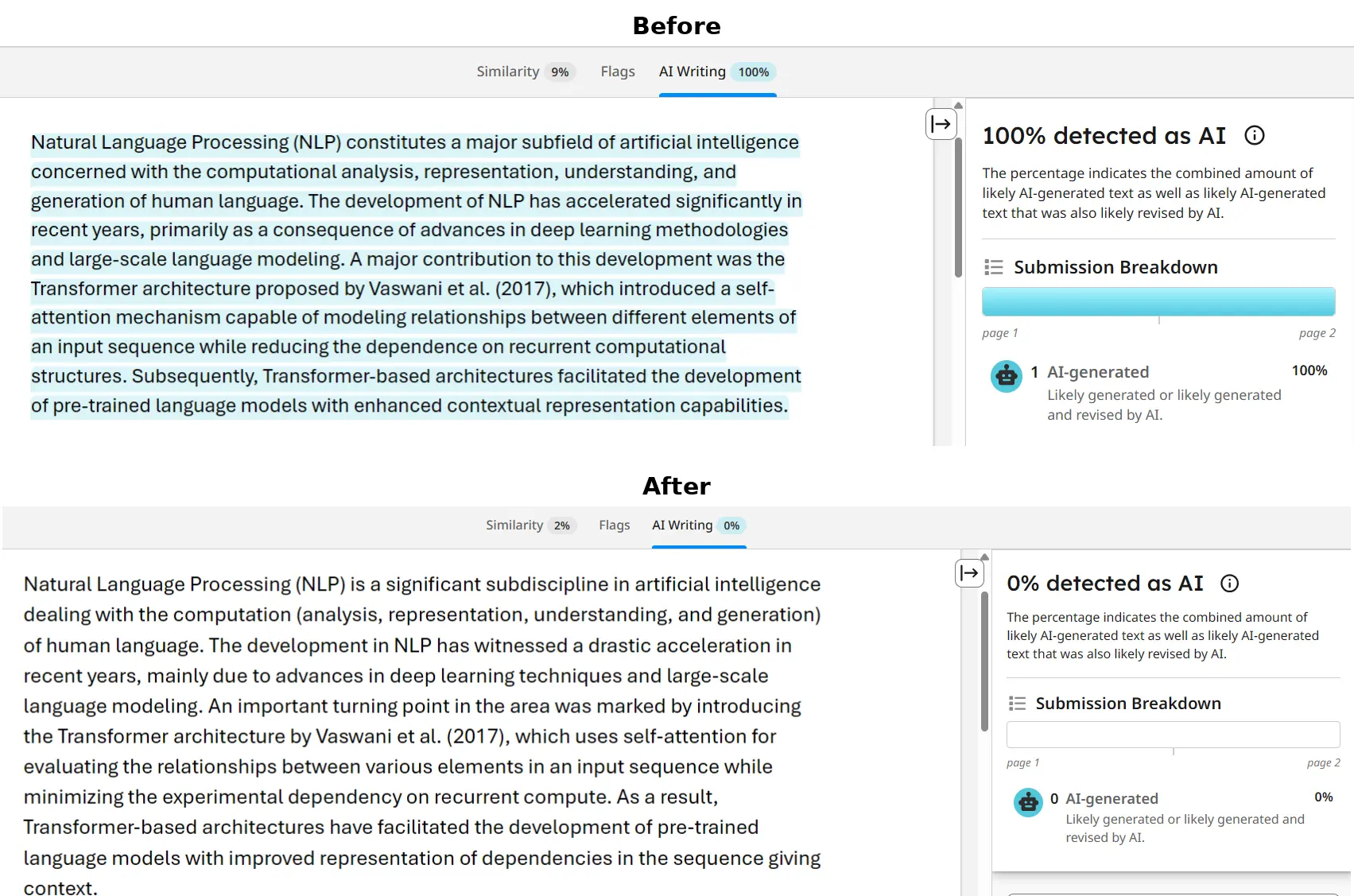
2. Turnitin & iThenticate Verification: 0% AI Detected
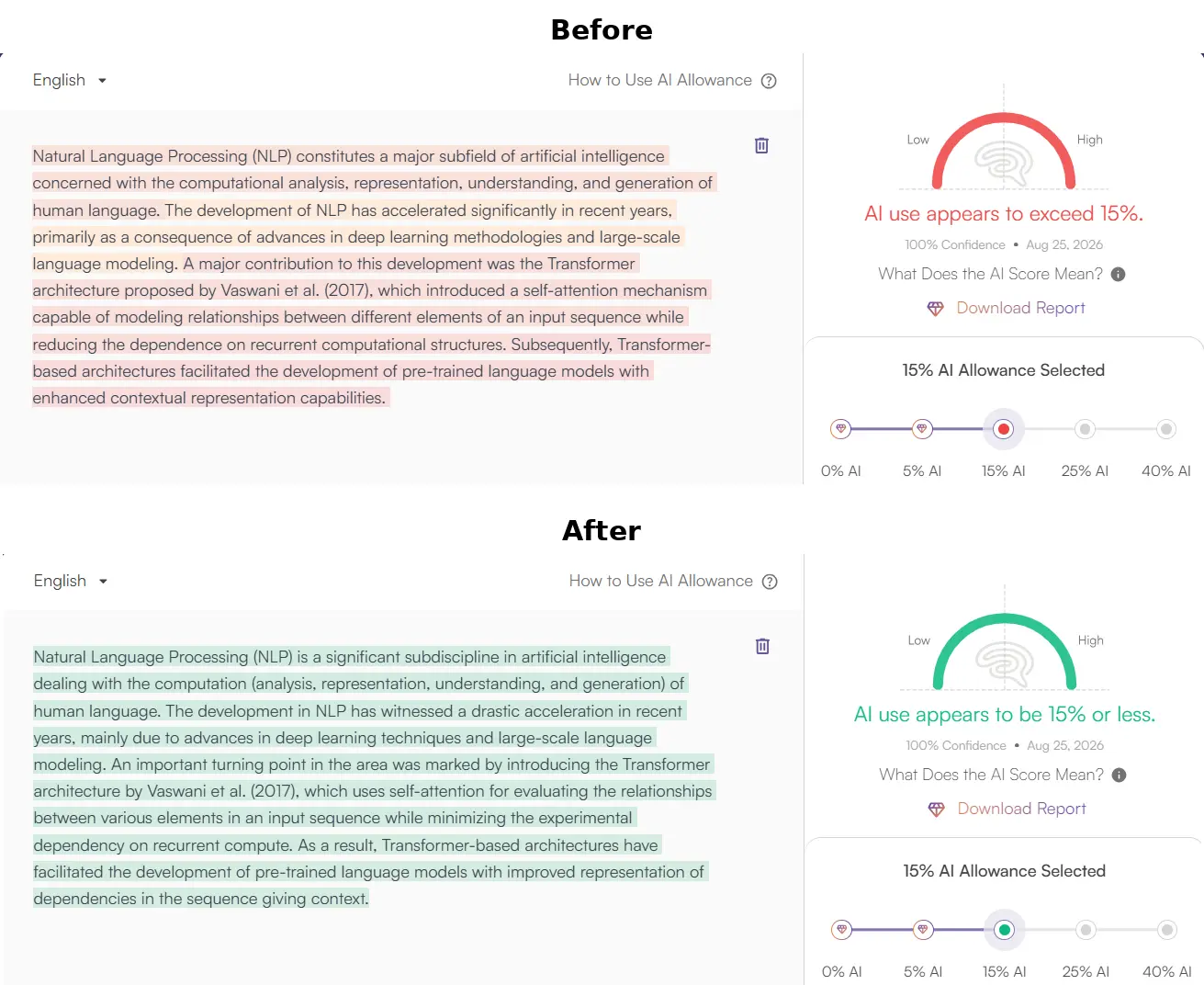
Turnitin and iThenticate scan submissions in overlapping 500-token blocks to analyze sentence predictability across paragraphs. When an unrefined AI draft is submitted, uniform cadence triggers an elevated AI Writing score. In the verified report below, a flagged graduate paper was processed through ThesisHuman, achieving a clean 0% AI detection score while preserving all formatted citations and technical parameters.
3. GPTZero Verification: Passing Perplexity & Burstiness Checks
GPTZero evaluates text by plotting sentence perplexity curves and global burstiness scores. When raw AI text is scanned, low sentence variance produces an immediate high-probability warning. ThesisHuman restores natural sentence entropy by restructuring syntax, varying clause lengths, and introducing authentic scholarly cadence, dropping AI probability to 0%.

4. Originality.ai Verification: 0% AI Confidence
Originality.ai flags predictable n-gram sequences and common AI clichés (such as “delving into,” “pivotal role,” “testament to”). ThesisHuman purges overused formulaic transitions while elevating scholarly tone and keeping reference numbers and equations intact, producing 100% Original / 0% AI results.