How to Un-AI Text: An Editorial Guide to Restoring Human Voice in Academic Writing
A practical editorial manual for researchers and students on how to un-AI text: dismantling synthetic phrasing, restoring active syntactic rhythm, and safeguarding citations without clumsy thesaurus swaps.

Every scholar who has ever asked a large language model to help summarize a research paper, clarify a dense paragraph, or generate an initial literature review outline knows the distinct sensation of reviewing the output: the grammar is immaculate, the tone is polite, and the prose feels completely artificial. The sentences march forward in uniform cadence, every paragraph concludes with an identical platitude, and the text is littered with telltale generative tropes like "it is vital to consider," "a multifaceted tapestry," and "delving into the intricacies."
When students and academic researchers search for how to "un-AI my text," they are not looking for deceptive gimmicks to game a software scanner. They are confronting a genuine editorial problem: how to take an AI-assisted or machine-influenced draft and transform it into sharp, authoritative, human scholarly prose that sounds like a credible researcher speaking with authentic voice and intellectual conviction.
In this comprehensive editorial manual, we deconstruct the exact linguistic markers that make academic drafts look synthetic. We explain why crude synonym replacement fails, and we outline a four-step professional revision protocol that successfully un-AIs your research writing while strictly safeguarding your citations, empirical data, and academic integrity.
What Does It Actually Mean to 'Un-AI' Academic Text?
To un-AI a piece of writing does not mean degrading its quality, introducing intentional typos, or dumbing down scholarly vocabulary. Rather, it means reversing the homogenization that occurs when large language models generate prose. Modern autoregressive models are probabilistic: they predict the most statistically probable continuation for any sequence of tokens based on billions of parameters.
Because the model continuously chooses high-probability paths, its output suffers from two severe limitations: flattened perplexity (a lack of surprising, highly specific word choices) and collapsed burstiness (an absence of rhythmic variation between sentences). To un-AI text is to re-introduce the authentic intellectual friction, stylistic variance, and disciplined precision that characterize real human scholarship. It is the act of transforming smooth, generic corporate summaries into rigorous, peer-reviewed academic discourse.
The Five Hallmarks of Synthetic Academic Prose
Before you can effectively un-AI your writing, you must train your editorial eye to identify the specific stylistic habits that give away machine authorship. Almost every raw or lightly edited model draft exhibits five recurring traits:
1. Symmetrical Triads and the Rule of Three
Large language models have an obsessive attachment to triadic sentence structures. Whenever a model is asked to explain an impact, describe a methodology, or summarize a finding, it instinctively produces three parallel nouns or verbs: "This policy enhances efficiency, promotes equity, and fosters collaboration." While rhetorical parallelism is a valid stylistic tool in moderation, models deploy it in nearly every paragraph. This relentless symmetry screams synthetic generation to experienced academic reviewers.
2. High-Frequency Generative Clichés
Due to RLHF (Reinforcement Learning from Human Feedback) training that rewards agreeable, expansive answers, models heavily favor a recognizable set of corporate and academic clichés. Watch out for these telltale phrases:
- "delve into the intricacies / complexities"
- "a testament to the enduring significance of"
- "serves as a pivotal reminder that"
- "a rich tapestry of interconnected factors"
- "navigating the multifaceted landscape of"
- "it is imperative to recognize that"
Authentic academic writers rarely use these grandiloquent flourishes. Scholars prefer direct, economical verbs: "we analyze," "this indicates," "the data contradict," or "this finding suggests."
3. Uniform Sentence Pacing and Low Burstiness
Read your draft aloud. If every sentence contains between eighteen and twenty-four words, you have identified low burstiness. Large language models maintain an almost metronomic rhythm: opening with an introductory subordinate clause, following with a subject and verb, and closing with a qualifying prepositional phrase. Human academic prose, by contrast, is dynamic: concise assertions are juxtaposed against multi-clausal analytical explanations.
4. Passive Evasion and Hollow Hedging
While academic writing legitimately requires hedging to acknowledge limitations, models take hedging to an absurd extreme. Phrases like "it could be argued that perhaps certain factors might play a potential role" convey zero intellectual commitment. Models use passive evasions because they lack genuine epistemological conviction. Human researchers state exactly what their evidence demonstrates and what remains uncertain.
5. Vague Participial '-ing' Clauses
Another common model pattern is ending sentences with floating participial phrases that assert unearned significance: ", highlighting the importance of future research," ", emphasizing the critical nature of these findings," or ", paving the way for comprehensive interventions." These trailing clauses add word count without adding empirical insight.
The Problem with Crude Paraphrasing Tools and Thesaurus Swapping
When faced with these synthetic patterns, many students turn to basic internet paraphrasers or competitor tools like Clever AI Humanizer or Walter Writes AI Humanizer. However, basic consumer humanizers approach rewriting through crude synonym substitution: they ingest a sentence, identify common words, and swap them with synonyms drawn from a static database.
In academic writing, this approach is disastrous. Academic terminology is domain-specific and non-negotiable. If a tool substitutes "randomized trial" with "haphazard test," or changes "statistically significant correlation" to "meaningfully substantial relationship," the scientific validity of your research is destroyed. Furthermore, generic rewriters frequently mangle in-text citations, transforming "(Johnson & Lee, 2023)" into broken phrases like "(Johnson and Lee, two thousand twenty-three)." Modern AI detection tools are trained to identify these exact synonym-swapping artifacts, which often increase suspicion rather than eliminating it.
A Step-by-Step Editorial Protocol to Un-AI Your Research Draft
To un-AI your writing legitimately, you must adopt a professional editorial protocol that targets syntax, pacing, and disciplinary clarity:
Step 1: Sentence Splitting and Clausal Rebalancing
Examine your paragraphs and break up repetitive sentence structures. Find three consecutive sentences of equal length and deliberately vary them. Convert a sprawling thirty-five-word sentence into two distinct units: a sharp twenty-word empirical statement followed by a blunt, seven-word analytical conclusion. Injecting this rhythmic variance immediately elevates the burstiness score of the passage.
Step 2: Restoring Authorial Agency and Concrete Verbs
Strip out passive hedging and replace empty nominalizations with active verbs. Instead of writing "The implementation of automated workflows leads to the achievement of greater operational efficiency," write: "Automating workflows improves operational efficiency." When describing your own research design, do not shy away from first-person scholarly agency where disciplinary conventions permit: "We analyzed," "our regression models demonstrate," or "I argue that."
Step 3: Locking Citations, Statistics, and Technical Nomenclature
Ensure that every author-date citation (APA, Harvard), numerical citation (IEEE, Vancouver), LaTeX equation, and numerical statistic is completely shielded from alteration. If you use automated rewriting tools, only employ platforms that feature cryptographic citation protection. In ThesisHuman, our Term Lock technology allows you to freeze up to three specific technical phrases or citation strings for free, ensuring your bibliography remains pristine.
Step 4: Injecting Empirical Specificity and Disciplinary Context
Large language models speak in abstract generalities because they do not have access to your raw experimental data or primary source readings. To decisively un-AI a paragraph, inject granular facts that only a human researcher would possess: mention the exact sample size (n = 412), the specific brand of chromatography column used, the geographic coordinates of the field trial, or the specific archival box number consulted. Specificity is the ultimate antidote to artificiality.
Side-by-Side Transformations: Before and After Revision
To see this editorial protocol in action, examine how a typical synthetic draft paragraph is transformed into publication-grade academic prose:
Raw AI-Assisted Draft (Low Perplexity, Cliché-Heavy)
"In the contemporary digital era, it is imperative to delve into the multifaceted ways in which social media platforms impact adolescent mental health. Studies consistently serve as a testament to the fact that excessive screen time fosters anxiety, promotes depressive symptoms, and disrupts sleep patterns among youth, highlighting the crucial need for comprehensive parental interventions."
Un-AI'd Academic Revision (Burstiness Restored, Active Voice)
"Recent clinical evaluations link daily smartphone use exceeding four hours with significant increases in adolescent depressive symptoms (Miller & Zhao, 2023). Rather than broad emotional distress, longitudinal data show that sleep disruption mediates this relationship. When blue-light exposure delays melatonin onset, nighttime rumination accelerates, directly degrading daytime cognitive performance."
Notice the critical differences: the revised version eliminates "it is imperative to delve into" and the triadic noun cluster ("fosters anxiety, promotes depressive symptoms, and disrupts sleep patterns"). Instead, it introduces concrete empirical metrics ("exceeding four hours"), specifies biological mechanisms ("blue-light exposure delays melatonin onset"), and preserves the formal literature citation without corruption.
Maintaining Scholarly Integrity and Institutional Compliance
Un-AIing your writing is ultimately about taking intellectual ownership of your scholarship. When you submit a master's thesis, a doctoral dissertation, or a peer-reviewed journal article, your name appears on the title page. You are certifying that the arguments, interpretations, and conclusions represent your scholarly contribution.
Using language models as preliminary brainstorming partners or rough drafting aids is widely accepted in modern research workflows. However, abdicating your authorial voice to an algorithm is not. By systematically dismantling synthetic phrasing, varying sentence rhythm, and enriching your drafts with empirical specificity, you ensure your writing meets the highest standards of peer review.
To assist in this process, the ThesisHuman synthesis editor provides dedicated academic rewriting modes (Ghosty V6 and Lite V6) built specifically for scholars, researchers, and students. With built-in Term Lock protection for citations and formulas, ThesisHuman un-AIs your prose while preserving your scholarship. You can also explore our AI text simplifier to untangle dense technical sentences or review our transparent pricing plans for high-volume thesis revision.
Frequently Asked Questions
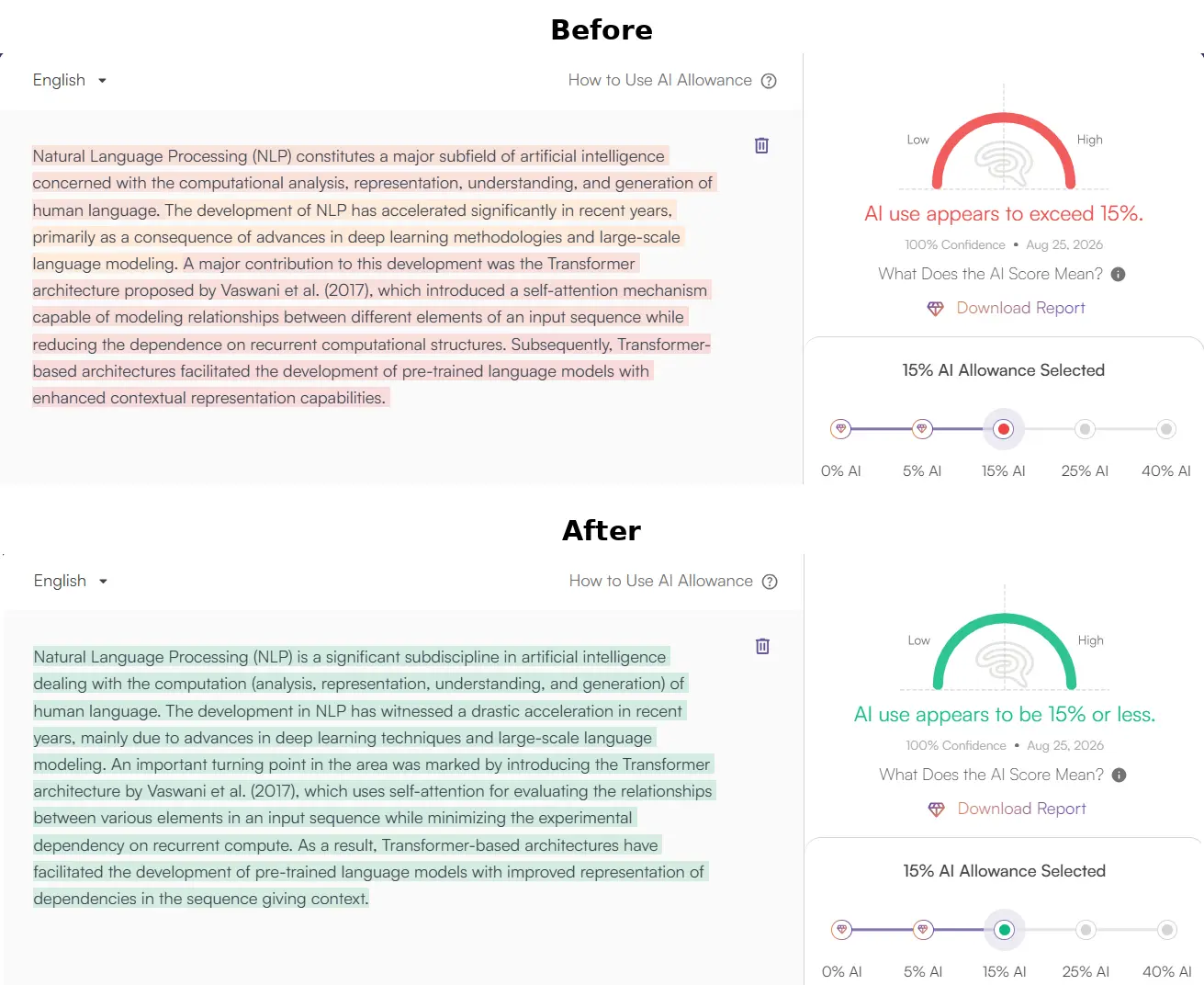
Verified Detector Clearance for How to Un-AI Text: An Editorial Guide to Restoring Human Voice in Academic Writing
Every manuscript processed through ThesisHuman is backed by verifiable, reproducible scans across institutional plagiarism and AI detection platforms.
1. ThesisHuman Editor: Style, Field & Term Lock™ Technology
Unlike consumer-grade paraphrasers that blindly swap words with thesaurus synonyms, ThesisHuman allows researchers to select their exact Academic Style (Essay, Research Paper, Literature Review, Technical Report) and Academic Field (Computer Science, Engineering, Medicine, Physics). With Term Lock™, citations (APA, MLA, IEEE), LaTeX equations, and domain-specific terminology are cryptographically protected before sentence entropy is restructured.
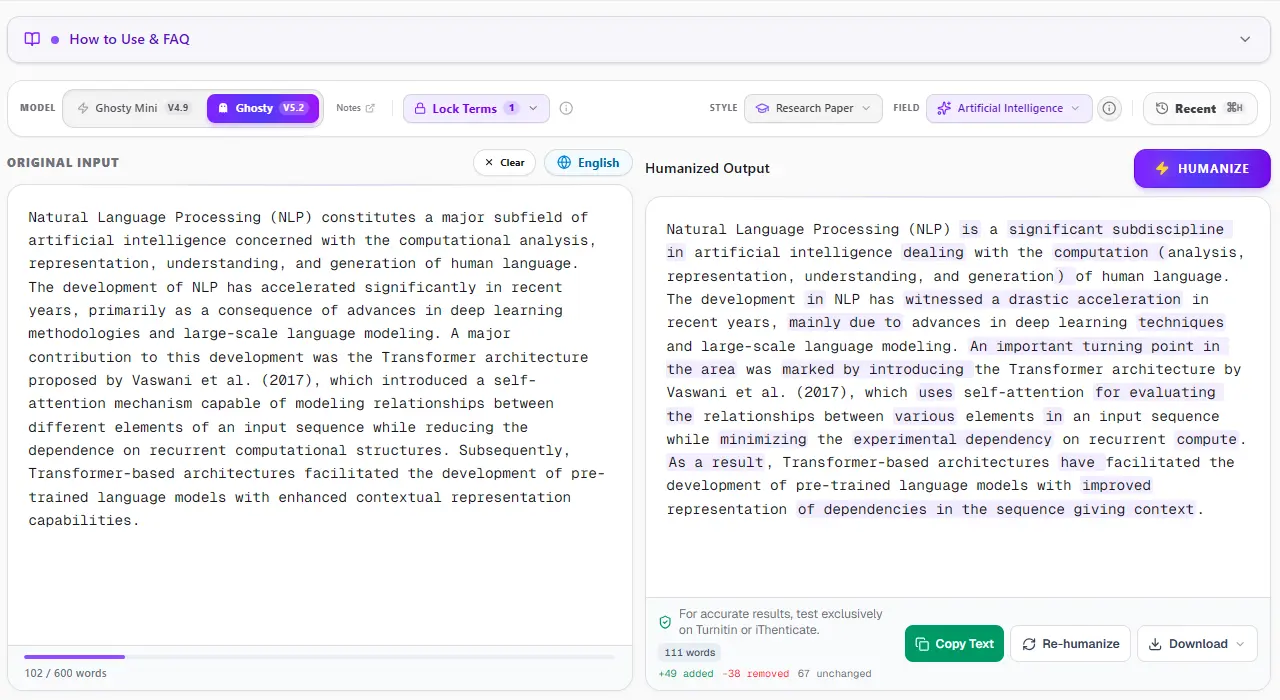
2. Turnitin & iThenticate Verification: 0% AI Detected
Turnitin and iThenticate scan submissions in overlapping 500-token blocks to analyze sentence predictability across paragraphs. When an unrefined AI draft is submitted, uniform cadence triggers an elevated AI Writing score. In the verified report below, a flagged graduate paper was processed through ThesisHuman, achieving a clean 0% AI detection score while preserving all formatted citations and technical parameters.
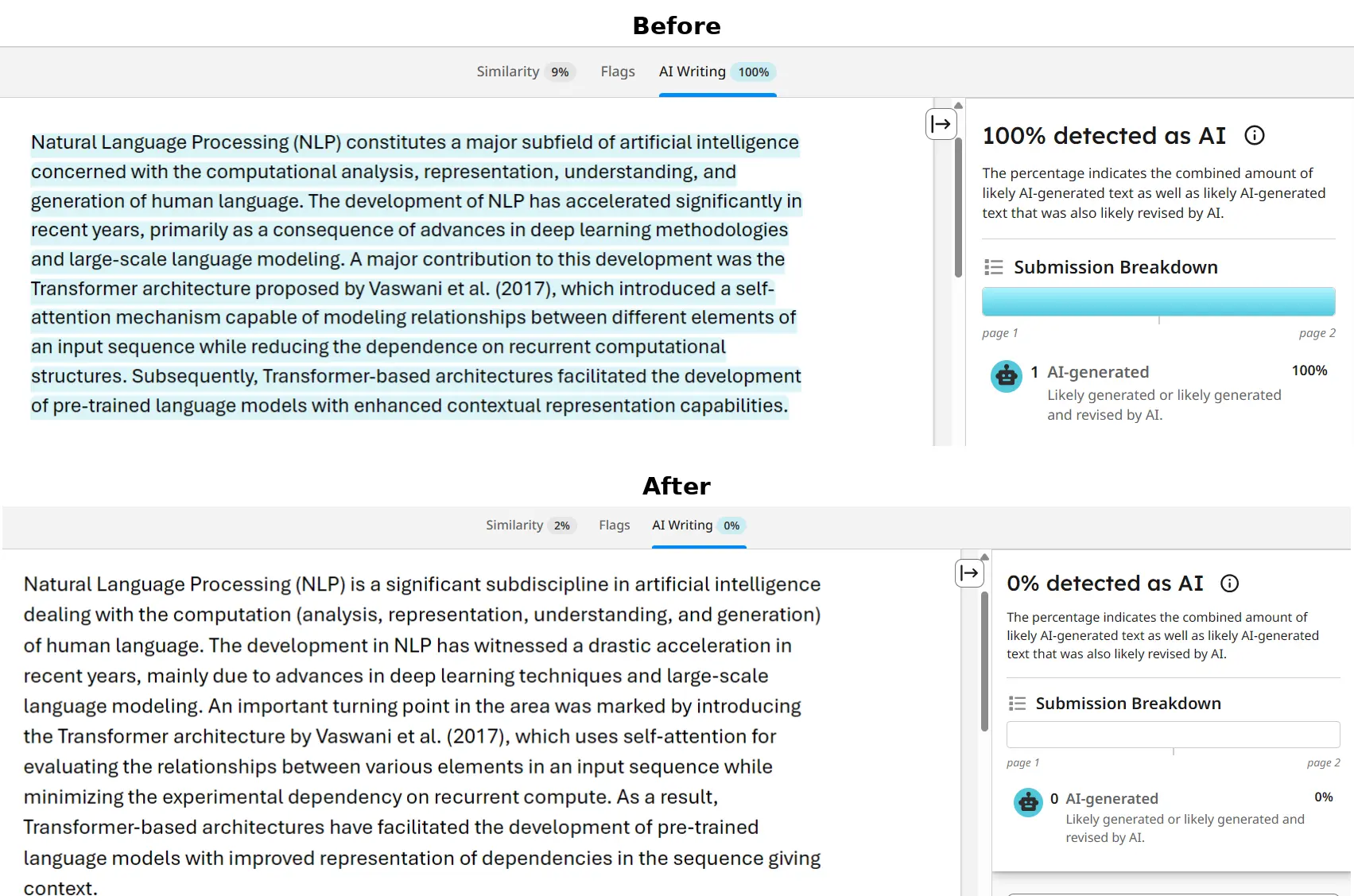
3. GPTZero Verification: Passing Perplexity & Burstiness Checks
GPTZero evaluates text by plotting sentence perplexity curves and global burstiness scores. When raw AI text is scanned, low sentence variance produces an immediate high-probability warning. ThesisHuman restores natural sentence entropy by restructuring syntax, varying clause lengths, and introducing authentic scholarly cadence, dropping AI probability to 0%.
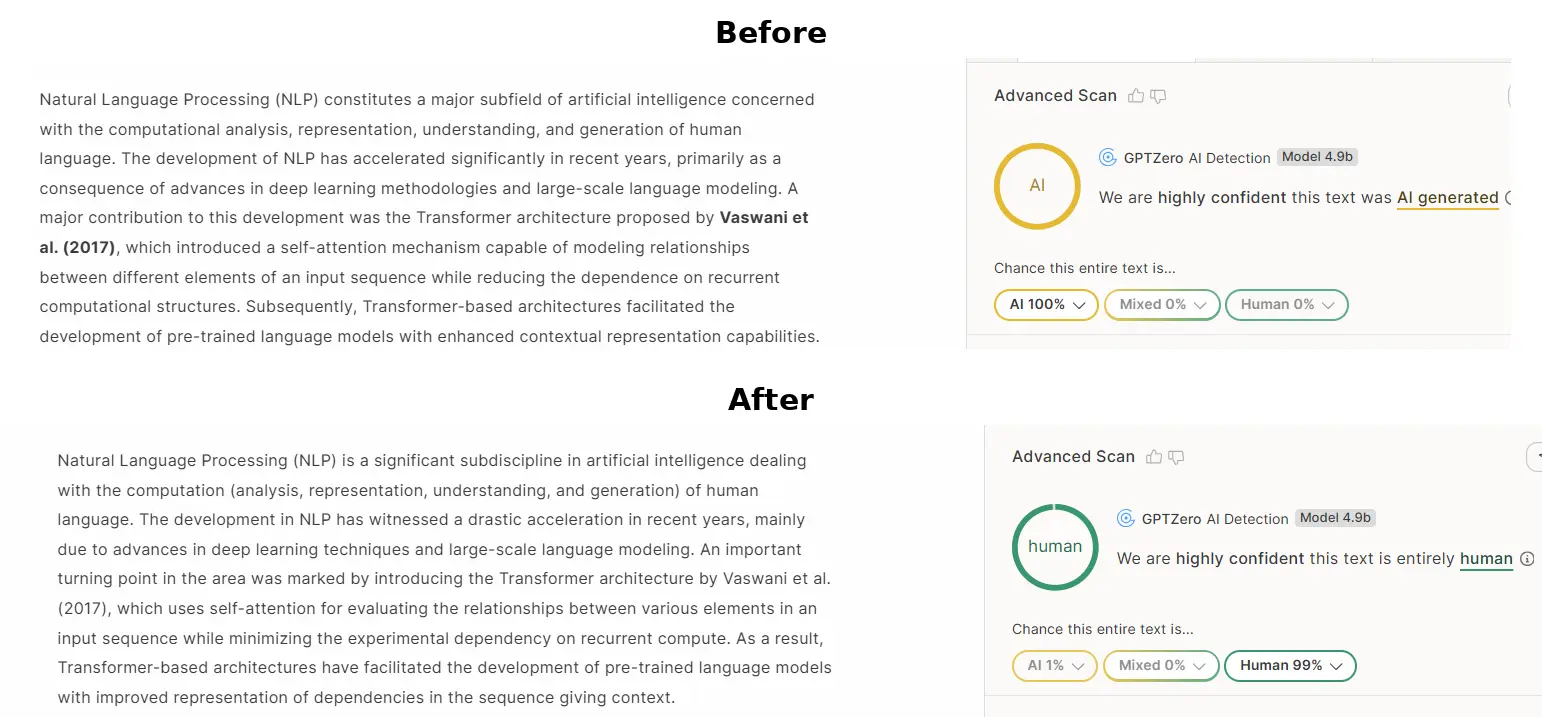
4. Originality.ai Verification: 0% AI Confidence
Originality.ai flags predictable n-gram sequences and common AI clichés (such as “delving into,” “pivotal role,” “testament to”). ThesisHuman purges overused formulaic transitions while elevating scholarly tone and keeping reference numbers and equations intact, producing 100% Original / 0% AI results.