Synthesizing Without Sounding Synthetic: How to Humanize an AI-Assisted Literature Review
Using AI to organize thematic literature matrices saves weeks of doctoral research, but unedited synthesis drafts reek of robotic formulas and uniform cadence. Here is how to naturalize literature reviews while protecting citations.

For any graduate student or academic researcher, conducting a comprehensive literature review is one of the most intellectually demanding phases of a research project. In an era where thousands of papers are published annually in every sub-discipline, utilizing AI tools to scan abstracts, categorize methodology types, and construct thematic comparison matrices is a transformative productivity leap. Tasks that once required two months of indexing can now be scoped in days.
However, when scholars ask large language models to turn those structured matrices into continuous narrative prose, the resulting draft almost always suffers from what editors call synthetic synthesis. The prose marches forward with mechanical predictability: each paragraph summarizes one study, uses the same attribution formula, and concludes with an identical bridging sentence. Modern screening tools like iThenticate, Turnitin, and Copyleaks flag these chapters quickly. Here is how to transform AI-assisted matrix synthesis into natural, defensible academic scholarship.
The Challenge of the AI-Assisted Literature Review
The fundamental purpose of a literature review is not to demonstrate that you read thirty papers. It is to construct an intellectual argument that justifies your study's existence. You are mapping the theoretical terrain: showing where scholars agree, identifying methodological contradictions, and pinpointing the exact gap your thesis addresses.
Language models struggle with critical evaluation. When prompted to synthesize literature, an LLM defaults to polite aggregation. It treats all cited studies as equally valid, balancing conflicting findings with superficial reconciliation. Worse, it writes with rhythmic monotony, producing an uninterrupted stream of low-perplexity compound sentences that detectors classify as machine-authored.
Three Signs of Synthetic Literature Synthesis
1. Mechanical Author Attribution Formulas
Notice how raw AI drafts introduce every cited study using the exact same syntactic formula:
"Smith (2022) examined the relationship between X and Y, finding that Z occurred. In a related study, Johnson (2023) investigated similar variables, demonstrating comparable results. Furthermore, Williams (2024) expanded upon this framework..."
Published scholars rarely string together three identical attribution templates. They lead with the claim or tension, tucking the citations into parenthetical anchors: "Early investigations focused almost exclusively on immediate post-operative outcomes (Smith, 2022; Johnson, 2023), leaving long-term cognitive impacts largely unexamined until Williams (2024)."
2. Superficial Reconciliations
When studies contradict each other, unedited AI drafts rely on vacuous bridging language: "While some studies suggest positive outcomes, others report negative effects, indicating that more research is needed to navigate this multifaceted landscape." A human scholar explains *why* the contradiction exists: differences in sample demographics, conflicting operational definitions, or divergent statistical controls.
3. Flat Perplexity Across Long Passages
Because literature reviews are dense with scholarly summaries, language models operate in their safest, most predictable predictive register. The perplexity score remains uniformly flat across thousands of words, triggering elevated AI writing indicators on institutional ETD submission portals.
Refining Matrix Output into Genuine Scholarly Debate
To transform an AI-organized matrix into authentic academic writing, execute these three structural revisions:
1. Organize by Disagreement, Not by Paper
Group papers in your matrix into conceptual camps. Structure your subheadings around unresolved questions (e.g., "Methodological Divergence in Measuring Cognitive Load") rather than listing individual authors sequentially.
2. Assert Critical Evaluative Voice
Do not just summarize what authors did; evaluate how well their methodologies supported their conclusions. Point out statistical underpowering, lack of longitudinal controls, or geographic homogeneity in prior cohorts.
3. Naturalize Cadence with ThesisHuman
Run dense synthesis sections through ThesisHuman's Literature Review Humanizer. The engine breaks up attribution monotony, varies sentence length entropy, and eliminates synthetic transition markers, ensuring your literature chapter reads with authentic doctoral authority.
Citation Preservation in Dense Literature Reviews
A literature review chapter in a doctoral thesis commonly contains between 80 and 200 in-text citations. If you use a generic paraphraser to edit this text, you risk corrupting dozens of citations: dates get altered, author names get misspelled, and citations get unlinked from their primary claims.
ThesisHuman's Term Lock isolates every citation style (including complex multi-author parentheticals like (Alvarez, Chen, & Dupont, 2024; Roberts et al., 2025) and IEEE numeric sequences like [18, 22-25]) by protecting them during editing. Before submitting your paper, review our step-by-step tutorial on how to verify AI-generated citations before submitting a research paper.
Passing iThenticate and Institutional ETD Audits
When your final literature review is screened by your university's ETD submission pipeline, it must pass both similarity and AI indicators. By structuring your synthesis around critical conceptual debates and naturalizing prose cadence with ThesisHuman, you ensure your work clears both thresholds. For candidates preparing complete doctoral dissertations, explore our dedicated thesis humanizer mode and our Turnitin AI humanizer protocol.
Verified Detector Clearance for Synthesizing Without Sounding Synthetic: How to Humanize an AI-Assisted Literature Review
Every manuscript processed through ThesisHuman is backed by verifiable, reproducible scans across institutional plagiarism and AI detection platforms.
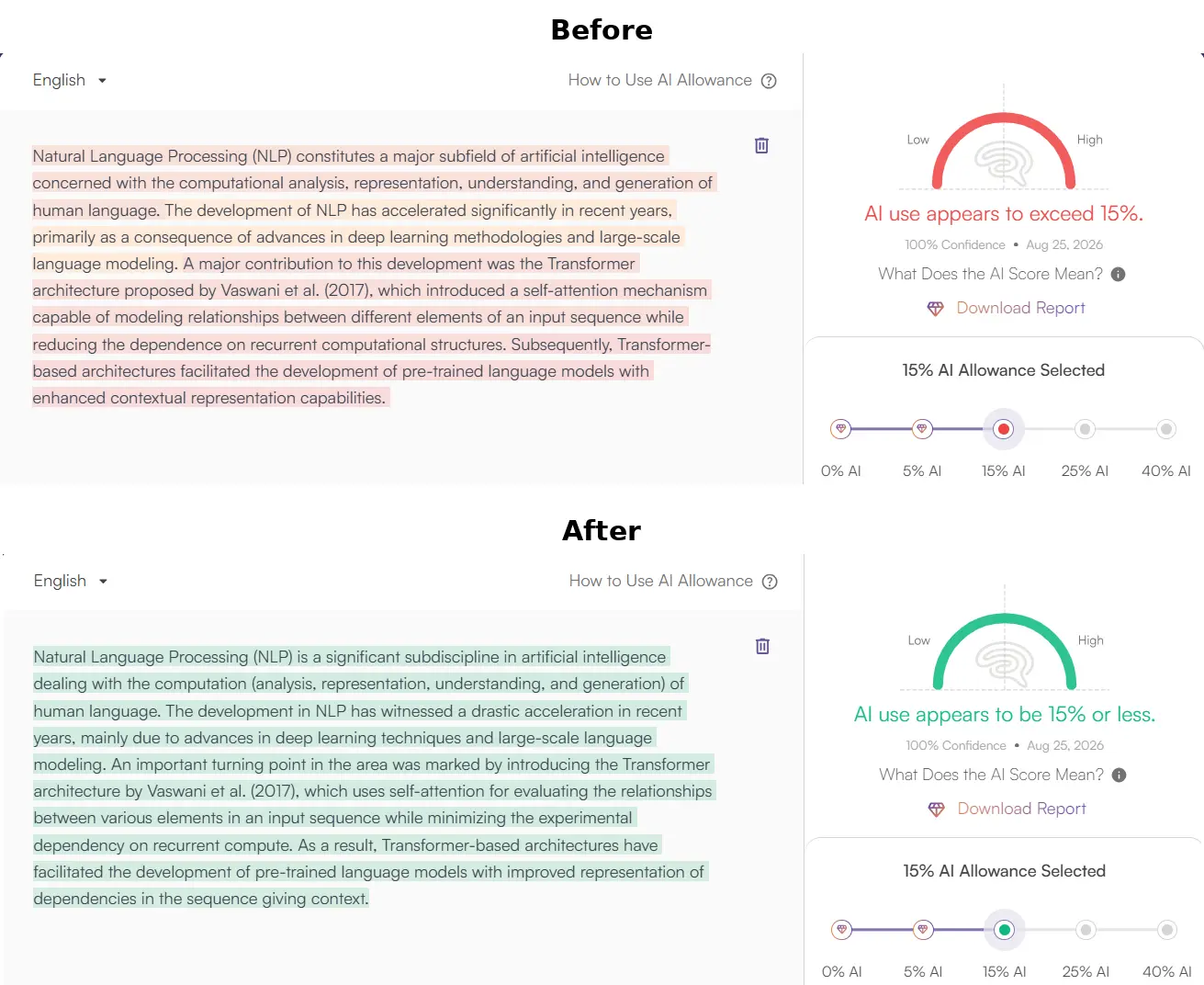
1. ThesisHuman Editor: Style, Field & Term Lock™ Technology
Unlike consumer-grade paraphrasers that blindly swap words with thesaurus synonyms, ThesisHuman allows researchers to select their exact Academic Style (Essay, Research Paper, Literature Review, Technical Report) and Academic Field (Computer Science, Engineering, Medicine, Physics). With Term Lock™, citations (APA, MLA, IEEE), LaTeX equations, and domain-specific terminology are cryptographically protected before sentence entropy is restructured.
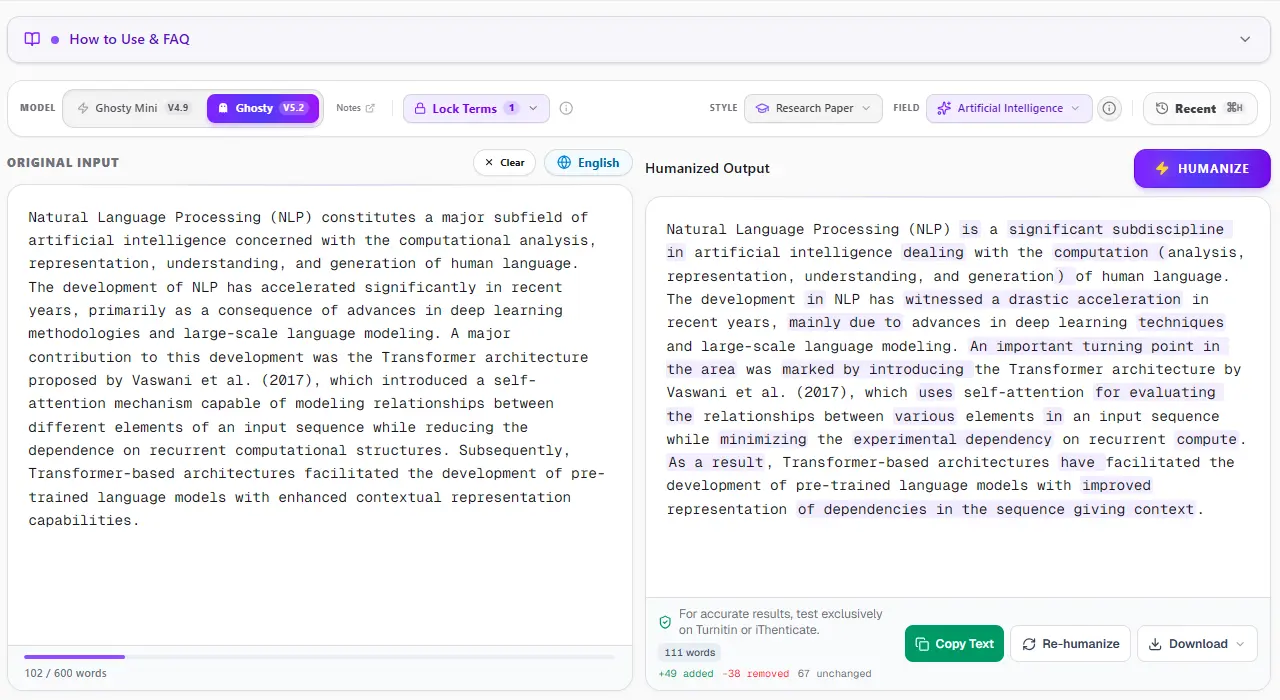
2. Turnitin & iThenticate Verification: 0% AI Detected
Turnitin and iThenticate scan submissions in overlapping 500-token blocks to analyze sentence predictability across paragraphs. When an unrefined AI draft is submitted, uniform cadence triggers an elevated AI Writing score. In the verified report below, a flagged graduate paper was processed through ThesisHuman, achieving a clean 0% AI detection score while preserving all formatted citations and technical parameters.
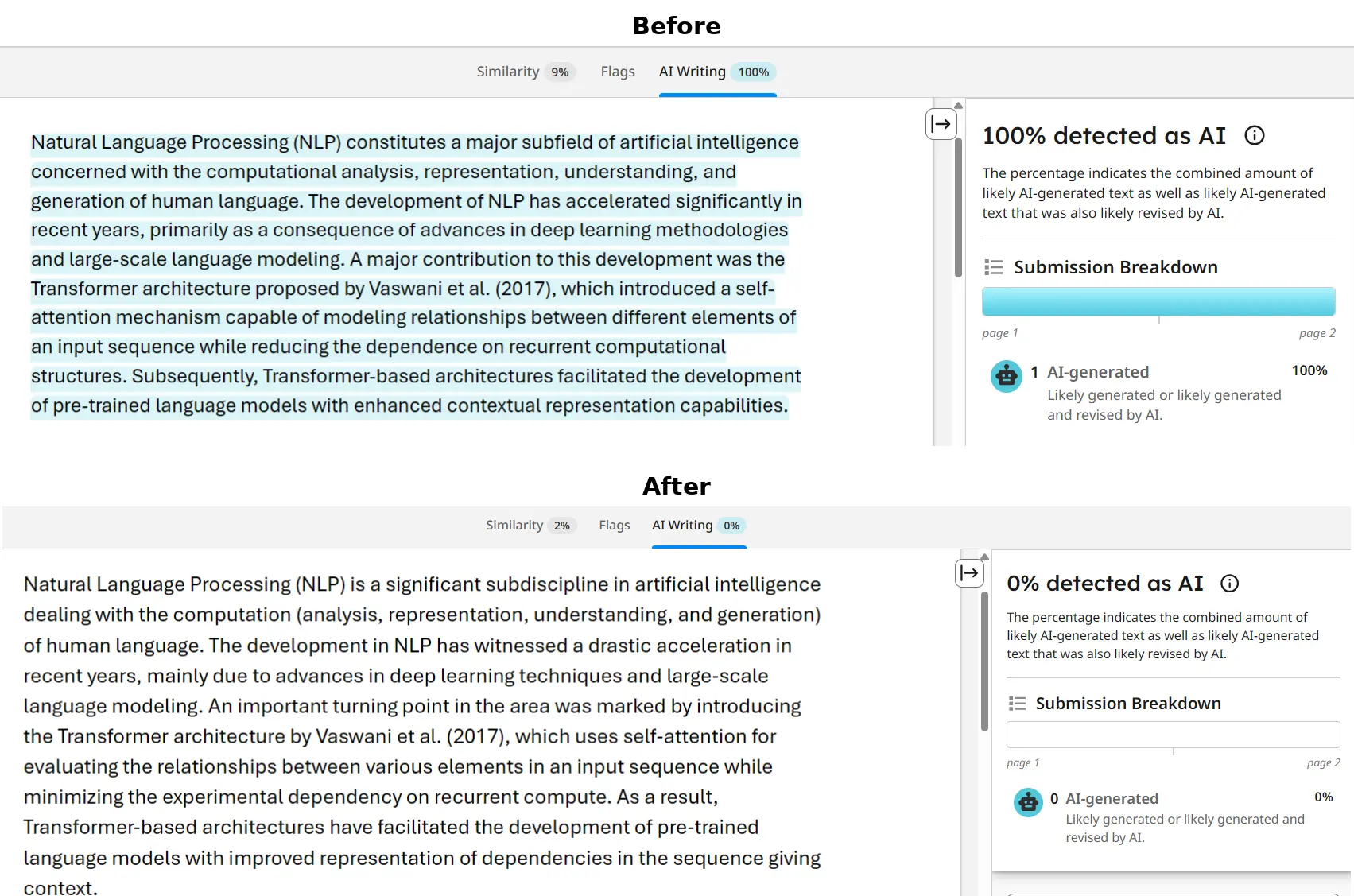
3. GPTZero Verification: Passing Perplexity & Burstiness Checks
GPTZero evaluates text by plotting sentence perplexity curves and global burstiness scores. When raw AI text is scanned, low sentence variance produces an immediate high-probability warning. ThesisHuman restores natural sentence entropy by restructuring syntax, varying clause lengths, and introducing authentic scholarly cadence, dropping AI probability to 0%.
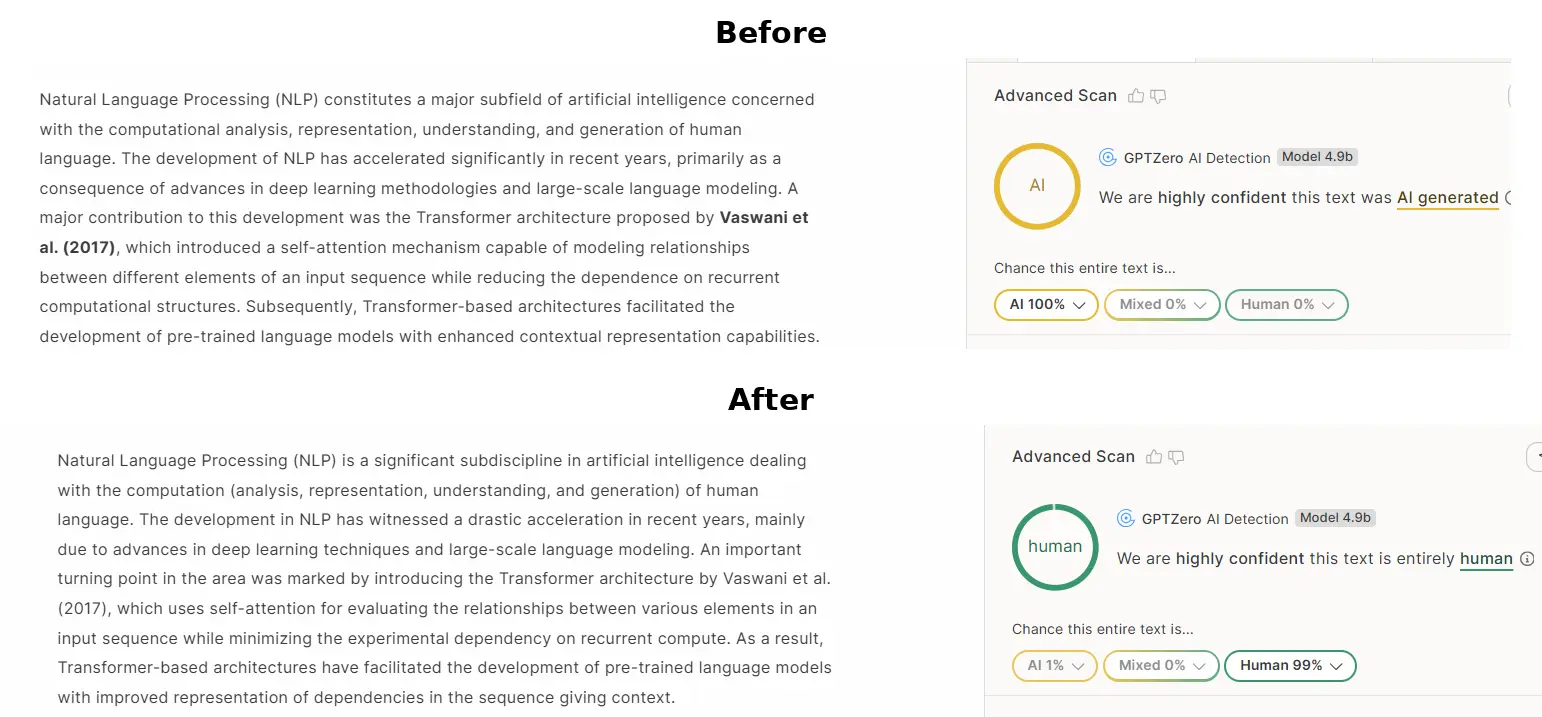
4. Originality.ai Verification: 0% AI Confidence
Originality.ai flags predictable n-gram sequences and common AI clichés (such as “delving into,” “pivotal role,” “testament to”). ThesisHuman purges overused formulaic transitions while elevating scholarly tone and keeping reference numbers and equations intact, producing 100% Original / 0% AI results.