How to Verify AI-Generated Citations Before Submitting a Research Paper
A five-point protocol for identifying fabricated references, verifying DOIs, and reconciling in-text citations before journal or thesis submission.

Among the potential issues when using generative AI for research writing, fabricated citations carry serious academic consequences. Journal editors at publishers such as Elsevier, Springer Nature, and IEEE report receiving manuscripts with references to articles, author combinations, and digital object identifiers (DOIs) that do not exist in academic records.
Including an unverified citation in a thesis or manuscript can lead to desk rejection, corrections, or formal integrity reviews. This guide examines why language models invent references and outlines a five-point audit to verify citations before submission.
The Fabricated Citation Problem in Scholarly Literature
Researchers use terms like phantom references to describe synthetic bibliographic entries generated by language models. A 2026 presentation at the Association for Computational Linguistics (ACL) evaluating preprint bibliographies and scientific submissions found that more than 146,000 hallucinated citations appeared in unverified drafts during the preceding year.
These references appear realistic because models combine real author names from a given subfield with plausible paper titles, correct journal abbreviations, and formatted DOI strings such as 10.1016/j.jbi.2024.104512.
Why Language Models Invent References
Language models do not query live bibliographic indices when generating continuous text. Instead, they are auto-regressive next-token predictors trained to produce statistically likely continuations of a prompt.
When asked for literature citations, the model does not search Crossref, PubMed, or Scopus. It generates text that matches the visual format of an academic citation. For example, in a passage about CRISPR gene editing, the model is likely to include authors frequently associated with that topic and draft a plausible title. The resulting reference looks authentic but may not correspond to an actual publication.
A practical rule for academic writing: find and read actual papers through trusted academic search engines first, then use language tools only to polish text you have independently checked.
The Five-Point Citation Audit
Before submitting a manuscript, review every bibliography entry against this five-point check:
- Test the DOI Directly: Paste the digital object identifier into
https://doi.org/. If the system reports that the DOI is not found, the reference is likely fabricated. - Check Academic Indexes: Search for the exact title in quotes on Google Scholar, Semantic Scholar, or PubMed to confirm the article exists.
- Verify Authors and Journal: Confirm that the authors listed actually wrote that paper and that it appeared in the stated volume, issue, and year. Models sometimes mix authors from one study with the title of another.
- Confirm the Specific Claim: Open the published PDF to ensure the cited article directly supports the statement you are attributing to it. Misrepresenting a real paper's findings is an editorial issue just like citing an invalid source.
- Reconcile In-Text Citations with the Bibliography: Check that every in-text citation matches an entry in your reference list and that there are no unmatched references. For LaTeX users, see our guide on LaTeX-Safe Academic Editing.
Verification Databases and Public Repositories
| Resource | Primary Function | Recommended Use |
|---|---|---|
| Crossref Metadata API | Official DOI registration database | Confirming DOIs and publisher metadata |
| Semantic Scholar | Academic literature graph | Checking author publication histories and abstracts |
| PubMed / NCBI | Biomedical and life sciences database | Verifying clinical trials and biomedical literature |
| Retraction Watch Database | Archive of retracted academic articles | Checking that cited publications remain in good standing |
Safeguarding Validated References During Editing
Once you verify that your bibliography is accurate, make sure language editing does not alter in-text citation keys. When editing prose for submission to venues that screen with tools like iThenticate, use ThesisHuman with Term Lock enabled.
Term Lock identifies citation formats (including APA, MLA, Chicago, and IEEE bracketed numbers) and freezes those tokens. Surrounding prose is adjusted for natural sentence flow while your verified references remain intact. For a comprehensive pre-submission review, consult The AI-Assisted Research Paper Pre-Submission Checklist.
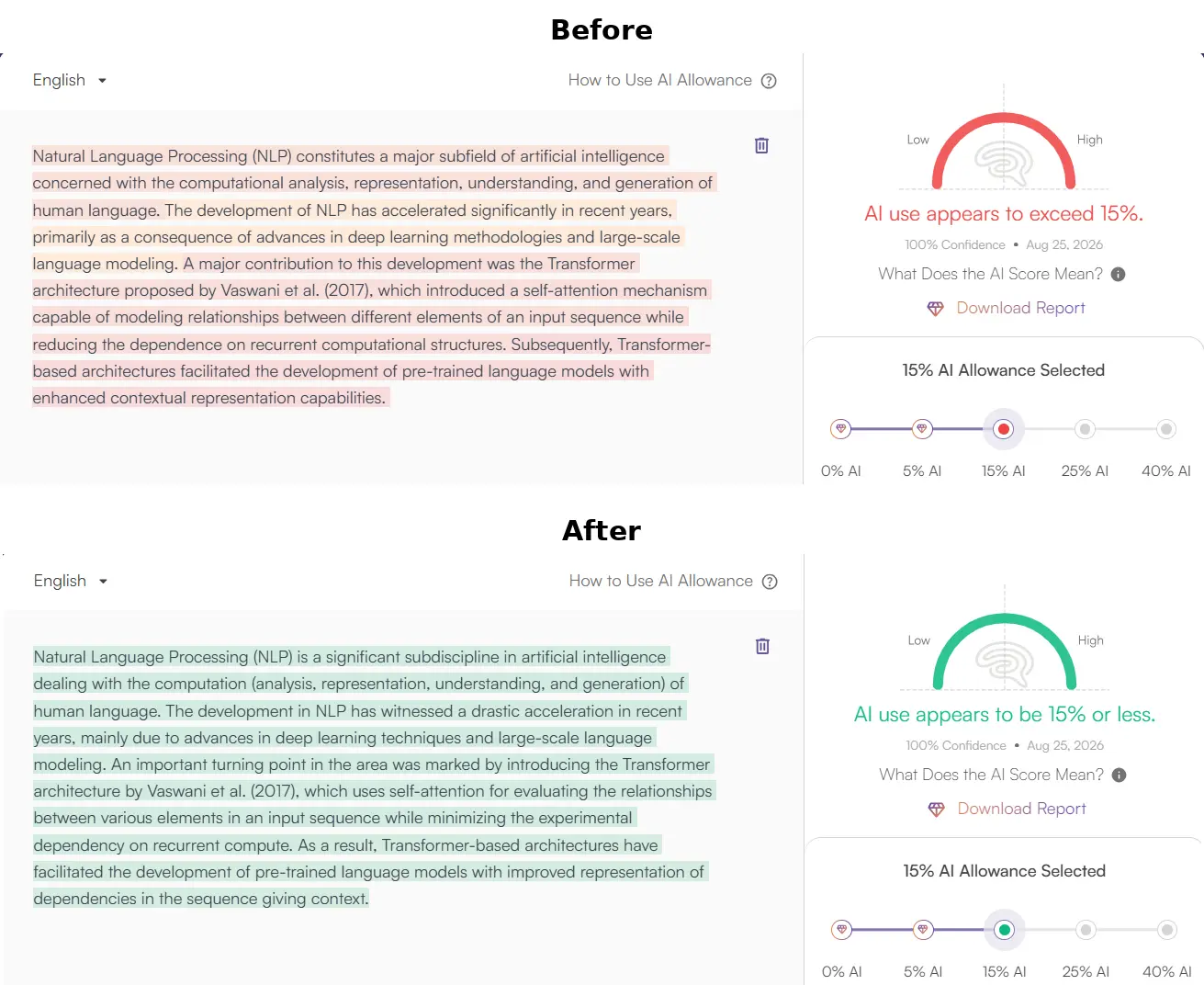
Verified Detector Clearance for How to Verify AI-Generated Citations Before Submitting a Research Paper
Every manuscript processed through ThesisHuman is backed by verifiable, reproducible scans across institutional plagiarism and AI detection platforms.
1. ThesisHuman Editor: Style, Field & Term Lock™ Technology
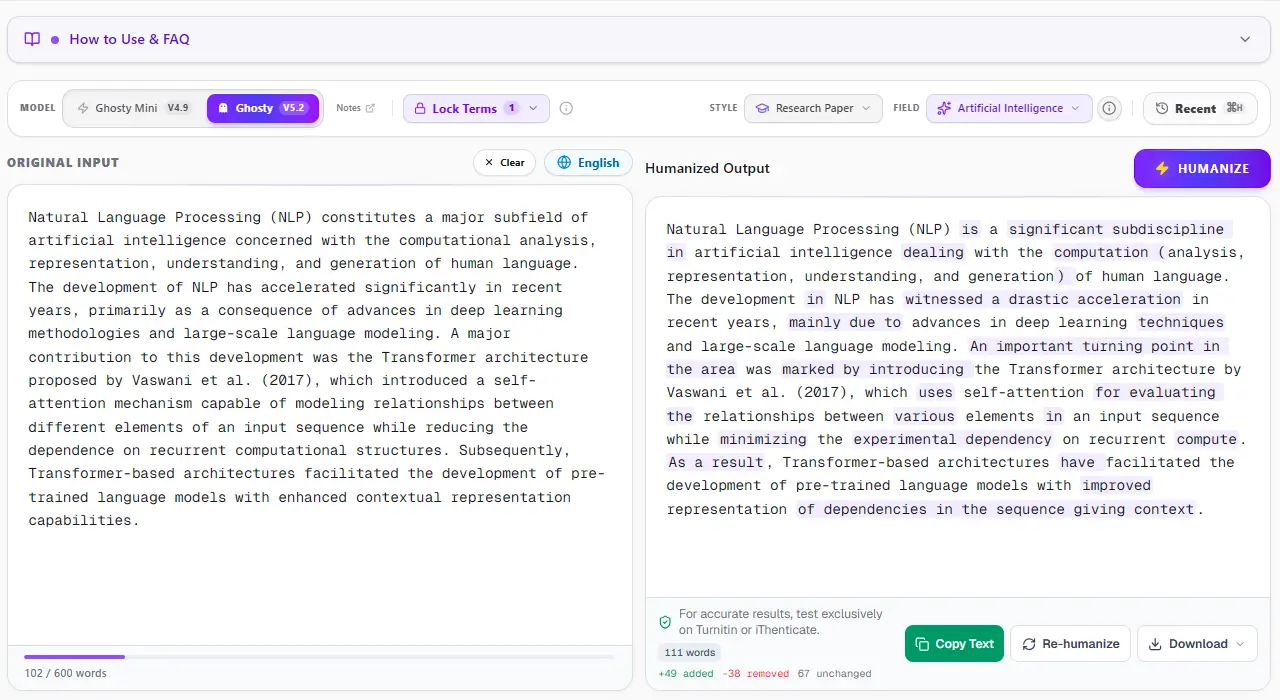
Unlike consumer-grade paraphrasers that blindly swap words with thesaurus synonyms, ThesisHuman allows researchers to select their exact Academic Style (Essay, Research Paper, Literature Review, Technical Report) and Academic Field (Computer Science, Engineering, Medicine, Physics). With Term Lock™, citations (APA, MLA, IEEE), LaTeX equations, and domain-specific terminology are cryptographically protected before sentence entropy is restructured.
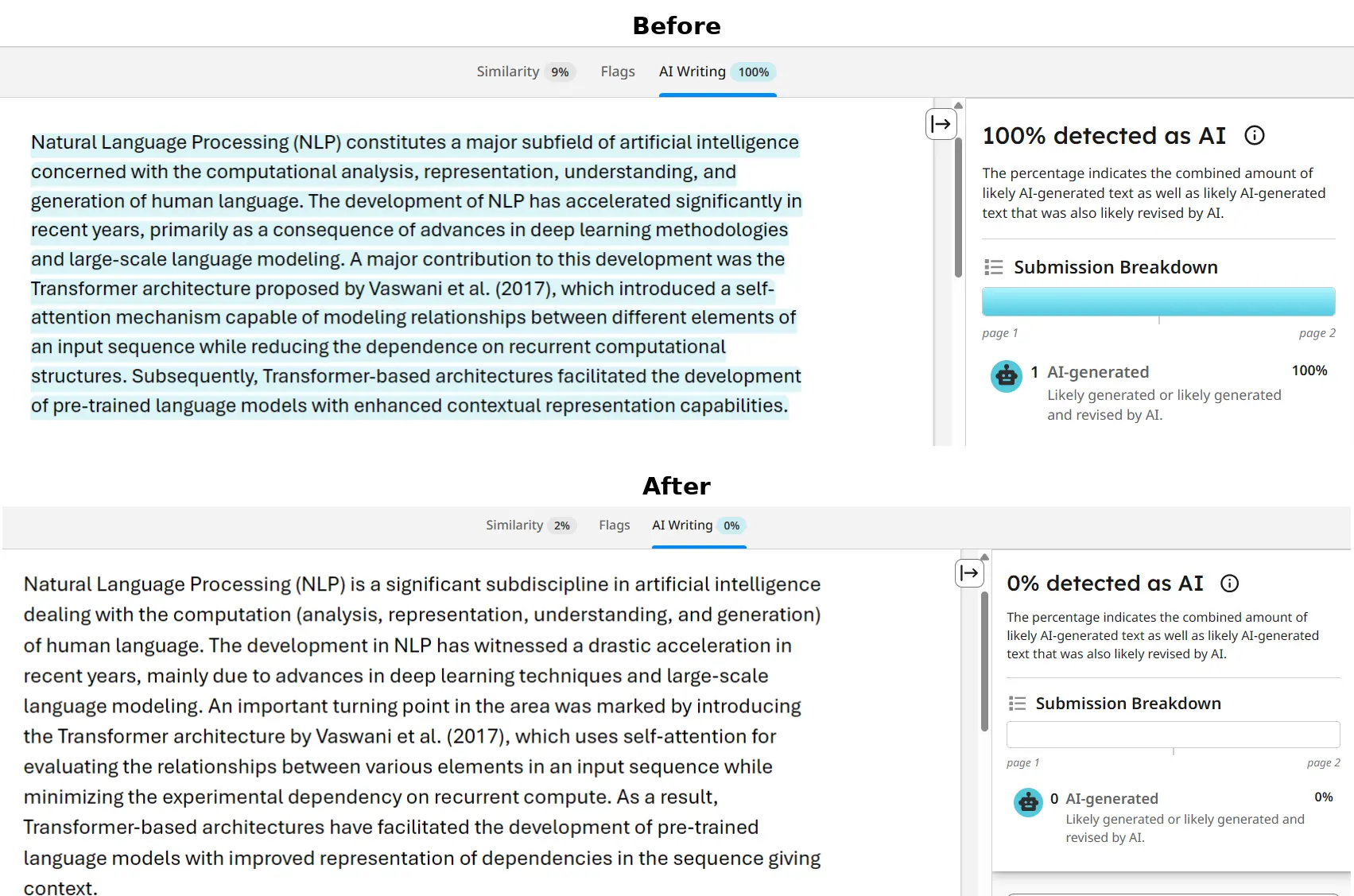
2. Turnitin & iThenticate Verification: 0% AI Detected
Turnitin and iThenticate scan submissions in overlapping 500-token blocks to analyze sentence predictability across paragraphs. When an unrefined AI draft is submitted, uniform cadence triggers an elevated AI Writing score. In the verified report below, a flagged graduate paper was processed through ThesisHuman, achieving a clean 0% AI detection score while preserving all formatted citations and technical parameters.
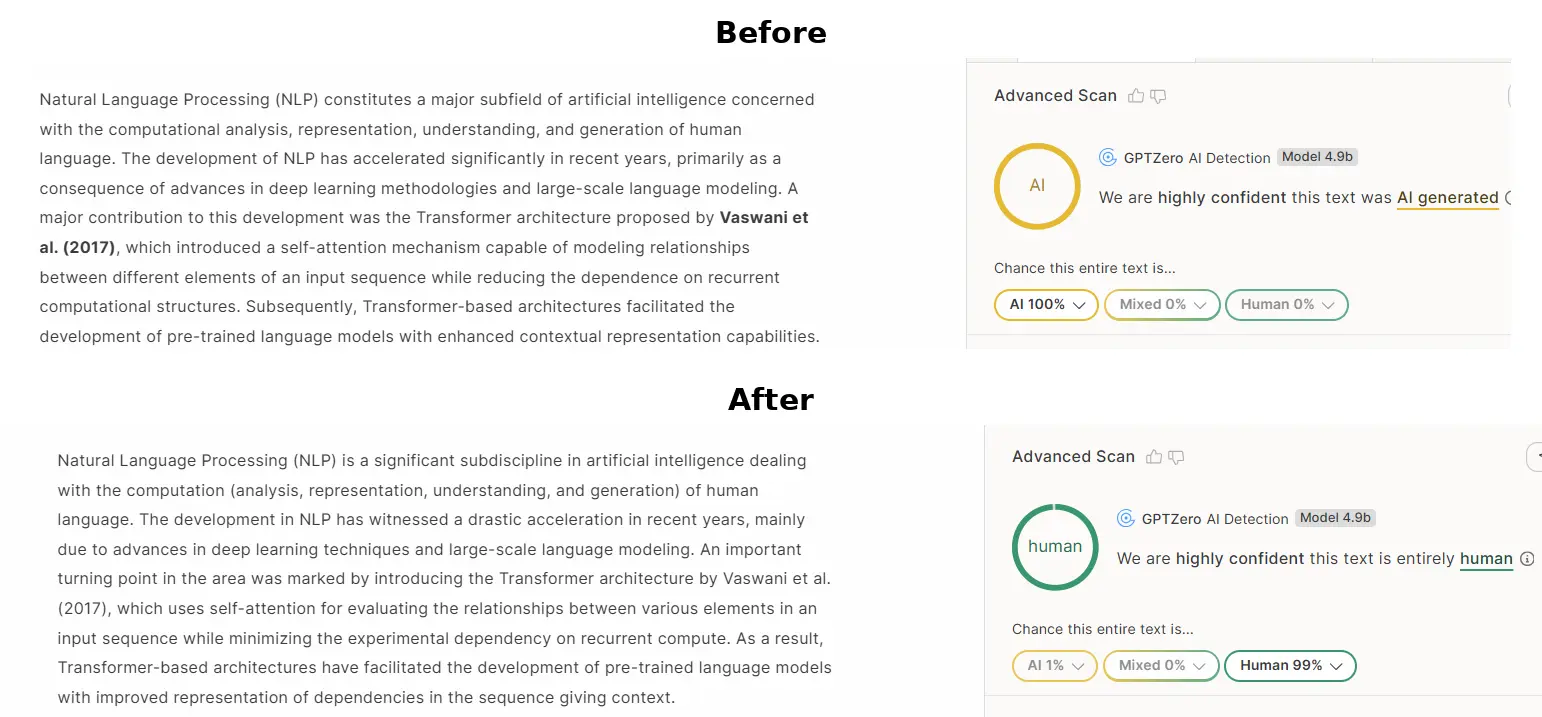
3. GPTZero Verification: Passing Perplexity & Burstiness Checks
GPTZero evaluates text by plotting sentence perplexity curves and global burstiness scores. When raw AI text is scanned, low sentence variance produces an immediate high-probability warning. ThesisHuman restores natural sentence entropy by restructuring syntax, varying clause lengths, and introducing authentic scholarly cadence, dropping AI probability to 0%.
4. Originality.ai Verification: 0% AI Confidence
Originality.ai flags predictable n-gram sequences and common AI clichés (such as “delving into,” “pivotal role,” “testament to”). ThesisHuman purges overused formulaic transitions while elevating scholarly tone and keeping reference numbers and equations intact, producing 100% Original / 0% AI results.