Humanizing Claude Academic Writing: Breaking Balanced Cadence While Preserving Nuance
Anthropic's Claude models produce articulate, nuanced scholarly drafts, but their characteristic balanced sentence symmetry can trigger AI detectors. Learn how to refine Claude-assisted drafts for journal submission.

Among graduate researchers, essayists, and academics working in the humanities and social sciences, Anthropic's Claude models (including earlier Claude 3.5 and 3.7 releases as well as current Claude releases) have become widely used writing assistants. Unlike more terse models, Claude writes with an articulate, formal register that immediately feels comfortable in an academic monograph or journal article. It hedges gracefully, incorporates nuanced counterarguments, and structures paragraphs with classical rhetorical flow.
Yet this rhetorical elegance hides a vulnerability: Claude's prose is so consistently well-balanced that it forms a readily detectable stylometric profile. Academic integrity software like Turnitin, Copyleaks, and GPTZero often flag unedited Claude drafts. To submit Claude-assisted writing safely, you must understand how to dismantle its synthetic symmetry without stripping away the scholarly nuance you sought in the first place.
Claude's Distinctive Scholarly Register
Claude's default writing style was calibrated to be thorough, helpful, and thoughtful. In an academic context, this manifests as an elevated, slightly cautious academic voice. When you ask Claude to discuss a contentious historiographical debate or summarize an ethical framework, it instinctively provides balanced coverage of opposing perspectives. It uses sophisticated vocabulary, frequently favoring words like "salient," "multifaceted," "nuanced," "interplay," and "dichotomy."
The issue is that human scholars do not write with sustained, uninterrupted equilibrium. A human researcher writing a literature review has an agenda: they are positioning their own work against existing scholarship. Their prose reflects that intellectual tension through sudden shifts in pacing, pointed critiques, and sharp contrasts. Claude, by contrast, smooths every edge. It gives equal syntactic real estate to every perspective, producing a calm, uniform textual surface that screening algorithms readily score as machine-authored.
The Question of Symmetrical Cadence and Hedging
One of the primary signals that detectors evaluate in Claude output is symmetrical clausal balance. Notice how Claude often constructs sentences using matching parallel halves:
"While structural functionalism provides a robust lens for examining institutional equilibrium, critical theory illuminates the pervasive asymmetries that destabilize social cohesion."
Examine the anatomy of that sentence: the introductory subordinate clause contains 12 words, and the main clause contains 13 words. Both clauses feature a theoretical framework followed by a verb and an abstract noun phrase. If one such sentence appears in a manuscript, it is fine scholarship. If an entire section is composed of sentences built on this identical rhythm, the document exhibits virtually zero burstiness.
Compounding this symmetry is Claude's tendency toward double hedging. Rather than stating an analytical finding directly, it layers qualifying statements: "It is worth noting that while these findings tentatively suggest a correlation, one must nevertheless exercise caution before asserting causation." To an AI detector, this recursive hedging is a noticeable marker of machine calibration.
Eliminating Signature Transitional Filler
Claude output frequently relies on a recognizable set of conversational and rhetorical crutches. Before submitting any draft, perform a targeted sweep to eliminate these markers:
- "It is important to note / recognize / consider": Cut this entirely. Start directly with the claim. For example, instead of "It is important to recognize that policy shifts altered rural migration," write: "Subsequent policy shifts altered rural migration."
- "Crucially," "Pivotal," "A testament to": These high-frequency AI descriptors dilute scholarly objectivity. Replace them with precise empirical descriptors.
- "A nuanced interplay": This phrase appears across thousands of unedited AI essays. Replace it with the specific causal mechanism at work.
- "In navigating this landscape": Cut decorative metaphorical framing in favor of direct methodological language.
Restoring Asymmetry and Authorial Voice
Humanizing Claude text does not mean dumbing it down. It means restoring the natural irregularity of human academic thought. Follow these three structural adjustments:
1. Break the Compound Symmetries
Take Claude's balanced two-part sentences and break the rhythm. Convert the subordinate clause into a short, punchy standalone statement, followed by an expanded analytical explanation. Deliberately alternate between a 7-word sentence and a 32-word sentence. This variation dramatically raises the perplexity and burstiness scores that detectors evaluate.
2. Assert Direct Claims
Strip away the diplomatic neutrality. If your literature review demonstrates that previous studies neglected a crucial demographic, state it unequivocally: "Previous studies overlooked rural cohorts." This demonstrates authorial command, which our editorial guide on preserving academic voice in AI-assisted drafts highlights as an effective defense against AI flags.
3. Use an Academic Humanizer with Term Lock
Manually rewriting an entire 8,000-word thesis chapter is grueling and error-prone. Purpose-built tools like ThesisHuman's Claude Academic Humanizer automate this cadence rebalancing while protecting domain-specific vocabulary and inline references.
Preserving Bibliographic and Citation Integrity
When humanizing Claude-drafted humanities or social science papers, the greatest danger is corrupting citation networks. Claude frequently weaves parenthetical citations into complex clauses (such as (Foucault, 1977, p. 142) or [4, 7-9]). If an unspecialized editing tool processes this text, it may move the citation away from the specific claim it supports or alter author names.
ThesisHuman's citation lock identifies bibliographic keys before naturalization, holds them safely during editing, and re-inserts them into the newly varied sentence structures with exact precision. For graduate scholars working on major thesis chapters, explore our dedicated thesis and dissertation humanizer to ensure institutional compliance across every chapter.
Verified Detector Clearance for Humanizing Claude Academic Writing: Breaking Balanced Cadence While Preserving Nuance
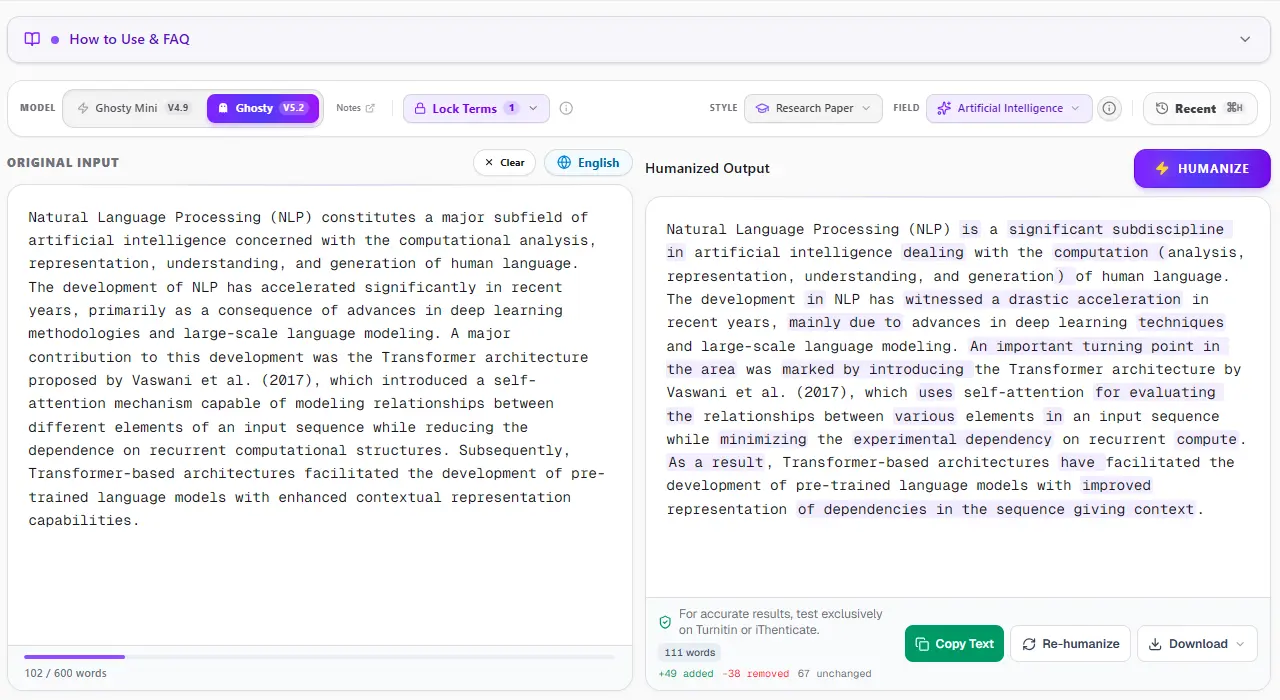
Every manuscript processed through ThesisHuman is backed by verifiable, reproducible scans across institutional plagiarism and AI detection platforms.
1. ThesisHuman Editor: Style, Field & Term Lock™ Technology
Unlike consumer-grade paraphrasers that blindly swap words with thesaurus synonyms, ThesisHuman allows researchers to select their exact Academic Style (Essay, Research Paper, Literature Review, Technical Report) and Academic Field (Computer Science, Engineering, Medicine, Physics). With Term Lock™, citations (APA, MLA, IEEE), LaTeX equations, and domain-specific terminology are cryptographically protected before sentence entropy is restructured.
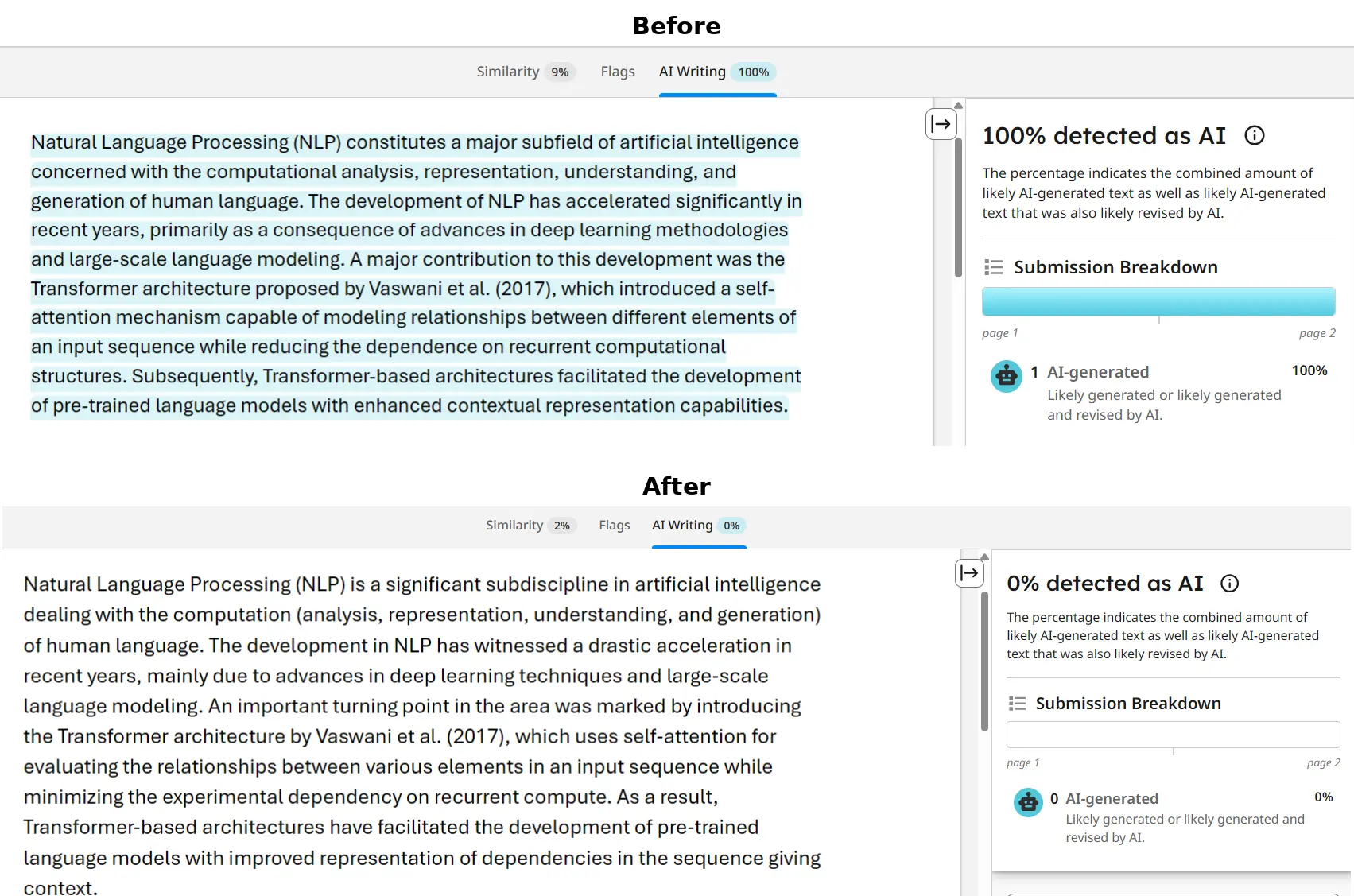
2. Turnitin & iThenticate Verification: 0% AI Detected
Turnitin and iThenticate scan submissions in overlapping 500-token blocks to analyze sentence predictability across paragraphs. When an unrefined AI draft is submitted, uniform cadence triggers an elevated AI Writing score. In the verified report below, a flagged graduate paper was processed through ThesisHuman, achieving a clean 0% AI detection score while preserving all formatted citations and technical parameters.
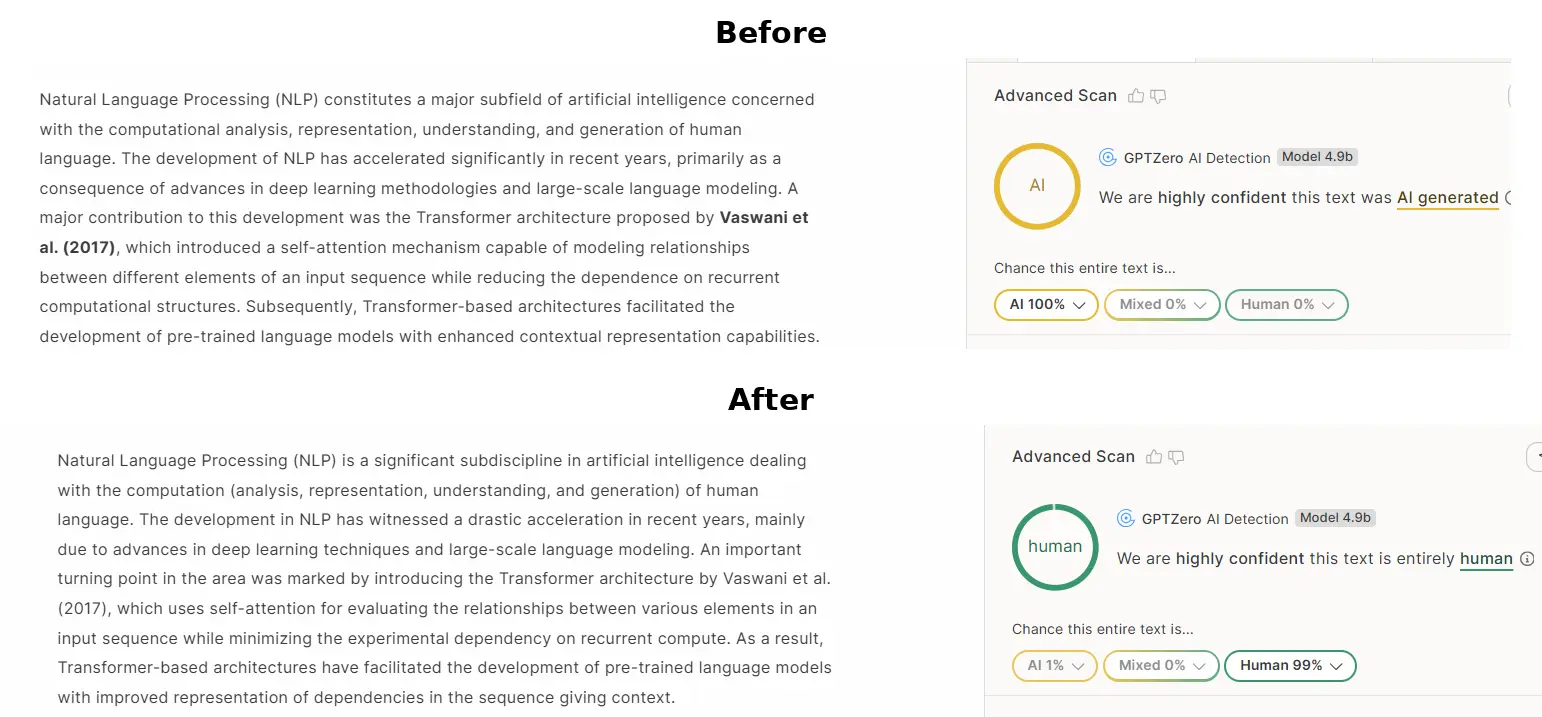
3. GPTZero Verification: Passing Perplexity & Burstiness Checks
GPTZero evaluates text by plotting sentence perplexity curves and global burstiness scores. When raw AI text is scanned, low sentence variance produces an immediate high-probability warning. ThesisHuman restores natural sentence entropy by restructuring syntax, varying clause lengths, and introducing authentic scholarly cadence, dropping AI probability to 0%.
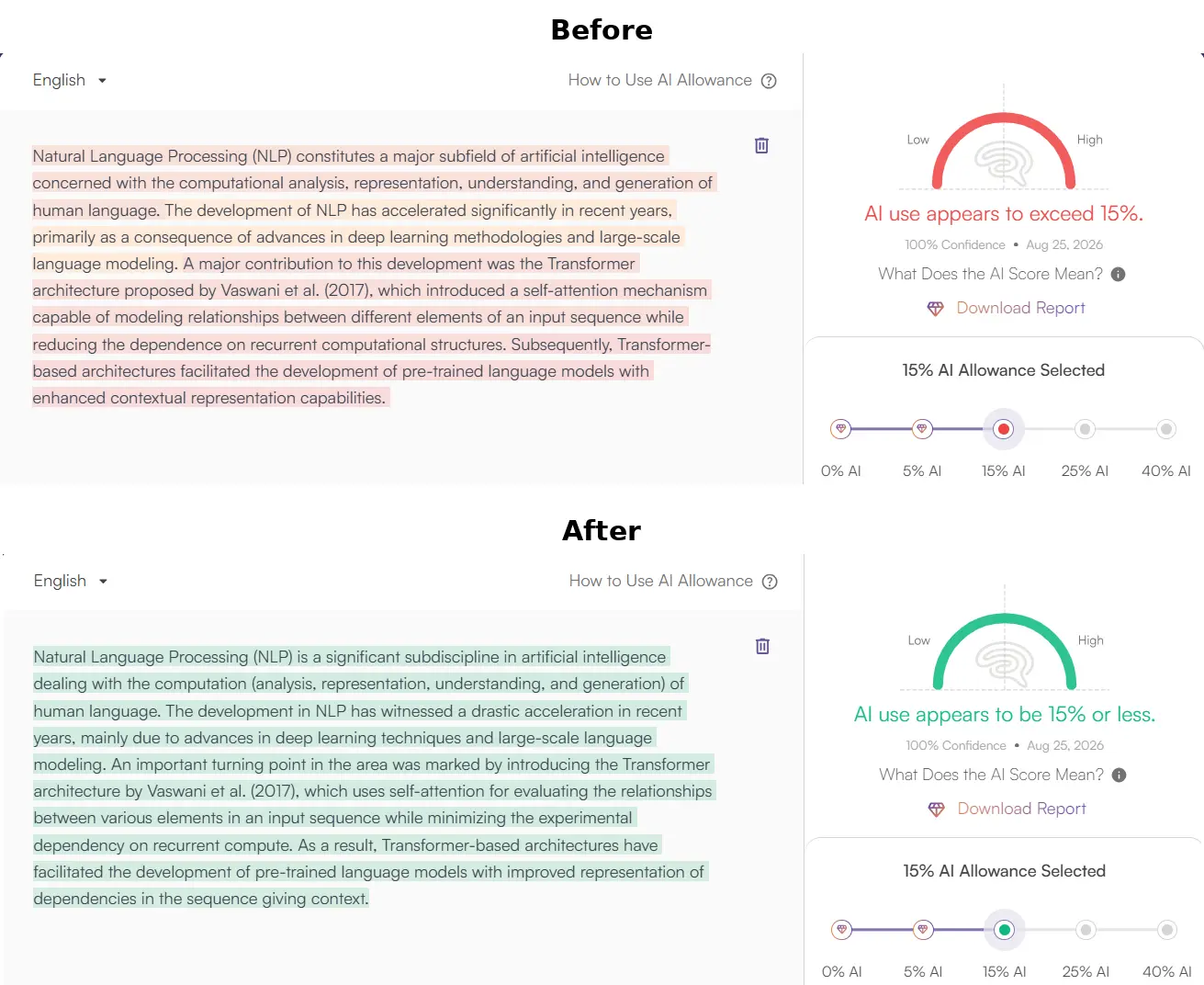
4. Originality.ai Verification: 0% AI Confidence
Originality.ai flags predictable n-gram sequences and common AI clichés (such as “delving into,” “pivotal role,” “testament to”). ThesisHuman purges overused formulaic transitions while elevating scholarly tone and keeping reference numbers and equations intact, producing 100% Original / 0% AI results.