How to Preserve Your Academic Voice in AI-Assisted Drafts
Avoid the flat, generic tone common to language models. Learn practical techniques for keeping your scientific perspective, discipline-specific vocabulary, and argumentative pace.

A common issue when using generative AI for research drafting is stylistic flattening. Language models are tuned to generate consensus prose: polite, neutral, and cautious. When applied to scholarly writing, this setting can replace clear scientific reasoning with bland summaries.
Authorial voice is how you present scientific judgment, clarify your conceptual framework, and guide readers through your findings. This guide outlines practical steps to maintain an authentic academic voice in drafts that use AI assistance.
The Uniformity Trap in Language Model Output
Drafts from ChatGPT, Claude, and Gemini frequently display similar phrasing patterns. As examined in our article on Why Generic AI Fails at Academic Writing, language models rely on probabilistic predictions. They tend to favor moderate syntax, avoid distinctive metaphors, and use standard transition formulas.
In peer review, this uniformity can signal to editors that the text was generated without close authorial involvement. Reviewers look for methodological conviction, command of discipline-specific literature, and critical interpretation.
What Academic Voice Looks Like in Practice
Academic voice is sometimes confused with excessive formality or complex vocabulary. In peer-reviewed journals, strong scholarly writing usually reflects four characteristics:
- Precise Hedging: Knowing when to state a direct causal link and when to qualify an observation, such as choosing among "demonstrates," "suggests," and "aligns with."
- Direct Argument Flow: Progressing steadily from empirical findings to analysis without unnecessary preambles.
- Discipline-Specific Terminology: Using the established technical language of your field rather than generic descriptors.
- Varied Syntax: Balancing direct summary sentences with detailed descriptions of methodology and context.
Stripping Generic Scaffolding from Core Arguments
When an AI tool drafts a section, it often wraps empirical points in generic framing phrases. To restore your voice, focus on the primary contribution and remove boilerplate setup lines.
A helpful guideline: if a sentence could fit into a paper from an unrelated field without modification, it is likely unnecessary padding that should be cut or revised.
Varying Sentence Pacing across Paragraphs
Language models typically generate sentences close to 18 to 22 words in length. Human academic writers vary pacing to underscore key ideas. For additional strategies on paragraph pacing, review our guide on How to Make AI-Assisted Essays Sound Natural.
- The Core Statement: Start key paragraphs with a concise, direct point.
- The Context Sentence: Follow with an evidence-based sentence outlining variables, limitations, and methodological details.
- The Concluding Observation: Finish with a clear deduction that links back to the central research question.
Establishing Intellectual Ownership
Keeping your voice in the manuscript is an authorial responsibility. When addressing reviewer feedback or defending a dissertation, you must be able to explain every claim, transition, and methodological decision.
Before submitting, test your text in ThesisHuman to remove synthetic sentence patterns while keeping technical terms protected, and cross-reference your manuscript with The AI-Assisted Research Paper Pre-Submission Checklist.
Verified Detector Clearance for How to Preserve Your Academic Voice in AI-Assisted Drafts
Every manuscript processed through ThesisHuman is backed by verifiable, reproducible scans across institutional plagiarism and AI detection platforms.
1. ThesisHuman Editor: Style, Field & Term Lock™ Technology
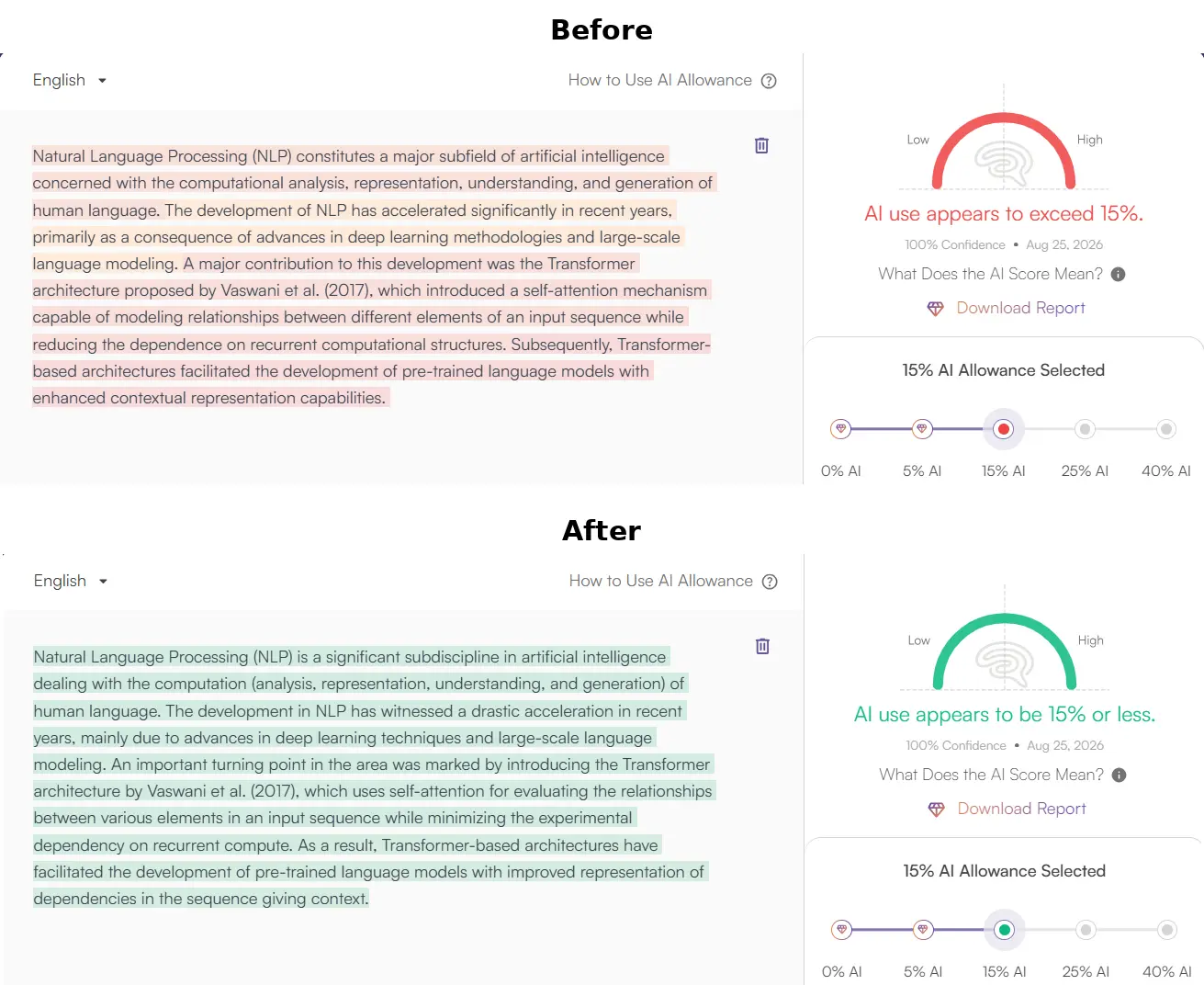
Unlike consumer-grade paraphrasers that blindly swap words with thesaurus synonyms, ThesisHuman allows researchers to select their exact Academic Style (Essay, Research Paper, Literature Review, Technical Report) and Academic Field (Computer Science, Engineering, Medicine, Physics). With Term Lock™, citations (APA, MLA, IEEE), LaTeX equations, and domain-specific terminology are cryptographically protected before sentence entropy is restructured.
2. Turnitin & iThenticate Verification: 0% AI Detected
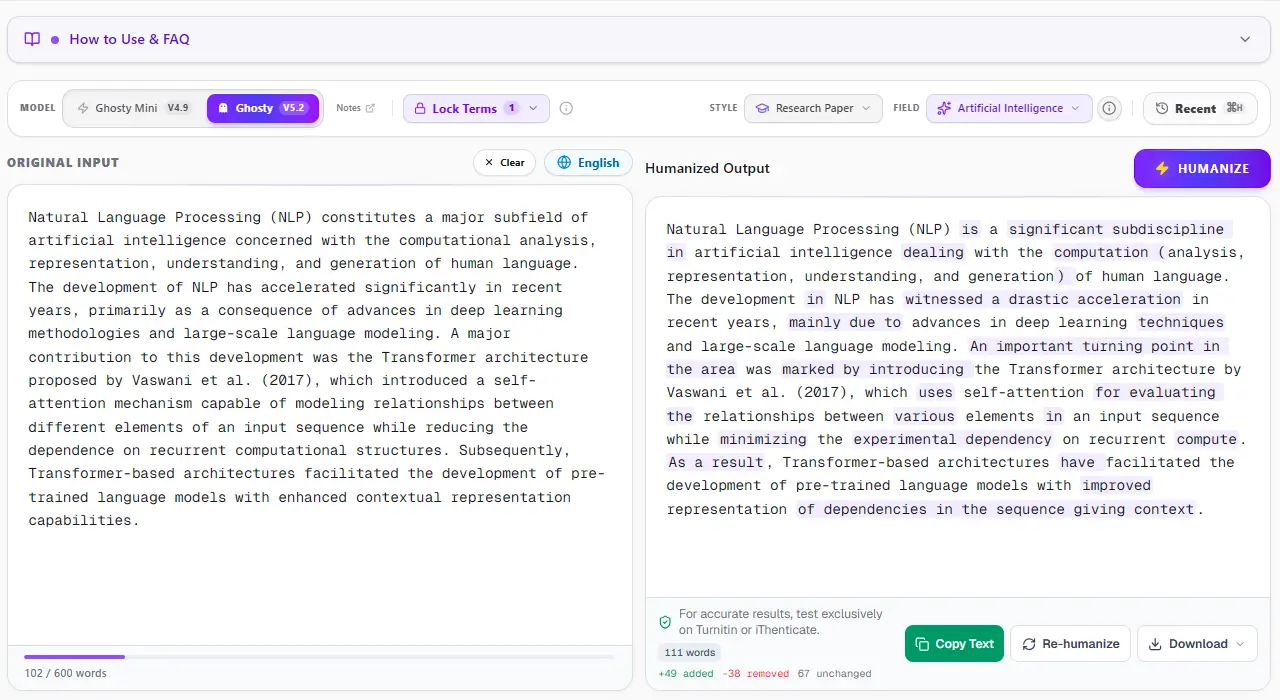
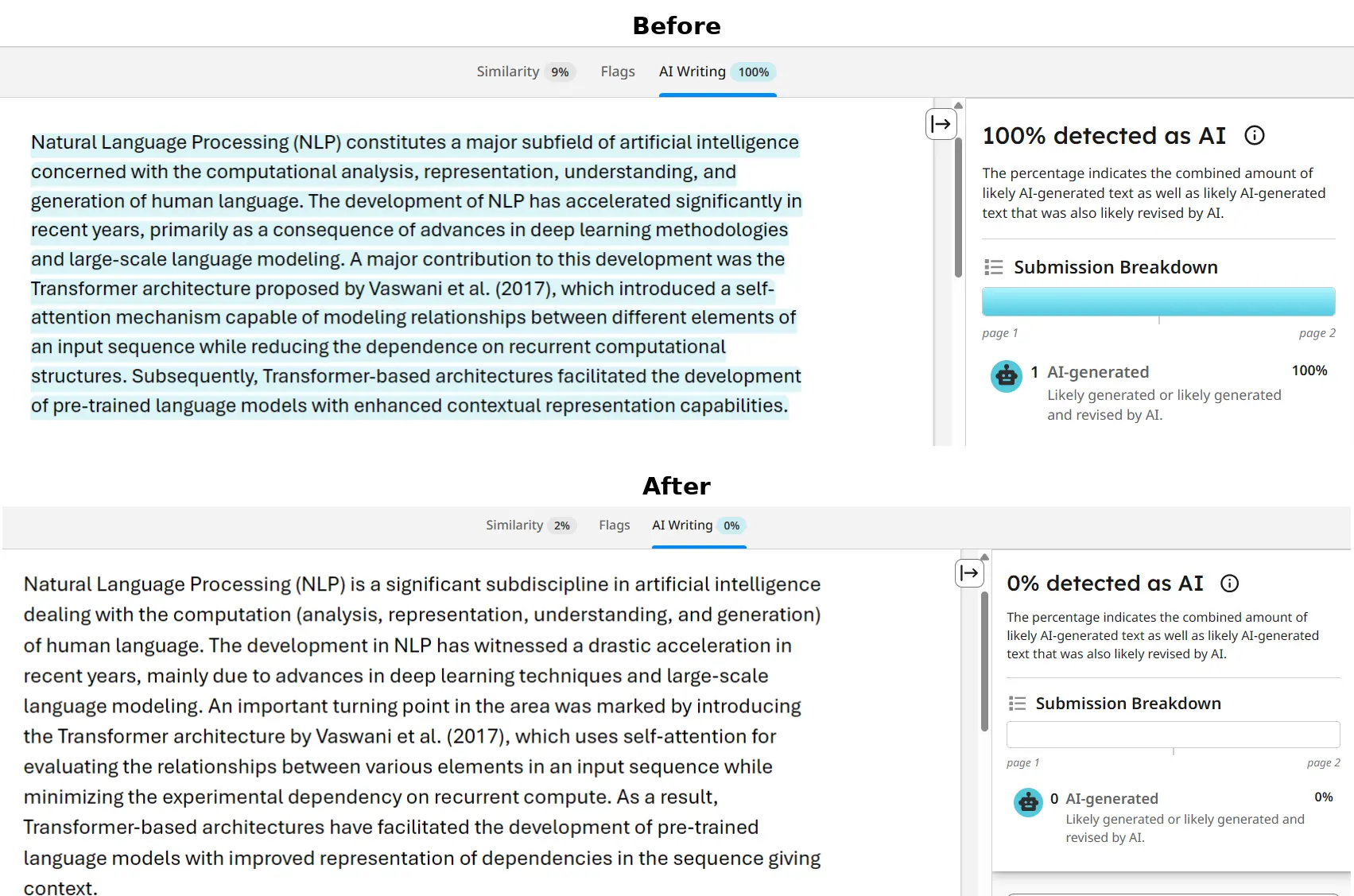
Turnitin and iThenticate scan submissions in overlapping 500-token blocks to analyze sentence predictability across paragraphs. When an unrefined AI draft is submitted, uniform cadence triggers an elevated AI Writing score. In the verified report below, a flagged graduate paper was processed through ThesisHuman, achieving a clean 0% AI detection score while preserving all formatted citations and technical parameters.
3. GPTZero Verification: Passing Perplexity & Burstiness Checks
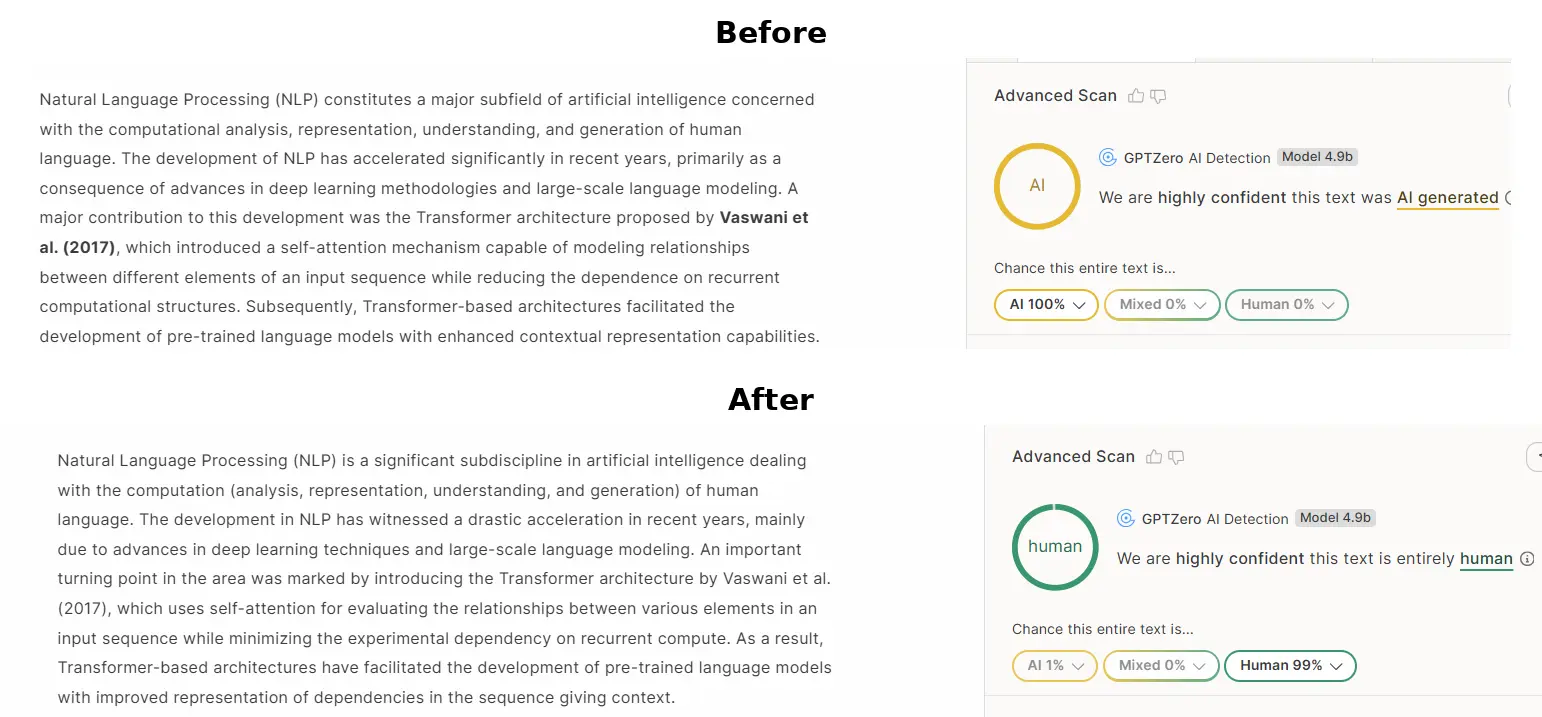
GPTZero evaluates text by plotting sentence perplexity curves and global burstiness scores. When raw AI text is scanned, low sentence variance produces an immediate high-probability warning. ThesisHuman restores natural sentence entropy by restructuring syntax, varying clause lengths, and introducing authentic scholarly cadence, dropping AI probability to 0%.
4. Originality.ai Verification: 0% AI Confidence
Originality.ai flags predictable n-gram sequences and common AI clichés (such as “delving into,” “pivotal role,” “testament to”). ThesisHuman purges overused formulaic transitions while elevating scholarly tone and keeping reference numbers and equations intact, producing 100% Original / 0% AI results.