How to Humanize DeepSeek Research Drafts for Academic Submission
DeepSeek models excel at mathematical derivation and literature synthesis, but their structured reasoning patterns and deductive scaffolding can trigger detector flags. Learn how to naturalize DeepSeek academic prose without compromising technical rigor.

Since the widespread adoption of DeepSeek-R1 in early 2025 and subsequent releases including the V3 and V4 model families, this open-weight series has become a staple across computational sciences, mathematics, and graduate engineering departments. Researchers value DeepSeek for its rigorous step-by-step derivations, its competence in synthesizing dense technical literature, and its low computational overhead. Yet when researchers incorporate DeepSeek-assisted sections into journal manuscripts or dissertation chapters, they frequently encounter an unwelcome obstacle: elevated AI probability scores on iThenticate, Turnitin, and Copyleaks.
The issue is not that the science is invalid. The issue is that DeepSeek models leave an identifiable statistical imprint in their prose rhythm. This guide examines why DeepSeek academic output triggers modern screening engines, why conventional synonym-swapping tools make the problem worse, and how to safely naturalize your draft using an academic humanization workflow that keeps your LaTeX equations and bibliographic citations completely intact.
The DeepSeek Paradox in Academic Drafting
The foundational DeepSeek-R1 work demonstrated that reinforcement learning can cultivate formidable mathematical and reasoning capabilities. For researchers, this means DeepSeek is remarkably capable of synthesizing complex proofs, explaining algorithmic convergence, and summarizing domain literature. Unlike purely conversational models, it approaches text as an orderly sequence of logical steps.
However, this strength in deductive logic is precisely what compromises its prose under stylometric analysis. Modern academic AI detectors do not evaluate conceptual validity; they measure token perplexity and burstiness. Because DeepSeek generates explanations along predictable linguistic paths, its perplexity curve remains relatively flat. In a human-authored paper, sentences alternate between compact assertions and sprawling, subordinate-clause-heavy explanations. In DeepSeek prose, sentence lengths often cluster tightly around similar word counts, producing a rhythmic regularity that screening algorithms flag quickly.
Common Structural Patterns in DeepSeek Academic Drafts
To successfully humanize DeepSeek-assisted research writing, you should recognize the specific structural habits that modern classifiers identify:
1. Structured Deductive Scaffolding
DeepSeek drafts frequently organize arguments using overt ordinal sequencing: "Firstly, the data indicates... Secondly, it is apparent that... Furthermore, we must acknowledge that... Consequently, this demonstrates..." While logically transparent, this rigid scaffolding is rare in published peer-reviewed prose, where authors naturally vary transitions and let empirical findings dictate thematic progression.
2. Symmetrical Clausal Weight
When explaining complex phenomena, DeepSeek often constructs compound sentences where each clause possesses approximately equal syllabic and syntactic weight. For example: "The proposed algorithm minimizes computational latency across distributed nodes, while the auxiliary caching protocol ensures deterministic memory allocation." A human researcher typically writes with greater clausal asymmetry, perhaps front-loading the operational challenge or appending a practical caveat.
3. Standardized Formal Phrasing
DeepSeek output frequently draws from a recurring set of Latinate transitions and evaluative adjectives: "paramount importance," "comprehensive framework," "crucial role," "pivotal milestone," and "delves into." Classifiers assign elevated machine probabilities to these exact multi-word n-gram sequences when they appear repeatedly in close proximity.
| Feature | Raw DeepSeek Output | Natural Academic Prose |
|---|---|---|
| Transition Style | Mechanical ordinals ("Firstly, Secondly") | Conceptual linkages ("In contrast to prior benchmarks") |
| Sentence Length Variance | Uniform lengths across consecutive sentences | Substantial variation mixing short statements and complex clauses |
| Hedging Mechanism | Generic boilerplate ("one must consider") | Disciplinary caveats ("subject to sample attrition") |
| Equation Integration | Formulaic introduction ("Equation 1 yields") | Contextual weaving ("Evaluating Eq. (1) across cohorts") |
Why Generic Paraphrasers Fail on DeepSeek Technical Papers
When researchers receive an elevated AI indicator score, their first instinct is often to paste the text into a consumer paraphrasing tool. In scientific writing, this approach introduces severe errors. Generic paraphrasers work by swapping individual words with dictionary synonyms. In a STEM or social science paper, this mechanism causes three major problems:
- Terminological Scrambling: A generic spinner transforms precise terms like "heteroskedasticity-consistent standard errors" into "varied-variance uniform errors," immediately signaling algorithmic corruption to peer reviewers.
- LaTeX Equation Destruction: Consumer tools do not parse TeX escape characters. They strip backslashes, convert inline variables
$x_i$into plain textxi, and corrupt alignment tags inalignblocks, rendering the source uncompilable in Overleaf. - Citation Syntax Corruption: Standard tools treat parenthetical citations (such as
[12]or(Smith & Doe, 2024)) as ordinary words, altering author names, mangling DOI strings, or separating citations from the claims they substantiate.
An academic AI humanizer does not replace words with synonyms. It restructures syntactic cadence and burstiness around frozen scientific terms, citations, and formulas.
A 4-Step Protocol to Naturalize DeepSeek Manuscripts
To prepare DeepSeek-assisted research for formal peer review or dissertation deposit, follow this systematic naturalization protocol:
Step 1: Isolate Equations and Citations with Term Lock
Before modifying any prose, ensure your mathematical notation and citation keys are protected. Using a purpose-built system like ThesisHuman's DeepSeek Academic Humanizer, in-text citations (IEEE, APA, Nature, Chicago) and LaTeX formula environments are isolated before processing. This ensures that while the narrative cadence is refined, not a single mathematical variable or bibliographic reference is altered.
Step 2: Dismantle Mechanical Deductive Chains
Locate instances where DeepSeek introduced arguments with "Firstly," "Secondly," or "Moreover." Replace these mechanical markers with thematic transitions that connect directly to your data. If paragraph one discusses computational latency and paragraph two addresses memory allocation, open paragraph two with: "Beyond processing latency, system memory constraints present an independent bottleneck." This simple structural shift raises burstiness and reflects genuine academic reasoning.
Step 3: Introduce Authentic Clausal Asymmetry
Examine paragraphs where sentences have uniform length. Combine two short observations into a single complex analytical sentence, followed immediately by a direct, declarative conclusion. For example, turn two evenly spaced sentences into:
- Raw DeepSeek: "The validation dataset demonstrates minimal variance across training cycles. This outcome indicates robust generalizability."
- Naturalized Academic: "Because the validation dataset exhibits minimal variance across consecutive training cycles, the model maintains generalizability under real-world domain shifts."
For section-by-section strategies across methodologies, discussions, and abstracts, review our guide on how to humanize AI text by document type.
Step 4: Pre-Screen with an Academic Integrity Engine
Never allow an editor's iThenticate run or university repository scan to be the first time your paper is evaluated. Pre-screen your manuscript using the research paper humanizer to ensure the statistical distribution aligns with human peer-reviewed baselines. If you also face Turnitin screening for thesis deposit, verify your draft against our dedicated Turnitin AI humanizer guidelines.
Ethical Disclosure and Journal Guidelines
Refining DeepSeek-assisted text is an editorial act, not an evasion trick. The Committee on Publication Ethics (COPE), along with publishers such as Elsevier, IEEE, and Springer Nature, explicitly acknowledge that generative AI can be legitimately employed for language editing, ideation, and literature scoping. The universal requirement across all major publishers is that authors remain fully accountable for scientific integrity and disclose the use of assistive tools in their submission statement.
When you humanize DeepSeek prose by restoring burstiness, varying cadence, and asserting your authorial voice, you align the draft with your genuine intellectual perspective. You transform raw algorithmic predictions into defensible scholarly prose that survives peer review, viva examinations, and institutional integrity inquiries.
Verified Detector Clearance for How to Humanize DeepSeek Research Drafts for Academic Submission
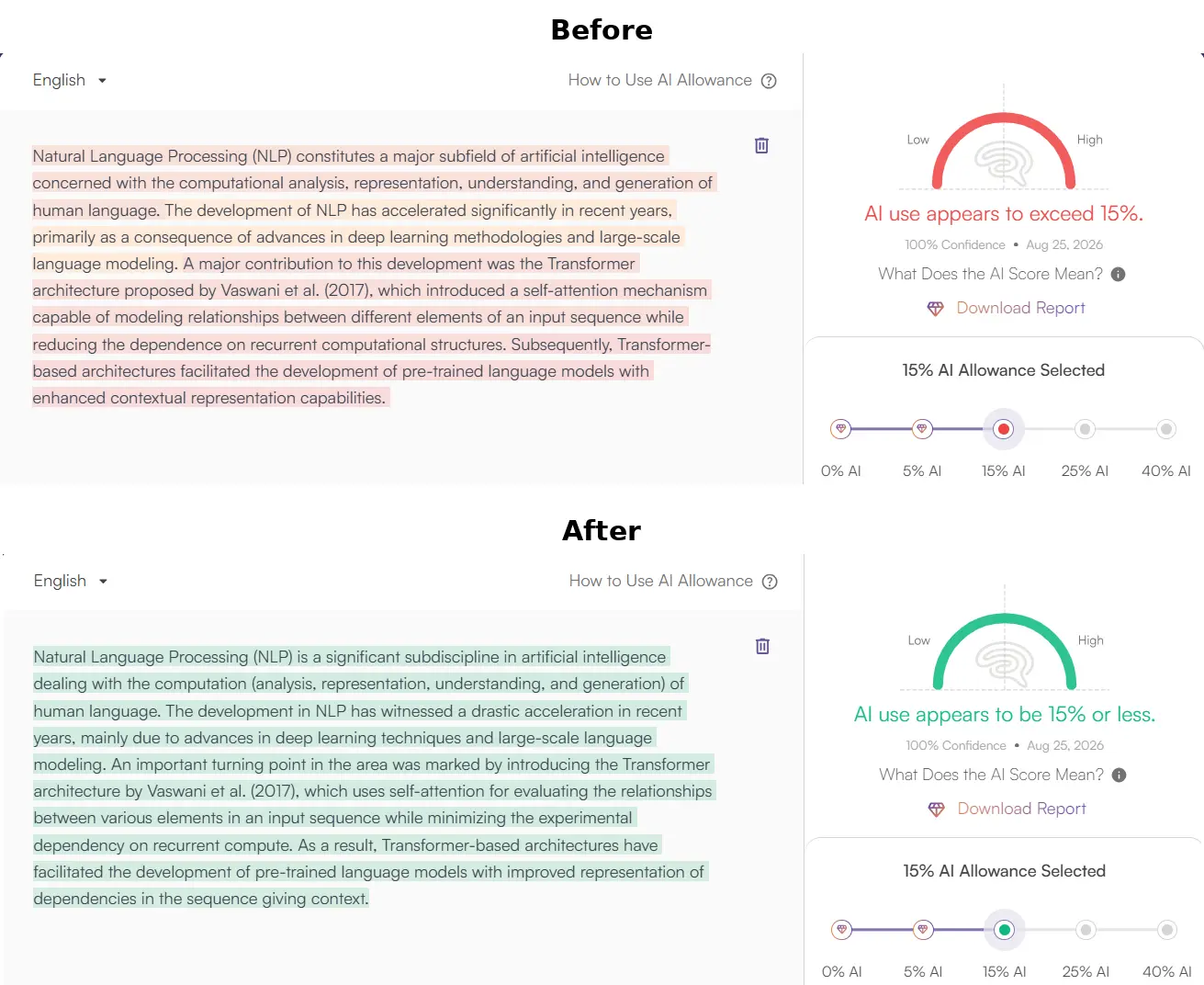
Every manuscript processed through ThesisHuman is backed by verifiable, reproducible scans across institutional plagiarism and AI detection platforms.
1. ThesisHuman Editor: Style, Field & Term Lock™ Technology
Unlike consumer-grade paraphrasers that blindly swap words with thesaurus synonyms, ThesisHuman allows researchers to select their exact Academic Style (Essay, Research Paper, Literature Review, Technical Report) and Academic Field (Computer Science, Engineering, Medicine, Physics). With Term Lock™, citations (APA, MLA, IEEE), LaTeX equations, and domain-specific terminology are cryptographically protected before sentence entropy is restructured.
2. Turnitin & iThenticate Verification: 0% AI Detected
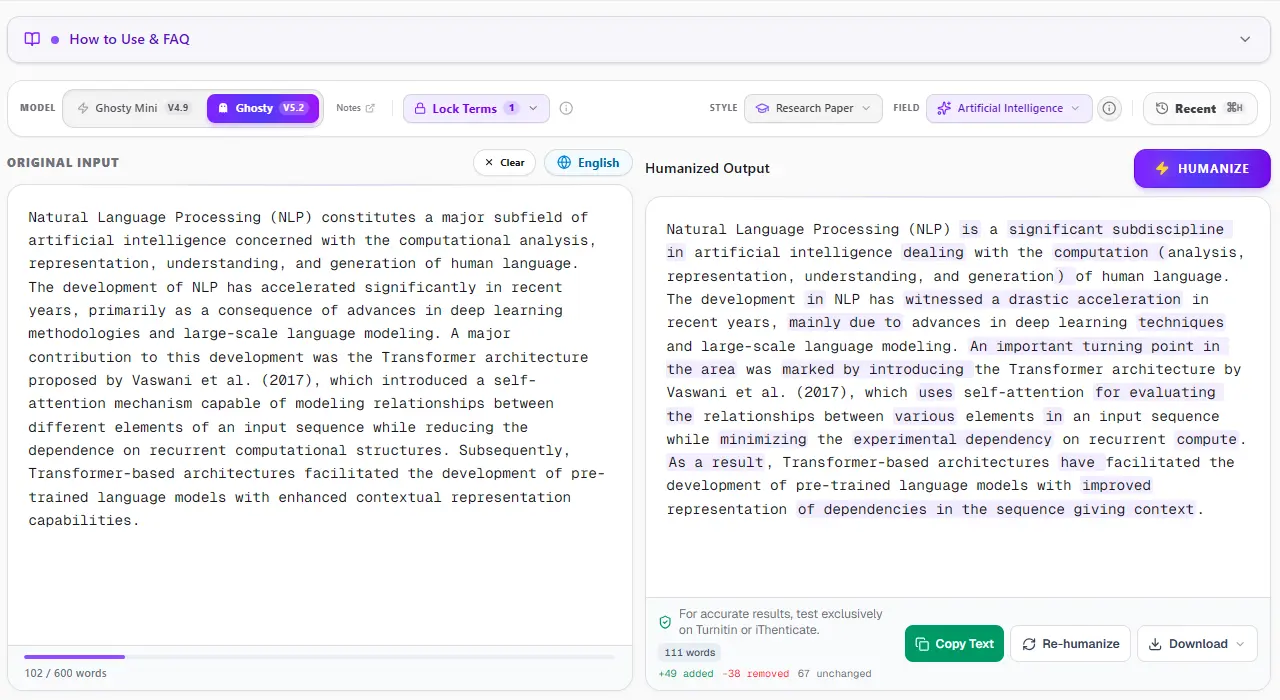
Turnitin and iThenticate scan submissions in overlapping 500-token blocks to analyze sentence predictability across paragraphs. When an unrefined AI draft is submitted, uniform cadence triggers an elevated AI Writing score. In the verified report below, a flagged graduate paper was processed through ThesisHuman, achieving a clean 0% AI detection score while preserving all formatted citations and technical parameters.
3. GPTZero Verification: Passing Perplexity & Burstiness Checks
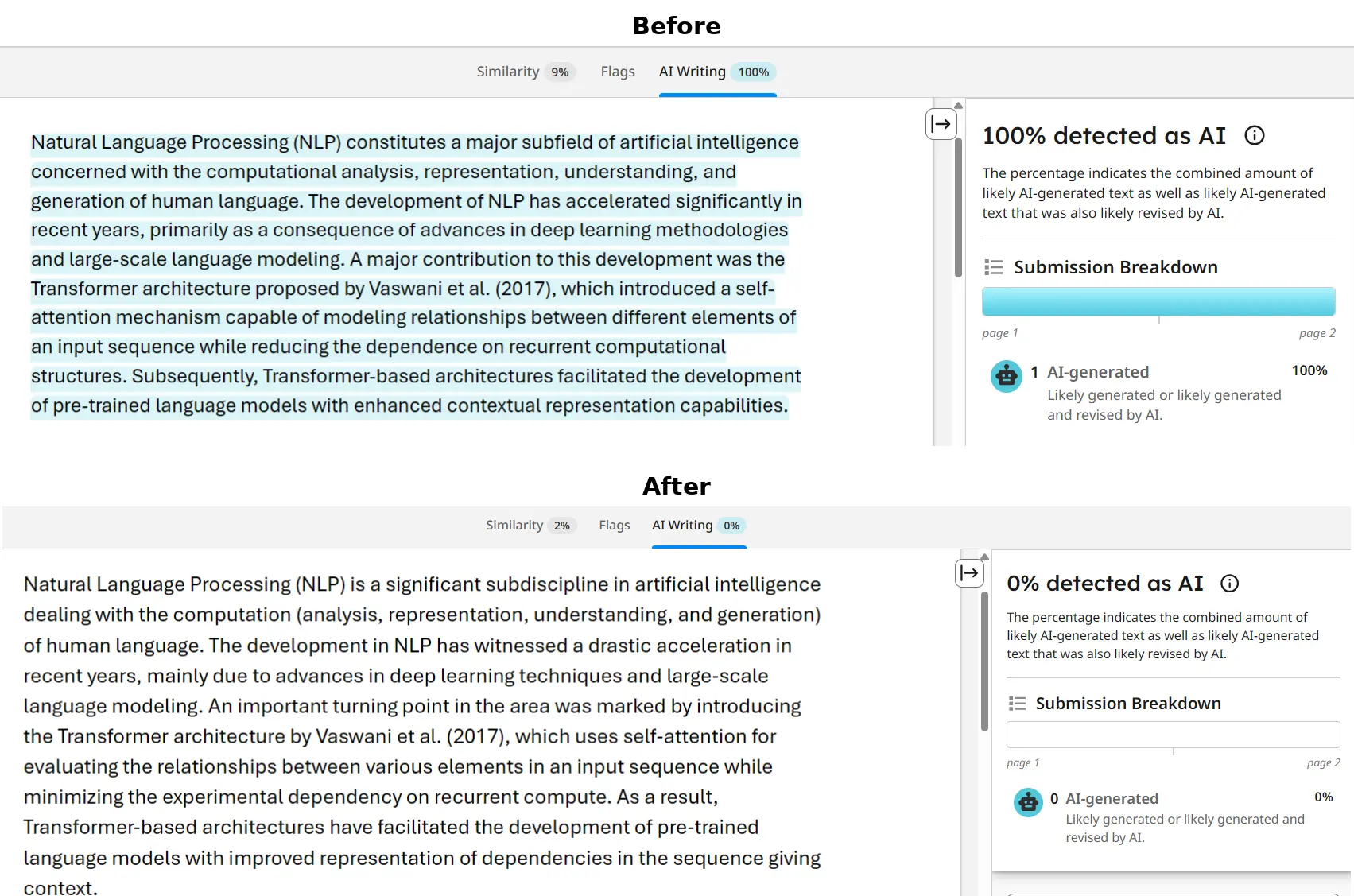
GPTZero evaluates text by plotting sentence perplexity curves and global burstiness scores. When raw AI text is scanned, low sentence variance produces an immediate high-probability warning. ThesisHuman restores natural sentence entropy by restructuring syntax, varying clause lengths, and introducing authentic scholarly cadence, dropping AI probability to 0%.
4. Originality.ai Verification: 0% AI Confidence
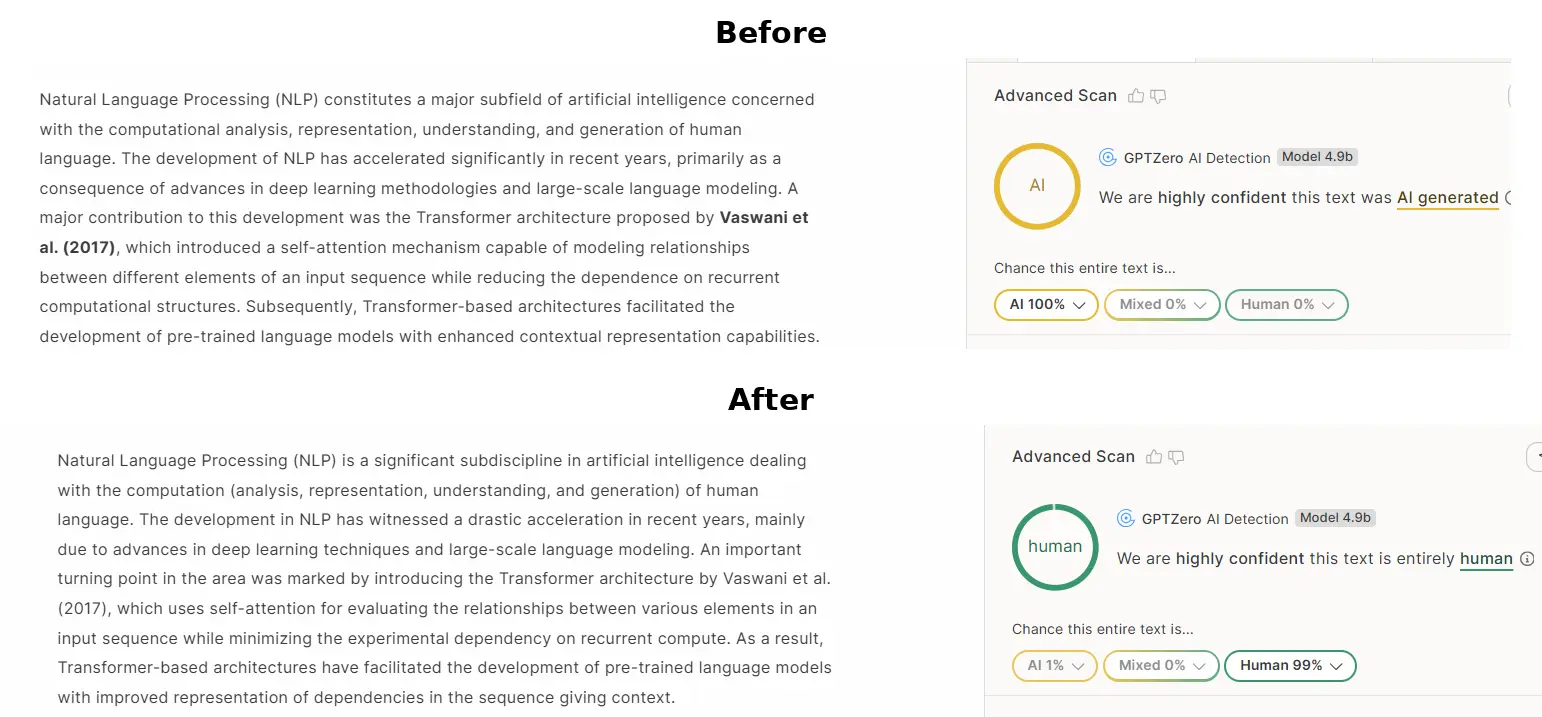
Originality.ai flags predictable n-gram sequences and common AI clichés (such as “delving into,” “pivotal role,” “testament to”). ThesisHuman purges overused formulaic transitions while elevating scholarly tone and keeping reference numbers and equations intact, producing 100% Original / 0% AI results.