How to Humanize AI Text by Document Type: Abstracts, Literature Reviews, Methodology, Discussion and Proposals
Every academic document type trips AI detectors for a different statistical reason. Learn the specific signal each one leaks and the targeted humanization fix that keeps your structure intact.

Most advice about humanizing AI-assisted academic writing treats a thesis as one undifferentiated block of prose. That is the single biggest reason researchers keep getting flagged even after they "humanize" their drafts. An AI detector does not score your document as a whole. It scores passages, often in sliding windows of a few hundred tokens, and different parts of a dissertation fail for completely different statistical reasons. An abstract gets flagged because it is over-compressed and unnaturally flat. A methodology section gets flagged because it is procedurally repetitive by necessity. A systematic review gets flagged because PRISMA reporting standards force a formulaic structure that happens to look exactly like machine output. The fix for one actively makes another worse.
This guide is the hub for a simple but underappreciated idea: humanization is document-type-specific. Below, for each major section of academic work, you will find the precise detection mechanism that catches it, why generic rewriting fails, and the targeted approach that lowers the AI signal without breaking factual accuracy or the rigid structure that reviewers and journals require. Each section links to a dedicated deep-dive so you can go as far down as you need.
Why Detection Is a Per-Document-Type Problem
AI text detectors are statistical classifiers, not plagiarism matchers. Tools like GPTZero, Originality.ai, and Copyleaks estimate how predictable your text is to a language model. The two workhorse signals are perplexity (how surprised a model is by your next word, on average) and burstiness (how much that surprise varies from sentence to sentence). Human academic writing tends to have moderate-to-high perplexity and high burstiness: we mix a dense 40-word sentence with a blunt 6-word one, we reach for an unexpected verb, we hedge inconsistently. Large language models, optimized to pick the locally most probable token, produce text with low perplexity and suspiciously even burstiness.
Here is the part that generic guides miss. Those two signals are not constant across a document. The baseline perplexity and burstiness of human-written text in each section differ enormously. A human-written abstract is naturally low-burstiness because the genre demands compression. A human-written discussion is naturally high-burstiness because argument is uneven. So a detector's threshold is effectively interpreted against your genre, and an LLM's flattening hurts you most precisely where human writing was already flat. That is why an over-humanized abstract still fails and a barely-touched discussion sometimes passes.
For the underlying machinery of how the two dominant academic systems turn these signals into a score and a report, see our deep dives on Turnitin AI Detection: How It Works and How to Pass It Safely and iThenticate AI Detection: The Complete Guide for Researchers and PhD Candidates. For a head-to-head on which tool catches what, see AI Detectors for Academic Writing Compared. This pillar assumes you understand the basics and focuses on the document-by-document strategy.
The mistake is treating "humanize my thesis" as one task. It is seven different tasks that happen to share a document. The signal you need to inject into an abstract is the opposite of the signal you need to inject into a methods section.
The Thesis Abstract: Over-Compressed and Statistically Flat
The abstract is the single most-flagged 250 words in any thesis, and the reason is structural. An abstract is a maximally compressed summary: it strips hedging, removes transitions, and packs one claim per sentence. That compression produces exactly the token distribution detectors associate with machine generation. Every sentence is roughly the same length, every sentence is declarative, and the vocabulary is high-frequency and generic ("This study investigates," "The results demonstrate," "These findings suggest"). Burstiness collapses toward zero, and because each sentence states the most expected next idea, perplexity drops too.
It gets worse when the abstract sits at the very top of the document, because some detection pipelines weight early passages heavily and because reviewers read it first and form a suspicion before reading anything else. A flagged abstract poisons the read of an otherwise clean thesis.
The Targeted Fix
You cannot solve a compression problem by adding words, because journals enforce strict abstract word limits and a padded abstract is a worse abstract. The fix is to redistribute, not inflate. Deliberately vary sentence length so a 28-word sentence sits next to an 11-word one. Front-load one sentence with a genuinely specific, lower-frequency detail from your actual results (a precise construct, an unusual sample frame, the exact analytical technique) so the local perplexity spikes where a generic template would have stayed flat. Replace at least one of the formula openers with a structure that no template generates. The goal is to raise burstiness inside a fixed word budget while keeping every factual claim intact.
This is delicate work because an abstract has the least margin for error of any section. Our full walkthrough, how to humanize an AI-written thesis abstract, shows the before-and-after at the sentence level and how to hit the variance target without exceeding a 250-word cap.
The Literature Review: Citation-Dense Uniformity
Literature reviews fail differently. They are not over-compressed; they are over-uniform. When an LLM synthesizes prior work, it falls into a repeating syntactic mold: "Smith (2020) argued that X. However, Jones (2021) found Y. Building on this, Lee (2022) proposed Z." The citations rotate but the sentence skeleton never changes. Detectors are sensitive to this kind of low-variance, high-template-fidelity prose because the inter-sentence transition probabilities are almost constant. The reviewer feels it too: the writing reads as a list of summaries rather than a synthesis with a point of view.
There is a second, subtler problem unique to AI-assisted reviews. Language models are prone to generating citations that are plausible but wrong, or attributing a finding to the wrong author. This is not a detection issue, it is an integrity issue, and it is the one that ends careers. COPE (the Committee on Publication Ethics) treats fabricated or misattributed references as a serious breach, and the same metadata infrastructure that powers reference checking, the DOI and citation records maintained by Crossref, makes it trivial for an editor to confirm whether a cited work actually exists. Humanizing a literature review without verifying every citation against the real source is malpractice, not a stylistic shortcut.
The Targeted Fix
- Break the citation-per-sentence rhythm. Cluster three sources that agree into one sentence, then spend two sentences on the single source that disagrees. Synthesis varies its density; summary does not.
- Move the citation around in the sentence. Sometimes lead with the author, sometimes bury the citation parenthetically after your own analytical claim. This alone destroys the template signature.
- Add a genuine evaluative voice. A human reviewer says a study was "underpowered," "surprisingly influential," or "rarely replicated." Those judgments are low-probability tokens that raise perplexity precisely because a model would not have inserted them.
- Verify every reference against the actual paper. Confirm the author, year, journal, and the specific claim. Never trust an AI-supplied citation.
Because this is the longest section in most theses and the most citation-dense, we split it into two guides: a structural walkthrough on humanizing an AI-generated literature review and a sentence-level guide on humanizing AI text for a literature review that focuses on the rewriting mechanics paragraph by paragraph.
The Methodology Section: Procedural Repetition by Design
A methods section is supposed to be repetitive. Reproducibility demands a fixed, parallel structure: participants, materials, procedure, analysis, each described in the same controlled register. Standardized phrasing is a feature, not a flaw, and reviewers expect it. The problem is that this required uniformity is statistically indistinguishable from machine output. Procedural prose has low perplexity (the next word in "Participants completed the questionnaire via" is highly predictable) and near-zero burstiness (every step is described in the same clipped, parallel form). Methods sections often score as the most "AI-like" passages in a manuscript even when a human wrote every word.
This creates a genuine trap. The features that make a method reproducible are the same features that trip the detector, and you are not allowed to sacrifice precision for stylistic variety. You cannot reword "2.5 mL of reagent" into something more "human." The dosage, the instrument, the statistical test, the inclusion criteria: all of it must stay exact.
The Targeted Fix
Humanizing a methodology is about varying the connective tissue while freezing the technical content. The values, units, instruments, and test names are load-bearing and never change. What you can change is how procedural steps are joined, sequenced, and motivated. Replace a chain of identical "We then..." sentences with a mix of subordinate clauses, occasional rationale ("to control for order effects, we counterbalanced..."), and varied sentence boundaries. Adding a brief, genuine justification for a methodological choice is the highest-value edit: it raises perplexity (it is unpredictable to a model) and simultaneously improves the science, because reviewers want to know why you chose a method, not just that you did.
| Element | Freeze (never touch) | Vary (humanize here) |
|---|---|---|
| Numeric values | Doses, sample sizes, p-values, thresholds, durations | Nothing |
| Named entities | Instruments, software, statistical tests, scales | Nothing |
| Step sequencing | The actual order of operations | How steps are joined and subordinated |
| Rationale | Nothing required | Add genuine "why" for key choices |
The full procedure, including a worked example of restructuring a repetitive protocol without altering a single measured value, is in our guide to humanizing an AI methodology section.
Results and Discussion: Where Flat Reporting Meets Argument
Results and discussion are two genres with opposite risk profiles, which is why they deserve to be handled as a pair. The results section is reporting: "Table 2 shows a significant main effect of condition." Like methods, it is naturally low-variance and often flags. The discussion, by contrast, is argument, and it is the one place where human writing is naturally bursty and high-perplexity. That makes the discussion the easiest section to humanize successfully and, paradoxically, the section where AI output looks most obviously machine-generated, because a model writes a discussion the same flat way it writes everything else.
An AI-drafted discussion betrays itself with hedged symmetry. It produces perfectly balanced "on one hand / on the other hand" structures, lists limitations in an even cadence, and never commits to a strong claim. Real researchers are lopsided. They argue hard for their main interpretation, dismiss one alternative in a single dismissive clause, and dwell on the one limitation that actually worries them. That asymmetry is high burstiness, and it is exactly what is missing from generated argument.
The Targeted Fix
In the results section, keep every number and statistic frozen and vary only the framing sentences around the tables and figures, the same freeze-and-vary discipline as methods. In the discussion, lean into genuine intellectual commitment. State which interpretation you actually believe and why. Connect a specific result back to a specific claim in your literature review rather than gesturing at "the existing literature." Let one limitation get three sentences while another gets half a clause. This is not stylistic decoration: an asymmetric, committed argument is both more human-looking and a better discussion. The strongest humanization signal you can add anywhere in a thesis is a real opinion defended with real evidence.
For the paragraph-level mechanics of converting hedged, symmetrical AI argument into committed scholarly prose, see our guide to humanizing an AI discussion section.
Research and Grant Proposals: Persuasion Under a Template
Proposals are a distinct problem because they are simultaneously templated and persuasive. A research proposal or grant application follows a rigid required structure (significance, aims, approach, budget justification, broader impacts) while needing to sound like a confident human who will deliver. AI-generated proposals fail on two fronts at once. The structure invites template-following, so the prose between headings reads as generic and interchangeable. And the persuasive register collapses into corporate-grant boilerplate: "This groundbreaking research will significantly advance the field." That sentence is pure low-perplexity filler, the kind of phrase a detector and a program officer both discount instantly.
There is a stakes asymmetry worth naming. A flagged thesis chapter is an awkward conversation with your supervisor. A grant proposal flagged for AI use, or simply written in unmistakable AI boilerplate, can sink funding you spent months pursuing, and some funders and publishers now ask authors to disclose AI assistance under policies aligned with COPE guidance and individual publisher rules from organizations such as Elsevier and IEEE. The bar for proposals is higher, not lower.
The Targeted Fix
- Replace generic significance claims with specific, falsifiable ones. Not "this will advance the field," but the precise gap your work closes and what becomes possible once it does. Specificity raises perplexity and persuades reviewers in the same stroke.
- Inject the personal stakes only a human author has: your prior pilot data, your lab's particular capability, the specific reason you are positioned to do this work. A model cannot invent your track record, so writing it in is inherently human.
- Vary register between sections. The significance section should sound urgent; the approach section should sound meticulous; the budget justification should sound dry and precise. AI output keeps one register throughout, which is itself a tell.
Because the research proposal and the grant proposal have different audiences and different failure modes, we treat them separately: see humanizing an AI research proposal for the academic-committee context and humanizing an AI grant proposal for the funder-facing persuasion and broader-impacts framing.
The Systematic Review: Formulaic by PRISMA Design
The systematic review is the hardest document type to humanize, and it is worth understanding why precisely. A systematic review is required to follow PRISMA reporting standards, which prescribe not just what to report but largely how to phrase it: the search strategy, the database list, the inclusion and exclusion criteria, the screening counts, the risk-of-bias assessment. The genre is engineered for reproducibility, which means it is engineered to be uniform, which means it produces the single flattest, most templated prose in all of academic writing. Detectors light up on it even when it is entirely human-written, because PRISMA-compliant text and machine-generated text share the same statistical fingerprint: low perplexity, near-zero burstiness, and high-frequency standardized vocabulary.
You cannot abandon the structure. The reporting standard is mandatory and reviewers will reject a review that deviates from it. So the freeze-list is enormous: search strings, database names, screening numbers, the PRISMA flow, the criteria, and the bias judgments are all immovable. This leaves the smallest humanization surface of any document type, and that constraint is exactly why generic "humanizer" tools mangle systematic reviews, because they rewrite the very elements that must stay fixed.
The Targeted Fix
Concentrate humanization in the narrow zones where PRISMA permits interpretation: the rationale for your inclusion criteria, the narrative synthesis of findings across studies, the discussion of heterogeneity, and the limitations of the evidence base. These are the parts where a human reviewer's judgment is supposed to show, and where varied, committed, specific prose is both allowed and expected. Leave the procedural reporting in its standardized form, because trying to "humanize" a search string or a screening count would break compliance and could distort the record. The skill is recognizing the boundary between the immovable reporting scaffold and the interpretive narrative laid over it, and pouring all your variance into the latter.
The full boundary map, showing exactly which PRISMA elements to freeze and which narrative zones to rewrite, is in our guide to humanizing an AI systematic review.
A Section-Aware Humanization Workflow
Pulling this together, the practical implication is that you should never run a whole thesis through a single pass with a single setting. Treat the document as a sequence of genres and handle each on its own terms. A reliable workflow looks like this:
- Segment first. Split the document into its genuine sections and identify the genre of each: compressed (abstract), synthetic (literature review), procedural (methods, results), and argumentative (discussion, proposal narrative).
- Build a freeze-list per section. Before touching anything, mark every load-bearing element: numbers, units, citations, named tests, search strings, screening counts. These never change, in any section, for any reason.
- Apply the genre-specific signal. Raise burstiness in flat sections by varying sentence length and adding specific detail; add committed argument in interpretive sections; vary connective tissue in procedural sections.
- Verify integrity last. Re-check every citation against its real source, confirm every number survived untouched, and read the result aloud. If it sounds like you defending your work to a skeptical examiner, it will read as human.
This is the logic built into the ThesisHuman editor: it detects which academic genre a passage belongs to and applies the right transformation instead of a one-size pass that flattens your numbers or scrambles your citations. The point is not to defeat detection by trickery. It is to restore the variance and the authorial voice that compression, templates, and reporting standards stripped out, while protecting the factual record that makes the work yours.
Detectors will keep evolving, and the specific thresholds will move. But the structural truth here is durable: academic genres impose statistical signatures that overlap with machine output, and the only defensible response is targeted, section-aware editing that adds real human judgment back into the writing. Start with whichever section is failing now, follow its dedicated guide, and bring the same discipline to the next. If you want to keep the whole-thesis view in mind as you go, the comparison of how the major academic detectors score each of these section types is the companion read to this hub.
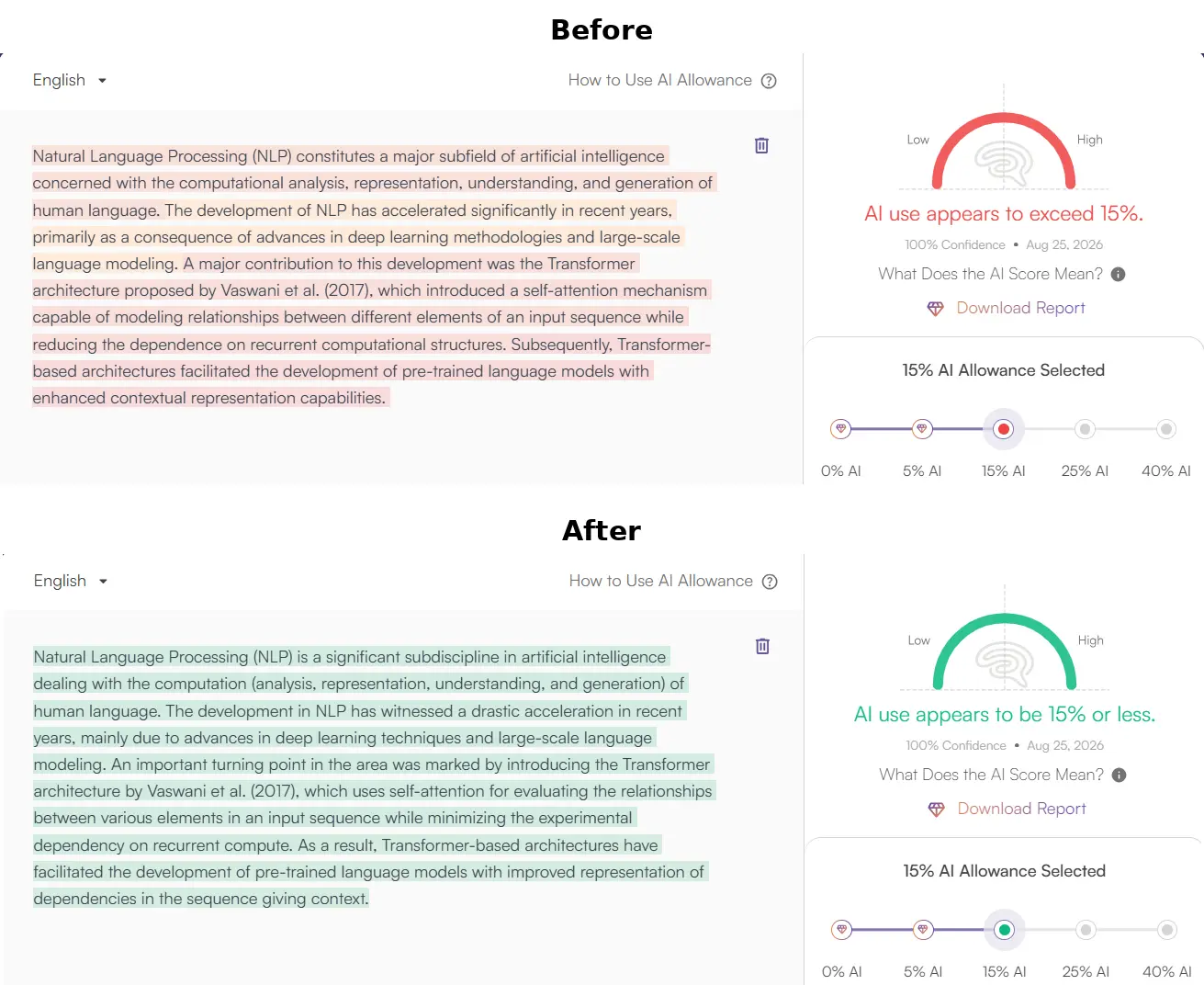
Verified Detector Clearance for How to Humanize AI Text by Document Type: Abstracts, Literature Reviews, Methodology, Discussion and Proposals
Every manuscript processed through ThesisHuman is backed by verifiable, reproducible scans across institutional plagiarism and AI detection platforms.
1. ThesisHuman Editor: Style, Field & Term Lock™ Technology
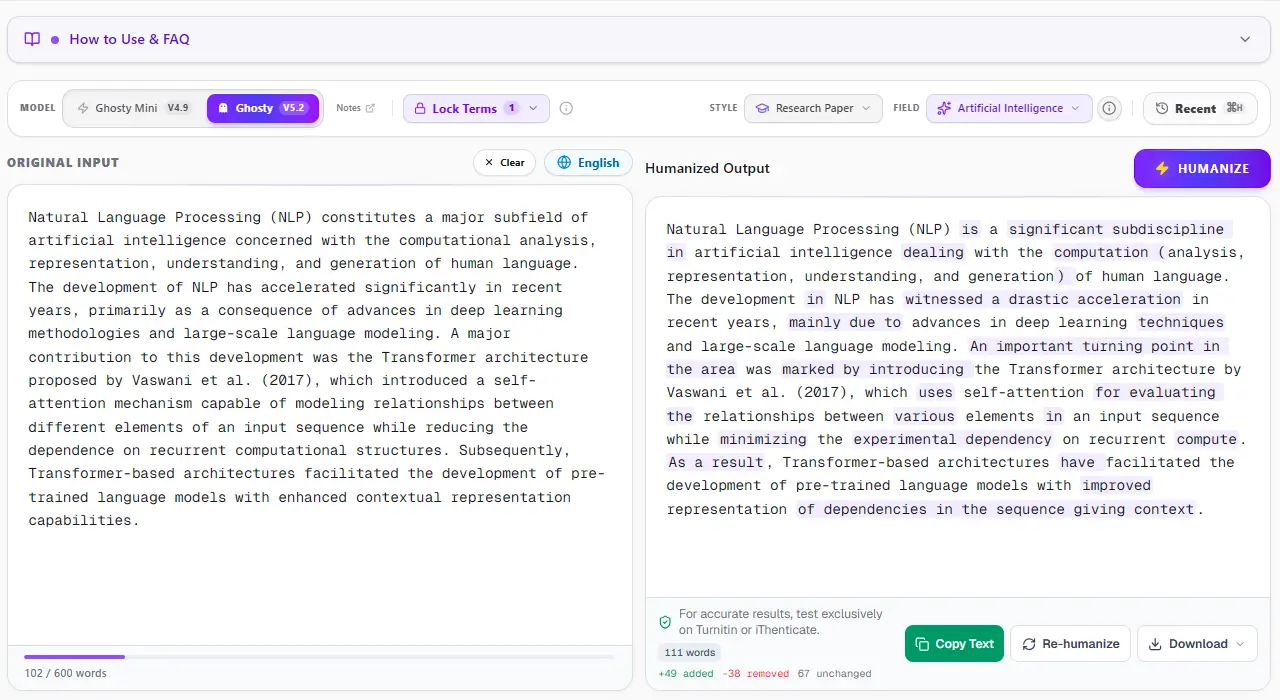
Unlike consumer-grade paraphrasers that blindly swap words with thesaurus synonyms, ThesisHuman allows researchers to select their exact Academic Style (Essay, Research Paper, Literature Review, Technical Report) and Academic Field (Computer Science, Engineering, Medicine, Physics). With Term Lock™, citations (APA, MLA, IEEE), LaTeX equations, and domain-specific terminology are cryptographically protected before sentence entropy is restructured.
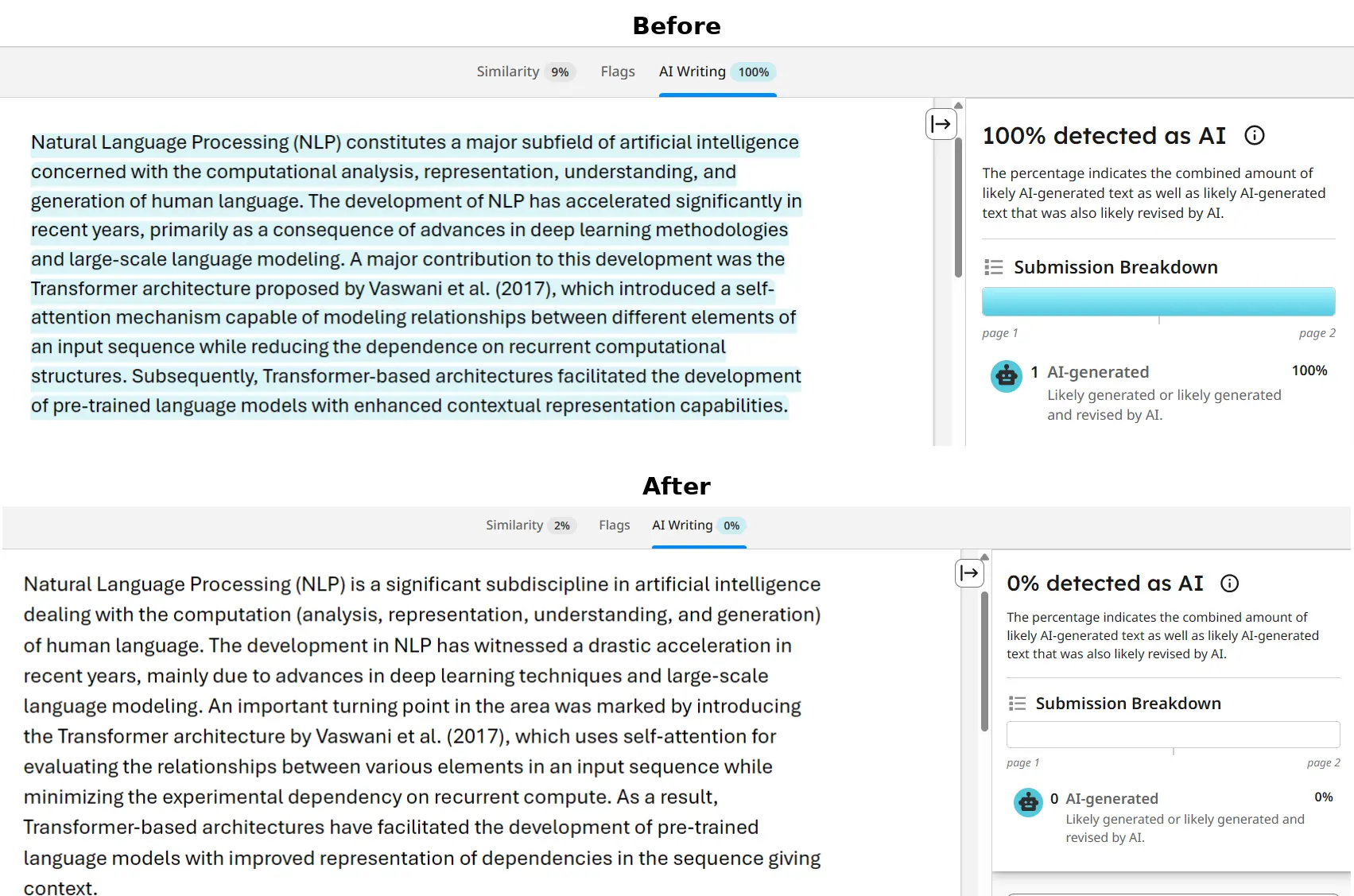
2. Turnitin & iThenticate Verification: 0% AI Detected
Turnitin and iThenticate scan submissions in overlapping 500-token blocks to analyze sentence predictability across paragraphs. When an unrefined AI draft is submitted, uniform cadence triggers an elevated AI Writing score. In the verified report below, a flagged graduate paper was processed through ThesisHuman, achieving a clean 0% AI detection score while preserving all formatted citations and technical parameters.
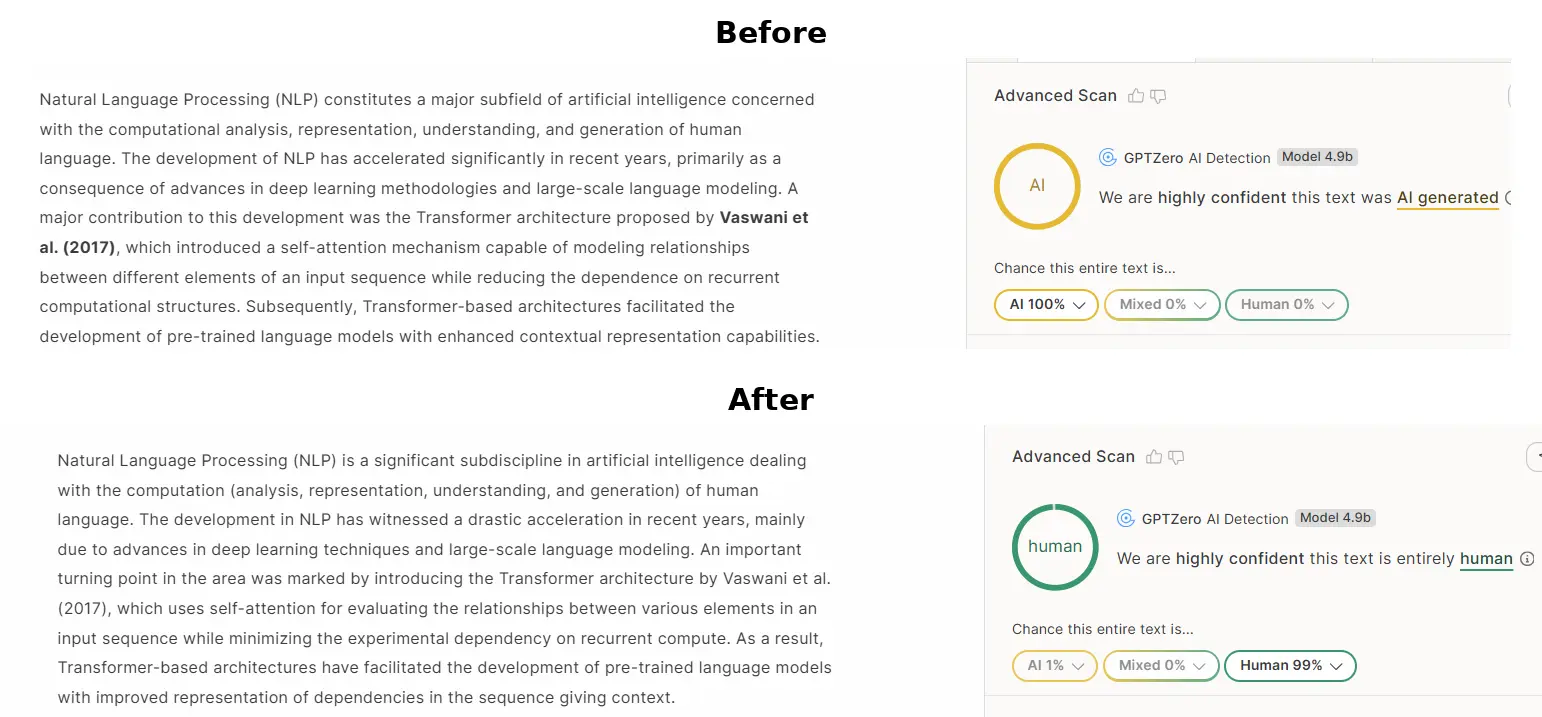
3. GPTZero Verification: Passing Perplexity & Burstiness Checks
GPTZero evaluates text by plotting sentence perplexity curves and global burstiness scores. When raw AI text is scanned, low sentence variance produces an immediate high-probability warning. ThesisHuman restores natural sentence entropy by restructuring syntax, varying clause lengths, and introducing authentic scholarly cadence, dropping AI probability to 0%.
4. Originality.ai Verification: 0% AI Confidence
Originality.ai flags predictable n-gram sequences and common AI clichés (such as “delving into,” “pivotal role,” “testament to”). ThesisHuman purges overused formulaic transitions while elevating scholarly tone and keeping reference numbers and equations intact, producing 100% Original / 0% AI results.