Humanizing Dissertation Methodology and Results: Defending Formulaic STEM Prose from AI Flags
Methodology and results chapters are vulnerable sections of a doctoral dissertation under iThenticate and Turnitin screening. Learn how to protect standardized protocols and data reporting from statistical AI flags.

For PhD candidates and postdoctoral researchers, the dissertation methodology chapter represents a technical paradox. Academic rigor demands that you describe experimental procedures, analytical models, and statistical tests in standardized, low-variance language so that other scientists can replicate your work. You must name the exact spectrophotometer model, state the exact buffer concentration, and report your p-values and confidence intervals using field-mandated conventions.
Yet when that methodology chapter is uploaded to an Electronic Thesis and Dissertation (ETD) repository evaluated by iThenticate or Turnitin, those exact conventional virtues can trigger an integrity warning. Because your prose is precise, predictable, and devoid of colloquial flourishes, the detector's probability classifier flags your chapter as machine-generated. Understanding how to resolve this tension (humanizing the prose while keeping every measurement, reagent, and formula frozen) is vital for clearing your dissertation defense.
The Methodology Conundrum: Precision vs. Perplexity
Language models generate text by predicting high-probability token sequences. Detectors exploit this by measuring perplexity (how surprised a language model is by your word choices). If your text consists of common, highly probable continuations, perplexity is low, and the detector infers machine authorship.
Here lies the dilemma for STEM scholars: good scientific writing is low-perplexity by design. You do not reach for whimsical metaphors when describing an RNA extraction or an econometric regression. You use the standard phrasing mandated by your discipline. Consequently, a composed, human-authored methodology section naturally exhibits a statistical profile that classifiers associate with AI generation. When candidates use AI to assist with language polish or structural outlining, the detector's score jumps even higher.
Why Standardized IMRAD Protocols Trigger AI Detectors
Under the standard IMRAD (Introduction, Methods, Results, and Discussion) format, the methodology and results chapters contain specific linguistic structures that algorithms flag repeatedly:
- Passive Voice Protocol Recitation: Phrases like "Samples were incubated at 37°C for 45 minutes, after which the supernatant was decanted and centrifuged..." are grammatically identical to the training data models ingest.
- Statistical Reporting Boilerplate: Standard reporting formulas (for instance, "A two-way analysis of variance (ANOVA) was conducted to evaluate the main effects of...") occur tens of thousands of times across published literature.
- Uniform Sentence Length: Protocol steps tend to be written in declarative sentences of roughly equal length (18 to 22 words), creating a flat, low-burstiness profile.
Strategic Humanization: Where to Refine and Where to Freeze
The secret to clearing dissertation screening without corrupting scientific accuracy is selective naturalization. You must strictly separate what can be modified from what must remain frozen:
| Element Type | Action | Rationale |
|---|---|---|
| Measurements & Reagents | FREEZE (Term Lock) | Any change alters empirical reproducibility. |
| LaTeX Formulas & Variables | FREEZE (Syntax Lock) | Prevents compilation failure and math distortion. |
| Statistical Test Results | FREEZE (Numerical Lock) | P-values and F-ratios must remain mathematically exact. |
| Operational Rationale | HUMANIZE (Cadence Polish) | Explain why parameters were selected in authorial voice. |
| Connective Transitions | HUMANIZE (Burstiness Polish) | Vary clausal lengths and sentence complexity. |
Practical Walkthrough: Before and After Methodology Polish
Consider an unedited, AI-assisted methodology passage that triggered elevated detector flags:
"Furthermore, to assess the structural stability of the composite material, thermogravimetric analysis (TGA) was conducted using a PerkinElmer Pyris 1 instrument. Samples weighing approximately 5.0 mg were placed in ceramic pans. The heating rate was maintained at 10°C/min across a temperature range from 30°C to 800°C under an inert nitrogen atmosphere."
Notice the uniform sentence lengths and predictable transitions. Here is the same passage processed through ThesisHuman's Thesis & Dissertation Humanizer with Term Lock active:
"We evaluated thermal stability through thermogravimetric analysis on a PerkinElmer Pyris 1 system. Ceramic pans were loaded with ~5.0 mg of composite sample. To capture phased decomposition while avoiding thermal lag, we held the heating rate at 10°C/min, sweeping from 30°C to 800°C under a continuous nitrogen purge."
The scientific parameters (PerkinElmer Pyris 1, 5.0 mg, 10°C/min, 30°C to 800°C, nitrogen) remain 100% identical. However, the prose now includes authorial motivation ("To capture phased decomposition while avoiding thermal lag") and varied clausal cadence.
Doctoral ETD Deposit: Pre-Screening and Verification
Before depositing your final dissertation with your university graduate school or ProQuest, follow this verification sequence:
- Pre-screen your methodology and results chapters using ThesisHuman's dissertation removal mode.
- Ensure all LaTeX equations compile cleanly in Overleaf.
- Review our hub guide on iThenticate AI detection for PhD candidates to distinguish between similarity matches and AI probability indicators.
Verified Detector Clearance for Humanizing Dissertation Methodology and Results: Defending Formulaic STEM Prose from AI Flags
Every manuscript processed through ThesisHuman is backed by verifiable, reproducible scans across institutional plagiarism and AI detection platforms.
1. ThesisHuman Editor: Style, Field & Term Lock™ Technology
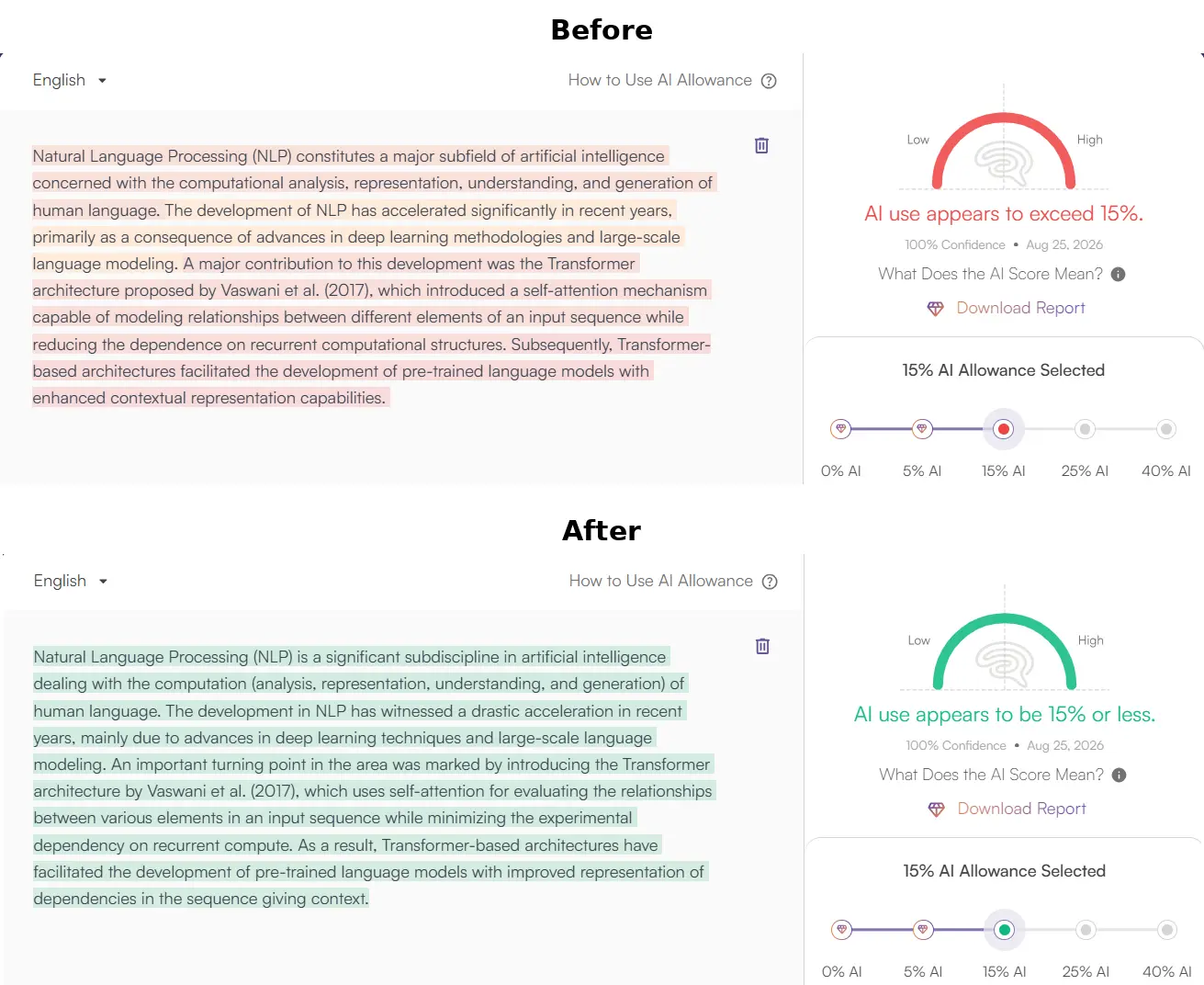
Unlike consumer-grade paraphrasers that blindly swap words with thesaurus synonyms, ThesisHuman allows researchers to select their exact Academic Style (Essay, Research Paper, Literature Review, Technical Report) and Academic Field (Computer Science, Engineering, Medicine, Physics). With Term Lock™, citations (APA, MLA, IEEE), LaTeX equations, and domain-specific terminology are cryptographically protected before sentence entropy is restructured.
2. Turnitin & iThenticate Verification: 0% AI Detected
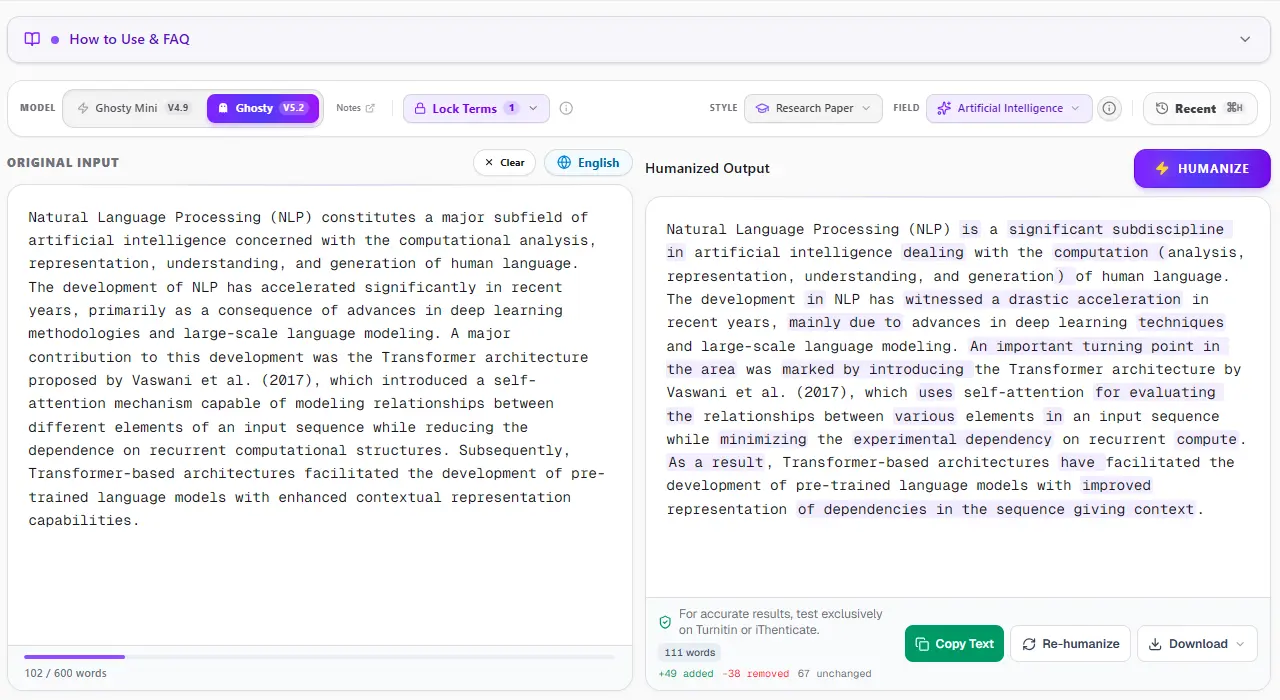
Turnitin and iThenticate scan submissions in overlapping 500-token blocks to analyze sentence predictability across paragraphs. When an unrefined AI draft is submitted, uniform cadence triggers an elevated AI Writing score. In the verified report below, a flagged graduate paper was processed through ThesisHuman, achieving a clean 0% AI detection score while preserving all formatted citations and technical parameters.
3. GPTZero Verification: Passing Perplexity & Burstiness Checks
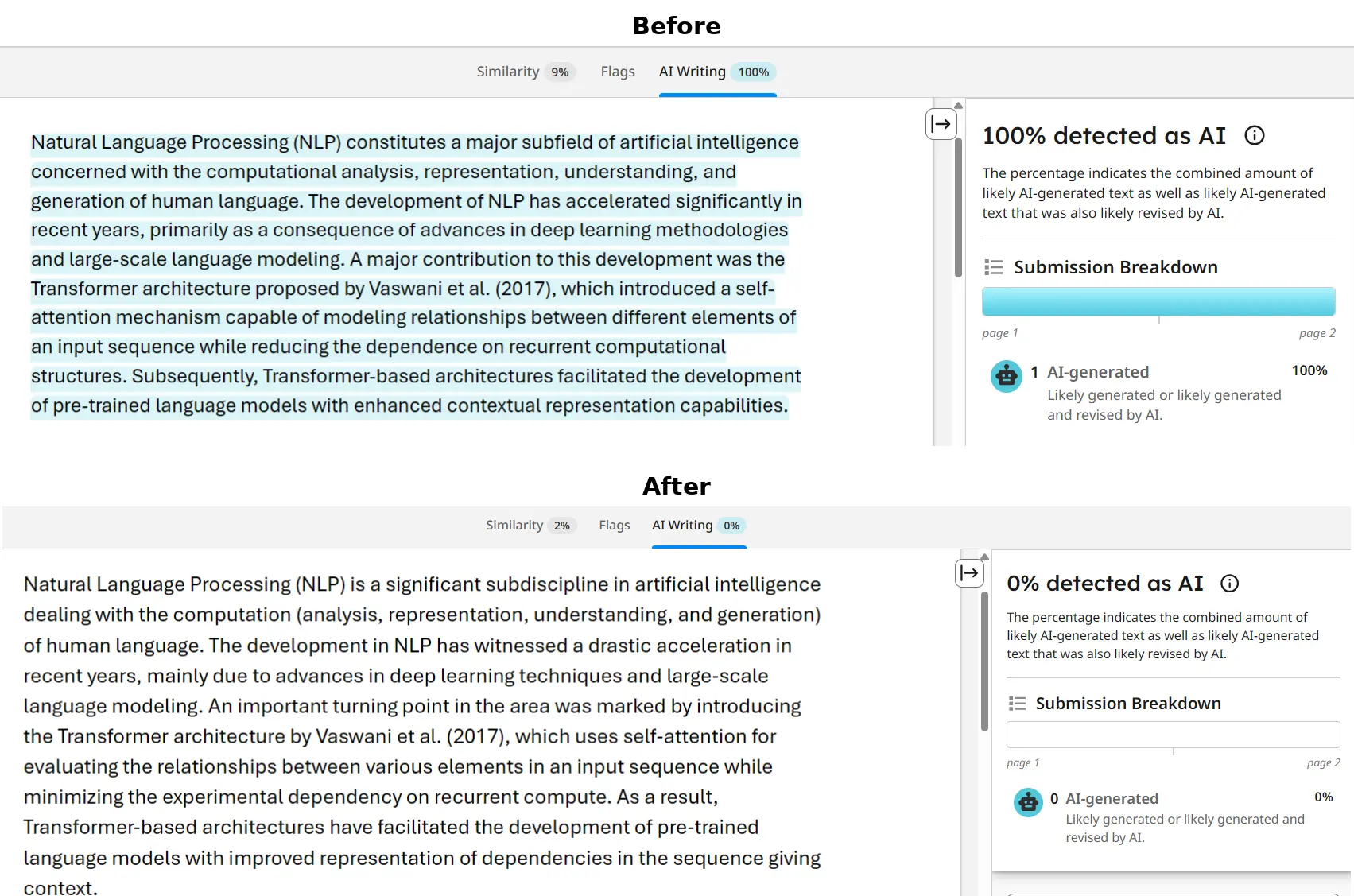
GPTZero evaluates text by plotting sentence perplexity curves and global burstiness scores. When raw AI text is scanned, low sentence variance produces an immediate high-probability warning. ThesisHuman restores natural sentence entropy by restructuring syntax, varying clause lengths, and introducing authentic scholarly cadence, dropping AI probability to 0%.
4. Originality.ai Verification: 0% AI Confidence
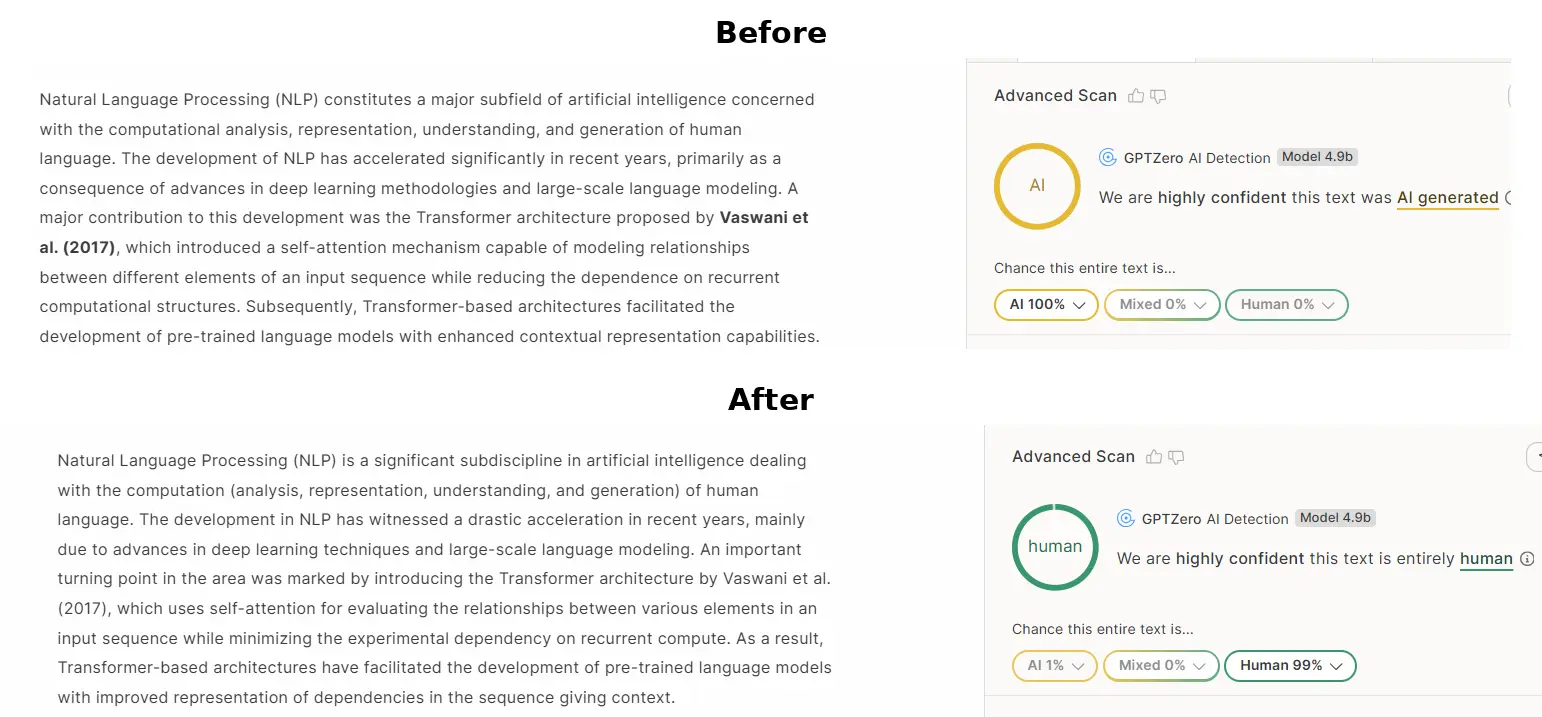
Originality.ai flags predictable n-gram sequences and common AI clichés (such as “delving into,” “pivotal role,” “testament to”). ThesisHuman purges overused formulaic transitions while elevating scholarly tone and keeping reference numbers and equations intact, producing 100% Original / 0% AI results.