How to Write a Book Title in an Essay: APA, MLA, and Chicago Rules
Learn how to format book titles in an essay across APA 7th, MLA 9th, and Chicago 18th editions. Discover rules for italics, quotation marks, capitalization, subtitles, and headings.

Formatting a book title in an academic essay seems deceptively straightforward, yet it remains one of the most frequent sources of grading deductions in undergraduate and graduate writing. Students frequently wonder: Should the title be italicized, enclosed in quotation marks, or underlined? Does every word need a capital letter? How do guidelines differ among APA 7th edition, MLA 9th edition, and the Chicago Manual of Style 18th edition?
This comprehensive guide provides definitive, authoritative rules for formatting book titles across major academic style manuals. You will learn the universal container principle, examine style-specific nuances for running text versus reference lists, master subtitle and heading formatting, and test your knowledge with practical exercises.
1. Direct Answer: Quick-Reference Formatting Rules
The universal rule for formal, typed academic essays is straightforward: the title of a complete, standalone book is always italicized. You do not place quotation marks around book titles, nor do you leave them in plain text.
- Complete Books (Standalone Works): Italicize the title (e.g., The Architecture of Cognition).
- Parts of Books (Chapters, Essays, Short Stories): Place the title in quotation marks (e.g., "Memory and Attention in Neural Systems").
- Handwritten Essays Only: Underline the title if italics cannot be rendered (e.g., The Architecture of Cognition).
Incorrect: In "Principles of Public Health Policy," Dr. Vance explores epidemiology.
Correct: In Principles of Public Health Policy, Dr. Vance explores epidemiology.
2. Italics vs. Quotation Marks: The Container Rule
To determine whether a title receives italics or quotation marks, apply the container rule. In bibliographic design, complete, independent creations serve as containers for smaller, subordinate creations.
Whole, independent works (the containers) are set in italics. Shorter works contained within those larger vessels are placed inside quotation marks.
| Format Category | Typography | Examples of Works |
|---|---|---|
| Complete, Standalone Works (Containers) | Italics | Books, edited anthologies, academic journals, newspapers, movies, musical albums, legal treatises. |
| Contained, Subordinate Works (Contents) | Quotation Marks | Book chapters, journal articles, newspaper stories, podcast episodes, short stories, poems, single songs. |
3. APA 7th Edition Rules for Book Titles
The American Psychological Association (APA 7th edition) maintains a crucial distinction that trips up many writers: book titles are capitalized differently depending on whether they appear in running text or in the final reference list.
APA Book Titles in Running Essay Text
When mentioning a book title directly in the prose of your essay, use title case (headline style) and italics. Capitalize all words of four letters or more, along with any noun, pronoun, verb, adjective, or adverb regardless of length.
Running Text Example: In The Dynamics of Urban Migration: Social Networks and Economic Mobility, Brooks (2023) examines metropolitan labor flow.
APA Book Titles in the Reference List
In the APA reference list, the book title remains in italics, but shifts to sentence case. You only capitalize:
- The first letter of the main title.
- The first letter of the subtitle (immediately following the colon).
- Any proper nouns or acronyms.
Reference List Entry: Brooks, T. M. (2023). The dynamics of urban migration: Social networks and economic mobility. Academic Press.
4. MLA 9th Edition Rules for Book Titles
The Modern Language Association (MLA 9th edition), favored across literature and the humanities, uses uniform title case capitalization in both the body of the essay and the Works Cited page.
MLA Rules at a Glance
- Always italicize book titles.
- Capitalize the first word, the last word, and all principal words (nouns, pronouns, verbs, adjectives, adverbs, subordinating conjunctions).
- Do not capitalize articles (a, an, the), prepositions (in, of, to, against), or coordinating conjunctions (and, but, for, or, nor, so, yet) unless they begin the title or subtitle.
MLA Text Example: Morrison explores familial resilience in Song of Solomon through recurring folkloric motifs.
MLA Works Cited Example: Morrison, Toni. Song of Solomon. Vintage Books, 2004.
5. Chicago Manual of Style (18th Edition) Rules
The Chicago Manual of Style (CMOS 18th edition), widely used in history, art, and book publishing, follows headline-style capitalization and italics for all book-length works across running text, footnotes, and bibliography citations.
- Italicize book titles in text and citations.
- Capitalize the first and last words of both the title and subtitle.
- Capitalize all other words except lowercase articles, coordinating conjunctions, prepositions (regardless of length, such as "through" or "between"), and the word "to" in infinitives.
Chicago 18th Text Example: In The Republic of Letters: Intellectual Networks in the Enlightenment, Professor Lin argues that epistolary exchanges shaped democratic ideals.
Chicago 18th Bibliography Entry: Lin, Arthur. The Republic of Letters: Intellectual Networks in the Enlightenment. Chicago: University of Chicago Press, 2024.
6. Book Titles in Essay Titles and Section Headings
When an essay title or section heading includes the title of a book, how you format it depends on the typographic styling of the surrounding title.
- Standard Plain Title: If your essay title is printed in regular roman type, simply italicize the book title.
Symbolism and Alienation in The Great Gatsby: A Clausal Critique
- Italicized Essay Title: If your essay title is set entirely in italics (common in certain article designs), use reverse italicization by setting the embedded book title in standard roman type.
Moral Dilemmas in Frankenstein: A Critical Re-Evaluation
- Bold Essay Title or Heading: If your heading is in bold, the book title should be both bold and italicized.
Historical Narratives in War and Peace
7. Capitalization Rules: Headline Style vs. Sentence Case
The two dominant capitalization frameworks in scholarly writing are headline style (title case) and sentence case. Knowing when to apply each is vital for academic compliance.
| Element | Headline Style (Title Case) | Sentence Case |
|---|---|---|
| Where Used | APA running text, MLA (all contexts), Chicago 18th (all contexts). | APA reference list entries only. |
| First & Last Words | Always capitalized. | First word capitalized; last word lowercase unless a proper noun. |
| Subtitles | First word after colon always capitalized. | First word after colon always capitalized. |
| Prepositions & Articles | Lowercased (unless starting a title or subtitle). | Lowercased. |
| Illustrative Model | The Architecture of Modern Thought: A Guide for Scholars | The architecture of modern thought: A guide for scholars |
8. How to Format Book Titles with Subtitles
Academic books frequently carry descriptive subtitles separated from the main title by a colon. Follow these strict conventions when formatting subtitles:
- Place a colon immediately after the main title, followed by a single space.
- Always capitalize the first word of the subtitle across all style guides, including APA sentence case.
- Ensure italics extend continuously through the main title, the colon, and the subtitle.
Full Italicized Subtitle: Fictional Worlds: Narrative Structure and Literary Realism
Notice that the colon itself is italicized along with both title segments.
9. Nested Titles: Book Titles Within Book Titles
When a book title contains another title within it, you must handle the typography carefully to avoid confusion.
- When an Italicized Book Title Contains Another Book Title: Set the internal book title in regular roman type.
Critical Essays on Don Quixote: Four Decades of Scholarship
- When an Italicized Book Title Contains a Shorter Work (Article or Story): Keep the main book in italics and enclose the short work title in quotation marks.
Approaches to Teaching Joyce's "The Dead"
10. Handwritten Essays: When to Underline Instead of Italicize
In handwritten in-class blue-book exams or timed testing environments where typography cannot be manipulated, underlining serves as the traditional surrogate for italics.
When writing by hand, draw a single, clean line underneath the book title. In all typed, electronic submissions, however, underlining is strictly obsolete; always use genuine digital italics.
11. Book Titles vs. Chapter Titles: Contrasting Examples
To reinforce the container rule, review these side-by-side examples distinguishing whole books from individual chapters contained inside them. For related guidance on citing chapters under APA rules, see our comprehensive guide on how to cite a chapter in a book APA.
| Entity | Formatting Standard | Sample Usage in Prose |
|---|---|---|
| Complete Book | Italics | In Advances in Sustainable Urbanism, scholars examine localized energy grids. |
| Contained Chapter | Quotation Marks | In "Solar Microgrids for Coastal Hubs," a chapter in Advances in Sustainable Urbanism, Dr. Lin presents recent sensor telemetry. |
12. Mentioning a Book vs. Formally Citing It
Formatting a book title with italics within an essay sentence does not replace a formal in-text citation. If you borrow ideas, statistics, or direct quotations from the book, you must also provide an author-date or parenthetical citation and an end-of-paper bibliographic entry.
Mere Mention (No specific claim attributed): In high school literature classes, students routinely encounter To Kill a Mockingbird as an introduction to southern gothic themes.
Scholarly Attribution (Formal Citation Required): As Lee argues in To Kill a Mockingbird, moral empathy requires stepping into another individual's perspective (1960, p. 39).
For an exhaustive walkthrough of in-text author-date mechanics, consult our guide on how to cite APA in text.
13. Seven Common Mistakes to Avoid
When grading academic essays, instructors frequently flag these seven recurring formatting errors:
- Quotation Marks Around Book Titles: Enclosing an entire book in quotation marks (e.g., "The Great Gatsby"). Always italicize.
- Missing Subtitle Capitalization: Forgetting to capitalize the first word following the colon in a subtitle (e.g., Urban Economics: an Introduction instead of Urban Economics: An Introduction).
- Over-Italicizing Trailing Punctuation: Italicizing punctuation marks that do not belong to the book title itself, such as the period or comma terminating the sentence.
- Sentence Case in APA Running Text: Using sentence case inside the body of an APA paper. Remember that APA only uses sentence case for titles in the reference list; running text requires title case.
- Confusing Chapters and Books: Treating an edited chapter as a standalone book by italicizing its title instead of putting it in quotation marks.
- Inconsistent Style Mixing: Alternating between MLA title case and APA sentence case in the same bibliography.
- Underlining in Digital Word Processors: Using underlining in modern submitted essays rather than standard italics.
14. Style Guide Comparison Table
Keep this consolidated reference table accessible during drafting to ensure complete style manual compliance.
| Rule / Scenario | APA 7th Edition | MLA 9th Edition | Chicago 18th Edition |
|---|---|---|---|
| Book in Running Text | Italics, Title Case | Italics, Title Case | Italics, Title Case |
| Book in Reference List / Bibliography | Italics, Sentence Case | Italics, Title Case | Italics, Title Case |
| Chapter or Contained Article | Plain text in references; Quotes in text | Quotation Marks | Quotation Marks |
| Subtitle First Word | Capitalized always | Capitalized always | Capitalized always |
| Handwritten Default | Underline | Underline | Underline |
15. Practical Correction Exercises with Solutions
Test your understanding by identifying and correcting the title formatting error in each sample sentence below.
Exercise 1 (MLA Style):
In "Beloved", Toni Morrison confronts historical trauma through fragmented memory.
Correction: In Beloved, Toni Morrison confronts historical trauma through fragmented memory.
Explanation: Because Beloved is a complete novel, it must be italicized rather than placed in quotation marks.
Exercise 2 (APA Running Text):
According to Henderson (2022) in The behavioral economics of consumer choice, pricing thresholds dictate adoption.
Correction: According to Henderson (2022) in The Behavioral Economics of Consumer Choice, pricing thresholds dictate adoption.
Explanation: In APA running text, book titles use title case (headline style). Sentence case is reserved strictly for the reference list.
Exercise 3 (Subtitle Capitalization):
Dr. Alvarez published Neural Networks: a Handbook for Cognitive Scientists last summer.
Correction: Dr. Alvarez published Neural Networks: A Handbook for Cognitive Scientists last summer.
Explanation: The first word following the colon in a subtitle must always be capitalized.
Exercise 4 (Chapter vs. Book):
We were assigned to read Metaphor and Meaning, which is chapter three of Semantics in Practice.
Correction: We were assigned to read "Metaphor and Meaning," which is chapter three of Semantics in Practice.
Explanation: The book title is italicized, while the chapter title contained inside it is placed in quotation marks.
Exercise 5 (Essay Heading with Book Title):
Essay Heading: The Duality of Human Nature in "Strange Case of Dr Jekyll and Mr Hyde"
Correction: Essay Heading: The Duality of Human Nature in Strange Case of Dr Jekyll and Mr Hyde
Explanation: Book titles within plain essay titles remain italicized, never enclosed in quotation marks.
16. Frequently Asked Questions
Here are clear answers to common questions regarding book title formatting in academic essays.
Do you put quotation marks around book titles in an essay?
No. In modern formal academic typing across APA, MLA, and Chicago styles, the title of a complete, standalone book is italicized, not placed inside quotation marks. Quotation marks are reserved for shorter works contained within a book, such as individual book chapters, short stories, essays, or poems.
How do you format a book title in APA 7th edition running text versus the reference list?
In APA 7th edition running text, italicize the book title and capitalize all major words in headline style (title case). In the reference list, however, italicize the book title but capitalize it in sentence case (only capitalizing the first word of the title, the first word of the subtitle, and proper nouns).
How do you write a book title if your essay title already contains it?
If your essay title is formatted in regular font (roman type), simply italicize the book title inside it. If your essay title is already italicized by design, apply reverse italicization by setting the book title in standard roman type.
What is the Chicago Manual of Style rule for book titles?
Under the Chicago Manual of Style (18th edition), titles of books are italicized in both running text and bibliography citations, using headline-style capitalization where all major words (nouns, pronouns, verbs, adjectives, adverbs) are capitalized.
Can ThesisHuman help format citations and titles accurately?
Yes. ThesisHuman features Term Lock controls that freeze italicized titles, parenthetical citations, and publication years so that stylistic remodeling does not alter your bibliographic apparatus. To refine your academic prose while preserving key terminology, explore our sentence rewriter and thesis rewriter.
Verified Detector Clearance for How to Write a Book Title in an Essay: APA, MLA, and Chicago Rules
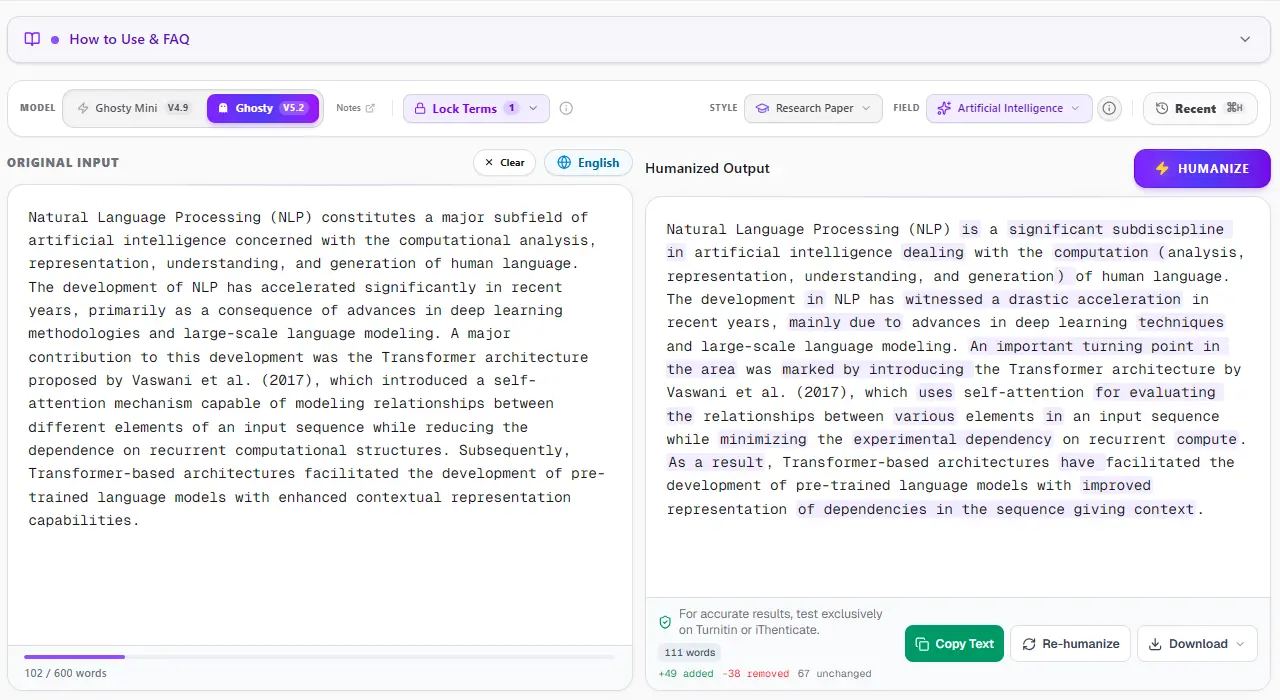
Every manuscript processed through ThesisHuman is backed by verifiable, reproducible scans across institutional plagiarism and AI detection platforms.
1. ThesisHuman Editor: Style, Field & Term Lock™ Technology
Unlike consumer-grade paraphrasers that blindly swap words with thesaurus synonyms, ThesisHuman allows researchers to select their exact Academic Style (Essay, Research Paper, Literature Review, Technical Report) and Academic Field (Computer Science, Engineering, Medicine, Physics). With Term Lock™, citations (APA, MLA, IEEE), LaTeX equations, and domain-specific terminology are cryptographically protected before sentence entropy is restructured.
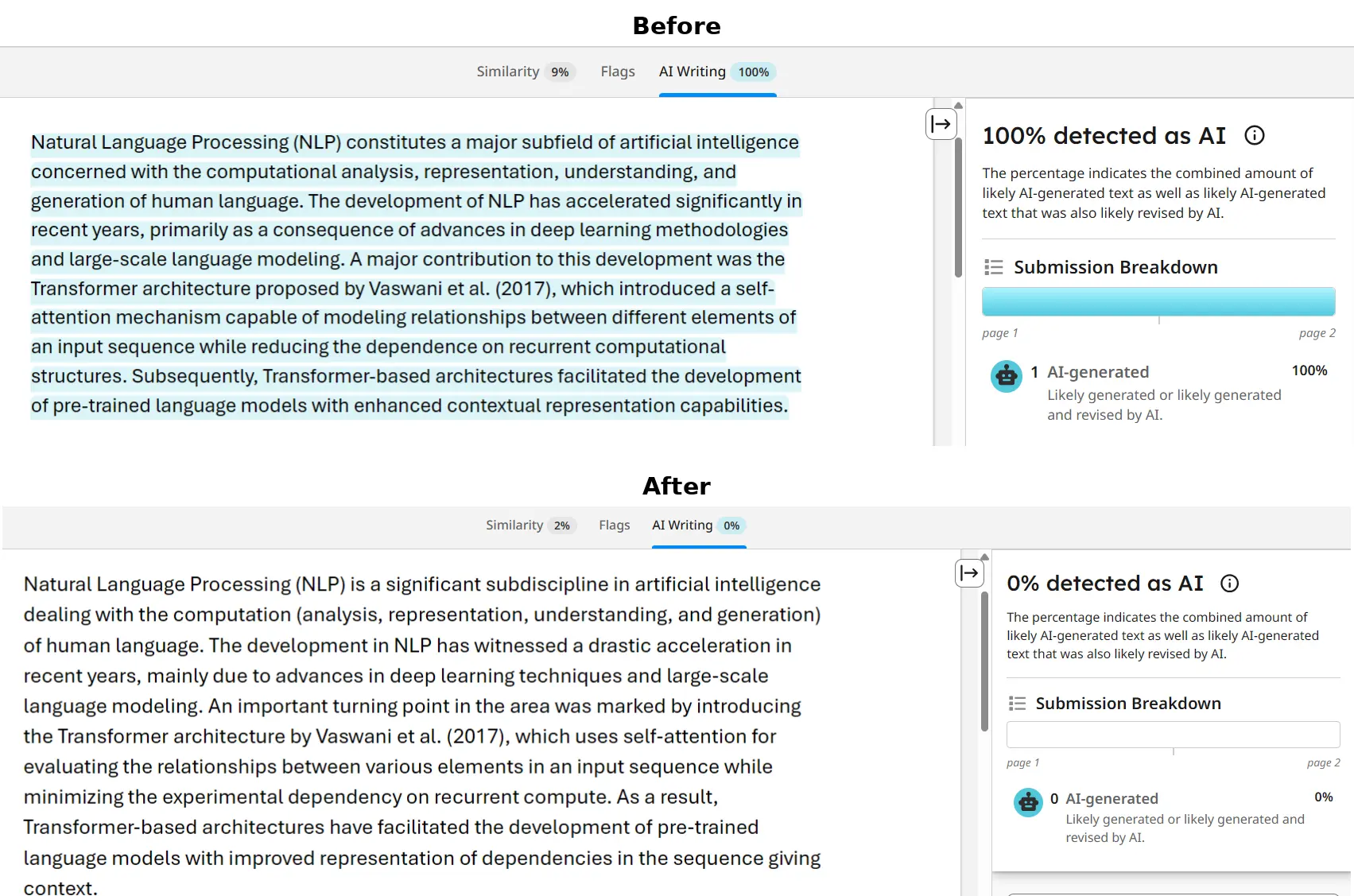
2. Turnitin & iThenticate Verification: 0% AI Detected
Turnitin and iThenticate scan submissions in overlapping 500-token blocks to analyze sentence predictability across paragraphs. When an unrefined AI draft is submitted, uniform cadence triggers an elevated AI Writing score. In the verified report below, a flagged graduate paper was processed through ThesisHuman, achieving a clean 0% AI detection score while preserving all formatted citations and technical parameters.
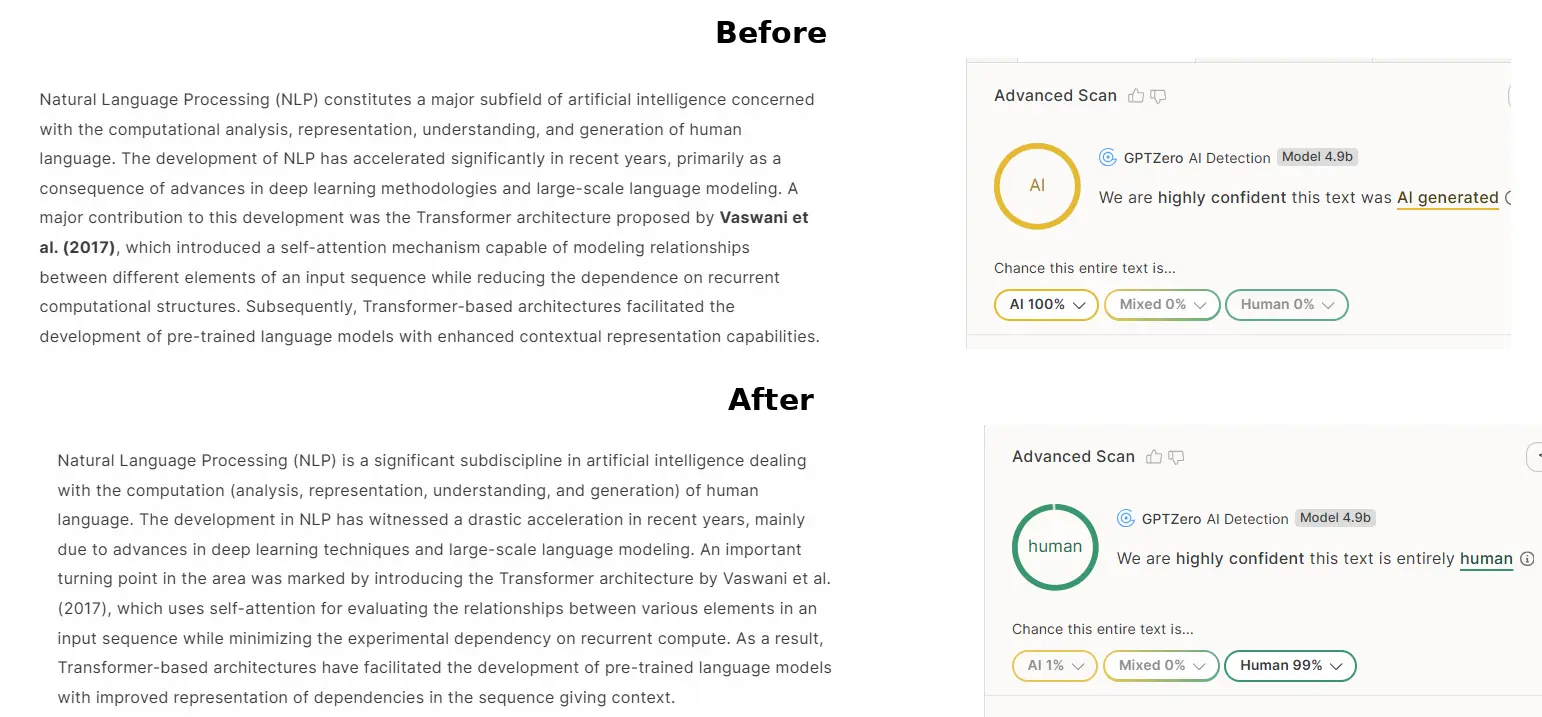
3. GPTZero Verification: Passing Perplexity & Burstiness Checks
GPTZero evaluates text by plotting sentence perplexity curves and global burstiness scores. When raw AI text is scanned, low sentence variance produces an immediate high-probability warning. ThesisHuman restores natural sentence entropy by restructuring syntax, varying clause lengths, and introducing authentic scholarly cadence, dropping AI probability to 0%.
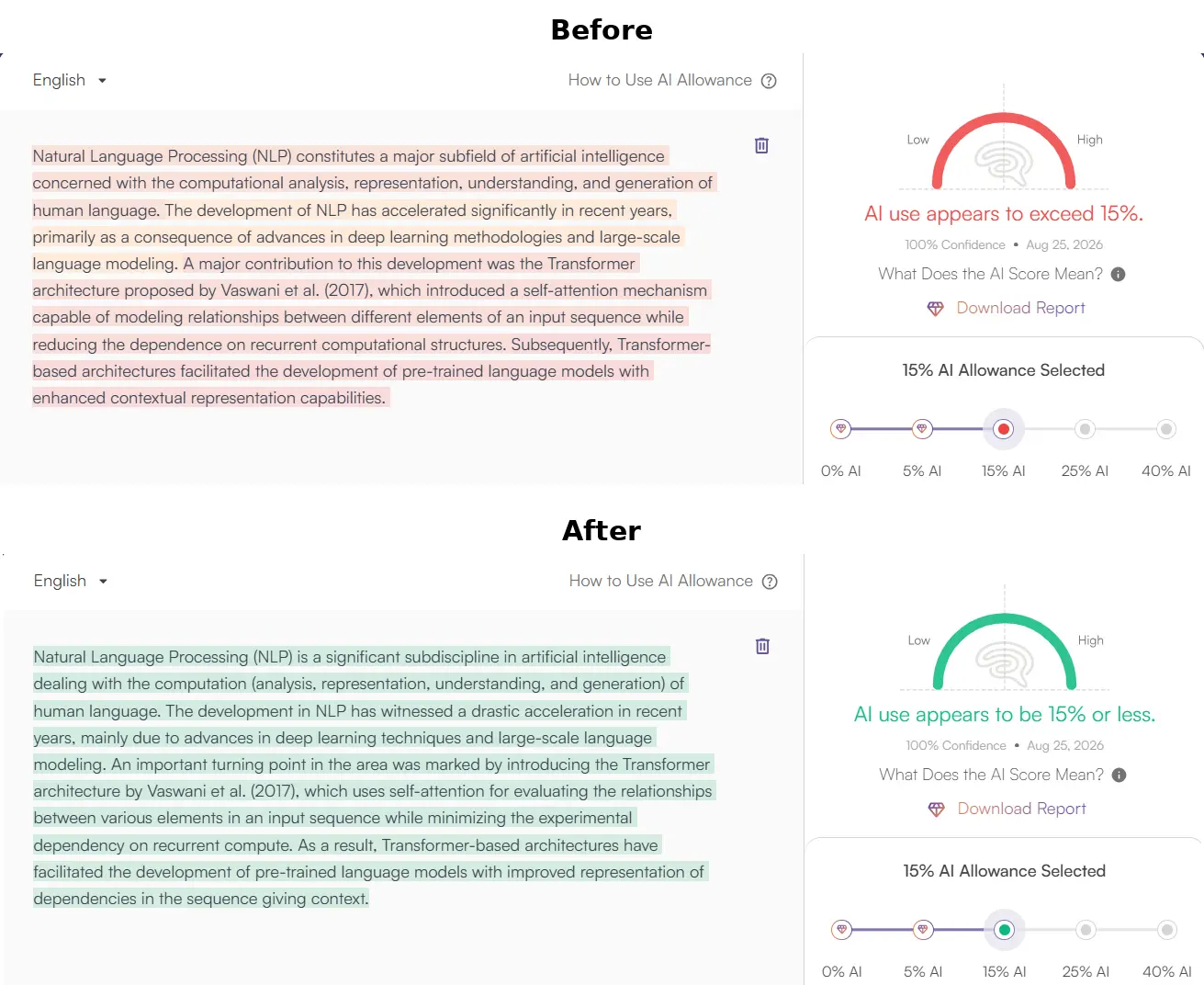
4. Originality.ai Verification: 0% AI Confidence
Originality.ai flags predictable n-gram sequences and common AI clichés (such as “delving into,” “pivotal role,” “testament to”). ThesisHuman purges overused formulaic transitions while elevating scholarly tone and keeping reference numbers and equations intact, producing 100% Original / 0% AI results.