Is Grammarly's AI Detector Accurate for Academic Submissions? (2026 Analysis)
How reliable is Grammarly's AI detector when evaluating university essays and research papers? We examine its technical architecture, false positive rates, and academic limitations.
HamzaPhD Researcher
14 min read
For over a decade, Grammarly was the standard proofreading companion for high school students, undergraduates, and academic faculty worldwide. Its spelling suggestions, punctuation corrections, and clarity prompts became integral to the revision workflow of millions of writers.
With the proliferation of generative artificial intelligence, Grammarly introduced its own proprietary AI detection feature. Unlike standalone classifiers, Grammarly's detector operates inside the very environment where writers draft their papers.
This integration has raised urgent questions among students and researchers: **Is Grammarly's AI detector accurate, and can instructors rely on its scores to judge academic integrity?**
This article delivers a technical evaluation of Grammarly's AI detection methodology, analyzes why scholarly manuscripts frequently trigger false accusations, and outlines practical defenses for students whose authentic human writing has been misclassified.
---
## Grammarly's Shift from Grammar Checker to AI Classifier
Grammarly's core business model was built on deterministic rule-based grammar checking combined with statistical language models. When a user drafted text, Grammarly highlighted passive voice, split infinitives, and wordy prepositional phrases.
With the release of Grammarly's generative writing assistant (GrammarlyGO) and its associated AI detection module, the platform entered the probabilistic classification space. Rather than evaluating whether a sentence is grammatically correct, the detector attempts to predict whether text was generated by a large language model.
This transition created an inherent tension:
1. **The Homogenization Feedback Loop**: For years, Grammarly actively advised writers to simplify their sentences, eliminate idiosyncratic phrasing, and adopt predictable syntax.
2. **The AI Pattern Conflict**: Large language models produce text characterized by high predictability and consistent sentence rhythm.
3. **The Unintended Result**: Writers who rigorously adopt Grammarly's stylistic recommendations often produce text with statistical properties nearly indistinguishable from AI-generated prose.
When Grammarly scans text that was polished according to its own editorial standards, its detector frequently flags the draft as artificial.
---
## How Grammarly's AI Detection Architecture Works
To evaluate Grammarly's accuracy, one must examine the computational mechanisms underlying its classification engine.
Grammarly's AI detection framework relies on three primary evaluation layers:
```
+-------------------------------------------------------------+
| Grammarly AI Detection Pipeline |
+-------------------------------------------------------------+
| 1. Perplexity Assessment |
| - Measures how "surprising" each token is to a reference |
| language model. Low perplexity indicates high AI |
| probability. |
| |
| 2. Burstiness and Cadence Mapping |
| - Tracks sentence length variation and syntactic |
| diversity across adjacent paragraphs. |
| |
| 3. Fine-Tuned Transformer Classifier |
| - Compares text representations against a corpus of |
| known machine-generated and human-written samples. |
+-------------------------------------------------------------+
```
### 1. Perplexity Evaluation
Perplexity is a mathematical measure of how well a probability distribution predicts a sample. In language models, low perplexity means the words chosen are the most statistically probable choices given the preceding context.
Generative models like GPT-4o and Claude 3.5 Sonnet naturally generate text with uniformly low perplexity. However, formal academic writing also exhibits low perplexity because scholars intentionally use conventional terminology, standardized methodological descriptions, and formal transition words. Grammarly's engine often conflates academic formality with machine generation.
### 2. Burstiness Scoring
Burstiness measures variance in sentence length, structure, and rhythm. Human speech and creative writing exhibit high burstiness: a two-word fragment might be followed by a 40-word descriptive sentence.
In academic papers, however, scholars maintain a measured, consistent cadence throughout literature reviews and discussions. This necessary professional consistency lowers burstiness scores, leading Grammarly's algorithm to classify the passage as artificial.
---
## Why Academic Prose Triggers High False Positive Rates
Empirical studies from Stanford University, Vanderbilt University, and independent computer science departments have repeatedly demonstrated that AI detectors struggle with specialized writing formats.
Academic manuscripts suffer disproportionately from false positive classifications due to several structural characteristics:
### 1. Standardized Methodology Terminology
In empirical research, experimental protocols must follow precise international conventions. A chemistry methodology describing titration, an engineering paper detailing finite element analysis, or a psychology paper outlining survey administration must use standardized language:
```
"Participants were randomly assigned to one of two experimental conditions
using a computer-generated random number sequence. All procedures were
approved by the Institutional Review Board, and informed consent was
obtained prior to data collection."
```
This passage was written entirely by a human researcher. Yet because identical phrasing appears in tens of thousands of published studies, its perplexity score is extremely low. Grammarly's detector frequently flags such passages as 100% AI-generated.
### 2. Academic Formulaic Conventions
Phrases such as "the remainder of this paper is structured as follows," "in accordance with previous empirical findings," and "these results should be interpreted with caution" are standard academic signposts. Because these n-grams appear frequently in AI training sets, classifiers misidentify them as synthetic artifacts.
### 3. Passive Voice in Scientific Reporting
While English composition instructors discourage passive voice, scientific journals often require it to emphasize the experiment over the investigator ("the solution was heated to 100 degrees Celsius" rather than "we heated the solution"). Grammarly's classifier associates dense passive constructions with automated output.
To understand how these detection dynamics interact across institutional platforms, explore our detailed analysis of [whether Grammarly triggers Turnitin AI detection](/blog/does-grammarly-trigger-turnitin-ai).
---
## The Documented Bias Against ESL and Non-Native Scholars
One of the most concerning findings in computational linguistics research is the systematic bias of AI detectors against non-native English speakers.
A landmark Stanford University study revealed that commercial AI detectors misclassified essays written by non-native English speakers as AI-generated in over 60% of test cases, while human-written essays by native speakers were flagged at dramatically lower rates.
```
+-------------------------------------------------------------+
| The Linguistic Bias Reality |
+-------------------------------------------------------------+
| Native English Writers Non-Native / ESL Writers |
| - Diverse colloquial lexicon - Constrained formal lexicon |
| - High idiomatic variance - Strict adherence to |
| - Irregular syntactic rhythm textbook grammatical rules |
| -> High Perplexity -> Low Perplexity |
| -> Low False Positive Rate -> HIGH FALSE POSITIVE RATE |
+-------------------------------------------------------------+
```
Why does this occur?
Non-native scholars typically rely on a smaller, more formal vocabulary. They avoid colloquialisms, slang, and complex idiomatic expressions, favoring straightforward grammatical structures taught in academic English curricula.
Because this constrained vocabulary closely mirrors the high-probability token selections of large language models, Grammarly's detector routinely penalizes international graduate students and researchers whose English is grammatically correct but stylistically uniform.
---
## How Grammarly Compares to Turnitin and GPTZero
When evaluating AI detection accuracy, it is critical to distinguish between consumer writing assistants and dedicated enterprise integrity tools:
| Feature Dimension | Grammarly AI Detector | Turnitin AI Writing Indicator | GPTZero (Advanced) |
|---|---|---|---|
| **Primary Audience** | Individual writers and workplace teams | University faculty, registrars, and exam boards | Educators, content platforms, and researchers |
| **Workflow Location** | Integrated in-browser editor and desktop app | Institutional Learning Management Systems (Canvas, Blackboard) | Standalone web dashboard and enterprise API |
| **Document Context** | Evaluates isolated text snippets in the editor | Analyzes full manuscript against institutional student repository | Document-level burstiness and sentence perplexity map |
| **False Positive Mitigation** | Basic thresholding; no public academic calibration data | Dedicated false-positive buffer for text under 20% | Highlighted sentence-level perplexity visualization |
| **University Adoption** | Rarely accepted as primary evidence for academic misconduct | Widely integrated as institutional standard evidence | Used as secondary verification tool by select departments |
While Turnitin provides institutional administrators with detailed similarity reports and confidence thresholds, Grammarly's detector provides a simplified percentage readout that lacks granular diagnostic detail.
---
## Can Universities Punish Students Based on Grammarly?
From an academic policy perspective, **no accredited university permits disciplinary action based solely on an AI detector score, including Grammarly**.
Major universities, including MIT, Vanderbilt, and the University of Texas, have issued explicit policy statements warning faculty against using AI detectors as definitive proof of academic dishonesty. The reasons cited by academic senates include:
1. **Lack of Independent Scientific Validation**: Neither Grammarly nor Turnitin has published peer-reviewed, independently reproducible benchmarks demonstrating zero false positive rates on academic manuscripts.
2. **Evidentiary Insufficiency**: A probabilistic score (e.g., "78% AI Detected") is a statistical likelihood, not forensic proof. It cannot distinguish between an AI-generated draft, an essay edited with grammar software, and authentic human writing with formal vocabulary.
3. **Legal and Due Process Vulnerability**: Punishing a student without tangible proof (such as conflicting document version history or contradictory interview testimony) exposes institutions to formal academic appeals and legal liability.
If an instructor confronts you with a Grammarly AI detection score, remember that the burden of proof rests on the institution, not the student.
---
## Practical Steps for Students Falsely Flagged by Grammarly
If your authentic research paper or essay has been flagged by Grammarly or an institutional classifier, take the following documented steps to defend your work:
### 1. Preserve Version History and Edit Timestamps
The single most effective defense against false AI accusations is verifiable version history:
- If you wrote your paper in **Google Docs**, open *File > Version history > See version history*. This provides a keystroke-by-keystroke timeline proving hours of iterative composition.
- If you used **Microsoft Word**, ensure *Track Changes* or OneDrive auto-save history is enabled to demonstrate organic paragraph evolution.
- If you used **LaTeX / Overleaf**, your Git commit log or Overleaf project history serves as immutable proof of authorial progression.
### 2. Provide Literature Search and Citation Breadcrumbs
Produce your research trail: show your Mendeley or Zotero library, PDF annotations, downloaded journal articles, and preliminary outline notes. An AI generator cannot manufacture a two-month-old trail of highlighted PDF research papers.
### 3. Request a Direct Academic Oral Defense
Offer to discuss the paper in person with your professor or department chair. Explain your methodology, define the technical terms used in the manuscript, and discuss the theoretical framework. A student who genuinely researched and wrote a paper can speak fluidly about its contents; a student who submitted unread machine output cannot.
For students revising complex thesis chapters, using an [academic essay rewriter](/essay-rewriter) that prioritizes structural naturalization and reference preservation can help smooth out artificial phrasing while keeping academic arguments coherent.
Explore our full range of academic analysis tools by checking our [best AI humanizer comparative benchmark](/best-ai-humanizer) and our clear [subscription pricing options](/pricing).
---
## Frequently Asked Questions
### Can Grammarly detect if I used ChatGPT to write my paper?
Grammarly can identify statistical patterns typical of raw ChatGPT output, such as repetitive sentence lengths and predictable vocabulary. However, if the text has been substantially rewritten or revised, Grammarly's accuracy declines significantly.
### Does using Grammarly to fix grammar make my paper look like AI?
Yes, in some instances. Grammarly's stylistic recommendations encourage concise, standardized phrasing. When a writer accepts dozens of automated suggestions, the resulting text exhibits lower perplexity and flatter burstiness, which can trigger AI detectors.
### Can my professor fail me based on a Grammarly AI score?
At most accredited institutions, university regulations prohibit faculty from failing students or initiating academic integrity proceedings based solely on an AI detector percentage. Classifiers are considered screening aids, not definitive forensic evidence.
### Why do scientific research papers score high on Grammarly's AI detector?
Scientific papers adhere to rigid linguistic conventions: passive voice, formal transition signposts, and standardized methodology descriptions. Because these conventions produce low perplexity, classifiers frequently mislabel them as synthetic.
Empirical Verification
Verified Detector Clearance for Is Grammarly's AI Detector Accurate for Academic Submissions? (2026 Analysis)
Every manuscript processed through ThesisHuman is backed by verifiable, reproducible scans across institutional plagiarism and AI detection platforms.
Phase 1: Academic Engine Configuration
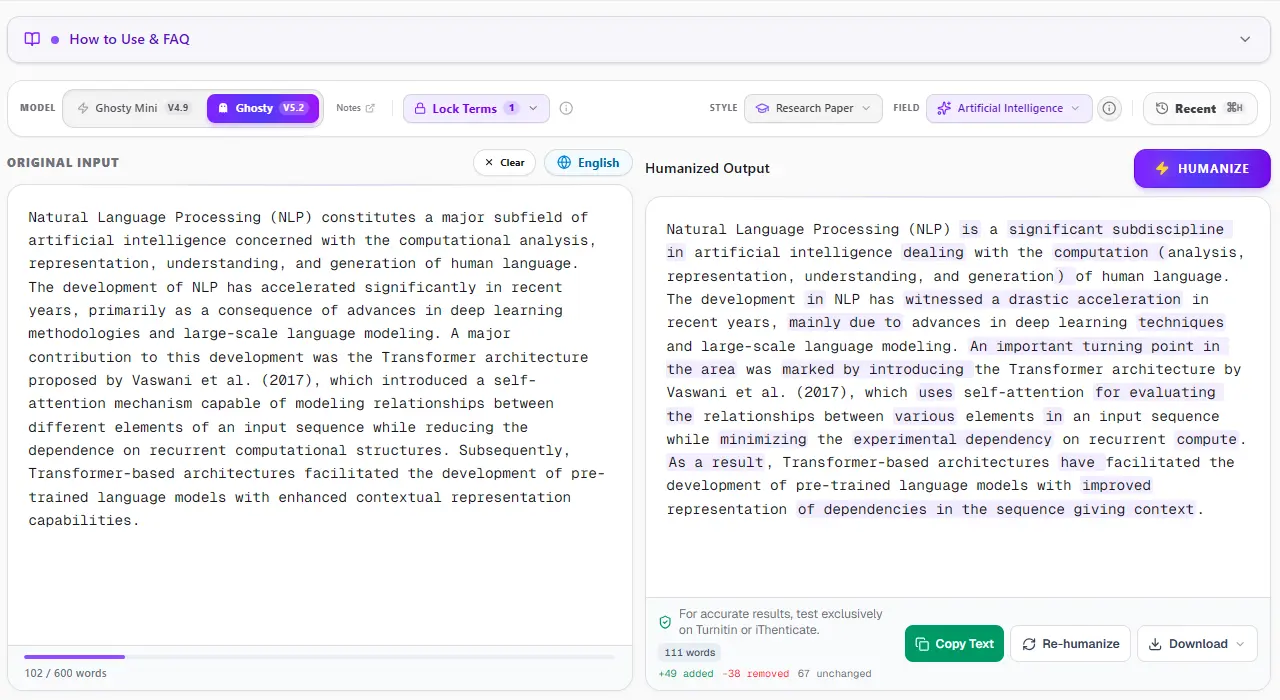
1. ThesisHuman Editor: Style, Field & Term Lock™ Technology
Unlike consumer-grade paraphrasers that blindly swap words with thesaurus synonyms, ThesisHuman allows researchers to select their exact Academic Style (Essay, Research Paper, Literature Review, Technical Report) and Academic Field (Computer Science, Engineering, Medicine, Physics). With Term Lock™, citations (APA, MLA, IEEE), LaTeX equations, and domain-specific terminology are cryptographically protected before sentence entropy is restructured.
Figure 1: The ThesisHuman editor processing an academic manuscript — featuring Academic Style selection, Academic Field customization, and Term Lock controls.
Phase 2: Institutional Integrity Screening
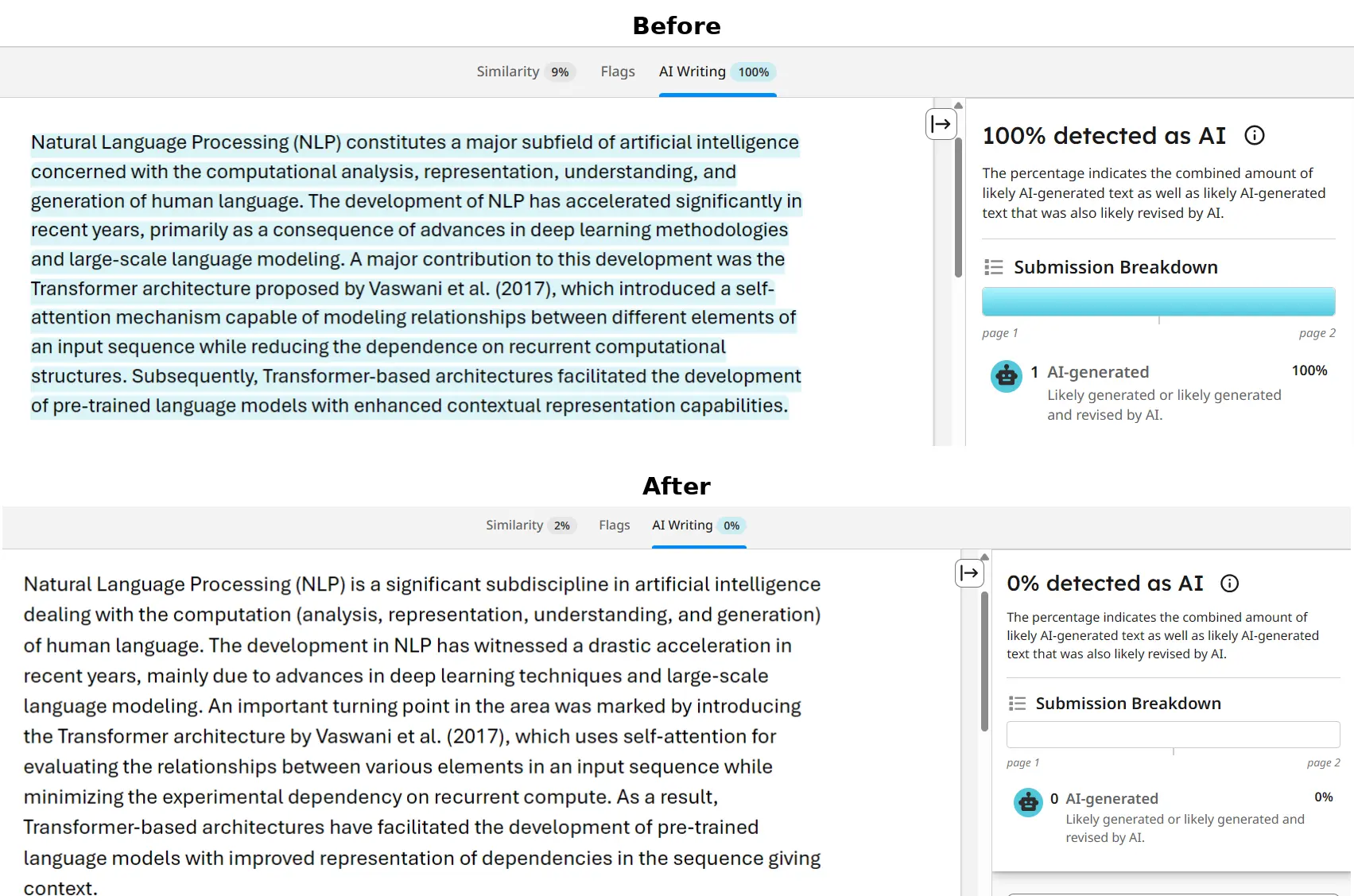
2. Turnitin & iThenticate Verification: 0% AI Detected
Turnitin and iThenticate scan submissions in overlapping 500-token blocks to analyze sentence predictability across paragraphs. When an unrefined AI draft is submitted, uniform cadence triggers an elevated AI Writing score. In the verified report below, a flagged graduate paper was processed through ThesisHuman, achieving a clean 0% AI detection score while preserving all formatted citations and technical parameters.
Figure 2: Turnitin AI detection scan — demonstrating complete 0% AI indicator clearance after ThesisHuman academic naturalization.
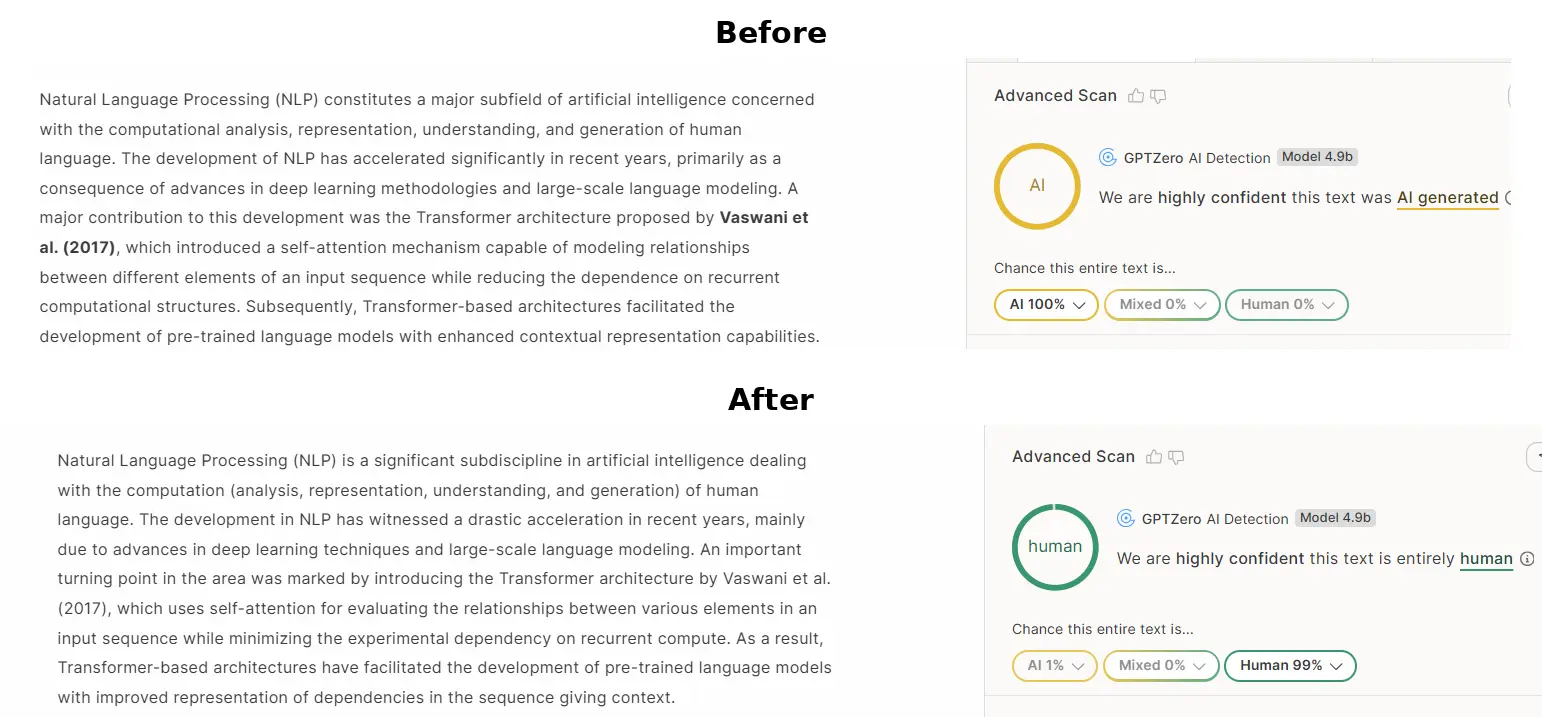
GPTZero evaluates text by plotting sentence perplexity curves and global burstiness scores. When raw AI text is scanned, low sentence variance produces an immediate high-probability warning. ThesisHuman restores natural sentence entropy by restructuring syntax, varying clause lengths, and introducing authentic scholarly cadence, dropping AI probability to 0%.
Figure 3: GPTZero perplexity and burstiness verification — raw machine-generated text (100% AI) transformed into 0% AI human-grade academic prose.
Phase 4: Cliché & N-Gram Elimination
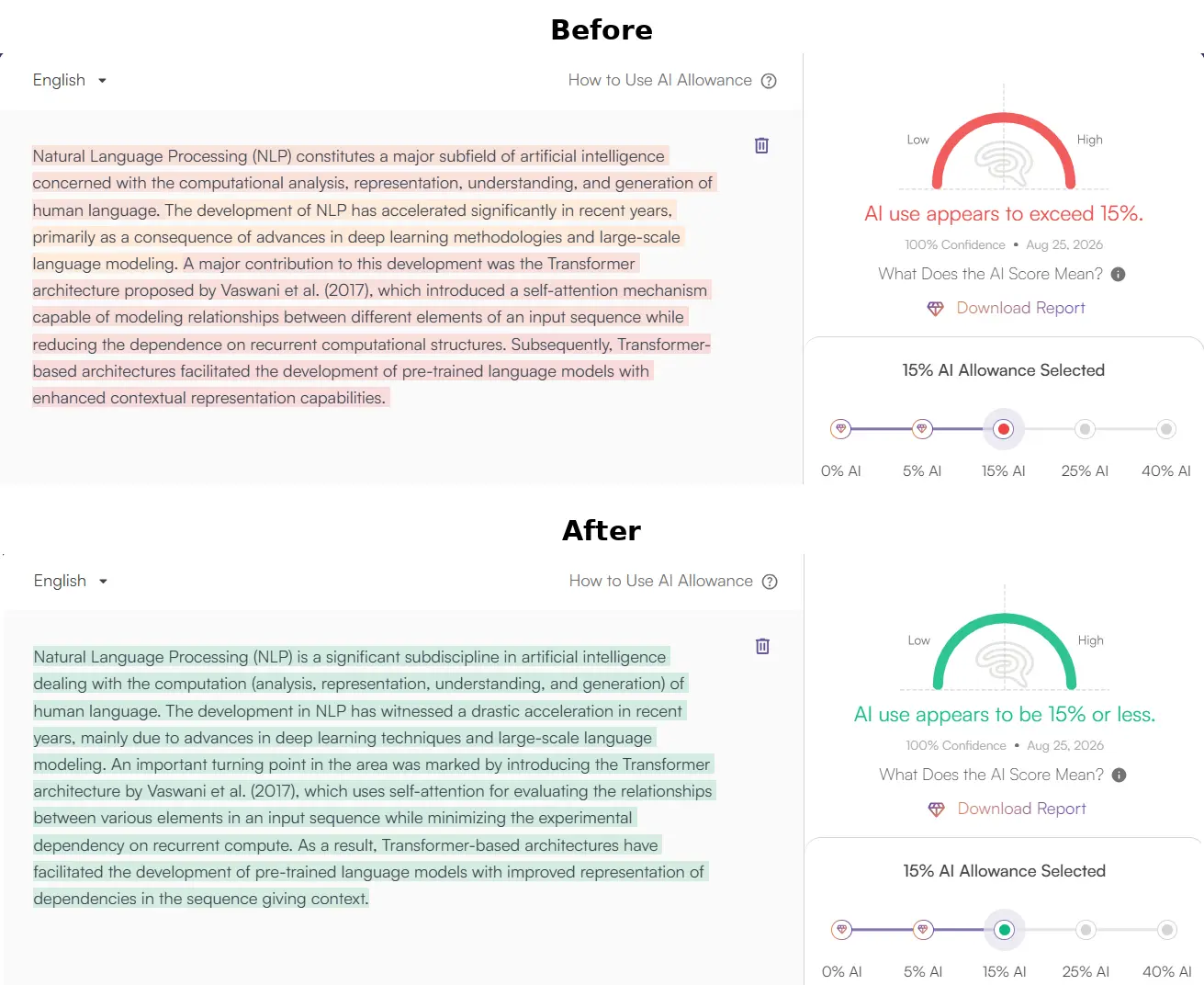
4. Originality.ai Verification: 0% AI Confidence
Originality.ai flags predictable n-gram sequences and common AI clichés (such as “delving into,” “pivotal role,” “testament to”). ThesisHuman purges overused formulaic transitions while elevating scholarly tone and keeping reference numbers and equations intact, producing 100% Original / 0% AI results.
Figure 4: Originality.ai detector scan — confirming complete removal of synthetic n-gram patterns and 0% AI detection confidence.
Can Grammarly detect if I used ChatGPT to write my paper?
Grammarly can identify statistical patterns typical of raw ChatGPT output, such as repetitive sentence lengths and predictable vocabulary. However, if the text has been substantially rewritten or revised, Grammarly's accuracy declines significantly.
Does using Grammarly to fix grammar make my paper look like AI?
Yes, in some instances. Grammarly's stylistic recommendations encourage concise, standardized phrasing. When a writer accepts dozens of automated suggestions, the resulting text exhibits lower perplexity and flatter burstiness, which can trigger AI detectors.
Can my professor fail me based on a Grammarly AI score?
At most accredited institutions, university regulations prohibit faculty from failing students or initiating academic integrity proceedings based solely on an AI detector percentage. Classifiers are considered screening aids, not definitive forensic evidence.
Why do scientific research papers score high on Grammarly's AI detector?
Scientific papers adhere to rigid linguistic conventions: passive voice, formal transition signposts, and standardized methodology descriptions. Because these conventions produce low perplexity, classifiers frequently mislabel them as synthetic.
Pass Turnitin AI Detection Without Losing Your Academic Voice
Refine AI-assisted essays, chapters, and papers into natural human writing while preserving citations and arguments. 500 words included free.