Pangram Labs Detection and Academic Publishing: What Researchers Need to Know in 2026
Founded by Stanford researchers and evaluated in independent university audits, Pangram Labs represents a major deep-learning classifier in scientific publishing. Here is an analysis of its architecture and false-positive risks.
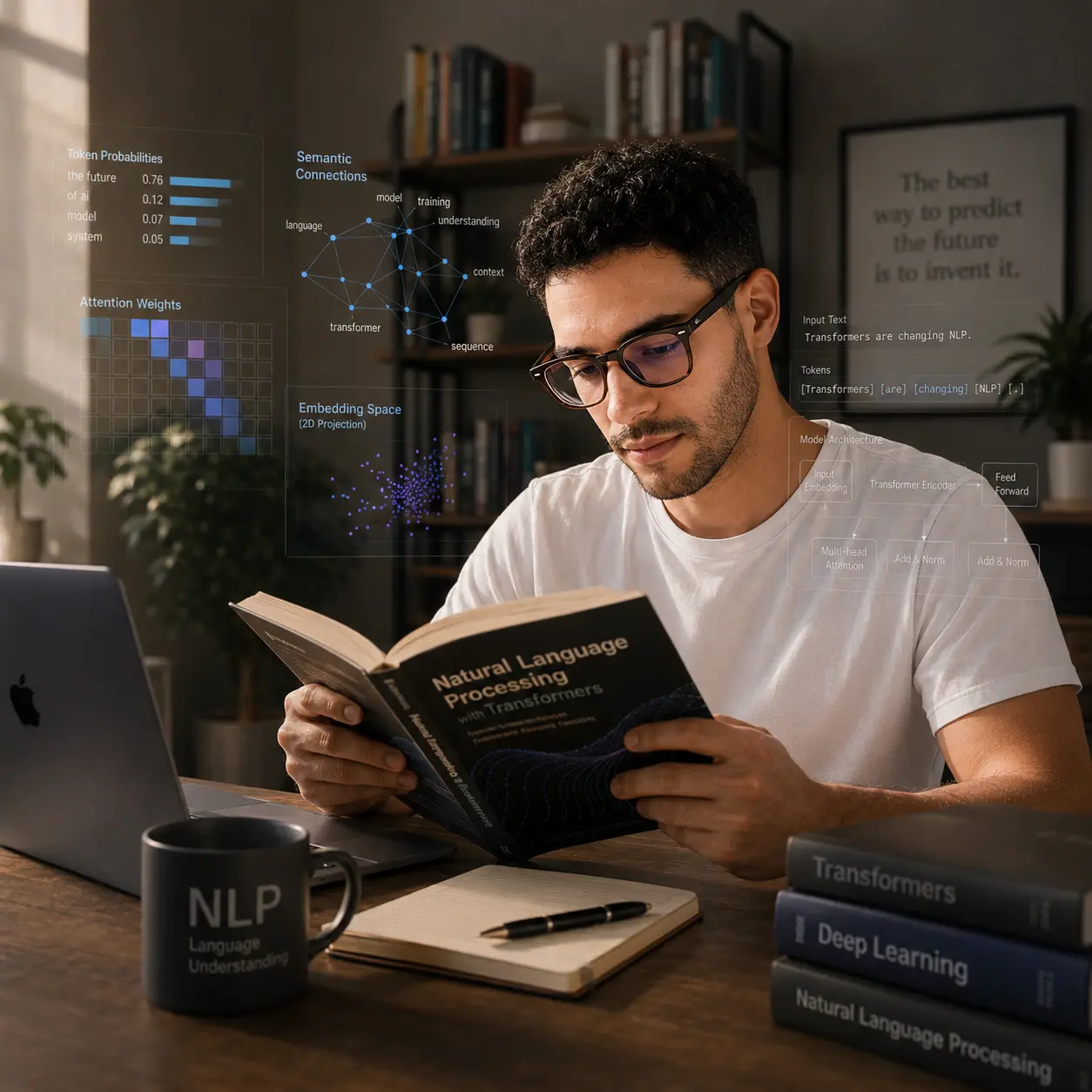
For over a decade, academic plagiarism screening was dominated by a single paradigm: matching text strings against publisher repositories and crawled web pages. The explosive adoption of generative AI upended that model. Today, journal editorial offices, conference program committees, and preprint servers are deploying deep-learning classifiers designed specifically to flag machine-generated text even when it matches nothing in any existing database.
Among the most technically sophisticated of these newer systems is Pangram Labs. Founded by Stanford computer science alumni Max Spero and Bradley Emi, Pangram has positioned its classifier, Pangram 4, for enterprise content verification. For researchers, understanding how Pangram operates is no longer an abstract question: it directly affects whether your manuscript reaches peer review or gets queried at the editorial threshold.
The Rise of Enterprise Classifiers in Scientific Publishing
Publishing consortia face immense pressure to prevent synthetic manuscripts from entering peer-reviewed literature. Traditional tools like Crossref Similarity Check (powered by iThenticate) were built for copyright and attribution verification, not statistical authorship classification. Consequently, publishers are piloting hybrid screening approaches that run submissions through both traditional similarity engines and deep neural classifiers.
Pangram Labs focuses heavily on fine-grained discrimination: distinguishing between purely human writing, lightly polished drafts, and fully synthetic generations. Where older tools evaluate text in broad sliding windows of several hundred words, Pangram analyzes sentence-level token transitions, attempting to identify the boundary where an author integrated AI assistance into an authentic draft.
Architecture of Fine-Grained Detection: How Pangram 4 Analyzes Text
According to technical documentation and public disclosures, Pangram 4 moves beyond basic perplexity and burstiness metrics to evaluate multi-layered linguistic features:
- Token Probability Mapping: Rather than just asking whether a word was predictable, it examines the probability distribution across alternative candidate tokens that a language model considered during generation.
- Syntactic Transition Asymmetry: Language models transition between subordinate clauses with mathematical consistency. Pangram measures the variation of grammatical transitions across paragraph boundaries.
- Hybrid Text Boundary Detection: The classifier is trained specifically to flag blended writing, where an author writes an opening sentence, pastes an AI explanation in the middle, and writes a concluding sentence.
Independent Audits and the Reality of False Positives
Pangram Labs reports high accuracy on curated evaluation sets. However, independent academic audits reveal the complex reality of deploying statistical classifiers in specialized fields. Notably, independent researchers, including an audit conducted by researchers associated with the Becker Friedman Institute at the University of Chicago, have evaluated commercial detection systems under varied real-world conditions.
The consistent finding across independent detector audits is that domain-specific prose produces false-positive spikes. When a classifier trained primarily on general prose encounters the dense, formulaic conventions of scientific methodology, clinical pharmacology, or mathematical economics, its false-positive rate climbs significantly. A rigorous study on detector bias from Stanford researchers highlighted that non-native English prose is systematically misclassified at high rates across leading detectors.
In academic publishing, a false-positive flag is not a minor inconvenience; it can delay a publication cycle, halt a PhD defense, or prompt a formal integrity inquiry before an editor ever evaluates the science.
Protecting Scientific Manuscripts Against False Flags
To safeguard your research against false-positive flags under Pangram and similar enterprise classifiers, adhere to three core manuscript preparation practices:
1. Protect Technical Notation with Term Lock
Never use consumer paraphrasers to alter technical text. Using ThesisHuman's Pangram Academic Humanizer, your mathematical proofs, Overleaf LaTeX equations, and Crossref DOIs are isolated during editing. The system adjusts narrative cadence without altering a single formula.
2. Disclose Experimental Constraints Concretely
Detectors flag abstract generalizations. Replace high-level summaries with precise experimental details: exact hardware configurations, software version tags, reagent batch numbers, and statistical confidence intervals. These specific details raise perplexity naturally because no generic language model could have predicted your specific laboratory environment.
3. Harmonize Hybrid Text Transitions
If you used an LLM to help draft an introductory literature review, do not leave it unedited alongside your self-written methodology. Re-synthesize the prose in your own authorial voice to eliminate stylistic seams that fine-grained classifiers target.
The Pre-Submission Manuscript Verification Protocol
Before submitting to any high-impact journal running automated integrity screening, complete this verification checklist:
- Pre-screen full draft text using ThesisHuman's research paper humanizer with academic Term Lock active.
- Cross-reference screening results against our comprehensive review of academic AI detectors compared across Turnitin, iThenticate, GPTZero, Copyleaks, and Originality.ai.
- Archive your intermediate drafts, laboratory notebooks, and Overleaf commit logs to maintain an indisputable provenance trail.
Verified Detector Clearance for Pangram Labs Detection and Academic Publishing: What Researchers Need to Know in 2026
Every manuscript processed through ThesisHuman is backed by verifiable, reproducible scans across institutional plagiarism and AI detection platforms.
1. ThesisHuman Editor: Style, Field & Term Lock™ Technology
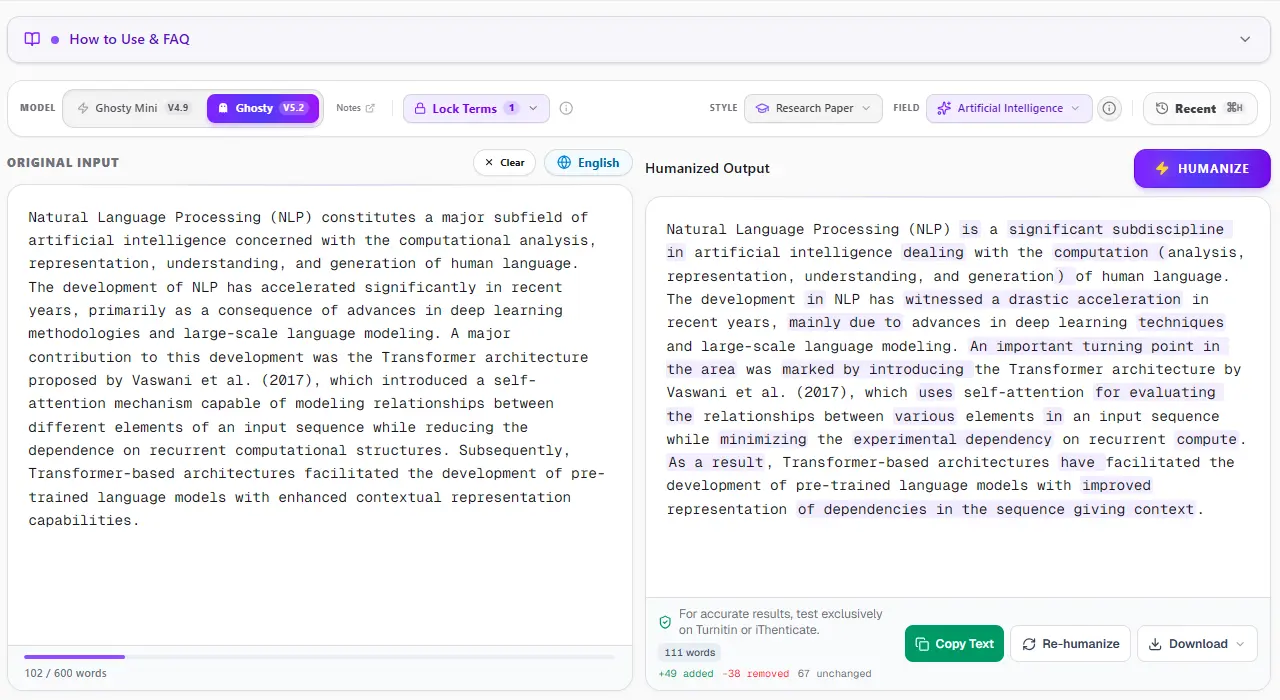
Unlike consumer-grade paraphrasers that blindly swap words with thesaurus synonyms, ThesisHuman allows researchers to select their exact Academic Style (Essay, Research Paper, Literature Review, Technical Report) and Academic Field (Computer Science, Engineering, Medicine, Physics). With Term Lock™, citations (APA, MLA, IEEE), LaTeX equations, and domain-specific terminology are cryptographically protected before sentence entropy is restructured.
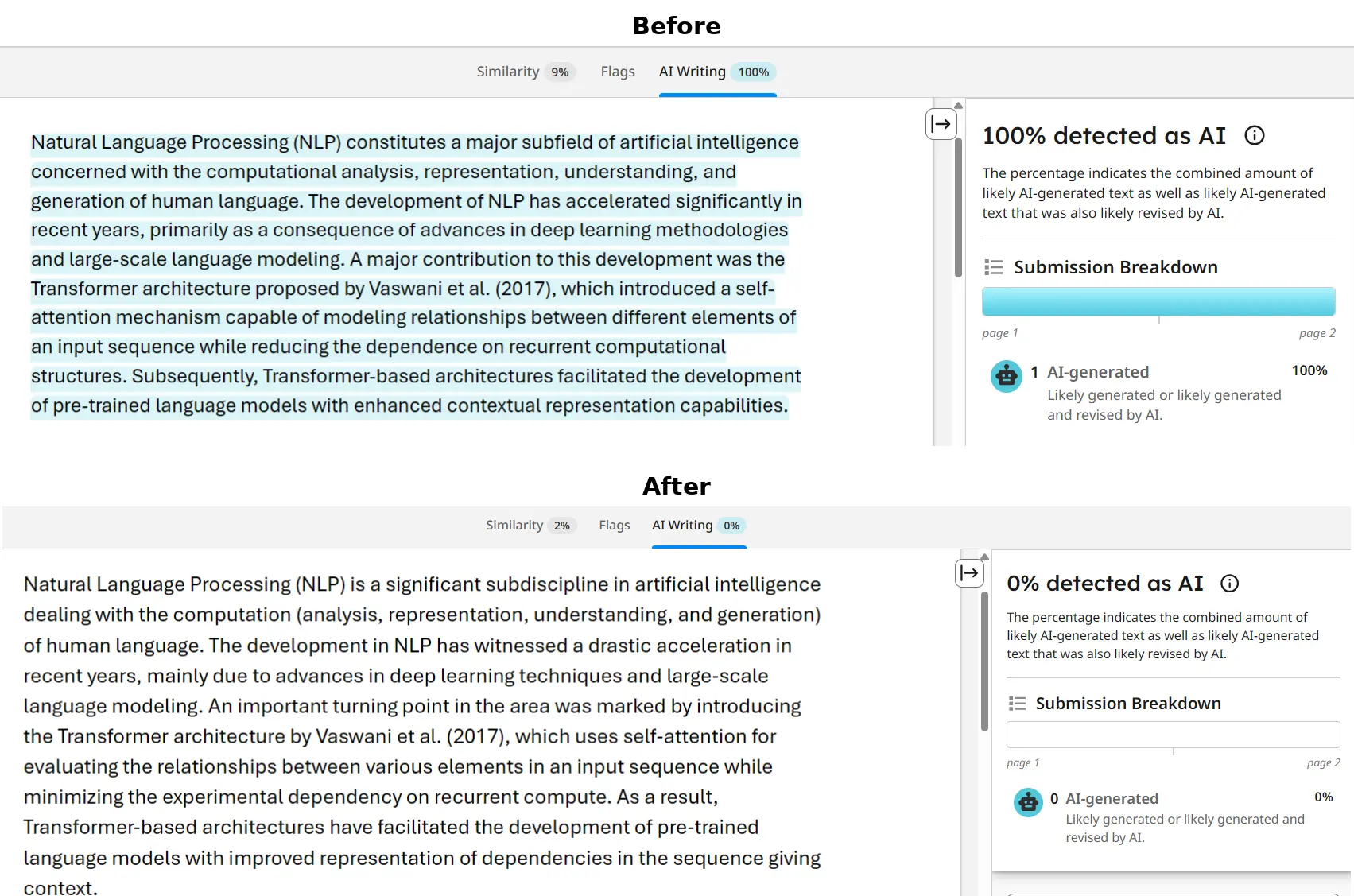
2. Turnitin & iThenticate Verification: 0% AI Detected
Turnitin and iThenticate scan submissions in overlapping 500-token blocks to analyze sentence predictability across paragraphs. When an unrefined AI draft is submitted, uniform cadence triggers an elevated AI Writing score. In the verified report below, a flagged graduate paper was processed through ThesisHuman, achieving a clean 0% AI detection score while preserving all formatted citations and technical parameters.
3. GPTZero Verification: Passing Perplexity & Burstiness Checks
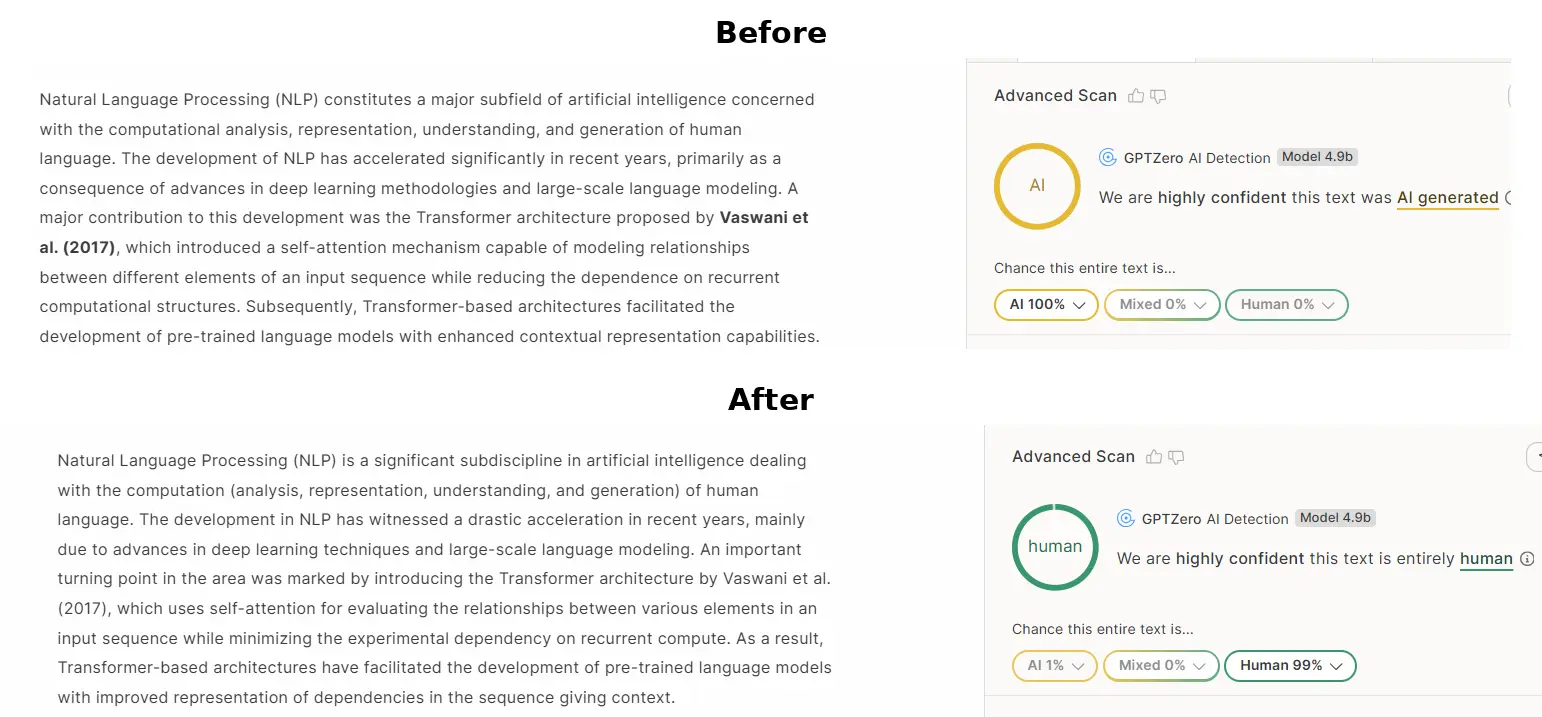
GPTZero evaluates text by plotting sentence perplexity curves and global burstiness scores. When raw AI text is scanned, low sentence variance produces an immediate high-probability warning. ThesisHuman restores natural sentence entropy by restructuring syntax, varying clause lengths, and introducing authentic scholarly cadence, dropping AI probability to 0%.
4. Originality.ai Verification: 0% AI Confidence
Originality.ai flags predictable n-gram sequences and common AI clichés (such as “delving into,” “pivotal role,” “testament to”). ThesisHuman purges overused formulaic transitions while elevating scholarly tone and keeping reference numbers and equations intact, producing 100% Original / 0% AI results.