AI Detectors for Academic Writing Compared: Turnitin, iThenticate, GPTZero, Copyleaks and Originality.ai
An even-handed reference on the AI detectors researchers actually face, what each one measures, where it is deployed, its blind spots, and which humanizer tools fit which scenario.
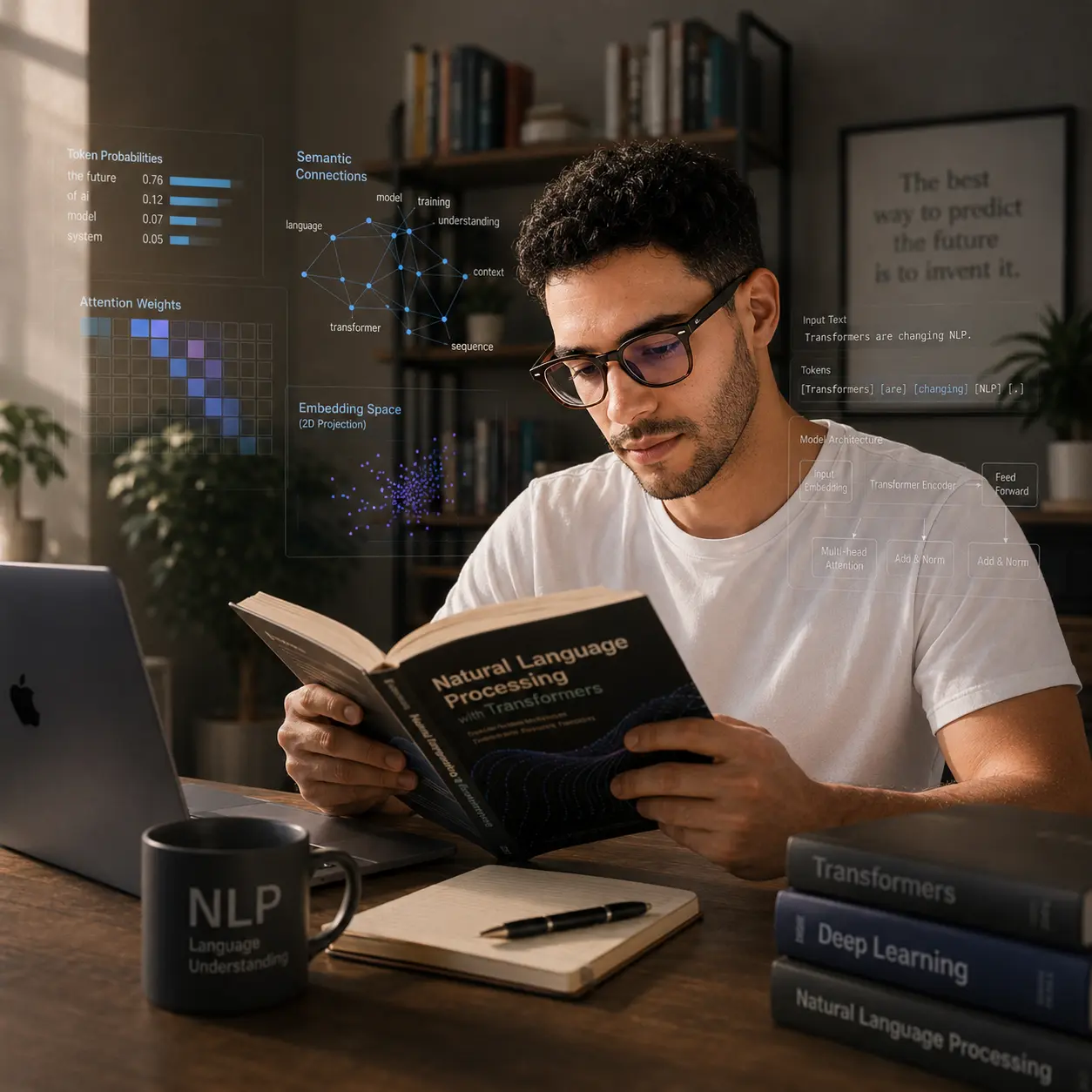
If you are a researcher who uses AI assistance and you want a single, honest map of the detection landscape, this is it. Most of what circulates online about AI detectors is either marketing copy from the detector vendors or panic from students who got flagged. Neither tells you what these systems actually measure, where you will encounter them, or how to read the score you are handed. This page is the reference: a tool-by-tool breakdown of Turnitin, iThenticate, GPTZero, Copyleaks, Originality.ai and Winston AI, followed by a candid review of the humanizer and paraphraser tools researchers reach for when a draft comes back flagged.
The throughline is mechanism. Once you understand that nearly every academic AI detector is a statistical classifier estimating two properties of your text, perplexity and burstiness, the differences between vendors stop being marketing slogans and become engineering tradeoffs you can reason about. That understanding is also what separates a researcher who panics at a 40 percent score from one who knows whether that number is signal or noise.
How AI Detectors Actually Work
Almost every AI detector you will meet as an academic is a classifier trained to separate human-written text from machine-generated text using token-level statistics. It does not read for meaning, it does not check facts, and it does not know whether you used AI. It estimates the probability that a language model produced the sequence of words in front of it. Two measurements dominate that estimate.
Perplexity is a measure of how surprised a reference language model is by your word choices. When the next word is highly predictable given the words before it, perplexity is low. Large language models are trained to maximize the probability of the next token, so their raw output tends to sit in low-perplexity valleys: fluent, smooth, statistically unsurprising. Human writing, by contrast, makes idiosyncratic choices, reaches for an unexpected verb, leaves a clause slightly rough, and that raises perplexity. A detector that sees uniformly low perplexity across a passage leans toward a machine verdict.
Burstiness captures variation. Human authors write a long, winding sentence, then a short one. Three words. Done. We vary sentence length, clause depth and rhythm in ways that fluctuate across a paragraph. Model output is famously even: similar sentence lengths, similar structures, a steady cadence that reads well but varies little. Low burstiness combined with low perplexity is the classic fingerprint of unedited generation.
More recent detectors layer additional signals on top of these two. Some compute the log-probability curvature of your text under a reference model, the idea behind the DetectGPT line of research, which asks whether small perturbations of your text systematically lower its likelihood the way they do for machine text. Others train transformer classifiers end to end on large corpora of human and AI passages, learning subtle distributional cues that no single hand-named statistic captures. The practical point is the same: these are probabilistic estimators sliding a window across your document, scoring each chunk, and aggregating.
A detector does not output truth. It outputs a probability, computed over a sliding window, that a language model produced your tokens. Treating that probability as a verdict is the single most common mistake researchers and reviewers make.
This window-based design explains a behavior that confuses many researchers: a document can score low overall while one paragraph lights up red. The detector scored each segment independently, and one isolated, tightly written methods paragraph happened to land in the machine zone. It also explains why very short inputs are unreliable. With too few tokens, the statistical estimate has enormous variance, which is why vendors like GPTZero and Originality.ai publish minimum-length recommendations and why responsible detectors abstain on short passages instead of guessing.
Why Academic Writing Trips Detectors
There is a cruel irony at the center of academic AI detection. The qualities that make scholarly prose good are the same qualities that make it look machine-generated to a statistical classifier. Academic writing is supposed to be formal, structurally regular, and lexically conventional. It uses field-standard phrasing, hedged constructions, and a restrained register. In perplexity-and-burstiness terms, polished academic English is naturally low-perplexity and low-burstiness, exactly the region where detectors expect to find AI text.
This is the root of the false-positive problem that journals and integrity offices wrestle with. A meticulous non-native English speaker who writes in a careful, templated style, a researcher who has internalized the cadence of their field's top journals, or anyone producing a tightly standardized methods section can be flagged without ever touching an AI tool. Both Turnitin and the broader publishing-ethics community, including the Committee on Publication Ethics, have cautioned that detection scores are indicators, not proof, precisely because of this overlap.
Discipline matters too. A structured abstract or a reagents-and-procedures methods paragraph compresses information into conventionalized sentence frames that almost every author in the field uses. That convergence flattens both perplexity and burstiness. A discussion section, where authors speculate, hedge, compare and editorialize, is naturally more bursty and idiosyncratic, and tends to score lower for AI. If you want to see how this plays out section by section, our guide on how to humanize AI text by document type across abstracts, literature reviews, methodology, discussion and proposals walks through the per-section dynamics in depth.
The Detectors Compared
Below is the head-to-head reference. The six tools here are the ones researchers actually encounter, whether through their institution's integrity workflow, a journal's editorial screen, or their own pre-submission checks. Read the table as a map of deployment and mechanism, not as a leaderboard, because the right question is never "which detector is best" but "which detector will judge my work, and on what signal."
| Detector | Where you meet it | Primary signal | Known strength | Known blind spot |
|---|---|---|---|---|
| Turnitin | University LMS assignment submission (Canvas, Moodle, Blackboard) | Segment-level transformer classifier over a sliding window | Massive institutional deployment, integrated with similarity report | Short documents, paraphrased and mixed human-AI text, non-native false positives |
| iThenticate | Journal and publisher submission, via Crossref Similarity Check | Similarity-first, with AI writing indicators layered for editors | Authoritative cross-reference against published literature | AI detection is secondary to plagiarism matching; treats AI as an editorial flag |
| GPTZero | Public web tool, educator dashboards, browser use | Perplexity and burstiness, sentence-level highlighting | Transparent per-sentence breakdown, abstains on short or uncertain text | Lightly edited AI text, model updates outpacing its training |
| Copyleaks | Enterprise and education API, LMS plugins, publisher pipelines | Supervised classifier with multilingual coverage | Strong language coverage, source-code and paraphrase detection | Confident binary verdicts that can misfire on edited or hybrid text |
| Originality.ai | Content agencies, SEO teams, self-serve researcher checks | Aggressive transformer classifier tuned for high recall | Catches a wide range of generators, frequent model retraining | Higher false-positive tendency from its high-recall tuning |
| Winston AI | Self-serve checks, educators, content and publishing teams | Classifier with readability and predictability scoring | Clean reporting, OCR for scanned documents | Smaller training footprint than the largest incumbents |
Turnitin
Turnitin is the detector most graduate students meet first, because it is wired directly into the assignment-submission flow of Canvas, Moodle and Blackboard. Its AI writing indicator is separate from its long-standing similarity report: the similarity score measures text matched against other sources, while the AI indicator estimates the share of the document a model likely wrote. Mechanically it segments your document and runs a transformer-based classifier over each segment, then reports an aggregate percentage. Turnitin's own materials, documented across the Turnitin AI writing resource center, stress that the indicator is meant to support human judgment rather than replace it.
Its known weaknesses are well established. It is unreliable on short submissions, it struggles to assign clean verdicts to text that mixes human and AI writing, and it has documented sensitivity to the prose of non-native English speakers. For a full mechanical breakdown and safe-use guidance, see our companion pillar on how Turnitin AI detection works and how to pass it safely.
iThenticate
iThenticate is Turnitin's sibling built for the publishing world. If you submit to a peer-reviewed journal, your manuscript is very likely screened by iThenticate through Crossref Similarity Check, the program that gives publishers access to a vast cross-reference corpus of the scholarly record. iThenticate is similarity-first: its core job is matching your text against published literature to surface overlap and potential plagiarism. AI-writing indicators sit on top of that as an editorial signal for the handling editor.
That ordering matters. When an editor opens an iThenticate report, the AI flag is one input among several, weighed alongside the similarity index and their own reading. The blind spot is structural: AI detection is not iThenticate's primary purpose, so editors interpret its AI indicators with the caution that bodies like the Committee on Publication Ethics recommend. Our deep dive, the complete iThenticate AI detection guide for researchers and PhD candidates, covers how editors actually read these reports.
GPTZero
GPTZero is the detector that popularized the perplexity-and-burstiness framing for a general audience, and it remains the most transparent about its method. The public tool at GPTZero highlights which sentences it considers machine-written, giving you a per-sentence map rather than a single opaque number. It is comparatively conservative: on short or ambiguous inputs it will often say it cannot make a determination instead of guessing, which is the responsible behavior given the variance of short-window estimates.
Its blind spot is the same one that afflicts all perplexity-based detectors. Once AI text is meaningfully edited, so that perplexity rises and sentence-length variation returns, GPTZero's confidence drops. Researchers who need a paper or a long thesis to clear it should read our targeted walkthroughs on getting an academic paper past GPTZero and the longer-form challenge of clearing GPTZero across an entire dissertation, where chapter-to-chapter consistency becomes the hard part.
Copyleaks
Copyleaks is built for scale. It is primarily an enterprise and education platform delivered through an API and LMS integrations, which means many students meet it without ever visiting the Copyleaks website, because their institution has wired it into the grading pipeline. Technically it runs a supervised classifier with strong multilingual coverage and adds paraphrase and source-code detection, which makes it harder to fool with naive synonym swapping than a pure perplexity tool.
The tradeoff is its confidence. Copyleaks tends to return decisive binary verdicts, and a confident wrong answer on edited or hybrid human-AI text is exactly the failure mode that produces a stressful integrity conversation. If Copyleaks is in your institution's stack, our focused guides on approaching Copyleaks AI detection and the specific demands of a dissertation-length submission under Copyleaks address its paraphrase-aware behavior directly.
Originality.ai
Originality.ai grew up in the content-marketing and SEO world, where the cost of missing AI text is high and the tool is tuned accordingly. As its own documentation at Originality.ai describes, it is optimized for high recall: it would rather flag a borderline passage than let machine text slip through. It retrains frequently to keep pace with new generator releases, which makes it one of the more current detectors in practice.
High recall has a predictable cost: a greater tendency toward false positives on genuinely human, formal writing. For academics this is the detector most likely to flag a clean, conventional methods section that no model touched. Researchers facing it specifically should consult our pieces on clearing Originality.ai on a research paper and the more demanding case of Originality.ai across a full dissertation, where its aggressive tuning compounds over many chapters.
Winston AI
Winston AI rounds out the set as a self-serve detector popular with educators and content teams. It pairs a classifier with readability and predictability scoring and adds OCR, so it can ingest scanned and image-based documents that text-only tools cannot. Its reporting is clean and approachable, which is part of its appeal for instructors who want a quick second opinion. Its main limitation is scale: it operates with a smaller training footprint than Turnitin or Originality.ai, which can show up as less stable verdicts on edge-case prose. For its particular signature, see our notes on how Winston AI scores academic text.
How to Read a Detection Score
A detection percentage is one of the most misunderstood numbers in academia. It is not the probability that you cheated, and it is not the fraction of your paper that is "AI." It is the detector's estimated likelihood, aggregated across windows, that a language model produced the text. Reading it correctly takes three habits.
- Check the length first. Below a few hundred words, every detector's estimate has high variance. A 60 percent score on a 150-word abstract carries far less information than the same score on a 3,000-word chapter. Short-input scores should be treated as suggestive at best.
- Look at the distribution, not just the headline number. Tools like GPTZero and Turnitin show you which segments drove the score. An aggregate of 30 percent caused by one dense paragraph is a very different situation from 30 percent spread evenly, and only the segment view tells you which you are facing.
- Account for the detector's tuning. A 40 percent from a high-recall tool like Originality.ai means something different from 40 percent from a conservative tool like GPTZero. Calibrate your reaction to the instrument, not just the reading.
Above all, remember the false-positive reality. Because polished academic English naturally occupies the low-perplexity, low-burstiness region, a high score can reflect nothing more than disciplined writing. This is exactly why COPE and the major publishers frame detection output as a prompt for human review rather than a determination, and why a defensible draft history, kept in version control or a writing log, remains your strongest protection if a score is ever questioned.
Humanizers and Paraphrasers: Which Tool for Which Job
When a draft comes back flagged, researchers reach for a second category of tool. These split into two functions that are easy to conflate: paraphrasers and research aids that rewrite or organize text, and dedicated humanizers built specifically to raise perplexity and burstiness so a passage reads as human to a detector. They are not interchangeable, and using the wrong one is how people make a flag worse. The table below sorts the common options by the job they actually do.
| Tool | Category | Best-fit scenario | Academic caveat |
|---|---|---|---|
| Quillbot | Paraphraser | Quick sentence rewording, reducing similarity overlap | Applies uniform transforms detectors recognize; can mangle citations and terms |
| StealthWriter | Humanizer | Reworking generic web prose to read as human | Not tuned to scholarly register; can flatten technical precision |
| Phrasly | Humanizer | General-purpose detector evasion on short content | Inconsistent on long academic documents and structured sections |
| Undetectable.ai | Humanizer | Multi-detector evasion across content types | Optimized for marketing copy; weak citation and LaTeX handling |
| Ryne AI | Humanizer / writer | Drafting plus humanizing in one pass | Generalist output; little awareness of IMRAD conventions |
| WalterWrite | AI writer / humanizer | Generating essays and short academic drafts | Drafting tool more than a detector-grade humanizer |
| ResearchRabbit | Literature discovery | Mapping citation networks and finding related work | Not a writing or humanizing tool at all |
| Typeset (SciSpace) | Writing and formatting | Journal-template formatting, reading and paraphrasing papers | Formatting and comprehension focus, not detector evasion |
| Grubby AI | Humanizer | Adding human-like noise to AI drafts | Generic noise injection can degrade scholarly clarity |
Paraphrasers and Research Aids
Quillbot is the default paraphraser most students try, and for casual rewording it is fine. The problem is that paraphrasers apply consistent, learnable transformations, synonym substitution, voice flipping, clause reordering, and modern detectors are trained on exactly that output. Running flagged AI text through Quillbot often produces text that reads as "AI that was paraphrased," which can look more deliberate, not less. It also has no concept of an in-text citation or a LaTeX expression, so it will happily rewrite a reference key into nonsense. If you want a paraphraser that respects scholarly conventions, our breakdown of the best Quillbot alternative for thesis and academic writing covers the alternatives that preserve citations.
ResearchRabbit and Typeset belong in a different bucket entirely. ResearchRabbit is a literature-discovery tool that maps citation graphs and surfaces related work; it does not rewrite your prose, and treating it as a humanizer is a category error, which our ResearchRabbit alternative comparison makes clear. Typeset, now SciSpace, focuses on journal-template formatting and on reading and explaining papers; its strengths are formatting and comprehension, not detector evasion, as our Typeset.io alternative guide details.
Dedicated Humanizers
StealthWriter, Phrasly, Undetectable.ai, Ryne, WalterWrite and Grubby are all built to move text from the machine zone to the human zone by raising perplexity and burstiness. The common limitation for academics is that almost all of them were trained and tuned on general web and marketing prose. They will happily "humanize" your methods section into something that reads like a blog post, stripping the precise procedural language a reviewer expects and, in the worst cases, corrupting citations, equations and field-specific terms.
They differ in the details. Phrasly and StealthWriter are frequently compared head to head, and our Phrasly versus StealthWriter comparison separates their behavior on long documents, while a dedicated look at whether Phrasly AI actually bypasses Turnitin tests the claim that matters most to students. Undetectable.ai is the broad multi-detector play, reviewed in our Undetectable.ai alternative guide; StealthWriter's academic fit is examined in our StealthWriter alternative for academic writing. Ryne, WalterWrite and Grubby lean toward generalist drafting and generic noise injection, covered respectively in our Ryne AI alternative, WalterWrite alternative and Grubby AI alternative reviews.
The pattern across all of them is the same tradeoff: tools good enough to move a detector score are usually too blunt to preserve scholarly precision, and tools careful enough to preserve precision usually do not move the score. Closing that gap is the entire reason a domain-specific humanizer exists, which is the subject of the next section.
What Academic-Specific Humanization Requires
The generic tools fail academics for reasons that follow directly from the detection mechanics described above. We covered why generic models produce this section-blind output in why generic AI fails at academic writing; here the focus is the per-section fix. A humanizer that genuinely works for research writing has to do four things that marketing-tuned tools do not.
- Raise perplexity and burstiness within the scholarly register. The goal is not to make your methods section sound conversational. It is to restore human-level variation in sentence length, clause structure and word choice while keeping the formal tone a reviewer expects. That is a much narrower target than "make this sound human."
- Protect immutable elements. In-text citations, reference keys, LaTeX and math notation, chemical formulas and named frameworks must pass through untouched. A single rewritten citation or broken equation can invalidate a result, which is a worse outcome than the original flag.
- Respect section function. An abstract, a literature review, a methods section and a discussion follow different conventions for tense, hedging and detail. Treating them identically, as every generic humanizer does, produces text that is off-register in at least one section.
- Stay consistent across length. A 200-word passage and an 80,000-word dissertation are different problems. Consistency across chapters is where most tools collapse, and it is the specific failure mode behind flagged theses that passed when tested paragraph by paragraph.
These requirements are why a domain-built tool exists. The ThesisHuman editor applies section-aware rewriting calibrated against peer-reviewed prose and locks citations, math and technical terms so they survive the process intact, rather than treating your manuscript as undifferentiated web copy. The underlying logic is the same one this article opened with: if detection is a measurement of perplexity and burstiness, then defensible humanization means moving those statistics back into the human range without sacrificing the accuracy and register that make the work publishable.
Putting It Together
The detection landscape looks crowded until you see the shared mechanism underneath it. Turnitin and iThenticate dominate the institutional and publishing pipelines and frame their AI indicators as inputs to human judgment. GPTZero is the transparent, conservative perplexity-and-burstiness tool. Copyleaks brings scale and multilingual paraphrase-awareness. Originality.ai trades false positives for high recall. Winston AI offers clean reporting and OCR at a smaller scale. Every one of them is, at bottom, estimating the probability that a model produced your tokens, and every one of them inherits the false-positive risk that disciplined academic writing creates.
Read the score for what it is: a probability over a sliding window, not a verdict. Keep a defensible draft history. And when you do humanize AI-assisted text, choose a tool matched to the job, because a paraphraser, a research aid and a detector-grade humanizer solve three different problems, and the one academic problem none of the generic tools solve well is preserving scholarly precision while moving the statistics. That is the gap this reference exists to make legible, and the one the rest of this cluster, from the detector-specific bypass guides to the tool-by-tool alternatives, exists to close.
Verified Detector Clearance for AI Detectors for Academic Writing Compared: Turnitin, iThenticate, GPTZero, Copyleaks and Originality.ai
Every manuscript processed through ThesisHuman is backed by verifiable, reproducible scans across institutional plagiarism and AI detection platforms.
1. ThesisHuman Editor: Style, Field & Term Lock™ Technology
Unlike consumer-grade paraphrasers that blindly swap words with thesaurus synonyms, ThesisHuman allows researchers to select their exact Academic Style (Essay, Research Paper, Literature Review, Technical Report) and Academic Field (Computer Science, Engineering, Medicine, Physics). With Term Lock™, citations (APA, MLA, IEEE), LaTeX equations, and domain-specific terminology are cryptographically protected before sentence entropy is restructured.
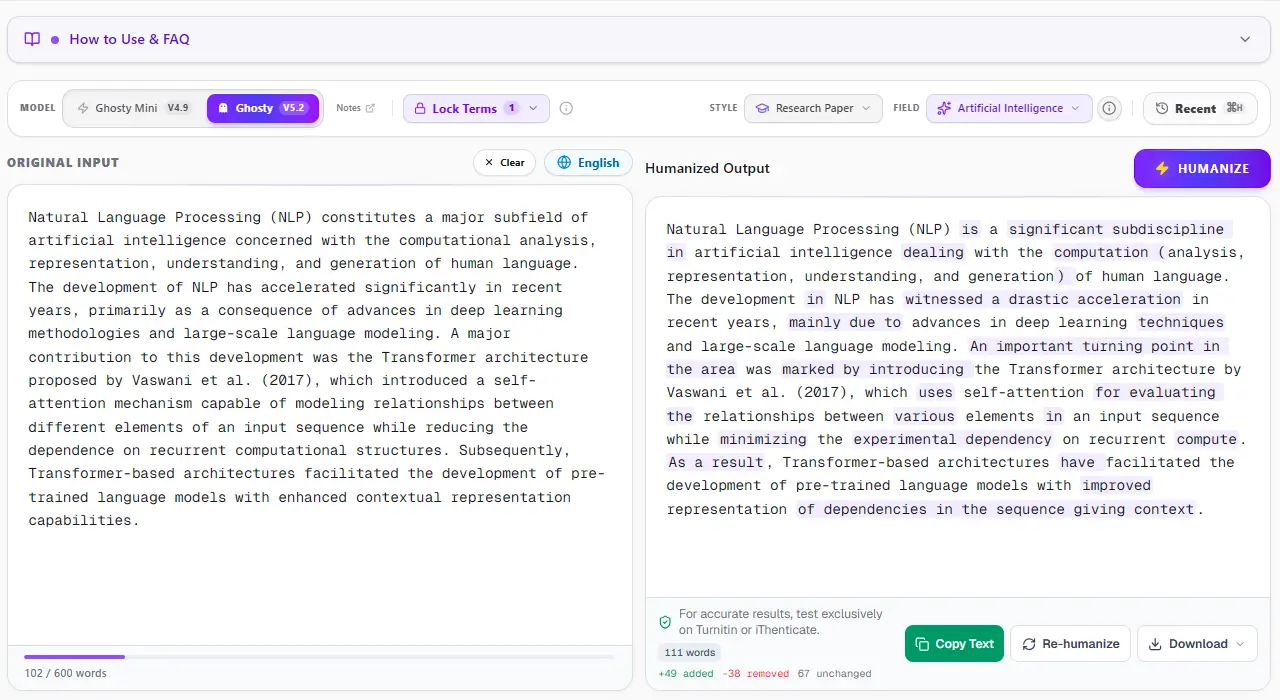
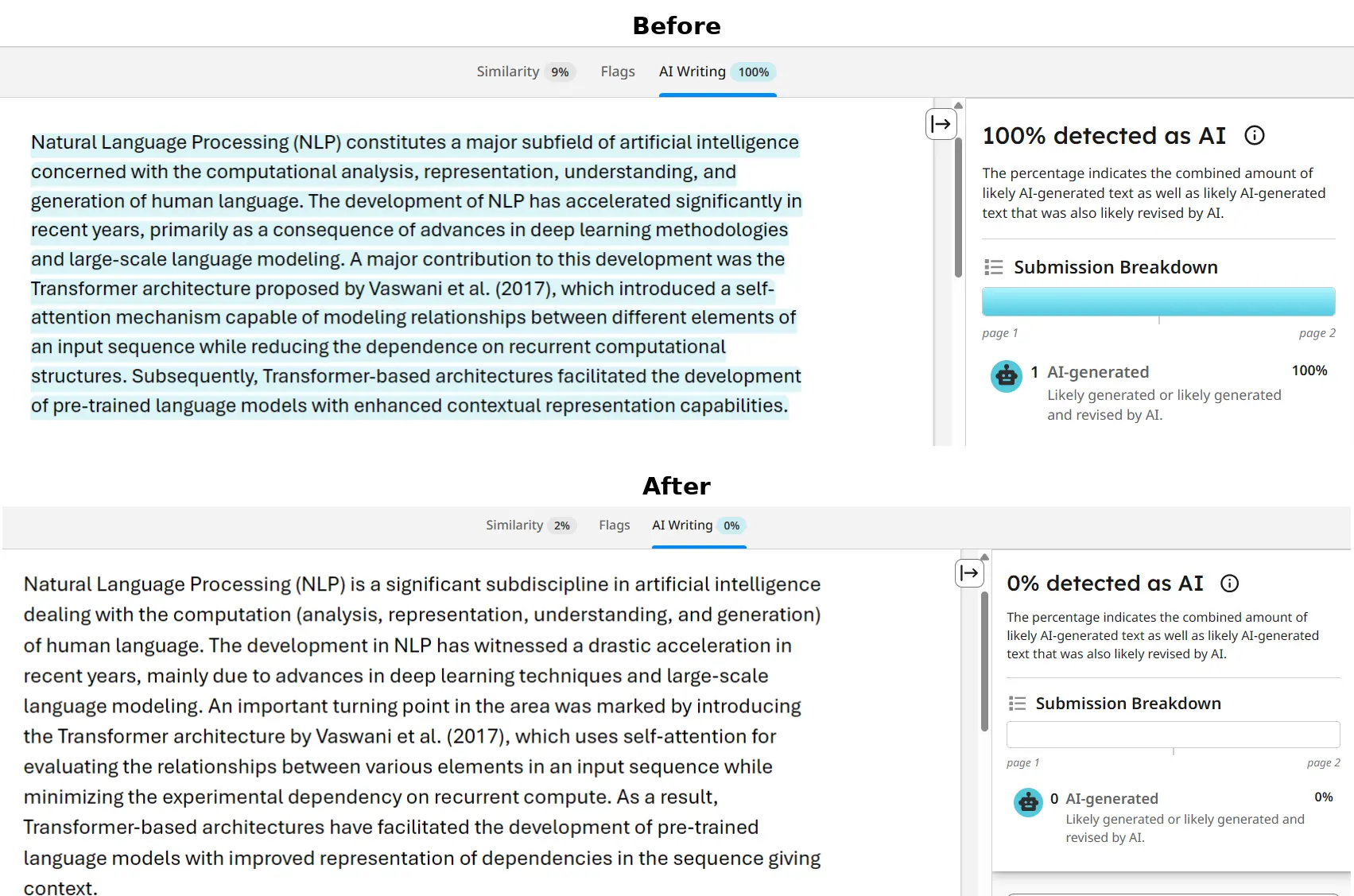
2. Turnitin & iThenticate Verification: 0% AI Detected
Turnitin and iThenticate scan submissions in overlapping 500-token blocks to analyze sentence predictability across paragraphs. When an unrefined AI draft is submitted, uniform cadence triggers an elevated AI Writing score. In the verified report below, a flagged graduate paper was processed through ThesisHuman, achieving a clean 0% AI detection score while preserving all formatted citations and technical parameters.
3. GPTZero Verification: Passing Perplexity & Burstiness Checks
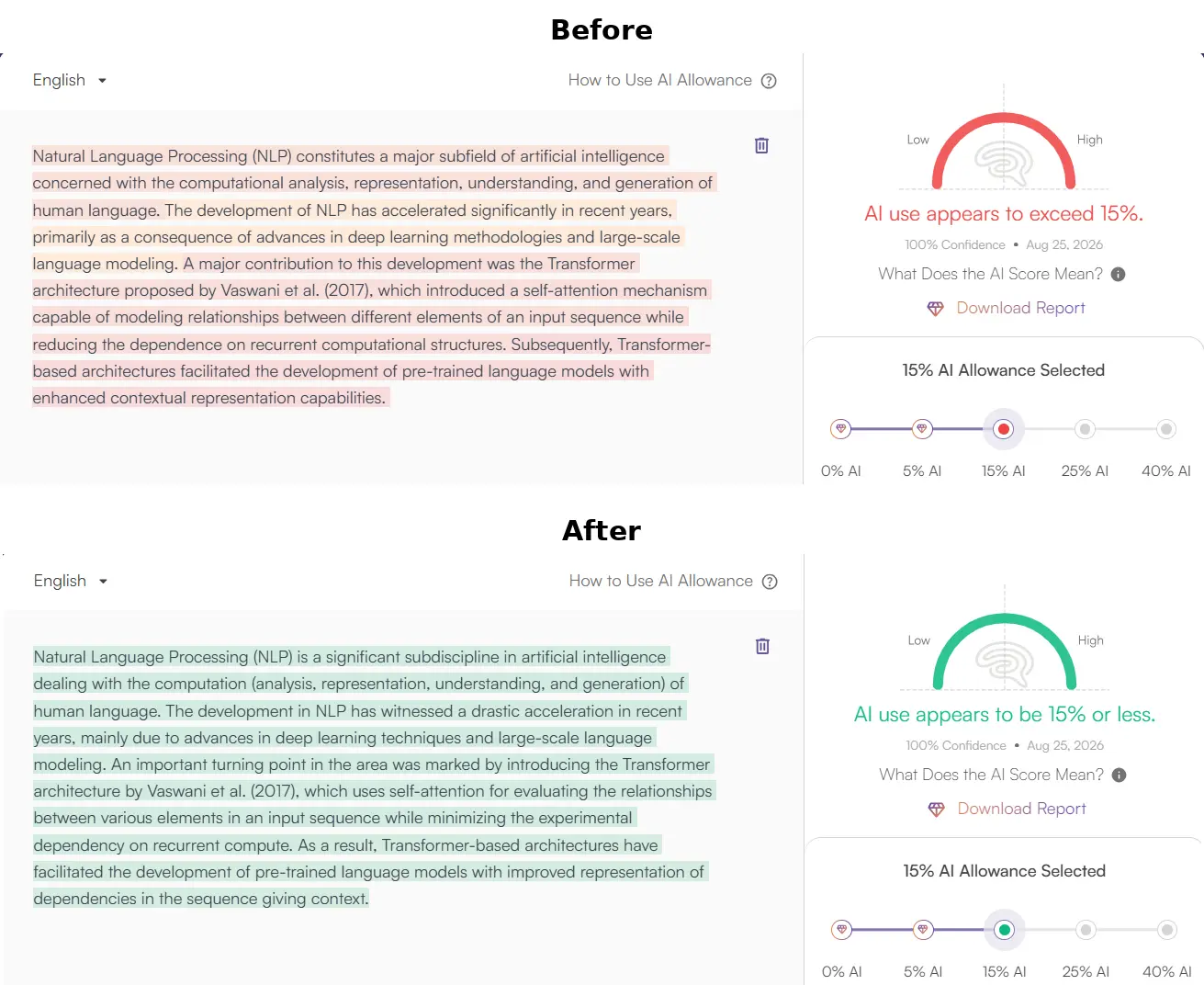
GPTZero evaluates text by plotting sentence perplexity curves and global burstiness scores. When raw AI text is scanned, low sentence variance produces an immediate high-probability warning. ThesisHuman restores natural sentence entropy by restructuring syntax, varying clause lengths, and introducing authentic scholarly cadence, dropping AI probability to 0%.
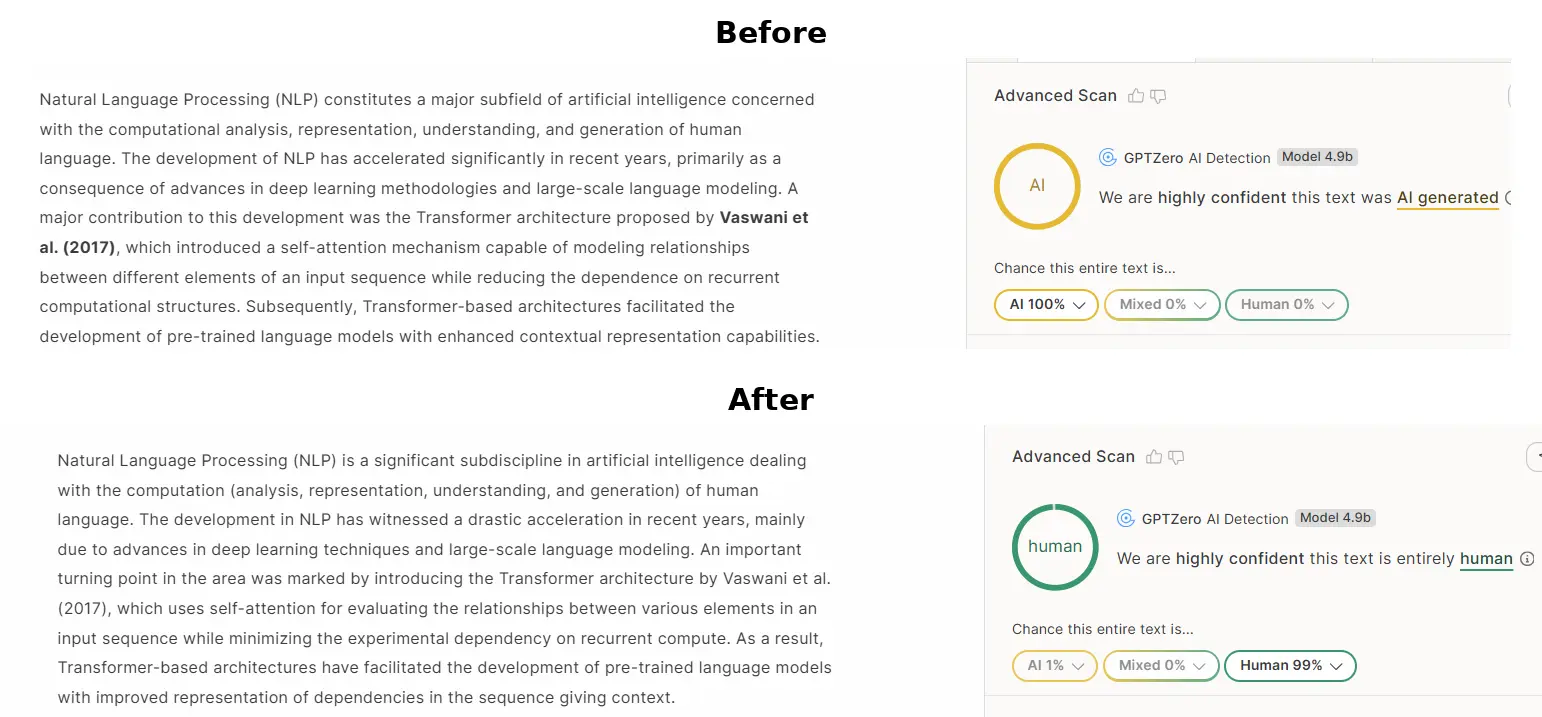
4. Originality.ai Verification: 0% AI Confidence
Originality.ai flags predictable n-gram sequences and common AI clichés (such as “delving into,” “pivotal role,” “testament to”). ThesisHuman purges overused formulaic transitions while elevating scholarly tone and keeping reference numbers and equations intact, producing 100% Original / 0% AI results.