Characteristics of a Good Paragraph: Structure, Examples, and Checklist
Learn the essential characteristics of an effective academic paragraph. Explore unity, coherence, topic development, annotated models, and a diagnostic checklist.
HamzaPhD Researcher
13 min read
An effective academic paragraph is an autonomous unit of thought that advances a single, well-defined claim. While introductory writing textbooks often reduce paragraph construction to a rigid count of sentences, professional scholarly writing evaluates paragraphs by cognitive architecture: unity, logical coherence, substantive development, and rigorous evidence integration.
In this guide, we examine the fundamental characteristics that distinguish a mature, coherent paragraph from an unformed cluster of sentences. You will explore structural components, annotated before-and-after models, diagnostic rubrics, and discipline-specific conventions.
---
## 1. What Makes an Academic Paragraph Effective?
A successful academic paragraph accomplishes four distinct cognitive tasks simultaneously:
1. **Focus**: It introduces and sustains a single controlling idea that directly supports the paper's overarching thesis.
2. **Order**: It organizes sentences according to a recognizable logical sequence so the reader never experiences cognitive friction.
3. **Substance**: It provides concrete evidence, data, citations, or textual excerpts rather than relying on unsupported generalities.
4. **Integration**: It explains how that evidence validates the controlling idea, bridging raw data with interpretive analysis.
When any of these four pillars is absent, the paragraph becomes either underdeveloped, unfocused, or mechanically repetitive. Writing a strong paragraph is not about reaching an arbitrary length; it is about reaching conceptual completeness.
---
## 2. Unity and the Single Controlling Idea
Paragraph unity requires that every sentence inside the paragraph directly relates to one controlling idea. The moment a sentence introduces an unrelated topic, the paragraph's structural integrity fractures.
Consider the relationship between the controlling idea and subordinate sentences:
- **The Anchor**: The controlling idea acts as a thematic filter. Every piece of context, citation, or explanatory commentary must pass through this filter.
- **Topical Drift**: A common error occurs when a writer follows an interesting tangential detail from an cited source, leading the second half of the paragraph far away from the initial topic sentence.
- **The Unity Test**: To test for unity, read each sentence in isolation and ask: "Does this specific clause directly elaborate, prove, or qualify the topic sentence?" If the answer is no, move the sentence to another paragraph or delete it.
---
## 3. Coherence and Sentence-Level Continuity
While unity ensures that all sentences share the same topic, **coherence** ensures that sentences connect smoothly to one another. A unified paragraph can still be completely incoherent if its sentences read like disconnected bullet points.
Achieving sentence-level coherence relies on three primary techniques:
### Known-to-New Information Flow
Scholarly readers process information most efficiently when sentences begin with familiar concepts (known information) and conclude with new or complex insights. Beginning a sentence with a reference to the preceding sentence anchors the reader before presenting novel data.
### Cohesive Lexical Chains
Maintain thematic continuity by repeating key nouns, using precise synonyms, and employing deliberate pronoun references. When you switch terminology arbitrarily (for example, alternating unpredictably between "educational software," "digital tutoring platforms," "instructional applications," and "virtual interfaces"), you create unnecessary cognitive ambiguity.
### Grammatical Parallelism
When presenting comparative data, multiple hypotheses, or sequential findings, use parallel grammatical structures. Parallelism allows the reader to focus on the underlying concepts rather than decoding shifting syntax.
---
## 4. Topic Sentences and Strategic Placement
The topic sentence states the controlling idea of the paragraph. In academic essays, its placement dictates how the reader interprets subsequent evidence.
| Topic Sentence Position | Primary Function | Typical Scholarly Context |
| :--- | :--- | :--- |
| **Initial (First Sentence)** | Establishes the claim immediately; maximum clarity | Standard body paragraphs, literature reviews, argumentative essays |
| **Delayed (Second or Third Sentence)** | Provides necessary transitional context or historical framing before making the claim | Complex discussions linking prior counter-arguments to new findings |
| **Final (Concluding Sentence)** | Presents evidence inductively and builds toward a synthesizing conclusion | Exploratory essays, nuanced qualitative analyses |
| **Implied (Unstated)** | Renders the controlling idea obvious through cumulative evidence | Literary narratives and creative nonfiction; rare in formal academic research |
In undergraduate and graduate research papers, placing the topic sentence at the start of the body paragraph remains the most reliable strategy. For comprehensive phrasing strategies, consult our guide on [topic sentence starters](/blog/topic-sentence-starters).
---
## 5. Adequate Development and Substantive Depth
An underdeveloped paragraph makes a general assertion, quotes a single source, and abruptly concludes without explanatory commentary. Adequate development requires the author to unpack the claim thoroughly.
A fully developed academic paragraph typically includes:
- Clear contextualization of the problem.
- Primary or secondary source evidence.
- Explanatory gloss clarifying technical terminology.
- Explicit synthesis demonstrating why the evidence proves the claim.
- Boundary qualifications detailing where the finding might not apply.
If your paragraph contains fewer than three sentences, it is almost certainly underdeveloped, functioning merely as an isolated claim or a fragmented summary note.
---
## 6. Supporting Evidence and Citation Integration
Evidence provides empirical or textual foundation for your assertions. However, evidence cannot stand alone. Dropping an unintroduced quotation into a paragraph disrupts authorial voice and confuses the reader.
To integrate supporting evidence effectively:
- **Introduce the Source**: Frame the evidence with an introductory attribution signal identifying the researcher or study context.
- **Maintain Formal Citations**: Ensure every external finding carries proper parenthetical attribution (such as APA, MLA, or Chicago format).
- **Prioritize Paraphrase Over Quotation**: In social science and STEM disciplines, synthesizing findings in your own words demonstrates deeper comprehension than stringing together direct quotations.
- **Preserve Academic Nomenclature**: Use precise technical terms when referencing disciplinary concepts. Tools like [ThesisHuman](/editor) use Term Lock features to ensure specialized academic nomenclature and citations remain intact during drafting revisions.
For introductory phrasing templates, refer to our curated directory of [evidence sentence starters](/blog/evidence-sentence-starters).
---
## 7. Explanation, Interpretation, and Analysis
The central analytical engine of an academic paragraph is the **interpretation**. Many developing writers make the mistake of assuming that evidence speaks for itself. In formal scholarship, evidence only demonstrates what you explicitly argue it demonstrates.
Follow the **Rule of Proportionality**: the space devoted to interpreting and analyzing evidence should equal or exceed the space occupied by the evidence itself.
When analyzing evidence, address these questions:
- What specific causal mechanism does this data reveal?
- How does this finding challenge, refine, or corroborate prior literature?
- What are the underlying assumptions or methodological limitations of this evidence?
- How does this specific point advance the central thesis of the essay?
---
## 8. Logical Sentence Organization Patterns
The internal sequence of your sentences determines the paragraph's persuasive force. Common scholarly organization patterns include:
1. **Deductive Order (General to Specific)**: Begins with a broad claim, introduces specific empirical evidence, and concludes with targeted analysis. This is the dominant pattern in academic prose.
2. **Inductive Order (Specific to General)**: Presents discrete observations or experimental anomalies first, guiding the reader toward a broader conceptual realization.
3. **Chronological or Process Order**: Arranges information according to historical sequence or methodological stages. Essential for historical retrospectives and lab methodology sections.
4. **Cause and Effect**: Articulates an initial condition or independent variable, followed by systematic analysis of the resulting outcomes or dependent variables.
5. **Problem to Solution**: Identifies an interpretive dilemma, theoretical contradiction, or empirical gap before outlining a proposed resolution.
---
## 9. Transitions and Inter-Paragraph Bridges
Paragraphs do not exist in isolation. They function as interconnected links in an argumentative chain. Effective writing requires two distinct tiers of transitional devices:
- **Internal Transitions**: Words and short phrases linking individual sentences within the paragraph (such as *consequently*, *furthermore*, *in contrast*, *specifically*).
- **External Bridge Sentences**: Sentences that connect the current paragraph's claim back to the preceding paragraph while pointing toward the overarching thesis.
Avoid relying exclusively on mechanical transitional adverbs at the beginning of every sentence. Instead, build conceptual bridges where the subject of the new sentence refers directly to the object or conclusion of the preceding sentence. For an in-depth taxonomy of transitional phrasing, see our guide on [transition sentences](/blog/transition-sentences).
---
## 10. Paragraph Purpose Across Scholarly Contexts
A paragraph's structure must reflect its pedagogical and disciplinary purpose within the paper:
- **Introductory Paragraphs**: Establish scholarly exigence, outline the problem space, provide background definitions, and culminate in an interpretive thesis.
- **Body Paragraphs**: Develop an individual sub-claim using empirical evidence, textual analysis, or theoretical synthesis. For detailed body mechanics, explore [what is a body paragraph](/blog/what-is-a-body-paragraph).
- **Counter-Argument Paragraphs**: Articulate an opposing interpretation or contradictory dataset fairly before methodically demonstrating why your thesis remains superior.
- **Concluding Paragraphs**: Synthesize findings across body paragraphs, answer the "So What?" question, and articulate broader theoretical implications without introducing ungrounded new claims.
---
## 11. Paragraph Length Versus Structural Completeness
A pervasive academic myth suggests that an ideal paragraph must contain exactly five sentences. In reality, academic paragraphs vary significantly depending on conceptual complexity.
- **Typical Length**: In scholarly journal articles and university essays, substantive body paragraphs typically range from 100 to 250 words (approximately 4 to 8 sentences).
- **The Danger of Short Paragraphs**: Paragraphs containing fewer than three sentences often indicate fragmented thinking, unanalyzed claims, or superficial outlining.
- **The Danger of Long Paragraphs**: Paragraphs exceeding 300 words often suffer from topical drift, visual fatigue, and multiple competing claims that should be split into distinct thematic units.
- **Determining Essay Balance**: For guidelines on balancing overall paragraph distribution across an entire paper, consult our resource on [how many paragraphs is an essay](/blog/how-many-paragraphs-is-an-essay) and [how many sentences are in a paragraph](/blog/how-many-sentences-are-in-a-paragraph).
---
## 12. Strong vs. Weak Paragraphs: Detailed Comparative Analysis
To illustrate how these characteristics operate in practice, let us examine two versions of a paragraph analyzing the adoption of artificial intelligence in higher education writing pedagogy.
### Weak Paragraph Example
> Artificial intelligence writing tools are becoming very popular in college classes. Many students use them to write papers and brainstorm topics. Turnitin developed an AI detector to find generated text, but some researchers say it makes mistakes on foreign students. Teachers are worried about cheating and academic integrity. Generative models use probability to choose words, which makes writing sound robotic. Some universities are changing their honor codes to address AI tools.
#### Diagnostic Critique of the Weak Version:
- **Lack of Unity**: The paragraph jumps haphazardly between student adoption, Turnitin detection accuracy, faculty anxiety, transformer probability mechanics, and institutional honor code reforms.
- **Poor Coherence**: Sentences are strung together without transitional connectives or conceptual continuity; it reads like a disjointed list of random thoughts.
- **Absent Evidence**: No empirical statistics, specific researchers, or formal citations are provided to support the broad generalizations.
- **Zero Interpretation**: The author offers no analytical commentary explaining how these disparate observations relate to a central argument.
### Strong, Revised Paragraph Example
> Although university administrators frequently treat artificial intelligence writing assistants as an existential threat to academic integrity, the pedagogical challenge lies in outmoded assessment design rather than generative technology itself. When evaluated across standardized undergraduate coursework, generative language models replicate the predictable syntactic cadences and low-perplexity token sequences characteristic of basic descriptive essays (Kaufman & Patel, 2024). Consequently, traditional prompts that reward formulaic summaries inadvertently incentivize automated completion. Rather than relying on algorithmic detection tools that demonstrate documented false-positive vulnerabilities among non-native English scholars, academic institutions must reconstruct assignment rubrics to emphasize multi-stage iterative drafting, contextual primary-source synthesis, and disciplined oral defense. By aligning evaluation criteria with interpretive depth rather than mechanical prose generation, educators can cultivate rigorous critical inquiry while rendering automated shortcuts ineffective.
#### Why the Strong Version Succeeds:
- **Clear Controlling Idea**: Every sentence serves the central argument that assessment design, not AI technology, requires systemic reform.
- **Substantive Development**: It explains *why* models mimic student prose (low-perplexity token sequences) and identifies *what* institutional changes are necessary.
- **Integrated Evidence**: Employs formal citation framing (Kaufman & Patel, 2024) to anchor theoretical claims.
- **Flawless Coherence**: Uses logical transitions (*Although*, *Consequently*, *Rather than*, *By aligning*) and parallel syntactic structures to guide the reader seamlessly.
---
## 13. Fully Annotated Academic Paragraph Model
Here is a fully annotated model illustrating the five core anatomical components of an advanced academic paragraph:
```text
[CLAIM / TOPIC SENTENCE]
Urban green spaces reduce physiological markers of chronic stress among socioeconomically marginalized populations through microclimate stabilization and sensory restoration.
[SUPPORTING EMPIRICAL EVIDENCE]
In a multi-neighborhood longitudinal study across metropolitan Chicago, residents living within a 400-meter radius of restored canopy parks exhibited a 19 percent mean reduction in diurnal salivary cortisol levels compared to baseline cohorts in high-imperviousness urban zones (Martinez et al., 2023).
[EXPLANATION OF MECHANISM]
This biochemical divergence occurs because dense tree canopies mitigate extreme urban heat island temperatures while simultaneously dampening low-frequency traffic noise, attenuating the persistent sympathetic nervous system arousal common in dense industrial corridors.
[INTERPRETATION & SYNTHESIS]
These findings demonstrate that public botanical infrastructure functions not merely as aesthetic municipal ornamentation, but as a preventative public health intervention capable of counteracting environmental determinants of cardiovascular morbidity.
[LINK TO BROADER ARGUMENT]
Consequently, municipal housing authorities must prioritize green space allocation as an indispensable component of equitable civic infrastructure planning.
```
---
## 14. Paragraph Diagnosis and Transformation Matrix
When revising your drafts, use this diagnostic matrix to identify common structural malfunctions and apply targeted structural remedies:
| Structural Defect | Diagnostic Symptom | Root Cause | Targeted Revision Strategy |
| :--- | :--- | :--- | :--- |
| **Lack of Unity** | Paragraph drifts into unrelated historical anecdotes or secondary debates | The author included interesting source notes without checking against the topic sentence | Identify the single controlling idea; cut or relocate all sentences that do not directly substantiate that idea |
| **Defective Coherence** | Sentences feel choppy, abrupt, or disjointed like an unordered bullet list | Absence of known-to-new information sequencing and transitional connectives | Begin each new sentence with an anchor concept introduced in the preceding sentence; add logical transition phrases |
| **Unsupported Assertion** | Paragraph contains strong theoretical claims with zero supporting citations | Authorial overconfidence or premature drafting without literature integration | Insert specific empirical studies, quantitative metrics, or direct textual evidence with proper parenthetical attribution |
| **Repetitive Monotony** | Every sentence begins with the same grammatical structure (Subject + Verb + Object) | Lack of syntactic variety; formulaic sentence composition | Vary clause openings by starting with prepositional phrases, adverbial dependent clauses, or appositive constructions |
| **Evidence Dumping** | Paragraph consists of two or three consecutive long quotations without commentary | Author relies on external voices to make the argument instead of interpreting data | Paraphrase source material into your own authorial voice; follow every citation with at least two sentences of analysis |
---
## 15. Disciplinary Variations: Humanities, STEM, and Social Sciences
Paragraph characteristics adapt to the methodological traditions of specific academic disciplines:
### Humanities (Literature, History, Philosophy)
- **Focal Point**: Textual deconstruction, interpretive close reading, and qualitative nuance.
- **Paragraph Cadence**: Often longer (180 to 280 words), characterized by intricate subordinating syntax and sustained theoretical development.
- **Evidence Profile**: Close textual excerpts, historical primary documentation, and philosophical counter-arguments.
- For deep structural guidelines on textual deconstruction, review our walkthrough on [how to write an analytical essay](/blog/how-to-write-an-analytical-essay).
### STEM (Biology, Engineering, Computer Science)
- **Focal Point**: Methodological replicability, empirical precision, and causal relationship verification.
- **Paragraph Cadence**: Concise and direct (100 to 180 words), emphasizing active verbs and dense data reporting.
- **Evidence Profile**: Quantitative metrics, confidence intervals ($p < 0.05$), mathematical notations, and systematic procedure descriptions.
### Social Sciences (Psychology, Sociology, Political Science)
- **Focal Point**: Hypothesis testing, demographic comparison, and policy implications.
- **Paragraph Cadence**: Balanced (140 to 220 words), structured around formal empirical claims, methodological contextualization, and sociological significance.
- **Evidence Profile**: Meta-analyses, participant sample sizes ($N = 1,450$), statistical surveys, and cross-cultural longitudinal datasets.
---
## 16. Practical Paragraph Self-Evaluation Checklist
Before finalizing any academic draft, subject each body paragraph to this 7-step quality control protocol:
- [ ] **1. Single Controlling Idea**: Can you summarize the core claim of this paragraph in a single concise phrase?
- [ ] **2. Explicit Topic Sentence**: Does the paragraph feature an unambiguous topic sentence positioned within the first two sentences?
- [ ] **3. Direct Evidence**: Does the paragraph contain concrete external evidence, data, or source material with complete parenthetical citations?
- [ ] **4. Interpretive Depth**: Does your explanatory commentary account for at least 50 percent of the paragraph's overall word volume?
- [ ] **5. Known-to-New Flow**: Does the beginning of each sentence connect logically to the information presented immediately before it?
- [ ] **6. Transitional Anchors**: Does the paragraph incorporate both internal sentence transitions and an external conceptual bridge linking back to the thesis?
- [ ] **7. Visual & Cognitive Balance**: Is the paragraph between 100 and 250 words, avoiding both single-sentence brevity and sprawling wall-of-text fatigue?
---
## 17. Common Paragraph Mistakes to Avoid
1. **The Orphan Topic Sentence**: Stating a bold claim at the start of a paragraph and immediately abandoning it to discuss an unrelated case study.
2. **The Quotation Sandwich Failure**: Dropping a direct quotation into the paragraph without framing it with an introductory lead-in or following it with interpretive analysis.
3. **Premature Conclusion**: Ending a paragraph with a sudden, unearned generalization that the preceding evidence has not fully established.
4. **Pronoun Ambiguity**: Beginning sentences with vague demonstrative pronouns like "This proves that..." without specifying the exact noun (*This statistical discrepancy proves that...*).
5. **False Parallelism**: Combining dissimilar grammatical units in a comparative series, creating rhythmic dissonance for the reader.
---
## 18. Frequently Asked Questions
### What are the five most essential characteristics of a good paragraph?
The five core characteristics of an effective academic paragraph are unity (focusing on one controlling idea), coherence (smooth logical connection between sentences), adequate development (sufficient evidence and analysis to prove the claim), clear topic organization (strategic placement of the topic sentence), and transition (explicit bridges linking the paragraph to the broader thesis).
### Does an academic paragraph always need a concluding sentence?
Not always. In a cohesive multi-paragraph argument, a mechanical concluding sentence that merely restates the topic sentence can feel redundant. Instead, effective scholarly writers conclude paragraphs with an analytical transition that links the current evidence to the upcoming argument or reinforces how the point contributes to the main thesis.
### Why is the five-sentence paragraph rule considered an oversimplification?
The five-sentence model is an introductory pedagogical device designed to teach elementary students basic paragraph structure. In university-level and professional academic writing, paragraph length depends on conceptual density and evidence requirements. A rigorous scientific or philosophical paragraph may require seven to nine carefully sequenced sentences to unpack complex methodologies, datasets, and interpretive caveats.
### How do I know if a paragraph has lost unity?
A paragraph has lost unity when it introduces secondary topics, historical digressions, or additional arguments that cannot be directly evaluated under the initial topic sentence. A reliable way to test unity is to read the topic sentence alongside each subsequent sentence independently; if a sentence discusses an idea that falls outside the topic sentence's conceptual boundaries, it must be relocated or excised.
### How does ThesisHuman assist scholars with paragraph coherence?
When revising complex academic manuscripts, students and researchers frequently encounter awkward syntax, low-burstiness phrasing, or accidentally scrambled parenthetical references. [ThesisHuman](/editor) refines sentence cadence, optimizes clausal rhythm, and incorporates active Term Lock controls to preserve disciplinary terminology, LaTeX formulas, and parenthetical citations without sacrificing formal academic register.
Empirical Verification
Verified Detector Clearance for Characteristics of a Good Paragraph: Structure, Examples, and Checklist
Every manuscript processed through ThesisHuman is backed by verifiable, reproducible scans across institutional plagiarism and AI detection platforms.
Phase 1: Academic Engine Configuration
1. ThesisHuman Editor: Style, Field & Term Lock™ Technology
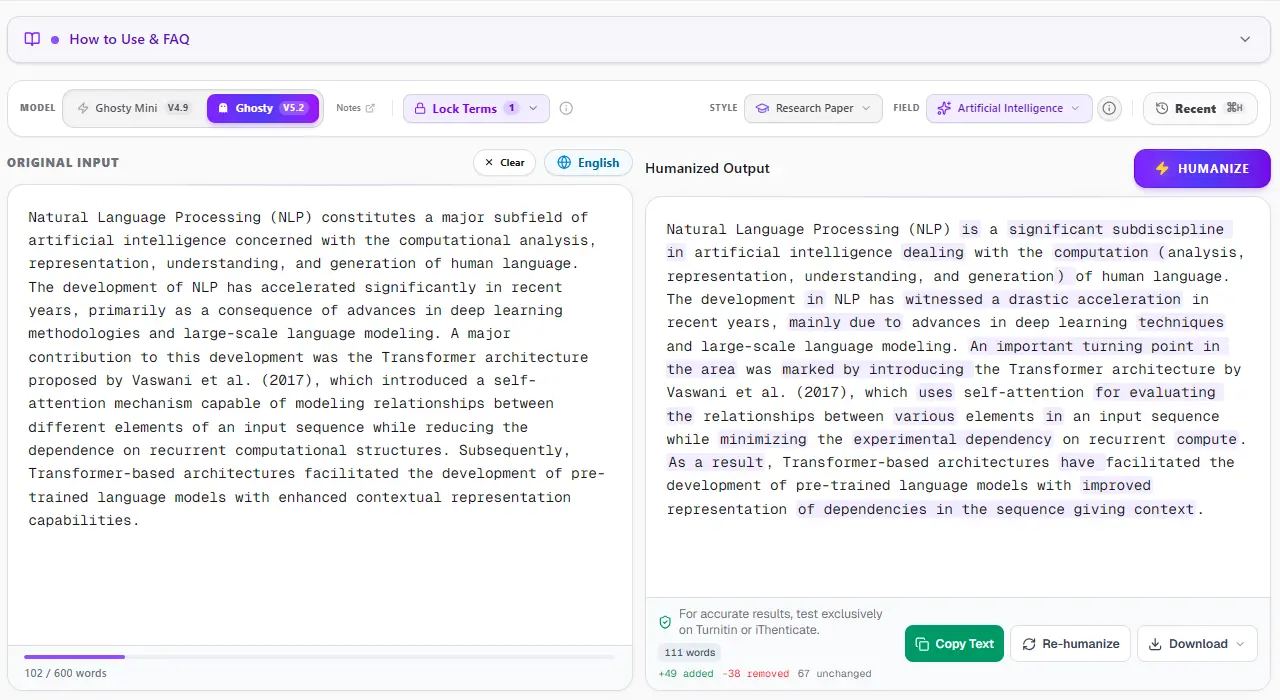
Unlike consumer-grade paraphrasers that blindly swap words with thesaurus synonyms, ThesisHuman allows researchers to select their exact Academic Style (Essay, Research Paper, Literature Review, Technical Report) and Academic Field (Computer Science, Engineering, Medicine, Physics). With Term Lock™, citations (APA, MLA, IEEE), LaTeX equations, and domain-specific terminology are cryptographically protected before sentence entropy is restructured.
Figure 1: The ThesisHuman editor processing an academic manuscript — featuring Academic Style selection, Academic Field customization, and Term Lock controls.
Phase 2: Institutional Integrity Screening
2. Turnitin & iThenticate Verification: 0% AI Detected
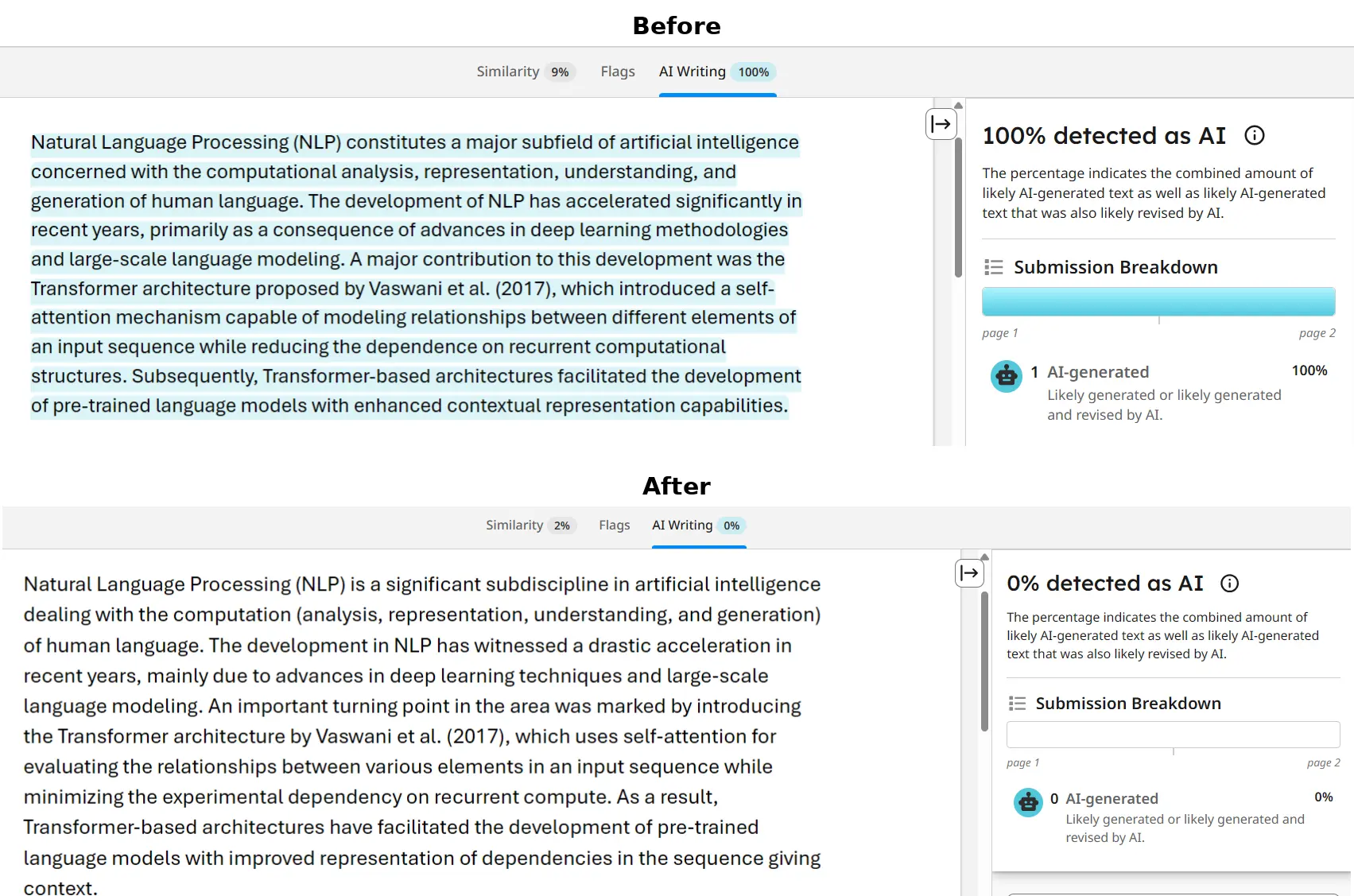
Turnitin and iThenticate scan submissions in overlapping 500-token blocks to analyze sentence predictability across paragraphs. When an unrefined AI draft is submitted, uniform cadence triggers an elevated AI Writing score. In the verified report below, a flagged graduate paper was processed through ThesisHuman, achieving a clean 0% AI detection score while preserving all formatted citations and technical parameters.
Figure 2: Turnitin AI detection scan — demonstrating complete 0% AI indicator clearance after ThesisHuman academic naturalization.
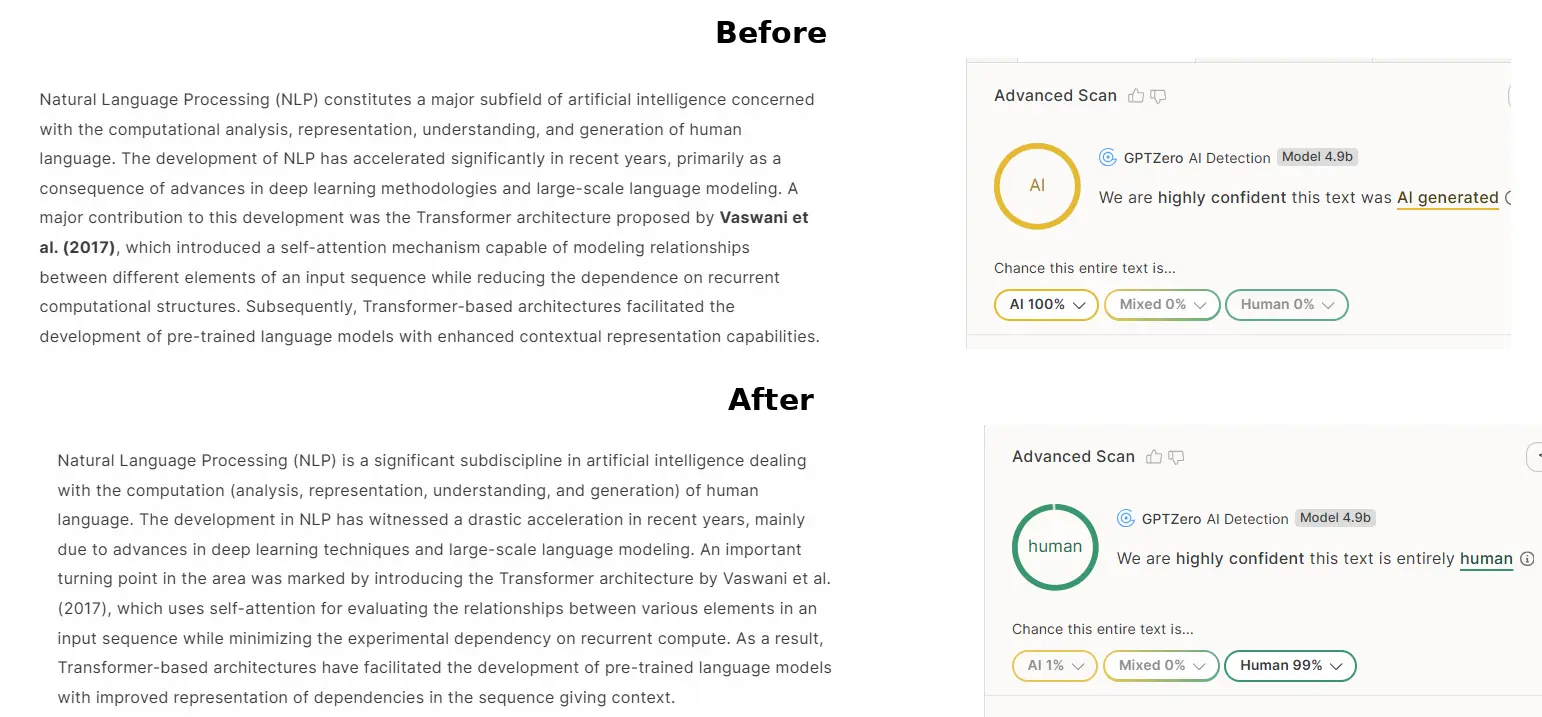
GPTZero evaluates text by plotting sentence perplexity curves and global burstiness scores. When raw AI text is scanned, low sentence variance produces an immediate high-probability warning. ThesisHuman restores natural sentence entropy by restructuring syntax, varying clause lengths, and introducing authentic scholarly cadence, dropping AI probability to 0%.
Figure 3: GPTZero perplexity and burstiness verification — raw machine-generated text (100% AI) transformed into 0% AI human-grade academic prose.
Phase 4: Cliché & N-Gram Elimination
4. Originality.ai Verification: 0% AI Confidence
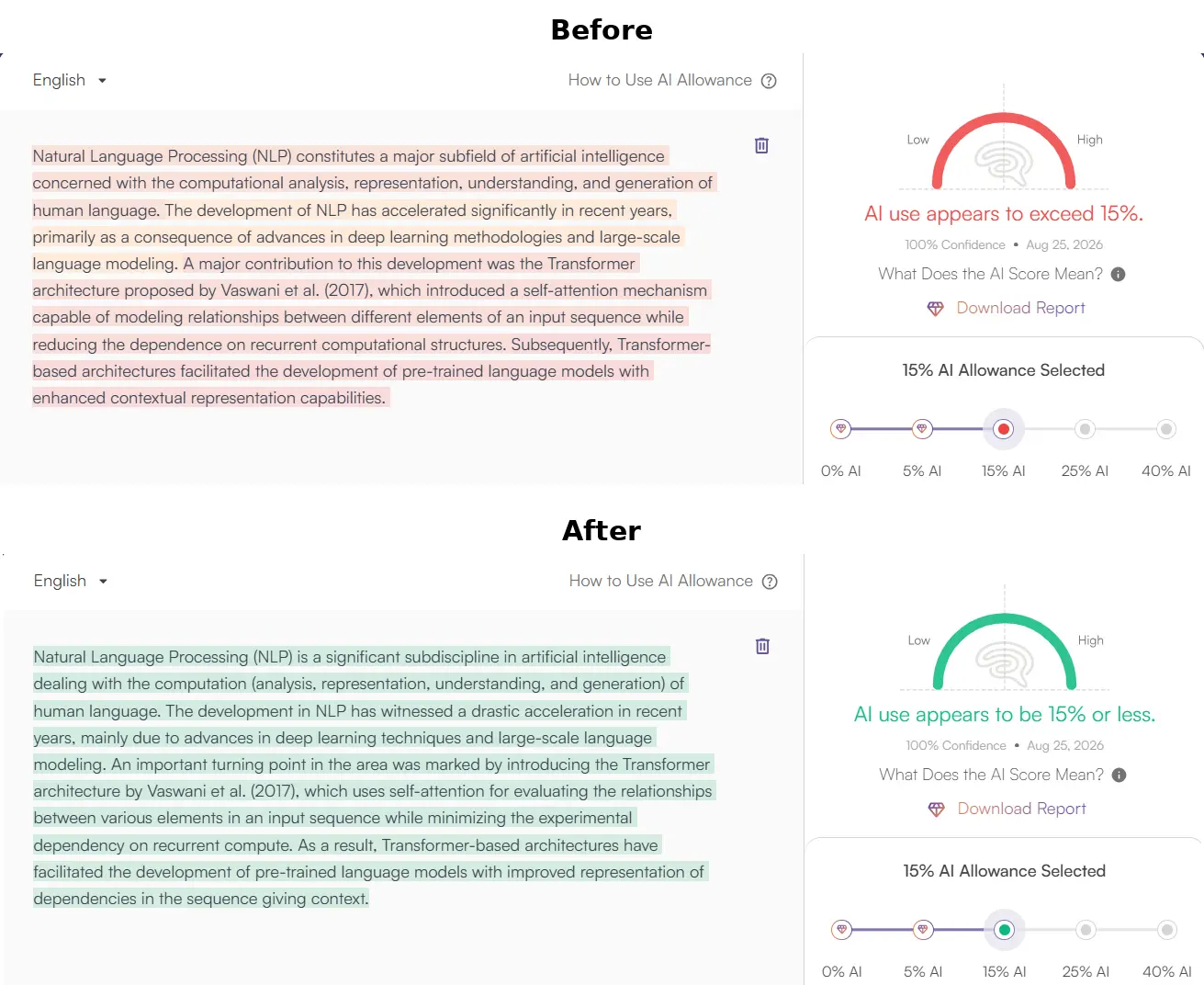
Originality.ai flags predictable n-gram sequences and common AI clichés (such as “delving into,” “pivotal role,” “testament to”). ThesisHuman purges overused formulaic transitions while elevating scholarly tone and keeping reference numbers and equations intact, producing 100% Original / 0% AI results.
Figure 4: Originality.ai detector scan — confirming complete removal of synthetic n-gram patterns and 0% AI detection confidence.
What are the five most essential characteristics of a good paragraph?
The five core characteristics of an effective academic paragraph are unity (focusing on one controlling idea), coherence (smooth logical connection between sentences), adequate development (sufficient evidence and analysis to prove the claim), clear topic organization (strategic placement of the topic sentence), and transition (explicit bridges linking the paragraph to the broader thesis).
Does an academic paragraph always need a concluding sentence?
Not always. In a cohesive multi-paragraph argument, a mechanical concluding sentence that merely restates the topic sentence can feel redundant. Instead, effective scholarly writers conclude paragraphs with an analytical transition that links the current evidence to the upcoming argument or reinforces how the point contributes to the main thesis.
Why is the five-sentence paragraph rule considered an oversimplification?
The five-sentence model is an introductory pedagogical device designed to teach elementary students basic paragraph structure. In university-level and professional academic writing, paragraph length depends on conceptual density and evidence requirements. A rigorous scientific or philosophical paragraph may require seven to nine carefully sequenced sentences to unpack complex methodologies, datasets, and interpretive caveats.
How do I know if a paragraph has lost unity?
A paragraph has lost unity when it introduces secondary topics, historical digressions, or additional arguments that cannot be directly evaluated under the initial topic sentence. A reliable way to test unity is to read the topic sentence alongside each subsequent sentence independently; if a sentence discusses an idea that falls outside the topic sentence's conceptual boundaries, it must be relocated or excised.
How does ThesisHuman assist scholars with paragraph coherence?
When revising complex academic manuscripts, students and researchers frequently encounter awkward syntax, low-burstiness phrasing, or accidentally scrambled parenthetical references. ThesisHuman refines sentence cadence, optimizes clausal rhythm, and incorporates active Term Lock controls to preserve disciplinary terminology, LaTeX formulas, and parenthetical citations without sacrificing formal academic register.
Bypass AI Detectors While Protecting Your Original Writing
Turn AI drafts into natural, undetectable academic writing. Protects your citations, research claims, and authentic scholarly tone. 500 words included free.