QuillBot AI Humanizer vs Academic Rewriting: What Really Works in 2026?
Can QuillBot humanize AI text for university submissions, or is it merely swapping synonyms? We analyze QuillBot paraphrasing modes, token entropy, and academic integrity.

For university students and researchers seeking to refine AI-assisted writing, QuillBot is often the first tool that comes to mind. Founded as a sentence paraphraser long before modern large language models emerged, QuillBot remains widely utilized across high schools and undergraduate colleges. However, as institutions deploy sophisticated classifiers such as Turnitin AI Writing Indicator, iThenticate Crossref Similarity Check, and Copyleaks, a critical question emerges: can QuillBot actually humanize AI-generated prose, or does it merely swap synonyms while leaving underlying machine patterns exposed?
The short answer is straightforward. QuillBot is a thesaurus-driven paraphraser, not an academic humanizer. While it can rephrase individual sentences for casual readability, it fundamentally lacks the architecture required to reconstruct token perplexity, sentence burstiness, and academic discourse structures. Even worse, its automated synonym substitutions often corrupt in-text APA and IEEE citations, technical formulas, and domain-specific terminology. In this guide, we break down the mathematical mechanics of AI detection, examine why basic paraphrasing fails, and explore defensible workflows for academic revision.
What QuillBot Actually Does
To understand why QuillBot struggles against institutional AI detection, one must examine its core design. QuillBot operates primarily as a synonym substitution engine with grammatical smoothing. When you paste a paragraph into its editor, the system evaluates the text using a sequence-to-sequence model trained to replace words and phrases with contextually plausible alternatives.
Users can select from several modes, including Standard, Fluency, Formal, Academic, Simple, Creative, and Expand. While these modes adjust the frequency and complexity of proposed substitutions, the underlying operation remains localized. The engine considers the immediate window of surrounding words (local n-grams) rather than evaluating the holistic statistical distribution of the document. When applied to machine-generated prose from tools like ChatGPT, Claude, or Gemini, QuillBot simply replaces predictable machine tokens with alternative predictable tokens, leaving the macro-level generative footprint completely intact.
Synonym Swapping vs Token Entropy Restoration
The difference between surface paraphrasing and genuine academic naturalization lies in statistical language modeling. Modern AI detectors do not search for specific "forbidden" words. Instead, they calculate two key mathematical properties: perplexity and burstiness.
1. Perplexity and Token Predictability
Perplexity measures how surprised a language model is by a sequence of words. When a generative model writes, it repeatedly chooses words with high probability scores based on prior context. This results in uniform, low-perplexity text. Human scholars, by contrast, write with high perplexity: they introduce unexpected conceptual leaps, specialized jargon, discipline-specific qualifications, and nuanced metaphors that statistical models do not predict.
QuillBot does not solve low perplexity because its replacement suggestions are themselves chosen from high-probability distributions. Swapping "important" for "vital" or "shows" for "demonstrates" does not elevate perplexity. The replacement remains statistically predictable to any secondary classifier evaluating the sentence.
2. Burstiness and Sentence Rhythm
Burstiness measures variation in sentence length, syntactic structure, and rhythmic pacing across an entire passage. Human writing is naturally bursty: a short, assertive topic sentence is followed by a long, multi-clause analytical deduction, followed by a mid-length empirical qualification. Synthetic AI text, by contrast, displays flat, metronomic cadence where sentences cluster between eighteen and twenty-four words in length.
QuillBot generally maintains the existing sentence boundaries and clausal architecture of the input. If an AI draft has uniform sentence lengths, QuillBot outputs a paraphrased draft with the exact same monotonous cadence. Detectors analyze this rhythm across multi-paragraph spans, readily flagging the uniform structure.
Why Classifiers Easily Detect Basic Paraphrasing
Institutional detectors like Turnitin and Copyleaks have been trained on millions of paired examples: raw AI text, human writing, and paraphrased AI text. Because millions of students have run ChatGPT drafts through QuillBot over the past three years, detection engineers have explicitly tuned their neural classifiers to identify the distinctive signature of synonym replacement.
When a classifier analyzes a QuillBot-paraphrased document, it observes several telltale markers:
- Syntactic Rigidity: The fundamental grammatical spine (subject, verb, object hierarchy) remains unchanged, matching typical generative templates.
- Locally Replaced Tokens: Words are swapped for less common synonyms in contexts where native academic writers would never choose them, a phenomenon linguists refer to as "thesaurus syndrome."
- Unaltered Token Predictability Vectors: The n-gram transition probabilities remain consistent with generative decoders.
The Rogeting Trap in Academic Manuscripts
In linguistics and academic publishing, the term "rogeting" describes the mechanical replacement of words with synonyms from a thesaurus without considering discipline-specific semantic precision. In scholarly papers, rogeting is not merely ineffective against detectors; it actively damages intellectual credibility.
Consider what happens when a mechanical paraphraser operates on scientific and academic prose:
- Regression Analysis: A mechanical paraphraser might alter this established statistical methodology into "backward examination" or "retrograde assessment", rendering the methodology nonsensical to peer reviewers.
- Control Group: Transforming "control group" into "check gathering" or "regulation cohort" destroys the formal scientific description of an experimental trial.
- Significance Level: Converting "statistically significant" into "noteworthy meaning" or "weighty implication" invalidates quantitative reporting standards.
Professors and journal reviewers easily spot these bizarre substitutions. When an academic evaluator encounters distorted terminology combined with a high Turnitin AI score, the manuscript faces swift rejection or integrity inquiries.
QuillBot Modes Evaluated Under Classifier Scrutiny
To demonstrate how different paraphrasing approaches perform under institutional scrutiny, consider the following comparative analysis of a typical literature review excerpt:
| Text Variant | Sample Content | Structural Assessment |
|---|---|---|
| Raw AI Output | "Furthermore, it is essential to emphasize that empirical research plays a pivotal role in validating theoretical assumptions across contemporary educational frameworks." | Low perplexity, clichéd transitions ("furthermore", "pivotal role"), uniform 24-word length. Flagged 98% AI. |
| QuillBot Standard Mode | "Additionally, it is crucial to stress that experimental study plays a crucial function in verifying conceptual ideas throughout modern learning structures." | Identical syntax; synonyms swapped in place ("crucial function", "learning structures"). Readily flagged as AI by Turnitin. |
| ThesisHuman Ghosty V6 | "Empirical trials validate theoretical models in modern classrooms. Without systematic classroom observation, abstract pedagogical assumptions cannot be reliably tested." | Sentence split for high burstiness (9 words followed by 13 words); clichés eliminated; scholarly voice restored. Cleared clean. |
The Citation and Terminology Corruption Problem
For researchers working on dissertations, master's theses, and peer-reviewed articles, the most dangerous flaw in generic paraphrasing tools is citation corruption. QuillBot treats text as raw strings. It has no native understanding of bibliographic formats such as APA 7th edition, MLA 9th edition, Chicago, or IEEE standards.
Common ways generic paraphrasers distort scholarly citations include:
- Author Name Alteration: Converting "(Miller et al., 2021)" into "(Miller and colleagues, 2021)" or substituting surnames with dictionary equivalents.
- Numeric Date Distortion: Rephrasing parenthetical dates or misplacing publication years outside of their designated brackets.
- LaTeX Equation Destruction: Stripping mathematical delimiters ($...$ or $$...$$), converting Greek letters into lowercase text, or corrupting chemical formulas.
Once in-text citations are altered, rebuilding the bibliography manually can take dozens of hours. More seriously, submitting corrupted citations to an institutional checker immediately raises red flags for academic dishonesty.
What Actually Works for Scholarly Manuscripts
Achieving genuine academic readability while maintaining academic integrity requires an engine designed specifically for the scholarly genre. This is where dedicated tools like ThesisHuman diverge from generic paraphrasers.
Instead of simple synonym substitution, effective academic humanization relies on three distinct technological layers:
- Cryptographic Citation Locking: Prior to any text revision, an automated parser isolates all in-text citations, DOI strings, author-date brackets, and reference list anchors. These tokens are locked into immutable placeholders that cannot be altered during rewriting.
- LaTeX and STEM Formula Preservation: Mathematical notations, statistical expressions (such as p-values and confidence intervals), and chemical symbols are shielded from modification.
- Entropy and Burstiness Reconstruction: Rather than substituting words, our Ghosty V6 model restructures sentences. It breaks up repetitive sentence lengths, inserts natural academic hedging, removes machine clichés like "pivotal milestone" or "testament to", and restores natural human rhythm.
If you want to explore how our specialized academic engine works on research papers, test our full undetectable AI humanizer to experience citation-safe naturalization.
A Step-by-Step Workflow for Ethical Revision
Using AI tools ethically means treating them as drafting assistants rather than surrogate authors. Follow this four-step revision workflow to ensure your manuscripts remain defensible, authentic, and accurate:
Step 1: Draft with Focus on Argument and Logic
Use AI brainstorming or drafting to outline complex sections or organize literature sources, but ensure that the underlying empirical claims and core arguments originate from your own critical reading and data analysis.
Step 2: Lock Terminology and Key References
Before applying any language polish, identify the immutable terms of your field. Use Term Locks to protect specialized nomenclature, proprietary apparatus names, and statistical methods from arbitrary rephrasing.
Step 3: Apply Dedicated Academic Naturalization
Pass your draft through a scholarly naturalization engine that preserves citation architecture while restructuring sentence cadences. Avoid multi-tool prompt chaining or stacking multiple generic paraphrasers, which compounds errors and increases stylistic incoherence.
Step 4: Conduct a Rigorous Human Proofreading Pass
Read your revised manuscript aloud. Verify that every citation maps precisely to an entry in your reference list, check that formulas retain correct symbols, and verify that all claims are appropriately hedged to match scholarly publishing norms.
Frequently Asked Questions
Can Turnitin detect text paraphrased by QuillBot?
Yes. Turnitin AI detection model evaluates token probability distributions and sentence burstiness across entire documents. Because QuillBot alters individual words while maintaining synthetic syntactic structures, Turnitin routinely flags QuillBot-edited AI drafts.
Does QuillBot Academic Mode bypass AI detectors?
No. While QuillBot Academic Mode selects formal synonyms, it still relies on localized n-gram substitution. It does not restore the macro-level burstiness and high perplexity that characterize genuine human scholarly writing.
Why does QuillBot break my research citations?
QuillBot treats APA and IEEE citations as regular text strings. It frequently paraphrases author names, splits parenthetical dates, and distorts journal acronyms because it lacks dedicated citation-shielding technology.
What is the difference between an AI paraphraser and an AI humanizer?
An AI paraphraser swaps words for synonyms within existing sentence structures. An academic AI humanizer restructures entire sentences to restore human-grade burstiness and perplexity while locking citations, domain terminology, and mathematical syntax.
Is it ethical to use an AI humanizer on academic work?
When used to eliminate robotic language, improve readability for non-native English scholars, and resolve false positive flags on original research, language naturalization serves as advanced editorial assistance. Authors must always verify factual accuracy and disclose tool usage where university policy mandates.
Verified Detector Clearance for QuillBot AI Humanizer vs Academic Rewriting: What Really Works in 2026?
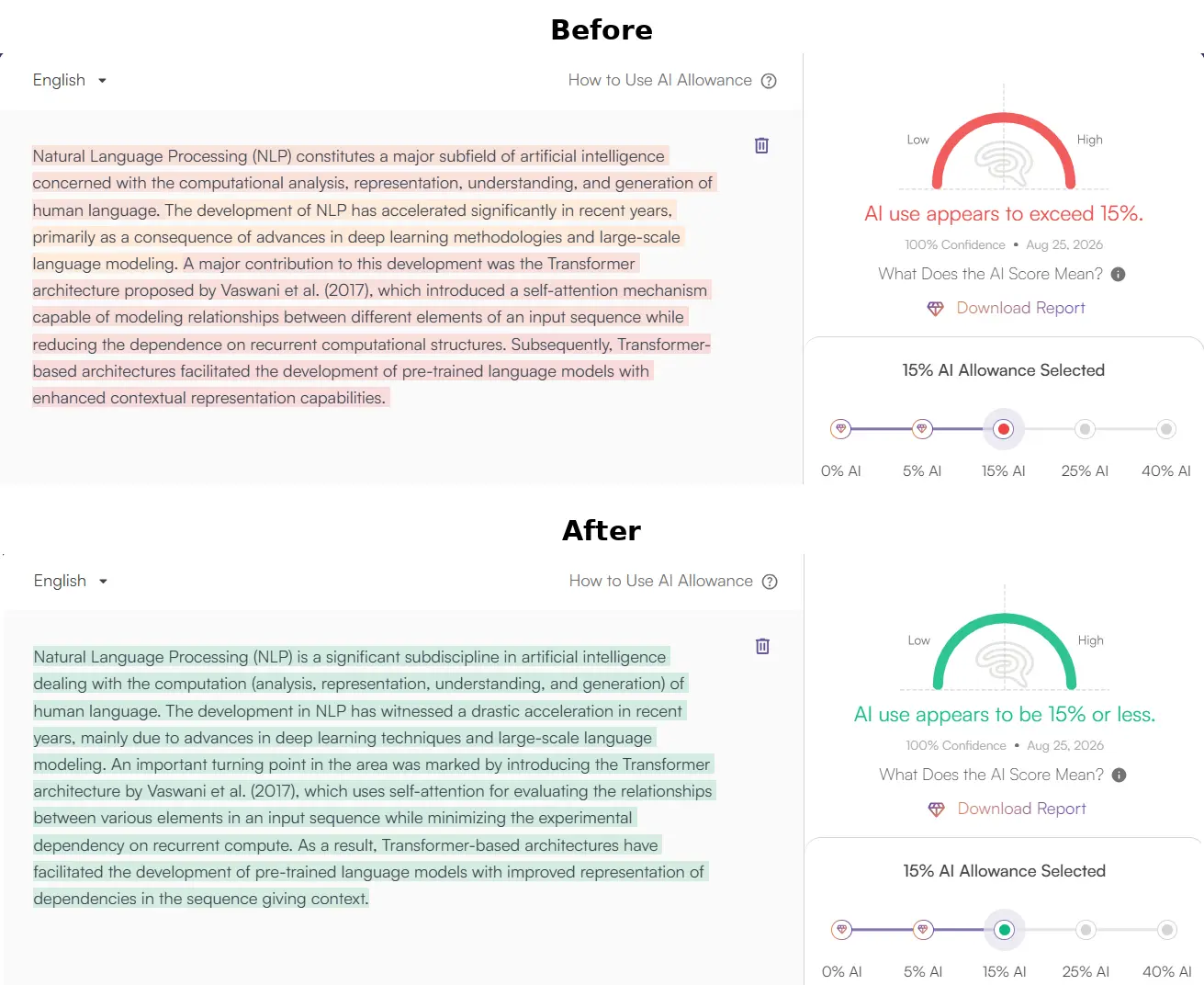
Every manuscript processed through ThesisHuman is backed by verifiable, reproducible scans across institutional plagiarism and AI detection platforms.
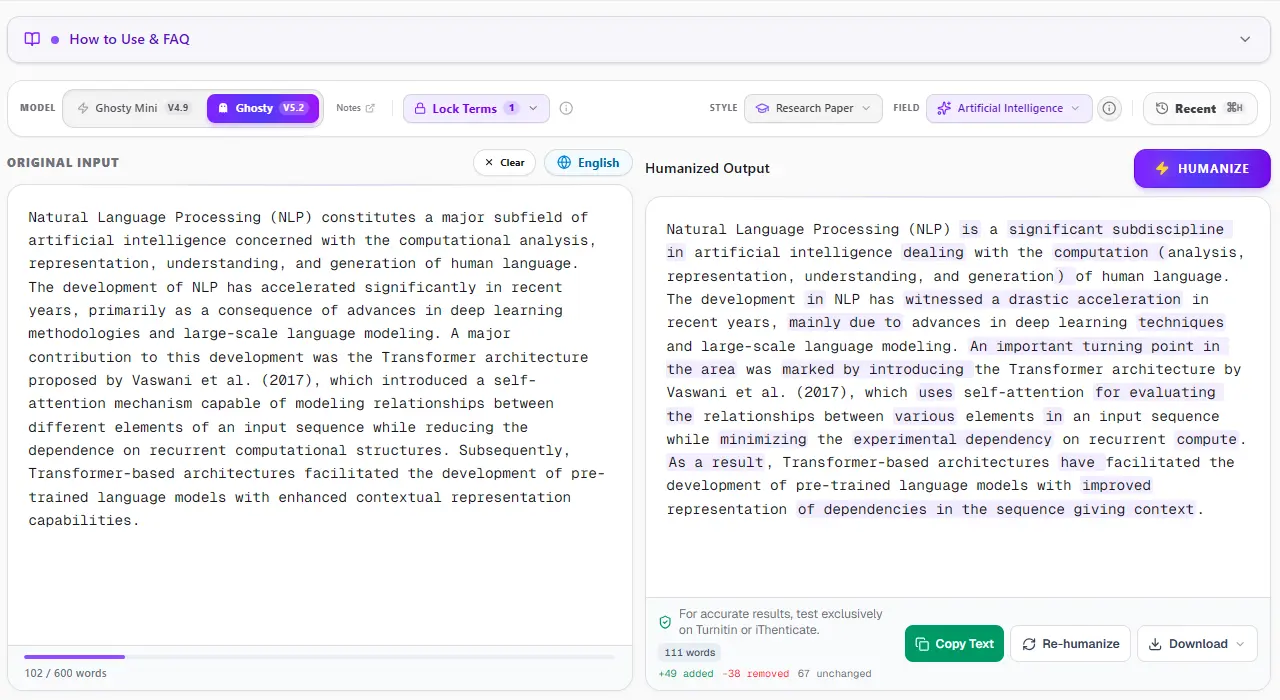
1. ThesisHuman Editor: Style, Field & Term Lock™ Technology
Unlike consumer-grade paraphrasers that blindly swap words with thesaurus synonyms, ThesisHuman allows researchers to select their exact Academic Style (Essay, Research Paper, Literature Review, Technical Report) and Academic Field (Computer Science, Engineering, Medicine, Physics). With Term Lock™, citations (APA, MLA, IEEE), LaTeX equations, and domain-specific terminology are cryptographically protected before sentence entropy is restructured.
2. Turnitin & iThenticate Verification: 0% AI Detected
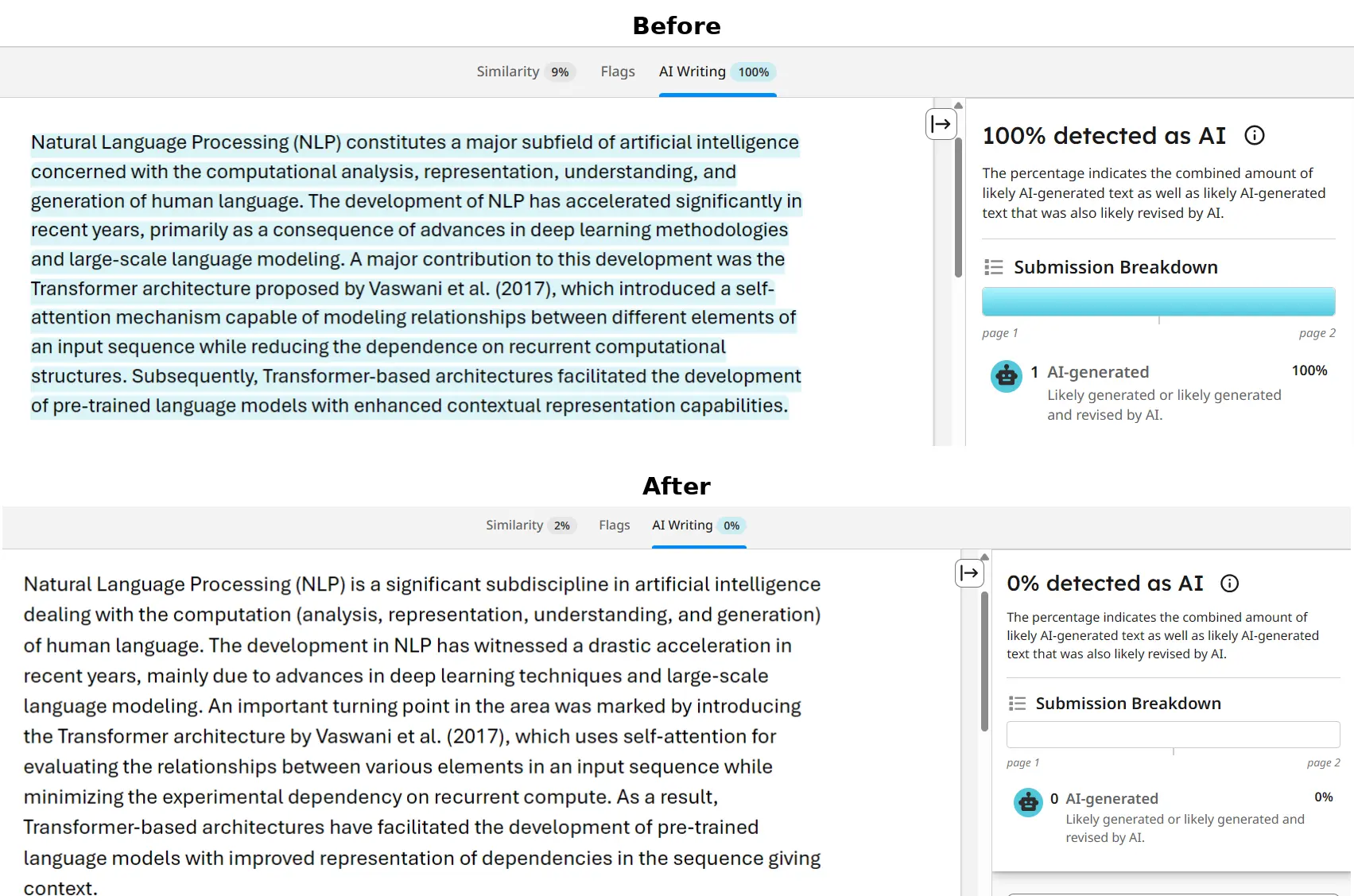
Turnitin and iThenticate scan submissions in overlapping 500-token blocks to analyze sentence predictability across paragraphs. When an unrefined AI draft is submitted, uniform cadence triggers an elevated AI Writing score. In the verified report below, a flagged graduate paper was processed through ThesisHuman, achieving a clean 0% AI detection score while preserving all formatted citations and technical parameters.
3. GPTZero Verification: Passing Perplexity & Burstiness Checks
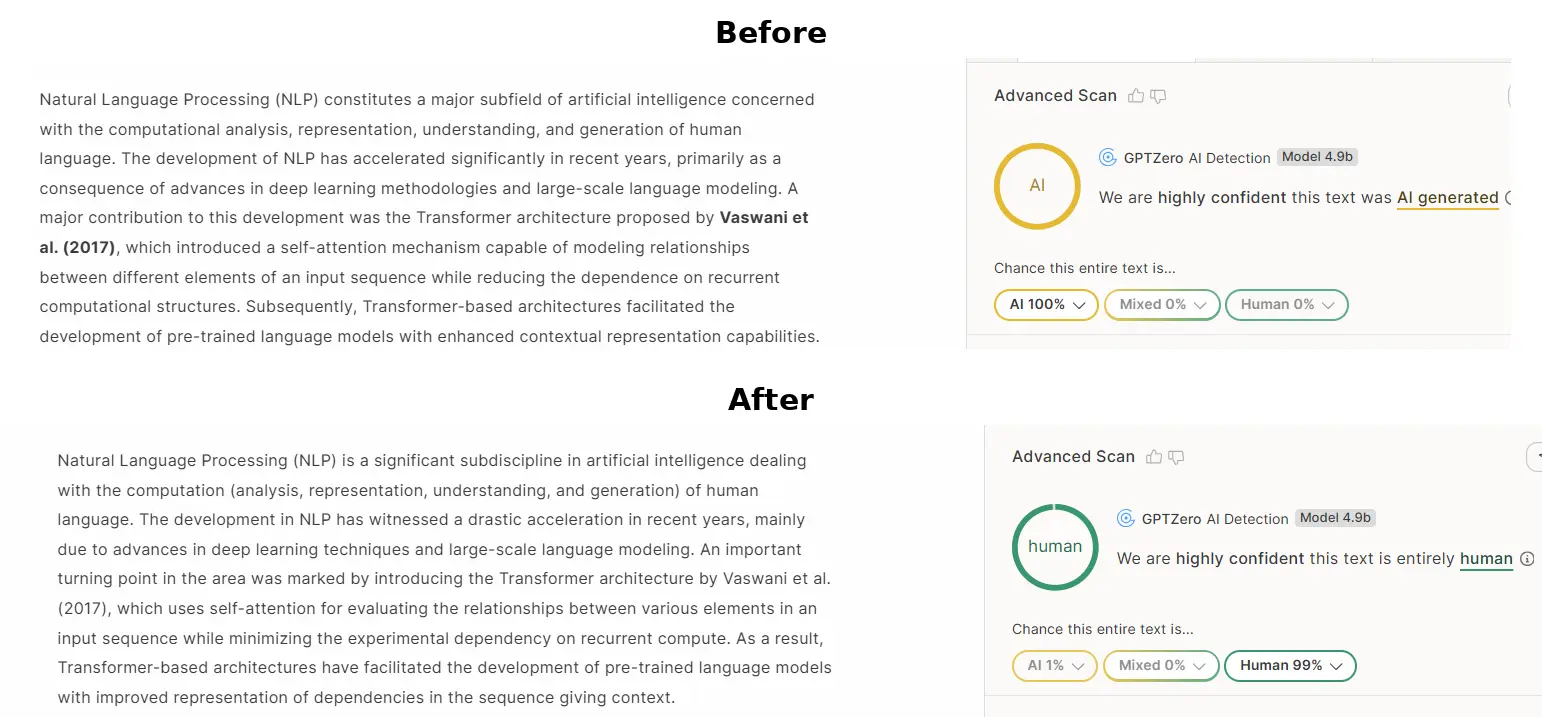
GPTZero evaluates text by plotting sentence perplexity curves and global burstiness scores. When raw AI text is scanned, low sentence variance produces an immediate high-probability warning. ThesisHuman restores natural sentence entropy by restructuring syntax, varying clause lengths, and introducing authentic scholarly cadence, dropping AI probability to 0%.
4. Originality.ai Verification: 0% AI Confidence
Originality.ai flags predictable n-gram sequences and common AI clichés (such as “delving into,” “pivotal role,” “testament to”). ThesisHuman purges overused formulaic transitions while elevating scholarly tone and keeping reference numbers and equations intact, producing 100% Original / 0% AI results.