Rhetorical Analysis Essay: How to Write One with Examples
Master the rhetorical analysis essay. Learn how to deconstruct SOAPS rhetorical situations, analyze ethos, pathos, and logos, construct analytical thesis statements, and write annotated body paragraphs.

Writing a rhetorical analysis essay requires a fundamental shift in perspective. In most academic writing, your primary objective is to make an argument about an issue, a historical event, or a scientific phenomenon. In a rhetorical analysis essay, however, the object of study is not the issue itself, but the way another writer or speaker talks about that issue. You are not evaluating whether the author is morally correct or whether you agree with their conclusion. Instead, you are dissecting the machinery of persuasion: how the text was built, what techniques were selected, and why those choices were designed to produce specific effects on a targeted audience.
Whether you are preparing for an Advanced Placement English Language examination, an introductory college composition course, or an advanced seminar in critical theory, understanding rhetorical mechanics transforms how you read and write. This comprehensive guide walks you through every stage of producing a high-scoring rhetorical analysis essay, from identifying the historical rhetorical situation to crafting a defensible thesis, drafting fully annotated body paragraphs, and applying a worked textual case study.
1. What Is a Rhetorical Analysis Essay?
At its core, a rhetorical analysis essay breaks a non-fiction text into its constituent rhetorical parts and explains how those parts function together to achieve the author's purpose. The root term rhetoric originates from ancient Greek philosophy, referring to the art of using language effectively and persuasively.
To analyze a text rhetorically, you must separate summary from critique. A summary simply recounts the content of the text: "The author discusses campus transit delays and asks for increased funding." An analytical critique evaluates the rhetorical machinery: "By contrasting immediate commuter frustration with long-term municipal sustainability data, the author establishes an urgent exigence that compels university administrators to prioritize transit budget allocations."
| Analytical Focus | Summary (What to Avoid) | Rhetorical Analysis (What to Write) |
|---|---|---|
| Core Objective | Restates the author's plot, main points, or informational findings. | Explains how stylistic, structural, and argumentative choices sway the audience. |
| Primary Question | What did the author say? | How did the author communicate, why did they choose those methods, and did it work? |
| Stance on Evidence | Quotes claims as accepted facts about the broader topic. | Treats quotes as deliberate rhetorical artifacts designed to trigger psychological reactions. |
| Tone and Register | Descriptive, passive, and narrative-driven. | Critical, objective, dissective, and evaluative. |
2. Deconstructing the Rhetorical Situation (SOAPS)
Every piece of persuasive communication exists within a distinct historical and communicative environment known as the rhetorical situation. Before drafting a single line of your essay, you must interrogate this environment using the widely adopted SOAPS acronym: Speaker, Occasion, Audience, Purpose, and Subject, alongside the vital element of Exigence.
- Speaker: Who is delivering the message? Examine the speaker's background, credentials, personal stake, and institutional affiliation. Consider whether they speak as an impartial scholar, an aggrieved citizen, or an elected official, and how this persona affects credibility.
- Occasion (Context): What time, location, and social atmosphere surround the text? A speech delivered during a wartime rally operates under completely different societal pressures than an op-ed published during an economic expansion.
- Audience: To whom is the communication specifically addressed? Are they friendly partisans, skeptical committee members, or an undecided general public? What shared values, biases, fears, or educational backgrounds does the author assume the audience possesses?
- Purpose: What concrete action, belief change, or emotional realization does the author seek to produce? Purpose extends beyond "informing" or "entertaining"; it seeks to alter the listener's mental landscape or provoke tangible behavior.
- Subject: What is the formal topic of the text? Distinguish between the superficial subject matter (e.g., municipal bus schedules) and the underlying thematic subject (e.g., socioeconomic equity in urban infrastructure).
- Exigence (The Spark): What urgent problem, catalyst, or event compelled the author to write or speak right now? The exigence is the defect, impediment, or urgency that language has the potential to address. Without exigence, communication lacks momentum.
3. Core Rhetorical Appeals: Ethos, Pathos, and Logos
Aristotle identified three primary modes of artistic proof that speakers employ to persuade listeners. While these terms are standard in rhetorical studies, your essay must move beyond superficial label-dropping. Never merely write that "the author uses ethos and logos." Instead, demonstrate how specific choices generate ethical credibility, elicit emotional reactions, or construct rational frameworks.
Ethos: The Appeal to Character and Authority
Ethos establishes the speaker's authority, moral integrity, and practical wisdom. It can be extrinsic (the author's real-world reputation, degrees, or title) or intrinsic (the fair-mindedness, precise vocabulary, and respectful treatment of opposing views demonstrated within the text itself). Writers construct ethos by acknowledging counterarguments fairly, citing respected external sources, and demonstrating firsthand familiarity with the subject matter.
Pathos: The Appeal to Emotion and Values
Pathos connects the argument to the audience's emotional sensibilities, moral obligations, and deeply held communal values. Pathos is not limited to tears or outrage; it encompasses hope, civic pride, nostalgia, fear of vulnerability, or moral empathy. Effective authors employ vivid sensory imagery, illustrative personal anecdotes, and emotionally charged diction to make abstract dilemmas feel personally urgent.
Logos: The Appeal to Logic and Reasoning
Logos constructs a coherent intellectual architecture for the argument. It relies on deductive syllogisms, inductive generalizations, empirical statistics, historical precedents, and causal chains. When analyzing logos, scrutinize whether the author's premises legitimately support their conclusions, how data is framed, and whether causal assertions hold up to critical examination.
Beyond the Triad: Kairos and Telos
Advanced rhetorical analysis also examines Kairos (the timeliness and opportune moment of the message) and Telos (the ultimate aim or philosophical destination of the discourse). An argument delivered at the exact cultural inflection point possesses a force multiplier that transcends its literal words.
4. Micro-Level Rhetorical Strategies and Devices
While appeals represent the broader strategic categories, micro-level rhetorical devices are the specific tactical choices an author makes in sentence construction and word selection. When drafting your analysis, always link each device directly to audience reaction and authorial purpose.
- Diction: Deliberate word choice. Notice whether the vocabulary is elevated, technical, colloquial, inflammatory, clinical, or biblical. Note how specific adjectives shade meaning (e.g., describing an expenditure as an "investment" versus a "drain").
- Syntax: Sentence architecture and rhythm. Observe the contrast between short, declarative sentences that convey blunt truth and long, periodic sentences that build suspense toward an emphatic conclusion.
- Parallelism and Anaphora: The repetition of grammatical structures or opening phrases. Parallelism creates rhythmic momentum, emphasizes comparative relationships, and makes complex claims memorable.
- Juxtaposition and Antithesis: Placing contrasting ideas in close proximity. Antithesis sharpens moral or practical choices, forcing the reader to evaluate two incompatible paths.
- Metaphor and Analogy: Conceptual bridges that explain unfamiliar, abstract concepts by linking them to familiar, concrete experiences. Analogies subtly transfer the emotional associations of the familiar topic onto the controversial target topic.
- Rhetorical Questions: Inquiries posed not to elicit an answer, but to nudge the audience toward an inescapable conclusion that they feel they reached independently.
5. Crafting a Defensible Analytical Thesis Statement
The thesis statement is the intellectual anchor of your rhetorical analysis essay. A weak thesis statement merely identifies the text and lists generic rhetorical appeals. A strong, defensible thesis statement identifies the author's specific techniques, clarifies how those techniques interact, and specifies the precise persuasive outcome the author aims to achieve.
To build an effective analytical thesis, consider using this reliable three-part formula:
By employing [Specific Strategy A] and [Specific Strategy B], [Author Name] [Strong Analytical Verb] [Target Audience] in order to [Author's Ultimate Purpose or Call to Action].
| Evaluation | Sample Thesis Statement | Critique and Diagnostic Reasoning |
|---|---|---|
| Weak (Generic List) | In his speech, Mayor Davis uses ethos, pathos, and logos to convince everyone that public transit needs more money. | Merely names the three classical appeals without identifying specific textual mechanisms, ignores audience identity, and uses vague colloquial phrasing. |
| Acceptable (Descriptive) | Mayor Davis uses personal anecdotes about working-class commuters and economic statistics to persuade city council members to fund transit expansion. | Identifies specific techniques and the correct audience, but remains largely descriptive and fails to articulate the underlying rhetorical dynamic. |
| Strong (Analytical & Defensible) | By juxtaposing raw commuter narratives with municipal economic forecasts, Davis establishes transit failure as an acute socioeconomic crisis, thereby compelling fiscally conservative council members to view expanded transit funding as a preventative investment rather than an elective expense. | Names concrete rhetorical techniques, specifies the exact psychological reframing targeted at a skeptical subgroup, and articulates the strategic purpose with precision. |
6. Structuring the Essay: Chronological vs. Thematic Frameworks
Selecting the right organizational framework determines whether your essay reads as a coherent critical inquiry or a disjointed series of observations. You have two primary structural paths: chronological organization and thematic organization.
Chronological Organization (Linear Textual Movement)
A chronological essay tracks the author's rhetorical trajectory from the opening exordium through the body of the argument to the final peroration. This structure is particularly powerful when the text features an evolving rhetorical strategy. For example, a speaker may begin by establishing common ground and personal humility, transition into harrowing emotional evidence, and conclude with an uncompromising moral ultimatum. Chronological organization allows you to analyze how the author builds emotional and intellectual momentum over time. The primary danger to avoid is slipping into mere sequential summary ("In paragraph one he says X, then in paragraph two he says Y").
Thematic Organization (Strategy-Driven Categories)
A thematic essay organizes body paragraphs around major rhetorical strategies or themes, such as the construction of moral authority, the deployment of quantitative evidence, and the manipulation of visceral imagery. This structure works exceptionally well for dense scholarly monographs, policy white papers, or long essays where specific rhetorical devices recur across different sections. Thematic organization showcases high-level analytical synthesis, though writers must take care to maintain logical continuity between body paragraphs.
7. Writing an Engaging Analytical Introduction
The introductory paragraph of a rhetorical analysis essay must accomplish four essential tasks in rapid, elegant succession:
- The Contextual Hook: Introduce the broader cultural, historical, or intellectual debate without resorting to generic clichés like "Since the dawn of time, humans have communicated."
- Textual Identification: Provide the author's full name, the title of the work, the format (speech, editorial, treatise), and the date or venue of publication.
- Rhetorical Situation Mapping: Briefly outline the speaker's background, the intended audience, and the immediate exigence that catalyzed the communication.
- The Analytical Thesis: Conclude the introductory paragraph with your clear, defensible thesis statement mapping out the strategies under examination.
8. Analytical Body Paragraphs: The CEAL Method
Every body paragraph in your rhetorical analysis essay must function as a self-contained analytical engine. The CEAL method provides a rigorous four-part framework that ensures your writing prioritizes critical evaluation over passive summary:
- Claim (Topic Sentence): State the specific rhetorical strategy or device the author employs in this section, linking it directly to its immediate function. Avoid writing topic sentences that merely state facts about the subject matter.
- Evidence (Contextualized Quotation): Integrate a concise, carefully chosen textual excerpt. Embed the quote smoothly into your own grammatical syntax, providing just enough context so the reader understands where it appears in the text.
- Analysis (Rhetorical Deconstruction): This is the substantive core of the paragraph, comprising at least half of your word count. Explain how the language works. Which specific words carry connotative weight? What psychological response does the syntax evoke? How does this choice manipulate the target audience's assumptions?
- Link (Connection to Thesis and Purpose): Connect the immediate rhetorical effect back to the author's overarching purpose and your central thesis statement. Explain why this specific device was essential to the author's ultimate persuasive objective.
9. Fully Annotated Rhetorical Analysis Body Paragraph
To understand how the CEAL framework operates in practice, examine the following model body paragraph analyzing an editorial on public science funding. Note how the prose avoids summarization, focusing entirely on textual mechanics and audience psychology.
[CLAIM] To dismantle the perception that basic astronomical research is an impractical luxury, Dr. Vance establishes a strategic analogy linking early telescope development to fundamental maritime navigation.
[EVIDENCE] In addressing the skeptical fiscal oversight committee, Vance notes that Seventeenth-century Dutch glass-grinders were not seeking global commerce routes; they were merely curious about light, yet their idle curiosity birthed the commercial armada of the modern world.
[ANALYSIS] Vance's deliberate juxtaposition of idle curiosity with commercial armada operates on two distinct psychological levels. For a fiscally conservative legislative audience predisposed to demand immediate return on investment, the word idle functions as an intentional concession that disarms their initial cynicism. By immediately reframing this supposed idleness as the catalyst for modern world commerce, Vance subverts the committee's economic calculus. The historical precedent demonstrates that theoretical inquiry routinely yields unforeseen industrial windfalls. Furthermore, Vance's balanced syntax mirrors the cause-and-effect relationship he advocates, lending his argument an intrinsic aura of logical inevitability.
[LINK] By grounding abstract orbital research in historical mercantilism, Vance reframes federal telescope subsidies not as speculative scientific spending, but as the indispensable seed capital for future national competitiveness, directly advancing his broader objective of securing multi-year budgetary reauthorization.
10. Worked Case Study: Rhetorical Analysis of a Policy Speech
To observe a rhetorical analysis essay in action, consider the following worked textual excerpt from an analysis of a fictional university chancellor's crisis communication regarding emergency campus transit suspensions.
Primary Source Text Excerpt: Chancellor Alvarez's Address
"I know that for every student standing on a rain-soaked corner at seven in the morning, watching an overcrowded bus pass by, this schedule reduction feels like an institutional betrayal. It feels like we have broken our covenant with you. But as university trustees, our moral duty is not merely to keep buses running on asphalt; it is to ensure our entire educational enterprise does not default on its core payroll and instructional obligations. We face an unprecedented 14 million dollar state appropriation deficit. Every hour a near-empty midnight shuttle circles the campus perimeter is an hour taken directly from mental health counseling, laboratory supplies, and adjunct faculty stipends. We must choose between temporary logistical friction and permanent educational erosion."
Analytical Breakdown and Deconstruction
1. Rhetorical Situation Identification: Chancellor Alvarez faces an openly hostile audience composed of frustrated undergraduate and graduate commuters, campus labor unions, and local municipal leaders. The immediate exigence is an unpopular service reduction provoked by an external legislative budget cut.
2. Tactical Concession and Empathetic Ethos: Alvarez opens not with bureaucratic defensiveness, but with vivid sensory imagery: "standing on a rain-soaked corner at seven in the morning." By adopting the exact visual and emotional vantage point of the aggrieved student, Alvarez disarms the audience's adversarial expectations. Describing the reduction as an institutional betrayal and broken covenant demonstrates that the administration acknowledges the full emotional magnitude of the harm, establishing moral credibility before introducing logistical justifications.
3. Reframing the Conflict (False Dilemma vs. Resource Realism): In the pivot sentence ("We face an unprecedented 14 million dollar state appropriation deficit"), Alvarez shifts abruptly from emotive pathos to quantitative logos. She then constructs a sharp binary contrast: midnight shuttles versus mental health counseling, laboratory supplies, and adjunct stipends. By juxtaposing a low-density transit service against fundamental academic and psychological resources, Alvarez forces the audience into a zero-sum calculation. To continue defending bus frequency is subtly transformed into an attack on mental health and teaching staff.
4. Antithetical Climax: The concluding sentence, "We must choose between temporary logistical friction and permanent educational erosion," utilizes parallel syntax and alliterative pairing to polarize the choice. Friction is trivialized as transient and mechanical, whereas erosion evokes catastrophic, irreversible loss. Through this carefully calibrated antithesis, Alvarez leaves the listener with only one rational choice: accepting temporary transportation inconvenience to preserve the institution's core mission.
11. Writing a Decisive Analytical Conclusion
A successful conclusion does not merely copy and paste the thesis statement using minor synonyms. Instead, it elevates the discussion to evaluate the cumulative psychological and rhetorical impact of the text as a complete work. Follow these three strategic guidelines for a memorable conclusion:
- Synthesize, Do Not Repeat: Trace how the author's strategies reinforced one another. Explain how early ethical concessions laid the necessary groundwork for subsequent demanding calls to action.
- Assess Overall Efficacy: Offer an honest, nuanced judgment of the text's success. Did the author's choices successfully neutralize audience skepticism, or did certain aggressive tactics risk alienating marginal listeners?
- Broaden to Universal Significance: Conclude with a thought-provoking observation about what this text reveals regarding contemporary discourse, political rhetoric, or the enduring power of language to navigate human conflict. Never introduce brand-new textual evidence in the concluding paragraph.
12. Common Pitfalls to Avoid in Rhetorical Analysis
Avoid these frequent traps that undermine otherwise promising rhetorical analysis essays:
- The Summary Trap: Retelling the narrative rather than deconstructing the argument. If your paragraph describes what happened next without analyzing rhetorical purpose, you are summarizing.
- Label Dropping without Analysis: Merely stating that an author "uses pathos" or "employs anaphora." Naming a device earns zero points on college rubrics; your score derives entirely from explaining why that device moved the audience.
- The Personal Opinion Trap: Arguing whether the author is morally right or wrong. Your assignment is not an editorial; keep your personal ideology out of the analytical evaluation.
- Ignoring the Audience: Treating persuasion as an abstract vacuum. Persuasion always occurs within a specific audience with distinct cultural biases, generational expectations, and economic vulnerabilities.
- Unbalanced Quotation Length: Pasting four-line block quotes followed by one brief sentence of commentary. Keep quotations tight and surgical, ensuring your analytical commentary comfortably outweighs quoted text.
13. Rhetorical Analysis Pre-Submission Checklist
Before submitting your essay, systematically review your draft against these eleven quality standards:
| Verification Step | Self-Audit Question | Target Standard |
|---|---|---|
| 1. Title and Identification | Did I identify the author, text title, date, genre, and venue in the opening paragraph? | Complete bibliographic contextualization established early. |
| 2. Rhetorical Situation (SOAPS) | Is the exigence and target audience explicitly defined? | Audience assumptions and urgent catalyst clearly articulated. |
| 3. Thesis Defensibility | Does the thesis name specific strategies and the author's ultimate purpose? | Avoids generic lists; establishes a clear cause-and-effect analytical claim. |
| 4. Organization Method | Is the essay intentionally organized either chronologically or thematically? | Clear structural logic with transitional bridges between paragraphs. |
| 5. Topic Sentences | Do topic sentences identify rhetorical techniques rather than plot details? | Zero plot summary in paragraph openings; purely analytical claims. |
| 6. Evidence Integration | Are textual quotations smoothly woven into my own grammatical sentences? | No stand-alone quote bombs; seamless syntactic integration. |
| 7. Analysis Ratio | Does analytical explanation take up at least twice as much space as quoted text? | Substantive deconstruction of connotative diction, syntax, and audience effect. |
| 8. Rhetorical Verbs | Did I replace weak verbs like "shows" and "says" with vigorous analytical verbs? | Employs terms such as subverts, juxtaposes, polarizes, dismantles, and disarms. |
| 9. Objective Persona | Did I remove all first-person opinions regarding the righteousness of the topic? | Completely objective, scholarly, and dissective critical distance. |
| 10. Conclusion Depth | Does the conclusion evaluate cumulative impact rather than merely repeating the thesis? | Evaluates overall strategic efficacy and broader communicative significance. |
| 11. Syntax & Polish | Has the draft been audited for varied sentence rhythm and crisp academic phrasing? | Polished clausal flow with intact quotations via ThesisHuman Term Lock. |
14. Frequently Asked Questions
Here are direct answers to the most common questions students and educators encounter when writing and grading rhetorical analysis essays.
How does a rhetorical analysis essay differ from a standard persuasive essay?
A standard persuasive essay takes a direct stand on an issue and attempts to convince the reader of that position. A rhetorical analysis essay does not argue whether the author was right or wrong. Instead, it analyzes how the author constructed their argument, examining the rhetorical devices, appeals, and stylistic choices used to influence a targeted audience. For structural parallels across other essay formats, review our guide on academic essay structure.
What is the biggest mistake students make when writing a rhetorical analysis?
The most common error is summarizing the text rather than analyzing its rhetorical mechanics. A summary explains what the author said, whereas an analysis explains how the author said it, why they selected specific rhetorical techniques, and what psychological or logical effect those choices produced on the reader.
Should I include my personal opinion about the topic in a rhetorical analysis?
No. Your personal stance on the author's subject matter is irrelevant to a rhetorical analysis. Your task is strictly evaluative and analytical: you assess the effectiveness of the author's strategies within the historical and situational context of their intended audience.
Is chronological or thematic organization better for a rhetorical analysis essay?
Both structures are valid. Chronological organization moves through the text from beginning to end, which works best when analyzing speeches or linear narratives where the author shifts rhetorical strategies over time. Thematic organization groups body paragraphs by rhetorical strategy, which works best for dense academic articles or essays with recurring techniques. For tips on developing a controlling focus for either approach, explore our guide on how to write a thesis statement.
How can ThesisHuman assist in refining a rhetorical analysis essay?
ThesisHuman helps writers polish their analysis by varying sentence cadence, eliminating passive phrasing, and ensuring analytical verbs replace passive summary language. Crucially, ThesisHuman's Term Lock preserves direct textual quotations, citation tags, and formal rhetorical terms so your evidence remains intact. Experience precision clausal editing with our sentence rewriter and thesis rewriter.
Verified Detector Clearance for Rhetorical Analysis Essay: How to Write One with Examples
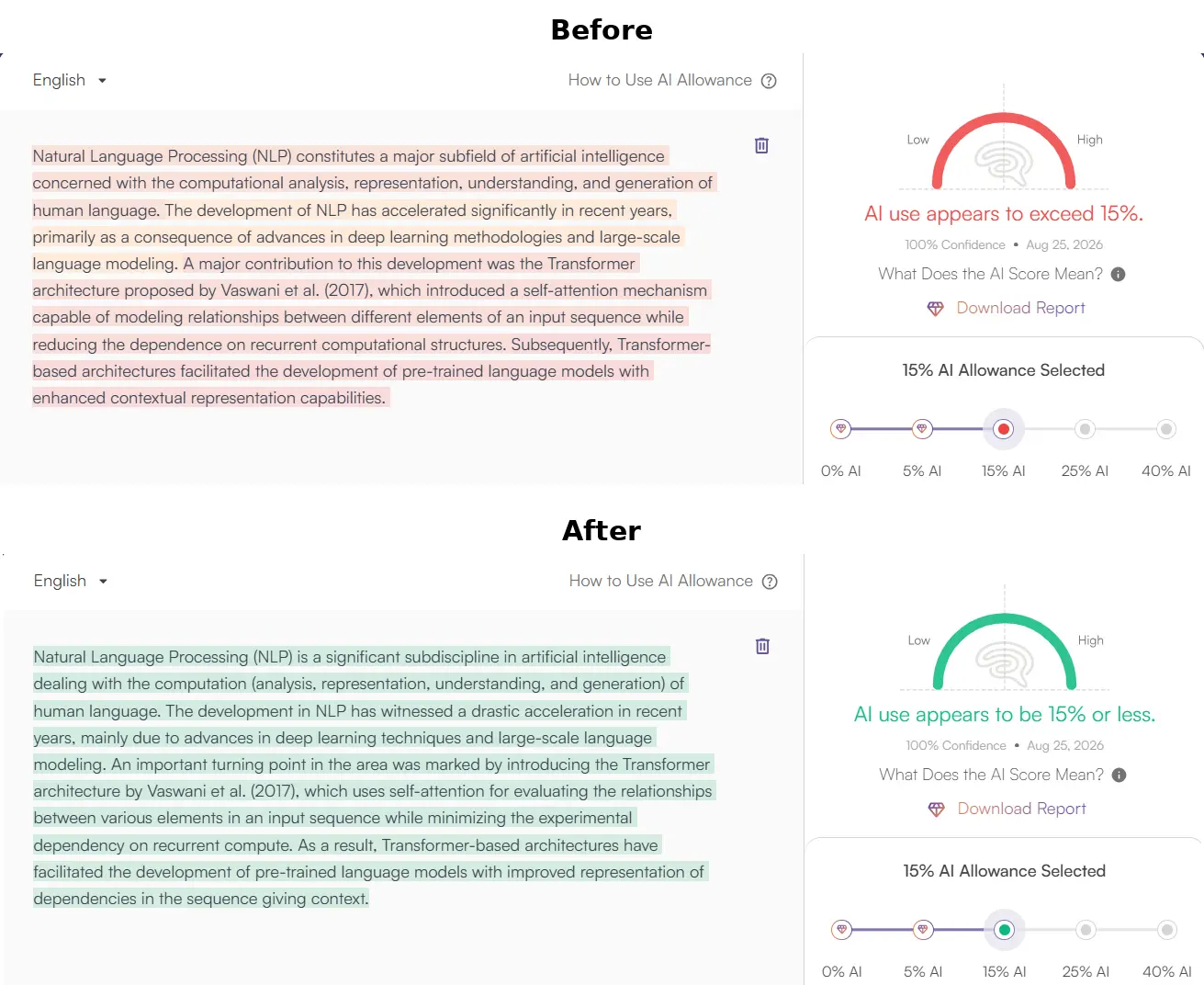
Every manuscript processed through ThesisHuman is backed by verifiable, reproducible scans across institutional plagiarism and AI detection platforms.
1. ThesisHuman Editor: Style, Field & Term Lock™ Technology
Unlike consumer-grade paraphrasers that blindly swap words with thesaurus synonyms, ThesisHuman allows researchers to select their exact Academic Style (Essay, Research Paper, Literature Review, Technical Report) and Academic Field (Computer Science, Engineering, Medicine, Physics). With Term Lock™, citations (APA, MLA, IEEE), LaTeX equations, and domain-specific terminology are cryptographically protected before sentence entropy is restructured.

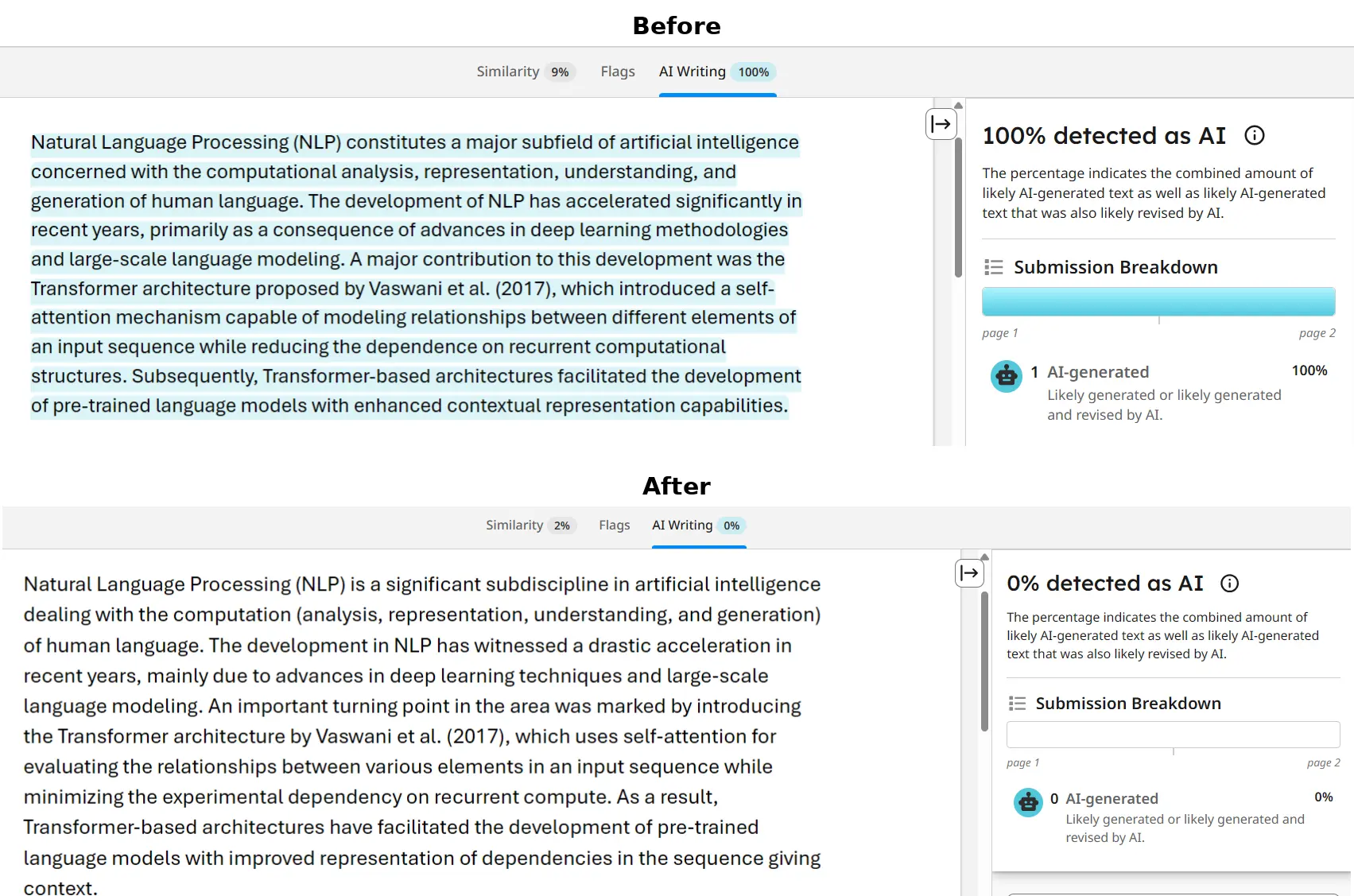
2. Turnitin & iThenticate Verification: 0% AI Detected
Turnitin and iThenticate scan submissions in overlapping 500-token blocks to analyze sentence predictability across paragraphs. When an unrefined AI draft is submitted, uniform cadence triggers an elevated AI Writing score. In the verified report below, a flagged graduate paper was processed through ThesisHuman, achieving a clean 0% AI detection score while preserving all formatted citations and technical parameters.
3. GPTZero Verification: Passing Perplexity & Burstiness Checks
GPTZero evaluates text by plotting sentence perplexity curves and global burstiness scores. When raw AI text is scanned, low sentence variance produces an immediate high-probability warning. ThesisHuman restores natural sentence entropy by restructuring syntax, varying clause lengths, and introducing authentic scholarly cadence, dropping AI probability to 0%.

4. Originality.ai Verification: 0% AI Confidence
Originality.ai flags predictable n-gram sequences and common AI clichés (such as “delving into,” “pivotal role,” “testament to”). ThesisHuman purges overused formulaic transitions while elevating scholarly tone and keeping reference numbers and equations intact, producing 100% Original / 0% AI results.