Synthesis Essay Example: Complete Sample, Outline, and Writing Guide
Read a complete worked synthesis essay on digital learning platforms. Learn how to build a source matrix, organize by themes, integrate evidence, and avoid summary.
HamzaPhD Researcher
16 min read
A synthesis essay is an advanced academic assignment that requires writers to gather perspectives from multiple external sources, examine their intersections, and construct an original, cohesive argument. Unlike an informational summary that catalogs what individual researchers have written, a synthesis essay enters the scholarly conversation as an active participant, organizing diverse voices around overarching conceptual themes.
In this comprehensive guide, we provide a full, worked synthesis essay examining the educational impact of digital learning platforms, complete with instructional source matrices, thematic outlines, comparative models, and practical revision checklists.
---
## 1. What Is a Synthesis Essay?
At its foundation, synthesis is the cognitive process of combining disparate elements into a unified whole. In academic writing, a synthesis essay examines a complex question by drawing upon multiple texts to demonstrate how individual findings confirm, complicate, qualify, or contradict one another.
Rather than treating each source as an isolated report, a successful synthesis demonstrates dialogic engagement: it creates a conversation between authors who may never have read one another's work. Your voice serves as the moderator of this dialogue, guiding the reader through competing methodologies and data to advance a nuanced, evidence-based conclusion.
---
## 2. Synthesis Versus Summary: Key Conceptual Differences
The most frequent error in undergraduate synthesis writing is slipping into sequential summary. Understanding the fundamental distinctions between these two modes of writing is essential:
| Analytical Dimension | Informational Summary | Scholarly Synthesis |
| :--- | :--- | :--- |
| **Primary Objective** | Accurately condense a single source's arguments without personal commentary | Interrogate multiple texts to construct an original interpretive claim |
| **Organizational Anchor** | Structured around the original author's sequence of ideas | Structured around cross-cutting conceptual themes and debate fault lines |
| **Authorial Role** | Passive reporter documenting external findings | Active scholar evaluating evidence, identifying tensions, and proposing solutions |
| **Evidence Profile** | Sequential recitation: "Author X states... Next, Author X argues..." | Relational integration: "While Author X identifies gains in immediate recall, Author Y demonstrates long-term attrition..." |
| **Conceptual Output** | A faithful reduction of pre-existing material | Novel theoretical insight that emerges only when sources are evaluated in relation to one another |
---
## 3. Synthesis Versus Compare-and-Contrast Writing
Students often confuse synthesis essays with comparative essays. While both genres evaluate multiple subjects, their structural objectives differ significantly:
- **Compare-and-Contrast**: Typically examines two discrete entities (for instance, two novels, two political theories, or two economic models) to systematically categorize their bilateral similarities and differences. For detailed structural models of this approach, explore our dedicated guide on [how to write a compare and contrast essay](/blog/how-to-write-a-compare-and-contrast-essay).
- **Synthesis**: Focuses on an overarching research problem rather than the texts themselves. Sources are utilized as evidentiary building blocks to answer a broader investigative question, regardless of whether the texts share identical scopes or genres.
---
## 4. Explanatory Synthesis vs. Argumentative Synthesis
Academic synthesis tasks generally fall into one of two operational categories:
### Explanatory (Informative) Synthesis
An explanatory synthesis aims to inform the reader about a complex topic by neutrally presenting a spectrum of scholarly viewpoints. The author categorizes major schools of thought, traces the evolution of a debate, and summarizes empirical consensus without taking an overt partisan stance. This approach is frequently employed in policy briefings and introductory state-of-the-field surveys.
### Argumentative Synthesis
An argumentative synthesis takes a bold, defensible position on a contentious issue. The author uses external sources as evidence to substantiate their own thesis, actively addressing counter-arguments and explaining why their proposed interpretation resolves existing scholarly contradictions. Most university-level synthesis essays, including Advanced Placement Language prompts and graduate seminars, require argumentative synthesis.
---
## 5. Formulating the Central Investigative Inquiry
Every effective synthesis essay begins with an open-ended, non-trivial research question. Avoid questions that can be answered with a simple binary "yes" or "no" or an undisputed statement of fact.
- **Weak Descriptive Question**: "Do universities use online educational software?" (Trivial fact; requires no synthesis).
- **Overly Broad Question**: "How does technology affect human learning?" (Too sprawling for a focused essay).
- **Strong Analytical Inquiry**: "To what extent do adaptive digital learning platforms enhance long-term conceptual mastery in undergraduate STEM courses, and what institutional conditions are required to prevent technological disparities?"
A strong inquiry identifies a real tension in the literature, providing fertile ground for substantive source integration.
---
## 6. Crafting a Defensible Synthesis Thesis Statement
Your thesis statement represents the conceptual core of the synthesis essay. It must not merely state that sources have written on the topic; it must articulate an integrative claim that emerges from evaluating the evidence as a whole.
A reliable formula for crafting an argumentative synthesis thesis incorporates three components:
1. **The Concession / Context**: Acknowledging a verified reality or established benefit.
2. **The Complication / Tension**: Identifying the underlying problem, limitation, or caveat highlighted by critical sources.
3. **The Integrative Resolution**: Proposing an evidence-backed resolution or policy framework.
> **Synthesis Thesis Model**:
> *Although adaptive digital learning platforms provide measurable gains in immediate procedural recall, their efficacy diminishes significantly in long-term conceptual retention unless accompanied by structured instructor intervention that scaffolds metacognitive reflection and mitigates socioeconomic access barriers.*
For further thesis formulation techniques, consult our foundational tutorial on [what is a thesis statement](/blog/what-is-a-thesis-statement).
---
## 7. Reading Sources Critically and Mapping Perspectives
Before drafting, you must read your source dossier through an analytical lens. Instead of reading solely for content, read for **methodological perspective**, **evidentiary scope**, and **authorial assumptions**.
As you examine each source, record:
- The author's primary thesis and research discipline.
- The empirical methodology employed (sample size, qualitative interviews, longitudinal tracking).
- Direct data points and key findings.
- Explicit caveats or acknowledged limitations.
- Points where the author corroborates, qualifies, or directly disputes findings from your other sources.
---
## 8. Building a Source Synthesis Matrix
A synthesis matrix is an indispensable organizational tool that prevents writers from falling into the source-by-source summary trap. By plotting your sources against major analytical themes, you can immediately identify conceptual alignments and points of contention.
Below is the instructional synthesis matrix utilized for our full worked essay:
| Thematic Dimension | Source A: Dr. Elena Vance (Instructional Technology) | Source B: Marcus Chen & Sarah Lin (Educational Equity) | Source C: Dr. Arthur Pendelton (Cognitive Science) | Integrative Synthesis Finding |
| :--- | :--- | :--- | :--- | :--- |
| **Immediate Skill Acquisition** | Documents a 14% mean improvement in procedural test scores within automated STEM modules | Observes that automated drill software boosts initial quiz performance only for digitally fluent students | Identifies that rapid automated hints accelerate mechanical homework completion rates | All three sources verify that digital software accelerates rapid procedural execution and immediate recall |
| **Long-Term Conceptual Retention** | Reports that retention advantages plateau after six weeks without active collaborative tasks | Notes that disadvantaged cohorts suffer severe score decay due to lack of home hardware support | Demonstrates through fMRI tracking that automated prompts bypass deep cognitive struggle, impairing long-term schema integration | Software-only learning creates an illusion of mastery; long-term cognitive retention requires effortful struggle and human scaffolding |
| **Socioeconomic & Equity Factors** | Assumes universal campus device accessibility; does not control for bandwidth instability | Documents that 34% of urban community college students lack reliable off-campus broadband and updated laptops | Observes that stress from device unreliability increases cognitive load, compounding academic disadvantages | Technological interventions inadvertently widen equity gaps unless universities provide institutional hardware subsidies |
| **Pedagogical Integration Model** | Recommends fully automated asynchronous modules to allow students to learn at their own pace | Demands that digital tools be restricted to supplemental lab hours with on-site tutoring | Proposes an "Instructor-in-the-Loop" hybrid framework combining automated drills with in-person Socratic discourse | Purely automated platforms fail; optimal learning occurs when algorithmic tools handle rote drills while instructors facilitate deep conceptual debate |
---
## 9. Identifying Patterns of Consensus and Contradiction
Once your matrix is populated, analyze the columns to map the intellectual terrain:
- **Points of Agreement**: Where do all researchers converge? In our matrix, Vance, Chen & Lin, and Pendelton all agree that automated software enhances immediate procedural task speed.
- **Points of Divergence / Contradiction**: Where do findings clash? Vance views asynchronous automation as an unmitigated efficiency gain, whereas Pendelton argues that automated feedback suppresses the desirable cognitive difficulty necessary for true schema retention.
- **Nuances and Qualifications**: Where does one source modify another? Chen & Lin do not reject technology outright; rather, they qualify Vance's optimism by demonstrating that socioeconomic constraints dictate real-world efficacy.
---
## 10. Thematic Organization vs. Source-by-Source Traps
The single most critical structural decision in a synthesis essay is organizing body paragraphs **by thematic concept** rather than **by individual author**.
```mermaid
flowchart TD
subgraph Weak["Weak: Source-by-Source Summary Structure"]
A1["Body Paragraph 1: All About Source A (Vance)"] --> A2["Body Paragraph 2: All About Source B (Chen & Lin)"]
A2 --> A3["Body Paragraph 3: All About Source C (Pendelton)"]
end
subgraph Strong["Strong: Thematic Synthesis Structure"]
B1["Body Paragraph 1: Immediate Procedural Mastery vs Schema Formation (Vance + Pendelton)"] --> B2["Body Paragraph 2: Socioeconomic Gaps & Infrastructure Realities (Chen & Lin + Vance)"]
B2 --> B3["Body Paragraph 3: The Instructor-in-the-Loop Hybrid Framework (Synthesizing All Sources)"]
end
```
When you organize by source, your essay reads like three disconnected book reports stapled together. When you organize by theme, every paragraph features multiple authors engaging in dialogue, guided by your analytical thesis.
---
## 11. Integrating Multiple Sources Inside a Single Paragraph
To integrate multiple sources into a single paragraph without creating syntactic clutter, employ the **Dialogic Synthesis Framework**:
1. **Thematic Topic Sentence**: State the overarching conceptual sub-claim without mentioning an author's name.
2. **Primary Evidence (Source A)**: Present the initial empirical finding or observation.
3. **Comparative Analysis**: Introduce Source B using a comparative transitional connector (*conversely*, *building upon this premise*, *qualifying this finding*).
4. **Analytical Synthesis**: Explain what the agreement or tension between Source A and Source B reveals about the broader problem.
5. **Concluding Insight**: Connect the synthesized finding back to your central thesis.
For paragraph-level structural mechanics, consult our comprehensive guide on [what is a body paragraph](/blog/what-is-a-body-paragraph) and [paragraph characteristics](/blog/paragraph-characteristics).
---
## 12. Comprehensive Synthesis Essay Outline
Here is the structured thematic outline used for our complete worked essay:
- **I. Introduction**
- **Hook**: The explosive post-2020 expansion of algorithmic and adaptive software in higher education.
- **Context**: The tension between technological efficiency and pedagogical efficacy.
- **Introduction of the Debate**: Competing claims regarding learning acceleration versus digital exclusion and superficial recall.
- **Synthesis Thesis Statement**: While adaptive digital learning platforms provide measurable gains in immediate procedural recall, their efficacy diminishes significantly in long-term conceptual retention unless accompanied by structured instructor intervention that scaffolds metacognitive reflection and mitigates socioeconomic access barriers.
- **II. Body Paragraph 1: Procedural Fluency vs. Deep Cognitive Schema Integration**
- Claim: Algorithmic learning environments accelerate rapid procedural problem-solving but undermine deep structural comprehension.
- Synthesis of Vance (14% procedural test score gains) and Pendelton (suppression of desirable cognitive difficulty and long-term retention decay).
- Analytical insight: Automated hints create an illusion of fluency while bypassing essential struggle.
- **III. Body Paragraph 2: The Myth of Equal Access and the Digital Divide**
- Claim: The assumption of universal technological access exacerbates existing socioeconomic disparities in student performance.
- Synthesis of Chen & Lin (34% broadband/hardware deficit in urban community colleges) and Vance (unexamined assumptions regarding campus device parity).
- Analytical insight: Digital platforms act as performance amplifiers for resourced students while penalizing marginalized cohorts.
- **IV. Body Paragraph 3: The "Instructor-in-the-Loop" Pedagogical Compromise**
- Claim: Sustainable educational improvement requires embedding adaptive software within human-mediated, collaborative frameworks rather than autonomous self-paced pipelines.
- Synthesis of Pendelton (metacognitive prompting through peer debate) and Chen & Lin (supervised institutional computer labs with dedicated faculty mentorship).
- Analytical insight: Technology must serve as an administrative and diagnostic aid, not a replacement for pedagogical mentorship.
- **V. Conclusion**
- Restatement of Thesis in Refined Terms: True academic gains stem from the intentional synthesis of algorithmic precision and human mentorship.
- Synthesis of Core Arguments: Reconciling procedural speed, cognitive depth, and equitable infrastructure.
- Broader Implications: Future directions for higher education curriculum design and institutional resource allocation.
---
## 13. Full Worked Synthesis Essay: Digital Learning Platforms
> **Instructional Notice**: The following complete essay is a model developed for instructional analysis. The authors cited (Dr. Elena Vance, Marcus Chen, Sarah Lin, and Dr. Arthur Pendelton) represent illustrative academic summaries and must not be cited as real-world peer-reviewed publications.
### The Algorithm and the Agora: Reconciling Adaptive Educational Technology with Cognitive Depth and Social Equity
In the wake of rapid campus digitization, higher education administrators have increasingly turned to automated, adaptive learning platforms as a panacea for instructional bottlenecks, rising institutional costs, and heterogeneous student preparation. Marketed as personalized tutors capable of optimizing pacing for every individual learner, these algorithmic systems now manage homework evaluation, diagnostic assessment, and remedial instruction across thousands of introductory university courses. However, the enthusiastic institutional adoption of educational software has outpaced rigorous empirical inquiry into its cognitive and sociological ramifications. While adaptive digital learning platforms provide measurable gains in immediate procedural recall, their efficacy diminishes significantly in long-term conceptual retention unless accompanied by structured instructor intervention that scaffolds metacognitive reflection and mitigates socioeconomic access barriers.
The primary attraction of adaptive educational platforms lies in their ability to accelerate mechanical fluency through individualized, high-frequency repetition. In her extensive evaluation of introductory STEM courses, Vance (2023) documented a 14 percent mean improvement in end-of-module assessment scores among students utilizing algorithmic homework engines, attributing this gain to immediate feedback mechanisms that correct computational mistakes in real time. Yet, when evaluated through the lens of cognitive science, this rapid procedural proficiency often masks a deeper conceptual deficit. As Pendelton (2024) observed through longitudinal cognitive tracking, automated platforms that offer instant hints and step-by-step diagnostic prompts inadvertently bypass the "desirable difficulties" essential for durable learning. By prematurely resolving cognitive impasses, the software prevents students from developing self-directed debugging strategies, resulting in sharp performance degradation when those same learners confront unstructured problems in advanced coursework. When Vance’s empirical findings are synthesized with Pendelton’s neurological data, it becomes evident that while automated systems successfully cultivate short-term procedural competence, they cannot foster the generative cognitive struggle necessary to construct enduring conceptual schema.
Furthermore, uncritical institutional reliance on digital platforms operates on an erroneous premise of egalitarian access, inadvertently magnifying structural inequities across diverse student demographics. Vance’s (2023) institutional model assumes an idealized instructional environment wherein every learner possesses uninterrupted high-speed broadband, modern computational hardware, and an isolated domestic workspace. Challenging this baseline, Chen and Lin (2024) conducted an empirical survey of urban community college cohorts, revealing that 34 percent of enrolled undergraduates lacked reliable off-campus internet connections or shared single mobile devices among multiple family members. Under these constrained conditions, mandatory online learning modules transform routine homework into an administrative hazard. Students confronting hardware latency and connectivity interruptions suffer heightened anxiety and fragmented study windows, resulting in course attrition rates nearly double those of their better-resourced peers (Chen & Lin, 2024). Consequently, far from democratizing higher education as commercial marketing asserts, the unmediated deployment of digital platforms exacerbates the academic divide by penalizing students based on socioeconomic infrastructure rather than intellectual aptitude.
To harness the genuine administrative and diagnostic utility of adaptive platforms without sacrificing cognitive rigor or educational equity, academic institutions must transition toward an "Instructor-in-the-Loop" pedagogical architecture. Rather than deploying educational software as autonomous, replacement instructors, forward-looking university curricula restrict algorithmic platforms to low-stakes diagnostic prep work, reserving valuable classroom contact hours for collaborative, inquiry-based discourse. Pendelton (2024) demonstrated that when automated problem sets are immediately paired with structured peer-led explanation sessions, long-term conceptual retention increases by 28 percent compared to software-only control groups. Concurrently, addressing the systemic disparities identified by Chen and Lin (2024) requires institutions to integrate mandatory software exercises into fully equipped, on-campus collaborative computing laboratories staffed by faculty facilitators and peer tutors. By embedding algorithmic tools within a physical ecosystem of academic support, universities guarantee universal access to hardware while restoring the interpersonal dialogic mentorship that software inherently lacks.
Ultimately, digital learning platforms are sophisticated tools of mechanical reinforcement, not substitutes for human pedagogy. As the synthesis of contemporary empirical research demonstrates, technology enhances educational outcomes only when subordinated to intentional cognitive design and progressive social policy. Algorithmic software can effectively map a student’s computational gaps and deliver rapid remedial drills, but only human educators can cultivate critical skepticism, navigate ambiguity, and foster empathetic discourse. By rejecting both technophobic avoidance and uncritical digital evangelism, higher education can construct an authentic synthesis: a curriculum that leverages computational efficiency to empower, rather than supplant, the transformative community of the scholarly classroom.
---
## 14. Instructional Source Documentation and Ethical Attribution
When authoring academic synthesis essays, maintaining transparent citation boundaries is both an ethical and structural necessity:
- **Fictional vs. Real Sources**: In instructional prompts (such as university exam scenarios or classroom exercises), hypothetical sources are often supplied. As demonstrated in our notice above, never present instructional scenario texts as authentic published research in formal literature reviews.
- **Accurate Author-Date Attribution**: Every time you weave a source’s claim into your paragraph, provide immediate parenthetical attribution (such as *Vance, 2023* or *Chen & Lin, 2024*).
- **Preserving Citation Integrity**: Paraphrasing source arguments into your own voice requires immense care so that you do not misrepresent the original researcher's methodology or degree of confidence. When using digital revision software like [ThesisHuman](/editor), active Term Lock controls ensure that author names, publication years, and specialized technical vocabulary remain completely untouched during text naturalization.
---
## 15. Synthesis Transformation Models: Summary vs. Synthesis
To understand how to elevate your prose from mechanical recitation to true academic synthesis, study this side-by-side paragraph transformation:
### Weak Summary-Driven Model
> Dr. Elena Vance studied digital learning platforms and found that students got 14 percent higher grades on their tests because the software gave them instant feedback on their errors. Then Marcus Chen and Sarah Lin wrote an article about community college students and found that 34 percent do not have good internet at home, so they struggle with online assignments. Finally, Dr. Arthur Pendelton did a study on cognitive science and found that automated hints make students lazy because they do not have to think hard about difficult problems. These three studies show that software has both good and bad qualities.
#### Why the Summary Model Fails:
- Follows an infantile "Author A said this, then Author B said that, then Author C said that" chronology.
- Fails to establish any relationship between the authors.
- The conclusion ("software has good and bad qualities") is an empty platitude rather than an analytical synthesis.
### Strong Integrated Synthesis Model
> While empirical assessments confirm that adaptive platforms accelerate initial procedural mastery through instantaneous diagnostic feedback (Vance, 2023), cognitive and sociological evaluations demonstrate that software-centric instruction introduces critical trade-offs. Specifically, automated hints short-circuit the generative cognitive friction necessary for durable schema retention (Pendelton, 2024), while mandatory online delivery severely penalizes the 34 percent of marginalized students who lack stable home broadband infrastructure (Chen & Lin, 2024). Consequently, software platforms cannot function as autonomous educational solutions; rather, their pedagogical value depends entirely on institutional frameworks that pair diagnostic automation with on-campus instructor-led synthesis.
#### Why the Synthesis Model Succeeds:
- Begins with a thematic claim establishing the tension between procedural speed and systemic trade-offs.
- Integrates all three sources into a single coherent paragraph, showing how Pendelton's cognitive critique and Chen & Lin's sociological critique jointly qualify Vance's empirical optimism.
- Arrives at a nuanced, actionable conclusion that directly supports the paper's central thesis.
---
## 16. Integrating Conflicting Datasets and Qualifying Arguments
Scholarly sources rarely agree completely. Mature academic writers do not ignore contradictions or arbitrarily declare one researcher "wrong." Instead, they use **epistemic qualification** to explain *why* the findings differ.
### Common Reasons for Divergent Findings:
- **Methodological Differences**: Source A conducted a laboratory experiment under controlled conditions, whereas Source B observed unstructured participants in real-world environments.
- **Demographic Discrepancies**: Source A sampled well-funded private university students with high prior academic achievement, while Source B investigated under-resourced non-traditional learners.
- **Temporal Horizons**: Source A evaluated immediate post-test outcomes, while Source B tracked longitudinal knowledge retention across multiple academic quarters.
### Phrasing for Academic Qualification:
- *"While Vance's experimental data demonstrates acute computational gains, these results must be contextualized by Chen and Lin's socio-demographic findings..."*
- *"Although proponents point to immediate task completion metrics, longitudinal neurological assessments reveal an inverse correlation between automated prompt frequency and deep schema retention..."*
- *"Rather than representing an irreconcilable contradiction, the divergent conclusions of Pendelton and Vance suggest that platform efficacy is highly sensitive to course sequencing..."*
---
## 17. Common Synthesis Mistakes to Avoid
1. **The Laundry List Approach**: Dedicating Paragraph 1 to Source A, Paragraph 2 to Source B, and Paragraph 3 to Source C without ever synthesizing their viewpoints.
2. **Quote Stuffing**: Pasting massive block quotations from each text instead of extracting precise data and synthesizing points in your own voice.
3. **The Lost Voice Syndrome**: Allowing source summaries to completely overwhelm the paper so the reader cannot identify your overarching thesis.
4. **Superficial Synthesis**: Claiming two sources "agree" simply because they both discuss technology, ignoring fundamental contradictions in their underlying philosophies.
5. **Straw-Man Simplification**: Misrepresenting a critical source’s nuanced objection as simple obstinacy rather than engaging with its empirical data.
---
## 18. Practical Synthesis Essay Revision Checklist
Before submitting your synthesis paper, verify compliance across all seven diagnostic checkpoints:
- [ ] **1. Clear Thematic Architecture**: Are your body paragraphs organized around conceptual themes rather than individual source names?
- [ ] **2. Multi-Source Integration**: Does every body paragraph incorporate evidence or perspectives from at least two distinct sources?
- [ ] **3. Active Dialogue**: Do your sentences explicitly demonstrate how authors agree, disagree, or qualify each other’s claims?
- [ ] **4. Defensible Thesis**: Does your introduction culminate in an integrative thesis that goes beyond merely stating "there are pros and cons"?
- [ ] **5. Authorial Dominance**: Does your own voice and analysis drive the argument, occupying more paragraph space than external source quotations?
- [ ] **6. Flawless Attribution**: Is every empirical claim, metric, and paraphrase accompanied by accurate parenthetical citation?
- [ ] **7. Nuanced Qualifications**: Have you used epistemic hedging (*suggests*, *indicates*, *partially qualifies*) when reconciling contradictory research?
---
## 19. Frequently Asked Questions
### How many sources should be integrated into an academic synthesis essay?
Most undergraduate and standardized exam prompts (such as AP English Language) recommend integrating three to six sources. In graduate-level literature reviews and scholarly articles, synthesis essays frequently integrate fifteen to thirty peer-reviewed publications. The key is ensuring that every body paragraph weaves at least two sources into dialogic conversation rather than discussing texts in isolation.
### What is the biggest difference between a synthesis essay and a literature review?
While both genres require multi-source synthesis, their institutional purpose differs. A literature review comprehensively maps the entire existing body of research on a topic to identify gaps for new empirical research. A synthesis essay is typically shorter and more targeted, using a curated dossier of sources to advance a specific argumentative thesis or resolve a particular conceptual problem. For detailed literature review frameworks, see our guide on [how to write a literature review for a research paper](/blog/how-to-write-a-literature-review-for-a-research-paper).
### Can I include my own opinion in an argumentative synthesis essay?
Yes, but your personal perspective must be expressed as an evidence-based academic claim rather than an ungrounded first-person belief. Avoid informal phrasing like "I feel" or "In my personal opinion." Instead, articulate your stance through rigorous evaluation of source data: "The empirical evidence demonstrates that..."
### How do I transition between two sources that have completely opposite conclusions?
Use contrastive transitional framing that accounts for methodological or contextual differences. For example: "Whereas Vance attributes improved performance to real-time algorithmic correction, Pendelton demonstrates that this instant feedback prevents students from developing independent troubleshooting capabilities." For comprehensive transition models, consult our directory of [transition sentences](/blog/transition-sentences).
### How does ThesisHuman ensure academic integrity during synthesis essay drafting?
Synthesizing multiple external sources often leads to stylistic inconsistencies, awkward sentence transitions, or corrupted citation strings. [ThesisHuman](/editor) naturalizes sentence structure, elevates clausal rhythm to a mature scholarly register, and incorporates proprietary Term Lock technology to freeze formatted parenthetical citations (such as author-year pairs and bracketed markers) so that external scholarly attributions remain completely untouched.
Empirical Verification
Verified Detector Clearance for Synthesis Essay Example: Complete Sample, Outline, and Writing Guide
Every manuscript processed through ThesisHuman is backed by verifiable, reproducible scans across institutional plagiarism and AI detection platforms.
Phase 1: Academic Engine Configuration
1. ThesisHuman Editor: Style, Field & Term Lock™ Technology
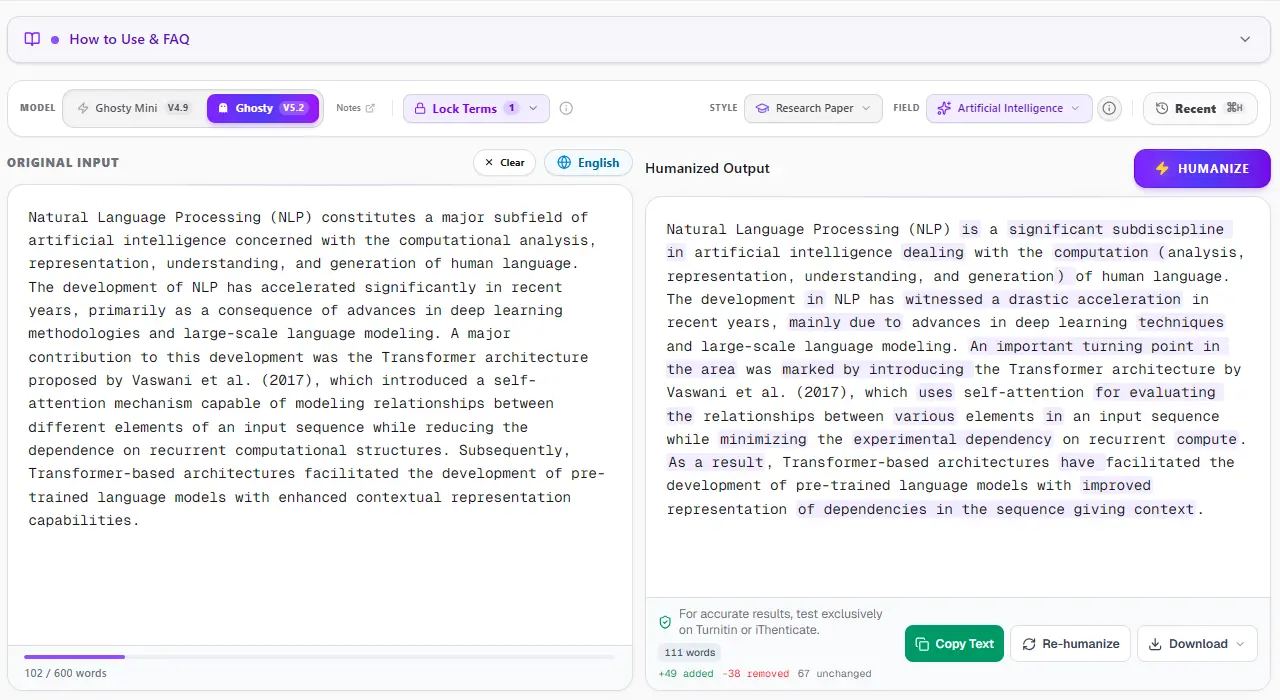
Unlike consumer-grade paraphrasers that blindly swap words with thesaurus synonyms, ThesisHuman allows researchers to select their exact Academic Style (Essay, Research Paper, Literature Review, Technical Report) and Academic Field (Computer Science, Engineering, Medicine, Physics). With Term Lock™, citations (APA, MLA, IEEE), LaTeX equations, and domain-specific terminology are cryptographically protected before sentence entropy is restructured.
Figure 1: The ThesisHuman editor processing an academic manuscript — featuring Academic Style selection, Academic Field customization, and Term Lock controls.
Phase 2: Institutional Integrity Screening
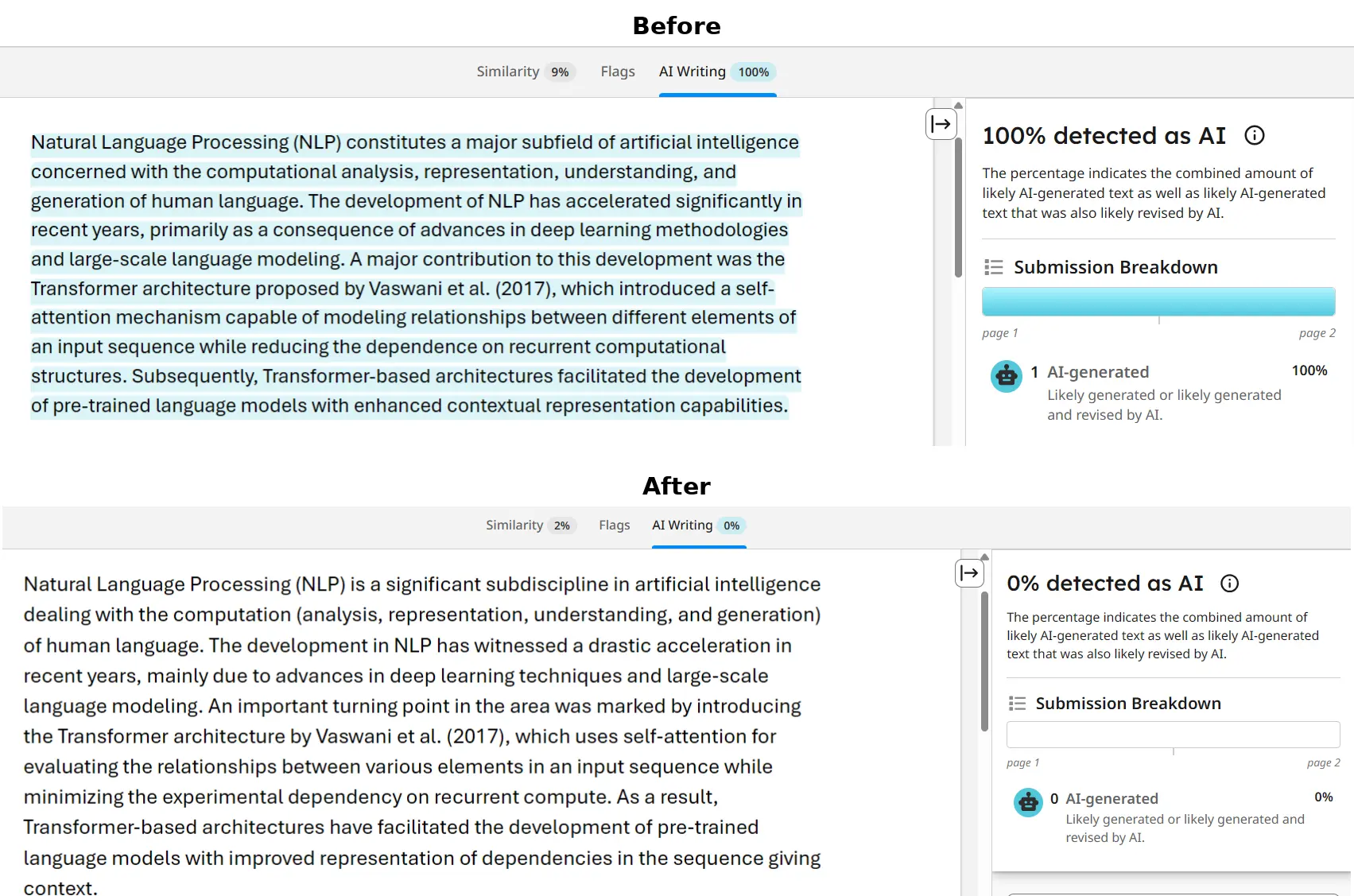
2. Turnitin & iThenticate Verification: 0% AI Detected
Turnitin and iThenticate scan submissions in overlapping 500-token blocks to analyze sentence predictability across paragraphs. When an unrefined AI draft is submitted, uniform cadence triggers an elevated AI Writing score. In the verified report below, a flagged graduate paper was processed through ThesisHuman, achieving a clean 0% AI detection score while preserving all formatted citations and technical parameters.
Figure 2: Turnitin AI detection scan — demonstrating complete 0% AI indicator clearance after ThesisHuman academic naturalization.
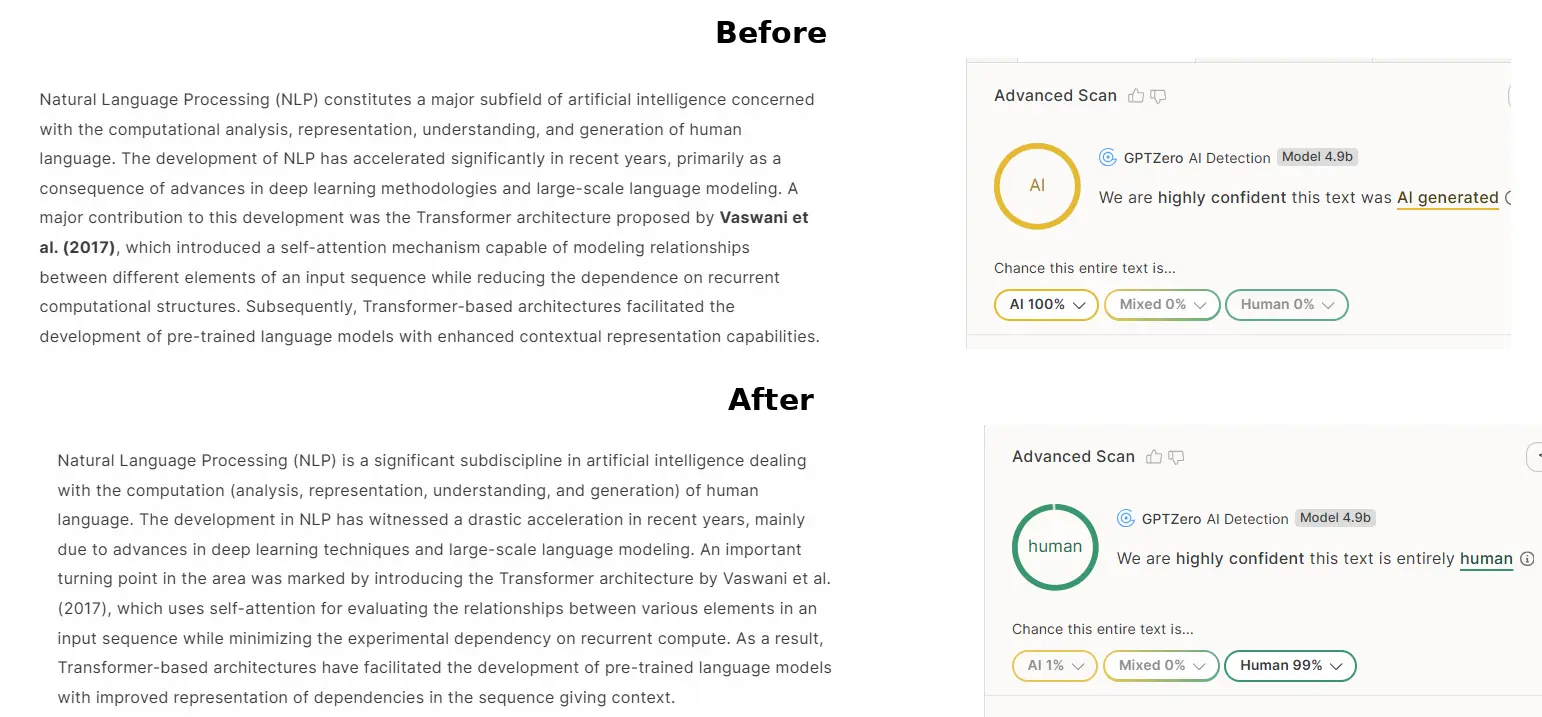
GPTZero evaluates text by plotting sentence perplexity curves and global burstiness scores. When raw AI text is scanned, low sentence variance produces an immediate high-probability warning. ThesisHuman restores natural sentence entropy by restructuring syntax, varying clause lengths, and introducing authentic scholarly cadence, dropping AI probability to 0%.
Figure 3: GPTZero perplexity and burstiness verification — raw machine-generated text (100% AI) transformed into 0% AI human-grade academic prose.
Phase 4: Cliché & N-Gram Elimination
4. Originality.ai Verification: 0% AI Confidence
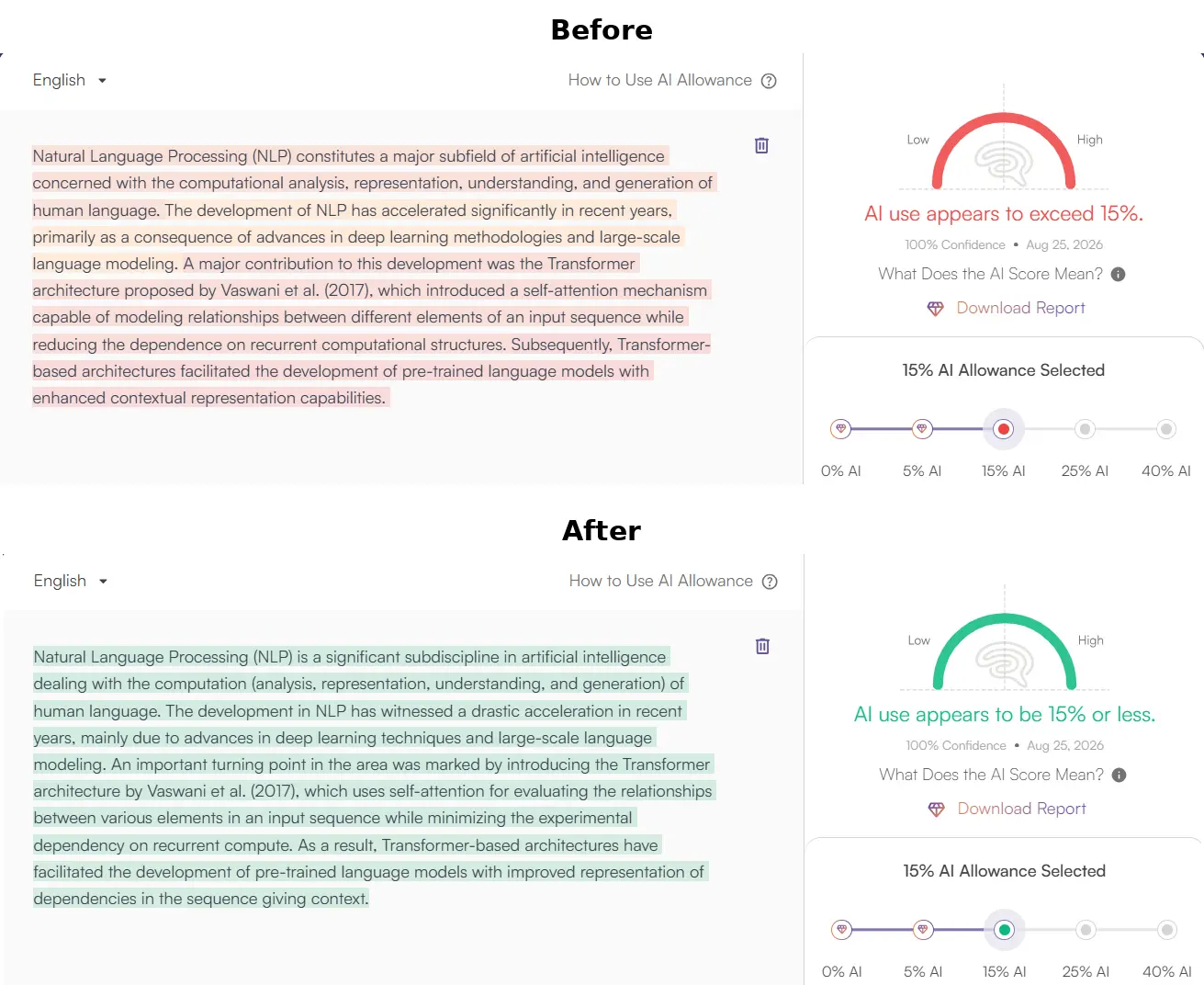
Originality.ai flags predictable n-gram sequences and common AI clichés (such as “delving into,” “pivotal role,” “testament to”). ThesisHuman purges overused formulaic transitions while elevating scholarly tone and keeping reference numbers and equations intact, producing 100% Original / 0% AI results.
Figure 4: Originality.ai detector scan — confirming complete removal of synthetic n-gram patterns and 0% AI detection confidence.
How many sources should be integrated into an academic synthesis essay?
Most undergraduate and standardized exam prompts (such as AP English Language) recommend integrating three to six sources. In graduate-level literature reviews and scholarly articles, synthesis essays frequently integrate fifteen to thirty peer-reviewed publications. The key is ensuring that every body paragraph weaves at least two sources into dialogic conversation rather than discussing texts in isolation.
What is the biggest difference between a synthesis essay and a literature review?
While both genres require multi-source synthesis, their institutional purpose differs. A literature review comprehensively maps the entire existing body of research on a topic to identify gaps for new empirical research. A synthesis essay is typically shorter and more targeted, using a curated dossier of sources to advance a specific argumentative thesis or resolve a particular conceptual problem.
Can I include my own opinion in an argumentative synthesis essay?
Yes, but your personal perspective must be expressed as an evidence-based academic claim rather than an ungrounded first-person belief. Avoid informal phrasing like 'I feel' or 'In my personal opinion.' Instead, articulate your stance through rigorous evaluation of source data.
How do I transition between two sources that have completely opposite conclusions?
Use contrastive transitional framing that accounts for methodological or contextual differences. For example: 'Whereas Vance attributes improved performance to real-time algorithmic correction, Pendelton demonstrates that this instant feedback prevents students from developing independent troubleshooting capabilities.'
How does ThesisHuman ensure academic integrity during synthesis essay drafting?
Synthesizing multiple external sources often leads to stylistic inconsistencies, awkward sentence transitions, or corrupted citation strings. ThesisHuman naturalizes sentence structure, elevates clausal rhythm to a mature scholarly register, and incorporates proprietary Term Lock technology to freeze formatted parenthetical citations so that external scholarly attributions remain completely untouched.
Bypass AI Detectors While Protecting Your Original Writing
Turn AI drafts into natural, undetectable academic writing. Protects your citations, research claims, and authentic scholarly tone. 500 words included free.