Body Paragraph Examples: 8 Complete Academic Models with Analysis
Explore 8 complete academic body paragraph models across diverse genres with sentence-by-sentence structural annotations, comparative revisions, and diagnostic checklists.

An academic body paragraph is not merely a typographical container separating blocks of text; it is a self-contained unit of analytical thought. While an introductory section frames an intellectual problem and formulates a thesis, the body paragraphs perform the heavy labor of substantiating, testing, and synthesizing claims through empirical evidence, textual interpretation, and rigorous reasoning.
Writers frequently master the definition of a topic sentence yet struggle to orchestrate the internal machinery of the full paragraph. Supporting sentences devolve into disconnected lists of quotations, empirical statistics are dumped without interpretive framing, and conclusions merely restate the opening line.
This guide presents eight complete, authentic academic body paragraph models across major scholarly genres, provides sentence-by-sentence functional annotations, evaluates popular teaching frameworks such as PEEL and TEEL, and analyzes a comprehensive before-and-after revision.
1. Direct Answer: What Defines a Rigorous Academic Body Paragraph?
A rigorous academic body paragraph is a cohesive, unified compositional unit that develops a single controlling claim through an integrated sequence of evidence, explanation, interpretation, and synthesis.
Rather than adhering to an arbitrary rule of thumb regarding sentence count, a scholarly body paragraph succeeds by satisfying five functional imperatives:
- Singular Focus (Unity): Every sentence directly supports, complicates, or refines the paragraph's designated controlling idea.
- Evidentiary Substance: Claims are corroborated by empirical data, primary source quotations, archival records, or established theoretical frameworks.
- Analytical Transformation: The writer actively interprets why the evidence matters, explaining the underlying causal mechanisms rather than assuming data speaks for itself.
- Internal Coherence: Sentences flow logically from one to the next through precise transitional syntax, lexical chaining, and pronouns with clear antecedents.
- Cumulative Contribution: The paragraph concludes by demonstrating how its proven sub-claim advances the larger thesis of the manuscript.
When all five criteria are met, the paragraph ceases to be a generic summary and becomes a resilient brick in an overarching argumentative structure. For a foundational exploration of core paragraph mechanics, consult our primer on what is a body paragraph.
2. Functional Anatomy: The Five Core Stages of Paragraph Development
Effective academic paragraphs follow a functional rhythm. While writers need not organize sentences into rigid mechanical slots, the developmental trajectory of an argument typically passes through five distinct stages:
1. Claim Staging (Topic Sentence)
   └─ Introduces topic and governing controlling idea
2. Contextual Elaboration
   └─ Clarifies operational terms and bounds the inquiry
3. Evidentiary Presentation
   └─ Integrates data, quotation, or historical precedent
4. Critical Analysis & Interpretation
   └─ Deconstructs the evidence and explains mechanisms
5. Synthesis & Cumulative Pivot
   └─ Links findings back to the thesis and stages the next step
Understanding these stages as rhetorical functions rather than rigid sentence counters allows you to write paragraphs that breathe naturally. In empirical research discussions, evidentiary presentation may span multiple sentences, followed by critical interpretation. In theoretical humanities analysis, interpretation may dominate the entire second half of the paragraph.
3. Pedagogical Models: Evaluating PEEL and TEEL as Flexible Frameworks
Instructional acronyms such as PEEL (Point, Evidence, Explanation, Link) and TEEL (Topic, Explanation, Evidence, Link) are widely taught in introductory composition courses. While these mnemonics provide helpful scaffolding for emerging writers, advanced academic scholars must recognize their structural limitations.
| Dimension | Basic Mnemonics (PEEL / TEEL) | Advanced Scholarly Practice |
|---|---|---|
| Organizational Rigidity | Prescribes one sentence per letter in fixed sequential order. | Allows functions to distribute flexibly across multiple sentences. |
| Evidence Placement | Isolates evidence into a single discrete block. | Weaves evidence and micro-analysis together across clauses. |
| Analytical Depth | Often reduces explanation to a superficial summary sentence. | Dedicates substantial space to interpreting mechanisms and caveats. |
| Transitional Staging | Concludes with a formulaic link back to the prompt. | Concludes with an analytical pivot toward the subsequent argument. |
| Counterargument Room | Rare accommodation for internal nuance or concession. | Frequently incorporates concessions and epistemic hedging. |
Use PEEL or TEEL as an initial structural diagnostic to ensure no essential function is omitted. However, do not hesitate to dismantle the formula when disciplinary nuance or comparative analysis demands a more sophisticated cadence.
4. Evidence vs. Analysis: Moving Beyond Uncritical Data Insertion
The single most common defect in academic writing is evidence dumping: dropping a raw statistic, quotation, or study finding into a paragraph without analytical framing.
Evidence is merely raw material; analysis is the intellectual value added by the author. Contrast these two treatments of the exact same empirical data point:
- Uncritical Data Insertion: "Research shows that 68% of hospital nurses report chronic occupational burnout during twelve-hour overnight shifts (Smith et al., 2024). This shows that shifts are too long and cause health problems."
- Analytical Integration: "Smith et al. (2024) observed that 68% of hospital nursing staff reported chronic occupational exhaustion during twelve-hour overnight rotations. Critically, this fatigue concentrated within the final four hours of the shift, correlating with a 31% rise in medication administration discrepancies. These findings indicate that the clinical danger stems not merely from aggregate weekly hours, but from the acute circadian disruption caused by prolonged night shifts that degrade cognitive attention."
In the analytical version, the author does not merely announce the statistic. The author highlights the specific distribution of the fatigue, connects it directly to clinical error rates, and identifies the underlying cognitive mechanism. When refining complex analytical prose, our academic paraphraser helps restructure evidence clauses without degrading disciplinary terminology.
5. Quotation Integration and Responsible Academic Paraphrasing
Quotations should never float detached between sentences. Every quotation requires an introductory signal phrase and a subsequent analytical unpacking:
- Objective reporting: demonstrates, observes, identifies, records
- Argumentative framing: contends, posits, challenges, asserts
- Hedged commentary: suggests, implies, proposes, indicates
Consider this illustrative excerpt examining early modern political theory:
Machiavelli (1513/1985) contends that an effective sovereign must "learn to be able not to be good, and to use this and not use it according to necessity." Rather than advocating mindless cruelty, this famous formulation establishes political necessity as an autonomous ethical sphere governed by state survival rather than private moral virtue.
Notice how the author immediately translates Machiavelli's phrasing into an analytical concept ("autonomous ethical sphere"). The quotation serves as an evidentiary launchpad, not a replacement for authorial explanation. When paraphrasing complex passages, remember that rewriting ideas in your own words does not eliminate the scholarly obligation to provide an accurate citation.
6. Sustaining Paragraph Unity and Logical Rhetorical Coherence
A paragraph possesses unity when every sentence focuses exclusively on the controlling idea announced in the topic sentence. It possesses coherence when the sentences connect seamlessly, guiding the reader from premise to conclusion without intellectual turbulence.
To sustain internal coherence, utilize three proven rhetorical devices:
- Known-to-New Information Progression: Open sentences with familiar concepts introduced in the preceding sentence before introducing novel terms at the sentence predicate.
- Lexical Chaining: Repeat key thematic nouns or elegant conceptual synonyms across consecutive sentences to maintain thematic momentum.
- Substantive Transitional Phrases: Use precise logical connectors (consequently, conversely, in contrast, furthermore, nevertheless) to signal relationships of addition, concession, causality, or contrast.
Avoid artificial sentence-starting formulas that read like mechanical lists. For a dedicated study of sentence-level connective tissue, explore our guide on transition sentences.
7. Calibrating Paragraph Length: Sentence Count vs. Argument Completeness
A pervasive myth in composition pedagogy is that an academic paragraph must contain exactly five sentences. In scholarly publishing, paragraph length varies according to argumentative complexity, disciplinary conventions, and rhetorical pacing:
- Standard Academic Paragraph: 150 to 250 words (typically four to eight sentences). Provides adequate space to introduce a claim, stage evidence, interpret mechanisms, and conclude.
- Short Focus Paragraph: 75 to 125 words (two to four sentences). Useful for staging a dramatic pivot, clarifying an operational definition, or summarizing an empirical obstacle before a major section transition.
- Extended Dense Paragraph: 250 to 350 words (eight to twelve sentences). Common in humanities close readings, legal statutory deconstructions, or complex multi-variable regression discussions.
If a paragraph exceeds 350 words, it almost invariably contains multiple competing controlling ideas and should be split. If a paragraph is shorter than 75 words, it usually lacks sufficient evidentiary development and requires expansion or consolidation. For broader structural rules, examine our overview of paragraph characteristics.
8. Eight Complete Academic Body Paragraph Models with Structural Breakdown
Below are eight complete, original body paragraphs covering major academic genres. Each paragraph is followed by a structural analysis detailing its main claim, supporting evidence, analytical reasoning, internal coherence, and relationship to the broader essay.
Model 1: Argumentative Essay (Labor Economics)
Algorithmic scheduling software shifts the financial burden of market volatility onto hourly service workers by converting predictable shifts into on-call availability. Rather than guaranteeing stable weekly schedules, contemporary retail management platforms utilize predictive sales forecasting to dispatch labor in real-time increments, frequently canceling shifts with fewer than three hours of notice. Data from the Economic Policy Institute reveals that service workers subject to automated scheduling experience weekly earnings fluctuations exceeding 35%, which destabilizes household budgeting and childcare arrangements. This instability is not an accidental software glitch, but an intentional corporate efficiency strategy designed to minimize labor overhead during low-volume retail windows. By privatizing the cost of operational downtime, algorithmic management converts human labor into a frictionless, on-demand utility, fundamentally eroding worker financial autonomy.
- Main Claim: Algorithmic scheduling transfers corporate market volatility costs directly onto service workers.
- Supporting Information: Retail scheduling software dispatch protocols and Economic Policy Institute earnings fluctuation data (35%).
- Analytical Reasoning: Explains that scheduling unpredictability is a deliberate efficiency optimization rather than a technical defect.
- Internal Coherence: Sentences progress logically from software function to concrete economic outcomes to corporate motivation.
- Relationship to Essay: Proves the chapter's thesis that workplace algorithmic optimization exacerbates economic inequality.
Model 2: Analytical Essay (Literary Studies)
In F. Scott Fitzgerald's The Great Gatsby, the Valley of Ashes functions as the physical and moral wasteland produced by unrestrained capitalist consumption. Situated halfway between the opulent enclaves of West Egg and the financial center of Manhattan, this desolate industrial dumping ground is perpetually blanketed in grey ash that smothers both the landscape and its impoverished inhabitants. Fitzgerald underscores this degradation through the spectral figure of George Wilson, who appears "mingled with the cement" and "veiled by a white ashen dust," literalizing the human cost of elite extravagance. Overlooking this desolate tableau, the faded billboard eyes of Doctor T. J. Eckleburg represent an abandoned, commercialized deity that watches over moral corruption with complete indifference. The Valley of Ashes is thus not an incidental geographical setting, but the hidden economic foundation of the Jazz Age, exposing the human debris required to sustain the Buchanans' careless privilege.
- Main Claim: The Valley of Ashes represents the moral and human debris generated by elite capitalist excess.
- Supporting Information: Textual descriptions of the industrial landscape, George Wilson's dust-covered appearance, and the billboard eyes of Doctor T. J. Eckleburg.
- Analytical Reasoning: Connects physical descriptions of ash and decaying billboards to the novel's critique of commodified morality.
- Internal Coherence: Employs spatial and visual imagery to tie setting, character description, and symbolic critique together.
- Relationship to Essay: Advances the central thesis that Gatsby's romantic mythology masks brutal socio-economic exploitation.
Model 3: Compare-and-Contrast Essay (Organizational Governance)
While hierarchical corporate organizations concentrate decision-making authority within formalized executive boards, decentralized autonomous organizations (DAOs) distribute governance rights to token-holders through immutable smart contracts. In traditional enterprise structures, managerial accountability flows upward to fiduciary officers whose fiduciary actions are governed by statutory corporate law and board oversight. Conversely, DAOs execute policy modifications automatically once a cryptographic token vote crosses predefined quorum thresholds, eliminating discretionary managerial intervention entirely. However, this algorithmic transparency introduces severe operational vulnerabilities during emergent financial crises; whereas a corporate board can convene emergency sessions and enact immediate liquidity freezes, DAOs remain constrained by mandatory public voting windows that prevent rapid crisis response. Consequently, the democratic governance advantages of decentralized architectures are offset by critical structural rigidities when confronting high-stakes financial contagion.
- Main Claim: DAOs achieve cryptographic transparency at the expense of executive crisis agility compared to traditional corporate hierarchies.
- Supporting Information: Operational mechanisms of corporate board oversight contrasted with smart-contract quorum thresholds.
- Analytical Reasoning: Analyzes how the very feature that eliminates managerial discretion (automated voting windows) prevents emergency interventions.
- Internal Coherence: Employs point-by-point comparative signposts ("While," "In traditional," "Conversely," "However," "Consequently").
- Relationship to Essay: Supports the thesis that decentralized governance models require hybrid emergency mechanisms to survive market stress.
Model 4: Expository Essay (Molecular Genetics)
CRISPR-Cas9 targeted genome editing operates through a dual-component molecular machinery that navigates the cellular nucleus to introduce double-stranded DNA breaks at precise genomic addresses. The system relies on a synthetic single-guide RNA (sgRNA) engineered to match a specific twenty-nucleotide target sequence adjacent to a protospacer adjacent motif (PAM). Once the sgRNA hybridizes with the complementary target DNA strand, the Cas9 endonuclease undergoes a conformational activation, deploying two distinct catalytic domains, RuvC and HNH, to cleave both strands of the double helix. The host cell immediately attempts to repair this double-stranded lesion through non-homologous end joining (NHEJ) or homology-directed repair (HDR). Because NHEJ is intrinsically error-prone, it frequently introduces nucleotide insertions or deletions that disrupt the open reading frame, effectively silencing the targeted gene. Through this clean programmable interface, molecular biologists can knock out specific genetic pathways with unprecedented nucleotide fidelity.
- Main Claim: CRISPR-Cas9 achieves precise gene silencing through an engineered guide RNA and dual-catalytic endonuclease cleavage.
- Supporting Information: Biochemical roles of sgRNA, PAM sites, Cas9 catalytic domains (RuvC, HNH), and host cellular repair pathways (NHEJ, HDR).
- Analytical Reasoning: Details the sequential biochemical steps from hybridization to repair-mediated gene knockout.
- Internal Coherence: Uses clear chronological and functional transitions tracing the molecular process from binding to cleavage to repair.
- Relationship to Essay: Establishes the molecular baseline necessary to understand downstream clinical therapeutic trials.
Model 5: Rhetorical Analysis (Civil Rights Discourse)
In his "Letter from Birmingham Jail," Martin Luther King Jr. dismantles the moderate clergy's plea for patience by strategically juxtaposing constitutional democratic ideals with visceral descriptions of racial violence. Rather than adopting an antagonistic stance, King establishes common ethical ground by addressing his critics as "men of genuine good will," before directly contrasting their abstract calls for negotiation with the daily terror experienced by Black citizens. He accelerates his rhetorical cadence through a single, 316-word sentence that catalogs lynchings, police brutality, and the agonizing psychological task of explaining segregation to a sobbing six-year-old daughter. By grounding his argument in the lived reality of racial trauma, King exposes the moderate appeal for "order" as an immoral defense of the status quo that values white tranquility over genuine justice. The letter thus transforms a localized defense of nonviolent direct action into an indictment of intellectual and moral complacency.
- Main Claim: King dismantles moderate calls for patience by contrasting abstract legal order with concrete physical and emotional trauma.
- Supporting Information: Quotations from the letter ("men of genuine good will"), stylistic analysis of the 316-word cumulative sentence, and specific narrative examples.
- Analytical Reasoning: Explains how King's shift from polite address to relentless rhythmic cataloging exposes moderate hypocrisy.
- Internal Coherence: Connects rhetorical tone, sentence architecture, and thematic moral philosophy into a unified analytical progression.
- Relationship to Essay: Validates the essay's thesis that King's epistolary rhetoric redefined the moral obligations of American civic religion.
Model 6: Cause-and-Effect Essay (Marine Ecology)
The bioaccumulation of microscopic synthetic polymer fragments in coastal estuaries disrupts trophic energy transfer across marine food webs by inducing false satiation in juvenile fish. Estuarine filter feeders, such as oysters and zooplankton, ingest microplastics suspended in water runoff, mistaking buoyant polyethylene particles for natural phytoplankton. Because synthetic polymers resist enzymatic digestion, these indigestible particles accumulate within the gastrointestinal tract, causing physical blockages and chronic cellular inflammation. When juvenile predatory fish consume these contaminated primary consumers, the synthetic plastic load biomagnifies while nutritional caloric absorption drops by up to 40%. Laboratory feeding trials demonstrate that plastic-burdened juveniles exhibit significantly reduced swimming velocity and impaired schooling cohesion, rendering them acutely vulnerable to avian and apex marine predators. Consequently, plastic pollution operates as a stealth ecological disruptor that undermines fisheries recruitment long before adult population collapses become visible.
- Main Claim: Microplastic bioaccumulation in estuaries impairs juvenile fish survival by reducing caloric intake and increasing predation risk.
- Supporting Information: Ingestion mechanisms of estuarine filter feeders, cellular inflammation evidence, and experimental feeding trial metrics (40% caloric deficit).
- Analytical Reasoning: Traces the causal chain from plastic ingestion to digestive blockage, reduced swimming performance, and heightened predation vulnerability.
- Internal Coherence: Uses causal transitional phrases ("Because," "When," "Consequently") to maintain developmental momentum.
- Relationship to Essay: Proves the chapter's thesis that non-point-source microplastic runoff destabilizes coastal commercial fisheries.
Model 7: Research Paper Discussion (Behavioral Medicine)
The comparable efficacy observed between digital cognitive behavioral therapy and traditional in-person clinical sessions indicates that therapeutic alliance is mediated by procedural engagement rather than shared physical co-presence. In our 16-week randomized non-inferiority trial ($N = 340$), participants in the asynchronous digital cohort demonstrated an average 7.8-point reduction on the Beck Depression Inventory-II, matching the 8.1-point decline recorded in the face-to-face control group ($p = 0.62$). Post-treatment working alliance inventories revealed that participants formed strong emotional bonds with the digital platform's structured interactive modules, attributing therapeutic value to on-demand accessibility and self-paced reflective journaling. While earlier clinical models insisted that nonverbal physical cues were indispensable to psychotherapeutic breakthroughs, our findings suggest that structured cognitive exercises and continuous accountability mechanisms can compensate for physical distance. Nevertheless, clinical providers must note that this parity degraded significantly among participants presenting with severe co-morbid trauma, indicating that asynchronous modalities remain best suited for mild-to-moderate depressive presentations.
- Main Claim: Digital cognitive behavioral therapy matches in-person clinical efficacy for mild-to-moderate depression through structured procedural engagement.
- Supporting Information: Trial parameters ($N = 340$, 16 weeks), statistical BDI-II score changes ($7.8$ vs. $8.1$, $p = 0.62$), and working alliance survey scores.
- Analytical Reasoning: Interprets why the outcome occurred (on-demand journaling replaces physical co-presence) while prudently hedging for severe clinical trauma cases.
- Internal Coherence: Transitions smoothly from primary statistical finding to psychological mechanism to clinical boundary conditions.
- Relationship to Essay: Validates the primary research question regarding scalable psychiatric intervention models in community health.
Model 8: Literature Review Synthesis (Developmental Economics)
Scholars of international poverty alleviation remain sharply divided over whether unconditional basic income (UBI) pilots foster financial self-determination or inadvertently erode formal labor market participation. Proponents of unconditional transfers, such as Banerjee et al. (2020) and Blattman et al. (2018), cite empirical trial data from East Africa demonstrating that recipients consistently channel cash grants into long-term capital investments, agricultural equipment, and educational fees rather than luxury consumption. Conversely, critical economists, including Hum and Simpson (2022), argue that short-term randomized trials fail to capture the long-term fiscal distortions and labor supply contractions that occur when transfers become permanent statutory entitlements. Furthermore, recent regional analyses by Ravallion (2023) indicate that the anti-poverty efficacy of cash transfers depends heavily on local market integration, with isolated rural economies experiencing localized consumer goods inflation that neutralizes the purchasing power of the grant. A comprehensive synthesis of the literature thus reveals that cash transfers cannot operate as standalone solutions without complementary investments in market infrastructure and local supply chains.
- Main Claim: Scholarly opinion on unconditional cash transfers is split between empirical evidence of capital investment and macroeconomic concerns regarding inflation and labor supply.
- Supporting Information: Citations and arguments from Banerjee et al., Blattman et al., Hum & Simpson, and Ravallion.
- Analytical Reasoning: Reconciles empirical micro-level successes with macro-level economic critiques, concluding that cash transfers require infrastructure support.
- Internal Coherence: Uses classical scholarly synthesis connectors ("Proponents," "Conversely," "Furthermore," "A comprehensive synthesis thus reveals").
- Relationship to Essay: Establishes the theoretical tension that the author's subsequent empirical field research seeks to resolve.
9. Three Sentence-by-Sentence Annotated Paragraph Breakdowns
To see how individual sentences perform specific developmental functions inside a paragraph, examine these three sentence-by-sentence analytical breakdowns corresponding to Models 1, 2, and 7 above.
Annotated Model A: Argumentative Structure (Model 1 Analysis)
- Sentence 1 (Governing Claim): Introduces the core assertion that algorithmic scheduling transfers market volatility onto workers.
- Sentence 2 (Operational Context): Explains how retail platforms utilize predictive sales forecasting to dispatch labor in real-time increments.
- Sentence 3 (Empirical Data): Supplies quantitative institutional data from the Economic Policy Institute showing 35% weekly earnings fluctuations.
- Sentence 4 (Critical Interpretation): Identifies corporate cost-minimization motives, proving the instability is a feature rather than an accidental glitch.
- Sentence 5 (Cumulative Synthesis): Synthesizes the argument into a broader economic conclusion regarding the erosion of worker autonomy.
Annotated Model B: Literary Analysis Structure (Model 2 Analysis)
- Sentence 1 (Thematic Claim): Connects the physical setting of the Valley of Ashes to moral decay in capitalism.
- Sentence 2 (Spatial Imagery): Positions the valley between West Egg and Manhattan, establishing the visual motif of suffocating ash.
- Sentence 3 (Textual Evidence): Directly integrates textual quotations describing George Wilson veiled in cement dust.
- Sentence 4 (Symbolic Expansion): Broadens analysis to include the billboard eyes of Doctor T. J. Eckleburg as an indifferent commercial deity.
- Sentence 5 (Thematic Synthesis): Closes by linking the setting directly to the novel's overarching critique of elite privilege.
Annotated Model C: Empirical Research Discussion Structure (Model 7 Analysis)
- Sentence 1 (Empirical Finding): States that digital cognitive therapy matches in-person clinical efficacy through procedural engagement.
- Sentence 2 (Statistical Evidence): Details the 16-week trial metrics ($N = 340$) and non-significant BDI-II score differentials ($p = 0.62$).
- Sentence 3 (Psychological Mechanism): Explains that working alliance is built through interactive journaling and on-demand access.
- Sentence 4 (Theoretical Contextualization): Challenges traditional assumptions that physical co-presence is indispensable for therapeutic alliance.
- Sentence 5 (Epistemic Boundary): Concludes with a clinical caveat regarding severe trauma cases, exhibiting scholarly hedging.
10. Weak vs. Strong Paragraph Revision: Full Before-and-After Case Study
To observe the transformative power of developmental editing, examine a weak initial draft and its authoritative academic revision.
The Weak Unrevised Draft
Social media is really bad for teenage mental health. A lot of kids spend hours on Instagram and TikTok every day. In a survey by Johnson (2023), 72% of teenagers said social media makes them feel bad about themselves. Also, cyberbullying is a huge problem in schools today, and teachers do not know what to do about it. The blue light from cell phones keeps students awake at night, so they are tired in class. When teenagers see perfect pictures of other people's lives, they feel depressed. Social media companies need to fix their algorithms because teenagers are getting worse mental health problems every year.
Diagnostic Breakdown of Weaknesses
- Lack of Topic Sentence Focus: Opens with an overly broad, subjective claim ("really bad").
- Evidence Dumping: Quotes Johnson (2023) without explaining the research methodology, cohort parameters, or psychological mechanism.
- Splintered Paragraph Unity: Jumbles four unrelated topics together: screen blue light, cyberbullying, upward social comparison, and corporate algorithmic ethics.
- Conversational Tone: Relies on informal colloquialisms ("really bad," "a lot of kids," "huge problem").
- Missing Analytical Mechanism: Fails to explain how viewing curated images produces depressive symptoms.
The Strong Academic Revision
Algorithmic feedback loops on image-centric social platforms intensify adolescent depressive symptoms by systematically stimulating upward social comparison. When teenagers encounter algorithmic feeds populated predominantly by curated representations of peer social success and physical beauty, they evaluate their everyday personal lives against idealized, digitally altered standards. In an adolescent cohort study ($N = 1,240$), Johnson (2023) observed that prolonged daily engagement on visual media correlated with a 72% increase in self-reported physical dysmorphia and social inadequacy. Crucially, this psychological distress concentrated among participants who passively scrolled algorithmic recommendation feeds rather than actively messaging direct acquaintances. This disparity indicates that mental health vulnerability is driven not by digital communication per se, but by passive exposure to algorithmic sorting mechanisms that artificially amplify unattainable social benchmarks. Consequently, mitigating adolescent digital distress requires targeting recommendation architecture rather than imposing generic screen-time restrictions.
Analysis of the Revision
- Restored Unity: Entirely strips out distractions (blue light, cyberbullying) to focus exclusively on upward social comparison and algorithmic feeds.
- Empirical Rigor: Adds sample size context ($N = 1,240$) and specific psychometric categories (physical dysmorphia, social inadequacy).
- Analytical Depth: Distinguishes between passive consumption and active messaging, identifying the true cognitive mechanism.
- Scholarly Cadence: Replaces conversational slang with precise academic terminology ("algorithmic feedback loops," "idealized representations," "mitigating digital distress"). To explore automated paragraph polishing, experiment with our paragraph rewriter.
11. Seven Common Body Paragraph Mistakes and How to Correct Them
Avoid these seven pervasive developmental traps when drafting your body paragraphs:
- The Floating Quotation: Dropping a quotation into a paragraph without an introductory signal phrase or subsequent explanation. Correction: Always introduce quotations with authorial framing and follow them with at least one sentence of analytical unpacking.
- The Runaway Evidence Dump: Stacking three citations or data tables in a row without offering critical interpretation. Correction: Adhere to the golden rule of evidence: for every line of cited evidence, provide at least one to two lines of authorial commentary.
- The Unannounced Topic Shift: Abruptly pivoting to an entirely new argument halfway through the paragraph. Correction: Break the paragraph in two; allow each argument to develop its own dedicated evidentiary scaffolding.
- The Formulaic Conclusion: Ending a paragraph by simply rephrasing the first sentence with different synonyms. Correction: Conclude by synthesizing how the evidence has proven or expanded the claim, or pivot toward the next logical step.
- The Missing Citation Anchor: Paraphrasing complex findings or citing statistics without formal bibliographic attribution. Correction: Anchor all external claims with proper parenthetical citations (e.g., APA, IEEE, MLA) immediately following the empirical assertion.
- The Anecdotal Slide: Substituting personal storytelling or subjective impressions for peer-reviewed evidence. Correction: Ground all argumentative claims in verifiable empirical data, textual records, or scholarly theory.
- The Syntax Monotony Trap: Writing eight consecutive sentences of identical length and subject-verb-object arrangement. Correction: Vary sentence structures by blending short assertions with compound-complex sentences featuring introductory subordinate clauses. For fine-grained sentence diagnostics, review what is a good sentence.
12. Actionable Ten-Point Body Paragraph Revision Checklist
Run your completed body paragraphs through this comprehensive diagnostic checklist prior to manuscript submission:
- Does the paragraph begin with an authoritative topic sentence establishing a distinct controlling idea?
- Is every supporting sentence directly unified under that central controlling idea?
- Is empirical data, textual evidence, or historical precedent present to substantiate all major assertions?
- Does authorial analysis and interpretation outweigh raw quotation and summary?
- Are all direct quotations smoothly integrated using active signal phrases?
- Have floating quotations and uncontextualized statistics been completely eliminated?
- Do sentences connect logically through known-to-new information flow and precise transitions?
- Is the paragraph length calibrated between 150 and 300 words without bloated fluff or premature truncation?
- Does the concluding sentence synthesize the paragraph's findings and connect back to the primary thesis?
- Are all em dashes and distracting typographical ticks eliminated in favor of clean academic punctuation?
13. Frequently Asked Questions About Body Paragraphs
How many body paragraphs should an academic essay contain?
There is no fixed formula. While secondary school writing frequently teaches a five-paragraph format (introduction, three body paragraphs, conclusion), college and graduate-level manuscripts determine paragraph counts based on the scope of the thesis and the depth of evidence required. A typical academic paper contains anywhere from six to thirty body paragraphs organized across distinct thematic sections.
Can a body paragraph contain more than one piece of evidence?
Yes. Sophisticated scholarly paragraphs frequently synthesize multiple pieces of evidence, comparing findings from two different empirical studies or pairing a quantitative statistic with a qualitative interview quotation. The critical requirement is that all pieces of evidence must serve the exact same controlling idea announced in the topic sentence.
How do I know when my body paragraph is getting too long?
A body paragraph is getting too long if it exceeds 350 words, addresses more than one central question, or leaves the reader searching for the original point. If you notice your paragraph pivoting with phrases like "In addition to this unrelated issue," split the paragraph immediately and craft a new topic sentence for the second idea.
What is the difference between a topic sentence and a body paragraph?
A topic sentence is a single declarative sentence that introduces the subject and controlling idea of a paragraph. A body paragraph is the complete compositional structure (usually four to eight sentences) that develops, tests, proves, and synthesizes that controlling idea through evidence and critical analysis.
How can I make my paragraph transitions sound natural instead of formulaic?
Avoid relying on robotic numbering words such as "Firstly," "Secondly," or "Thirdly." Instead, build conceptual transitions that pick up an idea or noun phrase from the conclusion of the previous paragraph and connect it directly to the claim of the new topic sentence. For additional models of transition architecture, examine our detailed guide on transition sentences.
Verified Detector Clearance for Body Paragraph Examples: 8 Complete Academic Models with Analysis
Every manuscript processed through ThesisHuman is backed by verifiable, reproducible scans across institutional plagiarism and AI detection platforms.
1. ThesisHuman Editor: Style, Field & Term Lock™ Technology
Unlike consumer-grade paraphrasers that blindly swap words with thesaurus synonyms, ThesisHuman allows researchers to select their exact Academic Style (Essay, Research Paper, Literature Review, Technical Report) and Academic Field (Computer Science, Engineering, Medicine, Physics). With Term Lock™, citations (APA, MLA, IEEE), LaTeX equations, and domain-specific terminology are cryptographically protected before sentence entropy is restructured.

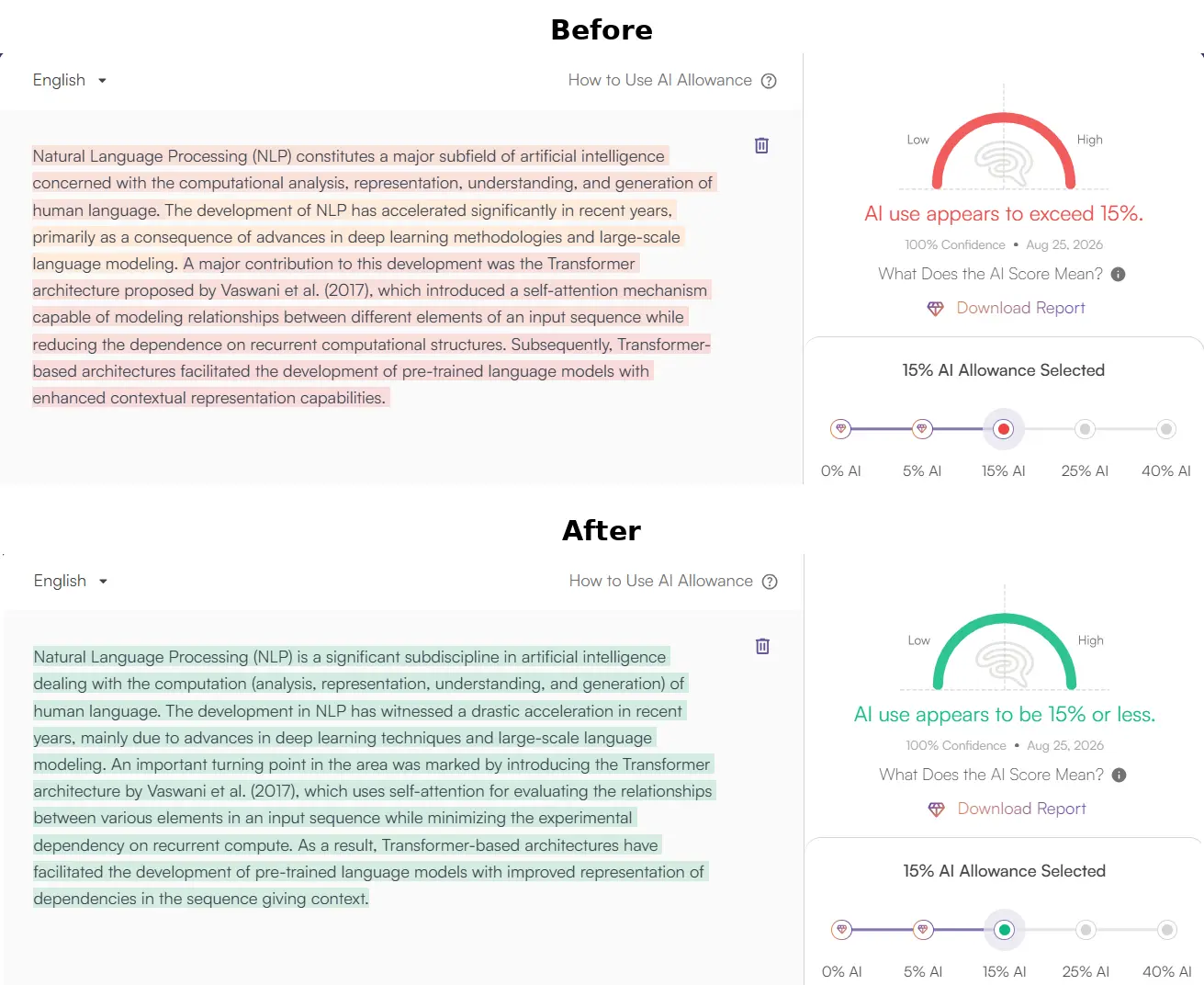
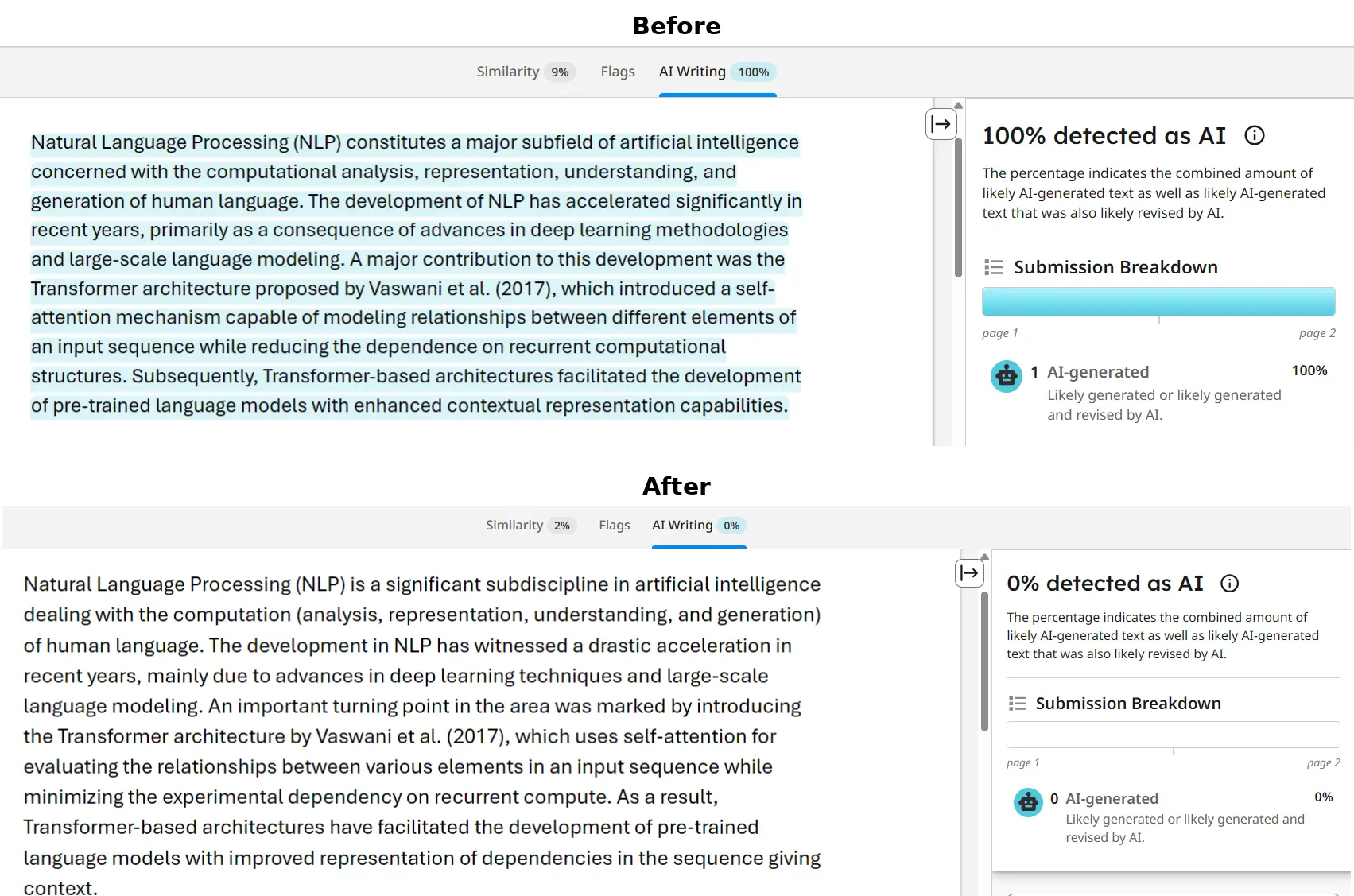
2. Turnitin & iThenticate Verification: 0% AI Detected
Turnitin and iThenticate scan submissions in overlapping 500-token blocks to analyze sentence predictability across paragraphs. When an unrefined AI draft is submitted, uniform cadence triggers an elevated AI Writing score. In the verified report below, a flagged graduate paper was processed through ThesisHuman, achieving a clean 0% AI detection score while preserving all formatted citations and technical parameters.
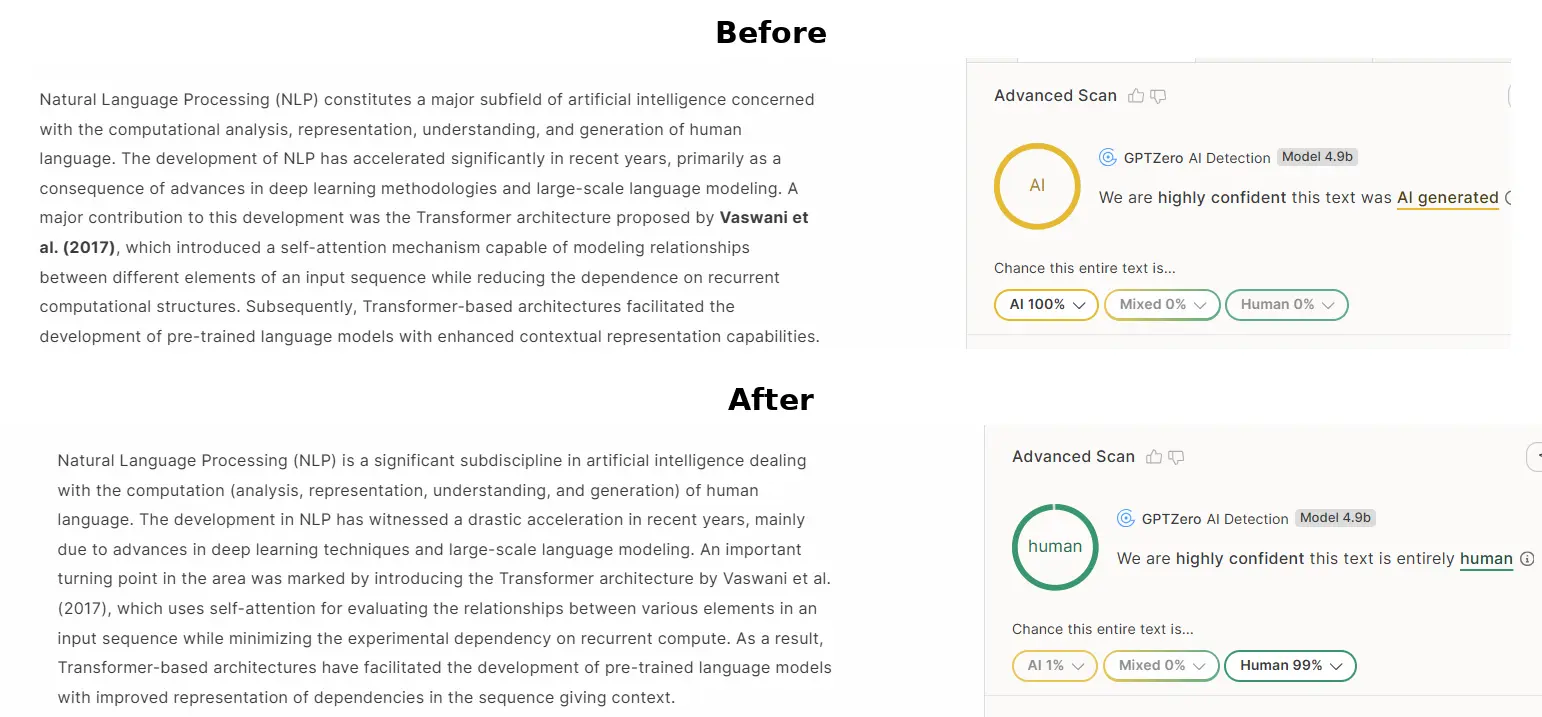
3. GPTZero Verification: Passing Perplexity & Burstiness Checks
GPTZero evaluates text by plotting sentence perplexity curves and global burstiness scores. When raw AI text is scanned, low sentence variance produces an immediate high-probability warning. ThesisHuman restores natural sentence entropy by restructuring syntax, varying clause lengths, and introducing authentic scholarly cadence, dropping AI probability to 0%.
4. Originality.ai Verification: 0% AI Confidence
Originality.ai flags predictable n-gram sequences and common AI clichés (such as “delving into,” “pivotal role,” “testament to”). ThesisHuman purges overused formulaic transitions while elevating scholarly tone and keeping reference numbers and equations intact, producing 100% Original / 0% AI results.