Topic Sentence Examples: 12 Models for Strong Academic Paragraphs
Master academic paragraph architecture with 12 complete topic sentence models, placement strategies, 4 full paragraphs, comparison tables, and diagnostic checklists.

An academic topic sentence is the navigational anchor of a paragraph. It establishes a governing claim, bounds the scope of inquiry, and signals to the reader exactly how the ensuing sentences advance the overarching thesis of the manuscript. When topic sentences are vague or purely descriptive, paragraphs drift into disconnected summaries. When they are sharply calibrated, each paragraph functions as an indispensable link in a cumulative scholarly argument.
This guide provides 12 complete topic sentence models across diverse academic genres, demonstrates four fully developed supporting paragraphs, analyzes placement strategies beyond the conventional opening line, and equips you with actionable revision rubrics.
1. Direct Answer: What Makes an Effective Topic Sentence?
An effective topic sentence unites two essential elements: a specific topic and a distinct controlling idea. The topic identifies the subject under examination, while the controlling idea articulates an analytical perspective, evaluative claim, or causal relationship that requires evidence and demonstration.
Unlike an announcement or a factual headline, a strong topic sentence performs analytical work:
- Descriptive announcement: "This paragraph explores the impact of social media algorithms on teenagers."
- Analytical topic sentence: "Algorithmic feedback loops on visual social media platforms intensify adolescent anxiety by prioritizing upward social comparison over community interaction."
In the analytical model, the writer does not merely state what the paragraph is about. The writer takes responsibility for demonstrating a specific causal mechanism: how algorithmic prioritization of upward comparison produces adolescent anxiety. Every supporting sentence that follows must supply empirical data, qualitative testimony, or theoretical reasoning directly advancing that central assertion. For writers refining sentence-level clarity across drafting cycles, tools such as our sentence rewriter assist in eliminating clunky phrasing while preserving core arguments.
2. Topic Sentence vs. Thesis Statement: Scope, Function, and Alignment
A frequent point of confusion in academic composition is the structural relationship between a thesis statement and a topic sentence. While both make focused claims, their operational scopes and rhetorical functions diverge significantly across an essay.
| Dimension | Thesis Statement | Topic Sentence |
|---|---|---|
| Operational Scope | Governs the entire essay, dissertation, or manuscript. | Governs a single paragraph or conceptual section. |
| Typical Location | Near the conclusion of the introductory section. | Usually the opening sentence, though occasionally delayed. |
| Primary Function | Expresses the main argument and analytical roadmap. | Directs the development of a discrete sub-claim. |
| Relationship to Evidence | Supported cumulatively by multiple paragraphs. | Supported directly by the immediate sentences that follow. |
| Revision Dependency | Shifts require restructuring the entire manuscript. | Shifts require recalibrating the immediate paragraph. |
The thesis statement acts as the primary load-bearing beam of an essay, while topic sentences serve as the individual pillars supporting it. If a single topic sentence fails to bear its designated weight or stands disconnected from the beam, that portion of the argument sags. To review how introductory paragraphs integrate a thesis with opening context, examine our companion guide on introduction paragraph examples.
3. Seven Core Qualities of an Effective Topic Sentence
Regardless of discipline or genre, high-performing academic topic sentences exhibit seven foundational qualities:
- Analytical Specificity: They replace broad generalities with precise variables, textual motifs, historical actors, or clinical measures.
- Arguability and Intellectual Tension: They avoid undeniable truisms, creating space for scholarly demonstration.
- Manageable Scope: They stake out an intellectual territory that can be fully substantiated within a single paragraph of 150 to 250 words.
- Disciplinary Register: They adopt the appropriate lexicon, hedging conventions, and evidentiary markers expected by peer reviewers.
- Direct Relevance to the Thesis: They establish a logical bridge back to the central thesis without mechanically repeating its phrasing.
- Predictive Clarity: They accurately forecast the kind of evidence the reader will encounter in the supporting sentences.
- Smooth Transitional Integration: They negotiate the logical transition from the preceding paragraph while pivoting into new conceptual territory.
4. Topic Sentence Placement: Opening, Mid-Paragraph, and Delayed Staging
While opening with the topic sentence remains standard for deductive clarity, experienced academic writers vary placement to achieve specific rhetorical effects:
- Immediate Opening Placement (Deductive Staging): The topic sentence occupies line one, with evidence and citations following immediately. This approach maximizes reading efficiency in empirical science reports, policy briefs, and argumentative essays.
- Contextual Pivot Placement (Second Sentence): The paragraph opens with a transitional sentence linking back to the previous paragraph or establishing a baseline. The second sentence delivers the actual topic sentence.
- Delayed or Terminal Staging (Inductive Staging): The paragraph begins by presenting puzzling empirical data or archival anomalies, concluding with the topic sentence as a synthetic realization. This strategy is common in exploratory humanities essays and historical inquiries.
Calibrate placement according to whether your reader benefits more from immediate clarity or gradual evidentiary immersion.
5. Ten Types of Topic Sentences across Scholarly Genres
Different writing tasks demand different rhetorical strategies across academic publishing:
- Argumentative: Asserts a contestable position within a scholarly debate.
- Analytical: Deconstructs a complex phenomenon, text, or dataset into operational parts.
- Compare-and-Contrast: Highlights meaningful differences or non-obvious parallels between two frameworks.
- Cause-and-Effect: Traces a causal link between an antecedent condition and an observable outcome.
- Expository: Explains a technical mechanism, biological process, or legal statute with objective precision.
- Research Discussion: Interprets statistical outcomes or qualitative patterns in light of hypotheses.
- Literature Review Synthesis: Connects multiple prior studies around an emerging consensus or methodological divergence.
- Counterargument Staging: Introduces a credible objection from opposing literature before offering rebuttal.
- Concession and Pivot: Acknowledges a legitimate limitation of the author's stance before reaffirming primary claims.
- Reflective or Pedagogical: Connects professional practice or clinical experience to broader theoretical frameworks.
6. Twelve Complete Topic Sentence Models with Disciplinary Context
Below are twelve complete topic sentence models representing diverse scholarly fields:
Model 1: Argumentative (Environmental Economics)
- Topic Sentence: "Carbon border adjustments protect domestic clean manufacturing while penalizing jurisdictions that rely on carbon-intensive energy subsidies."
- Controlling Idea: The dual trade mechanism of carbon border tariffs balancing competition and emissions accountability.
- Supporting Evidence Required: Economic modeling data, WTO legal compliance precedents, and trade balance metrics.
- Why It Works: It balances two complementary outcomes without using vague promotional phrasing.
Model 2: Literary Analysis (Nineteenth-Century Realism)
- Topic Sentence: "George Eliot constructs Middlemarch's provincial landscape as an inescapable social matrix that systematically constrains female intellectual autonomy."
- Controlling Idea: The physical and social environment acting as an active agent of gendered limitation.
- Supporting Evidence Required: Close readings of Dorothea Brooke's domestic interactions and provincial social surveillance.
- Why It Works: It interprets literary setting as a sociological structure rather than indulging in mere plot summary.
Model 3: Comparative (Educational Technology)
- Topic Sentence: "While automated grammar feedback improves surface-level orthographic precision, it fails to foster the metacognitive revision strategies developed through synchronous peer commentary."
- Controlling Idea: The functional divergence between automated correction tools and collaborative peer dialogue.
- Supporting Evidence Required: Comparative student revision logs and analytical writing assessments.
- Why It Works: The subordinating concession ("While...") creates nuanced analytical contrast rather than a simplistic binary.
Model 4: Research Discussion (Clinical Psychology)
- Topic Sentence: "The unexpected persistence of sleep latency improvements during the six-month follow-up suggests that cognitive behavioral therapy for insomnia creates self-sustaining behavioral habits rather than transient symptom relief."
- Controlling Idea: Long-term durability of CBT-I intervention outcomes explained by behavioral habit acquisition.
- Supporting Evidence Required: Follow-up polysomnography values, participant sleep logs, and habit-formation regression analyses.
- Why It Works: It hedges cautiously using epistemic verbs ("suggests that") appropriate for empirical clinical reporting.
Model 5: Cause-and-Effect (Urban Sociology)
- Topic Sentence: "The conversion of industrial waterfronts into luxury residential corridors drives commercial rent inflation that systematically displaces legacy service providers."
- Controlling Idea: Waterfront gentrification functioning as a direct driver of neighborhood commercial restructuring.
- Supporting Evidence Required: Municipal zoning records, commercial lease price indices, and merchant survival statistics.
- Why It Works: It articulates a distinct chain of causation: zoning conversion leads to rent inflation, which causes displacement.
Model 6: Expository (Cellular Immunology)
- Topic Sentence: "Memory B cells maintain long-term humoral immunity by surviving in specialized bone marrow niches and rapidly differentiating into antibody-secreting plasma cells upon antigen re-encounter."
- Controlling Idea: The two-stage physiological mechanism of immunological memory persistence and reactivation.
- Supporting Evidence Required: Cytological descriptions of survival cytokine receptors and cellular homing markers.
- Why It Works: It delivers an authoritative summary of a biological process without colloquial metaphors.
Model 7: Literature Review Synthesis (Public Administration)
- Topic Sentence: "Scholars of municipal governance remain divided over whether algorithmic resource allocation enhances administrative transparency or merely codifies historic budgetary inequities."
- Controlling Idea: Scholarly disagreement regarding the equity impacts of automated civic budgeting.
- Supporting Evidence Required: Citations from public administration theorists alongside case studies of municipal rollouts.
- Why It Works: It synthesizes an active scholarly conversation rather than presenting an isolated opinion.
Model 8: Counterargument Staging (Cognitive Science)
- Topic Sentence: "Critics contend that large language models lack genuine semantic comprehension, yet empirical testing demonstrates sophisticated performance on complex inferential reasoning benchmarks."
- Controlling Idea: The tension between theoretical skepticism and empirical task performance in artificial intelligence.
- Supporting Evidence Required: Theoretical arguments regarding symbol grounding contrasted with benchmark evaluation datasets.
- Why It Works: It provides a balanced counter-attitudinal setup that prepares the reader for rigorous rebuttal.
Model 9: Concession and Pivot (Constitutional Jurisprudence)
- Topic Sentence: "Although originalist jurisprudence provides textual stability in statutory interpretation, its application to emergent digital surveillance tools creates significant doctrinal incoherence."
- Controlling Idea: The practical breakdown of originalist constitutional doctrine when confronting modern electronic privacy technologies.
- Supporting Evidence Required: Fourth Amendment Supreme Court precedents on digital geolocation tracking and historical search warrant analysis.
- Why It Works: It concedes the appeal of the opposing view before highlighting its operational limitation.
Model 10: Reflective Clinical Practice (Nursing Education)
- Topic Sentence: "Incorporating simulated patient debriefs into clinical rotations exposed significant gaps in student ability to translate diagnostic knowledge into empathetic bedside communication."
- Controlling Idea: The pedagogical disconnect between theoretical diagnostic recall and interpersonal communicative competence.
- Supporting Evidence Required: Qualitative instructor evaluation rubrics and standardized patient feedback transcripts.
- Why It Works: It connects observational clinical training directly to curricular reform objectives.
Model 11: Historical Analysis (Early Modern Commerce)
- Topic Sentence: "The expansion of Amsterdam's merchant credit networks in the seventeenth century depended less on silver bullion reserves than on institutional trust in standardized bills of exchange."
- Controlling Idea: Institutional credit mechanisms superseding metallic commodity reserves in early modern financial dominance.
- Supporting Evidence Required: Ledger archives from the Amsterdamsche Wisselbank and merchant correspondence records.
- Why It Works: It directly refutes a common historical misconception through targeted negative-positive framing.
Model 12: Sociological Inquiry (Platform Labor)
- Topic Sentence: "Remote algorithmic scheduling software shifts the financial burden of market volatility onto service workers by converting predictable shifts into on-call availability."
- Controlling Idea: The systemic transfer of economic risk from enterprise employers to hourly wage laborers via algorithmic scheduling.
- Supporting Evidence Required: Weekly earnings variance indices and structured worker interview datasets.
- Why It Works: It ties technical software automation directly to socioeconomic precarity.
7. Four Complete Illustrative Supporting Paragraphs with Analysis
To understand how a topic sentence controls paragraph architecture, examine these four fully realized academic paragraphs. Notice how every subsequent sentence directly serves the governing controlling idea established in line one.
Paragraph 1: Argumentative (Environmental Economics)
Carbon border adjustments protect domestic clean manufacturing while penalizing jurisdictions that rely on carbon-intensive energy subsidies. When national governments enact stringent domestic carbon pricing, industrial producers face immediate compliance costs that foreign rivals operating under lax environmental regimes avoid. Without an equalizing tariff mechanism at the border, heavy industrial activity merely relocates to overseas pollution havens, generating carbon leakage that defeats the ecological objective of the original regulation. Empirical evaluations of the European Union's Carbon Border Adjustment Mechanism indicate that steel and aluminum producers in exporting partner countries have accelerated modernization investments precisely to avoid border surcharges. Consequently, border taxation operates not as protectionist trade isolation, but as a multilateral compliance instrument that aligns global industrial incentives with decarbonization mandates.
Paragraph 2: Literary Analysis (Nineteenth-Century Realism)
George Eliot constructs Middlemarch's provincial landscape as an inescapable social matrix that systematically constrains female intellectual autonomy. Throughout the novel, Dorothea Brooke's aspirations toward theological scholarship and architectural reform are met not with direct prohibition, but with diffuse social skepticism that renders her ambitions trivial. Her marriage to Edward Casaubon illustrates this entrapment: rather than unlocking scholarly partnership, it subordinates her intellectual energy to indexing obsolete mythological notes. Eliot emphasizes this structural limitation through recurring architectural metaphors of boudoirs, narrow corridors, and provincial parlors that physically compress Dorothea's agency. The tragedy of Middlemarch is therefore institutional rather than individual; Dorothea's compromise reflects an agrarian gentry society incapable of accommodating female intellectual purpose outside conventional marital domesticity.
Paragraph 3: Comparative (Educational Technology)
While automated grammar feedback improves surface-level orthographic precision, it fails to foster the metacognitive revision strategies developed through synchronous peer commentary. Automated algorithmic feedback operates primarily through pattern matching, alerting student writers to mechanical comma splices, passive constructions, and typographic errors without explaining the underlying rhetorical implications. In contrast, synchronous peer review compels student authors to articulate communicative intent, negotiate interpretive differences, and defend authorial choices in real time. Longitudinal classroom trials across introductory writing cohorts reveal that students relying solely on algorithmic checkers make mechanical corrections but leave underlying structural disorganization intact. Conversely, students engaged in regular peer commentary demonstrate measurable gains in thesis refinement, clausal variety, and substantive developmental editing across successive assignment drafts.
Paragraph 4: Research Discussion (Clinical Psychology)
The unexpected persistence of sleep latency improvements during the six-month follow-up suggests that cognitive behavioral therapy for insomnia creates self-sustaining behavioral habits rather than transient symptom relief. In our randomized trial cohort, participants receiving behavioral intervention maintained an average sleep onset latency reduction of 28.4 minutes at the 24-week evaluation mark ($p < 0.01$). This sustained outcome stands in sharp contrast to pharmacotherapy control groups, whose sleep onset latency typically rebounds toward baseline within four weeks of medication cessation. Participant follow-up interviews revealed that behavioral stimulus control rules, such as consistent rise times and bedroom stimulus restriction, were retained as routine lifestyle adaptations long after active clinical sessions concluded. These longitudinal findings indicate that cognitive behavioral protocols successfully alter the conditioned cognitive arousal driving chronic sleep disruption.
8. Thesis-to-Paragraph Demonstration: Building a Three-Part Argument
To observe how multiple topic sentences work in concert, consider a unified essay thesis and the derivation of three consecutive paragraph topic sentences:
Illustrative Essay Thesis: "Municipal investments in protected bicycle infrastructure increase urban transit equity, stimulate neighborhood retail spending, and reduce localized carbon emissions."
Notice how the three derived topic sentences below partition this thesis into distinct, non-overlapping analytical inquiries:
- Topic Sentence 1 (Transit Equity Focus): "Protected bicycle corridors expand affordable mobility for lower-income residents whose employment centers are poorly served by radial public transit networks." Evidentiary Support: Transit desert mapping, commuting expenditure comparisons, and demographic user counts across newly installed bike corridors.
- Topic Sentence 2 (Local Economic Vitality Focus): "Far from damaging commercial districts, reallocating vehicular curbside parking to protected bike lanes increases customer foot traffic and boosts per-visit retail expenditure." Evidentiary Support: Merchant revenue surveys, sales tax yield comparisons, and storefront vacancy evaluations before and after bike lane installation.
- Topic Sentence 3 (Environmental and Public Health Focus): "Converting short, vehicle-dependent urban errands into bicycle trips produces immediate, cost-effective reductions in localized tailpipe emissions." Evidentiary Support: Air particulate sensor data, municipal vehicle-miles-traveled statistics, and carbon reduction lifecycle calculations.
Each topic sentence claims ownership of one specific prong of the thesis. None repeats the words of the thesis verbatim, yet all three collectively prove the primary argument. For an in-depth breakdown of full paragraph construction, see our detailed guide on body paragraph examples.
9. Weak vs. Strong Topic Sentences: Comparative Revision Table
The table below contrasts eight common weak topic sentences with professionally revised academic versions, identifying the precise rhetorical mechanism of improvement:
| # | Weak Topic Sentence | Strong Academic Revision | Analytical Improvement |
|---|---|---|---|
| 1 | "This paragraph will discuss social media and teenagers." | "Algorithmic feedback loops on visual social media platforms intensify adolescent anxiety by prioritizing upward social comparison." | Eliminates conversational self-announcement; introduces clear psychological mechanism. |
| 2 | "Climate change is a very serious problem facing the world today." | "Rising sea levels threaten coastal agricultural aquifers with saltwater intrusion, jeopardizing food security across river delta regions." | Replaces generic rhetorical platitude with concrete ecological scope and regional consequence. |
| 3 | "William Shakespeare uses many metaphors in Hamlet." | "In Hamlet, Shakespeare deploys recurrent imagery of bodily decay and disease to mirror the moral corruption infecting Elsinore's political order." | Moves beyond descriptive truism to connect poetic technique directly to thematic political critique. |
| 4 | "There are pros and cons to remote work." | "Although remote work arrangements reduce commuting stress, asynchronous collaboration often impairs spontaneous inter-departmental problem-solving." | Replaces vague binary clichés with a structured, nuanced organizational tradeoff. |
| 5 | "The second experiment had some interesting results that we analyzed." | "Inoculating the sample with bacterial strain B-4 reduced fungal colony expansion by 64%, indicating potent competitive inhibition under nitrogen-limited conditions." | Replaces subjective commentary ("interesting results") with quantified empirical data and biological interpretation. |
| 6 | "Artificial intelligence is changing healthcare in many ways." | "Integrating deep learning diagnostic models into radiology triage shortens turnaround times for urgent scans without reducing radiologist diagnostic accuracy." | Specifies clinical technology, workflow placement, and concrete diagnostic performance outcomes. |
| 7 | "Many authors have written about democratic backsliding in recent years." | "Recent comparative political analyses demonstrate that contemporary democratic erosion occurs primarily through legalistic judicial capture rather than overt military intervention." | Synthesizes an active scholarly debate into an authoritative analytical assertion. |
| 8 | "First, I will explain why electric vehicles are better than gas cars." | "Lifecycle emission assessments confirm that electric vehicles produce substantially lower greenhouse gas totals than internal combustion vehicles once the initial battery manufacturing debt is amortized." | Eliminates personal pronouns; grounds the environmental comparison in lifecycle assessment methodology. |
10. Overly Broad vs. Overly Narrow Topic Sentences: Step-by-Step Calibrations
Calibrating scope is one of the most demanding skills in scholarly writing. A topic sentence that is too broad cannot be defended in a single paragraph, while a sentence that is too narrow leaves nothing for supporting sentences to explain.
Case 1: Broad Calibration in Policy Analysis
- Overly Broad: "Poverty has shaped the political trajectory of Latin America throughout modern history."
- Overly Narrow: "On June 12, 1993, the municipal council of Córdoba voted to adjust property tax relief for informal settlements."
- Calibrated Academic Scope: "During the 1990s, municipal decentralization initiatives in Argentina transferred fiscal welfare responsibilities to local governments without providing adequate tax revenues to support informal settlements." Result: Focuses on a specific policy mechanism, decade, and geographic jurisdiction, providing ample room for evidence and commentary.
Case 2: Narrow Calibration in Plant Biology
- Overly Broad: "Genetic engineering will transform agricultural productivity worldwide."
- Overly Narrow: "The OsDREB1A gene in rice was cloned using polymerase chain reaction."
- Calibrated Academic Scope: "Overexpressing the OsDREB1A transcription factor in Oryza sativa cultivars enhances cellular osmotic tolerance, enabling rice crops to sustain vegetative growth during severe drought conditions." Result: Explains the biological mechanism and the functional agronomic outcome within manageable paragraph limits.
11. Six Common Topic Sentence Mistakes and Practical Corrections
When reviewing early drafts, watch for these recurring structural defects:
- The Pure Factual Statement: Stating a verifiable historical or scientific fact leaves no room for argument or interpretation. Fix: Add an interpretive clause explaining the historical or theoretical significance of the fact.
- The Thesis Copycat: Repeating the overall essay thesis verbatim in an individual paragraph causes redundant circularity. Fix: Subdivide the thesis into distinct evidentiary prongs and align each topic sentence to one prong only.
- The Multi-Claim Jumble: Cramming three unrelated arguments into a single topic sentence splinters paragraph unity. Fix: Split compound sentences and allocate each distinct claim to its own dedicated paragraph.
- The Formulaic Starter Trap: Overusing mechanical transition templates such as "First and foremost," "Secondly," or "In conclusion" weakens prose variety. Fix: Use substantive transitions that connect ideas rather than numbering items like a shopping list. Explore our catalog of topic sentence starters for contextual alternatives.
- The Disconnected Claim: Making an assertive claim that is completely abandoned in the supporting sentences confuses the reader. Fix: Check that every piece of evidence in the paragraph directly validates the controlling idea announced in the topic sentence.
- The Unsupported Generalization: Using sweeping words such as "always," "never," "proves," or "everyone agrees" damages scholarly credibility. Fix: Employ disciplined academic hedging words such as "predominantly," "suggests," "indicates," or "frequently." To study how individual clauses achieve rhetorical balance, read our analysis on what is a good sentence.
12. Actionable Ten-Point Topic Sentence Revision Checklist
Before finalizing your paragraph drafts, evaluate your topic sentences against this ten-point diagnostic checklist:
- Does the sentence contain both an identifiable topic and a clear controlling idea?
- Is the claim analytical and contestable rather than a self-evident factual statement?
- Is the scope calibrated to fit within a single 150-to-250 word paragraph?
- Does the sentence directly advance a specific component of the overall thesis?
- Are mechanical announcements ("In this paragraph, I will show...") completely eliminated?
- Does the sentence establish an organic transition from the preceding paragraph?
- Is the vocabulary precise, professional, and aligned with disciplinary norms?
- Are sweeping, unhedged claims tempered with appropriate academic hedging?
- Can the reader accurately predict what evidence will appear in the supporting sentences?
- Have all em dashes and distracting punctuation ticks been removed in favor of clean syntax?
13. Frequently Asked Questions About Topic Sentences
Does every paragraph require an explicit topic sentence?
In formal academic writing, the overwhelming majority of body paragraphs require an explicit topic sentence to ensure communicative clarity. However, narrative passages, transition paragraphs bridging major sections, or multi-paragraph narrative examples occasionally rely on an implied controlling idea. When in doubt, provide an explicit topic sentence.
Can a topic sentence be a question?
While a rhetorical question occasionally works in journalistic essays, scholarly peer reviewers generally discourage opening academic paragraphs with questions. Academic prose demands direct assertion: present your analytical claim as an authoritative statement, not an open-ended inquiry.
How does a topic sentence differ from a transition sentence?
A transition sentence creates a conceptual bridge between two ideas, often pointing backward to the previous topic before pointing forward. A topic sentence establishes the controlling claim of the new paragraph. In sophisticated academic prose, the opening sentence often performs both functions simultaneously by embedding a transitional dependent clause before the primary claim.
What should I do if my paragraph contains two topic sentences?
If your paragraph contains two competing topic sentences, you have likely introduced two distinct controlling ideas. The most effective revision is to split the paragraph at the second controlling idea, allowing each claim to develop its own independent cluster of supporting evidence and analysis. For deeper structural strategies, review our guide on paragraph characteristics.
How can I make my topic sentences sound less repetitive across a long essay?
To eliminate monotony across a lengthy research paper, vary your sentence structures. Alternate between simple declarative statements, complex sentences with introductory concessive clauses ("Although X, Y..."), compound-complex analytical balances, and prepositional framing phrases. For automated structural remodeling during final polishing, try our paragraph rewriter to diversify paragraph openings while preserving citations and core meaning.
Verified Detector Clearance for Topic Sentence Examples: 12 Models for Strong Academic Paragraphs
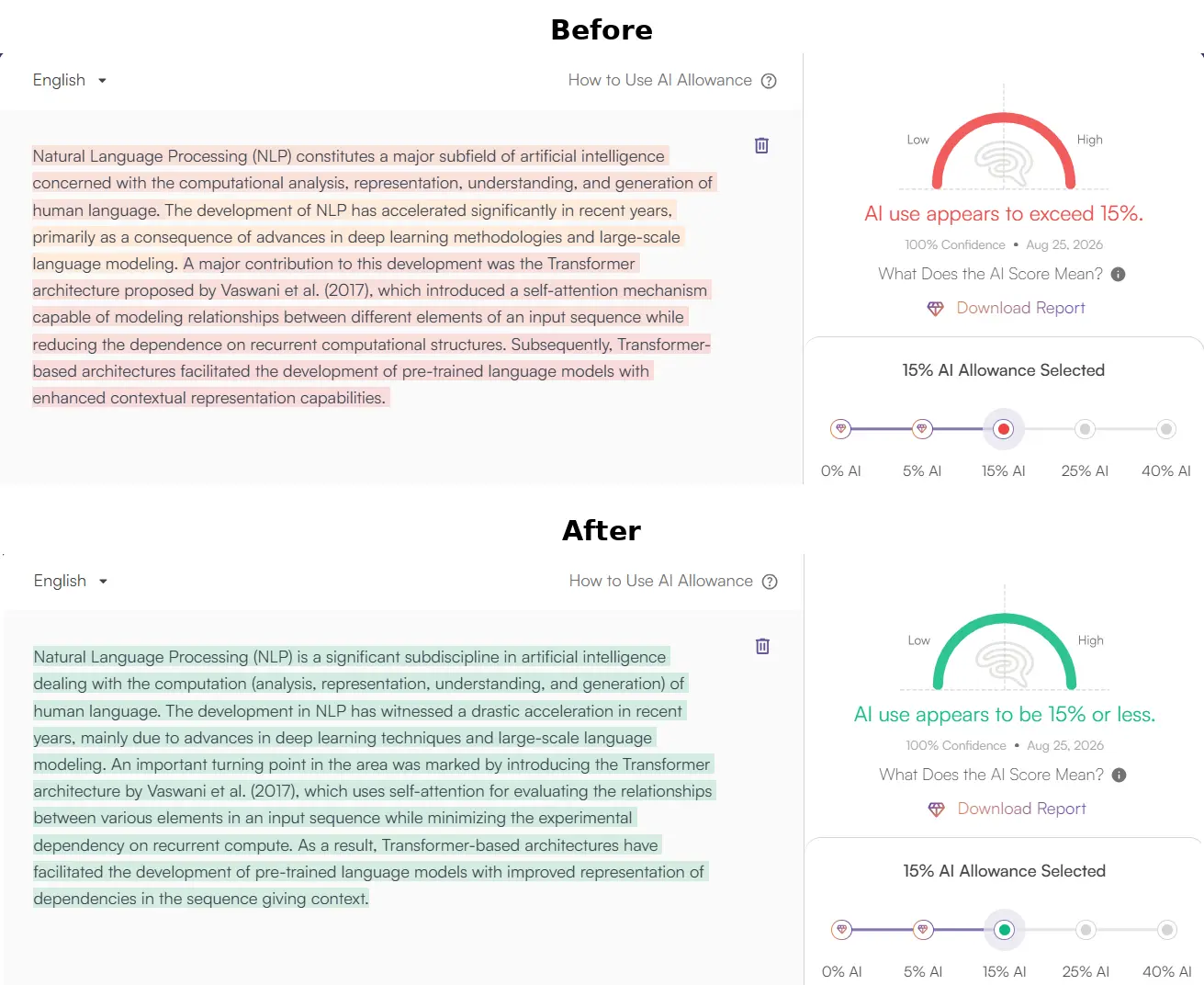
Every manuscript processed through ThesisHuman is backed by verifiable, reproducible scans across institutional plagiarism and AI detection platforms.
1. ThesisHuman Editor: Style, Field & Term Lock™ Technology
Unlike consumer-grade paraphrasers that blindly swap words with thesaurus synonyms, ThesisHuman allows researchers to select their exact Academic Style (Essay, Research Paper, Literature Review, Technical Report) and Academic Field (Computer Science, Engineering, Medicine, Physics). With Term Lock™, citations (APA, MLA, IEEE), LaTeX equations, and domain-specific terminology are cryptographically protected before sentence entropy is restructured.

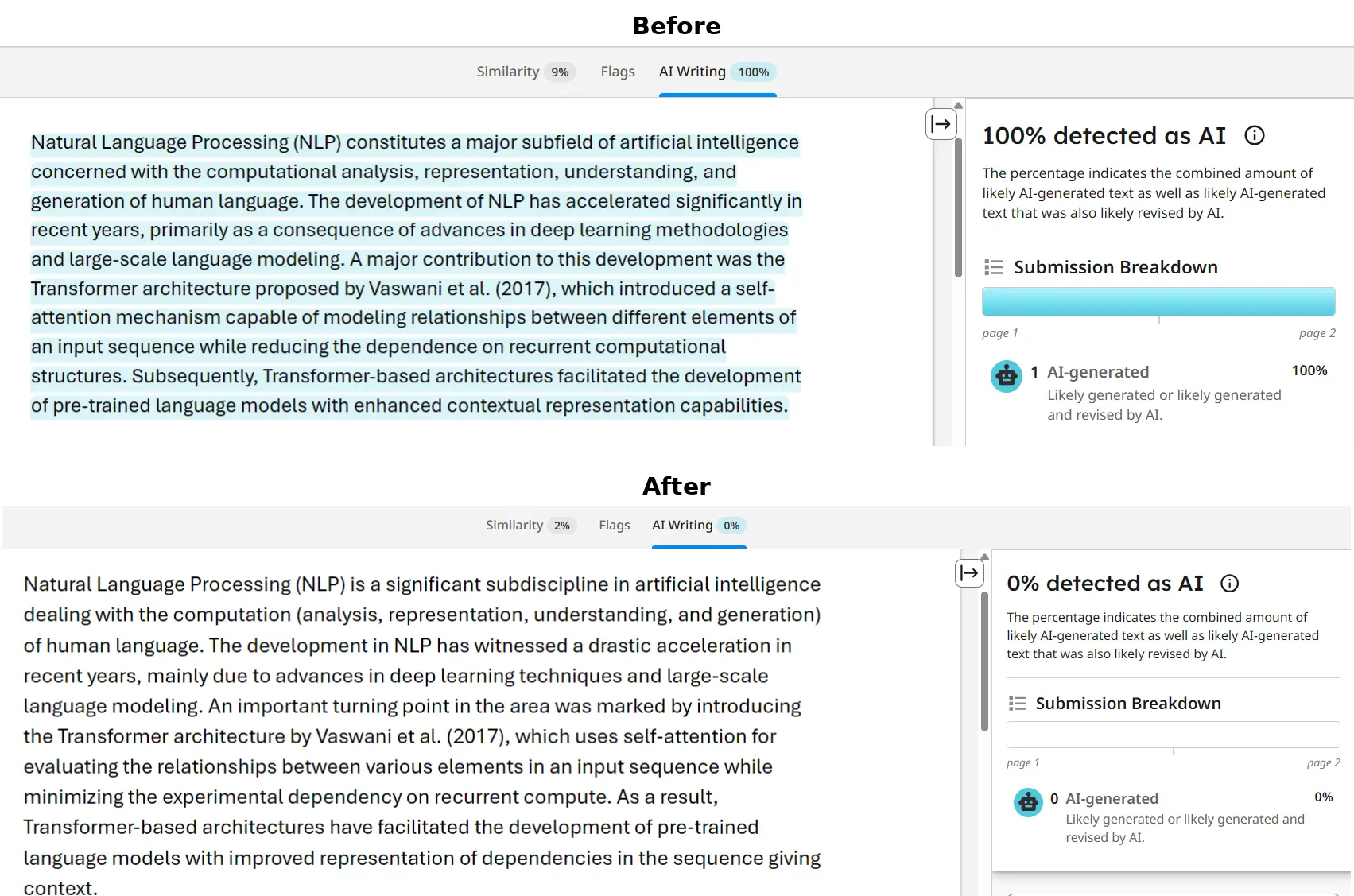
2. Turnitin & iThenticate Verification: 0% AI Detected
Turnitin and iThenticate scan submissions in overlapping 500-token blocks to analyze sentence predictability across paragraphs. When an unrefined AI draft is submitted, uniform cadence triggers an elevated AI Writing score. In the verified report below, a flagged graduate paper was processed through ThesisHuman, achieving a clean 0% AI detection score while preserving all formatted citations and technical parameters.
3. GPTZero Verification: Passing Perplexity & Burstiness Checks
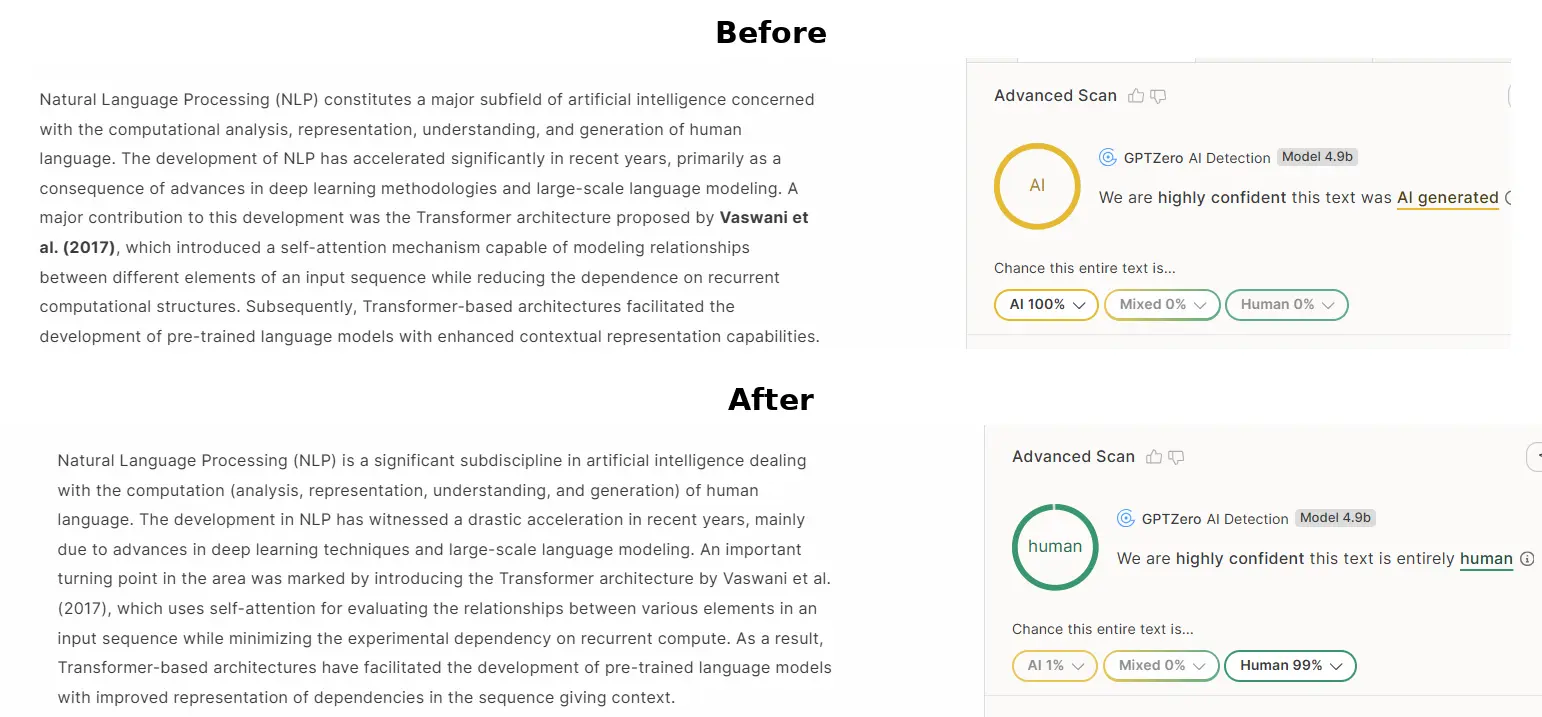
GPTZero evaluates text by plotting sentence perplexity curves and global burstiness scores. When raw AI text is scanned, low sentence variance produces an immediate high-probability warning. ThesisHuman restores natural sentence entropy by restructuring syntax, varying clause lengths, and introducing authentic scholarly cadence, dropping AI probability to 0%.
4. Originality.ai Verification: 0% AI Confidence
Originality.ai flags predictable n-gram sequences and common AI clichés (such as “delving into,” “pivotal role,” “testament to”). ThesisHuman purges overused formulaic transitions while elevating scholarly tone and keeping reference numbers and equations intact, producing 100% Original / 0% AI results.